

Travelling With a Stoma: Flights, Supplies and Airport Screening

Traveling to Turkey with a stoma is manageable with planning. Pack roughly double your usual supplies, split them between bags, and keep an emergency kit in hand luggage. Airport scanners may flag the pouch area; you can explain briefly or request private screening. Build rest days into your stay rather than planning a fast turnaround, especially if you are coming for treatment.
Two questions come up first for almost every traveller with a stoma: how will airport security handle the pouch, and what happens if supplies run short far from home? Both have straightforward answers. This guide covers them in detail, along with the parts of the trip people plan less carefully, hydration on long flights, hotel choice, and how to pace a recovery stay.
A stoma changes how you plan a journey, but it rarely changes whether the journey is possible. Most of the work happens before you leave home: counting supplies, deciding what travels in which bag, and thinking through the moments where a small kit within reach makes the difference between a minor inconvenience and a stressful hour. What follows is a practical walkthrough for anyone traveling to Turkey with a stoma, whether for treatment, follow-up, or an ordinary visit.
At a glance
- Best for: Patients with a colostomy, ileostomy, or urostomy traveling to Turkey
- Main focus: Supply planning, airport screening, in-flight comfort, and recovery pacing
- Key documents: Medical summary, prescription list, and a note describing your stoma products
- Supply rule: Pack at least double your usual amount and split it between bags
- Screening: You never need to show your pouch in public; private screening can be requested
- Helpful support: Interpreter, transfer, and appointment coordination for international patients
Start with a practical travel plan
Traveling to Turkey with a stoma is usually very manageable when you deal with the small details before departure. The aim is simple: no surprises on travel day, no shortage of supplies mid-trip, and a daily routine at your destination that does not exhaust you. That is true whether your stoma has been part of your life for years or is only a few months old.
Your plan should cover three areas. First, supplies: what you bring, where it travels, and what stays within arm’s reach. Second, airport logistics: how screening works, what to say if asked, and how to keep your kit accessible through a long transfer. Third, daily life on arrival: bathroom access, meal timing, rest, and, if you are coming for treatment, how appointments fit around your energy levels.
If your trip involves hospital care, the coordination layer matters as much as the packing. Acibadem’s international patient team arranges interpreters, appointment scheduling, and transport for overseas patients, which removes a good deal of the planning load on days when you would rather concentrate on your own routine. A predictable arrival day helps too; the guide on planning a low-stress arrival after a long flight walks through that part of the journey step by step.
One honest caveat before the detail: if your stoma is new, your output has been unstable, or you have had surgery recently, the question of when to travel belongs with your own surgical or stoma care team. They know your case. This guide covers the logistics; it does not replace that conversation.
How many stoma supplies to bring
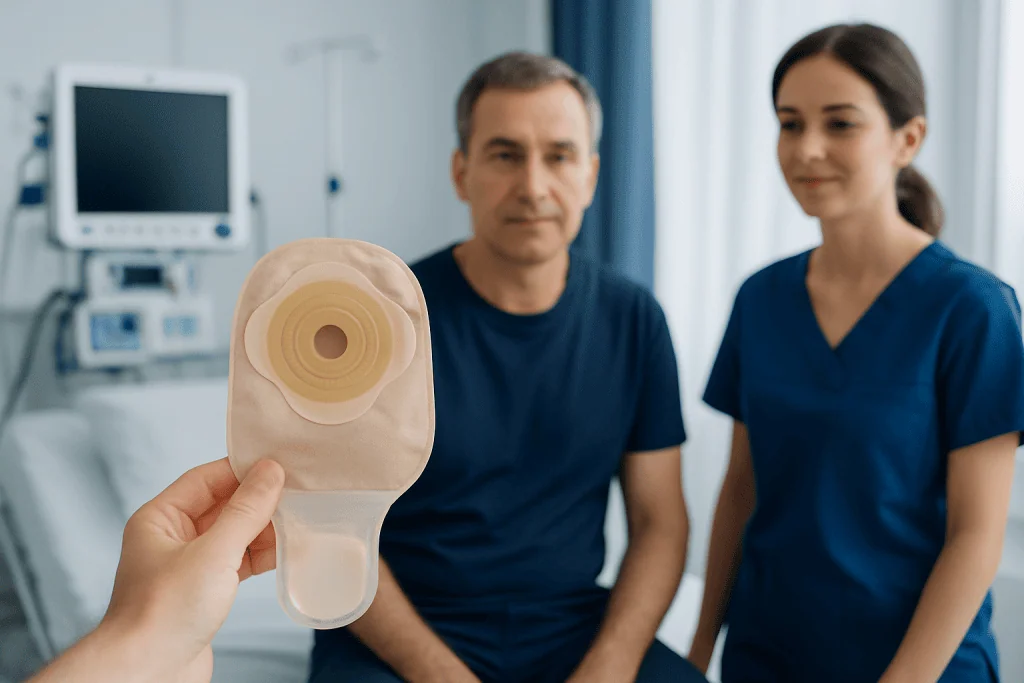
Bring more than you would use at home over the same number of days. This is the single most repeated piece of advice from experienced travellers with a stoma, and it holds up. Flight delays, heat, changes in food and water, stress, and disrupted sleep can all increase how often you empty or change your pouching system. A sensible rule: count what you would normally use for the length of the trip, then pack at least double, plus a small emergency kit that stays on your person at all times.
Just as important as the quantity is the distribution. Never put all your supplies in one suitcase. Checked baggage goes missing occasionally, and a delayed case should be an annoyance, not a crisis. Split supplies between hand luggage and checked bags so that either one, on its own, could see you through several days.
What belongs in your hand luggage
- Pouches and flanges, or one-piece systems, enough for several days
- Barrier rings, seals, or paste
- Adhesive remover and skin barrier wipes
- Disposal bags and tissues
- Dry wipes or gauze
- Any prescribed creams or powders you use around the stoma
- A complete change of underwear and clothing
If you normally cut your own baseplates, check your airline’s rules on scissors before you fly. Rounded-tip medical scissors are often permitted, but the simpler route is to pre-cut a supply of baseplates before departure so scissors never become a question at screening. Bring the exact products you know suit your skin; switching brands mid-trip because you ran out is an avoidable irritation, sometimes literally.
Organise supplies into kits, not piles
Clear, labelled pouches make everything easier. Many travellers keep three kits: a slim washroom kit for the plane with just enough for one change, a day kit for appointments and outings, and a base stock that stays at the hotel. When you need something at 35,000 feet or in a hospital waiting area, you want to reach for one small bag, not excavate a suitcase.
| Kit | Where it lives | What goes in it |
|---|---|---|
| Washroom kit | On you, during the flight | One pouch change, wipes, disposal bag, barrier wipe |
| Day kit | Your day bag in Turkey | Two or three changes, spare underwear, disposal bags |
| Base stock | Hotel or apartment | The bulk of your supplies, kept cool and dry |
Stoma supplies are only one part of a treatment trip. If you are coming for surgery or a hospital stay, the broader packing list for hospital and recovery covers the rest, clothing, documents, and comfort items that make a hospital room and a recovery hotel easier to live in.
Can you buy supplies in Turkey?
Ostomy products are sold in Turkey through pharmacies and medical suppliers, particularly in larger cities such as Istanbul, Ankara, and Izmir. That said, treat local availability as a backup, not a plan. The specific brand, size, and convexity you rely on may not be stocked where you happen to be, and adjusting to an unfamiliar system while travelling is exactly the kind of variable you packed double supplies to avoid. Bring a written note of your product names, reference numbers, and sizes so that, if you do need to buy locally, a pharmacist can find the closest match quickly.
Airport screening and flying with an ostomy
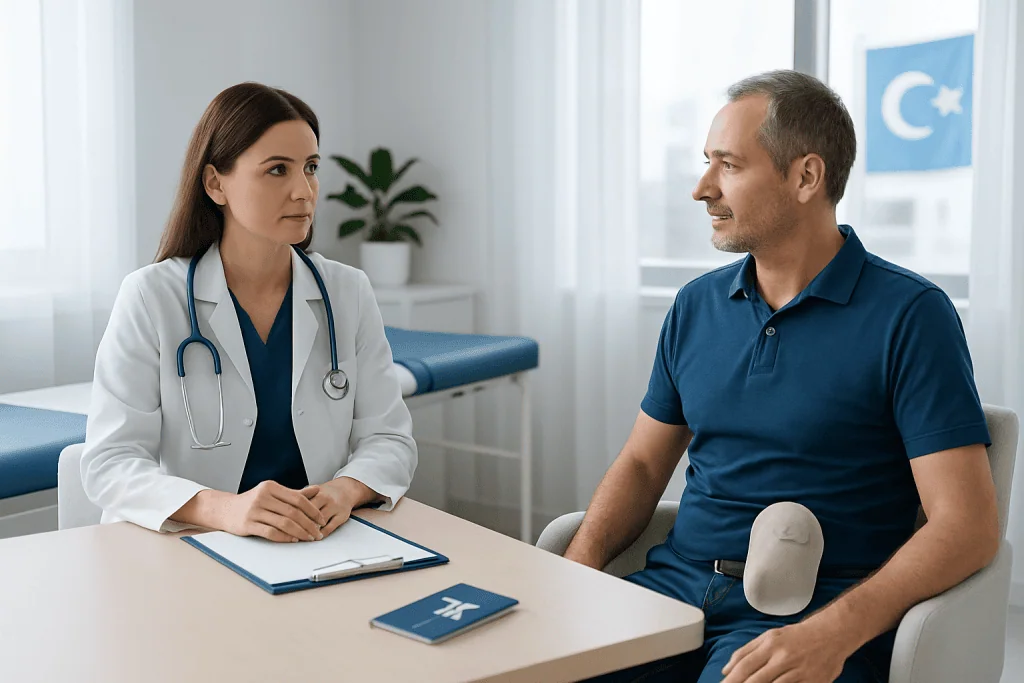
Security staff at international airports see medical devices and supplies every day. An ostomy pouch is not unusual to them, even if it feels deeply personal to you. The gap between those two facts is where most pre-flight anxiety lives, and a little preparation closes it.
What actually happens at the scanner
A body scanner may flag the pouch area as an anomaly, the same way it flags a forgotten belt or a thick pocket. If that happens, you can tell the officer, quietly and briefly, that you have a stoma and are wearing an ostomy pouch. In most cases that is the end of it, sometimes with a light pat-down over clothing. You are not required to show or remove your pouch in a public area. If any further check is needed, you can request a private screening room and, at many airports, a same-gender officer.
Some travellers carry a short medical note or a travel certificate stating that they wear an ostomy appliance and travel with medical supplies. It is rarely demanded, but having it in your document wallet removes the need to explain anything at length, especially where language is a barrier. The same logic applies to medicines: keep them in original packaging with a prescription list, as described in the guide on packing and documenting your regular prescriptions.
Making hand-luggage checks faster
Keep your ostomy supplies grouped in one clearly organised medical pouch rather than scattered through your bag. If an officer opens your hand luggage, a labelled kit answers most questions before they are asked. Liquids, gels, and pastes should follow the standard cabin rules; medically necessary items above the usual limits are generally allowed but may be inspected, so pack them where they can be lifted out easily.
During the flight
Empty your pouch before boarding, and again before the busy moments, meal service, the pre-landing queue. Cabin pressure changes can cause some pouch ballooning, which is normal but more comfortable to manage when the pouch is not already full. Wear soft, non-restrictive clothing that does not press on the stoma; waistbands that sit above or below it work better than anything that crosses it. Keep your washroom kit in the seat pocket or under the seat, not in the overhead locker, so a quick trip to the lavatory involves one small bag and no rummaging.
If long walks through terminals are difficult, after recent surgery, for instance, airport assistance can be booked in advance through your airline. The guide on flying to Turkey with limited mobility explains how that assistance works from check-in through to arrivals.
Food, hydration, and comfort during travel
Travel days disrupt routine, so keep the variables you can control as steady as possible. Eat familiar foods, eat slowly, and chew well. A long-haul flight is not the moment to test foods that you already know cause you excess gas, loose output, or blockage concerns. Pack snacks that suit you so you are never dependent on whatever the airport happens to sell.
Hydration deserves particular attention, especially with an ileostomy, where fluid losses run higher and cabin air, warm weather, and long queues all pull in the same direction. Carry water where permitted after security and sip steadily rather than waiting for thirst. If your own clinician has recommended oral rehydration products for high-output days, bring a supply from home, do not improvise with unfamiliar products mid-journey.
Turkey’s climate varies by season and region; summer heat in coastal and inland cities can be intense. Heat increases fluid loss and can soften adhesives, so plan for slightly more frequent checks of your baseplate in hot weather and keep your base stock of supplies out of direct sun and away from heaters. Loose, breathable layers handle both a chilled aircraft cabin and a warm arrivals hall.
Planning recovery time in Turkey
If you are coming for treatment, a review, or a second opinion, build slack into the itinerary. Even a brief appointment sits inside a tiring day when you add a flight, a transfer, an unfamiliar city, and the ordinary work of managing a stoma away from home. A schedule with rest days absorbs the unexpected, a delayed flight, a rescheduled scan, a night of poor sleep, without turning the whole trip into a scramble.
Choosing where to stay
The right room matters more than the right neighbourhood. Look for a private bathroom, reliable air conditioning, lift access, and food options within easy reach. If you are recovering from recent surgery or your mobility is reduced, ask in advance about walk-in showers, bed height, and whether extra pillows are available. A serviced apartment can suit longer stays: a small kitchen and your own washing arrangements make daily stoma routines simpler than a compact hotel room does.
Think, too, about the geometry of your days. Staying near the hospital shortens the most repeated journey of the trip. If a companion is travelling with you, agree in advance who handles errands, supply organisation, and transport on your lower-energy days, so those decisions are not being negotiated when you are tired. Patients travelling without a companion can find a fuller plan in the guide on planning a safe solo patient journey.
For patients treated at Acibadem hospitals, the international patient team coordinates interpreters, hospital transfers, and appointment timing, which reduces how much of this you carry alone. Interpreter support is worth arranging even if your English is strong: stoma care involves precise vocabulary, output, barrier, convexity, granulation, that benefits from accurate translation in both directions.
How stoma care works during a stay abroad
It helps to understand, before you travel, how stoma-related concerns are assessed anywhere in the world, because it tells you what documentation to carry. A clinician reviewing a stoma looks at the skin around it, the fit of the appliance, the character and volume of output, hydration, and how all of that compares with the patient’s usual baseline. The baseline is the part only you can supply, which is why the paperwork matters.
Carry a short medical summary covering your surgical history, the type of stoma you have, your medication list, and the exact stoma products you use, including sizes and reference numbers. With that in hand, any clinician, in Turkey or anywhere else, can understand your situation in minutes rather than reconstructing it from memory and translation. Hospitals that treat international patients routinely work with this kind of summary; stoma care nursing is an established specialty in Turkish hospitals, as it is elsewhere.
Most stoma-related issues on a trip are small: a minor leak, a patch of irritated skin, a routine that needs an extra day to settle. Doubled supplies, familiar products, and a written baseline handle the large majority of them. A simple backup plan, knowing which hospital serves your area and how you would get there, is the kind of preparation that gives reassurance precisely because you will probably never use it.
Step by step
- Check in with your clinician before you book. If your stoma is new, your output has been unstable, or you recently had surgery, ask your own care team whether your travel dates are sensible. Use the same conversation to review hydration advice, lifting limits, and anything specific to your situation.
- Prepare a supply plan for the full trip. Count your normal usage, pack at least double, and split it between hand luggage and checked baggage. Keep a small emergency kit on your person through every transfer, appointment, and day trip.
- Organise documents. Carry a medical summary, prescription list, a note describing your stoma and supplies, and a written record of your product names and sizes. Keep medications in original packaging where practical.
- Decide how you will handle screening. Plan a one-sentence explanation, know that private screening is available on request, and keep supplies grouped in one clear medical pouch. Pre-cut baseplates if you normally use scissors.
- Keep travel-day routines simple. Familiar food, steady sips of water, an emptied pouch before boarding, and soft clothing that does not press on the stoma. Keep the washroom kit within reach, not overhead.
- Set up a comfortable base in Turkey. Choose accommodation with a private bathroom, good climate control, and easy access to your hospital or clinic. Confirm room details in advance if mobility or recent surgery is a factor.
- Leave room for recovery. Do not pack the schedule tight. Allow extra days for rest, supply management, and any follow-up review before the flight home.
Your checklist
- Pack at least double your expected stoma supplies
- Keep several days of supplies in hand luggage
- Bring a spare outfit and disposal bags in your cabin bag
- Carry a medical summary, prescription list, and product reference numbers
- Pre-cut pouch openings if you normally use scissors
- Plan hydration and pack familiar snacks
- Book airport assistance in advance if long walks are difficult
- Save hospital, hotel, and transfer contacts on your phone
- Store your base stock of supplies away from heat and direct sun
Key takeaways
- Pack more stoma supplies than you expect to use and divide them between bags.
- Airport screening is routine for security staff; you never need to show your pouch in public and can request privacy.
- Hydration, familiar food, and non-restrictive clothing make travel days markedly easier.
- Build recovery time into your stay in Turkey rather than planning a rushed turnaround.
- A written baseline, medical summary, product list, surgical history, is the most useful document you can carry.
Frequently asked questions
Can I take ostomy supplies in my hand luggage?
Yes, and you should. Keep enough in your cabin bag for at least several days in case checked baggage is delayed. Group everything in one clearly organised medical pouch so hand-luggage checks are quick, and keep pastes and gels where they can be inspected easily.
Will airport security make me remove my stoma pouch?
No. If a scanner flags the area, you can explain briefly that you have a stoma and wear an ostomy pouch. You are not required to show or remove it in public, and you can request a private screening room if any further check is needed.
How much extra should I pack for my trip?
A practical rule is at least double your usual amount for the number of days away. Delays, heat, changes in food and water, and disrupted routines can all increase how much you use, and a surplus costs you nothing but a little bag space.
Is it safe to fly soon after stoma surgery?
That depends on how recent the surgery was, how your recovery is going, and your individual circumstances. It is a question for your own surgical or stoma care team, ideally before you book, so travel dates can be set around your recovery rather than the other way round.
Can I buy stoma supplies in Turkey if I run out?
Ostomy products are available through pharmacies and medical suppliers, especially in larger cities, but your specific brand and size may not be stocked locally. Treat local purchase as a backup, and carry a written list of your product names and reference numbers so a close match can be found quickly if needed.
Does cabin pressure affect an ostomy pouch?
Pressure changes can cause some pouch ballooning during a flight, which is normal. Emptying the pouch before boarding and before landing keeps it comfortable, and pouches with filters manage gas more gracefully than unfiltered ones.
Can Acibadem help with logistics if I travel with a stoma?
Acibadem’s international patient services coordinate practical details around treatment for overseas patients, including interpreters, appointment scheduling, and hospital transfers. That coordination is particularly useful if you are recovering from surgery or managing a stoma routine in an unfamiliar city.
Add us as a Preferred Source to see more of our trusted health content across Google Search, AI Overviews and Discover.

Update history
- PublishedAugust 14, 2026
- Medical review approvedSeptember 13, 2026
- Last content updateSeptember 12, 2026
References3
- NHS: Colostomy: Living with nhs.uk
- MedlinePlus: Ostomy medlineplus.gov
- CDC Travelers' Health: Travelers with Chronic Illnesses wwwnc.cdc.gov
More Patient Guides

Airport Wheelchair Assistance: How to Book It for a Medical Trip
Airport wheelchair assistance is free, it exists at every commercial airport, and airlines are legally required to provide it, yet half…
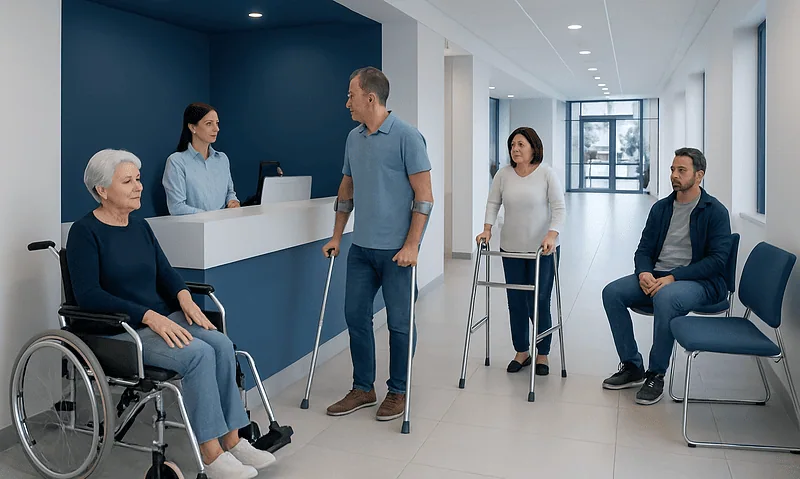
Mobility Aids in Turkey: Renting a Wheelchair, Walker, or Crutches
Mobility aids in Turkey can be rented through medical suppliers, pharmacies, and hospital-linked services in Istanbul and other cities.

Traveling to Turkey with Food Allergies or Special Diet Needs
Traveling to Turkey with food allergies or special diet needs is manageable with planning, translated allergy cards, and hotel and hospital support…

Flying to Turkey with Limited Mobility: Airport, Transfer, and Hotel Planning Tips
Flying to Turkey with limited mobility is easier with pre-booked airport assistance, accessible transfers, and hotel checks in Istanbul.