

Paying a Treatment Deposit from Abroad: Safe Steps for Patients

Pay only after you have a written treatment plan, a quotation, and official payment instructions from the hospital. Verify the beneficiary name, IBAN, SWIFT code, currency and patient reference through a second trusted channel, then use the documented route — usually a bank transfer or a secure payment link. Keep every receipt, send proof of payment, and ask for written confirmation that the deposit reached your patient account.
Sending money to a hospital in another country before you have met anyone there feels uncomfortable. That instinct is healthy. It is exactly what keeps you careful.
Paying a treatment deposit from abroad is safe when you follow a fixed routine: confirm exactly who you are paying, use a payment route the hospital has documented in writing, and keep a complete paper trail from quotation to receipt. This guide sets out that routine step by step, explains what can go wrong, and tells you plainly what a deposit does and does not settle.
At a glance
- When to pay: Only after your treatment plan, written quotation and official payment instructions are all confirmed
- Safest routes: An international bank transfer to verified hospital details, or a secure payment link issued through official channels
- What to verify: Beneficiary name, IBAN or account number, SWIFT/BIC, bank name, currency, amount and your patient reference
- What to keep: Quotation, payment instructions, transfer receipt, email confirmations and any deposit acknowledgment
- Main risk: Fraudulent “changed bank details” messages sent by email or messaging apps, usually with artificial urgency
- Golden rule: If anything changes suddenly, pause and reconfirm through a contact method you already know is genuine
Why a hospital may ask for a deposit before you travel
When you arrange treatment in another country, a deposit is often the point where planning becomes concrete. It may be linked to confirming a procedure date, reserving operating theatre time, securing an admission slot, or starting the administrative work your visit requires. International care involves scheduling across departments, and hospitals use deposits to hold that coordination in place while you book flights and accommodation.
Before you send anything, make sure you know what this specific deposit is for. Ask whether it relates to admission, a procedure, diagnostic testing, or a broader treatment package, and ask how it will be applied to your final bill. It is also worth asking, in writing, what happens if the plan changes after your in-person medical evaluation — because plans sometimes do change once a specialist has examined you and reviewed fresh test results.
Every well-run international hospital documents this paperwork in a consistent way; you can see one worked example in how Acibadem explains deposits, payment steps and billing documents. Whichever hospital you use, the principle is the same: paying a treatment deposit from abroad should never happen before the paperwork exists to support it.
What to confirm before sending any money

The single most important rule: do not transfer anything until you hold written confirmation of both the treatment plan and the payment instructions. In practice, that means a formal quotation or cost estimate, the full beneficiary details, the expected currency, and a patient or case reference to attach to the payment.
Check that the hospital name on your documents matches the beneficiary name on the bank details exactly, or in a way that is clearly explainable — large healthcare groups sometimes receive payments under a registered corporate name rather than the everyday brand name. If there is any difference, ask for a written explanation before you proceed. Do not accept a verbal reassurance alone.
Then verify the details through a second, independent channel. If the bank instructions arrived by email, confirm them by phone using a number taken from the hospital’s official website or from earlier correspondence you trust — not from the email itself. This one extra step defeats most payment fraud, because fraudsters can imitate an email but rarely control the hospital’s real phone lines. Cross-border medical payments are a known fraud target precisely because travel deadlines make patients feel rushed.
- Confirm the hospital or institution name and its relationship to the beneficiary name
- Confirm the IBAN or account number, SWIFT/BIC and bank name
- Confirm the exact amount and the currency it must arrive in
- Confirm your patient name and reference, character for character
- Confirm what the deposit covers and how it will appear on your account
- Confirm who pays intermediary bank charges, so the hospital receives the full expected amount
If your treatment is in Turkey, our companion guide on how to send a deposit for treatment in Turkey safely covers the country-specific details in more depth.
How to pay safely from abroad
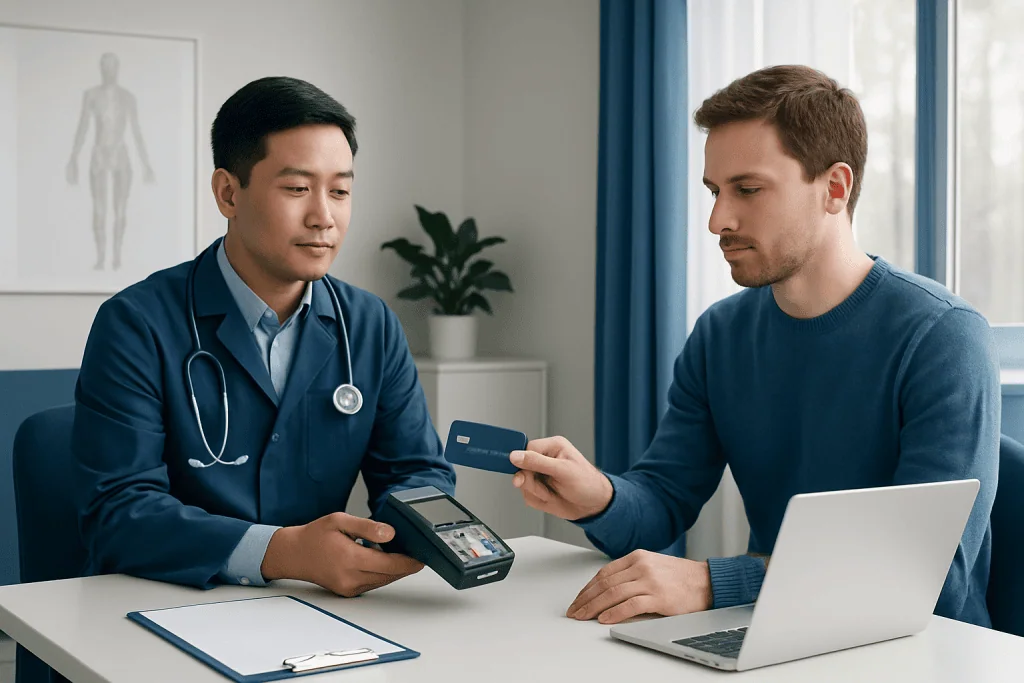
For larger amounts, an international bank transfer to verified hospital details is usually the most straightforward and traceable route. Where the hospital offers a secure online payment link or an approved card route, that can also be suitable, particularly for smaller deposits. The safest option is always the one the hospital has officially documented — never a personal account, an informal request, or instructions received only through a messaging app.
| Route | Strengths | What to check |
|---|---|---|
| International bank transfer | Fully traceable; suits larger amounts; produces a formal receipt | Beneficiary details verified twice; reference field completed; fee arrangement clarified |
| Secure payment link issued by the hospital | Fast; convenient for card payments | Link sent from an official address; page uses a secure connection; hospital named on the payment page |
| Card payment on arrival | No advance transfer needed for that portion | Whether it is accepted for deposits at all; your card’s foreign transaction settings and limits |
| Personal accounts, cash couriers, informal apps | None for hospital deposits | Legitimate hospitals do not ask for these — treat any such request as a warning sign |
When you initiate the transfer, enter the beneficiary details carefully and include your patient reference exactly as instructed. Use the payment message or notes field if your bank offers one; the finance team matches incoming payments to patient files by reference, and a missing note can delay confirmation for days, especially when several patients pay similar amounts in the same week.
Basic digital hygiene matters here too. Make the payment over a private, secure connection — not public Wi-Fi in an airport, hotel or café. Log in to online banking directly through your bank’s own app or website, never through a link in a message. If a payment link has been sent to you, check the sending address and the page’s security indicators before entering card details. A fuller list of route-by-route checks is in paying a treatment deposit in Turkey: safe methods and red flags.
Currency, bank fees and timing
Three practical details cause most of the friction in cross-border deposits, and none of them involves fraud.
Currency. Your quotation will state a currency. Confirm whether the hospital needs to receive that exact currency, or whether your bank may convert along the way. If your bank converts at an unfavourable moment, the amount arriving may fall short of the invoice, leaving a small balance open on your account before you have even travelled.
Fees. International transfers can pass through intermediary banks, each of which may take a charge from the amount in transit. Ask whether you are expected to cover charges so the hospital receives the full net amount, and select the matching fee option when you set up the transfer. Getting this wrong is not dangerous, but it creates avoidable back-and-forth.
Timing. International transfers are not instant. Depending on the countries and banks involved, funds can take several working days to arrive and then a little longer to be matched to your file. Build that lag into your travel planning, and ask the hospital when you should expect acknowledgment. Also check your own bank’s daily transfer limits in advance — many banks cap international payments by default, and raising a limit can itself take a day or two.
Warning signs of payment fraud
The biggest risk in overseas medical payments is not the transfer mechanism. It is fraudulent instructions arriving in the middle of a genuine process. The classic pattern is an email announcing that the hospital’s bank details have “changed”, sent at a plausible moment, written with urgency, and sometimes asking you not to phone. Criminals rely on pressure and on the fact that you are already expecting to pay.
Treat any of the following as a signal to stop and verify:
- New or “updated” bank details arriving after you already received official instructions
- A request to pay a personal account, an unfamiliar third-party company, or an account in a country unrelated to your treatment destination
- Urgency framed as a penalty — “pay today or lose your surgery date”
- Instructions delivered only through a messaging app or an unusual email domain that almost, but not quite, matches the hospital’s
- Invoices with spelling errors, inconsistent logos, or amounts that differ from your quotation without explanation
If anything feels off, stop. Verify through a contact method you already trusted before the suspicious message arrived. A brief delay while you reconfirm costs you nothing; a transfer to the wrong account can be very difficult to recover, because international payments move through several banks quickly. No legitimate hospital finance team will object to a patient double-checking account details before sending money.
After you pay: receipts, confirmation and matching
Once the transfer is sent, download or screenshot the confirmation immediately and keep the formal receipt from your bank. A useful receipt shows the sender name, the amount and currency, the date, the beneficiary details where possible, and your payment reference. Send a copy to the hospital through the channel it requested, so the finance team can watch for the incoming funds.
Then ask two questions in writing: when should the deposit appear on your patient account, and who will confirm it once it does? If the expected window passes without acknowledgment, follow up and resend the receipt — mismatched references are usually resolved quickly once the finance team can see your transfer details.
Do not treat the payment itself as confirmation of your trip. You may still need written confirmation of your appointment schedule, admission timing, pre-arrival documents, passport details for registration, visa planning, and any medical records the team needs before you travel. Some patients also need pre-arrival or pre-operative tests, which have their own timelines. Keep the payment thread and the travel thread moving together, so you never arrive with one confirmed and the other still open.
Refunds, plan changes and the final bill
A deposit is an advance payment inside a larger billing process — it is not a fixed final figure. Estimates prepared before you travel are based on the information available at the time. After your in-person consultation, the plan may be adjusted: additional tests, a longer stay, or a different approach can all change the final amount. That is not a warning sign; it is how honest medical quoting works. What matters is that any change is explained and documented before you agree to it.
Before you pay, ask three things and get the answers in writing:
- Refunds: What happens to the deposit if treatment is postponed, cancelled, or found unsuitable after evaluation? The answer may depend on timing, the reason for the change, and whether non-refundable arrangements have already been made.
- Application: How exactly is the deposit applied to the final bill, and will you receive a document showing it credited to your account?
- Settlement: When is the remaining balance due — before admission, at discharge, or in stages? Knowing this lets you prepare bank limits and transfer timing so nothing delays your admission.
Our guide to deposit, balance and billing questions for treatment in Turkey works through these settlement stages in more detail.
Keeping the whole process organised
Paying a treatment deposit from abroad feels intimidating because it combines health decisions, money and travel deadlines in one short window. A fixed routine removes most of the stress: verify details, pay only through documented channels, save every document, and ask for everything important in writing.
Keep one folder — digital or paper — holding your quotation, payment instructions, coordinator emails, transfer receipt, deposit confirmation, and any registration documents such as a passport copy if requested. If you are travelling with a companion, give them access to the same folder so they can help while you are in transit or in appointments. While you are organising documents, it is also a sensible moment to review what your travel insurance should cover for treatment abroad, since insurance paperwork and payment paperwork tend to be needed at the same moments.
Finally, expect to ask questions. Reputable international hospitals deal with overseas deposits every day, and a well-run international patient department should be able to explain each next step clearly. The goal is not simply to pay — it is to arrive knowing your arrangements are secure, documented and understood.
Step by step
- Receive your treatment plan and written payment instructions. Wait until you have a clear treatment recommendation, a quotation or estimate, and formal payment details from the hospital. You should know what the deposit is for and how it will be recorded on your account before any money moves.
- Verify the payment details independently. Check the beneficiary name, bank name, IBAN or account number, SWIFT/BIC, currency and amount. Then confirm the same details through a contact method you already know is genuine — a phone number from the official website or from earlier trusted correspondence, never from the email containing the bank details.
- Clarify currency and fees. Confirm which currency must arrive, who covers intermediary bank charges, and whether your own bank’s transfer limits need raising before you can send the full amount.
- Use the approved payment route. Pay by the route officially documented by the hospital — a bank transfer to verified details or a secure payment link. Refuse personal accounts, unfamiliar third parties, or instructions delivered only through informal messaging.
- Add your patient reference correctly. Include your full name and case reference exactly as instructed so the finance team can match the deposit to your file. If the reference field is short, put the most important identifier first.
- Save proof immediately. Download the transfer confirmation and keep the formal bank receipt. Send a copy to the hospital through the requested channel straight away.
- Ask for written acknowledgment. International transfers take time, so ask when confirmation should arrive. If the window passes silently, follow up and provide the receipt again.
- Reconnect payment with travel planning. Once the deposit is matched to your file, confirm admission timing, appointments, travel dates and outstanding documents, so payment and logistics stay aligned.
Your checklist
- Written quotation or estimate received
- Official payment instructions confirmed through a second trusted channel
- Beneficiary name, IBAN/SWIFT, bank, amount and currency checked character by character
- Currency, intermediary fees and your bank’s transfer limits clarified
- Patient name and reference prepared for the transfer note
- Payment made over a private connection via the documented route
- Receipt saved, backed up, and sent to the hospital
- Written deposit confirmation requested and received
- Refund, plan-change and final-balance questions answered in writing before travel
Key takeaways
- Pay a treatment deposit only after you hold a written quotation and official payment instructions.
- Verify bank details through a second trusted channel every time — especially if details “change”.
- Use the hospital’s documented payment route; never a personal account or informal request.
- Clarify currency, fees and timing in advance so the full amount arrives on schedule.
- Keep the complete paper trail, and get refund and final-balance policies in writing before you travel.
Frequently asked questions
Is it safe to pay a deposit for dental or medical work abroad?
It can be, provided the request comes through the hospital’s official channels, the beneficiary details are verified through a second trusted contact method, and you keep documentary proof of the payment. The transfer mechanism itself is rarely the risk; unverified instructions are.
Is it normal for a hospital abroad to ask for a treatment deposit?
Yes. Deposits are commonly used to confirm procedure dates, reserve operating theatre time and start admission planning for international patients. What matters is that the request arrives through official channels and clearly states what the deposit covers.
When should I submit my deposit payment?
Only after three things exist in writing: a treatment recommendation, a quotation or estimate, and formal payment instructions with a patient reference. Then allow enough lead time — several working days is a sensible planning assumption for an international transfer — so the funds are confirmed on your account before your travel dates depend on them.
What is the safest way to pay for medical treatment overseas?
An international bank transfer to independently verified hospital account details, or a secure payment link officially issued by the hospital. Avoid personal accounts, unfamiliar third parties and instructions received only through messaging apps, and keep the receipt so the payment can be traced if needed.
How can I check that the bank details are genuine?
Compare the details across your quotation, invoice and earlier correspondence, then confirm them by phoning a known official hospital number — one taken from the official website, not from the message containing the details. Be especially cautious with any message claiming the account has changed or pressing you to act quickly.
Can the final cost differ from the deposit or the estimate?
Yes. A deposit is an advance payment, and an estimate reflects the information available before your in-person evaluation. Final billing may change if additional tests, a longer stay or a different treatment approach become necessary — any such change should be explained and documented before you agree to it.
What should I do after I send the payment?
Save the transfer receipt immediately, send it to the hospital through the requested channel, and ask when the funds should appear on your account. Request written confirmation once the deposit is matched to your file, and follow up with the receipt if the expected window passes without acknowledgment.
What if I need to cancel or postpone my treatment?
Ask about the refund and rescheduling policy before you pay, and get the answer in writing. Whether a deposit is refundable can depend on timing, the reason for the change, and whether non-refundable arrangements have already been made on your behalf.
Add us as a Preferred Source to see more of our trusted health content across Google Search, AI Overviews and Discover.

Update history
- PublishedJuly 8, 2026
- Medical review approvedSeptember 1, 2026
- Last content updateSeptember 1, 2026
More Patient Guides

Private MRI, CT and Check-Up Costs in Turkey: How Scans Are Priced
How private MRI, CT, PET-CT and full check-up packages are priced in Turkey — modality, region, contrast, reporting — and what a…

Cataract Surgery Cost in Turkey: Per-Eye Prices and Lens Options
Cataract surgery in Turkey is priced per eye and the lens decides the quote. Biometry, both eyes on one trip, and what…

Lip Filler Cost in Turkey: Per-ml Prices Explained
Lip filler in Turkey is priced per millilitre with licensed hyaluronic acid brands and physician injectors. Volume, product, dissolving, safety and what…

Botox Cost in Turkey: Per-Area and Per-Unit Prices
How Botox is priced in Turkey — per area or per unit, brand, physician injectors, medical indications — and what a serious…