

Paying in Different Currencies for Treatment in Turkey

Turkey's official currency is the Turkish lira (TRY), but international patient quotes are often discussed in euros, US dollars, or pounds. Before you travel, confirm in writing which currency your quote uses, which currency will actually be charged, and how any conversion is handled. Your own bank's exchange rate and fees sit on top of whatever the hospital charges, so check both sides.
Will you be charged in lira or in your own currency? And how much will your bank quietly add on top? These are the two questions most international patients ask once a treatment date is booked, and they are worth answering before you fly, not at the cashier desk.
Paying in different currencies for treatment in Turkey is normal and manageable, but it involves two separate systems: the hospital’s payment process and your own bank’s conversion rules. This guide explains both. You will find out how the Turkish lira fits in, whether euros or dollars are practical, how quotes and exchange rates interact, and exactly what to confirm before you travel.
At a glance
- Local currency: Turkey’s official currency is the Turkish lira, shown as TRY or TL. Some charges may be processed in lira even if your quote was discussed in another currency.
- Quote currency: International patient quotes are often expressed in euros, US dollars, or pounds for convenience, confirm which currency applies to your payment.
- Payment methods: Bank transfer and credit or debit card are the most common and most traceable routes; large cash payments are rarely the best option.
- Exchange rates: Rates move daily. Your bank or card provider applies its own rate and fees, separate from anything on the hospital invoice.
- Support: Acibadem International patient services can explain payment instructions, invoices, and document requirements, but cannot control your bank’s rates or fees.
How currency works when you pay for treatment in Turkey
Turkey’s official currency is the Turkish lira, usually written as TRY or TL. Even when your treatment estimate is discussed in euros or dollars for convenience, some hospital systems, pharmacies, transport providers, and accommodation partners may process charges in lira. This is a reflection of local financial regulation and everyday operations, not a warning sign.
The practical consequence is that paying in different currencies for treatment in Turkey usually involves a conversion somewhere, either on the hospital side, on your card provider’s side, or at your bank when it sends a transfer. Each conversion has a rate and often a fee. Your job before travelling is to find out where those conversions happen and who sets the rate.
Three questions cover most of it. First: which currency is your written quote in? Second: which currency will actually be charged when you pay? Third: if those two differ, which exchange rate applies: the hospital’s stated rate, a daily official rate, or your bank’s rate? Get the answers in writing before you travel, especially for larger treatment plans or journeys with several appointments.
Acibadem International’s patient coordination teams can help you read payment instructions, understand the currency shown on your documents, and prepare the practical steps before arrival. They cannot control your bank’s exchange rate or international transfer fees, no hospital can, but they can make the hospital side of the process clear so there are fewer surprises at registration or discharge.
Euros, dollars, pounds, or lira: which should you use?
There is no single right answer, because the answer depends on where the conversion happens and at what rate. A few honest points help you decide.
For the treatment payment itself, the currency is set by the hospital’s payment instructions, not by preference. If your quote is in euros and the hospital accepts settlement in euros, paying in euros avoids one conversion. If the charge is processed in lira, your card provider or bank handles the conversion. Ask which applies to you rather than assuming.
For daily spendingtaxis, meals, pharmacies, small purchases, lira is the practical choice. Some shops and hotels in tourist areas may accept euros or US dollars informally, but they are not required to, and any rate they offer is unlikely to favour you. Cards are widely accepted in Turkish cities; a modest amount of lira covers the rest.
On dynamic currency conversion: if a card terminal offers to charge you in your home currency instead of lira, look carefully. That convenience usually comes with a conversion rate set by the terminal provider, which is often less favourable than your own bank’s rate. Many patients find it better to let the charge go through in the local currency and let their bank convert, but check your own card’s foreign transaction fees first, because they vary.
People often ask how far a fixed amount of their home currency goes in Turkey. There is no stable answer worth printing, because exchange rates move daily and sometimes quickly. Check a live rate close to your travel date, and build a buffer into your plans rather than relying on a figure you read weeks earlier.
Get a written quote before you pay anything
A written quote is the anchor document for everything else in this guide. It shows the estimated scope of treatment, the currency used, and what the initial plan includes. It is usually based on the medical documents you shared in advance, reports, scans, test results, a referral, and it may be updated after an in-person evaluation.
Treat a quote as an estimate unless the hospital states otherwise in writing. Plans can change after examination or new test results, so it is reasonable to ask what happens if your doctor recommends additional tests, a longer stay, different materials, or a revised treatment plan. Our guide on paying for extra tests when your plan changes covers this in detail.
Before paying, check that your quote or payment communication states:
- Your full name and date of birth or patient reference number.
- The currency of the quote and whether taxes or hospital fees are included.
- What is included: consultation, tests, the procedure, hospital stay, medication during admission, follow-up visits.
- What is excluded: hotel, flights, companion costs, extra nights, unrelated medical needs.
- Payment timing: deposit before travel, payment on admission, or settlement before discharge.
If you are weighing offers from more than one provider, compare like for like, currency, inclusions, and exclusions, before comparing totals. See comparing medical quotes from different hospitals in Turkey for a structured way to do this.
Paying by bank card, transfer, or cash
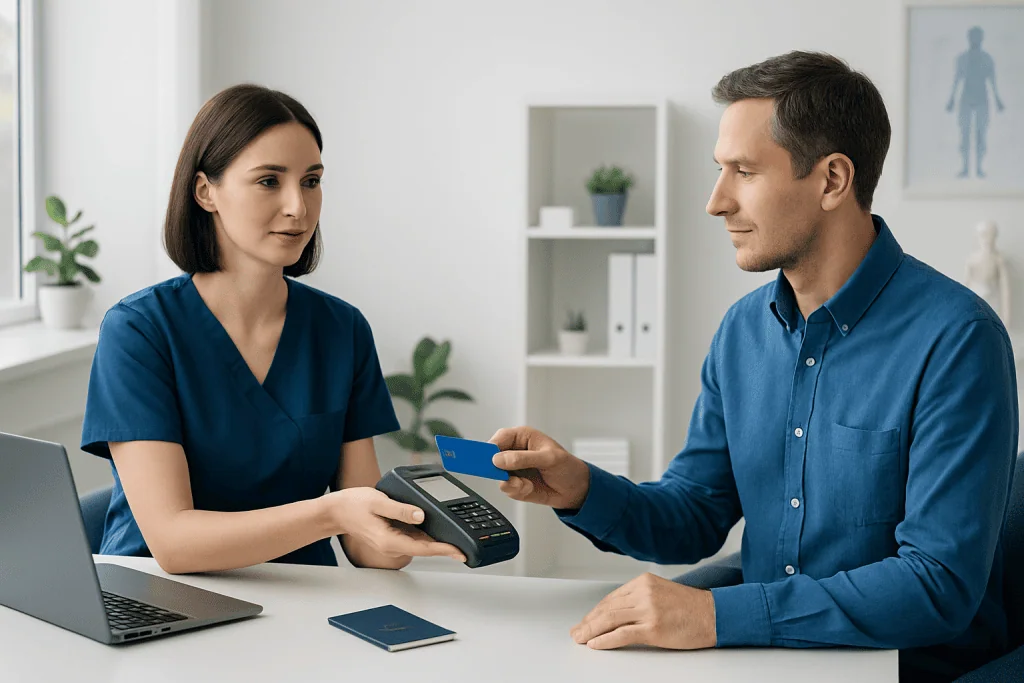
Most international patients settle treatment costs by bank transfer or by credit or debit card. Both create a clear payment record, which matters if you later need documents for an insurer, an employer, a national health authority, or your own accounting. If you plan to pay by card, tell your bank before travelling so a large overseas payment is not blocked as suspected fraud, and check that your card limit actually covers the expected amount.
Card payments may be charged in lira or another accepted currency, depending on the hospital’s payment system and what was agreed. Your card provider may add foreign transaction fees or apply a rate different from the mid-market rate you see online. Check the amount on the terminal before approving, decline dynamic currency conversion unless you have a specific reason to accept it, and take a receipt before you leave the cashier desk.
Bank transfers suit larger, planned amounts, but they take time. International transfers can pass through intermediary banks, and fees may be deducted along the way unless your bank sends the full amount at your cost. Ask your bank about the sending options it offers and how long the transfer typically takes. If a transfer might still be in transit when you arrive, bring proof of payment and access to your online banking. Our guide on cards, bank transfers, and timing when paying from abroad goes deeper on this.
Cash has a limited role. Carrying large sums across borders raises security and customs-declaration issues, and cash payments are harder to document for reimbursement. Keep cash for small daily expenses and use traceable methods for the treatment itself.
One rule applies to every method: use only official payment instructions received through the verified international patient channel. Never send money to a personal account, and never pay through a link you cannot verify. If you are asked for a deposit, read safe methods and red flags for treatment deposits before you transfer anything.
Exchange rates, fees, and timing
Exchange rates can move between the day you receive a quote, the day you send a transfer, and the day the hospital receives the funds. This is why anyone paying in different currencies for treatment in Turkey should ask, in writing, how exchange differences are handled. If your quote is in one currency but settlement happens in another, find out whether the hospital’s stated rate, a daily official rate, or your card provider’s rate applies.
Your home bank may charge several separate fees: outgoing international transfer fees, correspondent bank fees, a foreign exchange spread built into the rate, and card foreign transaction charges. None of these appear on the hospital invoice, because they are not hospital charges. For an accurate picture, ask your bank three things: what the total sending cost will be, how long the transfer will take, and whether the beneficiary will receive the full amount.
Timing matters most just before admission. A delayed transfer arriving after your procedure date creates avoidable stress. For major treatment, arrange payment steps early, keep proof of transfer with you, and make sure you can access online banking abroad, including any security app or device your bank requires. If you are travelling with a companion, consider whether they should be authorised to contact your bank while you are resting after treatment.
Receipts, invoices, and insurance documents
Keep every payment-related document: the quote, any proforma invoice, bank transfer receipts, card slips, the hospital invoice, the discharge invoice, and any refund or adjustment paperwork. Store digital copies in a secure folder and keep printed copies with your travel documents. This matters most if you will submit a claim to an insurer, a national health scheme, or an employer after returning home.
Ask in advance what your insurer or reimbursement body requires on the invoice. Common requirements include the patient’s full name, a procedure or diagnosis category, treatment dates, a hospital stamp, tax information, and proof of payment. Hospitals follow privacy and administrative rules, so request specific formats early, not after you are back home and the file is closed. Final invoices are typically completed at discharge, once all services are recorded, so build a little time into your departure plans if you need documents in hand.
If you need documents translated or formatted for a particular institution, ask patient services what is possible and how long it takes. For a fuller walkthrough of the billing sequence from deposit to final invoice, see deposit, balance, and billing questions answered.
Deposits, plan changes, and refunds
Some treatment journeys involve a deposit or prepayment before appointments are finalised, for example, when operating room time, special materials, or an admission slot is being reserved. The approach varies by treatment plan and hospital policy. You should always receive clear written instructions before making any payment, and those instructions should come through the official channel you have been using all along.
Medical care is personal, and plans change. After seeing you in person, your doctor may recommend additional imaging, laboratory tests, specialist consultations, or a different timeline. Travel with a financial buffer, and ask before you fly how additional charges are explained and approved before they are added to your account.
If treatment is postponed, cancelled, or changed, ask for the refund or adjustment process in writing. Where a refund applies, it is usually returned through the original payment route, and banking systems and compliance checks can make this slow. Keep the same bank account or card active until every financial matter is settled, closing the account mid-process complicates refunds considerably.
Step by step
- Request a written estimate. Share your medical documents through the official international patient channel. Check the currency, inclusions, exclusions, and whether the estimate may change after examination.
- Confirm the payment currency and route. Ask whether you will be charged in lira or another currency, and whether to pay by transfer, card, or another approved method. Use only official instructions.
- Speak with your bank. Ask about transfer costs and timing, card limits, foreign transaction fees, and fraud blocks. Request a temporary limit increase if a large card payment is planned.
- Plan for exchange-rate movement. Rates shift between quote and payment. Keep a buffer and confirm how differences are handled if quote and payment currencies differ.
- Keep payment proof accessible. Save transfer confirmations, card slips, and correspondence in one secure folder. Bring printed copies if a transfer may still be pending at arrival.
- Review the invoice before discharge. Confirm your name, treatment dates, and payment status are correct, especially if you need documents for reimbursement.
- Settle follow-up and refund details before flying home. Confirm whom to contact, what documents are still to come, and how long administrative steps usually take.
Your checklist
- Written quote showing the currency, inclusions, and exclusions
- Official payment instructions from the hospital or international patient office
- Passport and patient reference details matching your payment documents
- Bank card with sufficient limit and international use enabled
- Online banking access, with security app or device, available abroad
- Proof of bank transfer, card payment, or deposit confirmation
- A small amount of Turkish lira for daily expenses
- Financial buffer for plan changes or extra nights
- Insurer, employer, or reimbursement document requirements confirmed in advance
- Secure digital folder for invoices, receipts, and medical documents
Key takeaways
- Turkey’s local currency is the Turkish lira, but international patient quotes are often discussed in euros, dollars, or pounds, confirm which currency will actually be charged.
- Your bank or card provider applies exchange rates and fees separate from the hospital’s charges; check both sides before you travel.
- A written estimate should show inclusions, exclusions, the currency, and payment timing, treat it as an estimate unless stated otherwise.
- Use traceable, official payment methods; keep every receipt, invoice, and transfer confirmation.
- Plan for exchange-rate movement, possible plan changes, and administrative time for final invoices or refunds.
Frequently asked questions
Is it better to pay in euros or Turkish lira in Turkey?
It depends on where the conversion happens. For treatment, the currency is set by the hospital’s payment instructions, if your quote and settlement are both in euros, paying in euros avoids a conversion. For daily spending, lira is the practical choice. If a card terminal offers to convert into your home currency, that rate is often less favourable than your own bank’s, so compare before accepting.
Can you pay with USD in Turkey?
The official currency is the Turkish lira. Some hotels and shops in tourist areas may accept US dollars informally, but they are not required to, and their rates rarely favour you. For hospital payments, US dollars may be used where the hospital’s payment instructions state so, confirm the accepted currency in writing before you travel rather than assuming.
How far does a fixed amount of my home currency go in Turkey?
There is no stable answer, because exchange rates move daily and sometimes quickly. Any figure printed here would be out of date by the time you travel. Check a live exchange rate close to your departure date, budget your daily spending in lira, and keep a buffer rather than relying on a number you read earlier.
How much does medical treatment cost in Turkey?
There is no single figure, because the cost depends on your diagnosis, the recommended procedure, materials, length of stay, and any additional tests or consultations. The reliable route is a written quote based on your own medical documents, stating the currency, inclusions, and exclusions. Treat it as an estimate that may be updated after in-person evaluation, and compare quotes on scope, not just totals.
Will my card use my bank’s exchange rate or the hospital’s rate?
If the charge is processed in a currency different from your card account, your card provider usually applies its own rate, possibly with a foreign transaction fee. Some terminals offer conversion at the point of sale, which uses the terminal provider’s rate instead. Check the displayed amount and currency before approving, and ask your bank about its charges before travelling.
Should I bring cash for hospital payment?
For safety and documentation, traceable methods such as card payment or bank transfer are usually preferable for treatment costs. Large cash amounts create security and customs-declaration issues and are harder to evidence for reimbursement. Keep a modest amount of lira for taxis, meals, and small expenses, separate from your treatment payment plan.
What if the treatment cost changes after I arrive?
An estimate may change if your doctor recommends additional tests, a different plan, a longer stay, or extra services after examining you. Ask in advance how new charges are explained and approved before they are added to your account, and travel with a financial buffer so a plan change does not become a payment crisis.
How can Acibadem International help with payment logistics?
Patient services can help you understand written estimates, official payment instructions, payment timing around appointments, and document requests, and can coordinate with interpreters and administrative teams when something is unclear. They cannot control your bank’s exchange rate or fees, so confirm those directly with your bank before you travel.
Add us as a Preferred Source to see more of our trusted health content across Google Search, AI Overviews and Discover.

Update history
- PublishedJune 8, 2026
- Medical review approvedSeptember 13, 2026
- Last content updateSeptember 12, 2026
References1
- Turkey travel advice: GOV.UK gov.uk
More Patient Guides

Private MRI, CT and Check-Up Costs in Turkey: How Scans Are Priced
How private MRI, CT, PET-CT and full check-up packages are priced in Turkey, modality, region, contrast, reporting, and what a…

Cataract Surgery Cost in Turkey: Per-Eye Prices and Lens Options
Cataract surgery in Turkey is priced per eye and the lens decides the quote. Biometry, both eyes on one trip, and what…

Lip Filler Cost in Turkey: Per-ml Prices Explained
Lip filler in Turkey is priced per millilitre with licensed hyaluronic acid brands and physician injectors. Volume, product, dissolving, safety and what…

Botox Cost in Turkey: Per-Area and Per-Unit Prices
How Botox is priced in Turkey, per area or per unit, brand, physician injectors, medical indications, and what a serious…