

Remote Family Communication Plan During Treatment in Turkey

A remote family communication plan names one trusted contact person, sets a fixed update rhythm (usually once daily or after key appointments), lists times in both Istanbul time and your family's local time, and agrees privacy rules in advance. Build it before you travel, then adjust it after your first hospital appointment once you understand the real schedule.
Who will you call first after your appointment, and how many people will be waiting for that call? For most international patients, this is the quiet worry that surfaces the night before travel. Your loved ones may be thousands of kilometres away, but they are still deeply involved in every step.
A clear remote family communication plan during treatment in Turkey solves this before it becomes a problem. It keeps everyone informed and reassured, protects your privacy, and leaves you free to focus on treatment and recovery instead of managing a stream of anxious messages.
At a glance
- Best time to plan: Before you travel, then adjust after your first hospital appointment
- Main goal: Keep family informed without overwhelming you or your care team
- Core structure: One family contact person, one backup, a fixed update rhythm, shared schedule in two time zones
- Privacy focus: Decide in advance what can be shared, with whom, and how often, and ask about consent if a relative will receive information from the hospital
- Helpful support: International patient services and interpreters can assist with communication logistics; clinical questions stay with your treating team
Why a remote family communication plan matters when your family is far away
Receiving treatment in another country makes ordinary family communication harder in ways people rarely anticipate. Time zones shift a convenient evening call into someone else’s 3 a.m. Hospital schedules move without warning. Medical terminology arrives in a second language on a day when you are tired. Any one of these can turn a routine quiet period into hours of anxious speculation at home.
A remote family communication plan during treatment in Turkey gives you a simple structure: who receives updates, when they receive them, and what information is shared. It replaces improvisation with a routine that everyone understands before you board the plane.
The plan is not there to create more work for you. It protects your energy. Instead of answering the same three questions from six different relatives, you send one message to one person, who passes it on. On busy treatment days, during recovery, or in moments when you simply need to sleep, that difference matters more than most patients expect.
At Acibadem, many international patients arrive with relatives at home who want to follow the journey closely. International patient teams, interpreters, and care coordinators can help you understand hospital processes and prepare the practical side of your plan: you can read more about this in how we support family members during your treatment journey. Clinical decisions and medical information remain between you and your medical team; the communication plan handles everything around them.
Choose one main family contact and define roles early
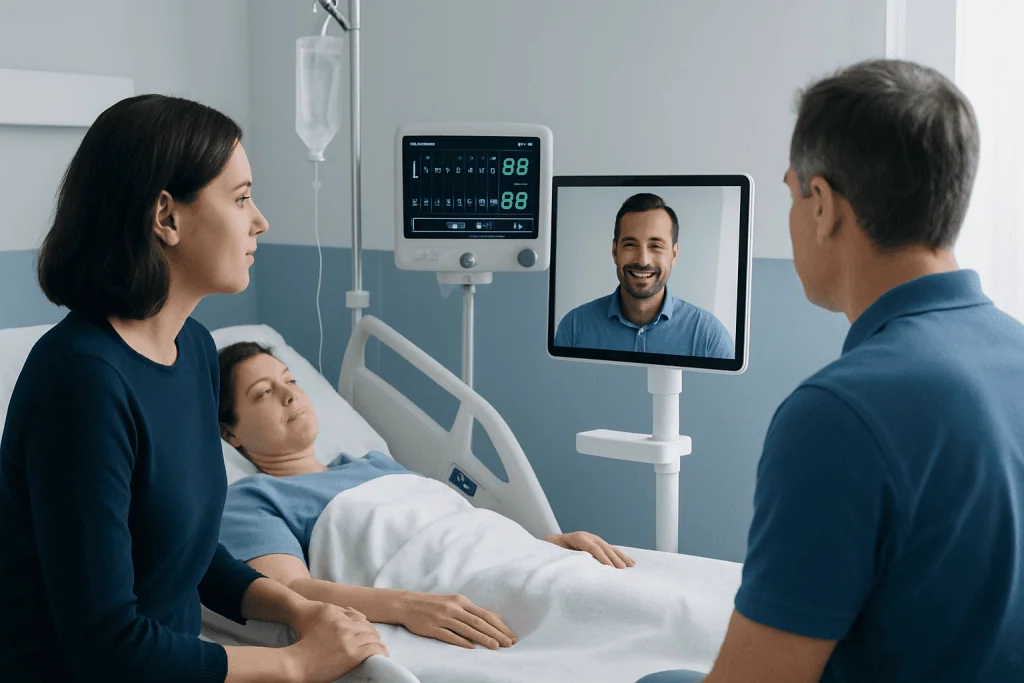
The single most effective step in any remote family communication plan is choosing one primary contact. This person receives updates from you or your companion and shares news with the wider family. They do not need to make medical decisions unless you formally authorise them to do so. Their job is narrower and more useful: reduce message traffic and keep everyone aligned on the same facts.
Choose someone calm, reliable, and comfortable with detail. They should keep information confidential, resist the urge to speculate, and summarise clearly. If your family is large or spread across countries, name a backup contact for the hours when the main person is asleep, working, or travelling. Time zones make a single point of contact fragile without one.
Assign practical roles before you travel
Beyond the main contact, it helps to divide responsibilities so no single relative carries everything:
- One person receives medical and schedule updates directly from you or your companion.
- One person coordinates messages to extended family and friends.
- One person helps with documents, insurance questions, or travel changes from home.
- One person supports children, elderly relatives, or dependents, if children are staying behind, our guide on planning childcare at home during treatment travel to Turkey covers this in detail.
Clear roles prevent several people from asking the hospital, your companion, or you for the same information. They also let your family help in an organised way rather than reacting urgently to every small schedule change. For a broader look at what relatives can usefully do from a distance, see how family members can support a patient during treatment in Turkey.
Set a realistic update rhythm that protects your rest

Before treatment begins, agree how often updates will come. Many families do well with one planned update per day, or one after each significant appointment. During active treatment or early recovery, a short message is enough: “Back in my room, resting, will update tomorrow.” It reassures without demanding a long conversation on a day when you have nothing left.
Just as important is agreeing what does not require an immediate update. Minor delays, routine waiting, and normal hospital observations do not need real-time reporting. Hospital schedules shift for entirely ordinary reasons, and not every change means something is wrong. Say this to your family explicitly before you travel. It is the single sentence most likely to prevent unnecessary worry later.
Decide, too, what silence means. A useful convention: “No message means resting and nothing new: the next update comes at the agreed time.” Without this rule, a quiet afternoon in Turkey can become a frightening one at home.
If a procedure or operation is planned, agree in advance who waits where, who sends the first message afterwards, and roughly when. Waiting periods are the hardest hours for families abroad, and this deserves its own preparation: our guide on family updates during surgery in Turkey explains how that day typically works and what your companion can realistically report, and when.
Your international patient contact can often explain the general appointment flow in advance, consultations, imaging, discharge planning, follow-up visits, so you can tell your family when updates are likely rather than leaving them guessing.
Use safe, simple tools for messages, documents, and video calls
Choose tools everyone can actually use, including the least technical member of the family. A private messaging group works well for short general updates. Sensitive medical documents deserve more care: avoid posting them in large group chats unless you are fully comfortable with everyone present seeing them, now and later. Group chats grow, and messages are easily forwarded.
For coordination, a shared calendar carries appointment times, travel dates, and expected call windows, always in both Turkey time and your family’s local time. A shared notes document lets your family contact collect questions before consultations, so you are not scrolling through dozens of messages the night before an appointment.
A workable toolkit usually looks like this:
- A private messaging group for short daily updates.
- A shared calendar for appointments and travel logistics, in two time zones.
- A secure folder for travel documents and any files you have chosen to share.
- Scheduled video calls for family conversations, on days when you feel well enough.
- Voice notes for days when typing is tiring but you still want to be heard.
Keep passwords private, use device locks, and avoid sending documents through platforms you do not know. If a document needs translating, uploading, or printing for hospital use, ask your international patient contact which format is preferred before you send three different versions.
Plan for language, time zones, and medical terminology
Even when your care team explains things carefully, medical information can be a lot to absorb, especially in a second language, after a long travel day. Professional interpreters help you understand consultations, instructions, and next steps. If a relative wants to help with language instead, weigh that decision carefully; our guide on medical interpreter or family member: who should help during appointments in Turkey walks through when each option makes sense.
If your family will follow appointments remotely, decide in advance which of three models you prefer: they listen in live, they receive a written summary afterwards, or they send questions ahead through your main contact. Each works. Mixing all three without agreement does not.
Time zones deserve their own line in the plan. Turkey does not observe seasonal clock changes, so the gap between Istanbul and your home city may shift during the year even though Turkish time stays fixed. Write every key time in one consistent format, “14:00 Istanbul time / your local time”, in the shared calendar. This small habit prevents more missed calls than any app.
When medical terms come up, ask for plain-language explanations, and request written instructions for things like wound care, diet, mobility, or follow-up planning where appropriate. Your family contact can then pass on a short, accurate summary rather than reconstructing complex terms from memory across a language barrier.
Respect privacy, consent, and emotional boundaries
Your family wants details because they care. That does not oblige you to share everything. Before you travel, decide three tiers: what stays private, what close family may know, and what can be shared more widely. Many patients are comfortable sharing appointment progress but not test details, images, diagnoses, or how they are feeling emotionally. Any line you draw is legitimate.
If someone will speak with the hospital or receive information on your behalf, ask in advance what consent or authorisation is required. Hospitals must protect patient confidentiality, and staff may not be able to discuss your care with relatives unless the proper permissions are in place. This is a safeguard for you, not an obstacle, but it works far better arranged before treatment than argued about during it.
Emotional boundaries matter as much as informational ones. Some patients draw strength from constant encouragement; others find repeated questions exhausting. A kind, prepared sentence does the work: “I appreciate your care. Updates will come through my sister once a day so I can rest between appointments.” Clear boundaries usually make family communication warmer, not colder, because everyone knows what to expect. If relatives at home have strong views about the treatment itself, it is worth reading managing family expectations during treatment in Turkey before you leave.
Prepare for urgent changes without creating alarm
Most communication during treatment is routine. Plan for the exceptions anyway. Decide who is contacted first if your schedule changes suddenly, if you stay in hospital longer than expected, or if your companion needs help with travel arrangements. Keep the important numbers in one place, on your phone and on paper: your hospital contact, hotel, companion, main family contact, your embassy or consulate if relevant, and your travel insurance assistance line.
One separate rule sits outside the plan entirely: if anyone, you, your companion, or a relative at home, develops sudden, severe symptoms, do not wait for the agreed update window. In that situation, call your local emergency number or go to the nearest emergency department now.
For everything short of an emergency, a good urgent message uses calm, factual language and always names the next update time. Templates written in advance help enormously, because nobody writes their clearest sentence under stress:
| Situation | Example message |
|---|---|
| Routine quiet day | “Nothing new today, resting well. Next update tomorrow evening Istanbul time.” |
| Schedule change | “The consultation moved to Thursday morning. Nothing is wrong: the plan is the same. Update after the appointment.” |
| Extended observation | “The doctor has recommended extra observation tonight. We are at the hospital, the team is monitoring things, and we will update you again at 20:00 Istanbul time.” |
| After a procedure | “Out of the procedure and back in the room. Sleepy but comfortable. Longer update tomorrow.” |
Each message gives facts, reassurance, and a next update time, and nothing speculative. Acibadem’s international patient services can help with practical coordination such as interpreter access, hospital navigation, and in many cases guidance around accommodation or travel changes. For medical questions, your treating team remains the right source; for logistics, patient services can help you find the next step more smoothly.
Step by step
- List everyone who needs updates. Write down close relatives, friends, caregivers, and anyone managing responsibilities at home. Then sort honestly: who needs detail, and who only needs occasional reassurance.
- Choose your primary family contact and a backup. Select one trusted person to receive updates and share them onward, plus a backup for time-zone gaps. Tell the wider family clearly that this is the communication point during your treatment in Turkey.
- Agree the update frequency, and what silence means. Set a routine such as once daily or after major appointments, and agree that no message means resting and nothing new. Add a stock phrase like “quiet day, next update tomorrow” for slow periods.
- Build a shared schedule in two time zones. Include travel days, consultations, expected treatment dates, recovery time, and follow-up appointments, each written in Istanbul time plus your family’s local time.
- Write down your privacy rules. Decide what can be shared, with whom, and whether photos, documents, or test results stay private. If someone may speak with the hospital on your behalf, ask about the required consent process before you travel.
- Plan interpreter-supported communication. Decide how information from interpreted consultations will be summarised for the family, and avoid relying on a relative’s rushed translation for anything that affects your care instructions.
- Create the urgent contact card. Save the key numbers, companion, hospital contact, hotel, family contact, embassy or consulate, insurance assistance, on your phone and on paper, and agree who sends urgent updates and what they include.
- Review the plan after your first appointment. Once you see how the hospital’s schedule actually runs, adjust the rhythm and roles. Treatment plans evolve; a communication plan that cannot flex will fail exactly when you need it.
Your checklist
- Primary family contact and backup contact chosen
- Family messaging group created with clear rules
- Daily or appointment-based update rhythm agreed, including what silence means
- Shared calendar includes Istanbul time and home time zone
- Privacy preferences written down and shared with key people
- Important phone numbers saved on your phone and on paper
- Interpreter needs discussed with international patient services
- Consent requirements checked if a relative will receive information
- Short message templates prepared for routine and urgent updates
- Document-sharing method chosen for approved files only
Key takeaways
- A remote family communication plan during treatment in Turkey keeps relatives informed without overwhelming you or your care team.
- One main family contact, plus a backup, reduces repeated questions and keeps everyone working from the same facts.
- A fixed update rhythm, and an agreed meaning for silence, matters most across time zones and during recovery.
- Privacy and consent should be settled before anyone receives medical information on your behalf; hospitals require proper permissions.
- International patient services and interpreters support the logistics of communication, while your treating team remains the only source for clinical information.
Frequently asked questions
Should my family join medical consultations by video call?
It depends on your preference, the appointment setting, and hospital policies. Some patients want a relative listening and taking notes; others prefer to speak with the doctor privately and share a summary afterwards. Ask your care coordinator in advance so expectations are clear and interpreter support can be arranged if appropriate.
How often should I update relatives during treatment in Turkey?
For most families, one planned update per day is enough unless something meaningful changes. Updates after key consultations or procedures also work well. The essential point is to set the rhythm before treatment begins, and to agree what silence means, so a quiet day is never misread as bad news.
Can Acibadem speak directly with my family abroad?
Patient privacy rules apply, so staff may need your consent before sharing information with anyone else. International patient teams can guide you on communication logistics and interpreter arrangements. For clinical information, your treating physician and care team are the appropriate source, and they will follow the consent process you have set up.
What if my relatives keep messaging me too much?
Set a gentle, specific boundary. Say that you appreciate their concern but need rest, and that updates will come once a day through one named contact. Most families respond well once they know exactly when the next update will arrive, uncertainty, not distance, is usually what drives the message flood.
What information should I avoid sharing in a family group chat?
Avoid sensitive documents, detailed test results, identity documents, and photos unless you are comfortable with everyone in the group seeing them, including people added later. Group chats grow and messages get forwarded. Use a more private channel for personal medical information, and keep the group for short, general updates.
How can we manage time-zone differences?
Write every appointment and call time in both Istanbul time and your family’s local time, ideally in a shared calendar. Note that Turkey keeps the same clock year-round, so the gap with your home country may change with the seasons. If relatives are spread across several countries, let your main contact set one reasonable update window.
What should my companion in Turkey tell family members after treatment?
Only what you have agreed can be shared. A good update covers where you are, whether you are resting, any confirmed next steps, and when the next message will come. Your companion should never guess or interpret medical details beyond what the care team has actually explained: a short accurate message beats a long speculative one.
Add us as a Preferred Source to see more of our trusted health content across Google Search, AI Overviews and Discover.

Update history
- PublishedJune 9, 2026
- Medical review approvedSeptember 13, 2026
- Last content updateSeptember 12, 2026
More Patient Guides

Medical Travel with a Companion: Who Should Come and Why
Medical travel with a companion can make treatment in Turkey easier by providing practical help, communication support and reassurance before and after…

How Family Members Can Help Without Disrupting Recovery
Family support during recovery helps when you listen, organize practical tasks and follow the care plan without taking over, in Turkey or…

Need a Family Member to Travel With You? A Companion Decision Guide
A companion travel guide for treatment in Turkey: decide who should travel with you, plan practical support, and prepare for Istanbul care.

Unexpected Overnight Stay in Turkey: What Patients and Companions Should Be Ready For
Unexpected overnight stay in Turkey? Here is what patients and companions should prepare for, from essentials and updates to hospital logistics in…