

Storing Medicines Safely in Your Hotel Room in Turkey

Keep most medicines in a cool, dry, shaded spot in the main room, a wardrobe shelf or closed drawer, not the bathroom, a windowsill or a hot car. Keep originals labelled, store refrigerated medicines only in a confirmed working fridge away from the freezer compartment, and keep everything out of reach of children. Confirm exact storage requirements with your pharmacist before you travel.
You have landed, the room is warm, and your medicine bag is still sitting on the bed. Where should it go? It is a small decision, but it matters more than most travellers expect.
Storing medicines safely in your hotel room in Turkey comes down to four things: temperature, humidity, privacy and access. Get those right on the first evening and the rest of your stay becomes simpler, no hunting for a missing box before an appointment, no wondering whether the insulin got too warm in the transfer, no pill organiser sitting open on a bedside table within reach of a child. This guide walks through where to put your medicines, what genuinely damages them, how to handle refrigerated items, and what to do when something goes wrong.
At a glance
- Best storage spot: a cool, dry, shaded place in the main room: a wardrobe shelf or closed drawer, out of reach of children
- Avoid: the bathroom, windowsills, balconies, parked cars and anywhere near a kettle or radiator
- Keep with you: daily essentials, emergency medicines and copies of prescriptions, always in hand luggage
- Refrigerated medicines: confirm a working fridge before arrival, keep items away from the freezer compartment, and ask a pharmacist how long the product tolerates room temperature
- Packaging: original boxes with readable labels, for border checks, pharmacy questions and hospital visits alike
Why storing medicines safely in your hotel room in Turkey matters
When you travel for treatment, your medicines are rarely optional extras. They may be part of a long-term routine, a preparation plan your surgical team has set, or the recovery instructions you will carry out of the hospital. A hotel room is not designed around any of that. Rooms heat up when curtains stay open or the air conditioning switches off while you are out. Bathrooms turn humid after every shower. Housekeeping moves things. Children and companions share the space. None of these is dramatic on its own, but together they are exactly the conditions that degrade medicines, cause missed doses, or create confusion between similar-looking boxes.
Turkey’s climate adds a layer worth respecting. Istanbul, Izmir and Antalya can all be genuinely hot for much of the year, and even in cooler months a south-facing room behind glass can climb well above the temperature range printed on most medicine labels. Most tablets and capsules are intended for storage below roughly 25°C in a dry place: the exact figure is on the leaflet or packaging, and it varies by product. Storing medicines safely in your hotel room in Turkey therefore starts with a simple habit: read the label, then choose the spot in the room that best matches it.
If any of your medicines came from your treating hospital rather than your home pharmacy, the storage instructions on the discharge paperwork take priority over general advice, keep those documents together with the medicines themselves. Our guide to how medicines are managed before and after treatment explains what that paperwork typically covers.
Choose the safest place in your room

Pick one dedicated storage area as soon as you check in, before you unpack anything else. One place, always the same place. A high shelf inside the wardrobe, a closed drawer away from the window, or a zipped travel medicine pouch kept inside your suitcase all work well. The test is simple: is it dry, shaded, easy for you to remember, and hard for a child or a casual visitor to reach?
| Location | Verdict | Why |
|---|---|---|
| Wardrobe shelf or closed drawer | Good | Dark, dry, stable temperature, out of sight |
| Zipped pouch inside a suitcase | Good | Discreet, portable, undisturbed by housekeeping |
| Bathroom counter or cabinet | Avoid | Heat and humidity spike after every shower |
| Windowsill or balcony | Avoid | Direct sun; temperatures swing far outside label ranges |
| Bedside table, open | Avoid | Within reach of children; easily knocked or moved |
| Parked car or transfer vehicle | Never | Interior heat rises fast, even on mild days |
| Hotel safe | Sometimes | Fine for documents and non-sensitive items; safes near warm walls or minibars can run warm, and access is slower in a hurry |
A few habits make any spot work better:
- Keep tablets and capsules in their original packaging whenever possible, with the leaflet inside the box.
- Store liquids upright and check caps are fully closed each time: a slow leak in a warm room ruins everything around it.
- Separate morning, evening and as-needed medicines so you are not reading small print at 6 a.m. in a dark room.
- Keep injection needles and other sharp items contained in a rigid case, out of sight and out of the regular rubbish.
If you are setting up a room for a longer post-operative stay, this medicine station is one part of a broader arrangement: our hotel recovery room setup checklist covers the rest, from seating to bathroom access.
What actually damages medicines: heat, humidity and light
It helps to know what you are protecting against, because it explains why the bathroom and the windowsill fail even when they seem convenient. Heat can change the chemistry of some active ingredients and soften capsules, gels and suppositories until they deform or stick together. Humidity is absorbed by tablets, especially effervescent, dispersible or sublingual forms, which can make them crumble or lose potency. Light degrades certain products, which is why some come in amber bottles or foil blisters; the packaging is doing a job, which is one more reason to keep it.
Damage is not always visible. A tablet that has spent an afternoon on a sunlit ledge usually looks identical afterwards. That is why the sensible rule is prevention rather than inspection: control the conditions rather than trying to judge the medicine by eye. Where you can see changes, colour shifts, unusual smells, clumping powder, cloudiness in a liquid that used to be clear, cracked or sweating capsules, treat them as a reason to ask a pharmacist before use, not as a curiosity.
Freezing is the mirror-image problem. Insulin and many other biological medicines are permanently damaged by freezing, even briefly, and a hotel mini-fridge with an iced-up compartment can freeze anything pressed against it. Cold is not automatically safe; the label’s range has a bottom as well as a top.
Managing temperature-sensitive or refrigerated medicines
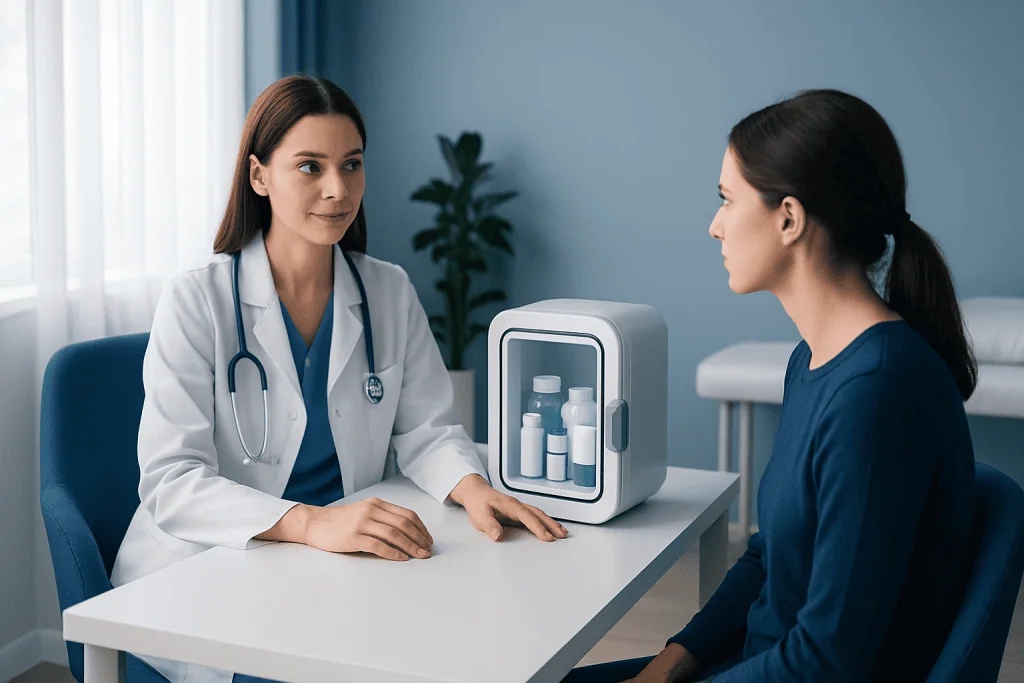
Some medicines, certain injections, some eye drops, many biologic treatments, need refrigeration, typically within a narrow range printed on the packaging. Before you travel, ask your prescribing doctor or pharmacist two specific questions: what is the exact storage range, and how long can this product safely stay outside it? The second answer matters enormously in practice, because many refrigerated medicines tolerate hours or even days at room temperature once in use, while others do not. Do not guess; the tolerance differs product by product, and sometimes between the unopened and in-use state of the same product.
Confirm the fridge situation with your hotel before arrival, in writing if you can. Ask whether the room has a genuine mini-fridge (not just a stocked minibar cabinet, which is sometimes only lightly cooled) and whether reception can offer secure refrigerated storage as a fallback. When you arrive, check the fridge is actually running before you trust it. If you use it:
- Place the medicine on a middle shelf, away from any freezer or ice compartment.
- Avoid the door shelf, where temperature swings most with each opening.
- Do not bury it behind food and drinks: an overfilled fridge cools unevenly.
- Consider a small fridge thermometer if your medicine is unforgiving; they are cheap, light and remove the guesswork.
For transfers between airport, hotel and hospital, an insulated pouch or cool bag is usually enough for short journeys if your pharmacist agrees. Keep the medicine in hand luggage, never checked baggage, where temperatures are uncontrolled and delays are possible, and avoid direct contact between the medicine and frozen gel packs unless the manufacturer says that is safe. Wrapping a towel between them is a simple fix.
If you suspect a refrigerated medicine has been exposed to heat or freezing, do not use it on the assumption it is probably fine. A pharmacist can usually tell you, from the product and the exposure, whether it remains usable, and the original packaging with its batch details makes that conversation much easier.
Keep labels, prescriptions and schedules clear
In a new country, with appointments, jet lag and sometimes fasting instructions layered on top of each other, it is easier than usual to lose track of what you took and when. Keep medicines in their original labelled boxes, and carry a written list showing each medicine’s name, strength, dose, timing and purpose. A photo of every package on your phone is a useful backup if you need to describe a medicine to a doctor or pharmacist.
If your medicines are labelled in a language other than English or Turkish, do not rely on colour, shape or memory to tell them apart. Ask your home pharmacist to help you prepare a clear English list before you fly. This matters most for medicines where an error is serious: anticoagulants, insulin and other diabetes medicines, heart and blood pressure medicines, seizure medicines, steroids, strong pain relief and immune-related treatments.
Set phone alarms in Turkey local time as soon as you arrive. If you crossed several time zones, the question of when to take the next dose is not always obvious, for some medicines a shifted schedule is trivial, for others it needs a deliberate plan from your prescriber. Our guide to keeping regular medicines on schedule during medical travel goes through this in depth. On treatment days, bring the written list, and, where practical, the boxes themselves, to the hospital so the team can confirm names, strengths and any interactions with anaesthesia, tests or new prescriptions.
Privacy, child safety and housekeeping
Hotel rooms are shared spaces: companions, visiting family, children, cleaning staff. Your medicine setup should protect all of them as well as you. Store medicines out of reach and out of sight, ideally in a zipped pouch or a suitcase that locks. This matters most for strong pain medicines, sedatives, diabetes medicines, medicated patches, liquids and anything that could seriously harm a person it was not prescribed for.
If you are travelling with children, a few rules hold everywhere and hold doubly in an unfamiliar room. Never call medicine sweets or candy. Never leave a filled pill organiser on a bedside table, organisers are convenient precisely because they open easily, which is the opposite of child-resistant. And remember that child-resistant packaging slows children down; it does not stop them. If a child does get hold of a medicine, the packaging is what tells clinicians exactly what was taken, one more reason to keep boxes intact.
Housekeeping staff move items while cleaning, usually with good intentions. Before leaving for appointments, return everything to your chosen storage spot and check that liquids, injections and sharps are secure. The hotel safe is a reasonable home for prescriptions, doctor letters and non-temperature-sensitive spare stock, but think twice before locking away anything you might need quickly, and skip the safe entirely if it sits against a warm wall. If a companion is staying in a separate room, agree who holds what: our guide on booking a companion room in Turkey touches on the practical side of splitting a stay across two rooms.
Bringing medicines into Turkey: packaging and paperwork
Safe storage in the room starts with what arrives at the room, so three border-adjacent questions come up constantly.
Loose pills in a plastic bag. A week’s tablets decanted into a zip-lock bag will usually pass through an airport without comment, but when questions do arise, at security, at customs or later at a Turkish pharmacy counter, unlabelled loose pills are the hardest thing in your luggage to explain. Original packaging with the pharmacy label answers most questions before they are asked. If you want the convenience of a daily organiser, carry both: boxes in the suitcase compartment, organiser for the day’s doses.
Common painkillers. Ordinary over-the-counter pain relief such as ibuprofen or paracetamol, in personal quantities and original packaging, does not normally cause difficulty, and equivalents are widely available in Turkish pharmacies. Brand names and available strengths differ, so knowing the generic (active ingredient) name is more useful than the brand you buy at home.
Controlled and restricted medicines. Some medicines that are routine at home, certain opioid painkillers, some sedatives and sleep medicines, some ADHD treatments, are controlled substances in Turkey and elsewhere, and carrying them may require documentation such as a doctor’s letter or the original prescription, with quantities limited to personal use. Rules change and depend on the specific substance, so check current official guidance for Turkey before you fly rather than relying on a forum post or an old itinerary. Our companion guide on travelling to Turkey with regular prescriptions covers the documentation in detail, and if you leave with new prescriptions after treatment, the same logic applies in reverse on the way home, see returning home with new medicines after treatment in Turkey.
If something goes wrong
If you spill a liquid, crush a tablet strip, or realise a medicine spent the afternoon somewhere hot, pause before deciding anything. Whether a medicine is still usable, and what to do about a missed or uncertain dose, depends entirely on the specific product and your condition: there is no universal rule, and missed-dose instructions differ widely between medicines. The leaflet in the box often answers the simple cases; a pharmacist or your prescriber answers the rest. What you should not do is improvise a compensating dose on your own judgement.
If a medicine is lost or damaged beyond use, replacement in Turkey is often possible through a licensed pharmacy, but not always straightforward: brand names differ, some strengths are not marketed here, many products require a Turkish prescription, and controlled medicines carry extra rules. This is why the written medicine list, prescription copies and photos of the packaging earn their place in your luggage: they turn a vague description into an identifiable product. It is also why the spare supply you packed at home is the single best insurance: running low with days of buffer left is an errand, while running out on the day of a dose is a problem.
Step by step
- Prepare before you fly. Pack enough medicine for your full stay plus a buffer in case plans change, treatment travel dates move more often than holidays do. Keep everything in original packaging with prescriptions or a doctor’s letter, especially for injections, controlled medicines and anything needing special storage.
- Keep essentials in hand luggage. Daily medicines, emergency medicines and temperature-sensitive items travel with you through flights and transfers. Checked luggage can be delayed, lost or exposed to extreme temperatures; it is the wrong place for anything you cannot do without.
- Inspect the room on arrival. Find the coolest, driest, most shaded spot away from the bathroom and window. If you need refrigeration, confirm the fridge runs at a sensible temperature before trusting it, and ask reception about alternatives if it does not.
- Set up a simple medicine station. Medicines, dose schedule, water and any measuring device together in one discreet place, out of reach of children and out of the path of housekeeping.
- Switch your schedule to Turkey time. Set phone alarms in local time and, if you crossed time zones, follow the transition plan your prescriber or pharmacist gave you rather than improvising.
- Bring your list to hospital visits. The written list, and the boxes, when useful, lets your team confirm names, strengths and interactions with tests, anaesthesia and new prescriptions.
- Dispose of waste safely. Loose needles, syringes and lancets never go in hotel rubbish. Keep sharps in a rigid container and ask the hospital, clinic or a pharmacy about proper disposal.
Your checklist
- Original medicine packaging with readable labels
- Prescription copies or a doctor’s letter, in English where possible
- Written medicine list with name, strength, dose, timing and purpose
- Photos of every package on your phone
- Insulated pouch for temperature-sensitive medicines, if recommended
- Small fridge thermometer for unforgiving refrigerated products
- Phone alarms set to Turkey local time
- Zipped pouch or lockable suitcase space for privacy and child safety
- Measuring spoon, syringe or device supplied with liquid medicines
- Spare supply covering unexpected travel delays
- Rigid container and a plan for safe sharps disposal, if relevant
Key takeaways
- Store most medicines in a cool, dry, shaded place in the main room, never the bathroom, a windowsill or a parked car.
- Heat, humidity and light damage medicines invisibly; controlling conditions beats inspecting tablets by eye.
- Confirm refrigeration before arrival, keep medicines away from the freezer compartment, and know how long each product tolerates room temperature.
- Original labelled packaging plus a written medicine list solves most problems, at the border, at the pharmacy and at the hospital.
- Keep medicines out of sight and out of reach of children, companions and housekeeping movement.
- Never improvise missed-dose decisions; the right answer depends on the specific medicine.
Frequently asked questions
What medications are not allowed in Turkey?
Turkey, like most countries, restricts certain controlled substances, typically strong opioid painkillers, some sedatives and sleep medicines, and some ADHD treatments. Many can still be carried for personal use with documentation such as the original prescription or a doctor’s letter, and within quantity limits. Rules change and depend on the specific substance, so check current official guidance for Turkey shortly before travelling rather than relying on older information.
Is it okay to have a Ziploc bag of medicine and pills when flying?
Loose pills in a plastic bag will often pass without comment, but they are the hardest item in your luggage to explain if questions arise at security, customs or a pharmacy. Original labelled packaging answers those questions before they are asked. If you like the convenience, carry both: boxes packed away, a small labelled organiser for the day’s doses.
Can I bring ibuprofen to Turkey?
Common over-the-counter pain relievers such as ibuprofen, in personal quantities and original packaging, do not normally cause difficulty, and equivalents are widely sold in Turkish pharmacies. Knowing the generic name of what you take is more useful abroad than the brand name, because brands and strengths differ between countries.
Can I use a pill organizer for international travel?
Yes, and for daily routines it genuinely helps, but keep the original packaging with you as well, so names and strengths stay verifiable for border checks, pharmacy questions and hospital visits. Refill the organiser in a quiet, well-lit moment, not in a hurry, and never leave a filled organiser within a child’s reach; organisers open easily by design.
Can I keep my medicines in the hotel bathroom?
It is usually better not to. Bathrooms become warm and humid after every shower, and moisture is one of the main things that degrades tablets and capsules. A dry drawer, a wardrobe shelf or a medicine pouch in the main room is almost always the safer choice, unless the label says otherwise.
Is a hotel mini-fridge safe for injections or insulin?
Often, but verify before trusting it. Mini-fridge temperatures vary, especially when the fridge is overfilled or opened frequently, and items pressed against a freezer compartment can freeze, which permanently damages insulin and many biologics. Use a middle shelf, avoid the door, and consider a small fridge thermometer. If freezing or overheating may have occurred, a pharmacist can advise whether the product remains usable.
What if I miss a dose during an appointment day?
Check the leaflet or your written instructions first, because missed-dose rules differ from medicine to medicine, for some the answer is to skip, for others to take it late, and taking a double dose to catch up can be harmful. When the leaflet does not settle it, your prescriber or a pharmacist can, and telling your hospital team what happened lets them factor it into the day’s plan.
Can I buy replacement medicines in Turkey if I run out?
Often yes, through licensed pharmacies, but not always simply: brand names differ, some strengths are not marketed in Turkey, many products need a Turkish prescription, and controlled medicines carry extra rules. Your prescription copies, original packaging and package photos make identification much faster. The most reliable protection remains the spare supply you packed at home.
Add us as a Preferred Source to see more of our trusted health content across Google Search, AI Overviews and Discover.

Update history
- PublishedJune 16, 2026
- Medical review approvedAugust 30, 2026
- Last content updateAugust 30, 2026
References3
- Storing your medicines: MedlinePlus Medical Encyclopedia medlineplus.gov
- Traveling Abroad with Medicine: CDC Travelers' Health wwwnc.cdc.gov
- Foreign travel advice: Turkey: GOV.UK gov.uk
More Patient Guides

Flying With Medication: Airline Rules, Documents and Packing
Every day, travelers hold up security lines worrying about a bag full of tablets that nobody actually wants to confiscate. The rules…

How to Send Your Medical Files Securely Before Treatment in Turkey
Send medical files securely before treatment in Turkey by using approved channels, clear file names and a complete health summary.
Pain Control After Treatment in Turkey: What Patients Should Expect and Ask About
Pain control after treatment in Turkey usually includes a tailored medicine plan, clear warning signs, and follow-up support before you leave Istanbul.

Managing Medicines Across Borders After Treatment in Turkey
Managing medicines across borders after treatment in Turkey means carrying clear documents, checking import rules, and planning refills before you fly.