

Temperature-Sensitive Medicines During Medical Travel to Turkey

Keep temperature-sensitive medicines in your carry-on bag, in original packaging, with a prescription and a medical letter in English. Choose a cooling method that covers the whole door-to-door journey, not just the flight. Check hotel fridges before trusting them. If a medicine may have gone outside its labelled range, keep it aside and ask a pharmacist or your prescriber before using it.
Insulin, biologic injections, fertility medicines, certain eye drops, if any of your medicines must stay within a set temperature range, the journey to Turkey needs a plan of its own. A long flight is only part of it. The taxi, the security queue, the departure lounge, the transfer and the hotel mini-fridge all count. A few decisions made before you leave home will spare you real stress later.
This guide sets out a practical cold-chain plan for temperature-sensitive medicines during medical travel to Turkey: what to confirm before you fly, how to pack, what to expect at security and customs, how to handle storage once you arrive, and what to do if something goes wrong along the way.
At a glance
- Best place to pack: Carry-on bag, never checked luggage
- Key documents: Prescription, medical letter in English, medicine list, original packaging
- Main risk points: Delays, layovers, hot transfers, and unreliable hotel fridges
- Golden rule: Plan cooling for the whole door-to-door journey, not the flight time
- If exposure happens: Set the medicine aside and ask a pharmacist or your prescriber before using it
- Who can help in Turkey: Your treating team and patient coordinators, for storage during appointments
Why temperature-sensitive medicines during medical travel to Turkey need a proper plan
Temperature-sensitive medicines can include insulin, certain biologic injections, fertility medicines, some eye drops, some liquid antibiotics, growth hormone and other treatments that may lose quality if they become too hot, too cold, or frozen. The safe range is not the same for every product, and two medicines that look similar can have very different rules. Your first reference is always the package leaflet, the pharmacy label, and the advice of your prescribing doctor or pharmacist, not a general guide, and not this one.
What makes medical travel different is the length of the chain. Your medicine’s journey may include the trip to your home airport, check-in, security, the departure lounge, the aircraft cabin, passport control, a transfer across a Turkish city, hotel check-in and a wait for a working refrigerator. Each stage is manageable on its own. The mistake most travellers make is planning for the flight alone and being caught out by everything around it. Season matters too: an August transfer in Istanbul or Antalya sits at a very different temperature from a February one, which is worth reading about in our guide to how weather can affect medical travel plans in Turkey.
Storage labels use a fairly consistent vocabulary. The table below explains what the common phrases usually mean and what to clarify with your pharmacist, but the leaflet for your specific product always takes priority.
| Label phrase | What it usually means | What to ask your pharmacist |
|---|---|---|
| Store in a refrigerator (2–8°C) | The medicine must be kept cold but not frozen | How long, if at all, it may safely sit at room temperature during travel |
| Do not freeze | Freezing may permanently damage the medicine, even briefly | How to stop it touching frozen gel packs directly |
| Store below 25°C or below 30°C | Normal room temperature is acceptable; heat is the risk | Whether a hot taxi or summer transfer is a concern for this product |
| Protect from light | Keep it in its original carton or sleeve | Whether the outer packaging is enough during transit |
| In-use / once opened | Storage rules often change after first use | How long an opened pen, vial or bottle remains usable, and at what temperature |
Confirm the storage rules for each medicine
Before you book or fly, make a simple medicine-by-medicine storage list. For each item, write the brand and generic name, the dose, how often you take it, the required storage range, whether it tolerates a limited time at room temperature, and whether it must be protected from light. Some medicines forgive a few hours outside the fridge; others do not. Never guess based on a different medicine you have used before: the rules are product-specific.
Then sit down with your pharmacist and ask what the instructions mean in practice. If the label says to refrigerate, ask what to do across a full travel day, whether frozen gel packs are suitable for this product, and what signs might suggest a medicine should not be used. If you inject, ask how to carry needles, pens, syringes, alcohol wipes, spare cartridges and a sharps plan in a way that meets airline and security rules. If your treatment involves several medicines on different schedules, it helps to combine this conversation with the planning described in our guide to keeping your regular medicines on schedule during medical travel, because time-zone shifts and storage planning are easiest to solve together.
Ask your prescriber for a written medical letter, in English if possible. It should state that the medicines and supplies are for your personal use and that some items must remain with you in the cabin. Keep the letter with your prescription and medicine list in your hand luggage, never in a checked bag.
Packing your medicines for the flight to Turkey

Temperature-sensitive medicines travel in your carry-on bag. Checked luggage can be exposed to uncontrolled heat and cold, can be delayed, and can be lost, and you cannot reach it if your route changes mid-journey. Keep every medicine in its original packaging where possible, because readable labels help airport staff, pharmacists and hospital teams identify each item quickly and correctly.
Choose a purpose-made insulated medication case or cooler that suits the length of your journey. Travellers commonly use gel packs, phase-change packs or cooling wallets, but the right choice depends on the medicine’s storage range and the total travel time, another question for your pharmacist. Note one common error: a medicine that must be kept cool can be damaged by touching a frozen pack directly. If your pharmacist recommends it, use a barrier such as the manufacturer’s sleeve, bubble wrap or a folded cloth between the medicine and the pack.
Plan for the longest realistic journey, not the scheduled one. Add time for leaving home, airport arrival, check-in, security, boarding, possible delays, the transfer in Turkey and hotel or hospital check-in. If you have a connection, add buffer time and decide in advance what you would do if you missed it. If you are travelling in a busy period, factor in longer queues and fuller flights: our guide to planning medical travel during peak holiday seasons explains what changes at those times.
- Keep at least a few days of essential medicine in your personal item, where cabin rules allow.
- Carry a small digital thermometer or temperature indicator if your pharmacist recommends one.
- Separate medicines from food, drinks and toiletries so security screening is quick and clear.
- Bring spare cooling supplies if your route is long or includes layovers.
For the broader question of organising all your medicines, room-temperature ones included, see our companion guide on how to store and carry your medicines safely during treatment travel.
Airport security, airline rules and customs
Airlines and security teams see passengers with medicines every day, but rules vary by country, airline and airport. Contact your airline before travel if you carry liquid medicines, injectables, needles, cooling packs or a larger-than-usual medication bag. Ask two specific questions: whether advance notification is needed, and whether your medication cooler counts against your cabin baggage allowance. Liquid medicines are generally exempt from the standard liquids limit when supported by documentation, but the exemption is applied at the security officer’s discretion, which is exactly why the medical letter earns its place.
At security, present your medicines clearly and calmly. Place the medication bag in its own tray and have your letter ready before questions arise. Do not open sterile packaging unless staff specifically require an inspection; if you are concerned about an item, ask whether a visual check is possible instead.
For arrival in Turkey, bring quantities suitable for personal use and keep your documentation with you. Regulations can change, and some controlled or specialised medicines may need additional paperwork before travel. If you are unsure whether a medicine falls into that category, ask your prescribing doctor, your pharmacist, your airline, or the relevant Turkish consular authority well before your departure date, not at the airport.
Storage at your hotel, apartment or hospital
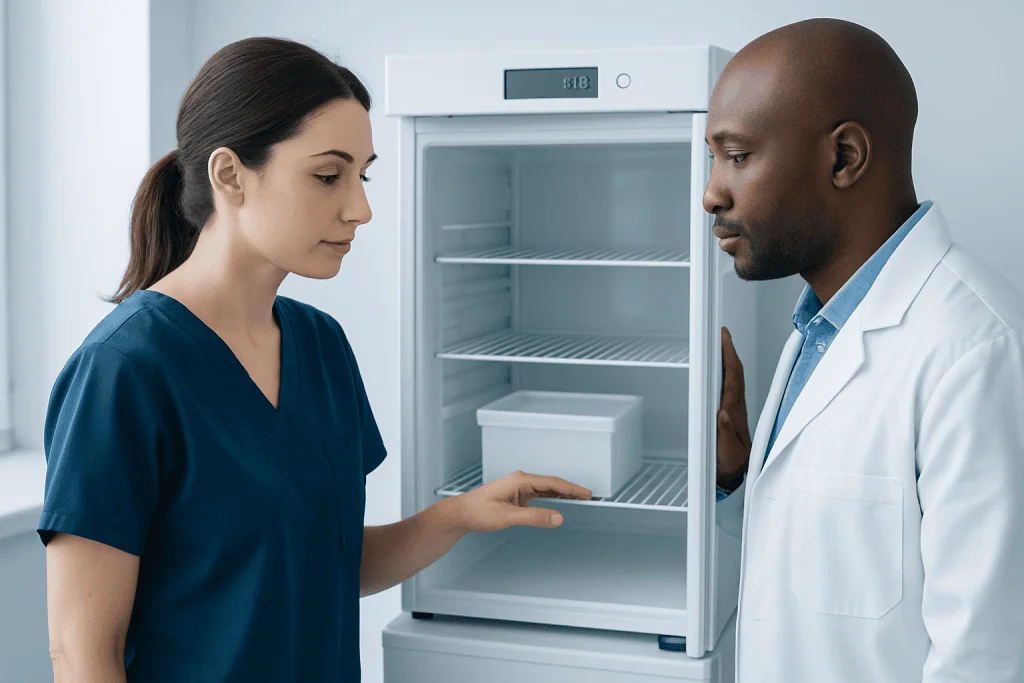
Once you land, do not assume every refrigerator is suitable for medicines. Hotel mini-fridges are built for drinks, not pharmaceuticals: they can fluctuate widely, freeze items placed against the back wall or cooling plate, and in many hotels they switch off entirely when the room key card is removed from its slot. If your medicine has strict requirements, ask before arrival whether a monitored or more reliable refrigerator is available, or how storage can be handled during hospital appointments.
If you do use a room refrigerator, place the medicine in the middle of the cabinet, away from the freezer compartment and the back wall. Keep it in its packaging, ideally inside a sealed container to protect it from spills and condensation. A small thermometer helps you notice obvious problems, though it cannot replace professional judgement: if a medicine has been outside its recommended range, the question of whether it is still usable belongs to a pharmacist or clinician.
During days at the hospital, consultations, imaging, tests, treatment, tell your coordinator or nurse that you are carrying temperature-sensitive medicine. Storage options depend on the medicine, the department and your schedule, and the team can explain what practical arrangements are possible while you wait. Patients managing long-term treatment alongside a procedure abroad may also find our guide to managing chronic conditions during medical travel useful here.
What to do if your medicine gets too warm, too cold, or frozen
If you suspect a temperature problem, do not panic, and do not automatically throw the medicine away unless the manufacturer’s instructions say so. First, separate the affected item from the rest. Note what happened, estimate how long the exposure lasted, and record the highest or lowest temperature if you have a monitor. Keep the packaging, batch number and expiry date to hand.
Then ask before you use it. The right course depends on the specific medicine, the temperature reached, the duration of exposure, and whether the product shows visible changes such as cloudiness or particles. Some medicines tolerate a short excursion; others may not be safe or effective after freezing or prolonged heat. Only a pharmacist, your prescriber, or the clinician responsible for your treatment can weigh those factors for your product. What matters most is not to change or skip doses of an essential medicine on your own judgement, dose decisions belong to your treating doctor, particularly for chronic conditions.
If the exposure happens while you are already in Turkey for care, the same principle applies: keep the item, keep the details, and let the professionals looking after your treatment weigh in before the next dose is due.
Planning for delays, replacements and peace of mind
The most reassuring travel plan carries a backup inside it. If your doctor and local regulations allow, bring more medicine than you strictly expect to need, treatment dates can shift and recoveries can run longer than planned. Where possible, split supplies between two carry-on locations, such as your personal item and a companion’s cabin bag, while keeping everything documented and reachable.
Before you travel, ask your prescriber whether your medicine is available in Turkey and whether the same brand, strength or injection device is commonly supplied. Availability varies, and substitutions should only ever be made with medical guidance. If replacement might be difficult, your doctor may advise bringing a suitable reserve from home.
Finally, share the plan with whoever travels with you. Your companion should know where the medicines are, what temperature range each one needs, and who to reach if a question comes up. A cold chain that lives in two heads is far more resilient than one that lives in yours alone. Handled this way, temperature-sensitive medicines during medical travel to Turkey become a manageable logistics task rather than a source of worry.
Step by step
- Make a complete medication list. Include every medicine you are bringing, temperature-sensitive items, room-temperature medicines, supplements, injections and devices, with dose, schedule, storage range and your prescriber’s contact details.
- Speak with your pharmacist before travel. Confirm exactly how to keep each medicine safe across the full door-to-door journey, and whether cooling packs, insulated cases, thermometers or manufacturer travel containers are recommended for your specific products.
- Request travel documentation. Carry a prescription and a medical letter, preferably in English, stating that the medicines and supplies are for personal use. Keep documents with the medicines in your cabin bag.
- Pack for the longest realistic journey. Add margin for airport arrival, delays, layovers, passport control and transfers in Turkey. Your cooling method should outlast the whole journey, not just the flight.
- Keep medicines in the aircraft cabin. Never place temperature-sensitive medicines in checked luggage. Cabin access means you can respond if plans change or staff need to inspect the bag.
- Arrange storage before you arrive. Ask your hotel or apartment host about refrigeration in advance. If your medicine has strict requirements, do not rely on a mini-fridge without checking how it behaves.
- Tell your care team in Turkey. When attending appointments, let your coordinator or nurse know you are carrying temperature-sensitive medicine so practical storage options can be explained for waiting periods.
- Act methodically if exposure occurs. Record the details, keep the packaging, and ask a pharmacist or clinician before using the medicine. Do not adjust doses or stop essential medicines without professional advice.
Your checklist
- Original medicine packaging with readable labels
- Prescription and English medical letter
- Medicine list with dose, schedule and storage range
- Insulated medication travel case or suitable cooler
- Cooling packs or cooling wallet matched to your medicine
- Barrier material to prevent direct contact with frozen packs, if advised
- Thermometer or temperature indicator, if recommended
- Backup supplies: needles, pens, syringes and a sharps plan if needed
- Airline confirmation for liquids, injectables, cooling packs and cabin baggage
- Contact details for your doctor, pharmacist, hotel and patient coordinator
Key takeaways
- Temperature-sensitive medicines travel in your carry-on bag, with documentation and original packaging.
- Storage rules are product-specific, confirm each one with your pharmacist before you fly.
- Plan cooling for the full door-to-door journey, including delays, transfers and check-in.
- Hotel mini-fridges are not reliable by default; check how yours behaves before trusting it.
- After any suspected exposure, record the details and ask a professional before using the medicine.
- A companion who knows the plan makes the whole cold chain more resilient.
Frequently asked questions
Can I bring temperature-sensitive medicines into Turkey for my own use?
In many cases, yes, personal medicines can travel with you when they are properly documented and clearly intended for personal use. Carry your prescription, a medical letter and the original packaging. Rules differ for controlled or specialised medicines, so check with your airline, doctor, pharmacist or the relevant Turkish consular authority before travel.
Should I put refrigerated medicines in checked luggage?
No. Checked luggage can be exposed to uncontrolled heat and cold, and it can be delayed or lost. Keeping medicines in the cabin protects them and keeps them accessible if your flight is delayed or rerouted.
Will airport security allow gel packs or cooling packs?
Cooling packs used for medicines are commonly accepted when supported by medical documentation, but rules vary by airport and airline. Confirm with your airline and departure airport before travel, keep the packs with the medicines, and present everything clearly in its own tray at screening.
Can I use a hotel mini-fridge for my medicine in Istanbul?
Sometimes, but check first. Mini-fridges can fluctuate, freeze items near the back wall, or switch off when the key card leaves its slot. If your medicine has strict requirements, ask about refrigeration options before arrival and place the medicine in the middle of the cabinet, away from the cooling plate.
What if my medicine freezes during travel?
Freezing can permanently damage some medicines, but the correct next step depends on the specific product. Set it aside, note how long it may have been frozen, keep the batch number and packaging, and ask a pharmacist or clinician before using it or replacing it.
How much extra medicine should I bring for medical travel?
Ask your prescribing doctor what is appropriate for your condition and expected length of stay. Where regulations and your prescription allow, many travellers bring extra supply to cover flight delays, schedule changes or a longer recovery. Keep any extra documented and in original packaging.
What should my medical letter include?
A useful letter states your name, the medical need where appropriate, the medicine names, the supplies you carry such as needles or pens, and the requirement to keep items in the aircraft cabin. It should include the prescriber’s contact details and be written in English if possible. Keep it with your passport and medicines throughout the journey.
Add us as a Preferred Source to see more of our trusted health content across Google Search, AI Overviews and Discover.

Update history
- PublishedJune 16, 2026
- Medical review approvedAugust 30, 2026
- Last content updateAugust 30, 2026
References3
More Patient Guides

Flying With Medication: Airline Rules, Documents and Packing
Every day, travelers hold up security lines worrying about a bag full of tablets that nobody actually wants to confiscate. The rules…

How to Send Your Medical Files Securely Before Treatment in Turkey
Send medical files securely before treatment in Turkey by using approved channels, clear file names and a complete health summary.
Pain Control After Treatment in Turkey: What Patients Should Expect and Ask About
Pain control after treatment in Turkey usually includes a tailored medicine plan, clear warning signs, and follow-up support before you leave Istanbul.

Managing Medicines Across Borders After Treatment in Turkey
Managing medicines across borders after treatment in Turkey means carrying clear documents, checking import rules, and planning refills before you fly.