

Traveling to Turkey with CPAP or Oxygen Support: A Practical Patient Checklist

Most people who use CPAP or oxygen support can travel to Turkey with preparation. Confirm your airline's rules on device carriage, batteries and in-flight use for every flight segment, keep equipment and documents in hand luggage, bring an adapter for Turkey's Type F sockets, and tell your hotel and hospital in advance exactly what support you rely on.
Will the airline let your CPAP on board? Does it count against your cabin bag? Where will you plug it in at the hotel? These are the questions that keep people awake before a trip, and every one of them has a practical answer.
If you use CPAP at night or need oxygen support, traveling to Turkey with CPAP or oxygen support is usually a matter of planning, not a barrier. This guide walks you through the medical conversations, airline rules, packing decisions, power logistics and hospital coordination that make the journey predictable. It covers what applies to almost everyone, and it is honest about the points where only your airline or your treating doctor can give you the final answer.
At a glance
- When to start: Two to four weeks before departure, earlier if you need airline medical clearance for oxygen
- The decisive step: Confirm each airline’s rules on CPAP carriage, batteries, portable oxygen concentrators and in-flight use, for every flight segment
- Key documents: Prescription, device details, a doctor’s travel letter (and fit-to-fly note if advised), contact numbers
- Carry-on rule: Breathing-support equipment and documents travel in hand luggage, never in checked bags
- Power in Turkey: 230V, 50Hz, Type F (European-style) sockets, check voltage compatibility and bring the right adapter
- At the hospital: Share your device model and support routine before arrival so the team can plan your admission and room
Start with a staged plan, not a single worry
Traveling to Turkey with CPAP or oxygen support becomes far more manageable once you stop treating it as one big problem and break it into stages: getting to your departure airport, the flight itself, any layover, arrival in Turkey, the transfer to your hotel, the hospital visit if you are coming for treatment, and the journey home. Each stage has its own question, power access, oxygen arrangements, luggage handling, rest breaks, and each question can be answered before you leave home.
Give yourself more lead time than a standard trip would need. Airlines sometimes request medical forms, equipment suppliers may need to provide battery documentation, and your doctor may want to review your settings before writing a travel letter. None of these steps is difficult, but each one takes days rather than minutes, and stacking them at the last moment is where trips go wrong.
If your journey is built around treatment, the planning load is heavier because you are also managing appointments, records and recovery. A separate guide covers what CPAP users should arrange before flying in more detail; this page covers CPAP and oxygen support together, because the airline and logistics questions overlap heavily.
What to discuss with your doctor before you fly
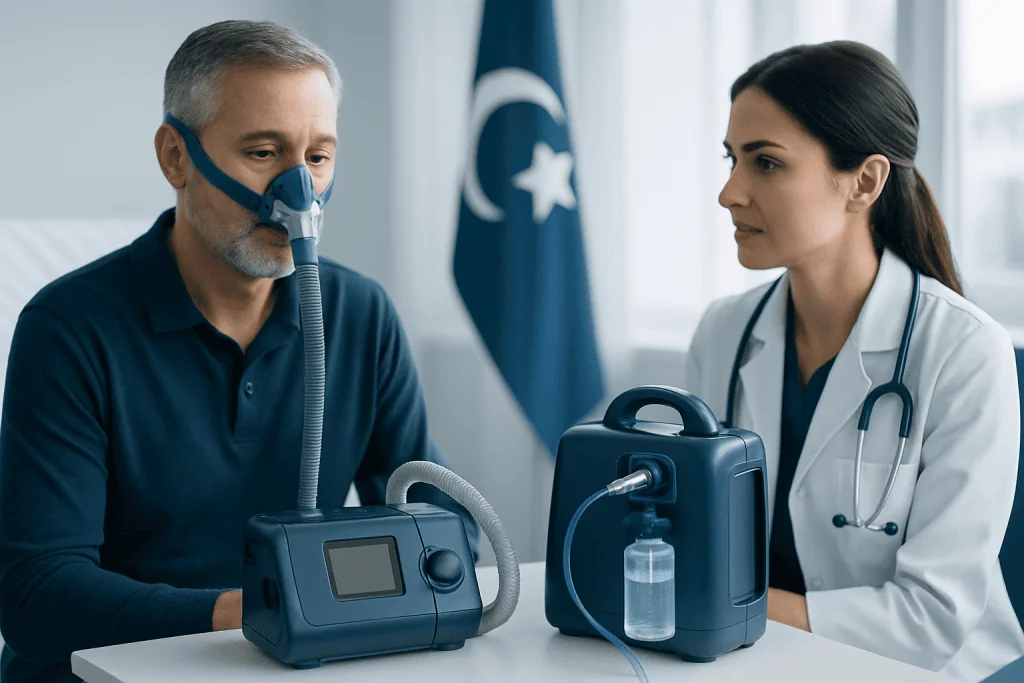
Before you finalise dates, your own doctor is the person who confirms whether you are fit to fly and what support you should use during the journey. If you use CPAP for sleep apnoea, ask whether you need it only overnight or whether naps during long layovers matter too. If you use oxygen, ask about your prescribed flow rate, whether your needs change with walking or exertion, and whether cabin altitude could affect you, aircraft cabins are pressurised to roughly the equivalent of a moderate mountain altitude, and some people who manage well at sea level need supplemental oxygen or an adjusted flow in flight. Only your doctor can say whether that applies to you.
Ask for written details that match your equipment exactly: the device make and model, whether it is portable, whether you use humidification, what accessories you rely on, and battery specifications if relevant. Keeping these details identical across your doctor’s letter, your prescription and any airline forms prevents the small mismatches that cause delays at check-in.
A short medical summary or fit-to-fly note is often useful even when no one formally requires it, because it explains your diagnosis, current treatment and equipment in plain terms that check-in staff, security officers and hospital admissions teams can all read. If you are coming for treatment, this sits naturally alongside the wider medical records you should gather before traveling.
- Ask whether your current CPAP or oxygen settings are safe for air travel
- Request a recent prescription and a travel letter in English if possible
- Clarify whether you need oxygen in flight, at the airport, or only at your destination
- Confirm which medications must stay in your hand luggage, and see the guide on packing and documenting regular prescriptions
Airline rules decide more than anything else
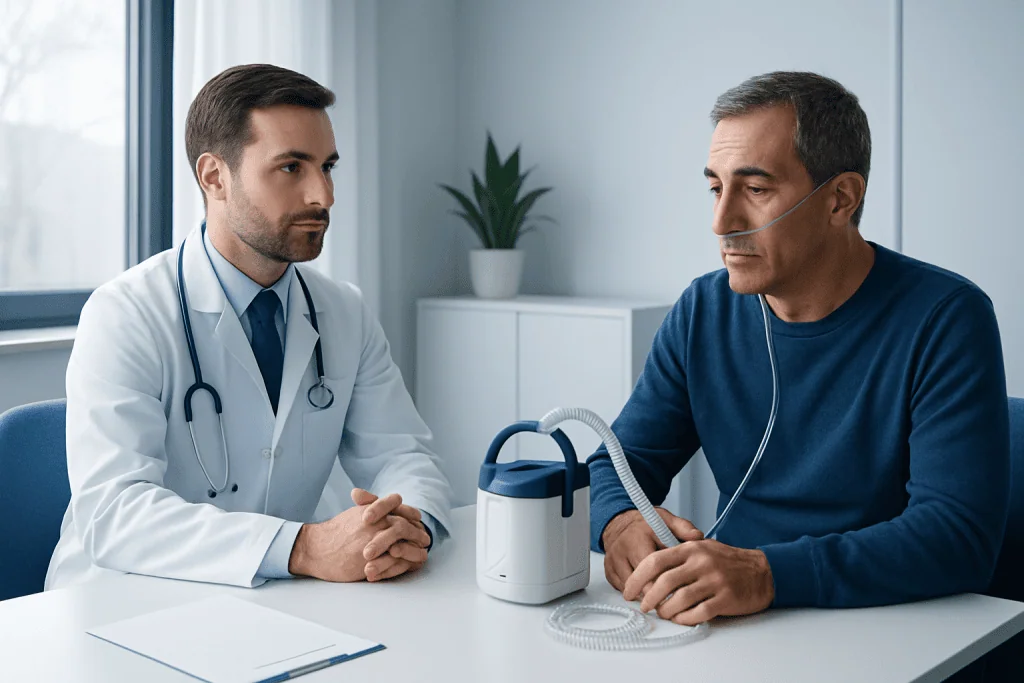
Every airline has its own process for passengers with breathing-support equipment, and the rules are not interchangeable. Many airlines treat a CPAP machine as assistive medical equipment that does not count against your normal cabin allowance, but not all do, and some apply labelling or notification requirements. Never assume; ask.
Oxygen is more restricted. Personal oxygen cylinders are prohibited or tightly limited on most passenger flights. In practice, in-flight oxygen usually means either an airline-approved portable oxygen concentrator (POC) that you bring, or oxygen the airline itself supplies by prior arrangement, where that service exists at all. Both routes typically need medical clearance and paperwork completed well in advance.
After booking, contact the airline’s special assistance or medical desk and ask, in writing where possible:
- Does my CPAP count as an extra item, or does it use my cabin allowance?
- May I use the device during the flight, and does the seat have power? (Assume it does not unless confirmed, seat power can be absent or out of order.)
- Which portable oxygen concentrator models are approved, and what forms does my doctor need to complete?
- What battery reserve is required? Many airlines ask POC users to carry battery capacity covering well beyond the scheduled flight time, commonly around one and a half times the flight duration, to allow for delays.
- Are spare lithium batteries permitted, and how must they be carried? (Spare lithium batteries generally must travel in the cabin with terminals protected, never in checked baggage.)
Ask these questions for every flight segment, including codeshares and any domestic connection inside Turkey, because a partner airline can apply different rules. If you have a layover, check its length honestly against how you move: a tight connection is hard work if you walk slowly, carry equipment or need oxygen. Airport wheelchair or mobility assistance can be booked in advance and often makes the difference between an exhausting transfer and a calm one.
One rule holds everywhere: your machine, prescription, documents and batteries travel in hand luggage. Checked bags get delayed and mishandled; medical equipment stays with you.
Getting through airport security with your device
Security screening with a CPAP or portable concentrator is routine at major airports, including in Turkey, but it goes faster when you know the pattern. Officers will usually ask you to remove the device from its case and place it in a tray for X-ray screening, the same way as a laptop. Some airports swab the machine for trace testing. Neither harms the device.
A few habits make screening smoother:
- Keep the device accessible at the top of your bag rather than buried under clothing
- Empty and dry the humidifier chamber before you leave for the airport, water in the chamber can trigger liquid rules and leaks in transit
- Carry your prescription or doctor’s letter in the same bag, in case an officer asks what the equipment is
- Consider placing the machine in a clear plastic bag inside its case if you are concerned about tray hygiene
In the United States, TSA screens CPAP machines this way as standard; procedures at Turkish and European airports are broadly similar. The letter is rarely demanded, but having it turns a potential conversation into a ten-second glance.
Packing CPAP or oxygen equipment for Turkey
Pack as if you might need to use your equipment unexpectedly, during a delay, in a lounge, or on arrival before your luggage catches up. The table below summarises the core differences.
| CPAP | Portable oxygen concentrator | |
|---|---|---|
| Airline approval | Usually notification only; some airlines want the model details | Almost always needs advance approval and medical forms |
| Where it travels | Cabin, ideally as an extra medical item | Cabin, with required battery reserve |
| Batteries | Optional; useful for flights and power cuts | Essential; spares carried in cabin with terminals protected |
| Core spares | Mask cushion, tubing, filters, power supply | Cannulas, tubing, filters, chargers, operating instructions |
| Water | Humidifier users need suitable water per device instructions | Not applicable for most models |
For CPAP, that means the machine, mask, tubing, power supply, plug adapter, cleaning supplies and the humidifier chamber if you use one. For oxygen, it means the approved concentrator, spare cannulas and tubing, all chargers, and printed operating instructions. Label everything with your name, phone number and your accommodation details in Turkey, keep a paper copy of key documents with the device, and save digital copies on your phone.
A small backup kit in a separate bag, spare mask cushion, tubing connectors, filters, batteries, medication list, protects you if one bag goes astray. If your trip is coordinated through a hospital’s international patient department, sharing your device list before you fly helps staff understand what you are bringing. For everything else that goes in the suitcase, the hospital-stay packing checklist covers the non-equipment side of the same trip.
Power, hotels and sleeping well in Istanbul or beyond
Turkey runs on 230 volts at 50Hz with Type F, European-style two-pin sockets. Most modern CPAP machines and concentrators have dual-voltage power supplies, but check the label on your specific power brick before you leave, and travel with the manufacturer’s own charger rather than a generic substitute. Depending on where you are flying from, you may need only a plug adapter, or, rarely, a voltage converter, which is a different device.
When booking accommodation, a few questions save real discomfort: Is there a power socket within reach of the bed, or should you bring a short extension lead in good condition? Is there a lift, if stairs are hard work? Can they offer a quieter room if broken sleep is a concern? If you use humidification, ask your clinician and your device manual what water is suitable, and plan where you will buy it, distilled water is not stocked in every corner shop, so pharmacies and larger supermarkets are the more reliable option.
If you are arriving for treatment, the first day is usually the most tiring: flight, transfer, check-in, sometimes tests within hours of landing. The arrival day checklist maps that sequence from airport to hospital so you can see where your equipment and rest needs fit.
Coordinating with your hospital in Turkey
Hospitals plan differently for a patient who uses CPAP overnight or needs oxygen during the day, so this information belongs in your pre-arrival file, not in a conversation at the admissions desk. It affects room planning, pre-assessment, anaesthetic review if you are having a procedure, and any monitoring your clinical team wants to arrange. It also matters for sleep apnoea specifically: anaesthetists routinely want to know about CPAP use before sedation or surgery, and patients are often asked to bring their own machine for use during the hospital stay.
A useful pre-arrival summary is short: your diagnosis, your normal support routine, the device make and model, daytime versus night-time needs, any recent change in symptoms, and any concerns about sleep, exertion or transport. Hospitals that regularly receive international patients typically have coordinators whose job includes exactly this kind of detail, interpreting, transfers between airport, hotel and hospital, and passing equipment information to the clinical team. That coordination does not replace your own doctor’s instructions; it makes the hospital side of the trip run to plan.
If a companion travels with you, make sure they also understand how the equipment works and where the documents are kept. It removes a single point of failure on a tiring day.
The journey home deserves the same planning
Return travel is where preparation quietly lapses, especially after treatment. Before discharge, the treating team can tell you whether anything has changed that affects the flight home: oxygen needs, energy levels, medication timing, or updated fit-to-fly advice. A plan made before a procedure does not automatically still fit afterwards, so treat the return leg as its own journey rather than a mirror of the outbound one.
Before leaving the hotel for the airport, do a deliberate sweep of the bedside area, sockets and bathroom shelves. Mask parts, chargers, battery packs, adapters and prescriptions are exactly the small items that vanish when packing happens in a hurry, and the hardest to replace mid-journey.
Step by step
- 1. Speak to your doctor. Confirm fitness to fly and exactly what breathing support you may need during flights, stopovers, sleep and recovery. Ask for a prescription, a brief medical letter in English, and early completion of any airline forms.
- 2. Check every airline’s medical equipment policy. Ask the special assistance team about CPAP carriage, approved portable oxygen concentrators, battery reserve rules and onboard use. Repeat for each segment, including codeshares and domestic connections.
- 3. Prepare documents and device details. Keep printed and digital copies of your prescription, doctor’s letter, passport, itinerary and equipment information, model, battery type, contact numbers, in one folder.
- 4. Pack for reliability, not convenience. Essential equipment travels in hand luggage with key spares, chargers and approved batteries. Bring supplies for the whole stay plus a margin for delays, and dry the humidifier chamber before security.
- 5. Arrange accommodation and ground transport. Choose lift access if needed, bedside power and a calm sleep environment. If you are traveling for care, ask about airport transfer and arrival support when your trip is being coordinated.
- 6. Send the hospital your support summary before arrival. Device model, routine, recent changes, daytime and night-time needs. This lets the team plan admission, room arrangements and any assessment involving sedation or anaesthesia.
- 7. Re-plan the return trip before you fly home. Ask at discharge whether your support needs or travel advice have changed, and whether you need updated documents for the airline.
Your checklist
- Doctor’s letter or fit-to-fly note, if advised
- Current prescription for CPAP, oxygen and medications
- Airline approval or completed medical forms where required
- CPAP machine or approved oxygen equipment in hand luggage
- Chargers, Type F plug adapter, and approved backup batteries with terminals protected
- Mask, tubing, cannulas, filters and spare small parts
- Humidifier chamber emptied and dried for the flight
- Medication list and emergency contact details
- Hospital and accommodation contact numbers in Turkey
- Travel insurance documents, if applicable
Key takeaways
- Traveling to Turkey with CPAP or oxygen support is usually manageable with early, staged planning.
- Airline rules on devices, batteries and onboard use vary by carrier and must be confirmed for every flight segment.
- Oxygen needs more lead time than CPAP: approvals, medical forms and battery reserve requirements are the norm.
- Medical equipment and key documents travel in hand luggage, never in checked baggage.
- Turkey uses 230V Type F sockets, check voltage compatibility and bring the correct adapter.
- Telling your hotel and hospital about your support routine before arrival is what makes the trip run smoothly.
Frequently asked questions
Does a CPAP count as a carry-on for international flights?
Many airlines treat a CPAP as assistive medical equipment that does not count against your standard cabin allowance, but this is airline policy rather than a universal rule. Confirm with each carrier on your itinerary before you fly, and ask whether they want advance notification or device details.
How do you travel internationally with a CPAP machine?
Carry the machine in your hand luggage in its travel case, bring your prescription and a doctor’s letter, empty the humidifier chamber before security, pack a plug adapter for your destination, and confirm the airline’s carriage and in-flight use rules for every segment. Batteries are worth carrying if you plan to use the device on board, since seat power may not be available or working.
How do I get through TSA or airport security with a CPAP machine?
Screening is routine: you will usually be asked to remove the machine from its case for X-ray, the same as a laptop, and it may be swabbed for trace testing. Keeping the device accessible, the humidifier dry, and your prescription in the same bag makes the process quick at US, European and Turkish airports alike.
Is medical tourism safe in Turkey?
Safety is not a property of a country; it depends on the individual hospital, the clinical team, and how well the trip is planned. Sensible steps include checking how a hospital handles international patients, sharing your complete medical history, including CPAP or oxygen use, before travel, and getting your own doctor’s view on fitness to fly and on the planned treatment.
Can I travel to Turkey if I use oxygen support?
Many people can, but oxygen needs more planning than CPAP. Personal oxygen cylinders are restricted on most flights, so in-flight oxygen usually means an airline-approved portable concentrator with the required battery reserve, or airline-supplied oxygen arranged in advance. Your doctor confirms your travel fitness and flow requirements; the airline approves the specific equipment.
Do I need a doctor’s letter for CPAP or oxygen travel?
For oxygen it is often required by the airline; for CPAP it is strongly recommended even when optional. A clear letter stating your condition, device, prescription and travel recommendations helps at check-in, security and hospital admission, and turns questions into quick confirmations.
Will I need a power adapter for my device in Turkey?
Turkey uses 230V, 50Hz Type F sockets, so you may need an adapter depending on where you travel from. Most modern devices have dual-voltage power supplies, but check the label on your specific power supply, and bring the manufacturer’s own charger rather than a generic one.
What if my condition changes after treatment and before my flight home?
Treat the return flight as its own journey. Before departure, your treating team can advise whether your oxygen needs, medication timing or fit-to-fly status have changed and whether the airline needs updated documents. A plan made before a procedure does not automatically still fit afterwards.
Add us as a Preferred Source to see more of our trusted health content across Google Search, AI Overviews and Discover.

Update history
- PublishedJuly 8, 2026
- Medical review approvedSeptember 13, 2026
- Last content updateSeptember 12, 2026
References3
- CDC Yellow Book: Air Travel wwwnc.cdc.gov
- NHS: Sleep apnoea nhs.uk
- MedlinePlus: Traveling with breathing problems medlineplus.gov
More Patient Guides

GHIC and EHIC in Turkey: Why They Do Not Cover You
The blue card that quietly covers you across Europe stops working at the Turkish border, and every summer, travelers discover this…

Do You Need Vaccinations for Turkey?
Here is the answer travel clinics give every day: no vaccinations are required to enter Turkey from anywhere in the normal course…

Flying With a Broken Leg or Cast: Airline Rules and Comfort
A broken leg does not cancel a flight, airlines carry passengers in casts every single day. What surprises travelers is that…

Travel Insurance After Cancer: What Patients Should Know
A cancer diagnosis changes how insurers read your name, but it does not end your traveling life. Thousands of people with…