

Using Translation Apps Safely During Medical Visits in Turkey

Translation apps are useful for everyday logistics during medical travel, directions, appointment desks, transport, shopping. They are not reliable enough for diagnosis, consent, medication instructions or discharge planning. For those conversations, use a professional interpreter and ask for the key points in writing. Keep sensitive documents and ID numbers out of public apps, and prepare a few offline phrases before you arrive.
Somewhere on your packing list for treatment in Turkey sits a quiet worry: what happens when someone speaks to you and you do not understand a word? Most people reach for a translation app, and that instinct is sound. Apps genuinely help with everyday questions, directions and quick reminders during medical travel.
The key is knowing the app’s job. It is a convenience tool, not a clinical one. Using translation apps safely during medical visits in Turkey means drawing a clear line: apps for logistics, professional interpreters for anything that touches your diagnosis, your medicines or your consent. This guide shows you where that line sits and how to stay on the right side of it.
At a glance
- Best use: Simple, non-urgent phrases and everyday logistics, directions, desks, transport, shops
- Do not rely on apps for: Consent forms, diagnosis discussions, medication instructions or urgent situations
- Safer option: A qualified interpreter for any conversation involving decisions or risk
- Privacy rule: Keep full names, ID numbers, reports and prescriptions out of public apps
- Helpful habit: Get important points in writing and repeat them back before you leave the room
- Prepare: Offline language packs, saved key phrases, a charged phone and a power bank
What translation apps do well during medical travel
When you travel to Turkey for healthcare, a translation app makes dozens of small moments easier. You can ask where the lift is, confirm an appointment time at a reception desk, read a sign in a corridor, order food that fits your diet, or understand a driver on the way to the hospital. If you use taxis often, it pairs naturally with the tips in our guide to taxis and ride-hailing apps for hospital visits in Turkey.
These small interactions matter more than they look. Each one you handle yourself reduces stress and helps you feel independent between formal appointments. Turkish uses the Latin alphabet, so camera translation of signs and menus tends to work reasonably well, and major apps support Turkish in both text and voice modes. Hospital wayfinding signage in large Turkish hospitals is often bilingual, which lowers the pressure further.
Apps also help you prepare. Before a consultation, you can draft your questions in your own language, translate them into English or Turkish, and check that the translation reads sensibly. Arriving with a written list of topics is useful regardless of language: it keeps a short appointment focused on what matters to you.
Where apps reach their limits
Medical conversations are a different category. Symptoms, allergies, consent forms, dosing schedules and follow-up plans carry details that an app may translate too literally, too vaguely, or not at all. Medical vocabulary is precise in ways general translation engines are not built for: a phrase such as “before meals” versus “after meals”, or “as needed” versus “on a fixed schedule”, changes what you actually do with a medicine. A small mistranslation there creates unnecessary risk.
There are structural reasons for this, not just occasional glitches. Apps translate words, not clinical intent. They cannot ask a clarifying question when a sentence is ambiguous. They do not know that a drug brand name in your country maps to a different name in Turkey. They cannot read tone, hesitation or the moment when you have stopped following the explanation. A human interpreter does all of these things as a matter of routine.
Voice translation adds its own failure points: background noise in a busy clinic, medical terms the speech engine has never heard, accents, and the simple fact that people talk over each other in real conversations. Camera translation of a dense medical report often produces text that looks fluent but quietly drops or distorts key values. That is why using translation apps safely during medical visits in Turkey means treating them as a backup channel, never the main one.
Use professional interpreters for decisions and consent

For any conversation involving diagnosis, treatment options, risks, benefits, consent, discharge instructions or medication changes, ask for a professional interpreter. This matters most when you are tired, anxious, in pain or absorbing complex information, exactly the moments when typing into a phone is hardest. A trained medical interpreter understands clinical context and helps both you and the care team confirm meaning in both directions, which is the part an app cannot do.
Hospitals that regularly treat international patients, including Acibadem, generally plan interpreter support around consultations, admission and discharge when they know your language needs in advance. The practical step on your side is simple: make your preferred language for medical discussions known when your visit is being arranged, rather than on the day.
Do not feel awkward asking a doctor or nurse to pause while an interpreter joins. Needing language support is normal for international patients, and clear communication is part of safe care, not an inconvenience to it. A phrase worth memorising: “I would like an interpreter before I decide.”
What about family? A relative who speaks some Turkish or English can offer comfort and handle everyday communication, but interpreting a consent discussion is a specialised task, and household fluency rarely covers medical vocabulary. We compare the two roles in detail in medical interpreter or family member: who should help during appointments in Turkey. Apps still have a supporting role in these meetings, use one to prepare your list of topics, but let a qualified person carry the actual discussion.
Protect your privacy when using apps
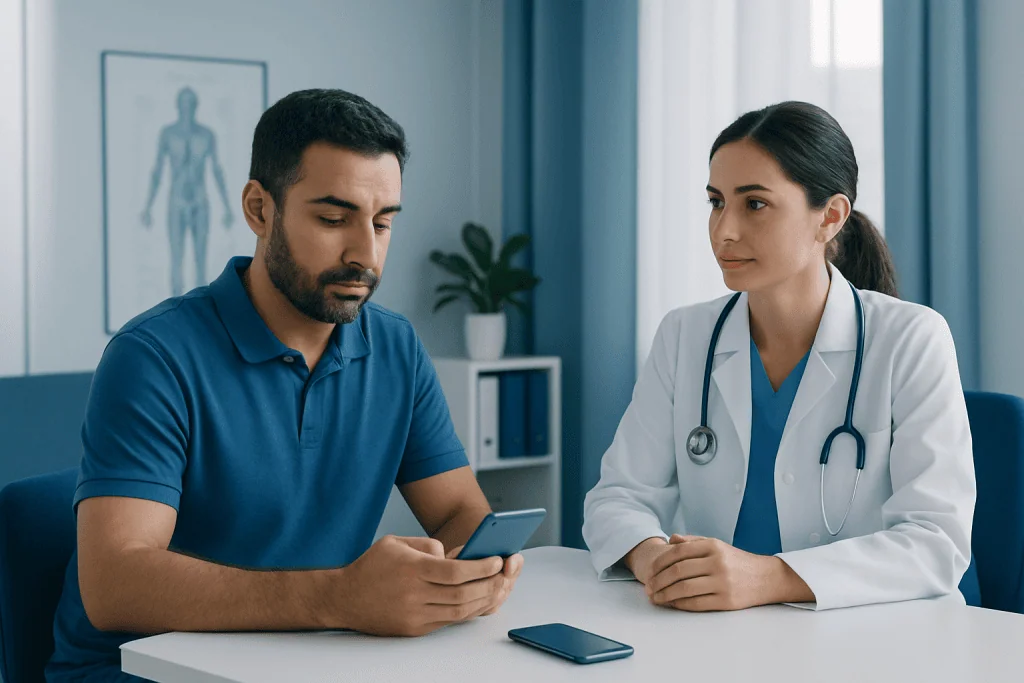
Most translation apps send your text, voice or images to cloud servers for processing. That is what makes them fast and accurate, but it also means you rarely know exactly how the data is stored, for how long, or whether it trains future models. Medical information is among the most sensitive data you carry, so treat the app’s text box the way you would treat a postcard: fine for general phrases, wrong for anything identifying.
A workable rule: never enter full names, passport numbers, national ID numbers, hospital file numbers, complete reports, imaging results or diagnosis documents into a public translation app. If a document needs translating properly, that is a job for professional document translation, see our guide to medical report translation for treatment in Turkey for how that works and why certified translation matters for clinical records.
You can also shrink the risk by shrinking the input. Type “I need help finding the pharmacy” rather than photographing a full prescription page. If you use voice translation in a waiting area, step aside and keep the volume low so strangers do not hear personal details.
- Do not photograph confidential documents into an app unless your care team has advised it.
- Use a phone lock, and never leave your device unattended in waiting areas.
- Delete screenshots and voice recordings that captured sensitive information once they have served their purpose.
- Prefer offline translation mode for simple phrases, offline processing keeps the text on your device.
- Keep original documents organised and secure separately from your phone; our guide on keeping your medical records organised during treatment in Turkey covers a practical system.
Prepare key phrases before your appointment
Before you arrive at the hospital, build a small set of phrases in your language and Turkish (or your language and English, since English is widely used in international patient settings). This is your safety net if you lose internet access, feel rushed, or need help quickly. Keep every phrase short and unambiguous.
Phrases worth preparing:
- I need an interpreter.Tercüman istiyorum.
- I have an appointment.Randevum var.
- I have an allergy.Alerjim var.
- I do not understand.Anlamıyorum.
- Please write this down.Lütfen bunu yazar mısınız?
- I need to call my patient coordinator.
Save these three ways: as a note on your phone, as a screenshot in your photo gallery (screenshots open without any signal), and on a printed card in your document folder. Alongside them, keep your name, appointment time, department and the hospital address ready to show. A written allergy list and a list of your current medicines, prepared before travel, does more for clarity than any live translation: the guide on keeping your regular medicines on schedule during medical travel explains how to document them well.
Confirm medication and discharge instructions carefully
Medication instructions are the single most important area to confirm with a human professional rather than an app. Drug names, dosages, timing, food instructions and interactions are precisely the kind of dense, high-stakes text that machine translation handles worst. Brand names also differ between countries, so a literal translation of a label may point you at the wrong product entirely.
Before leaving the hospital or clinic, ask for your medication plan and discharge instructions in writing whenever possible. Then have the nurse, pharmacist, doctor or interpreter walk through the key points with you. Use the repeat-back habit: “I take this twice a day, after meals, for seven days, is that correct?” Saying the plan aloud in your own words catches misunderstandings while the person who can fix them is still in the room.
If you use a translation app to organise your own notes afterwards, keep those notes clearly separate from the official written instructions unless a professional has checked them. Never adjust dose timing, stop a medicine or combine medicines based on an app’s translation, decisions about your medication belong with your treating doctor. If a translated phrase leaves you unsure what a written instruction means, treat that uncertainty as a question for a professional, not a puzzle to solve with a second app.
Plan for internet, battery and stressful moments
An app is only useful if your phone is charged, connected and easy to reach. Before a hospital day: charge the device fully, carry a power bank, and download the offline language pack for Turkish if your app offers one. Offline packs are less accurate than online translation but they work in basements, lifts and imaging areas where signal drops. Sort your connectivity before you land: our guide to eSIMs and mobile data in Turkey during medical travel covers the options, and save key phone numbers, appointment details and the hospital address somewhere you can open without internet.
Plan for stress, too. If you are arriving for surgery, tests or a sensitive consultation, you do not want your communication strategy to depend on typing accurately into a phone at the worst possible moment. Find out in advance how interpretation will be arranged for your visit and where you should go on arrival, so the app stays in reserve rather than on the front line.
If a companion travels with you, agree a simple division of labour before the appointment: who holds the documents, who asks for the interpreter, who takes notes. Three clear roles beat three people all reaching for their phones. It keeps your attention on the appointment rather than the technology.
Knowing when an app is not the right tool
Some moments call for putting the phone down. In any genuinely urgent situation, speed and human contact matter more than a polished translation, hospital staff are trained to respond without a shared language, and simple words, gestures or a single saved phrase communicate faster than live typing. Trying to perfect a sentence in an app during an urgent moment costs time you do not need to spend.
Outside emergencies, there are quieter signals that the app has reached its limit: a translation that reads strangely, staff who look unsure about what your phone is showing them, a form you are being asked to sign that you do not fully understand, or any conversation that has moved on to risks and alternatives. In each of these cases, the safe move is the same, pause the process and say that you need language assistance before continuing. No reasonable clinician objects to that pause.
Your role as a patient is not to manage medical translation alone. Your role is to notice when clarity has dropped and to say so. Asking for help early is a practical safety step, not an imposition.
Step by step
- Choose one or two apps before you travel. Install and test them at home. Try typing, voice mode, camera mode and offline mode with Turkish, so you know what actually works on your phone before you need it.
- Save essential phrases offline. Prepare phrases such as “I need an interpreter”, “I have an allergy” and “please write this down”. Save them as screenshots and notes so they open without mobile data.
- Arrange language support in advance. Make your preferred language for medical discussions known while your visit is being planned. Interpreter support for consultations, admission and discharge works best when it is scheduled, not improvised.
- Use apps mainly for simple logistics. Directions, reception desks, transport, hotels and everyday requests are the app’s territory. Symptoms, consent, treatment decisions and medication instructions are not.
- Ask for written confirmation. After important conversations, request written notes: appointment times, medication plans, follow-up steps. Written points can be reviewed calmly later with your interpreter or family.
- Protect sensitive information. Keep full reports, ID documents and prescription pages out of public translation apps. Use short general phrases and route document translation through professional channels.
- Repeat back what you understood. For any important instruction, say the plan back in your own words and ask whether it is correct. This one habit catches most misunderstandings before you leave the building.
Your checklist
- Phone charged, charger and power bank packed for hospital days
- Offline Turkish language pack downloaded and tested
- Preferred language for medical discussions communicated in advance
- Key phrases saved as notes, screenshots and a printed card
- Allergy list and current medications written clearly before travel
- Hospital address and contact numbers saved offline
- Notebook or notes app ready for appointment questions
- Medication and discharge instructions confirmed in writing
- Sensitive documents kept out of public translation apps
Key takeaways
- Translation apps are genuinely useful for travel and hospital logistics, but they are not a substitute for professional medical interpretation.
- Ask for an interpreter for diagnosis, consent, medication instructions, discharge planning and any conversation involving risk.
- Protect your privacy: keep full reports, ID numbers and identifying details out of public apps, and use offline mode for simple phrases.
- Prepare saved phrases, offline language packs and battery backup before appointment days so stress cannot take the tool away from you.
- Get important instructions in writing, and repeat back what you understood before leaving the room.
Frequently asked questions
Can I use a translation app during my doctor consultation in Turkey?
You can use it as a support tool, for example, to show a prepared list of questions, but it should not replace a professional interpreter for the discussion itself. Any conversation involving diagnosis, treatment options, risks, consent or medication instructions deserves human interpretation, because an app cannot ask clarifying questions or confirm that both sides understood the same thing.
Will Acibadem provide language support?
Acibadem’s international patient coordination services can include interpreter assistance, appointment guidance and practical hospital navigation. Arrangements depend on timing, department and the language involved, so it helps for your preferred language to be known while your visit is being planned rather than on the day of the appointment.
Is it safe to translate my medical reports with an app?
Be cautious. Most apps process text and images through external servers, so uploading full reports raises privacy concerns, and camera translation of dense clinical text can quietly drop or distort important values. Reports, prescriptions and official documents are better handled through professional medical document translation.
What should I do if an app translation does not make sense?
Stop and ask for clarification rather than guessing. Show the confusing phrase to the interpreter, nurse or doctor and say plainly that you are not sure you understood. It is always acceptable to pause before signing a form, taking a medicine or agreeing to a plan until the meaning is clear.
Can my family member interpret for me instead of an app?
A family member can help with everyday communication and provide real comfort, but medical interpretation is a specialised task. Household fluency rarely covers medical vocabulary, and important terms about risks and instructions must be conveyed precisely. A professional interpreter is safer for clinical discussions; your companion can still take notes and help you remember questions.
Which phrases should I prepare before going to the hospital?
Short, direct ones: “I need an interpreter”, “I have an allergy”, “I do not understand”, “please write this down” and “I need to contact my patient coordinator”. Also keep your name, appointment time, department and hospital address easy to show. Saved phrases are more reliable than live typing under stress.
Should I use voice translation in waiting areas?
Use it discreetly, because other people can hear both sides of the conversation. If the topic involves symptoms, medicines or personal details, move to a quieter spot or ask staff for assistance instead. Keep your phone locked, and delete any recordings or screenshots that captured private information.
Do translation apps work without internet in Turkey?
Many major apps offer downloadable offline packs for Turkish. Offline translation is less accurate than the online version, but it works in lifts, basements and imaging areas where signal drops. Download and test the pack before your hospital day, and treat offline mode as a fallback for simple phrases rather than a tool for detailed conversation.
Add us as a Preferred Source to see more of our trusted health content across Google Search, AI Overviews and Discover.

Update history
- PublishedJune 22, 2026
- Medical review approvedSeptember 13, 2026
- Last content updateSeptember 12, 2026
References1
- CDC Travelers' Health: Getting Health Care Abroad wwwnc.cdc.gov
More Patient Guides

When a Hospital Stay in Turkey Becomes Longer Than Planned: What to Arrange
If your hospital stay in Turkey is longer than planned, arrange medical updates, accommodation, travel changes, insurance and support for your companion.

Waiting for Test Results in Turkey: How to Use Time Between Appointments
Waiting for test results in Turkey is easier with a clear plan for appointments, rest, records, questions and support in Istanbul.

Unexpected ICU Stay in Turkey: What Patients and Families Should Expect
Unexpected ICU stay in Turkey: learn what patients and families can expect, from communication and visiting to care updates and travel support.

How to Manage Special Diets During Medical Travel in Turkey
Special diets during medical travel in Turkey are easier to manage when you share your needs early, confirm meals and carry safe…