Bobath Neurodevelopmental Treatment
Bobath Neurodevelopmental Treatment is a rehabilitation approach in which physical, occupational, and speech therapists use guided handling, positioning, and task practice to improve posture and movement in people with cerebral palsy, stroke,…
Quick answer
Bobath Neurodevelopmental Treatment is a hands-on rehabilitation approach in which trained therapists guide posture and movement through touch, positioning, and functional tasks. It is used mainly for cerebral palsy, stroke, and brain injury. Sessions are outpatient and low-risk; evidence shows it can improve function, though not clearly more than other active therapies.
What is Bobath Neurodevelopmental Treatment?
Bobath Neurodevelopmental Treatment (often shortened to NDT or the Bobath concept) is a hands-on rehabilitation approach used by physical therapists, occupational therapists, and speech-language pathologists to help people whose movement has been affected by damage to the brain or spinal cord. It was developed in the mid-twentieth century by Berta Bobath, a physiotherapist, and her husband Karel Bobath, a physician, and it has continued to evolve as knowledge about the nervous system has grown.
The central idea is that the brain can reorganize itself after injury, a property called neuroplasticity. Therapists trained in the Bobath approach use guided touch, positioning, and carefully chosen activities to help a person experience more efficient movement patterns and to reduce unhelpful patterns such as excessive muscle stiffness (spasticity) or poor trunk control. Rather than exercising one muscle at a time, the therapist looks at how the whole body organizes itself to sit, stand, reach, or walk.
Bobath neurodevelopmental treatment is most commonly used for:
- Cerebral palsy in infants, children, and adults. Cerebral palsy is a group of lifelong conditions affecting movement and posture that result from injury to the developing brain.
- Stroke, when a blocked or burst blood vessel interrupts blood flow to part of the brain and leaves weakness or paralysis on one side of the body (hemiparesis or hemiplegia).
- Traumatic brain injury and other acquired brain injuries.
- Some other neurological conditions that affect posture and coordination, when a rehabilitation team judges that the approach may help.
It is a therapy, not a surgery or a medication, and it is usually delivered as part of a broader rehabilitation program in a department such as Physical Medicine & Rehabilitation.
Who is a candidate
People often ask who needs Bobath neurodevelopmental treatment. In general, it may be considered for anyone whose ability to control posture and movement has been changed by a central nervous system injury and who is able to take part, actively or passively, in guided therapy sessions. Typical candidates include:
- Infants and children with cerebral palsy or with delayed motor development linked to a brain injury around birth.
- Adults recovering from a stroke who have weakness, poor balance, or difficulty using an arm or leg.
- People with traumatic brain injury who have movement or coordination problems.
- Individuals who need help with everyday tasks such as rolling, sitting, transferring from bed to chair, standing, or walking.
There are situations where the approach is not suitable, or where it should be delayed or adapted:
- Medically unstable patients, for example in the very early hours after a stroke before the medical team has confirmed it is safe to begin mobilization.
- People with unhealed fractures, severe uncontrolled pain, or acute joint inflammation that would be worsened by handling and weight-bearing.
- Conditions in which the movement problem is caused mainly by the muscles or peripheral nerves rather than the brain or spinal cord; other therapy approaches may then be more appropriate.
- Situations where a person or family prefers a different, well-established approach. Bobath is one of several accepted rehabilitation methods, and your treating team may combine it with other techniques.
A rehabilitation physician (a doctor who specializes in restoring function after illness or injury) and a therapist usually assess each person individually before recommending a plan.
How the procedure works
The term bobath neurodevelopmental treatment procedure can be misleading, because there is no single operation or fixed protocol. Instead, treatment is a series of therapy sessions built around the person’s own goals. The following description explains what commonly happens.
Before treatment begins
- The therapist takes a detailed history and asks about daily activities that are difficult, such as dressing, eating, playing, or walking to the bathroom.
- A movement assessment is carried out. The therapist watches how the person moves, feels how the muscles respond to gentle handling, and notes areas of stiffness, weakness, or poor alignment.
- Realistic, functional goals are agreed with the patient or, for children, with the parents or caregivers.
During a session
- Sessions are usually one-to-one and typically last around 45 to 60 minutes, although this varies with the age, stamina, and needs of the person.
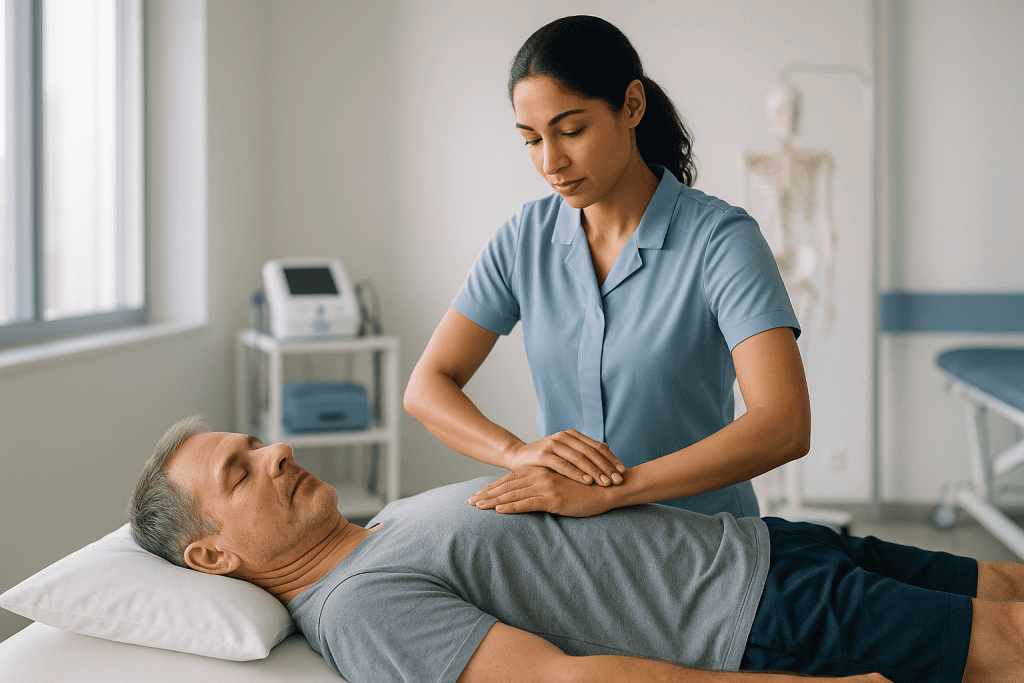
- The therapist uses their hands at specific points on the body, often the trunk, pelvis, shoulder girdle, or limbs, to guide movement. This is called facilitation. The aim is to help the person feel and produce a more balanced, efficient movement.
- The therapist may also use positioning, therapy balls, benches, wedges, or mirrors to support posture and give sensory feedback.
- Movements are practiced in meaningful tasks, for example reaching for a cup, moving from sitting to standing, or taking a step. For children, therapy is often built into play.
- As control improves, the therapist gradually reduces hands-on support so that the person is doing more of the work independently.
After a session
- The therapist usually explains what was practiced and may give a home program: simple positioning ideas, activities, or handling tips for family members and caregivers.
- Progress is reviewed regularly and goals are updated.
- Bobath therapy is often combined with other treatments in the rehabilitation plan, such as strengthening exercises, task-specific practice, splints or orthoses (supportive braces), and, when a doctor considers it appropriate, medications or injections to reduce spasticity.
Preparation for Bobath neurodevelopmental treatment
No special medical preparation is usually needed, but a few practical steps make sessions safer and more useful:
- Wear loose, comfortable clothing and flat, supportive footwear that allows the therapist to see and guide movement.
- Bring any walking aids, splints, orthoses, or wheelchairs you normally use so the therapist can assess how they fit into your movement.
- Bring a current list of medications and recent medical reports, including imaging results if available.
- For children, schedule sessions at a time when they are rested and fed, and bring a familiar toy or comfort item.
- Tell the therapist about any pain, recent falls, seizures, skin problems, or changes in your general health before the session starts.
- Think about the everyday activities that matter most to you, because these will shape the goals of treatment.
Recovery and aftercare
When people search for bobath neurodevelopmental treatment recovery time, they are often thinking of recovery from a surgery. Bobath therapy is different: there is usually no recovery period from the treatment itself, and most people can return to normal daily activities immediately after a session. Some mild tiredness or muscle soreness may occur, especially early on or after working on new movements.
The more meaningful question is how long it takes to see functional change, and here the timeline depends heavily on the underlying condition:
- After a stroke, the most rapid improvement typically occurs in the first weeks and months, and rehabilitation is often most intensive during this period. Many patients continue to make slower gains for a year or more.
- For children with cerebral palsy, therapy is often ongoing throughout childhood, with the focus shifting as the child grows, changes size, and takes on new activities such as school and sports.
- Following traumatic brain injury, progress can be uneven and may continue over many months.
Aftercare between sessions matters. Therapists commonly recommend:
- Practicing the home program daily in short, manageable blocks rather than in long, exhausting sessions.
- Using the positioning advice given for sitting, lying, and carrying (for children) to support good alignment throughout the day.
- Wearing prescribed splints or orthoses as instructed and checking the skin for redness or pressure marks.
- Keeping a simple log of activities and any difficulties to discuss at the next appointment.
- Attending regular reviews with the rehabilitation team so the plan can be adjusted.
Risks and side effects
Any discussion of bobath neurodevelopmental treatment risks and benefits should start by noting that this is a low-risk, non-invasive therapy. Serious complications are uncommon. Possible side effects and risks include:
- Muscle soreness or fatigue after sessions, particularly when new movements are practiced.
- Temporary discomfort during stretching or weight-bearing on a stiff limb; the therapist should adjust the intensity if you report pain.
- Falls during balance or walking practice. Therapists reduce this risk with close supervision and appropriate equipment, but it cannot be eliminated entirely.
- Skin irritation or pressure marks from splints, orthoses, or prolonged positioning.
- Frustration or emotional fatigue, since progress can be slow and effortful. Children may become upset if sessions are too long or too demanding.
- Opportunity cost: if therapy time is devoted only to one approach, other evidence-based strategies might be underused. Most modern rehabilitation teams address this by blending approaches.
Because the approach depends on skilled handling, the quality of treatment relies heavily on the training and experience of the therapist. Certification courses in the Bobath concept exist for pediatric and adult practice.
Results and outlook
The Bobath concept has been widely used for decades, and many patients and families report that it helps them move more comfortably and take part in daily life. At the same time, it is important to be honest about the research. Systematic reviews of clinical studies have generally found that Bobath neurodevelopmental treatment produces improvements in function, but that it has not been shown to be clearly superior to other active rehabilitation approaches such as task-specific training, strength training, or constraint-induced movement therapy. Some reviews have found that certain other approaches show stronger evidence for particular outcomes, especially in cerebral palsy.
For this reason, current practice in many rehabilitation centers is to use Bobath principles as one component of an individualized program rather than as the only method. Factors that generally influence outcomes include:
- The type, location, and severity of the brain injury.
- The time since injury and how early rehabilitation began.
- The intensity and frequency of therapy and how consistently home activities are carried out.
- The person’s age, general health, motivation, and support from family or caregivers.
- Other problems such as pain, seizures, vision loss, or cognitive difficulties that can affect participation.
Bobath therapy does not cure cerebral palsy, stroke, or brain injury. Its realistic aim is to help each person use the abilities they have as fully and efficiently as possible, to reduce secondary problems such as contractures (permanent tightening of muscles and joints), and to support independence and participation in everyday life.
Cost considerations
Because Bobath neurodevelopmental treatment is a course of therapy rather than a single procedure, the total cost depends mainly on how much therapy is delivered and in what setting. Factors that commonly influence cost include:
- The number and length of sessions, and whether they are delivered weekly for months or as an intensive block.
- Whether therapy is provided as an outpatient, in a day rehabilitation program, or as part of an inpatient rehabilitation stay, which adds accommodation and nursing costs.
- The involvement of more than one discipline, for example physical therapy, occupational therapy, and speech therapy together.
- Equipment prescribed alongside therapy, such as orthoses, seating systems, standing frames, or walking aids.
- Initial specialist assessments and follow-up reviews with a rehabilitation physician.
- Insurance coverage and referral requirements, which vary widely between countries and plans.
Asking the rehabilitation team for a written outline of the proposed program can help you understand what is included before treatment begins.
Frequently asked questions
What is Bobath neurodevelopmental treatment used for?
It is mainly used to help people with movement and posture problems caused by injury to the brain or spinal cord. The most common conditions are cerebral palsy in children and stroke or traumatic brain injury in adults. A therapist uses hands-on guidance and functional activities to help the person move more efficiently and take part in daily tasks.
What does the Bobath neurodevelopmental treatment procedure involve?
There is no operation involved. Treatment consists of therapy sessions in which a trained therapist assesses how you move, then uses specific handling, positioning, and practice of meaningful tasks to guide better movement patterns. Sessions typically last about 45 to 60 minutes and are usually repeated over weeks or months, with a home program in between.
How long is the Bobath neurodevelopmental treatment recovery time?
There is generally no recovery period from the therapy itself; most people resume normal activities right away, perhaps with mild tiredness. Functional improvement, however, takes time and depends on the condition. After a stroke, gains are often fastest in the first months, while children with cerebral palsy may continue therapy over many years as their needs change.
What are the main Bobath neurodevelopmental treatment risks and benefits?
The benefits many patients report include improved posture, balance, and ease of everyday movement, along with practical advice for caregivers. Risks are usually minor and include muscle soreness, fatigue, occasional discomfort during stretching, and a small risk of falls during balance practice. Serious complications are uncommon when therapy is delivered by trained professionals.
Who needs Bobath neurodevelopmental treatment rather than other therapy?
No single group must have Bobath therapy specifically. It is one of several recognized approaches for neurological rehabilitation, and research has not shown it to be clearly better than other active methods. A rehabilitation team may recommend it, often combined with other techniques, based on your goals, your condition, and the skills of the therapists available.
Is Bobath therapy suitable for babies and young children?
Yes, it is frequently used in pediatric rehabilitation, including for infants with cerebral palsy or delayed motor development. Sessions are adapted to the child’s age and built around play. Parents and caregivers are usually taught positioning and handling strategies to use at home, because much of the benefit comes from consistent daily practice.
Does Bobath treatment cure cerebral palsy or stroke?
No. Neither cerebral palsy nor the brain damage caused by a stroke can be cured by therapy. The aim of Bobath treatment is to help a person make the best possible use of their abilities, reduce secondary complications such as joint tightness, and improve independence and quality of life within the limits of their condition.
When to see a doctor
You should be assessed by a rehabilitation physician, neurologist, or pediatrician if you or your child has:
- New or worsening weakness, stiffness, or loss of coordination in an arm, leg, or one side of the body.
- Delays in reaching motor milestones in infancy, such as rolling, sitting, or walking, or persistent asymmetry in how a baby moves or uses the hands.
- Increasing difficulty with daily tasks such as dressing, walking, or transferring after a stroke or brain injury, even after initial recovery.
- Pain, joint tightness, or changes in posture that are interfering with sitting, sleeping, or mobility.
During a course of Bobath neurodevelopmental treatment, contact your doctor or therapist promptly if you notice increasing pain, new skin breakdown or pressure sores under splints, repeated falls, or a sudden loss of function that was previously present. Seek emergency care immediately for signs of a new stroke, such as sudden facial drooping, arm weakness, slurred speech, sudden severe headache, or sudden confusion, and for a first seizure or any seizure that lasts longer than a few minutes or is followed by prolonged unresponsiveness. Sudden high fever, breathing difficulty, or a head injury with vomiting or drowsiness also require urgent medical attention.
Preparation
- Wear loose, comfortable clothing and supportive flat shoes, and bring any splints, orthoses, or walking aids you normally use. Bring a list of current medications and recent medical reports. Tell the therapist about pain, recent falls, seizures, or health changes before the session. For children, schedule sessions when they are rested and fed.
Aftercare
- Most people can return to normal activities immediately after a session, though mild soreness or tiredness may occur. Practice the home program daily in short blocks and follow positioning advice throughout the day. Wear prescribed splints as instructed and check the skin for pressure marks. Attend regular reviews so the rehabilitation team can adjust goals.
Medically reviewed by the Acıbadem International Medical Board September 13, 2026
See our medical review board →
Update history
- PublishedSeptember 13, 2026
- Medical review approvedSeptember 13, 2026
- Last content updateSeptember 13, 2026
References3
From the Acibadem Blog

Inside a Bobath Treatment Session: Guided Handling, Positioning and Task Practice
A Bobath therapy session is a hands-on neurological rehabilitation appointment, usually with a physiotherapist or occupational therapist, in which the therapist guides your movement,…