Coronary Angiogram and Angiography — Explained by Medical Evidence, Not Myths

A coronary angiogram is the imaging result; coronary angiography is the procedure used to produce it. The test uses a thin catheter, contrast dye, and X-ray imaging to look for narrowing or blockages in the heart’s arteries.
Key Takeaways
- A coronary angiogram is the imaging result; coronary angiography is the procedure used to produce it.
- The test uses a thin catheter, contrast dye, and X-ray imaging to look for narrowing or blockages in the heart’s arteries.
- It is often recommended for chest pain, abnormal cardiac test results, suspected coronary artery disease, or during an emergency such as a heart attack.
- Most people are awake during the procedure, and recovery is usually short unless another treatment is done at the same time.
- Possible risks exist but are uncommon when the test is performed by experienced teams with appropriate monitoring.
Coronary angiogram and angiography are tests that let doctors see how blood flows through the heart’s arteries. They help confirm or rule out narrowed or blocked coronary arteries and guide the next steps, which may include medicines, lifestyle changes, or procedures.
Overview: what coronary angiogram and angiography mean
Coronary angiogram and angiography are closely related terms that are often used interchangeably, but they are not exactly the same. Coronary angiography is the medical procedure in which a doctor guides a thin tube called a catheter through a blood vessel and injects contrast dye while taking X-ray images. A coronary angiogram is the set of images that shows whether the coronary arteries, which supply blood to the heart muscle, are open, narrowed, or blocked.
This test is considered one of the most direct ways to evaluate the heart’s blood vessels. It can help explain symptoms such as chest pressure, shortness of breath with exertion, or signs of reduced blood flow on other tests. It may also be used urgently when a heart attack is suspected, because it can quickly identify a blocked artery and help doctors decide whether immediate treatment is needed.
Unlike broad online summaries that present it only as a diagnostic test, coronary angiography is also part of decision-making in real time. During the same session, doctors may determine that no blockage is present, confirm coronary artery disease, or move directly toward treatment such as angioplasty and stent placement when appropriate. This is why the procedure is both an imaging tool and a practical guide for care.
Why doctors recommend this test
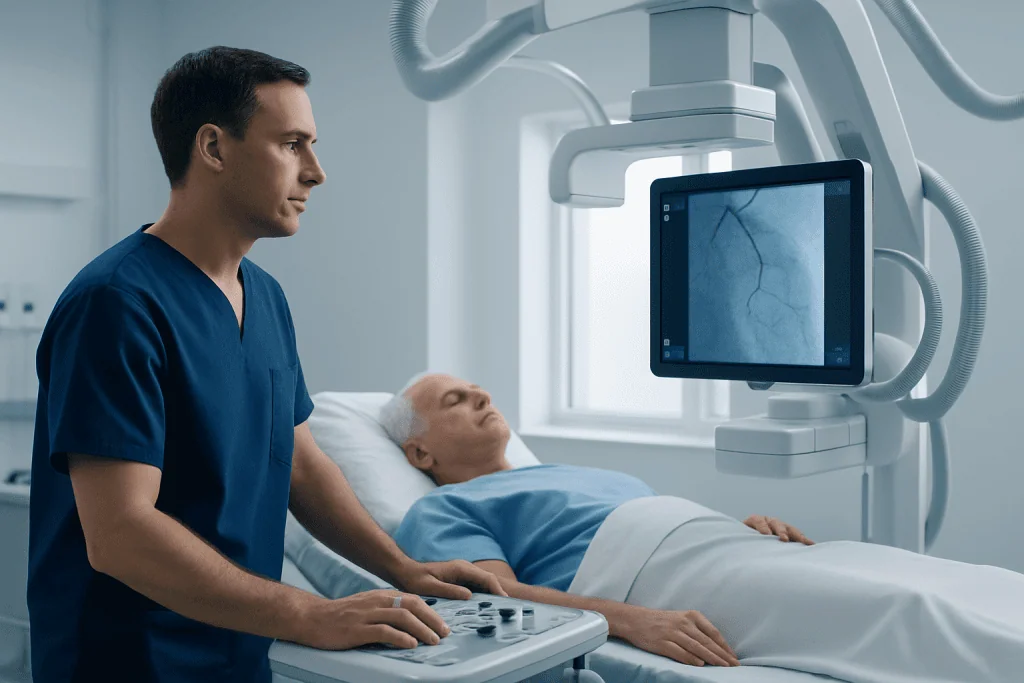
Doctors usually recommend coronary angiography when they need a clear view of the coronary arteries. This may happen after symptoms suggest reduced blood flow to the heart, or when noninvasive tests do not fully answer the question. The goal is not simply to “look inside,” but to understand whether a person’s symptoms are related to a blocked artery and how severe the problem might be.
Common reasons for referral include ongoing or unexplained chest pain, abnormal stress test results, suspected angina, reduced heart function, or signs of a heart attack. It may also be done before some heart surgeries or after a person has survived a cardiac event and doctors need to map the arteries carefully.
Coronary angiography may be considered in situations such as:
- Chest pain or pressure, especially with exertion
- Shortness of breath thought to be related to the heart
- Abnormal electrocardiogram, stress test, or cardiac imaging findings
- Suspected or known heart attack
- Assessment before procedures such as coronary bypass surgery
Not everyone with chest discomfort needs this test. Many people are first assessed with history, physical examination, blood tests, ECG, echocardiography, or stress imaging. Coronary angiography is usually chosen when doctors need more definitive information or when the situation is urgent.
How the procedure is done and what to expect

Before the procedure, the medical team reviews symptoms, medicines, allergies, kidney function, and bleeding risk. A person may be asked not to eat or drink for several hours beforehand. In many cases, the test is performed in a hospital catheterization laboratory, where the person stays awake but receives medication to help them relax.
The doctor numbs the skin and inserts a catheter into a blood vessel, usually at the wrist or groin. The catheter is gently guided to the heart’s arteries. Contrast dye is then injected, and a series of X-ray images is taken. Some people notice a brief warm sensation when the dye is injected, but the test itself is usually not painful beyond mild pressure at the access site.
The procedure time varies depending on the reason for the test and whether additional treatment is needed. If a severe narrowing is found, the team may discuss immediate treatment during the same session, such as cardiac catheterization with an interventional step like balloon angioplasty or stent placement. In other cases, the test ends after imaging, and treatment decisions are made afterward.
After the procedure, the catheter is removed and pressure or a closure device is used to reduce bleeding. Recovery is often short, especially when the wrist is used. Many people go home the same day, while others stay longer if they had an emergency presentation, another intervention, or need closer monitoring.
What the results can show
The angiogram helps doctors see the pattern of blood flow through the coronary arteries. It can show whether the arteries are normal, mildly narrowed, severely narrowed, or completely blocked. It can also identify how many arteries are involved and where the narrowings are located, which matters when choosing the most suitable treatment.
A normal result means blood flows through the coronary arteries without significant obstruction. An abnormal result may suggest atherosclerosis, in which fatty deposits and inflammation narrow the arteries over time. In some cases, symptoms may be caused by small-vessel disease or artery spasm, which can be harder to detect and may need further assessment even if major arteries are not severely blocked.
The findings help doctors choose among several paths:
- Medicines and lifestyle changes if disease is mild or stable
- Stent treatment if a specific blockage is suitable for catheter-based therapy
- Surgery if there are multiple complex blockages or disease in certain critical areas
- Additional testing if symptoms persist but large-vessel blockage is not the main issue
It is important to remember that the images are interpreted in context. Doctors consider symptoms, blood tests, heart function, and overall risk rather than relying on the angiogram alone.
Benefits, limits, and possible risks
The main benefit of coronary angiography is clarity. It gives detailed information about the heart’s arteries and can speed up diagnosis when time matters. In urgent situations, it may allow diagnosis and treatment in one setting, which can restore blood flow quickly and reduce heart muscle damage.
At the same time, this is an invasive test, so it is not the first step for every patient. It mainly shows the larger coronary arteries and may not fully explain symptoms caused by microvascular dysfunction, spasm, or non-cardiac conditions. That is why doctors weigh the expected value of the information against the need for an invasive procedure.
Like any medical procedure, coronary angiography has risks, though serious complications are uncommon. These may include bleeding or bruising at the catheter site, allergic reaction to contrast dye, irregular heart rhythm, infection, kidney strain, or, rarely, stroke or heart attack. People with kidney disease, diabetes, contrast allergy, or bleeding disorders may need extra precautions.
Risk is usually reduced by careful preparation, experienced teams, and close monitoring before, during, and after the test. Patients should tell their doctor about all medicines they take, especially blood thinners, diabetes medicines, and any past reactions to contrast dye.
Treatment after coronary angiography
The next step depends on what the angiogram shows and how the person is feeling. If the arteries are normal or only mildly narrowed, treatment may focus on controlling symptoms, reducing cardiovascular risk, and looking for other possible causes. This often includes medications, blood pressure control, cholesterol management, smoking cessation, exercise guidance, and dietary changes.
If one or more significant blockages are found, doctors may recommend a procedure to improve blood flow or surgery for more complex disease. A stent may be appropriate for some narrowed segments, while bypass surgery may be preferred when there are multiple blockages, involvement of major branch points, or certain patterns of disease. Treatment decisions are individualized and made after considering the angiogram, symptoms, age, other illnesses, and personal preferences.
In some cases, the best approach is intensive medical therapy rather than an immediate procedure. This can be appropriate in stable disease, especially when symptoms are manageable and the anatomy does not suggest a high-risk pattern. Follow-up remains important because coronary artery disease is usually a long-term condition that benefits from ongoing prevention.
Near the end of the care pathway, some people may seek evaluation at centers with coordinated heart services. Acibadem International’s multidisciplinary specialists and JCI-accredited hospitals diagnose and treat heart conditions for international patients, including catheter-based and surgical options when indicated.
Preparation, recovery, and self-care
Good preparation can make the procedure smoother and safer. Patients are usually told when to stop eating and whether to adjust specific medicines. It is especially important to ask about blood thinners, diabetes medication, kidney disease, pregnancy, and allergies to contrast dye or iodine-based products.
After the procedure, rest and hydration are commonly advised unless a doctor recommends otherwise. Mild soreness or bruising at the insertion site can happen. Most people are asked to avoid heavy lifting and strenuous activity for a short period, and to watch for increasing swelling, bleeding, numbness, fever, or chest symptoms.
Long-term self-care after coronary angiography depends on the results, but it often includes heart-healthy habits such as:
- Not smoking and avoiding secondhand smoke
- Taking prescribed medicines exactly as directed
- Managing blood pressure, cholesterol, and diabetes
- Following a balanced eating pattern rich in vegetables, fruits, whole grains, and healthy fats
- Being physically active within a doctor’s guidance
- Keeping follow-up appointments and reporting new symptoms promptly
These steps do not replace medical treatment, but they can meaningfully support heart health and reduce the chance of future problems.
When to seek medical care
Medical care should be sought promptly for chest pain, pressure, or discomfort that is new, worsening, severe, or associated with shortness of breath, sweating, nausea, fainting, or pain spreading to the arm, jaw, back, or shoulder. These symptoms need urgent assessment because they can signal a heart attack or another serious heart problem.
After coronary angiography, a doctor should be contacted if there is persistent bleeding, rapidly increasing swelling, severe pain, fever, signs of infection at the catheter site, or changes such as coldness, weakness, or numbness in the limb used for access. Emergency care is needed if chest pain returns, breathing becomes difficult, or a person feels suddenly unwell.
Even when symptoms are mild, a medical review is sensible if chest discomfort happens repeatedly with activity, if exercise tolerance is falling, or if there are strong risk factors such as diabetes, smoking, high cholesterol, high blood pressure, or a family history of early heart disease. Early assessment can help guide the right tests and treatment before complications develop.
Frequently asked questions
What is the difference between a coronary angiogram and coronary angiography?
Coronary angiography is the procedure used to examine the heart’s arteries with a catheter, contrast dye, and X-ray imaging. A coronary angiogram is the image or result produced by that procedure. In everyday use, people often use the terms to mean the same thing.
Is coronary angiography painful?
Most people do not describe the procedure as painful, although they may feel brief pressure when the catheter is inserted and a warm sensation when contrast dye is injected. The skin is numbed first, and medicines are often given to help relaxation. Mild soreness or bruising at the access site can occur afterward.
How long does recovery take after a coronary angiogram?
Recovery is often short, and many people go home the same day if the test is straightforward and no additional treatment is performed. The exact timeline depends on the access site, overall health, and whether a stent or another intervention was done. A doctor will advise when normal activities can be resumed.
Why might a doctor order coronary angiography after other heart tests?
Other tests can suggest reduced blood flow to the heart, but coronary angiography gives a direct view of the coronary arteries. It is often used when symptoms persist, results are unclear, or urgent treatment may be needed. It helps doctors decide whether medicines, a stent, surgery, or another approach is best.
What are the risks of coronary angiography?
Possible risks include bleeding, bruising, contrast reaction, kidney strain, irregular heartbeat, or infection, with serious complications being uncommon. The overall risk depends on a person’s age, kidney function, medical history, and the reason the test is being done. Doctors take steps to reduce these risks with careful screening and monitoring.
Can coronary angiography treat a blockage as well as diagnose it?
Yes, in some cases treatment can happen during the same session if a suitable blockage is found. For example, a doctor may perform balloon angioplasty and place a stent to improve blood flow. In other situations, the angiography is diagnostic only, and treatment is planned afterward.
References
- American Heart Association
- National Heart, Lung, and Blood Institute
- European Society of Cardiology
- Society for Cardiovascular Angiography and Interventions
- Mayo Clinic
This article is for general information only and is not a substitute for professional medical advice. Please consult a qualified doctor about your individual situation.
Explore treatments in Turkey — costs, top hospitals & a free quote
JCI-accredited · board-certified surgeons · reply within 24h
Add us as a Preferred Source to see more of our trusted health content across Google Search, AI Overviews and Discover.

More from the Health Library

Peniserect: An Evidence-Based Guide for Patients

Diabetic Shock: A Complete Medical Overview

Tetralogy of Fallot: What Patients Need to Know

Paradoxical Breathing: An Evidence-Based Guide for Patients

Rhonchi: Symptoms, Causes, and Treatment — Complete Patient Guide