Hypertrichosis: Diagnosis, Outlook, and Modern Treatment Approaches

Hypertrichosis means excessive hair growth and is different from common age- or hormone-related hair changes. It can be congenital or acquired, and acquired cases sometimes point to medications, metabolic problems, or other medical conditions.
Key Takeaways
- Hypertrichosis means excessive hair growth and is different from common age- or hormone-related hair changes.
- It can be congenital or acquired, and acquired cases sometimes point to medications, metabolic problems, or other medical conditions.
- Diagnosis focuses on the pattern of hair growth, medical history, examination, and targeted tests when needed.
- Treatment may include addressing the underlying cause and using hair-reduction methods such as shaving, laser, or electrolysis.
- A new or rapidly developing change in hair growth should be assessed by a qualified doctor.
Hypertrichosis is a condition that causes excessive hair growth in areas where hair is not usually expected for a person’s age, sex, or background. It may be present from birth or develop later in life, and the outlook depends largely on the underlying cause and the person’s goals for treatment.
Overview: what hypertrichosis means
Hypertrichosis is excessive hair growth that is greater than expected for a person’s age, sex, ethnicity, or body area. It can affect one small region or be more widespread, and the extra hair may be fine and soft, longer and darker, or thicker and more noticeable. In simple terms, hypertrichosis describes an unusual amount of hair rather than a disease with one single cause.
Doctors usually divide hypertrichosis into two broad forms. Congenital hypertrichosis is present at birth or begins very early in life. Acquired hypertrichosis develops later and may be related to medicines, chronic irritation, nutrition problems, endocrine or metabolic disease, or, less commonly, an internal medical disorder.
Hypertrichosis is not the same as hirsutism. Hirsutism refers specifically to increased coarse hair growth in women in androgen-sensitive areas such as the chin, chest, or lower abdomen, often due to hormone-related causes. Hypertrichosis can occur in any sex and may involve body sites that are not typically driven by male hormones.
The outlook varies. In some people, especially when an external trigger can be identified and removed, the hair growth may lessen over time. In others, especially congenital forms, treatment focuses on long-term hair management and emotional well-being rather than a permanent cure.
How hypertrichosis can appear
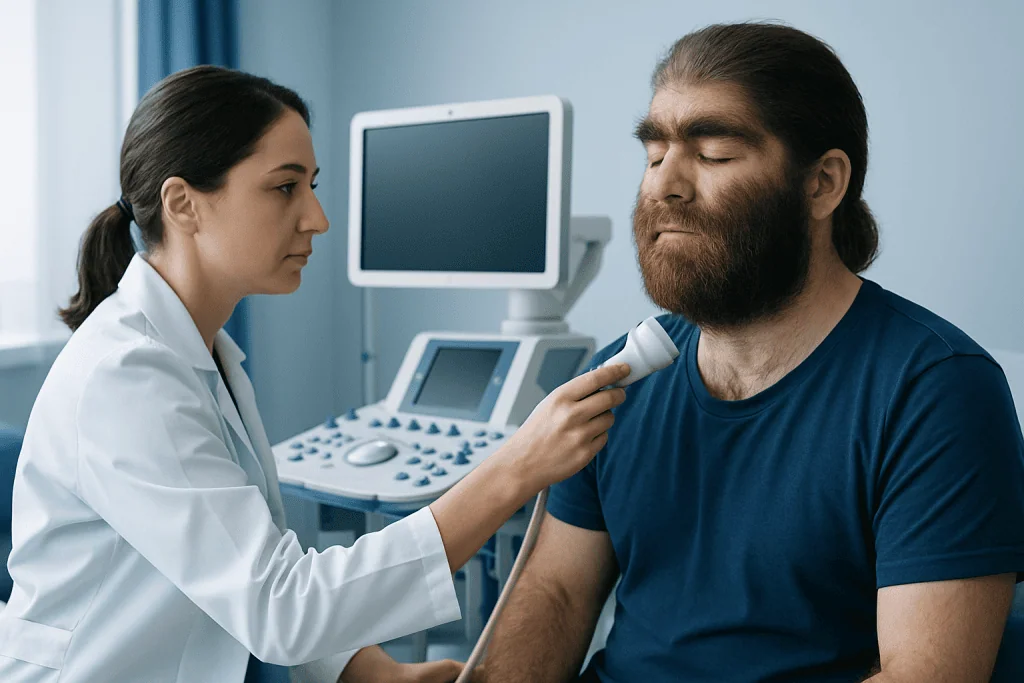
The appearance of hypertrichosis depends on the type of hair involved and where it grows. Some people notice soft, light-colored lanugo-like hair, while others develop longer vellus hair or terminal hair that is darker, thicker, and more visible. Growth may be limited to the face, arms, back, or shoulders, or it may affect several body regions.
The condition may be generalized or localized. Generalized hypertrichosis affects larger areas of the body. Localized hypertrichosis is confined to one site, sometimes near a scar, cast, repeatedly irritated skin, or an area with inflammation. The pattern can provide clues about the cause.
Hypertrichosis itself does not usually cause physical pain. However, the skin underneath may be affected if there is an associated disorder such as irritation, friction, inflammation, or a birthmark. The psychological impact can be significant, especially when hair growth is visible on the face or begins suddenly.
Features that often lead people to seek care include:
- Hair growth that seems out of proportion to family traits
- New hair appearing in unusual body areas
- Rapidly increasing facial or body hair
- Hair growth associated with medication use or skin changes
- Distress, embarrassment, or difficulty with daily grooming
Causes and risk factors

Hypertrichosis has many possible causes, which is why diagnosis begins with a broad view rather than one assumption. Congenital forms are uncommon and may be linked to genetic changes that affect hair follicle development or the persistence of fetal-type hair. In these cases, the pattern often starts early and may be accompanied by other physical findings, depending on the syndrome involved.
Acquired hypertrichosis is more common than congenital forms in clinical practice. It can occur as a side effect of certain medicines, including some used for inflammation, immune conditions, blood pressure, or hair growth stimulation. Repeated skin trauma, chronic friction, burns, casts, or inflammation may also trigger localized increased hair growth.
General medical issues can play a role as well. Nutritional disorders, severe weight loss, metabolic disease, and some endocrine conditions may be associated with excessive hair growth. In a small number of cases, particularly when generalized lanugo-like hair appears suddenly in an adult, doctors may investigate for an underlying systemic illness, including cancer, as part of a careful workup.
Because hair disorders can overlap, doctors may also consider other explanations such as polycystic ovary syndrome when a patient has acne, irregular periods, or signs of androgen excess, or they may distinguish it from alopecia and other conditions that change hair density in different ways. Risk factors for acquired hypertrichosis include relevant medication exposure, chronic skin irritation, hormonal or metabolic illness, and a family history of unusual hair patterns.
How doctors diagnose hypertrichosis
Diagnosis is based first on clinical assessment. A doctor will ask when the hair growth started, whether it was gradual or sudden, which areas are involved, and whether there are related symptoms such as weight change, menstrual irregularity, skin rash, weakness, or changes in medications. This history often provides the most important clues.
The physical examination looks at the type of hair, its distribution, and whether there are signs of hormone imbalance, nutritional deficiency, congenital syndromes, or skin disease. The doctor may also review family photos or earlier personal photos to understand whether the pattern is long-standing or new. In children, growth and developmental history are especially important.
Tests are not necessary for every patient. If hypertrichosis seems likely to be medication-related or clearly localized after skin irritation, further investigation may be limited. When the cause is unclear, targeted blood tests may be used to look for endocrine, metabolic, or nutritional abnormalities. Imaging or referral to another specialist may be advised if the examination suggests an internal cause.
Dermatology is often central to assessment, but some patients also benefit from endocrinology, pediatrics, genetics, or oncology input, depending on the presentation. The goal is not only to label the hair growth pattern but also to identify whether it is a harmless variation, a reversible reaction, or a sign that another condition needs attention.
Treatment options and modern hair-reduction approaches
Treatment for hypertrichosis depends on the cause, the extent of hair growth, and the person’s preferences. If a trigger such as a medication, cast, or chronic skin irritation is identified, the first step is to address that factor when medically appropriate. If an underlying medical condition is found, treatment is directed at that condition as well as the unwanted hair.
For symptom management, temporary hair-removal methods include trimming, shaving, plucking, waxing, and depilatory creams. These options are practical for many people, but they need regular repetition and may irritate sensitive skin. A dermatologist can help choose the safest method based on hair type, skin tone, body area, and personal tolerance.
Longer-lasting options may include laser hair removal and electrolysis. Laser treatment works best when the contrast between hair pigment and skin allows the energy to target the follicle effectively, although newer technologies can treat a broader range of skin types than in the past. Electrolysis treats individual follicles and can be useful for smaller areas or hair colors that respond less well to laser.
Some patients also need care for associated skin concerns such as irritation, folliculitis, or pigment change after hair removal. In selected situations, evaluation by dermatology specialists helps tailor both diagnosis and cosmetic management. Near the end of the care pathway, centers such as Acibadem International may support international patients through multidisciplinary evaluation and treatment planning in JCI-accredited hospitals.
Living with hypertrichosis: self-care and long-term outlook
The long-term outlook for hypertrichosis depends on why it happened. If it is caused by a medicine or external trigger, hair growth may improve after the trigger is removed, although this can take weeks or months because hair cycles change gradually. Congenital forms are usually long-term conditions, but many people manage them successfully with ongoing grooming or procedural treatments.
Self-care focuses on skin protection as much as hair reduction. Gentle cleansing, fragrance-free moisturizers, and careful technique during shaving or waxing can help reduce irritation. Sun protection is also useful, especially after laser procedures or when hair removal leaves skin more exposed.
Emotional health matters. Visible hair growth can affect confidence, social comfort, and quality of life, particularly in adolescents and young adults. Support from clinicians, family, and in some cases counseling can be helpful, especially when the condition is persistent or associated with a rare syndrome.
Regular follow-up may be advised if the diagnosis is uncertain, symptoms are changing, or treatment is being adjusted. Photographs taken over time can help monitor progress objectively. When expectations are discussed clearly, patients often do better with treatment decisions because they understand that improvement may be gradual and maintenance is common.
When to seek medical care
Medical review is recommended when hypertrichosis appears suddenly, progresses quickly, or develops along with other unexplained symptoms. These may include weight loss, fatigue, menstrual changes, acne, deepening of the voice, weakness, or skin findings such as darkening, thickening, or persistent inflammation. A prompt assessment can help rule out a treatable underlying cause.
Children with unusual hair growth should also be assessed, particularly if the hair was present from birth, is increasing over time, or occurs together with developmental, dental, eye, or skeletal differences. Early evaluation can clarify whether the pattern is isolated or part of a broader syndrome.
People should speak with a doctor if hair growth begins after starting a new medicine or if home hair-removal methods are causing cuts, infection, ingrown hairs, or significant irritation. Repeatedly changing products without guidance can worsen the skin even if the hair itself is harmless.
Urgent medical care is not usually needed for the hair growth alone, but rapid generalized hair growth in an adult deserves timely attention. The best next step is a qualified clinician who can assess the full picture and decide whether dermatology, endocrinology, genetics, or other specialist input is appropriate.
Frequently asked questions
Is hypertrichosis the same as hirsutism?
No. Hypertrichosis means excessive hair growth in general and can affect any sex and many body areas. Hirsutism refers specifically to androgen-related coarse hair growth in women in a typically male-pattern distribution.
Can hypertrichosis go away on its own?
Sometimes it can improve, especially if it is triggered by a medicine, skin irritation, or another reversible cause. In congenital forms, it is more often a long-term condition that is managed rather than permanently cured.
What doctor treats hypertrichosis?
A dermatologist is often the main specialist involved because diagnosis begins with examining the skin and hair pattern. Depending on the findings, an endocrinologist, pediatrician, geneticist, or another specialist may also be involved.
Is sudden excessive hair growth a warning sign?
It can be. Sudden or rapidly progressive hair growth, especially in an adult, should be assessed because it may occasionally be linked to medication effects, hormone imbalance, nutritional problems, or a systemic illness.
Does laser hair removal work for hypertrichosis?
It can be very helpful for many patients, particularly when the hair and skin characteristics are suitable for laser targeting. Multiple sessions are usually needed, and results are often hair reduction rather than complete permanent removal.
Can children have hypertrichosis?
Yes. Some forms are present from birth or begin in early childhood. Children with unusual or widespread hair growth should be evaluated to determine whether it is an isolated trait or part of a broader condition.
References
- American Academy of Dermatology
- MedlinePlus
- National Organization for Rare Disorders
- Merck Manual Consumer Version
- Genetic and Rare Diseases Information Center
This article is for general information only and is not a substitute for professional medical advice. Please consult a qualified doctor about your individual situation.
Hair transplant in Turkey — costs, graft counts & a free assessment
JCI-accredited · board-certified surgeons · reply within 24h
Add us as a Preferred Source to see more of our trusted health content across Google Search, AI Overviews and Discover.
Check your numbers in seconds
BMI, calories, due date, blood pressure and 30+ more clinical calculators — free, instant, doctor-reviewed ranges.