Isokinetic Exercise: What Patients Need to Know
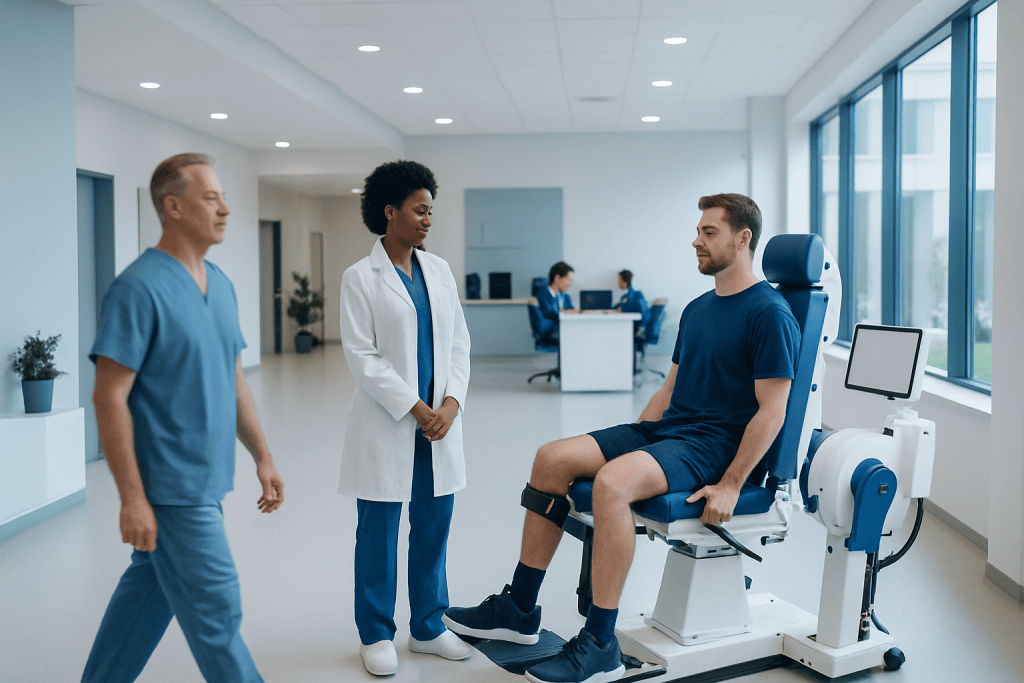
Isokinetic exercise keeps movement speed constant while resistance changes to match the person’s effort. It is commonly used in rehabilitation after injury or surgery and in sports performance testing.
Key Takeaways
- Isokinetic exercise keeps movement speed constant while resistance changes to match the person’s effort.
- It is commonly used in rehabilitation after injury or surgery and in sports performance testing.
- This type of exercise may help strengthen muscles through the full range of motion with controlled joint loading.
- Specialized machines and professional guidance are usually needed for true isokinetic training.
- It is not the same as isometric or isotonic exercise, which use different movement and resistance patterns.
Isokinetic exercise is a type of movement performed at a constant speed using specialized equipment that adjusts resistance throughout the motion. It is most often used in rehabilitation and sports medicine to help improve strength, control, and joint function in a measured, supervised way.
Overview: what is isokinetic exercise?
Isokinetic exercise is a form of strength training in which a limb moves at a constant, preset speed while a machine automatically changes the resistance to match how hard the person pushes or pulls. In simple terms, the speed stays the same, but the force can vary through the movement. This makes isokinetic exercise different from many everyday exercises, where the weight stays the same and the movement speed changes.
Patients most often encounter isokinetic exercise in rehabilitation clinics, sports medicine centers, or specialized physical therapy settings. It may be used after injury, during recovery from surgery, or when a clinician wants to measure muscle strength more precisely. Because the equipment controls motion closely, isokinetic exercise can help train muscles in a structured and repeatable way.
Many people compare isokinetic exercise with other common exercise types. In isometric exercise, the muscle contracts without visible joint movement, such as holding a plank. In isotonic exercise, the muscle moves a weight through a range of motion, such as during a squat or biceps curl. In isokinetic exercise, the joint moves, but the machine keeps the motion at a set speed throughout.
How it works and why it is used
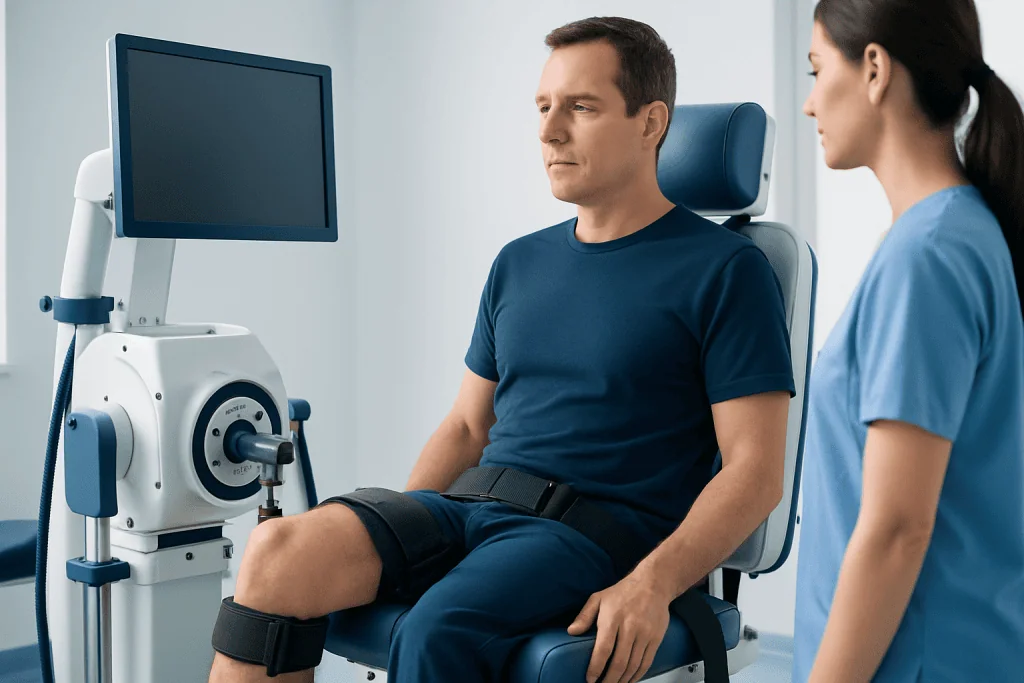
True isokinetic exercise requires specialized equipment, often called an isokinetic dynamometer. The person performs a movement such as bending or straightening the knee, rotating the shoulder, or moving the ankle. The machine senses the amount of force being applied and provides matching resistance so the chosen speed remains constant from start to finish.
This approach can be useful because muscles do not produce the same amount of force at every point in a movement. With standard weights, some parts of a motion may feel easier and others harder. Isokinetic equipment can accommodate these changes, allowing muscles to work throughout more of the range of motion while reducing uncontrolled acceleration.
Clinicians may use isokinetic exercise for both training and assessment. It can help identify differences in strength between the right and left sides or between muscle groups such as the quadriceps and hamstrings. These measurements may support treatment planning in rehabilitation programs, including care for certain knee pain problems or recovery after orthopedic procedures.
Potential benefits for patients

One of the main potential benefits of isokinetic exercise is controlled strengthening. Because the machine regulates speed, the movement can be performed in a steady way that may feel more secure for some patients, especially when they are rebuilding confidence after injury. The resistance adapts to the person’s effort, which can allow meaningful muscle work without needing to lift a fixed heavy load.
Another possible advantage is that isokinetic training can target specific joints and muscle groups with precision. This may be helpful in rehabilitation when a clinician wants to focus on the knee, shoulder, hip, or ankle. The equipment can also provide objective data about strength, endurance, and side-to-side differences, which may be useful for tracking progress over time.
For some patients, isokinetic exercise may support functional recovery by improving muscle performance across the full range of motion. It is often one part of a broader rehabilitation plan that may also include flexibility work, balance exercises, manual therapy, and gradual return-to-activity training. In selected cases, isokinetic methods may complement care plans offered in physical therapy and rehabilitation programs.
- May improve strength in a controlled environment
- Can help assess muscle imbalance more objectively
- Often useful for joint-specific rehabilitation
- May support return to sport or daily activity planning
Who may benefit from isokinetic exercise?
Isokinetic exercise is most often considered for people recovering from musculoskeletal injuries or surgery. Examples include rehabilitation after ligament injury, tendon problems, cartilage-related symptoms, or procedures involving the knee or shoulder. It may also be used in athletes who need detailed muscle testing before returning to training or competition.
Patients with weakness after immobilization, repeated strains, or long periods of reduced activity may also be candidates. In these situations, the goal is usually not just to build strength, but to rebuild coordinated movement in a gradual, measurable way. Some clinicians use isokinetic testing as part of return-to-activity decisions after conditions such as ACL injury.
Even so, isokinetic exercise is not necessary for everyone. Many people recover well with standard resistance training, guided home exercise, and conventional physical therapy. A clinician decides whether isokinetic work is appropriate based on the person’s diagnosis, stage of healing, pain level, joint stability, and overall health goals.
Risks, limits, and who should use caution
Although isokinetic exercise is generally considered safe when supervised appropriately, it is not risk-free. Any strengthening program can cause temporary muscle soreness, fatigue, or symptom flare-ups if it is introduced too early or performed too intensely. If a joint is inflamed, unstable, or still healing, the timing and settings need to be chosen carefully.
Some patients should use special caution, particularly those with acute pain, recent fractures, severe joint swelling, uncontrolled cardiovascular symptoms, or recent surgery that still has movement restrictions. In such cases, a doctor or rehabilitation professional should decide when strengthening is safe to begin and how much force is appropriate.
There are also practical limits. True isokinetic exercise depends on specialized machines that are not available in most gyms, so it is less accessible than standard resistance training. In addition, isokinetic strengthening is usually only one part of recovery. Patients may still need other treatments, such as activity modification, manual therapy, structured exercise progression, or in some cases orthopedic rehabilitation after injury or surgery.
How isokinetic exercise fits into diagnosis and rehabilitation
Isokinetic exercise is not a diagnosis by itself, but it can play a role in evaluating how muscles and joints are functioning. During testing, the machine may measure peak force, total work, endurance, and differences between sides. These findings can help clinicians understand whether weakness is improving and whether additional rehabilitation is needed.
For example, after a knee injury, a patient may feel generally better but still have significant quadriceps weakness compared with the other side. Isokinetic testing can make this deficit easier to detect. This may help explain why some people continue to feel unstable or have difficulty returning to previous activity even when basic daily tasks seem manageable.
In a rehabilitation program, clinicians usually combine isokinetic work with broader assessment and treatment rather than relying on it alone. A full plan may include evaluation by orthopedics, sports medicine, or rehabilitation specialists, especially if symptoms persist. When necessary, patients may also be assessed in services related to orthopedics and traumatology to look for structural causes of pain or weakness.
What a typical session may involve
Before starting, a clinician usually reviews the patient’s history, symptoms, and movement restrictions. The machine is adjusted to the patient’s body size and the specific joint being trained. The clinician then selects the speed, range of motion, and type of movement, such as extension and flexion at the knee or rotation at the shoulder.
Sessions often begin with a warm-up and practice repetitions so the person can learn the movement pattern. The actual exercise may involve several sets of controlled repetitions at one or more speeds. Some sessions focus on strength, while others focus more on endurance or comparison between muscle groups. The clinician watches for pain, compensatory movements, or fatigue.
Afterward, the patient may receive additional exercises for flexibility, balance, or everyday function. Because soreness can happen after any strengthening session, guidance on recovery is often provided. Progress is usually gradual, and the program is adjusted over time based on symptoms, clinical findings, and individual goals.
Self-care and when to seek medical care
For patients interested in isokinetic exercise, the most helpful first step is to seek an appropriate evaluation rather than trying to recreate it alone. Since true isokinetic training depends on specialized equipment, home alternatives are usually not truly isokinetic. A qualified clinician can advise whether this method is useful or whether a simpler strengthening program is enough.
General self-care during rehabilitation includes following the prescribed exercise plan, pacing activity, allowing adequate recovery, and avoiding sudden increases in intensity. Patients should also pay attention to swelling, loss of motion, or unusual pain after exercise. Good communication with the rehabilitation team can help keep training both safe and effective.
Medical review is important if pain is severe, swelling increases, the joint gives way, numbness develops, or function worsens instead of improving. It is also sensible to seek care if symptoms continue for several weeks, if an injury prevents normal walking or use of an arm, or if recovery after surgery does not seem to progress as expected. Acibadem International’s multidisciplinary specialists and JCI-accredited hospitals diagnose and treat musculoskeletal conditions for international patients when expert assessment is needed.
Frequently asked questions
What is the difference between isokinetic and isotonic exercise?
Isokinetic exercise keeps the speed of movement constant with the help of specialized equipment that changes resistance as needed. Isotonic exercise uses a more fixed load, such as a dumbbell or body weight, while the speed can vary during the movement.
Is isokinetic exercise only used for athletes?
No. Although athletes may use it for testing and return-to-sport decisions, isokinetic exercise is also used for many non-athletes in rehabilitation. It can be helpful after injury, surgery, or periods of weakness when precise, joint-specific training is needed.
Can isokinetic exercise help after knee surgery?
It may be useful in some knee rehabilitation programs, especially when clinicians want to measure or rebuild strength in a controlled way. However, the right timing depends on the type of surgery, healing stage, and surgeon or therapist guidance.
Is isokinetic exercise safe if there is pain?
Mild discomfort during rehabilitation can sometimes occur, but significant pain should not be ignored. A clinician should decide whether the exercise is appropriate, whether the settings need adjustment, or whether another problem needs evaluation.
Do people need special equipment for isokinetic exercise?
Yes. True isokinetic exercise requires specialized machines that control movement speed and adapt resistance during the exercise. Standard gym machines, resistance bands, and free weights can be useful for strengthening, but they are not truly isokinetic.
How often is isokinetic exercise done?
The schedule varies according to the condition being treated, the person’s general fitness, and the goals of rehabilitation. A physical therapist, rehabilitation physician, or orthopedic specialist usually decides the safest frequency and progression.
References
- American College of Sports Medicine
- American Physical Therapy Association
- National Institute of Arthritis and Musculoskeletal and Skin Diseases
- MedlinePlus
- American Academy of Orthopaedic Surgeons
This article is for general information only and is not a substitute for professional medical advice. Please consult a qualified doctor about your individual situation.
Joint and spine care in Turkey — expert assessment & treatment
JCI-accredited · board-certified surgeons · reply within 24h
Add us as a Preferred Source to see more of our trusted health content across Google Search, AI Overviews and Discover.