Prostate Biopsy Procedure: A Complete Medical Overview

A prostate biopsy procedure helps confirm whether abnormal prostate findings are due to cancer or another condition. The two main approaches are transrectal and transperineal biopsy, often guided by ultrasound and sometimes MRI findings.
Key Takeaways
- A prostate biopsy procedure helps confirm whether abnormal prostate findings are due to cancer or another condition.
- The two main approaches are transrectal and transperineal biopsy, often guided by ultrasound and sometimes MRI findings.
- Most people go home the same day, but mild bleeding, soreness, or blood in urine or semen can occur for a short time.
- Biopsy results guide next steps, which may include monitoring, repeat testing, or treatment planning.
- Fever, heavy bleeding, trouble urinating, or worsening pain after the procedure need prompt medical attention.
A prostate biopsy procedure is a test used to remove tiny samples of prostate tissue so a laboratory can check for cancer, inflammation, or other abnormal changes. It is usually recommended after an abnormal PSA blood test, an unusual digital rectal exam, or a suspicious finding on prostate imaging.
Overview: what a prostate biopsy procedure is
A prostate biopsy procedure is a diagnostic test in which a doctor removes very small pieces of tissue from the prostate gland and sends them to a laboratory for examination under a microscope. The main goal is to find out whether suspicious results from a PSA blood test, digital rectal exam, or imaging scan are caused by prostate cancer, inflammation, enlargement, or another noncancerous change.
The procedure does not treat the condition itself. Instead, it provides tissue confirmation, which is often the most reliable way to diagnose or rule out cancer. In many cases, biopsy results are combined with PSA levels, MRI findings, family history, age, and general health to decide what care is needed next.
Modern prostate biopsy planning is more targeted than in the past. A doctor may recommend a standard systematic biopsy, a targeted biopsy based on MRI findings, or a combination of both. This approach can improve diagnostic accuracy while helping avoid unnecessary repeat testing.
Why a doctor may recommend this test
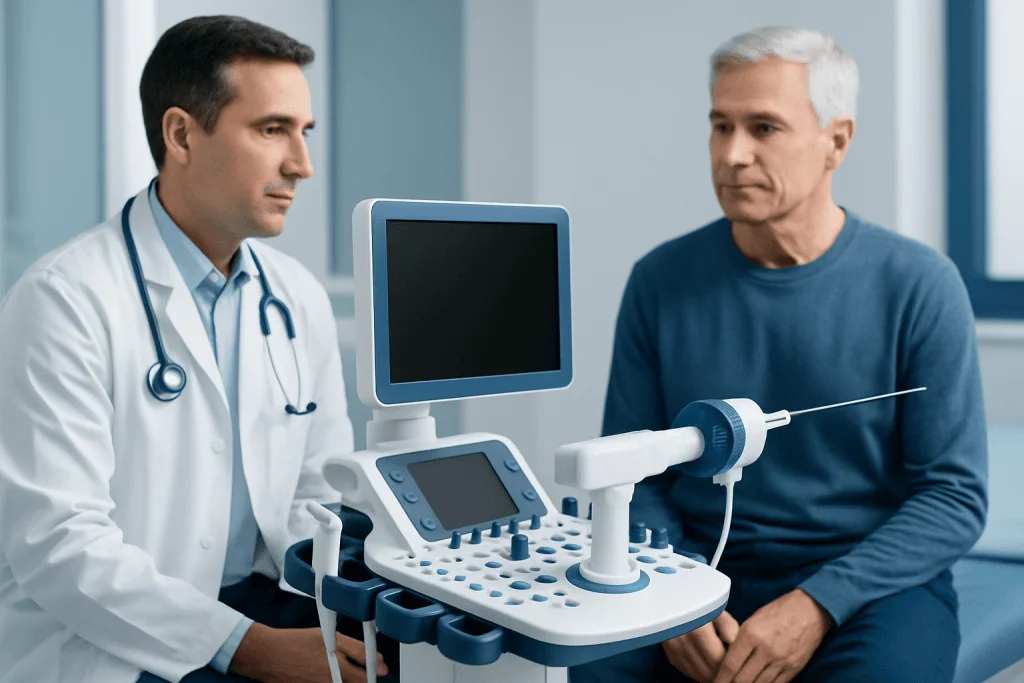
A prostate biopsy is usually recommended when something suggests a higher chance of significant disease in the prostate. Common reasons include a PSA level that is higher than expected, a PSA that rises over time, an abnormal digital rectal exam, or a suspicious area seen on prostate MRI or ultrasound.
It is important to remember that an abnormal PSA does not automatically mean cancer. PSA can also rise because of benign prostate enlargement, inflammation, infection, recent ejaculation, urinary retention, or recent procedures involving the urinary tract. A biopsy helps clarify the cause when the overall picture remains uncertain.
Doctors also use biopsy in some people who are already known to have low-risk prostate cancer and are being monitored through active surveillance. In that setting, repeat tissue sampling may help show whether the cancer remains stable or has changed over time, which may affect future treatment decisions related to prostate cancer.
Types of prostate biopsy and how the procedure is performed

The two main approaches are transrectal biopsy and transperineal biopsy. In a transrectal biopsy, a needle passes through the wall of the rectum into the prostate, usually with ultrasound guidance. In a transperineal biopsy, the needle passes through the skin between the scrotum and anus. Both methods can collect multiple tissue samples from different parts of the gland.
Many centers now use ultrasound guidance together with MRI information when a scan has identified a suspicious area. This is often called targeted or MRI-fusion biopsy. It allows the doctor to sample the area of concern more precisely while also taking standard samples from the rest of the prostate when needed.
Before the procedure, the care team reviews medicines, allergies, bleeding risks, and infection risks. Some people may need to stop blood-thinning medicines for a short time under medical advice. Antibiotics may be given depending on the biopsy approach and local practice. Local anesthesia is commonly used, and some patients also receive sedation.
During the test, the patient is positioned comfortably while ultrasound helps guide needle placement. The sampling itself is quick, but preparation and recovery add time. Most people return home the same day. In some cases, further evaluation with prostate MRI or targeted planning through MR fusion biopsy may be part of the diagnostic pathway.
What to expect before, during, and after the biopsy
Preparation instructions vary, so it is important to follow the specific guidance given by the doctor or hospital. Patients are commonly advised about eating and drinking, whether to take regular medications, and when to pause blood thinners or supplements that may increase bleeding. Some may also be asked to provide a urine sample beforehand to check for infection.
During the procedure, a brief sting or pressure may be felt from the anesthetic, followed by a sensation of pressure, movement, or clicking as samples are taken. Many people find the test uncomfortable rather than severely painful. Sedation or stronger pain control may be offered in selected cases.
After the biopsy, mild soreness, light bleeding from the rectum, pink or red urine, and blood in the semen can happen for a short period. Semen discoloration may last longer than urine bleeding and can still be normal during recovery. Rest, hydration, and avoiding strenuous activity for a short time are often recommended.
The care team explains how to watch for warning signs and when normal activities can resume. If further evaluation is needed, options may include additional imaging, follow-up PSA testing, or consultation with specialists in urology.
Possible risks and side effects
Like any invasive test, a prostate biopsy has potential risks, but serious complications are uncommon. The most frequent side effects are minor bleeding, temporary discomfort, and blood in the urine, stool, or semen. These usually settle on their own over days to weeks depending on the symptom.
Infection is an important but less common concern. The risk can vary by biopsy method, with transperineal approaches often associated with a lower infection risk than transrectal approaches in some settings. Doctors take steps to reduce this risk through sterile technique and, when appropriate, antibiotics.
Urinary problems can also occur. A small number of patients may have difficulty passing urine, especially if the prostate is already enlarged or inflamed. Rarely, stronger bleeding or urinary retention may require urgent assessment or treatment.
People should tell their doctor about bleeding disorders, anticoagulant use, previous infections after procedures, or allergy to antibiotics or anesthetics. This information helps the team choose the safest biopsy approach and recovery plan.
Understanding the biopsy results
Biopsy samples are examined by a pathologist, who looks for cancer cells and other changes such as prostatitis or benign enlargement. Results usually do not come back immediately because the tissue must be processed and reviewed carefully. The report helps show whether cancer is present, where it was found, and how abnormal the cells appear.
If cancer is detected, the report often includes a Gleason score or Grade Group, which helps estimate how likely the cancer is to grow or spread. This information is not used alone. Doctors also consider PSA level, MRI findings, age, overall health, and whether the cancer seems confined to the prostate.
If no cancer is found, that can be reassuring, but it does not always end evaluation. Some patients may still need follow-up if PSA remains concerning or MRI shows a suspicious area that may have been missed. In selected situations, repeat biopsy, monitoring, or additional imaging may be advised.
When cancer is confirmed, management can range from active surveillance to surgery, radiation therapy, or other treatments depending on the individual case. For some patients, discussions may include robotic surgery as one of several treatment approaches after diagnosis is complete.
When to seek medical care after a prostate biopsy
Most recovery symptoms are mild, but certain changes should not be ignored. A patient should contact a doctor promptly if there is fever, chills, worsening pain, inability to urinate, heavy rectal bleeding, large blood clots in the urine, or bleeding that seems to be getting worse instead of better.
Medical advice is also important if there is dizziness, weakness, or symptoms that raise concern for infection after the procedure. Early treatment can prevent more serious problems. When in doubt, it is safer to ask the care team whether a symptom is expected.
In general, patients should keep their follow-up appointment even if they feel well. The biopsy result discussion is a key part of care because it explains what was found and what next steps, if any, are appropriate.
Follow-up, self-care, and the broader care pathway
Recovery after a prostate biopsy is usually simple. Patients are often advised to drink fluids, avoid heavy lifting for a short period, and take medicines exactly as prescribed. Following aftercare instructions can help reduce discomfort and lower the chance of complications.
The next stage depends entirely on the biopsy findings. Some people need only observation and repeat PSA testing. Others may be advised to have more imaging, repeat biopsy, or treatment planning with a multidisciplinary team that may include urologists, radiologists, pathologists, and oncologists.
It can help to prepare questions before the follow-up visit, such as what the biopsy found, whether the result explains the PSA level, whether more tests are needed, and what the benefits and risks of each management option may be. Clear communication supports informed decision-making and reduces uncertainty.
For international patients who need coordinated evaluation, Acibadem International’s multidisciplinary specialists and JCI-accredited hospitals diagnose and treat prostate conditions using modern imaging, biopsy, and treatment pathways tailored to the individual patient.
Frequently asked questions
Is a prostate biopsy procedure painful?
Most people describe a prostate biopsy as uncomfortable rather than severely painful. Local anesthesia is usually used, and some centers also offer sedation depending on the method and the patient's needs. Brief pressure, stinging, or a clicking sensation may be felt during sampling.
How long does it take to recover from a prostate biopsy?
Most patients recover quickly and go home the same day. Mild soreness or light bleeding may last a few days, while blood in the semen can last longer and still be normal. The care team will explain when normal exercise and work can usually be resumed.
What are the signs of infection after a prostate biopsy?
Fever, chills, worsening pain, or feeling generally unwell after a biopsy can suggest infection and should be assessed promptly. Difficulty urinating or severe burning may also need urgent review. Patients should contact their doctor without delay if these symptoms occur.
Can a prostate biopsy miss cancer?
Yes, a biopsy can sometimes miss a cancerous area, especially if the abnormal tissue is small or difficult to reach. That is why doctors may combine MRI with ultrasound guidance and may recommend follow-up or repeat biopsy if concern remains high. Results are always interpreted together with PSA, exam findings, and imaging.
Why would someone need a prostate biopsy if the PSA is high?
A high PSA can happen for several reasons, including benign enlargement, inflammation, infection, or cancer. A biopsy helps determine whether cancer cells are actually present in the prostate tissue. It is the most direct way to confirm the diagnosis when other tests are inconclusive.
What happens if the biopsy result is negative?
A negative result means no cancer was found in the sampled tissue, which can be reassuring. However, follow-up may still be needed if PSA stays abnormal or MRI shows a suspicious area. The doctor may recommend monitoring, repeat testing, or another biopsy depending on the overall risk.
References
- American Cancer Society
- National Cancer Institute
- National Health Service
- European Association of Urology
- Urology Care Foundation
This article is for general information only and is not a substitute for professional medical advice. Please consult a qualified doctor about your individual situation.
Oncology care in Turkey — second opinion and treatment plan
JCI-accredited · board-certified surgeons · reply within 24h
Add us as a Preferred Source to see more of our trusted health content across Google Search, AI Overviews and Discover.