M C a Medical Abbreviation: A Complete Medical Overview

MCA most often means middle cerebral artery in brain scans, neurology notes, and stroke care. An MCA blockage or bleeding event can cause sudden stroke symptoms and needs emergency assessment.
Key Takeaways
- MCA most often means middle cerebral artery in brain scans, neurology notes, and stroke care.
- An MCA blockage or bleeding event can cause sudden stroke symptoms and needs emergency assessment.
- In trauma records, MCA may mean motor vehicle collision; some services use MVC instead.
- No abbreviation should be interpreted alone: the specialty, test, and reason for care determine its meaning.
- New sudden weakness, speech trouble, facial drooping, severe headache, or symptoms after a collision require urgent medical care.
The M C A medical abbreviation has more than one meaning. In neurology, it most commonly refers to the middle cerebral artery, a major blood vessel in the brain; in emergency documentation, it may refer to a motor vehicle collision, so the surrounding clinical context is essential.
What does M C A mean in medicine?
The M C A medical abbreviation most commonly means middle cerebral artery. This is a large artery that supplies blood to important areas on the outer surface of the brain, including regions involved in movement, sensation, language, attention, and vision. The meaning is especially likely when MCA appears in a brain scan report, neurology consultation, stroke assessment, or vascular imaging result.
However, medical abbreviations are not universal. In emergency, ambulance, or trauma documentation, MCA may mean motor vehicle collision, describing how an injury occurred. Some clinical teams prefer the term MVC, for motor vehicle collision, because the word “collision” does not assume that the event was accidental. Other, less common meanings may be used in highly specialized settings.
The safest way to understand MCA is to read the complete sentence and identify the care setting. Words such as “occlusion,” “territory,” “aneurysm,” “angiography,” or “thrombectomy” usually point to the middle cerebral artery. Terms such as “driver,” “seat belt,” “impact,” “airbag,” or “trauma” generally point to a motor vehicle collision. A clinician or the department that issued the record can clarify any abbreviation that remains unclear.
MCA as the middle cerebral artery
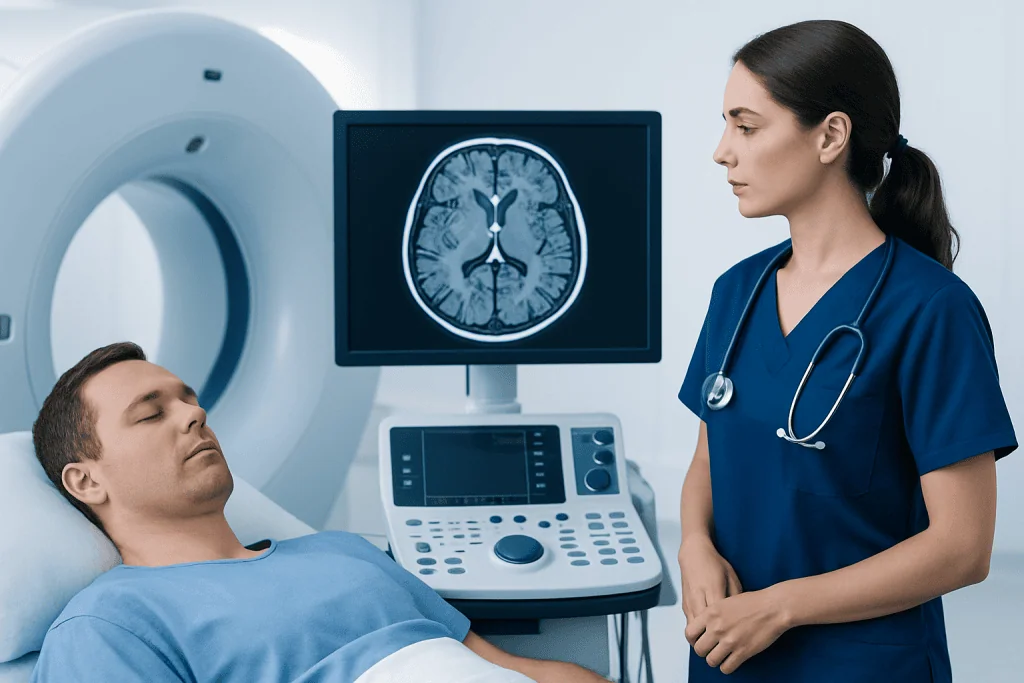
The middle cerebral artery is one of the main branches of the internal carotid artery, which carries blood from the neck toward the brain. There is an MCA on each side of the brain. Each travels within a natural groove near the brain’s surface and gives off smaller branches that deliver oxygen-rich blood to broad areas of one cerebral hemisphere.
The exact functions affected by an MCA problem depend on which side and which branch is involved. In many people, the left side of the brain is dominant for language. Therefore, a left MCA event may cause difficulty speaking, understanding speech, reading, or writing. A right MCA event may be more likely to affect attention to one side of the body or surroundings, spatial awareness, and recognition of visual information.
The MCA also supplies areas that help control movement and feeling in the face and arm, often more than the leg. For this reason, clinicians carefully assess facial symmetry, arm strength, sensation, speech, vision, coordination, and alertness when they suspect an MCA-related condition. The abbreviation by itself does not diagnose a disease; it identifies an anatomical blood vessel whose condition may need further evaluation.
Why MCA appears in stroke and scan reports

MCA is frequently used in discussions of stroke because an interruption of blood flow in this artery can cause an ischemic stroke. This may happen when a clot forms in a brain artery, travels from the heart or another blood vessel, or when narrowing from artery disease reduces blood flow. A less common but serious problem is bleeding from a weakened blood vessel, including an aneurysm in or near the MCA circulation.
Imaging reports may use phrases such as “MCA territory infarct,” “MCA stenosis,” or “MCA occlusion.” An infarct means an area of tissue injury caused by inadequate blood supply. Stenosis means narrowing, and occlusion means blockage. These terms describe findings that must be interpreted alongside the person’s symptoms, examination, timing, medical history, and imaging details.
Doctors may use computed tomography (CT), CT angiography, magnetic resonance imaging (MRI), MR angiography, ultrasound of neck vessels, heart testing, and blood tests to investigate a suspected stroke. The choice depends on the clinical situation. Rapid assessment matters because some people with an acute ischemic stroke may be eligible for time-sensitive treatments intended to restore blood flow, while others need targeted care to prevent complications and reduce future risk.
- Left MCA involvement: may affect language and cause weakness or numbness on the right side.
- Right MCA involvement: may affect awareness of the left side and cause weakness or numbness on the left side.
- Small branch involvement: may produce more limited symptoms, but still requires medical assessment.
Symptoms that may suggest an MCA-related stroke
Symptoms of an MCA stroke usually begin suddenly. They can include weakness, numbness, or drooping of the face on one side; weakness or loss of feeling in one arm or leg; trouble speaking clearly; difficulty finding or understanding words; new confusion; loss of balance; or a sudden change in vision. Symptoms may be obvious, but they can also be subtle, especially when a smaller branch is involved.
A useful public reminder is to think of FAST: Face drooping, Arm weakness, Speech difficulty, and Time to call emergency services. This is not a diagnosis, and not every stroke follows this pattern. Sudden severe headache, loss of consciousness, seizure, abrupt dizziness with neurological symptoms, or a new major change in behavior can also require emergency evaluation.
Symptoms that improve after a few minutes should not be ignored. A transient ischemic attack, sometimes called a TIA or “mini-stroke,” can cause temporary neurological symptoms without lasting visible injury on some scans. It may be an important warning sign of future stroke. Only an urgent clinical assessment can distinguish a TIA, stroke, migraine, seizure-related symptoms, low blood sugar, or another condition that can look similar.
MCA in trauma records: motor vehicle collision
In emergency and trauma care, MCA can mean motor vehicle collision. The abbreviation may appear in paramedic records, emergency department notes, imaging requests, discharge summaries, or insurance-related documentation. It describes the mechanism of injury rather than the diagnosis. A record may then specify whether the person was a driver, passenger, pedestrian, cyclist, or motorcyclist, along with details such as speed, use of restraints, airbag deployment, or loss of consciousness.
After a collision, healthcare professionals assess symptoms and the forces involved to decide whether imaging, observation, wound care, pain management, or specialist review is needed. Neck pain, headache, chest pain, abdominal pain, breathing difficulty, limb pain, confusion, vomiting, weakness, or new numbness may need evaluation. Some injuries become more noticeable over the following hours or days, so discharge instructions should be followed carefully.
Not everyone needs extensive testing after every collision. The decision is based on the person’s symptoms, age, medical conditions, medications such as blood thinners, examination findings, and the nature of the incident. It is appropriate to ask the treating team what MCA means in a specific note and what symptoms should prompt a return for urgent care.
How clinicians clarify the abbreviation and plan care
Clinicians avoid relying on abbreviations alone when making important decisions. They consider where the term appears, why the person is receiving care, associated symptoms, physical examination findings, laboratory results, and imaging. For example, “left MCA occlusion” in a CT angiography report has a very different meaning from “presented after MCA” in an emergency note.
When an MCA-related brain circulation problem is suspected, treatment depends on whether the issue is a clot, bleeding, narrowing, aneurysm, inflammation, or another cause. Acute stroke care may involve emergency medicines or procedures for selected patients, followed by close monitoring, rehabilitation, and management of contributing conditions. Long-term prevention may include treatment for high blood pressure, diabetes, high cholesterol, heart rhythm disorders, or other individual risk factors.
When MCA means motor vehicle collision, care focuses on identifying and treating injuries, relieving symptoms safely, and supporting recovery. This may include imaging, treatment for fractures or soft-tissue injuries, concussion guidance, rehabilitation, or referral to another specialist. Acibadem International’s multidisciplinary specialists and JCI-accredited hospitals diagnose and treat neurological and trauma-related conditions for international patients.
When to seek medical care
Emergency medical care is needed immediately for possible stroke symptoms, including sudden facial drooping, weakness or numbness on one side, speech or understanding difficulties, sudden vision loss, severe unexplained headache, new confusion, collapse, or a seizure. The person should not drive themselves to hospital. Emergency services can begin assessment and direct the person to appropriate stroke care.
Urgent assessment is also important after a motor vehicle collision if there is loss of consciousness, worsening headache, repeated vomiting, confusion, seizure, neck or back pain with weakness or numbness, chest pain, trouble breathing, abdominal pain, heavy bleeding, or an inability to use a limb normally. People taking blood-thinning medicines, older adults, pregnant people, and young children may need a lower threshold for medical review after an injury.
For a non-urgent question about an abbreviation on a report, patients can contact the clinician who ordered the test, their primary care doctor, or the medical records department. Bringing the full report, rather than only the abbreviated phrase, helps the clinician give an accurate explanation. Online information can provide context, but it cannot determine the intended meaning or replace individual medical advice.
Frequently asked questions
What is the most common meaning of MCA in medical terms?
In neurology and brain imaging, MCA most often means middle cerebral artery. This artery supplies blood to large areas of the brain, so it is commonly mentioned in stroke assessments and scan reports.
Does MCA always mean middle cerebral artery?
No. In emergency or trauma records, MCA may mean motor vehicle collision. The full sentence, healthcare setting, and nearby terms are needed to determine the intended meaning.
What does an MCA occlusion mean?
An MCA occlusion means that the middle cerebral artery, or one of its branches, is blocked. It can reduce blood flow to the brain and may cause an ischemic stroke, requiring urgent assessment and treatment planning.
What symptoms can occur with an MCA stroke?
Symptoms can include sudden weakness or numbness on one side, facial drooping, speech or language problems, vision changes, confusion, or loss of balance. Because stroke symptoms can be time-sensitive, emergency services should be contacted immediately if they occur.
Can an MCA stroke affect speech?
Yes. When the MCA on the language-dominant side of the brain is affected, a person may have trouble speaking, understanding words, reading, or writing. Language effects vary widely depending on the location and size of the affected area.
Should a person be concerned if MCA is written on an emergency department note?
Not necessarily. In an emergency note, it may simply record that the person was involved in a motor vehicle collision. The note should also describe any injuries, tests, findings, and follow-up recommendations.
This article is for general information only and is not a substitute for professional medical advice. Please consult a qualified doctor about your individual situation.
Explore treatments in Turkey — costs, top hospitals & a free quote
JCI-accredited · board-certified surgeons · reply within 24h
Add us as a Preferred Source to see more of our trusted health content across Google Search, AI Overviews and Discover.

More from the Health Library

Oversleeping: What Patients Need to Know

Otoconia — Explained by Medical Evidence, Not Myths

Gerontologist — Explained by Medical Evidence, Not Myths

Nosophobia: Understanding the Fear of Serious Illness

Slippery Elm: What Patients Need to Know