Pityriasis Rosea vs Ringworm: Causes and Appearance

Ringworm is caused by fungi; pityriasis rosea is not a fungal infection and is not usually contagious. Ringworm often forms an enlarging, scaly ring with a clearer center, while pityriasis rosea commonly begins with one larger herald patch followed by smaller patches.
Key Takeaways
- Ringworm is caused by fungi; pityriasis rosea is not a fungal infection and is not usually contagious.
- Ringworm often forms an enlarging, scaly ring with a clearer center, while pityriasis rosea commonly begins with one larger herald patch followed by smaller patches.
- A clinician may confirm ringworm by examining a skin scraping under a microscope or sending it for laboratory testing.
- Antifungal medicines treat ringworm, but they do not treat pityriasis rosea.
- A new widespread rash, a rash in pregnancy, or a rash with pain, fever or mucosal sores should be assessed promptly.
Pityriasis rosea and ringworm can both cause scaly pink or red patches, but they are different conditions. Pityriasis rosea is usually a temporary inflammatory rash that resolves on its own, whereas ringworm is a contagious fungal infection that needs antifungal treatment.
Pityriasis Rosea vs Ringworm: A Side-by-Side Comparison
Pityriasis rosea and ringworm may look similar at first because both can produce scaly, discolored patches on the skin. The key difference is their cause: ringworm, also called tinea, is a superficial fungal infection, while pityriasis rosea is an inflammatory skin eruption whose exact cause is not fully understood. Pityriasis rosea is generally temporary and tends to clear without specific treatment; ringworm can persist or spread if it is not treated with an appropriate antifungal medicine.
| Feature | Pityriasis rosea | Ringworm |
|---|---|---|
| Cause | Usually an inflammatory reaction, possibly associated with viral reactivation in some cases | Dermatophyte fungi infecting the outer skin layer |
| Contagious? | Not thought to be contagious | Can spread through close contact, shared items, animals, and contaminated surfaces |
| Typical first sign | One larger oval patch, called a herald patch | One or more scaly patches that gradually expand outward |
| Pattern | Smaller oval patches may follow on the trunk in lines of skin cleavage | Often a ring-shaped lesion with a raised scaly edge and relative central clearing |
| Usual course | Often improves over several weeks | May worsen, spread, or recur without treatment |
| Main treatment approach | Itch relief and skin comfort while the rash settles | Topical or, when needed, oral antifungal treatment |
Appearance alone does not always provide a definite answer. Ringworm does not always make a perfect circle, especially in early stages or on darker skin tones. Likewise, pityriasis rosea can occasionally appear in less typical locations or patterns. A medical assessment is useful when the diagnosis is uncertain, the rash is widespread, or initial treatment has not helped.
How the Rashes Usually Look and Feel
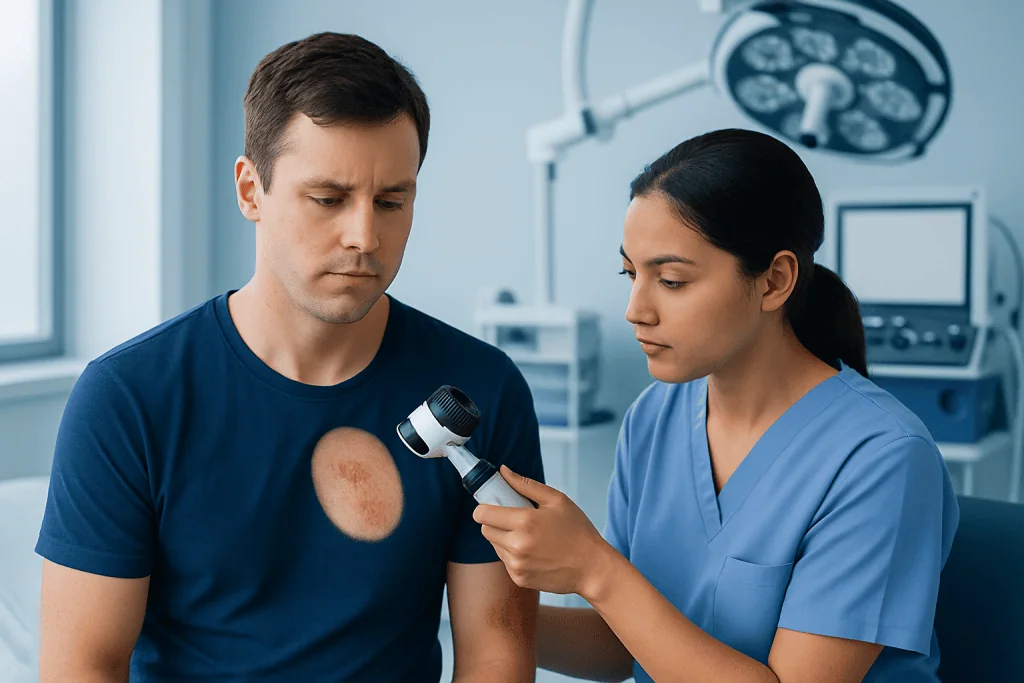
Pityriasis rosea often starts with a single, larger oval plaque on the chest, abdomen, back, or neck. This herald patch may be pink, tan, brown, purple, or darker than the surrounding skin depending on natural skin tone. It commonly has fine scale just inside its border. Days to a few weeks later, many smaller oval patches can develop, especially across the trunk and upper arms or thighs.
The later pityriasis rosea rash is sometimes described as following a “Christmas tree” pattern on the back because the patches align with natural skin lines. Itching may be absent, mild, or bothersome, and can increase with heat, sweating, or hot showers. Most people otherwise feel well, although a mild cold-like illness may precede the rash in some cases.
Ringworm of the body, medically called tinea corporis, often begins as a small scaly patch that slowly enlarges. Its outer edge may be more raised, red, darker, or scaly than the center. As it expands, the middle can look clearer, creating the familiar ring-like appearance. Itching is common, but not universal. Ringworm can affect many body areas and may be passed between people, from animals such as cats or dogs, or through shared towels, clothing, sports equipment, or damp communal surfaces.
Neither condition should be diagnosed solely from an online image. Other conditions, including eczema, psoriasis, contact dermatitis, drug eruptions, secondary syphilis, and other fungal infections, can sometimes resemble one or both of these rashes. Skin color can also alter how redness and inflammation appear, making professional examination especially valuable when the rash is unclear.
How a Clinician Tells Them Apart

A clinician begins by asking about the rash timeline, itch, recent illnesses, household contacts, exposure to animals, sports participation, travel, new medicines, and previous skin conditions. The distribution of the rash and the appearance of its border can offer important clues. A herald patch followed by multiple smaller trunk lesions supports pityriasis rosea, while a slowly enlarging patch with an active scaly rim supports ringworm.
When ringworm is suspected, a clinician may gently collect scales from the active outer edge of a lesion. The sample can be examined using potassium hydroxide preparation, commonly called a KOH test, which may reveal fungal elements. In selected cases, a fungal culture or other laboratory test can help identify the infection, particularly if the rash has not responded to treatment or if scalp or nail involvement is suspected.
Pityriasis rosea usually does not require laboratory testing when its pattern is typical. However, testing may be appropriate if the presentation is unusual, the rash lasts longer than expected, or another condition needs to be excluded. Depending on the person’s symptoms and medical history, clinicians may consider tests for infections or assess whether a medication reaction is possible.
Using a steroid cream on an undiagnosed fungal rash can reduce visible redness and itch while allowing the fungus to continue spreading. This altered appearance is sometimes called tinea incognito. For this reason, it is sensible to seek medical advice before using prescription-strength steroid products on a new, expanding, scaly rash.
What to Do if It Is Pityriasis Rosea
Pityriasis rosea is generally harmless and self-limited. The rash often fades over several weeks, although the duration can vary. It does not usually require antifungal medication, antibiotics, or aggressive skin treatments. After the active rash has resolved, temporary lighter or darker areas may remain, particularly in richly pigmented skin; these color changes typically improve gradually.
Care focuses on controlling discomfort and avoiding irritation. Fragrance-free moisturizers, lukewarm rather than hot baths or showers, gentle cleansers, and loose breathable clothing can be helpful. A clinician or pharmacist can advise on suitable options for itch relief, which may include a topical anti-itch product, an antihistamine, or a short course of a low-potency anti-inflammatory cream when appropriate.
Strong sunlight or ultraviolet exposure should not be used as unsupervised treatment. Some people notice improvement with carefully managed light exposure, but excessive sun can burn the skin and contribute to pigment changes. It is better to discuss persistent or troublesome symptoms with a dermatologist.
Pregnant people who develop a new rash should contact their obstetric clinician or dermatologist, particularly early in pregnancy. Pityriasis rosea is usually uncomplicated, but a clinician can confirm the diagnosis and discuss the individual situation. A new widespread rash should also be reviewed if it follows the start of a medicine.
What to Do if It Is Ringworm
Ringworm needs antifungal treatment because it is caused by fungi, not worms. For a small, uncomplicated area of ringworm on the body, a clinician or pharmacist may recommend an over-the-counter topical antifungal. It should be used exactly as directed and continued for the full recommended course, even if the rash looks better sooner. A clinician may prescribe oral antifungal medicine for extensive infection, repeated infection, or involvement of the scalp, beard area, or nails.
Keeping the area clean and dry can support treatment. People should avoid sharing towels, clothing, razors, bedding, and sports gear until the infection is controlled. Washing clothing and linens regularly, changing out of sweaty clothes promptly, and wearing footwear in shared showers or changing rooms may reduce spread. Pets with areas of hair loss or scaly skin may need assessment by a veterinarian, since animals can be a source of infection.
Antifungal products are not interchangeable with steroid creams. Combination products containing an antifungal and a steroid may not be appropriate for every situation, especially without a confirmed diagnosis. If a rash spreads despite treatment, returns frequently, or has not improved as expected, medical review is important to confirm the cause and guide the next step.
Scalp ringworm deserves particular attention because creams alone are often insufficient and delayed treatment can lead to hair breakage or, rarely, scarring inflammation. Children with scaly scalp patches, hair loss, swollen lymph nodes, or tender areas of the scalp should be assessed by a qualified clinician.
Prevention and Practical Skin Care
There is no proven way to prevent pityriasis rosea because its precise trigger is uncertain. Once it occurs, gentle skin care can reduce irritation. Avoiding harsh exfoliants, heavily fragranced products, very hot water, and tight clothing may make the rash more comfortable while it heals.
Ringworm prevention focuses on reducing exposure to fungi and keeping skin dry. Hands should be washed after touching a suspected rash, treating an affected pet, or using shared athletic facilities. Towels, socks, underwear, and workout clothing should not be shared. Drying carefully between the toes and in skin folds is also helpful, as fungi thrive in warm, moist environments.
People who participate in contact sports should follow their team, school, or sports organization’s infection-control guidance. Covering a rash alone may not prevent transmission if the lesion remains untreated. A healthcare professional can advise when it is appropriate to return to close-contact activities.
For repeated fungal infections, a clinician may look for contributing factors such as chronic moisture exposure, diabetes, immune suppression, household spread, infected pets, or an incorrect original diagnosis. Recurrent symptoms do not necessarily mean that hygiene is poor; they are a reason to identify the source and choose the most suitable treatment.
When to Seek Medical Care
Medical assessment is appropriate for any unexplained scaly rash that is enlarging, spreading, very itchy, painful, or not improving. It is especially important to seek care when the rash involves the scalp, face, genitals, nails, or a large area of the body. A clinician can distinguish fungal infection from pityriasis rosea and other skin conditions, helping avoid unnecessary or ineffective treatment.
Prompt care is advised if the rash is accompanied by fever, significant unwellness, blisters, skin peeling, pus, severe pain, mouth or eye sores, facial swelling, or trouble breathing. These features are not typical of simple pityriasis rosea or uncomplicated ringworm and need timely evaluation. Urgent assessment is also appropriate for signs of bacterial infection, such as increasing warmth, swelling, tenderness, or drainage.
People who are pregnant, have a weakened immune system, take immune-suppressing medicines, or have diabetes should contact a clinician early about a new or persistent rash. Children with possible scalp ringworm should also be evaluated without delay. Acibadem International’s multidisciplinary specialists and JCI-accredited hospitals can assess and treat skin conditions for international patients when specialist care is needed.
A dermatologist may be particularly helpful when the diagnosis remains uncertain, when fungal testing is needed, or when symptoms do not respond to initial care. Bringing a list of medicines, photographs showing how the rash changed over time, and information about potential exposures can help make the appointment more useful.
Frequently asked questions
Can pityriasis rosea be mistaken for ringworm?
Yes. Both conditions can cause scaly oval or round patches, especially early in their course. Ringworm more often has an expanding, active scaly border, while pityriasis rosea commonly starts with a herald patch and then produces multiple smaller trunk lesions.
Is pityriasis rosea contagious like ringworm?
Pityriasis rosea is not generally considered contagious and does not usually spread through household contact. Ringworm is a fungal infection that can pass between people, from animals to people, and through contaminated personal items or surfaces.
Will antifungal cream treat pityriasis rosea?
No. Antifungal cream targets fungi, and pityriasis rosea is not considered a fungal infection. It may be used unnecessarily if the rash is misdiagnosed, which is why an uncertain or persistent rash should be checked by a clinician.
Can ringworm have more than one patch?
Yes. Ringworm can cause several lesions, especially after skin-to-skin contact, scratching, or exposure from a shared source such as an infected pet. Multiple lesions may also occur when the infection has been present for some time.
How long does pityriasis rosea usually last?
Pityriasis rosea often improves over several weeks, although the timing varies from person to person. If the rash is persisting, worsening, or does not fit the usual pattern, medical review can help rule out another cause.
Should a person use steroid cream on a suspected ringworm rash?
It is best to ask a clinician or pharmacist before using steroid cream on a suspected fungal rash. Steroids can temporarily reduce redness and itch but may allow a fungal infection to spread or make it harder to recognize.
This article is for general information only and is not a substitute for professional medical advice. Please consult a qualified doctor about your individual situation.
Explore treatments in Turkey — costs, top hospitals & a free quote
JCI-accredited · board-certified surgeons · reply within 24h
Add us as a Preferred Source to see more of our trusted health content across Google Search, AI Overviews and Discover.

More from the Health Library

What Is Amitriptyline Used for? A Doctor-Reviewed Answer

How Long Keytruda Stays in Your System After Stopping

Can You Take Ibuprofen on an Empty Stomach? A Doctor-Reviewed Answer

Colon Pain: Possible Causes and When to Seek Care

Can Vitamin B12 Deficiency Be a Sign of Cancer? Here Is What the Evidence Says