Wide Complex Tachycardia Treatment: How It Works, Results and What to Expect

A wide complex tachycardia is a fast rhythm with widened electrical signals on an ECG and should be assessed promptly. Until proven otherwise, a regular wide complex tachycardia is commonly managed as ventricular tachycardia in acute care.
Key Takeaways
- A wide complex tachycardia is a fast rhythm with widened electrical signals on an ECG and should be assessed promptly.
- Until proven otherwise, a regular wide complex tachycardia is commonly managed as ventricular tachycardia in acute care.
- Unstable symptoms such as fainting, chest pain, low blood pressure or severe breathlessness require emergency treatment.
- Treatment may include synchronized cardioversion, antiarrhythmic medicine, catheter ablation or an implantable cardioverter-defibrillator.
- The outlook depends largely on the rhythm type, heart function, underlying heart disease and response to treatment.
Wide complex tachycardia treatment is guided first by how stable the person is, then by the likely heart rhythm and its underlying cause. Urgent electrical cardioversion may be needed for an unstable episode, while medicines, catheter ablation, implanted devices and treatment of heart disease can help prevent recurrence.
Overview: how wide complex tachycardia treatment works
Wide complex tachycardia treatment aims to quickly restore a safe heart rhythm, support circulation and identify why the rhythm occurred. A tachycardia is a heart rate that is faster than normal. It is called “wide complex” when the electrical tracing on an electrocardiogram (ECG) shows a widened QRS complex, usually 120 milliseconds or longer.
Some wide complex rhythms arise in the heart’s lower chambers and are called ventricular tachycardia (VT). Others are fast rhythms that begin above the ventricles but travel through the heart in an unusual way. Because VT can be dangerous, clinicians generally approach an unexplained wide complex tachycardia cautiously and treat it as VT unless assessment shows otherwise.
The immediate plan depends on the person’s symptoms, blood pressure, mental alertness, oxygen level, ECG findings and known heart conditions. A hospital team may involve emergency physicians, cardiologists, electrophysiologists and critical care specialists to provide rapid, coordinated care.
Is wide complex tachycardia serious?
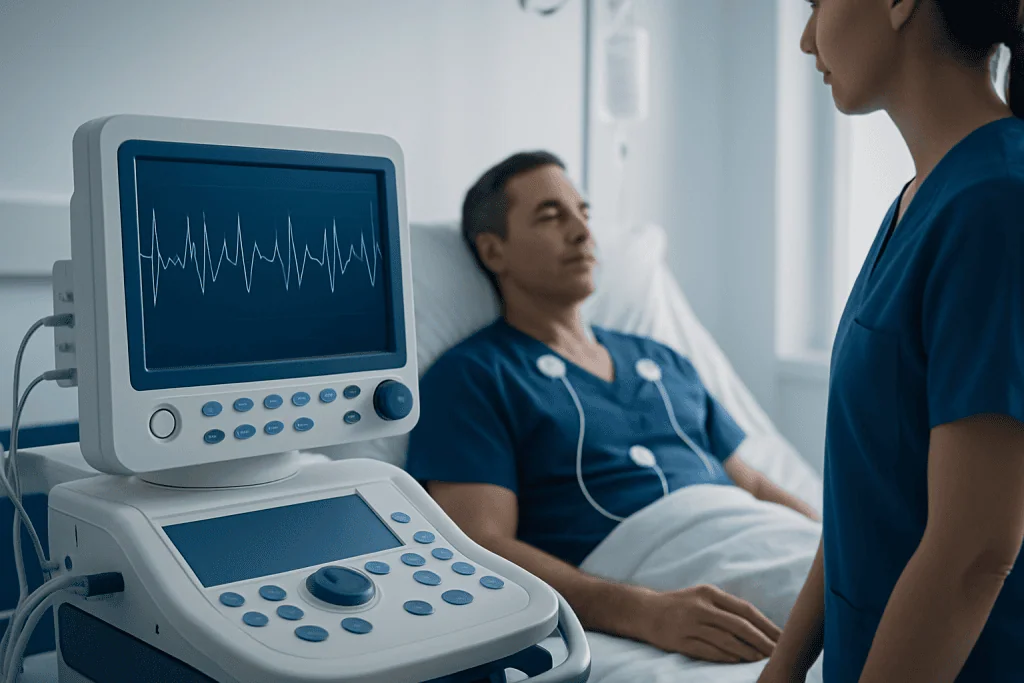
Wide complex tachycardia can be serious, particularly when it is ventricular tachycardia or when it reduces the heart’s ability to pump blood effectively. A very fast or poorly tolerated rhythm can cause dizziness, fainting, low blood pressure, chest discomfort, breathlessness or shock. In some circumstances, VT may deteriorate into ventricular fibrillation, a life-threatening rhythm that requires immediate defibrillation.
Not every wide complex tachycardia has the same level of risk. A person who is awake, comfortable and has stable blood pressure may still need urgent medical evaluation, but the clinical team has time to confirm the rhythm and choose the safest treatment. The ECG pattern, episode duration, medical history and tests of heart structure all help clarify risk.
Emergency services should be contacted immediately for a rapid heartbeat with fainting, near-fainting, chest pain, severe shortness of breath, confusion, marked weakness or collapse. People should not drive themselves to the hospital during these symptoms.
Assessment and candidacy for treatment

Assessment begins with a 12-lead ECG whenever possible, continuous heart monitoring, vital signs and a focused medical history. Clinicians ask about previous arrhythmias, coronary artery disease, heart failure, cardiomyopathy, heart surgery, medication use, stimulant exposure and a family history of sudden cardiac death. Blood tests may check electrolytes, kidney function, thyroid function and markers of heart injury when relevant.
An echocardiogram can evaluate heart pumping strength, valves and chamber size. Depending on the situation, cardiac MRI, coronary imaging, an exercise test, ambulatory rhythm monitoring or an electrophysiology study may also be recommended. These tests help distinguish VT from other rhythms and look for a correctable cause.
People may be candidates for different approaches based on the type of arrhythmia. Catheter ablation is often considered for recurrent VT, symptoms despite medication, medication side effects, or a rhythm arising from a clearly identifiable electrical focus. An implantable cardioverter-defibrillator (ICD) may be advised for selected people at meaningful risk of recurrent dangerous ventricular rhythms or sudden cardiac arrest.
Existing heart disease should be treated alongside the rhythm problem. For example, management may include addressing coronary artery disease, heart failure, inflammation, electrolyte imbalance or medication-related triggers. Individual decisions are made with a cardiology team after weighing expected benefit, procedural considerations and personal preferences.
Step by step: emergency and longer-term treatment
When wide complex tachycardia causes low blood pressure, altered consciousness, ongoing chest pain, signs of shock or acute heart failure, the usual urgent treatment is synchronized electrical cardioversion. With monitoring, brief sedation when feasible and defibrillator pads in place, a carefully timed electrical shock is delivered to reset the rhythm. If there is no pulse, the situation is managed as cardiac arrest with immediate CPR and defibrillation.
For a stable regular wide complex tachycardia, clinicians may use an antiarrhythmic medicine while continuously monitoring the person, or they may perform cardioversion if it is appropriate. The specific medicine is selected by the treating clinician based on the ECG, heart function, other illnesses and potential drug interactions. Careful observation is important because rhythm medicines can sometimes affect blood pressure or alter conduction.
After the immediate episode is controlled, an electrophysiologist may recommend catheter ablation to reduce recurrent arrhythmia. During this procedure, thin catheters are passed through blood vessels to the heart. Electrical mapping identifies the area involved in the abnormal circuit, and controlled heat or cold energy is used to modify small targeted areas of tissue. Sedation or anesthesia and the exact technique depend on the rhythm and the person’s health.
For some patients, an ICD is part of long-term protection. The device continuously monitors the rhythm and can deliver pacing or a shock if it detects a dangerous ventricular arrhythmia. ICDs do not replace treatment of the underlying rhythm problem, but they may lower the risk of death from certain recurrent life-threatening arrhythmias.
Benefits, risks and recovery timeline
Prompt treatment can restore an effective rhythm, relieve symptoms and protect blood flow to the brain and other organs. Longer-term care can reduce future episodes, improve quality of life and address the heart condition contributing to the arrhythmia. However, no approach completely removes all risk for every person, so follow-up and an individualized emergency plan remain important.
Electrical cardioversion is often completed within minutes once a team is prepared. People may feel sleepy for several hours after sedation and can have mild skin irritation where pads were placed. If no complications or ongoing cause requires admission, some people can go home the same day; others need monitoring in hospital, especially after VT or if they have structural heart disease.
Recovery after catheter ablation commonly includes several hours of bed rest to protect the catheter entry site, followed by a period of reduced strenuous activity as advised by the care team. Mild bruising or tenderness in the groin, wrist or neck can occur. Depending on the complexity of the procedure and the underlying heart condition, hospital observation may be brief or longer.
Possible procedural risks include bleeding, bruising, blood vessel injury, infection, blood clots, damage to the heart or surrounding structures, rhythm recurrence and, rarely, more serious complications. Antiarrhythmic medicines also have potential side effects and interactions. The team explains the relevant risks before treatment and reviews symptoms that should prompt urgent contact after discharge.
How long does it take to get rid of tachycardia?
The time needed to stop tachycardia varies with the rhythm, its cause and the person’s stability. An unstable episode may be terminated within minutes by synchronized cardioversion. Stable episodes may stop with monitored treatment, may resolve spontaneously, or may require a more gradual diagnostic and treatment process.
Even after the immediate fast rhythm ends, finding and treating the cause can take days to weeks. Testing may identify factors such as low potassium or magnesium, medication effects, ischemic heart disease, thyroid disease or scar tissue in the heart. Some people need only trigger management and follow-up, while others need ongoing medication, ablation or a device.
After ablation, the goal is long-term reduction or elimination of the target rhythm rather than a guarantee that every palpitation will disappear immediately. The care team may schedule rhythm monitoring and follow-up visits to assess healing, medication needs and whether further treatment is required.
What drugs should be avoided in patients with irregular wide complex tachycardia?
Irregular wide complex tachycardia needs expert interpretation because one possible cause is atrial fibrillation with pre-excitation, such as Wolff-Parkinson-White syndrome. In this setting, medicines that only slow conduction through the atrioventricular (AV) node can be harmful. They may allow very rapid conduction over an accessory pathway and increase the risk of a dangerous ventricular rhythm.
Clinicians generally avoid isolated AV-nodal blocking medicines in suspected pre-excited atrial fibrillation, including adenosine, beta blockers, non-dihydropyridine calcium channel blockers such as verapamil or diltiazem, digoxin and, in many emergency guidelines, intravenous amiodarone. The safest choice depends on the precise rhythm and clinical condition, so treatment should be directed by emergency and cardiology professionals.
People should not attempt to self-treat a new rapid irregular rhythm with leftover medication or another person’s prescription. Bringing an up-to-date medication list to emergency care helps clinicians avoid interactions and select appropriate treatment.
What is the prognosis for wide complex tachycardia?
The prognosis for wide complex tachycardia is highly variable. It is generally more favorable when the rhythm has a reversible trigger or occurs in a structurally normal heart, and more guarded when it is associated with reduced heart pumping function, prior heart attack scar, inherited cardiomyopathy or advanced heart failure.
Accurate diagnosis makes a meaningful difference. Treatment may prevent recurrent episodes and reduce symptoms, while ICD therapy can protect selected people from sudden death due to dangerous ventricular arrhythmias. Regular follow-up allows clinicians to adjust medication, review device data when applicable and monitor the underlying heart condition.
People can support heart health by taking prescribed medicines consistently, avoiding non-prescribed stimulants, limiting alcohol when advised, maintaining sleep and hydration, and attending recommended reviews. Exercise advice should be individualized, particularly after VT or when an inherited heart condition is being evaluated.
Acibadem International’s multidisciplinary cardiology and electrophysiology specialists in JCI-accredited hospitals assess and treat arrhythmias for international patients, including evaluation for ventricular tachycardia.
When to seek medical care
A new episode of a fast heartbeat should be medically assessed, especially if it is persistent, recurrent, associated with known heart disease or accompanied by dizziness, shortness of breath, chest discomfort or reduced exercise tolerance. A clinician may arrange an ECG, ambulatory monitor or referral to a heart rhythm specialist even if symptoms have already resolved.
Emergency care is needed immediately for palpitations with collapse, fainting, severe dizziness, chest pain, severe breathlessness, confusion, blue or gray lips, or signs of poor circulation. If a person is unresponsive and not breathing normally, bystanders should call emergency services and begin CPR if trained.
People with an established arrhythmia diagnosis should follow their individualized action plan. They should seek timely advice for increasing episode frequency, ICD shocks, new medication side effects or any symptoms that feel different from their usual pattern.
Frequently asked questions
What is wide complex tachycardia?
Wide complex tachycardia is a rapid heart rhythm with a widened QRS pattern on an ECG. It may be ventricular tachycardia or a rhythm starting above the ventricles that is conducted abnormally. An ECG and clinical assessment are needed to determine the cause.
Can wide complex tachycardia go away on its own?
Some episodes can stop spontaneously, particularly if they are brief and caused by a reversible trigger. However, a wide complex rhythm should not be assumed to be harmless, especially when it is new, prolonged or symptomatic. Medical assessment is important even if the heartbeat returns to normal.
Is cardioversion painful?
Synchronized cardioversion is usually performed with sedation when time and the person’s condition allow, so the person generally does not experience the shock as painful. Mild skin tenderness where pads were applied can occur afterward. In a life-threatening emergency, restoring circulation takes priority over sedation.
When is catheter ablation considered for wide complex tachycardia?
Catheter ablation may be considered for recurrent ventricular tachycardia, bothersome symptoms, episodes that continue despite medication, or when medicines are unsuitable. It may also be recommended when mapping identifies an arrhythmia source that can be targeted. Suitability depends on the rhythm type, heart anatomy and overall health.
Can stress cause wide complex tachycardia?
Stress can increase adrenaline and trigger palpitations or contribute to some fast rhythms, but it should not be assumed to be the cause of wide complex tachycardia. Heart disease, scar tissue, electrolyte abnormalities, medicines and inherited conditions are among other possible contributors. A clinician should evaluate new or recurrent episodes.
What should a person do after an episode of wide complex tachycardia?
After emergency assessment, the person should attend recommended cardiology follow-up and complete any tests advised to identify the cause. They should take medications only as prescribed and discuss caffeine, alcohol, supplements and exercise with their clinician. New severe symptoms or a recurrent prolonged episode require urgent medical care.
References
- American Heart Association
- American College of Cardiology
- Heart Rhythm Society
- European Society of Cardiology
- National Heart, Lung, and Blood Institute
This article is for general information only and is not a substitute for professional medical advice. Please consult a qualified doctor about your individual situation.
Heart care in Turkey — expert evaluation and treatment
JCI-accredited · board-certified surgeons · reply within 24h
Check your numbers in seconds
BMI, calories, due date, blood pressure and 30+ more clinical calculators — free, instant, doctor-reviewed ranges.