Jaundice Light Therapy at Home: How It Works, Results and What to Expect
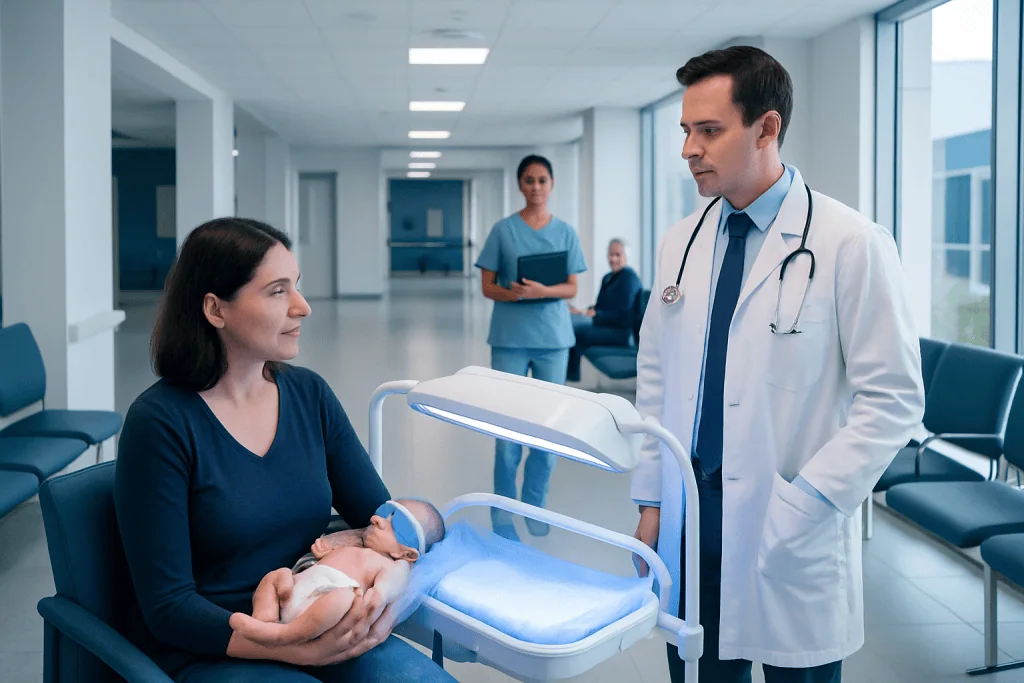
Home phototherapy is intended mainly for selected newborns with uncomplicated, mild to moderate jaundice. Phototherapy changes bilirubin into forms that can leave the body in urine and stool.
Key Takeaways
- Home phototherapy is intended mainly for selected newborns with uncomplicated, mild to moderate jaundice.
- Phototherapy changes bilirubin into forms that can leave the body in urine and stool.
- A clinician must confirm eligibility and arrange follow-up bilirubin testing before home treatment begins.
- Feeding often and monitoring wet diapers, stools, temperature and alertness support safe treatment.
- Yellowing may improve before bilirubin levels have fallen enough, so blood tests remain important.
- Urgent assessment is needed if a baby is difficult to wake, feeds poorly, has fever, unusual movements or worsening yellowing.
Jaundice light therapy at home, also called home phototherapy, uses prescribed blue-spectrum light to help a newborn’s body remove excess bilirubin. It can be an appropriate option for carefully selected babies, but it requires medical assessment, proper equipment, feeding support and scheduled bilirubin monitoring.
Overview: what is jaundice light therapy at home?
Jaundice light therapy at home is a clinician-supervised treatment for newborn jaundice. It uses a medical phototherapy device, usually a blue light blanket or pad, to lower the level of bilirubin in the baby’s blood. Bilirubin is a yellow pigment made when red blood cells naturally break down; newborns may temporarily have difficulty clearing it quickly enough.
Home treatment is not simply placing a baby near sunlight or using a household lamp. Sunlight is not a reliable or safe replacement for prescribed phototherapy because its intensity cannot be controlled and it can lead to overheating, sunburn or dehydration. Medical equipment and blood-test follow-up are essential.
Many newborns develop mild jaundice in the first days after birth, and it often resolves with adequate feeding and time. When bilirubin reaches a level where treatment may help, the care team considers the baby’s age in hours, gestational age, bilirubin trend, feeding, weight change and medical history before deciding whether treatment can safely happen at home.
How home phototherapy works
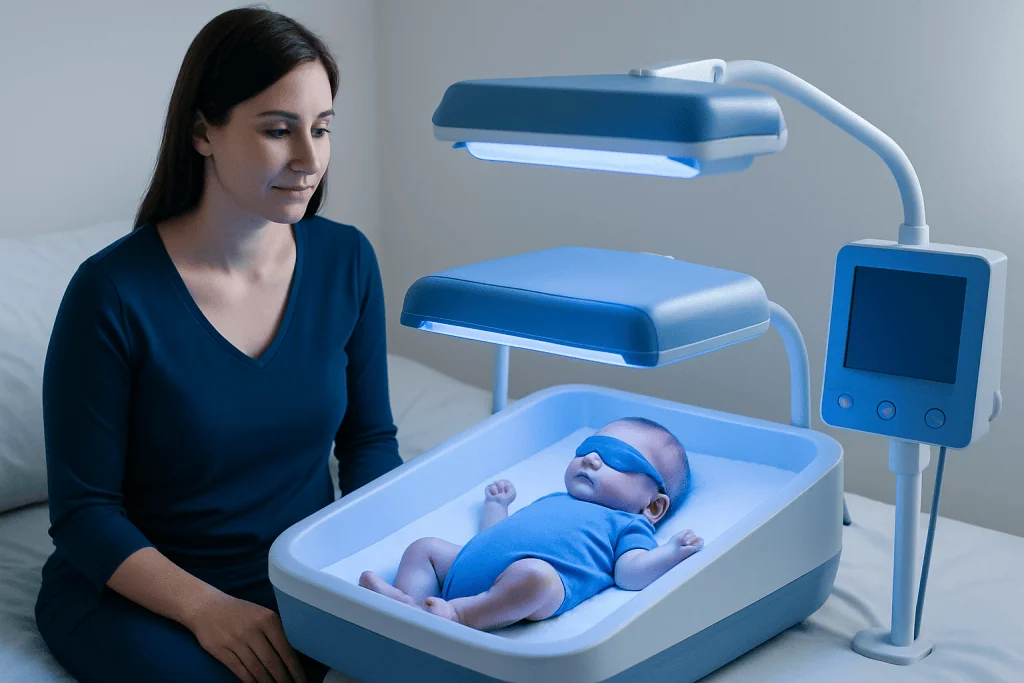
Phototherapy exposes bilirubin in the skin to a specific wavelength of blue light. The light changes bilirubin into water-soluble forms that the body can remove more easily through urine and stool. It does not treat every possible cause of jaundice, which is why clinical evaluation remains important.
At home, the most common system is a fiber-optic blanket or pad placed against the baby’s skin beneath clothing or a wrap. Some services may provide an overhead light unit. The device is used exactly as instructed by the prescribing team, including guidance on skin exposure, feeding breaks and safe positioning.
Light treatment is most effective when it is used consistently. Families are usually advised to keep the baby on the device as much as possible, with breaks for feeding, burping, diaper changes and comforting. A clinician will set the plan and determine when repeat bilirubin testing is needed.
- Phototherapy helps the body clear bilirubin; it does not replace feeding.
- The response is assessed with bilirubin measurements, not skin color alone.
- Parents should use only prescribed, approved equipment and instructions.
Who may be a candidate for jaundice light therapy at home?
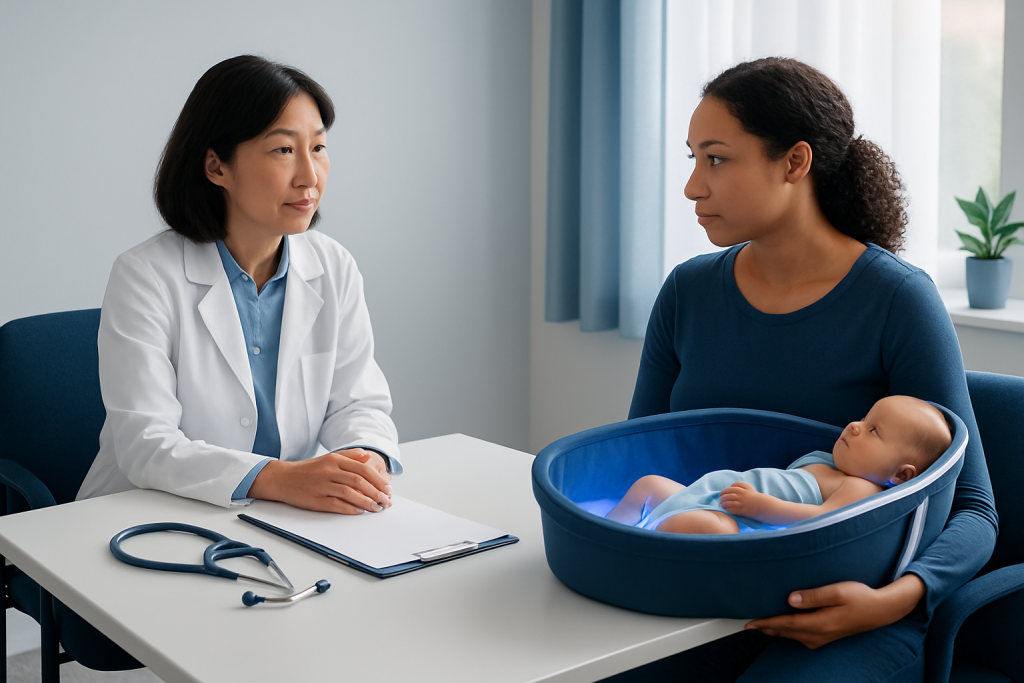
Home phototherapy may be considered for a newborn who is otherwise well, is feeding adequately, has a bilirubin level that is suitable for outpatient management and can return promptly for blood tests or review. The family also needs a safe home setting, reliable access to the care team and confidence using the equipment.
It may not be appropriate for babies born significantly early, babies with rapidly rising bilirubin, signs of illness, dehydration, substantial feeding difficulty or a higher likelihood of hemolysis, where red blood cells break down faster than usual. Babies with certain blood-group incompatibilities, infection concerns or other medical conditions may need hospital observation and more intensive treatment.
The decision is individual. A pediatric clinician may review the baby’s gestational age, age after birth, examination findings, weight, urine and stool output, maternal and infant blood groups, and laboratory results. Newborn jaundice can sometimes be associated with newborn jaundice causes that require additional investigation rather than light therapy alone.
What happens during home phototherapy?
Before treatment starts, a healthcare professional measures the bilirubin level and confirms a care plan. Parents receive instructions about the device, how long it should be used, when to feed the baby, how to protect the equipment and whom to contact if they have concerns. They should ask for clarification if any part of the plan is unclear.
During treatment, the baby is placed on or near the prescribed light system according to its instructions. The baby should sleep on their back in a safe sleep space, unless the clinical team provides a different device-specific instruction. Loose blankets, overheating and unapproved positioning should be avoided.
Feeding remains a central part of care. Frequent breastfeeds or formula feeds, as advised by the baby’s clinician, can support hydration and bilirubin elimination. Parents should monitor feeding quality and keep note of wet diapers and stools. The care team may arrange a visiting nurse, clinic appointment or laboratory test within a defined timeframe to recheck bilirubin.
Home phototherapy should continue only for the period recommended by the clinician. It should not be stopped early because the skin appears less yellow, and it should not be extended without advice. For families seeking coordinated assessment and treatment, phototherapy can be planned through an appropriate pediatric service.
How long does it take for light therapy to work on jaundice?
Phototherapy begins changing bilirubin as soon as effective light exposure starts, but the measurable response varies. In many babies, bilirubin levels begin to fall within the first several hours to a day. The total duration may be about one to two days, although some babies need longer treatment depending on the starting level, the cause of jaundice and how well they are feeding.
The medical team will use repeat bilirubin results to decide whether treatment is working and when it can stop. A baby’s face and chest may look less yellow over time, but visible color changes are not a dependable measure of bilirubin level, especially across different skin tones and lighting conditions.
After treatment ends, some babies need another bilirubin check to ensure the level remains at a safe range. This is particularly important when jaundice began early, the bilirubin had been rising quickly or there are risk factors for recurrence.
How to know if phototherapy is working?
The most reliable sign that phototherapy is working is a bilirubin blood test that is falling or no longer rising to a treatment level. Clinicians compare the result with the baby’s age and risk factors rather than relying on one number alone. They also assess the baby’s feeding, hydration, weight and overall behavior.
At home, parents may notice that the yellow color gradually becomes less obvious and that stools become more frequent or looser. These changes can occur during successful treatment, but they cannot confirm that bilirubin is safe. Scheduled testing and communication with the clinical team remain necessary.
Parents should contact the care team promptly if the baby is increasingly sleepy, hard to wake for feeds, feeding less effectively, producing fewer wet diapers, vomiting repeatedly or appearing more yellow. These signs do not always mean treatment has failed, but they require timely assessment.
Benefits, possible risks and recovery after treatment
For appropriate candidates, home phototherapy can allow a baby to receive treatment while remaining with their family and continuing usual feeding routines. It may reduce disruption while still providing medically supervised bilirubin reduction. Its suitability depends on follow-up being dependable and the baby remaining clinically well.
Phototherapy is generally well tolerated. Possible short-term effects include loose stools, mild skin rash, temporary changes in skin color, increased fluid needs or difficulty maintaining temperature if the baby is not managed according to instructions. Fiber-optic blankets generally allow holding and feeding more easily than some overhead systems, but every device has its own directions.
Once bilirubin is at a safe level and treatment has stopped, most babies need no special recovery period. Feeding should continue normally, and follow-up testing should be completed if advised. Jaundice may remain faintly visible for a short time even as the bilirubin level improves.
Can jaundice come back after light therapy? A mild rebound in bilirubin can occur after phototherapy stops, particularly when treatment was started early or an underlying factor is still present. This is why some babies have a repeat test after treatment; a clinically significant rebound is less common in otherwise healthy babies but should be identified through the follow-up plan.
Can jaundice go away without phototherapy? When to seek medical care
Can jaundice go away without phototherapy? Yes. Many cases of normal newborn jaundice are mild and resolve as feeding becomes established and the liver matures. However, it is not safe to assume that yellowing will settle on its own, because bilirubin can sometimes rise to levels that need treatment before the baby looks seriously unwell.
Parents should contact a newborn clinician on the same day if jaundice appears in the first 24 hours after birth, becomes more noticeable, spreads to the legs, lasts longer than expected, or is accompanied by poor feeding or fewer wet diapers. The baby should receive urgent medical assessment if they are very difficult to wake, have a high-pitched cry, fever, unusual limpness or stiffness, repeated vomiting, breathing difficulty, seizures or abnormal movements.
Acibadem International’s multidisciplinary pediatric specialists and JCI-accredited hospitals assess and treat newborn jaundice for international patients when hospital-based monitoring or more intensive care is needed. Families should follow the plan of their own qualified pediatric clinician and seek emergency care promptly for concerning symptoms.
Frequently asked questions
Is jaundice light therapy at home safe for newborns?
It can be safe for selected newborns when it is prescribed by a clinician, uses approved medical equipment and includes scheduled bilirubin monitoring. It is not appropriate for every baby, particularly those who are premature, unwell, feeding poorly or have rapidly rising bilirubin.
Can parents use sunlight instead of a phototherapy light?
No. Sunlight is not a safe or reliable treatment for newborn jaundice because the amount of useful light cannot be controlled and it may cause overheating, dehydration or skin injury. A prescribed phototherapy device provides a controlled treatment approach.
Should a baby wear clothes during home phototherapy?
This depends on the type of device. A fiber-optic blanket is commonly placed directly against the baby’s skin and can often be used under a light layer of clothing, while an overhead light may require more skin exposure. Parents should follow the device instructions and the clinical team’s directions exactly.
Do babies need eye protection with home phototherapy?
Eye protection is generally required for overhead phototherapy lights because the light shines toward the baby’s face. It is usually not needed with fiber-optic blankets because the light is directed into the pad against the skin, but parents should follow the instructions for their specific device.
How often should bilirubin be checked during home phototherapy?
The timing depends on the baby’s bilirubin level, age, risk factors and treatment response. A clinician may arrange repeat testing within hours or the next day and may also recommend a check after treatment ends. Families should not skip or delay the planned test.
What should parents monitor while a baby receives home phototherapy?
Parents should watch feeding effectiveness, wet diapers, stools, body temperature and the baby’s alertness. They should contact the care team promptly if the baby is difficult to wake, feeds poorly, has fewer wet diapers, seems more yellow or develops any concerning symptoms.
References
- American Academy of Pediatrics
- National Institute for Health and Care Excellence
- World Health Organization
- Centers for Disease Control and Prevention
This article is for general information only and is not a substitute for professional medical advice. Please consult a qualified doctor about your individual situation.
Explore treatments in Turkey — costs, top hospitals & a free quote
JCI-accredited · board-certified surgeons · reply within 24h
Add us as a Preferred Source to see more of our trusted health content across Google Search, AI Overviews and Discover.