Plagiocephaly Therapy: How It Works, Results and What to Expect

Most positional plagiocephaly improves with early assessment and simple measures that vary a baby’s head position. Physiotherapy is important when torticollis, or limited neck movement, contributes to the flattening.
Key Takeaways
- Most positional plagiocephaly improves with early assessment and simple measures that vary a baby’s head position.
- Physiotherapy is important when torticollis, or limited neck movement, contributes to the flattening.
- Helmet therapy is considered for moderate to severe cases that do not improve sufficiently with conservative care.
- Treatment is usually most effective while the skull is growing rapidly during infancy, but an assessment at 7 months can still be worthwhile.
- Plagiocephaly is usually a shape difference and does not by itself mean that a baby has a brain problem.
Plagiocephaly therapy supports a more balanced head shape by reducing repeated pressure on one area of a baby’s skull. Treatment may include repositioning, supervised tummy time, physiotherapy for neck tightness and, for selected infants, a custom cranial remolding helmet.
Plagiocephaly Therapy: How It Works
Plagiocephaly therapy is a group of treatments used to improve flattening or asymmetry of a baby’s head shape. In most cases, the condition is positional plagiocephaly, which develops when a soft, growing skull rests repeatedly against the same surface or when a baby prefers turning the head to one side. Therapy aims to reduce ongoing pressure on the flattened area while supporting normal movement and skull growth.
The first approach is usually conservative. Parents may be shown how to alternate the direction a baby faces in the cot, change the side used for holding and feeding, and provide frequent supervised tummy time while the baby is awake. These measures encourage the baby to look in different directions and spend less time resting on the flat spot.
If the baby has torticollis, a condition in which neck muscles are tight or movement is limited, paediatric physiotherapy can help restore comfortable head turning. When flattening is more pronounced or does not respond adequately to these measures, a specialist may discuss helmet therapy. A cranial remolding helmet provides gentle, guided space for growth in flatter areas rather than squeezing the skull into shape.
Positional plagiocephaly differs from craniosynostosis, a less common condition in which skull sutures close too early. A clinician should distinguish between these conditions because their assessment and management are different.
Assessment and Candidacy for Treatment
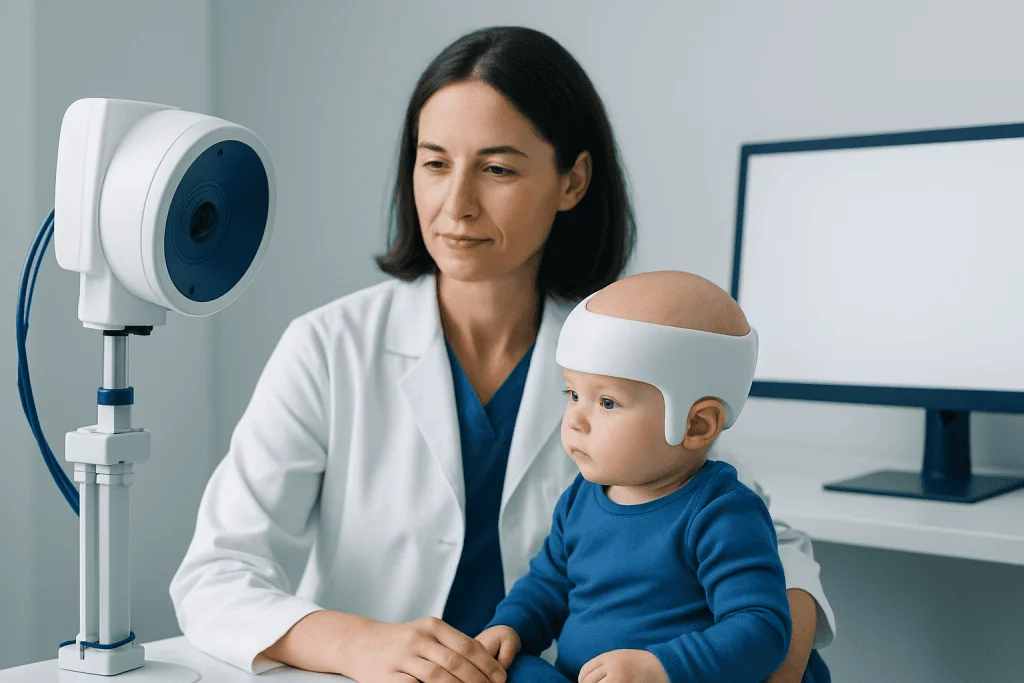
A paediatrician, paediatric physiotherapist, craniofacial specialist or orthotist usually begins with a clinical examination. They assess the head from several angles, check ear position, forehead shape, facial symmetry and neck movement, and ask about sleep position, feeding, developmental milestones and time spent in car seats, bouncers or other supportive devices.
Measurements or three-dimensional photographs may be used to document the degree of asymmetry and monitor progress. Imaging is not routinely necessary for typical positional plagiocephaly. However, it may be considered if the head shape is unusual, skull ridges are felt, head growth is concerning, or a clinician needs to exclude craniosynostosis.
Conservative plagiocephaly therapy is appropriate for many babies, especially when flattening is mild and identified early. Helmet therapy may be considered when asymmetry is moderate to severe, when there is little improvement after repositioning and physiotherapy, or when a baby is first assessed at an age when growth time is becoming more limited.
Suitability is individualized. The decision should consider the baby’s age, skull growth, head-shape measurements, neck mobility, response to earlier measures and the family’s ability to attend reviews and follow the wear plan safely.
What Happens During Plagiocephaly Therapy?

Repositioning therapy begins at home and is incorporated into daily care. Parents can place interesting objects or position themselves on the side the baby is less likely to turn toward, alternate the baby’s orientation in the cot, and vary carrying positions. Awake tummy time should be started gradually and increased as tolerated, always with close adult supervision.
For babies with neck preference or torticollis, physiotherapy typically includes gentle movement exercises, positioning guidance and play activities that encourage turning toward the less-preferred side. Parents are taught techniques to use between appointments. Exercises should be demonstrated by a qualified clinician rather than forced, as movement should remain comfortable for the baby.
If a cranial remolding helmet is recommended, the process usually starts with a scan or mould of the head. A custom lightweight helmet is then made to fit closely. At fitting, the orthotist checks comfort, explains skin care and gives a gradual schedule for building up wear time. Helmets are commonly worn for most of the day, with brief breaks for hygiene and as advised by the treating team.
Follow-up visits are important because the helmet needs adjustment as the baby grows. The team monitors skin, fit, head-shape change and the baby’s tolerance. Families should not buy or alter a helmet without professional assessment, as an incorrect fit may be ineffective or cause pressure problems.
Expected Results, Benefits and Possible Risks
The main benefit of plagiocephaly therapy is an improved head shape and facial symmetry over time. Repositioning and physiotherapy also support comfortable neck movement and age-appropriate opportunities for motor development. Improvement is usually gradual, because treatment works with the baby’s natural skull growth rather than producing an immediate change.
Helmet therapy can provide more directed correction for selected babies with persistent or more marked asymmetry. It is most useful while skull growth is rapid, and results depend on the initial shape, age at treatment, consistent wear when prescribed and regular adjustments. Treatment can improve asymmetry, although complete symmetry cannot always be expected.
Conservative measures are generally low risk when safe-sleep guidance is followed. Babies should always sleep on their backs on a firm, flat sleep surface, even if they have plagiocephaly. Positioning devices, pillows, wedges and sleep products intended to hold a baby’s head in place are not recommended for unsupervised sleep because they may create a suffocation risk.
Possible helmet-related issues include temporary redness, skin irritation, sweating, unpleasant odour, discomfort or difficulty settling during the early adjustment period. These concerns often improve with correct hygiene and fit checks. Persistent redness, broken skin, fever, rash or signs that a baby is in pain should be reported promptly to the clinical team.
How long does it take to correct plagiocephaly?
The time needed to improve plagiocephaly varies. With early repositioning and treatment of neck tightness, some babies show visible improvement over several weeks to months as they gain head control, roll, sit and spend less time lying on the back while awake. Follow-up measurements help show whether progress is on track.
When helmet therapy is used, treatment often lasts several months, but the exact duration depends on the baby’s age, growth rate and severity of asymmetry. Starting earlier in the appropriate treatment window may mean a shorter course than starting later, because the skull grows more quickly in younger infants.
Families should focus on steady progress rather than a fixed deadline. The treating clinician can provide a more individualized estimate after examining the head shape and reviewing changes over time.
Do babies grow out of plagiocephaly? Can plagiocephaly be reversed? Is 7 months too late for helmet therapy?
Do babies grow out of plagiocephaly? Many babies with mild positional plagiocephaly improve as they become more mobile and spend less waking time with pressure on one part of the head. However, improvement is variable. More noticeable flattening, a persistent head-turning preference or associated torticollis deserves professional assessment rather than waiting alone for change.
Can plagiocephaly be reversed? Positional plagiocephaly can often be improved, particularly when treatment starts early and addresses the reason for repeated pressure. Repositioning, tummy time, physiotherapy and, where appropriate, helmet therapy may reduce asymmetry. The goal is meaningful improvement and healthy development; complete correction is not always necessary or possible.
Is 7 months too late for helmet therapy? No. Seven months is not automatically too late, and some babies may still benefit from helmet therapy after specialist assessment. However, skull growth slows gradually with age, so clinicians generally prefer to evaluate persistent moderate or severe asymmetry promptly. The best plan depends on the baby’s measurements, growth, prior treatment and overall clinical picture.
At Acibadem International, multidisciplinary specialists and JCI-accredited hospitals can assess plagiocephaly, neck movement and developmental needs for international patients, and coordinate appropriate paediatric, physiotherapy and orthotic care.
When to Seek Medical Care
Parents should arrange a routine assessment if they notice a persistent flat area, uneven forehead, asymmetrical facial appearance, one ear appearing more forward than the other, or a strong preference for looking to one side. Early advice can make repositioning and physiotherapy easier to implement while the skull is growing rapidly.
Medical review is especially important if a baby cannot comfortably turn the head both ways, has a neck lump or tightness, seems to have delayed motor skills, or the head shape is becoming more asymmetrical despite home measures. A clinician can also check head growth and make sure the pattern is consistent with positional plagiocephaly.
Prompt specialist evaluation is needed if there is a hard ridge along a skull suture, an unusual head shape present from birth that seems to worsen, a bulging fontanelle when the baby is calm and upright, repeated vomiting, unusual sleepiness, seizures or other acute concerns. These signs do not necessarily indicate a serious condition, but they require timely medical assessment.
For safe sleep, babies should continue to be placed on their backs for every sleep. Tummy time is valuable only while awake and directly supervised, and it should never replace established safe-sleep recommendations.
Frequently asked questions
What is the difference between plagiocephaly and brachycephaly?
Plagiocephaly usually refers to flattening on one side of the back of the head, often with some asymmetry of the forehead or ears. Brachycephaly refers to a head that is relatively broad and short because the back of the head is flattened more centrally. Both may be positional and can be assessed using similar approaches.
Does plagiocephaly affect a baby’s brain development?
Positional plagiocephaly is generally considered a skull-shape difference and does not by itself cause brain damage. Some babies with plagiocephaly may also have developmental delays or neck tightness, so clinicians may check development and movement. This helps identify needs early and provide appropriate support.
Can tummy time help plagiocephaly?
Yes. Regular, supervised tummy time while awake reduces time spent with pressure on the back of the head and helps strengthen neck, shoulder and trunk muscles. It should be introduced gradually and done only when an attentive adult is present.
Should a baby sleep on the side to improve a flat head?
No. Babies should be placed on their backs for every sleep to reduce the risk of sleep-related infant death. Side sleeping, pillows and positioners are not safe substitutes for clinical plagiocephaly treatment. Repositioning strategies should be used during awake, supervised time and through changes to the baby’s environment.
How many hours a day does a plagiocephaly helmet need to be worn?
Wear schedules vary by the device and treating team, but helmets are often prescribed for most hours of the day. Families usually build up wear gradually after fitting and remove the helmet for hygiene and as instructed. Consistent use and regular adjustments are important for both safety and effectiveness.
Will helmet therapy be uncomfortable for my baby?
A correctly fitted helmet should not be painful, although babies may need time to adjust to wearing it. Heat, sweating and temporary skin redness can occur, especially early on. The orthotist should review any persistent redness, skin breakdown, poor fit or signs of discomfort.
References
- American Academy of Pediatrics
- Centers for Disease Control and Prevention
- National Health Service
- Congress of Neurological Surgeons
- HealthyChildren.org
This article is for general information only and is not a substitute for professional medical advice. Please consult a qualified doctor about your individual situation.
Explore treatments in Turkey — costs, top hospitals & a free quote
JCI-accredited · board-certified surgeons · reply within 24h
Add us as a Preferred Source to see more of our trusted health content across Google Search, AI Overviews and Discover.