Laser Treatment for Prostate Cancer: How It Works, Results and What to Expect

Laser ablation is a focal treatment that targets a specific area of prostate cancer rather than removing the entire prostate. It is not suitable for every prostate cancer type, grade, location, or stage.
Key Takeaways
- Laser ablation is a focal treatment that targets a specific area of prostate cancer rather than removing the entire prostate.
- It is not suitable for every prostate cancer type, grade, location, or stage.
- MRI, biopsy findings, PSA results, and overall health help the care team decide whether treatment is appropriate.
- Recovery is often shorter than after major surgery, but urinary and sexual side effects can still occur.
- Ongoing PSA tests, imaging, and sometimes repeat biopsy are important after focal therapy.
Laser treatment for prostate cancer is a minimally invasive approach that uses laser energy to heat and destroy a defined area of cancerous prostate tissue. It may be considered for selected people with localized disease, particularly when the goal is to treat the tumor while preserving as much healthy prostate tissue and function as possible.
Overview: what is laser treatment for prostate cancer?
Laser treatment for prostate cancer, also called laser ablation or focal laser ablation, uses focused laser energy to heat and destroy prostate tissue containing cancer. The treatment is designed to target a known tumor area while limiting injury to nearby healthy tissue. It is usually considered for localized prostate cancer, meaning cancer that has not spread beyond the prostate.
Unlike radical prostatectomy, which removes the prostate gland, focal laser treatment treats only part of the gland. The intention is to balance cancer control with preservation of urinary control and sexual function where possible. However, because prostate cancer can be multifocal, with more than one area of cancer in the gland, careful assessment and long-term surveillance are essential.
Laser ablation is one of several approaches that may be discussed for localized prostate cancer. Depending on the cancer features, alternatives may include active surveillance, surgery, radiation therapy, other focal therapies, hormone treatment, or systemic therapies.
How laser ablation works
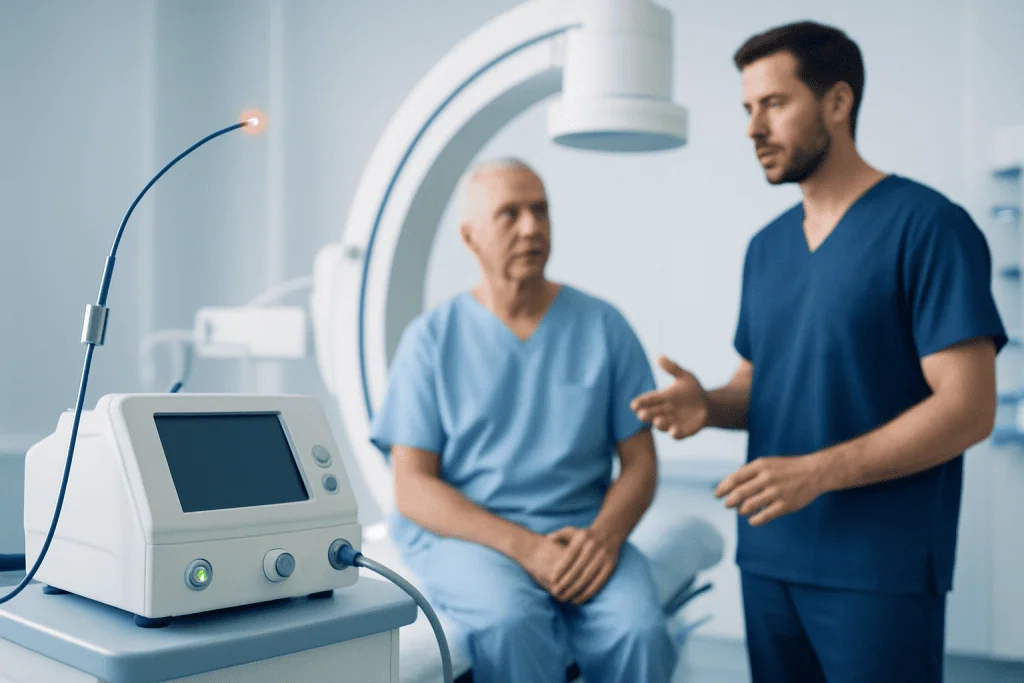
The procedure works by delivering laser light through a thin fiber placed into the prostate. The light produces controlled heat, causing targeted cells to break down. Doctors use imaging guidance to place the fiber accurately and to monitor the treatment area while protecting surrounding structures as much as possible.
Magnetic resonance imaging (MRI) is commonly used before treatment to identify suspicious lesions and map their location. During the procedure, guidance may be provided with MRI, ultrasound, or a combination of imaging methods, depending on the technique and center. Temperature monitoring may also be used to help control the area receiving heat.
The goal is to create a planned zone of tissue destruction that includes the visible tumor and an appropriate margin around it. Because imaging cannot always identify every microscopic cancer focus, laser ablation should be understood as a treatment strategy that requires structured follow-up rather than a one-time procedure with no further monitoring.
Laser treatment is different from laser procedures used to relieve urinary blockage caused by benign prostate enlargement. A cancer-focused procedure is planned around biopsy-confirmed cancer and requires specialist assessment by urology, radiology, pathology, and oncology professionals.
Who may be a candidate?

Laser treatment for prostate cancer may be an option for carefully selected people with a small, clearly identified area of localized cancer. It is more often considered when the disease appears limited to one region of the prostate and when imaging and biopsy findings can define the target reliably.
Clinicians consider the PSA level and its pattern over time, digital rectal examination, multiparametric MRI, biopsy grade group, number and location of positive biopsy samples, prostate size, urinary symptoms, age, general health, and personal priorities. A targeted and systematic biopsy may be needed because it helps identify whether cancer is present elsewhere in the prostate.
People with higher-risk cancer, cancer in several separate parts of the prostate, evidence of spread outside the gland, or disease close to structures that cannot be treated safely may be better served by another approach. Focal treatment may also be less suitable when MRI does not show the cancer clearly enough to guide therapy.
A multidisciplinary discussion is valuable because there is no single best treatment for every person. The decision should include a clear comparison of expected cancer control, possible side effects, follow-up requirements, and the possibility that additional treatment could be needed later.
What happens before and during the procedure?
Before treatment, the care team confirms the diagnosis and maps the cancer. This usually includes review of pathology slides, PSA testing, prostate MRI, and biopsy information. Some patients have additional targeted biopsy samples to ensure the treatment plan matches the full extent of disease.
Patients are given instructions about eating and drinking before anesthesia, regular medicines, and blood-thinning medicines. The exact preparation varies. It is important not to stop prescribed medication without specific advice from the treating clinician.
During the procedure, anesthesia or sedation is used so the patient is comfortable. The doctor places the laser fiber through the skin between the scrotum and anus or, in some settings, through another guided route. Real-time imaging helps position the fiber and assess the treatment zone.
The laser is activated for a planned period, with the team monitoring the temperature and treatment boundaries. A urinary catheter may be inserted at the end of the procedure to allow urine to drain while swelling settles. Many patients return home the same day or after a short observation period, depending on their health and the technique used.
Benefits, limitations and possible risks
A potential benefit of focal laser therapy is that it treats less prostate tissue than whole-gland surgery or radiation. For some appropriately selected patients, this may reduce the likelihood or severity of urinary leakage and erectile difficulties. It is also minimally invasive and may involve a relatively short hospital stay and recovery period.
However, preserving more tissue does not mean there are no side effects. Temporary burning with urination, blood in urine or semen, pelvic discomfort, urinary urgency, difficulty passing urine, and urinary tract infection can occur. A catheter may be needed for several days, and temporary swelling can slow the urinary stream.
Less commonly, more significant complications can include urinary retention, bleeding, infection requiring treatment, narrowing of the urethra, or injury to nearby tissues. Erectile function may change after treatment, especially if cancer is close to the nerves involved in erections. The individual risk depends on the tumor location, baseline function, prostate anatomy, and treatment area.
Another important limitation is uncertainty about long-term cancer control compared with well-established whole-gland treatments for some risk groups. Cancer may remain in the treated zone or be found elsewhere in the prostate later. Repeat focal treatment, surgery, radiation, or another therapy may therefore be recommended in some cases.
Recovery timeline and follow-up
Recovery varies, but mild tiredness and local discomfort are common during the first few days. If a catheter is used, the care team will explain catheter care and when it should be removed. Drinking fluids as advised, avoiding heavy lifting initially, and following instructions about exercise, sexual activity, and driving can support recovery.
Urinary symptoms may temporarily worsen as inflammation resolves. Some people notice urgency, frequency, a weaker stream, or small amounts of blood in urine. These symptoms should gradually improve, but persistent or worsening symptoms should be discussed with the treating team.
Follow-up is a core part of laser treatment for prostate cancer. PSA testing is performed at planned intervals, although PSA does not usually fall to zero because untreated prostate tissue remains. Repeat MRI and, in many programs, follow-up biopsy are used to check the treated area and identify any cancer elsewhere in the gland.
Patients should attend all surveillance appointments even when they feel well. If testing suggests persistent or recurrent cancer, the multidisciplinary team can discuss options such as repeat focal treatment, prostate cancer treatment with surgery or radiotherapy, or continued monitoring where appropriate.
When to seek medical care
People with possible prostate symptoms should arrange medical assessment rather than assuming symptoms are caused by cancer. Difficulty starting urination, a weak stream, frequent urination, blood in urine, bone pain, or unexplained weight loss can have several causes. Early evaluation can help identify the cause and guide appropriate care.
After laser ablation, urgent medical advice is needed for fever, chills, worsening pain, inability to pass urine after catheter removal, heavy bleeding or blood clots in urine, severe weakness, or signs of an allergic reaction to a medicine. These symptoms may indicate infection, urinary blockage, or another complication that needs timely assessment.
A person newly diagnosed with prostate cancer should ask about their cancer grade, stage, imaging results, and all reasonable treatment choices. A second pathology review or specialist opinion can be useful when deciding between surveillance, focal therapy, surgery, radiation, or systemic treatment.
At Acibadem International, multidisciplinary specialists in JCI-accredited hospitals evaluate and treat prostate cancer for international patients, including assessment of whether focal approaches are appropriate. Care plans should always be individualized according to clinical findings and the patient’s preferences.
Frequently asked questions
Is laser treatment for prostate cancer a cure?
Laser ablation can destroy a targeted area of localized prostate cancer, but whether it provides durable cancer control depends on the cancer characteristics and the accuracy of tumor mapping. It is not appropriate for every patient, and ongoing PSA testing, imaging, and often follow-up biopsy are needed to check for remaining or recurrent cancer.
How long does laser treatment for prostate cancer take?
The procedure length varies according to the number, size, and location of areas being treated, as well as the imaging method used. Preparation, anesthesia, recovery monitoring, and catheter placement can add time beyond the actual laser treatment.
Will a patient need a catheter after prostate laser ablation?
Many patients have a urinary catheter for a short period after treatment because swelling can temporarily affect urine flow. The treating team provides individualized instructions for catheter care and removal.
Does laser ablation cause erectile dysfunction?
Erectile function may be preserved better for some patients than with treatments that affect the whole prostate, but erectile dysfunction can still occur. Risk depends on baseline erections, age, other health conditions, and whether treatment is close to the neurovascular bundles.
Can prostate cancer return after laser treatment?
Yes. Cancer can persist in the treated area, recur there, or be detected in another part of the prostate that was not treated. This is why structured follow-up with PSA testing, MRI, and sometimes biopsy is essential.
Is focal laser therapy better than surgery or radiation?
No treatment is best for everyone. Focal laser therapy may offer a tissue-preserving option for selected localized cancers, while surgery and radiation have longer-established evidence for many prostate cancer situations. A specialist team can compare benefits, limitations, and likely side effects for the individual patient.
References
- European Association of Urology
- National Cancer Institute
- American Urological Association
- National Comprehensive Cancer Network
- American Cancer Society
This article is for general information only and is not a substitute for professional medical advice. Please consult a qualified doctor about your individual situation.
Prostate Cancer in Turkey — costs, top hospitals & a free quote
JCI-accredited · board-certified surgeons · reply within 24h
Add us as a Preferred Source to see more of our trusted health content across Google Search, AI Overviews and Discover.

More from the Health Library



Related Specialists

Dr. Cansel Karaali
Anesthesiology
Prof. Dr. V. Melih Kara
General Surgery
Dr. Ertan Sağol
Orthopedic Surgery & Traumatology
Prof. Dr. İftahar Köksal
Infectious Diseases & Clinical Microbiology