

Why Do Bladder Stones Form? Retained Urine, Enlarged Prostate and What Treatment Fixes

Key Takeaways
- Bladder stones form when urine is left behind after voiding, so the underlying problem is almost always drainage rather than diet.
- Bladder stones make up roughly 5 percent of urinary tract stones and, in adults, occur mostly in men over 50 with prostate enlargement.
- Uric acid stones are common in obstructed adults and can be invisible on plain X-ray, which is why ultrasound or CT is used to find them.
- Struvite stones are driven by urease-producing bacteria that turn urine alkaline, so treating the infection is part of treating the stone.
- No drink or supplement has been shown to dissolve a formed bladder stone; most are removed through a scope in a procedure called cystolitholapaxy.
- Stones tend to return unless the cause of retention is managed, which is why men are often offered prostate treatment alongside stone removal.
Bladder stones usually form when the bladder does not empty fully, so leftover urine sits, concentrates and lets minerals crystallize. In adults the most common reason is an enlarged prostate blocking outflow; nerve damage, long-term catheters and infection are other causes. Stones rarely pass on their own. Treatment typically means removing the stone, most often through a scope, and then addressing whatever kept urine trapped.
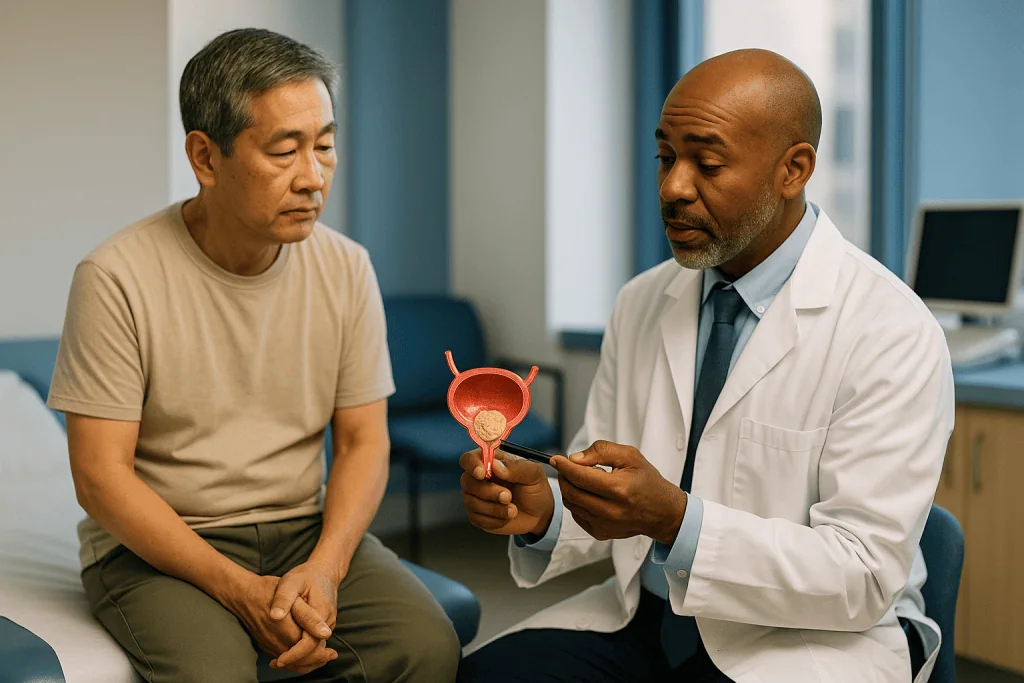
He had blamed the prostate for years. Three trips to the bathroom a night, a stream that took its time, the sense that he was never quite finished. Then one morning the water in the bowl was faintly pink, and the ultrasound a week later showed something nobody had mentioned before: a stone, sitting at the bottom of his bladder like a pebble in a boot.
His first question was the one almost everyone asks in that chair. Where did it come from? Understanding what causes bladder stones turns out to be less about diet or bad luck and more about plumbing. A bladder is built to empty completely, many times a day. When it cannot, whether because a gland is pressing on the outlet or the muscle has lost its nerve supply, urine lingers, thickens and begins to crystallize.
This explainer follows that logic from cause to treatment: why the stone formed, how clinicians confirm the reason, what removal actually involves, and why fixing the drainage matters more than fixing the stone.
What causes bladder stones: a bladder that never quite empties
Think of the bladder less as a tank and more as a rinse cycle. Several times a day it fills, contracts and pushes almost everything out, carrying dissolved minerals away before they can settle. Stones appear when that cycle breaks. Ask a urologist what causes bladder stones and the first answer is not diet but incomplete emptying: a portion of urine stays behind after every visit to the bathroom, grows more concentrated, and gives crystals the stillness and time they need to grow.
That leftover volume is called post-void residual, meaning the urine still in the bladder after you have finished passing water. A healthy bladder leaves very little. When outflow is blocked or the muscle cannot squeeze properly, the residual climbs, and with it the risk of a stone (Mayo Clinic).
Who gets them tells the story. Bladder stones are uncommon compared with kidney stones, accounting for roughly 5 percent of urinary tract stones, and in adults they cluster heavily in men over 50, the same group in whom prostate enlargement begins to squeeze the urethra (StatPearls, NHS). Nerve damage that weakens bladder contraction, long-term catheters, bladder prolapse in women and repeated infection round out the list.
Here is the point worth underlining for any reader: a bladder stone is usually the visible result of a drainage problem, not a disease in itself. Removing the stone treats the immediate trouble. Finding and managing the reason urine was sitting still is what stops the next one. Every section that follows works back toward that idea.
How does urine turn into a stone?
Urine is a solution held near the edge of its capacity. Salts of calcium, uric acid, phosphate and magnesium are dissolved in it, and as long as the fluid keeps moving and stays moderately dilute, they remain dissolved. Concentrate it, let it stand for hours, or shift its acidity, and the solution becomes supersaturated, a chemistry term meaning it holds more mineral than it can comfortably keep in liquid form.
Crystals then need something to grow on. A speck of debris, a cluster of bacteria, a fragment of kidney stone, a strand of mucus or the tip of a catheter can act as a nucleus. Layer by layer, more mineral deposits onto that seed. Given weeks of stagnant urine, a grain becomes a pebble; given months or years, a pebble can grow to several centimeters across, and often more than one forms at a time (Cleveland Clinic).
Composition varies with the cause. In adults with obstruction, uric acid stones are common, favored by acidic, concentrated urine (StatPearls). Calcium oxalate and calcium phosphate stones also occur. Struvite stones follow infection with bacteria such as Proteus that produce an enzyme called urease; it splits urea into ammonia, turning the urine alkaline and precipitating magnesium ammonium phosphate. Ammonium urate stones are described in people with catheters and in some children.
Why does composition matter? A struvite stone points to infection that must be treated, a uric acid stone points to urine chemistry that can sometimes be adjusted under supervision, and both point back to the question of why urine was not leaving. Laboratory analysis of the removed stone is one of the quieter but more useful steps in the whole process.
Enlarged prostate and bladder stones: why men over 50 are most affected
The prostate is a walnut-sized gland that sits directly beneath the bladder and wraps around the urethra, the tube that carries urine out. Benign prostatic hyperplasia, usually shortened to BPH, is the non-cancerous growth of that gland that happens to most men as they age (NIDDK). Because the urethra runs through the middle of the prostate, growth does not push outward harmlessly; it narrows the very channel the bladder is trying to empty through.
The bladder responds the way any muscle does to resistance. It thickens and pushes harder, which works for a while. Over time the muscle can become stiff, overstretched or simply tired, and each void ends with more urine left behind. That residual is the raw material for stones. It also explains why a man can have a stream that looks reasonable yet still carry a surprising volume after he finishes.
Prostate enlargement is the most common cause of bladder stones in adult men, and the NHS notes that most people who develop them are men over 50 (NHS, StatPearls). Two caveats belong here. First, the great majority of men with BPH never form a stone; the gland has to be causing meaningful retention, not merely mild symptoms. Second, stone symptoms and prostate symptoms overlap so heavily, with frequency, urgency, a hesitant start and nighttime trips, that a stone can hide for years behind what a man assumed was just his prostate.
That overlap is why a clinician who finds a bladder stone in a man will nearly always measure how well the bladder empties and examine the prostate itself. Treating one without assessing the other tends to buy only a temporary result.
Nerve damage, catheters and prolapse: the other reasons urine stays behind
Not every stagnant bladder is blocked. Some simply cannot squeeze. A bladder that has lost its normal nerve control is called a neurogenic bladder, and it can follow spinal cord injury, multiple sclerosis, stroke, spina bifida or the nerve damage of long-standing diabetes (Mayo Clinic). The muscle may contract weakly, at the wrong moment, or against a sphincter that will not relax. Whatever the pattern, urine lingers.

Foreign objects are the second big group. An indwelling catheter, a thin tube left in the bladder to drain it, gives crystals a permanent surface to cling to and often carries bacteria with it. Stones can also form on surgical staples or stitches near the bladder lining, on the tip of a migrated stent, or on any object that ends up inside the bladder. People who have had bladder reconstruction using a segment of bowel produce mucus in the bladder, and that mucus is another nucleus for stone growth (StatPearls).
Infection deserves its own line. Certain bacteria manufacture urease, which raises urine pH and triggers struvite stones; those stones then shelter more bacteria, and a loop forms in which infection and stone feed each other.
Women form bladder stones far less often, but when they do, the cause is frequently a cystocele, a prolapse in which the bladder sags into the vaginal wall and traps a pouch of urine that never drains (Cleveland Clinic). Bladder diverticula, small outpouchings of the wall, do something similar in either sex.
A stone can also arrive rather than form. A kidney stone small enough to travel down the ureter may reach the bladder and, if the outlet is narrowed, stay there and keep growing. The origin differs; the message is the same. Something kept it from leaving.
Bladder stones vs kidney stones: what's the difference?
People use the two terms interchangeably, and the confusion costs them. Kidney stones form high up, inside the collecting system of the kidney, and their main drivers are urine chemistry and volume: how much calcium, oxalate or uric acid is excreted, how much water dilutes it, and inherited tendencies. Bladder stones form low down, in the reservoir, and their main driver is stasis. A person can have a perfectly ordinary mineral balance and still grow a bladder stone because the bladder never empties (Mayo Clinic).
The experience differs too. A kidney stone announces itself when it moves, producing colic, a wave-like pain that starts in the flank and radiates toward the groin as the stone scrapes down the ureter. Bladder stones tend to be quieter and lower. Discomfort sits in the lower abdomen or at the tip of the penis, urination may sting, the stream can stop abruptly as a stone rolls over the outlet like a ball valve, and bathroom trips multiply (NHS). Some cause no symptoms at all and turn up on a scan done for another reason.
Demographics split as well. Kidney stones affect men and women across adult life. Bladder stones in high-income countries are largely a condition of older men and of people with neurological disease or catheters (StatPearls).
Treatment logic follows the cause. For kidney stones, prevention leans on fluids and diet adjustments matched to the stone type. For bladder stones, that advice helps only at the margins; the decisive step is restoring drainage. A person handed a kidney stone diet after a bladder stone has been given half an answer, and the less important half.
How doctors work out what causes bladder stones in your case
The workup has two aims that run in parallel: confirm the stone, and explain it. A conversation comes first, covering urinary habits, previous stones, neurological conditions, catheter use and any prostate history. In men, a digital rectal exam gives a rough sense of prostate size (NIDDK).
Urine testing follows. A urinalysis can show blood, signs of infection, crystals and the acidity of the urine; a culture identifies the bacteria if infection is present, which matters because struvite stones keep forming while a urease-producing organism is left in place.
Imaging then shows the stone and the bladder around it. Ultrasound is quick, painless and radiation-free, and it does double duty by measuring post-void residual, the volume left after you urinate. A plain abdominal X-ray catches many stones but can miss uric acid stones, which are radiolucent, meaning X-rays pass through them without leaving a shadow. CT scanning detects almost all stones regardless of composition and shows size, number and any kidney involvement (Mayo Clinic). Cystoscopy, a look inside the bladder with a thin lighted telescope passed through the urethra, is the definitive view and is often the same instrument used for removal.
Functional tests round out the picture. Uroflowmetry simply measures how fast urine leaves, with a low flow suggesting obstruction. Blood tests check kidney function and, where relevant, uric acid and calcium levels.
Two results are easy to overlook and worth asking about afterward: the stone analysis, which reveals composition, and the residual urine measurement, which reveals how much the bladder is failing to empty. Together they explain the cause more clearly than the stone itself ever will.
Can bladder stones dissolve or pass on their own?
The short, honest answer: occasionally, and usually not. A very small stone in a bladder whose outlet is open may wash out with generous fluid intake, and clinicians sometimes suggest a period of drinking plenty of water for exactly that reason (Mayo Clinic). The catch is built into the diagnosis. Most bladder stones exist because the outlet is narrowed or the muscle is weak, so the same problem that grew the stone also blocks its exit. Waiting for a stone to leave a bladder that cannot empty is waiting for something the anatomy will not allow.
Search engines are full of the question “what will dissolve bladder stones,” and the answer disappoints. No drink, juice, vinegar, herbal tea or supplement has been shown in mainstream evidence to dissolve a formed bladder stone. Lemon water and cranberry juice are harmless in moderation, but they do not eat away mineral the way the internet implies.
One narrow exception exists in the medical literature. Pure uric acid stones can, in principle, be made to shrink by making the urine less acidic with prescribed alkalinizing medication over a period of weeks, an approach more often used for kidney stones (StatPearls). For bladder stones it is rarely the first choice: the stone must be confirmed as uric acid, the underlying retention still has to be fixed, and progress needs monitoring. Whether it suits an individual is a decision for the treating urologist.
Leaving a stone in place carries its own costs. It rubs the lining and causes bleeding, harbors bacteria, can wedge in the outlet and cause sudden retention, and keeps growing. Doing nothing is a choice too, and rarely the gentle one.
What actually happens during bladder stone removal
The most common procedure has an intimidating name and a simple idea. Cystolitholapaxy means breaking a bladder stone into pieces and washing them out, and the transurethral version does it entirely through the natural opening, with no external incision (NHS).
You are given either a general anesthetic or a spinal anesthetic that numbs you from the waist down. The surgeon passes a cystoscope, a slim tube with a light and camera, through the urethra into the bladder, fills the bladder with sterile fluid to see clearly, and locates the stone. An energy source is applied through the scope: a laser fiber, an ultrasound probe, a pneumatic device that works like a tiny jackhammer, or a mechanical crusher for softer stones. The stone shatters into fragments small enough to be suctioned or flushed away, and the surgeon inspects the bladder and prostate before withdrawing (Mayo Clinic). A catheter may be left briefly to drain the bladder while the lining settles.
When a stone is very large, very hard or the urethra is too narrow, a percutaneous approach is used instead. A small cut is made in the lower abdomen, a tract is created directly into the bladder, and the stone is fragmented and removed through it. This route is often preferred in children because their urethra is small (StatPearls).
Open surgery, called cystolithotomy, removes the stone whole through an abdominal incision. It is reserved for stones too big to break efficiently or for cases in which the surgeon is already operating on the bladder or prostate.
Risks are real but uncommon: urinary tract infection, bleeding, injury to the bladder or urethra, later narrowing of the urethra, and fragments left behind that need a second look (NHS). Your team will weigh these against the specific stone in front of them.
Which bladder stone treatment fits which situation?
No single approach is right for everyone. The choice turns on stone size and hardness, how many there are, the state of the urethra and prostate, general health and whether the cause is being fixed at the same time. The table summarizes what clinicians generally weigh; it describes options, not recommendations.
| Approach | What it involves | Typically considered when | Points to discuss |
|---|---|---|---|
| Fluids and observation | Drinking generously and re-imaging to see whether a stone passes | Stone is small and the bladder empties reasonably well | Rarely works with significant retention; a time limit is set |
| Transurethral cystolitholapaxy | Scope through the urethra; stone fragmented with laser, ultrasound or mechanical energy and flushed out | Most adult bladder stones of moderate size | Often same-day or short stay; small risk of infection or bladder injury |
| Percutaneous cystolitholapaxy | Small abdominal incision to reach the bladder directly | Large or very hard stones, narrow urethra, children | Somewhat longer recovery than the transurethral route |
| Open cystolithotomy | Stone removed whole through an abdominal incision | Very large stones, or when open bladder or prostate surgery is planned anyway | Longest hospital stay and recovery of the options |
| Stone removal plus outlet surgery | Prostate or bladder-neck procedure in the same session as stone removal | Retention clearly caused by an enlarged prostate | Addresses cause and effect together under one anesthetic |
A few patterns hold across the rows. The less invasive the route, the quicker the recovery, but the more the surgeon depends on a wide enough urethra and a stone that will fragment. Combining the stone procedure with treatment of the blockage is common for men with prostate-related retention, because leaving the obstruction in place invites a repeat (StatPearls). Observation is offered less often than patients hope, for the reason that runs through this article: the bladder that grew the stone is usually the bladder least able to pass it.
Who is treated straight away, and who is usually asked to wait
Urgency is decided by what the stone is doing, not just that it exists. A stone that has caused acute retention, the sudden inability to pass urine at all, is dealt with quickly, usually by draining the bladder with a catheter and then planning removal. So is a stone accompanied by fever and a urinary infection that is not settling, one causing repeated heavy bleeding, or one associated with signs that urine is backing up toward the kidneys (Mayo Clinic). Large or multiple stones tend to move toward earlier scheduled removal because they will not shrink and symptoms rarely improve on their own.
Being asked to wait does not mean being ignored. Common reasons for a pause include an active infection that should be treated before instruments enter the bladder, since operating through infected urine raises the risk of a serious systemic infection. People taking blood thinners need a plan agreed with the prescribing doctor for how those medicines are handled around the procedure; that plan belongs to the clinicians, never to the patient acting alone. Heart or lung conditions may need optimizing before anesthesia. Pregnancy changes both timing and imaging.
A small stone in a person whose bladder empties adequately may reasonably be given a trial of time and fluids, with a date set to re-check (Mayo Clinic). Children are usually referred to teams experienced in pediatric urology, where the route of removal is chosen around their smaller anatomy.
What matters is that any waiting is deliberate, with a named reason and a follow-up point. If you have been told to wait and are unsure why, that is a fair question to bring back to the team rather than a sign of being brushed off.
Bladder stone removal recovery: what the following days and weeks look like
After a transurethral cystolitholapaxy, many people go home the same day or after a single night, while percutaneous or open procedures usually mean a few days in hospital (NHS). The first sensations are predictable. Urine is often pink for a day or two, passing it may burn, and the bladder can feel urgent and irritable because the lining has been worked on. Drinking plenty of fluids, unless told otherwise, keeps the urine dilute and helps flush out grit.
If a catheter was left in, it typically stays from hours to a few days depending on how the bladder looked at the end of the operation and whether prostate surgery was done at the same time. Removing it is quick. Some men notice a spell of frequency or leakage afterward as the bladder relearns its rhythm.
Activity returns in steps. Walking is encouraged early. Heavy lifting and vigorous exercise are usually held back for a week or two after transurethral surgery and longer after an open procedure, with the surgical team setting the exact limits (Mayo Clinic). Antibiotics may be prescribed for a short course; how long is the prescriber’s call.
Two appointments matter more than they seem. The stone analysis result usually returns within a few weeks and shapes prevention. A follow-up scan or scope confirms that no fragments remain and, crucially, re-measures how well the bladder empties now. If the residual is still high, the conversation turns to treating the cause, whether that is the prostate, the nerves or the catheter.
Recovery from the stone is usually straightforward. Recovery from the reason for the stone is the longer project.
Treating the cause so the stones don't come back
If nothing changes about how the bladder empties, stones tend to return, and clinicians consider the underlying cause the main determinant of recurrence (StatPearls). So the second half of treatment is about drainage.
For men with prostate enlargement, two medication classes are commonly discussed, and it helps to know what each does rather than what to take. Alpha-blockers relax the smooth muscle in the prostate and bladder neck, widening the channel; their effect on flow is felt within days to weeks. Five-alpha-reductase inhibitors block a hormone that drives prostate growth and slowly shrink the gland, an effect that builds over several months (NIDDK). Which, if either, is appropriate, and for how long, is entirely a matter for the prescribing clinician; nobody should start, stop or adjust these on the strength of an article.
When medicines are not enough or retention is severe, procedures on the prostate itself open the channel. Transurethral resection of the prostate, the removal of obstructing tissue through a scope, is the long-established option, and laser and other minimally invasive alternatives exist. As the treatment table showed, this is often done in the same session as stone removal.
For neurogenic bladder, the goals are the same with different tools: scheduled intermittent catheterization, in which a clean catheter is inserted several times a day to empty the bladder fully, regular changes of any indwelling catheter, and prompt treatment of infection. Women with a cystocele may be offered pelvic floor therapy, a supportive pessary or surgical repair. Bladder diverticula can be corrected surgically if they are the culprit.
Fluids help everyone at the margins by keeping urine dilute, but they are the supporting act. The lead role belongs to whatever restores an empty bladder.
What people often get wrong about bladder stones
“I ate too much calcium.” Diet plays a modest part in kidney stones and a smaller one in bladder stones, where stasis dominates. Cutting dairy will not empty a bladder blocked by a prostate, and restricting calcium without medical reason has its own downsides for bone.
“Cranberry, lemon or apple cider vinegar will dissolve it.” There is no mainstream evidence that any food or drink dissolves a formed bladder stone. Fluids can help a tiny stone pass through an open outlet; they cannot melt one.
“Only men get them.” Men over 50 are by far the most affected, but women with prolapse, people of any sex with neurological disease or catheters, and children in some parts of the world develop them too (NHS, StatPearls).
“If it doesn’t hurt, it can’t be doing harm.” Painless stones still harbor bacteria, irritate the lining and grow. Some are found only when a routine scan or an unexplained infection prompts a look.
“Once the stone is out, I’m fixed.” Removal treats the stone. The reason urine sat still is a separate problem, and leaving it untreated is the usual path to a second stone.
“Blood in the urine means it’s cancer.” Stones are a common, benign reason for visible blood. Even so, blood in urine is never assumed to come from a stone until a clinician has checked, because bladder cancer shares that sign and the two can coexist (Mayo Clinic). The lesson is not to panic, and not to skip the appointment either.
“A kidney stone diet will prevent the next one.” Advice built for kidney stones helps only at the edges when the real issue is emptying. Ask what your residual urine volume was, not just what to eat.
Questions to ask your care team
A good consultation about a bladder stone covers the stone, the cause and the plan. These questions help make sure all three get airtime.
- How large is the stone, how many are there and what is it most likely made of?
- How much urine is left in my bladder after I void, and what does that number tell you about the cause?
- Is my prostate, my nerves, a catheter or something else the likely reason, and how will you confirm that?
- Which removal route are you proposing for me, and why that one rather than the alternatives?
- Will the underlying blockage be treated during the same procedure or separately, and what would each path involve?
- What are the specific risks in my case, given my other conditions and medicines?
- How should my blood thinners or other regular medicines be handled around the procedure, and who will give me those instructions?
- Will I have a catheter afterward, and for roughly how long?
- When can I expect to return to work, driving and exercise?
- Will the stone be sent for analysis, and when do we discuss the result?
- How will we check that my bladder is emptying properly afterward, and what happens if it still is not?
- What symptoms after the procedure should prompt me to call, and whom do I call?
Bring a list of every medicine and supplement you take, including over-the-counter products, since some affect bleeding or bladder function. Writing the answers down, or bringing someone to listen, is not overcautious; procedure conversations move quickly, and the details about the cause are the ones most easily lost. Every decision about timing, route and follow-up rests with your treating team, but a well-briefed patient tends to leave with a plan they actually understand.
When to call your doctor
Bladder stones usually develop slowly, but the complications that make them urgent can arrive fast. Contact your doctor promptly, or go to an emergency department, if you notice any of the following, whether you are waiting for treatment or have recently had a stone removed (NHS, Mayo Clinic):
- You cannot pass urine at all, or only a few drops, especially with a painfully full lower abdomen. This is acute retention and needs same-day care.
- Fever, chills, shaking or feeling suddenly unwell alongside urinary symptoms, which can signal infection spreading beyond the bladder.
- Heavy bleeding, urine that looks like red wine rather than pink, or clots that make it hard to urinate.
- Severe pain in the lower abdomen, flank or back that is not settling.
- Vomiting and inability to keep fluids down, particularly with fever.
- After a procedure: a catheter that has stopped draining, pain that worsens rather than eases, or burning and frequency that intensify after the first few days instead of fading.
- New confusion or drowsiness in an older adult with urinary symptoms, which can be the first sign of serious infection.
Less dramatic changes still deserve a call rather than a wait. New blood in the urine, even once and even painless, should always be checked by a clinician. Recurring urinary infections, a stream that stops and starts, or a growing sense that the bladder never feels empty are all reasons to ask for an assessment, since each can point to the retention that underlies stones. Nothing in this article replaces that conversation; if you are unsure whether a symptom counts, the safer course is to ask.
Frequently asked questions
What are the first signs of bladder stones?
Often there are none at first, and the stone is found on a scan for something else. When symptoms do appear they tend to be low and gradual: an ache in the lower abdomen, stinging when you urinate, a stream that stops and restarts, more frequent trips, and urine that looks cloudy, dark or pink. Because these overlap with prostate enlargement and infection, only a clinician can tell which is responsible.
Can dehydration cause bladder stones?
Dehydration contributes but rarely acts alone. Concentrated urine holds more mineral per drop, lowering the threshold at which crystals form. In a bladder that empties fully, those crystals are flushed out before they matter. In a bladder that retains urine, dehydration speeds a process that stasis has already started. Staying well hydrated is sensible, but it does not substitute for treating the reason urine is being retained.
What will dissolve bladder stones?
Nothing you can buy in a grocery store or supplement aisle. No food, juice or home remedy has been shown to dissolve a formed bladder stone. The one medical exception is a confirmed pure uric acid stone, which can sometimes be shrunk by prescribed medication that makes the urine less acidic over weeks, under monitoring. For most people, the practical answer is removal followed by treatment of the cause.
Do bladder stones go away on their own?
Rarely. A very small stone in a bladder that empties normally may pass with plenty of fluids, and a clinician may offer a short, time-limited trial of that approach. Most bladder stones, however, exist because the outlet is narrowed or the muscle is weak, and the same problem that grew the stone also blocks its exit. Untreated stones tend to enlarge, irritate the lining and harbor infection.
Can a kidney stone turn into a bladder stone?
Yes, in the sense that a small kidney stone can travel down the ureter, reach the bladder and stay there. In a bladder that empties well it is usually passed within days. In a bladder with an obstructed outlet, it can become the seed around which a much larger stone grows. Imaging can often tell the two origins apart, and the treatment principle is the same: restore drainage.
Do women get bladder stones?
They do, though far less often than men. In women the usual cause is a cystocele, a prolapse in which the bladder sags into the vaginal wall and traps a pocket of urine that never drains, or a neurological condition or long-term catheter that prevents complete emptying. Diagnosis and removal follow the same steps as in men, with prevention aimed at the specific reason urine is being retained.
Does an enlarged prostate always lead to bladder stones?
No. Most men with benign prostatic hyperplasia never form a stone. Stones develop when enlargement causes meaningful retention, meaning a significant volume is left behind after each void, not simply when a man has slower flow or nighttime trips. A stone in a man with prostate symptoms is a signal that the retention has become substantial, which is why clinicians measure residual urine and reassess the prostate.
How long does bladder stone removal recovery take?
It depends on the route. After transurethral cystolitholapaxy many people leave hospital the same day or after one night, with pink urine and burning for a day or two and a return to light activity within days; heavy exertion is usually held back for a week or two. Percutaneous and open procedures involve a few days in hospital and a longer recovery. Your surgical team sets your specific limits.
Will bladder stones come back after removal?
They can, and the likelihood depends largely on whether the cause is addressed. If a prostate is still blocking the outlet, a catheter remains in place or a neurogenic bladder still fails to empty, the conditions that formed the first stone persist. Treating that cause, keeping urine dilute and having residual volume re-checked after the procedure are the steps that reduce the chance of a repeat.
Are bladder stones dangerous if left untreated?
They are usually not immediately life-threatening, but they cause real harm over time. A stone can rub the lining and bleed, shelter bacteria that lead to recurring infections, grow to a size that makes removal harder, and wedge in the outlet, causing sudden painful retention. Persistent retention can also strain the kidneys. Any stone found on imaging warrants a plan, even when it is currently painless.
References
- NHS — Bladder stones
- Cleveland Clinic — Bladder Stones
- NIH StatPearls — Bladder Stones
- NIH NIDDK — Prostate Enlargement (Benign Prostatic Hyperplasia)
This article is for general information only and is not a substitute for professional medical advice. Please consult a qualified doctor about your individual situation.

More from the Blog

What Happens in Testicular Torsion Surgery: Detorsion, Orchiopexy and Fixing Both Sides
Testicular torsion surgery is an emergency operation to untwist a spermatic cord that has cut off blood flow to a testicle. Under general anesthesia,…
How CT, Ultrasound and Urine Tests Shape a Kidney Stone Treatment Plan
A non-contrast CT scan is the most accurate single test for finding kidney stones and measuring their size and position, but it is not…

Vascular, Hormonal or Nerve-Related: How the Cause of Erectile Dysfunction Guides Treatment
The causes of erectile dysfunction fall into three broad groups: vascular (narrowed or leaky penile blood vessels), hormonal (low testosterone, thyroid or prolactin problems)…

Vasectomy Recovery Timeline: Rest, Cold Packs and When Everyday Activity Usually Resumes
Most people rest for the first 24 hours after a vasectomy, use wrapped cold packs and snug supportive underwear for about two days, and…