

Phototherapy for Psoriasis Explained: What Sessions Involve, How Often and Who May Benefit

Key Takeaways
- Narrowband UVB, the most common phototherapy for psoriasis, uses a narrow slice of ultraviolet light around 311 to 313 nanometers that slows overactive skin-cell division and suppresses the immune cells driving plaques.
- A typical course described by the NHS involves two or three sessions a week for roughly six to eight weeks, with each exposure lasting seconds at first and building to a few minutes.
- Psoriasis plaques turn over skin cells in about three to four days instead of the usual month, which is why they build scale faster than it can shed.
- Long-term follow-up shows PUVA raises skin-cancer risk enough that services cap lifetime treatments, whereas studies of narrowband UVB have not shown a clear increase so far.
- Home narrowband UVB has performed similarly to hospital treatment in trials only when a dermatologist prescribed the unit, set the protocol and reviewed the skin regularly.
- Tanning beds emit mainly UVA with no clinical supervision and are not a substitute for medical phototherapy, according to Mayo Clinic guidance.
Phototherapy for psoriasis uses controlled ultraviolet light, most often narrowband UVB, to slow the overactive skin-cell growth and immune signalling that drive plaques. Sessions last only a few minutes in a hospital or clinic light cabinet, are usually given two or three times a week, and a course commonly runs for several weeks. Dermatology teams typically offer it when creams alone have not been enough, after checking skin type, medicines and skin-cancer history.
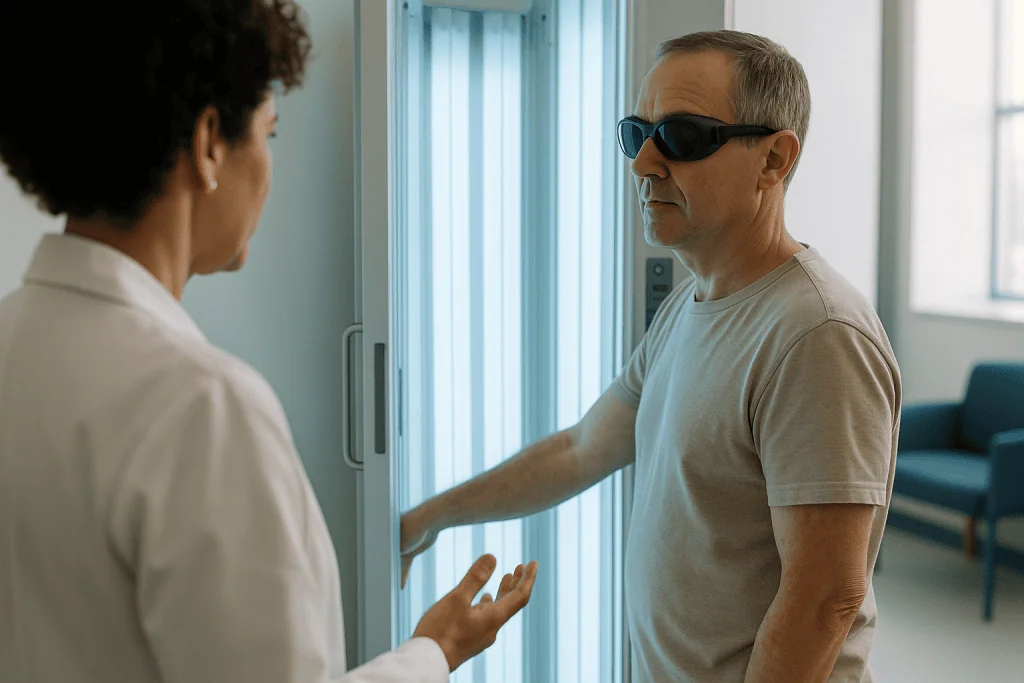
The cabinet looks like a narrow shower stall lined with fluorescent tubes. A nurse hands you a pair of goggles that seal to your face, checks that your groin is covered, and asks you to stand still. The lamps hum, glow a cool violet-white, and then, ninety seconds or so later, click off. That is it. You get dressed and drive to work. People who have spent years wrestling with thick, scaly plaques often say the strangest part of starting phototherapy for psoriasis is how ordinary it feels.
The questions come afterward, usually in the car park. Why does light help when sunshine on holiday only sometimes did? How many of these appointments will there be? Is a machine that emits ultraviolet light really safer than a tanning bed? And what happens to the skin once the course ends?
Those are fair questions, and the answers are more nuanced than most online summaries let on. This guide walks through what the evidence actually shows, what a course typically involves, and where the honest uncertainties lie, so that the conversation with your dermatology team starts from solid ground.
How does phototherapy for psoriasis actually work?
Psoriasis is, at its core, a problem of speed. In healthy skin, a cell born in the deepest layer of the epidermis takes roughly a month to rise to the surface and flake away. In a psoriasis plaque that journey collapses to three or four days, according to patient information from the Cleveland Clinic. Cells pile up before they have matured, producing the raised, silvery scale that never quite sheds.
Driving that acceleration is an immune system that has misread the skin as a threat. T cells (white blood cells that coordinate immune attacks) crowd into the dermis and release chemical messengers called cytokines, which tell skin cells to multiply and blood vessels to dilate. That is why plaques are red and warm as well as thick.
Ultraviolet light interrupts this loop at several points. The wavelengths used in phototherapy penetrate the upper layers of skin and damage the DNA of rapidly dividing cells just enough to slow their division. They also trigger the death of the activated T cells sitting in the plaque and dampen the production of inflammatory cytokines. The clinical review by Zhang and Wu, published in Lasers in Medical Science and indexed on PubMed, describes these combined effects as the reason narrowband UVB clears plaques rather than simply tanning them.
One detail explains a lot of the practical rules you will hear. The therapeutic wavelengths are a narrow slice of the ultraviolet spectrum, mainly around 311 to 313 nanometers for narrowband UVB. Ordinary sunlight and tanning lamps deliver a much broader mix, including wavelengths that burn and age skin without adding much treatment benefit. Medical phototherapy is not more light; it is more selective light, delivered in measured exposures that a nurse adjusts each visit.
What types of UVB light therapy and PUVA are used for psoriasis?
Four approaches account for almost all phototherapy prescribed for psoriasis today. They differ in wavelength, in whether a light-sensitizing medicine is added, and in how much skin is treated at once.
| Type | What it involves | Typically used for | Key considerations |
|---|---|---|---|
| Narrowband UVB (NB-UVB) | Whole-body or partial cabinet using a narrow band of UVB light; no medicine needed | Widespread plaque or guttate psoriasis not controlled by creams | Usually first-choice phototherapy; suitable for many children and during pregnancy when supervised |
| Broadband UVB | Older lamps emitting a wider range of UVB | Where NB-UVB is unavailable; sometimes with tar (Goeckerman regimen) | Generally considered less effective and more likely to burn than NB-UVB |
| PUVA | Psoralen, a plant-derived medicine that makes skin sensitive to light, taken by mouth or applied in a bath, followed by UVA exposure | Thick, stubborn plaques, palm and sole disease, cases that failed UVB | Higher long-term skin-cancer risk; eye protection needed for the rest of the treatment day; not used in pregnancy |
| Excimer laser or lamp | A hand-held device delivering intense UVB to individual patches | Localized plaques, scalp, elbows, knees | Spares unaffected skin; impractical for widespread disease |
The NHS treatment guidance describes NB-UVB as the phototherapy most commonly offered in the UK, with PUVA reserved for people whose psoriasis has not responded well enough, or for hand and foot involvement. Mayo Clinic’s treatment overview lists the same options and adds that broadband UVB and the Goeckerman method (coal tar applied before light) have largely given way to narrowband lamps in most services.
Which type you are offered depends less on preference than on the pattern of your psoriasis, your skin type, your medical history and what the local service can provide. That decision sits with the dermatology team, and it is worth asking why a particular option was chosen.
Does phototherapy actually work for psoriasis?
Yes, for a substantial proportion of people with plaque psoriasis, and the evidence behind narrowband UVB in particular is among the most consistent for any psoriasis treatment. The clinical review by Zhang and Wu summarizes decades of trials showing that NB-UVB reduces plaque thickness, scale and redness in most people who complete a course, with clearance or near-clearance common, and that it performs at least as well as PUVA for typical plaque disease while carrying fewer long-term risks.
Three honest caveats belong alongside that headline. First, phototherapy controls psoriasis rather than removing it permanently. The NHS is explicit that psoriasis is a long-term condition and that treatments aim to manage it. Plaques tend to return over months once light stops, although the length of remission varies widely.
Second, response is not uniform. Guttate psoriasis (small drop-shaped spots, often after a throat infection) and thin plaques generally respond faster. Very thick plaques on the shins, disease on the palms and soles, and nail or inverse psoriasis in skin folds respond less predictably, partly because light cannot reach or penetrate those sites well.
Third, most of the trial evidence measures skin scores rather than the things people care about day to day, such as sleep, itch and confidence. Those often improve alongside the skin, but the published numbers describe plaques, not lives.
Where does that leave someone weighing the option? Phototherapy is a well-established, guideline-supported treatment with a real chance of clearing widespread psoriasis for a period of months. It asks for time and repeated visits. It does not involve systemic medicines, which is why many clinicians consider it before moving to tablets or injections. Whether that trade-off makes sense for you is a conversation for your dermatology team, not a foregone conclusion.
What happens during a phototherapy session?
The first appointment is longer than the rest. A nurse or dermatologist records your skin type, asks about sunburn history, medicines, previous skin cancers and any conditions that react to light. Some services perform a small test on a patch of skin, exposing it to graduated amounts of light and checking the next day for the faintest pinkness. That reading, sometimes called the minimal erythema dose (the smallest exposure that produces visible redness), sets your personal starting point. Others start from a standard exposure based on skin type.
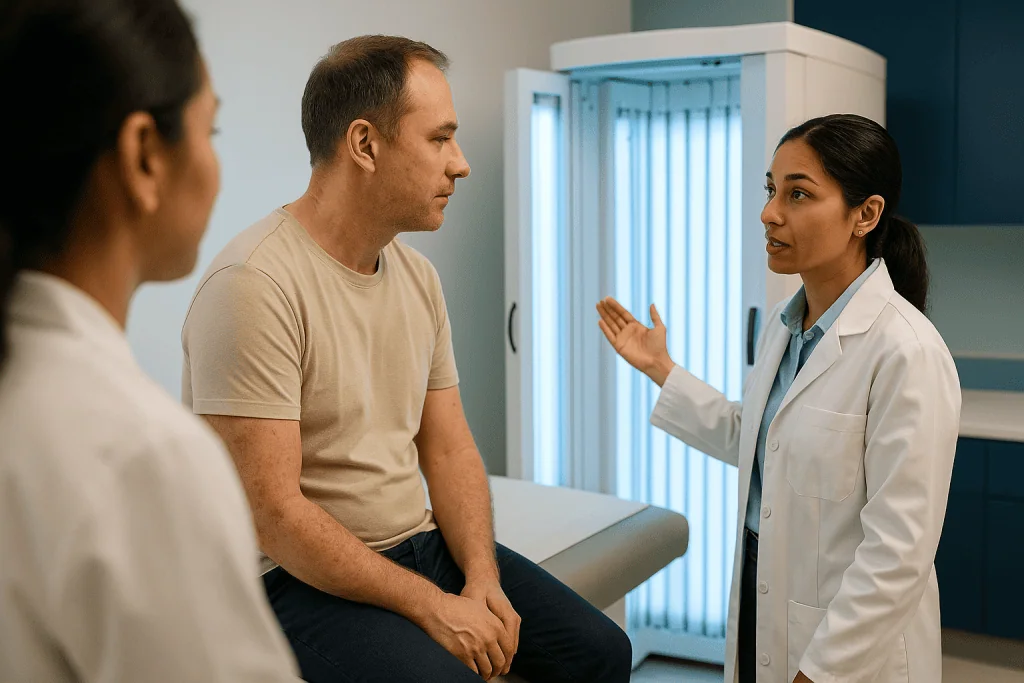
Routine sessions run to a rhythm. You undress to the level agreed with the team, usually keeping underwear on so the genital area is shielded, and put on wraparound UV-blocking goggles. Men are asked to cover the genitals because that skin is particularly prone to UV-related cancer. The face is often shielded with a visor or a layer of sunscreen if it is clear of psoriasis. Any prescribed moisturizer or emollient is applied as instructed, because a thin layer can help light penetrate scale, while thick greasy products can block it.
You then step into the cabinet or stand in front of a panel. The nurse programs the exposure, the lamps switch on, and you turn as directed so front and back are treated evenly. Exposure times at the start are typically measured in seconds; later in the course they lengthen into a few minutes as your skin tolerates more.
Before each session the nurse asks how the skin reacted to the previous one. Faint pinkness that fades within a day usually means the increase can continue. Tender redness, blistering or pain means the exposure is held or reduced. This check-in is the safety valve of the whole process, so honest answers matter more than pushing ahead quickly.
Including changing time, most people are in and out of the department in fifteen to twenty minutes.
How often is phototherapy for psoriasis given, and how long does a course last?
The NHS describes a typical narrowband UVB course as two or three sessions a week at a hospital, with each session lasting only minutes, over roughly six to eight weeks. Some services continue a little longer if the skin is still improving, and Mayo Clinic notes that PUVA is often given in a similar weekly pattern but that its higher intensity means fewer total exposures may be needed for thick plaques.
Why not daily? Ultraviolet light causes microscopic injury that the skin repairs over about a day. Spacing sessions gives that repair time to happen and lets the nurse read the skin’s reaction before the next exposure. Spacing them too far apart, on the other hand, loses ground, because the pigment and thickening your skin develops as protection fades between visits and the exposure has to be dropped back. Three times a week is the compromise most services settle on; twice weekly works for some people who cannot manage more, at the cost of a slower response.
Consistency matters more than perfection. Missing one session is usually manageable; the team simply keeps the exposure the same rather than increasing it. Missing a week or more often means stepping back down to avoid a burn, which lengthens the course.
The question people most want answered is how long the benefit lasts afterward. The evidence gives a range, not a promise. Many people enjoy several months of clear or much-improved skin after a full course; some relapse within weeks, others stay clear for a year or more. Zhang and Wu note that maintenance schedules, with sessions spaced out to weekly or fortnightly, can prolong remission but add to cumulative UV exposure, so they are used selectively. Whether to repeat a course, and how many courses over a lifetime are sensible, is something the dermatology team tracks for every patient.
Who is usually offered light therapy, and who is asked to wait?
Phototherapy sits on the second step of most psoriasis treatment pathways. The NHS treatment guidance and Mayo Clinic both describe it as an option when topical treatments such as vitamin D analogue creams and corticosteroids have not controlled the disease, or when psoriasis is too widespread for creams to be practical. Someone with plaques covering the trunk and all four limbs may simply run out of hours in the day to apply ointment.
Beyond that, dermatologists tend to favor phototherapy for particular groups. People who want to avoid systemic medicines, or who cannot take them because of liver, kidney or blood test findings, are often good candidates. Narrowband UVB is one of the few psoriasis treatments considered acceptable during pregnancy and breastfeeding under supervision. Children and teenagers with widespread disease may be treated with NB-UVB when their team judges the benefit worth the exposure, although PUVA is generally avoided in young children.
Other people are asked to wait, or steered elsewhere. A history of melanoma or multiple non-melanoma skin cancers is usually a reason not to use UV treatment. Conditions in which light itself triggers disease, such as lupus or the rare inherited disorder xeroderma pigmentosum, rule it out. Very fair skin that burns without tanning is not an absolute barrier but calls for cautious exposure. People taking medicines that heighten light sensitivity may be asked to discuss alternatives with the prescriber first, and anyone with active cold sores or an infected plaque may be paused until it settles.
Practical barriers count too. If you live far from the nearest unit or cannot leave work three times a week, the team may weigh a home unit or a systemic option instead. None of these are judgments about how much you deserve treatment; they are attempts to match the tool to the person.
How should you prepare, and which medicines matter?
Preparation is mostly about telling the truth and protecting the parts of you that do not need treating.
Start with a complete list of everything you take, including over-the-counter products and herbal supplements. Several medicine classes make skin react more strongly to ultraviolet light: certain antibiotics from the tetracycline and fluoroquinolone families, thiazide diuretics used for blood pressure, some non-steroidal anti-inflammatory drugs, oral retinoids, a few antidepressants and antihistamines, and the herbal remedy St John’s wort. None of this means you should stop anything on your own. It means the dermatology team needs to know so they can set exposures conservatively or talk to whoever prescribed the medicine.
Mention any tanning bed use, recent sunburn, or a planned beach holiday. Skin that has already been exposed will react differently, and the team may adjust timing.
On treatment days, skip perfume, aftershave, scented lotions and any product containing coal tar or other ingredients not approved by the team. Fragrances can react with UV to produce patchy burns. Apply plain emollient only if you have been told to, and wear the same underwear coverage at every session so the boundary between treated and untreated skin stays consistent; a shifting line can burn a strip of skin that has never been exposed.
Eye protection is not optional. Goggles are worn inside the cabinet, and for PUVA, UV-blocking sunglasses are needed outdoors for the rest of the day because psoralen sensitizes the lens of the eye as well as the skin. Mayo Clinic and the NHS both flag cataract risk as the reason.
Finally, ask how the unit will monitor you. A photograph or plaque score at the start gives a baseline. A cumulative record of your total exposures follows you between courses and helps future clinicians judge lifetime UV risk.
What do the first days and weeks of a course usually look like?
Week one tends to be underwhelming. Exposures are short, the skin barely changes, and it is easy to wonder whether anything is happening. Beneath the surface it is: the immune cells in the plaque are already being suppressed, even though the visible thickness has not moved. Some people notice a mild warmth or dryness a few hours after treatment. Plain moisturizer, applied after rather than before the session unless instructed otherwise, usually manages it.
By the second and third weeks, exposures have lengthened and most people see the first real shifts. Scale becomes thinner and softer. Plaque edges lose their sharp, raised rim. Itch often eases before redness does. Faint pinkness the evening after a session is expected; if it lingers into the next morning or feels sore, that is the signal to tell the nurse so the exposure can be held.
Weeks four through six are when the pattern becomes clearer. Thin plaques may flatten to leave slightly darker or lighter marks, which is discoloration rather than active disease and fades over months. Thicker patches shrink from the edges inward. Unaffected skin, meanwhile, tans; a subtle but unavoidable side effect of whole-body treatment. The contrast sometimes makes remaining plaques look more prominent for a while, which can be discouraging until the plaques themselves catch up.
By the end of a course, the team reassesses. Some people are clear and stop. Others are much improved with a few stubborn areas that might suit a targeted laser or a topical treatment. A minority have responded little, and that is useful information too, because it points toward other options earlier rather than later.
After the last session, the skin’s protective tan fades over weeks. Sun care habits matter especially during this window, when the skin has been primed by treatment but is no longer being monitored three times a week.
What are the side effects of phototherapy for psoriasis, short term and long term?
Short-term effects are common and mostly mild. Redness resembling a light sunburn, dryness, itch and a feeling of tightness are the ones people report most. Blistering is uncommon and usually means the exposure outpaced what the skin could tolerate, often because a missed week was not accounted for or a new medicine increased sensitivity. Cold sores can flare in people prone to them, since UV suppresses local immunity. Some people find psoriasis briefly looks worse before it improves, particularly where scale lifts and reveals the red base beneath.
PUVA adds its own list. Oral psoralen can cause nausea, and the whole-day light sensitivity it produces means strict sunglasses and sun avoidance until the medicine has cleared. Mayo Clinic notes that PUVA sessions can also leave the skin feeling more intensely burned than UVB.
The longer-term question is skin cancer. Ultraviolet light is a known carcinogen, and any phototherapy adds to a person’s lifetime exposure. The evidence, summarized in the Zhang and Wu review and reflected in NHS guidance, draws a clear distinction between the two main approaches. Long-term follow-up of people treated with PUVA shows a meaningfully increased risk of squamous cell carcinoma and, at high cumulative exposures, melanoma, which is why services cap the total number of PUVA treatments a person receives over a lifetime. For narrowband UVB, studies to date have not shown a clear rise in skin cancer, although researchers caution that follow-up periods are shorter and that a small effect cannot be excluded.
Photo-ageing, meaning wrinkling, uneven pigment and a leathery texture, is a real but gradual cost of repeated courses. Cataract risk is the reason for goggles and, with PUVA, day-long eye protection.
None of this is a reason to refuse phototherapy. It is a reason to keep a record of every course, to have periodic skin checks afterward, and to ask your team how they weigh cumulative exposure when recommending a repeat.
Excimer laser and targeted phototherapy for stubborn patches
Whole-body cabinets are efficient when psoriasis is everywhere. They make less sense for a person whose disease amounts to two elbows, a knee and a patch at the hairline. Treating the whole skin surface to reach five percent of it exposes the other ninety-five percent to UV for no benefit.
Targeted phototherapy solves that. An excimer laser or lamp is a hand-held device that emits UVB at a wavelength very close to that of narrowband cabinets but concentrated onto a small area. Because only the plaque is treated, the clinician can use higher intensities than would be safe across normal skin, which is why Mayo Clinic notes that excimer treatment may need fewer sessions than conventional phototherapy. The device is passed over each plaque in turn, a process that takes a few minutes for a handful of patches.
Scalp psoriasis is a particular beneficiary. Hair blocks cabinet light almost completely, but a hand-held device can be worked along parted hair or, in some services, used alongside a comb-style UVB attachment. Elbows, knees, shins and the lower back, all sites where plaques are thick and stubborn, also respond well because the concentrated light penetrates scale that cabinet exposures struggle with.
There are limits. Targeted devices are impractical for widespread disease, and availability varies between services. Side effects mirror those of cabinet UVB but are confined to the treated area: redness, occasional blistering, and temporary darkening of the surrounding skin ring. Long-term skin-cancer data for excimer treatment are thinner than for cabinet phototherapy simply because the technique is younger, though the sparing of unaffected skin is generally considered a safety advantage.
Targeted treatment is often combined with a course of cabinet phototherapy: the cabinet clears the bulk of the disease, and the laser mops up resistant plaques at the end. Whether that combination is available or appropriate is a question for your team.
At-home light therapy for psoriasis: what the evidence says
Three visits a week for two months is a real burden, and it is the main reason people abandon phototherapy before it has a chance to work. Home narrowband UVB units, ranging from full-body panels to hand-held wands, promise the same treatment without the commute. The question is whether they deliver it safely.
Research summarized in the Zhang and Wu review, including a randomized trial comparing supervised home NB-UVB with hospital treatment, found that outcomes for plaque psoriasis were broadly similar when home units were prescribed by a dermatologist, patients were trained in their use, and exposures followed a set protocol with regular check-ins. Side-effect rates were comparable. Patients in home arms often reported greater satisfaction with the convenience, though the review is careful to note that these studies involved medical-grade equipment and structured supervision rather than devices bought and used independently.
That distinction is the whole story. A home unit under dermatology supervision is a legitimate way to deliver phototherapy for psoriasis. A device used without a prescribed schedule, without anyone checking the skin’s response, and without a record of cumulative exposure is a way to accumulate UV risk with no guarantee of benefit. Consumer devices vary enormously in output and wavelength, and many marketed for skin conditions emit little of the narrow band that actually treats psoriasis.
Practical points the evidence supports: home treatment suits people who have already tolerated a hospital course and understand how their skin responds; unaffected skin and eyes still need the same protection as in a clinic; and follow-up appointments remain part of the plan, not an optional extra. Hand-held units may be reasonable for a few localized plaques when whole-body treatment is unnecessary.
If travel is the obstacle, raise it directly with your team. Some services run home phototherapy programs; others can adjust scheduling. Either way, the decision about whether a home unit is appropriate, and which kind, belongs with the clinician who knows your skin.
What people often get wrong about light therapy for psoriasis
Tanning beds are a cheaper version of the same thing. They are not. Tanning lamps emit mostly UVA with a scatter of broadband UVB, a mix optimized for pigment rather than for suppressing the immune cells in a plaque. There is no nurse adjusting exposure to your skin’s reaction, no shielding of the genitals, and no record of cumulative dose. Mayo Clinic explicitly cautions against tanning beds as a substitute. Some people do notice their psoriasis softens after a tanning session; that reflects the small UVB component and comes bundled with substantially more skin-cancer and ageing risk per unit of benefit.
If sunshine helps, more sunshine helps more. Brief, regular sun exposure can improve psoriasis, and Mayo Clinic lists it as a possible adjunct. Sunburn, on the other hand, can trigger a flare through the Koebner phenomenon, the tendency of psoriasis to appear at sites of skin injury. The line between helpful and harmful is narrow and shifts with latitude, season and skin type.
A celebrity got rid of her psoriasis with one treatment. Searches for how a particular reality-television personality treated her psoriasis spike whenever she posts about it. Her public comments describe years of trying creams, injections, diets and light, with flares continuing. That is the honest shape of the condition for most people: managed, not eliminated, with the mix of treatments changing over time.
Phototherapy works by giving you vitamin D. UVB does raise vitamin D, but the improvement in plaques comes from direct effects on skin and immune cells, not from vitamin levels. Supplementing vitamin D alone has not been shown to substitute for light treatment.
It is only for the skin. Psoriasis is a systemic inflammatory condition. The joints, heart and metabolism are affected in a proportion of people, and phototherapy treats none of those. Clearing the skin should not mean skipping the wider check-ups your team recommends.
Questions to ask your care team before starting phototherapy
A good consultation leaves you knowing not just what will happen but why this option was chosen over others. These questions tend to open up the conversation.
- Which type of phototherapy are you recommending for me, and what about my psoriasis makes it the better fit compared with the alternatives?
- How many sessions a week do you expect, and roughly how long might the course run before we judge whether it is working?
- What are the practical options if I cannot get here three times a week? Is home phototherapy something this service supports?
- Do any of my current medicines or supplements increase light sensitivity, and who should I speak to about that?
- Have you taken account of my history of sunburn, skin cancer or family skin-cancer risk in setting the plan?
- What should my skin look like the evening after a session, and what would count as too much?
- How will you record my total exposure over time, and how many courses do you consider reasonable over a lifetime?
- If my plaques clear, how long do people with psoriasis like mine typically stay clear, and what is the plan if it comes back?
- Are there patches you expect phototherapy to miss, such as the scalp or skin folds, and what would we do about those?
- Do I need any blood tests, eye checks or skin examinations before, during or after the course?
- How does phototherapy fit with the rest of my care, including monitoring for joint symptoms and cardiovascular risk?
- Who do I contact between sessions if something does not seem right?
Writing the answers down during the appointment is worthwhile, because the details about exposure, shielding and what to report are exactly the kind that blur by the second week. If a question cannot be answered on the spot, ask when and how it will be. A team that welcomes these questions is a good sign for the months ahead.
When to call your doctor during or after a phototherapy course
Most of what phototherapy does to the skin is expected and mild. A small number of reactions need prompt attention, and a few point to problems beyond the skin altogether.
Contact the phototherapy unit or your dermatology team the same day if you develop painful redness that does not settle overnight, blistering or peeling, or a burn-like reaction on skin that was supposed to be shielded. These usually mean the exposure needs adjusting, and continuing without a review risks a worse burn at the next session. Report new sensitivity to light on unexposed skin, a spreading rash that looks different from your psoriasis, or eye pain, watering and blurred vision, which can indicate UV injury to the cornea. After PUVA, any eye symptoms or severe nausea should be reported without waiting for the next appointment.
Seek urgent medical care if psoriasis suddenly spreads to cover most of the body with widespread redness, heat and shedding, if you develop clusters of small pus-filled spots on red skin, or if any skin reaction is accompanied by fever, chills, a racing heart or feeling faint. These can signal erythrodermic or pustular psoriasis, rare but serious forms that the NHS lists as reasons for immediate assessment, and they need hospital care rather than a routine appointment.
Between and after courses, book a review for any new or changing mole, a sore that does not heal within a few weeks, a scaly or pearly lump, or a plaque that bleeds without being scratched. Ultraviolet treatment adds to lifetime skin-cancer risk, and early assessment is straightforward.
Finally, do not treat joint pain, morning stiffness lasting more than half an hour, swollen fingers or toes, or heel pain as separate from your skin. Psoriatic arthritis affects a meaningful proportion of people with psoriasis, and MedlinePlus and the NHS both advise raising these symptoms promptly, because joint damage is easier to prevent than to reverse.
Frequently asked questions
Does phototherapy actually work for psoriasis?
For most people with widespread plaque psoriasis, yes: narrowband UVB has decades of trial evidence showing it reduces thickness, scale and redness, with clearance or near-clearance common after a full course. It controls rather than permanently removes the condition, so plaques usually return over months. Thick plaques, palms, soles, nails and skin folds respond less predictably. Your dermatology team can judge how likely your pattern of psoriasis is to respond.
How long does phototherapy last for psoriasis?
Individual sessions take only seconds to a few minutes of light exposure, and a full course typically runs two or three sessions a week for around six to eight weeks, according to NHS guidance. How long the improvement lasts afterward varies widely, from weeks to over a year, with several months of clearer skin being common. Maintenance sessions can extend remission but add to cumulative ultraviolet exposure.
How often is phototherapy for psoriasis given each week?
Most services schedule narrowband UVB two or three times a week, with at least a day between sessions so the skin can repair before the next exposure. Three times weekly generally produces a faster response; twice weekly is used when travel or work makes more visits impractical. Missing a week usually means the exposure is reduced at the next visit to avoid a burn, which lengthens the course.
Is UVB light therapy for psoriasis safe during pregnancy?
Narrowband UVB is one of the few psoriasis treatments generally considered acceptable during pregnancy and breastfeeding when given under specialist supervision, because no medicine enters the bloodstream. PUVA is avoided in pregnancy because psoralen is taken by mouth or absorbed through the skin. Anyone who is pregnant or planning to be should tell the dermatology team so the plan can be reviewed.
What are the side effects of phototherapy for psoriasis?
Short-term effects include mild sunburn-like redness, dryness, itch and occasional cold-sore flares; blistering is uncommon and signals the exposure was too high. Long-term risks are skin ageing and, particularly with PUVA, an increased chance of skin cancer, which is why lifetime treatment totals are tracked. Eye protection during sessions, and all day after PUVA, guards against cataract risk.
Can I use at home light therapy for psoriasis instead of going to hospital?
Possibly, if a dermatologist prescribes a medical-grade narrowband UVB unit, trains you to use it, sets the exposure schedule and reviews your skin regularly. Trials of supervised home phototherapy found results and side-effect rates broadly similar to hospital treatment. Consumer devices used without that structure vary widely in output and offer no monitoring, so they are not equivalent. Raise travel difficulties with your team before buying anything.
Can I use a tanning bed to treat psoriasis?
Tanning beds are not recommended as a substitute for medical phototherapy. They emit mainly UVA with a variable scatter of broadband UVB, a mix designed to produce pigment rather than to suppress the immune activity in plaques, and nobody adjusts the exposure to your skin’s reaction or shields vulnerable areas. Any softening of plaques comes with a much higher skin-cancer and ageing cost per unit of benefit.
What organ is linked to psoriasis?
The skin is the organ most obviously affected, but psoriasis is a systemic inflammatory condition. Joints are the next most common site, with psoriatic arthritis developing in a proportion of people. Research also links psoriasis with higher rates of cardiovascular disease, type 2 diabetes, fatty liver and depression. Phototherapy treats the skin only, so wider health monitoring remains part of good care.
How did a celebrity like Kim Kardashian treat her psoriasis?
Public accounts from well-known people with psoriasis, including that reality-television personality, typically describe years of trying creams, light treatment, dietary changes and prescription medicines, with flares continuing intermittently. That mirrors the experience of most people: psoriasis is managed through a shifting combination of treatments rather than resolved by any single one. What worked for someone else is not a guide to what your team will recommend for you.
What happens if phototherapy does not clear my psoriasis?
A limited response is useful information rather than a failure. Your dermatology team may add targeted laser treatment for stubborn plaques, combine light with topical treatments, switch to PUVA for thick or palm-and-sole disease, or move to systemic options such as oral or injectable medicines that act on the immune pathways driving psoriasis. Which step comes next depends on your disease pattern, health history and preferences.
References
- NHS — Psoriasis: Treatment
- NHS — Psoriasis: Overview
- Cleveland Clinic — Psoriasis
- MedlinePlus — Psoriasis
This article is for general information only and is not a substitute for professional medical advice. Please consult a qualified doctor about your individual situation.

More from the Blog

Niacinamide: Why This Quiet Ingredient Is in Everything
Niacinamide, the amide form of vitamin B3, is a well-studied skincare ingredient that supports the skin barrier, may reduce the look of dark spots…
How to Get Rid of Ingrown Hair: Safe Fixes and Prevention
Most ingrown hairs clear up on their own within one to two weeks once you stop shaving or waxing the area. To speed things…
What Salicylic Acid Does for Skin — and Who Should Use It
Salicylic acid is a beta hydroxy acid that loosens the bonds between dead skin cells and dissolves oil inside pores. On skin, it exfoliates,…
Tattooing Over Scars: What Is Possible and When to Wait
In many cases, yes — you can tattoo over scars, but timing and scar type matter more than most people expect. Fully matured scars…
How to Get Rid of Razor Bumps: The Routine That Prevents Them
Razor bumps usually fade on their own within two to three weeks once you stop shaving the area. Cool compresses, gentle cleansing, and moisturizing…

Is Shingles Contagious? Who to Keep Away From Until the Blisters Crust Over
Shingles itself is not contagious, but the varicella-zoster virus inside its blisters can spread. Someone who has never had chickenpox or the chickenpox vaccine…