

Tattooing Over Scars: What Is Possible and When to Wait
Key Takeaways
- Most flat, pale, fully matured scars can be tattooed, but scars keep remodeling for a year or more, up to two years for some, per the NHS, so readiness depends on appearance and stability, not just the calendar.
- Ink generally holds in mature scar tissue but saturates unevenly, which is why scar work often includes a planned touch-up session and favors bold, organic designs over fine lines.
- Keloids can be triggered by any skin injury, including a tattoo needle, in people prone to them, so a keloid history anywhere on your body warrants a dermatologist's opinion before tattooing.
- Scar tissue's damaged and regrown nerves make pain unpredictable: the same scar can be numb in one spot and hypersensitive an inch away.
- Tattooing over a scar can hide future skin changes from view, so any nearby mole or unexamined skin change should be checked by a clinician before it goes under ink.
- After tattooing, spreading redness, worsening pain, pus, fever, or a scar that starts thickening or expanding are red flags that need medical attention, not just extra aftercare.
In many cases, yes: you can tattoo over scars, but timing and scar type matter more than most people expect. Fully matured scars that are flat, pale, and at least one to two years old generally hold ink best, though results are less predictable than on unscarred skin. Raised, keloid-prone, or still-changing scars deserve a medical opinion first, and some should not be tattooed at all.
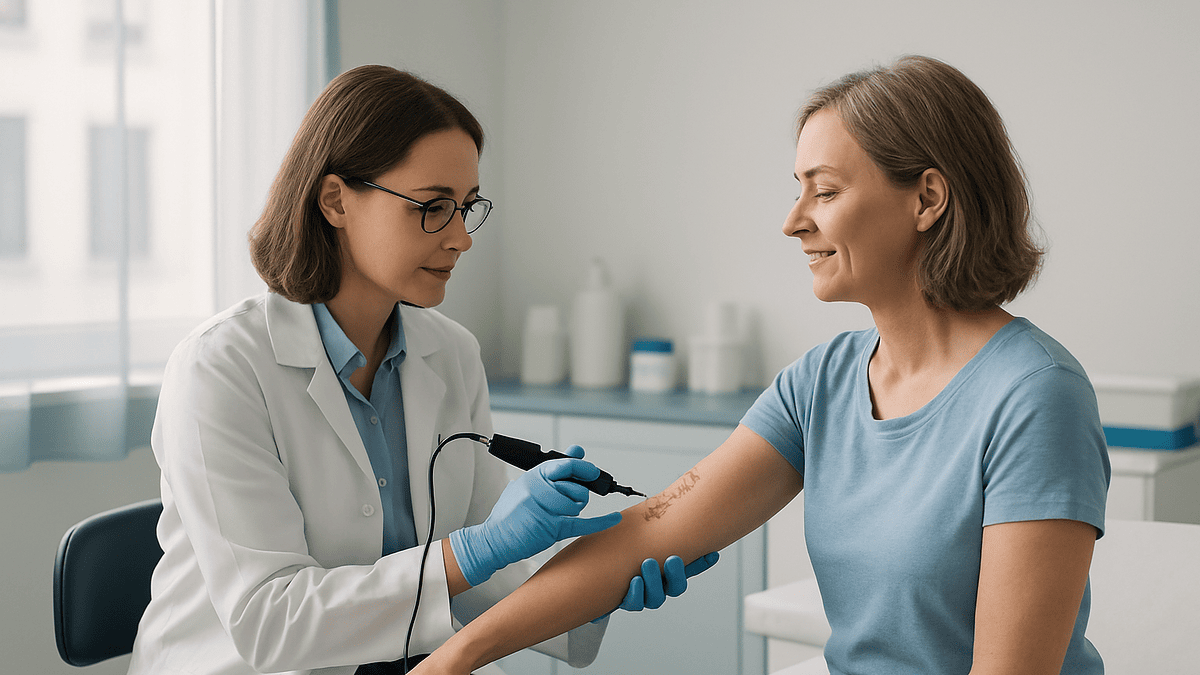
She kept touching it while she talked: a thin, silvery line across her forearm, souvenir of a bike accident at nineteen. The tattoo artist listened, then pressed a gloved thumb gently along the scar, feeling for ridges the way a carpenter checks a board for warp. Only after that did the conversation turn to design.
That small moment captures what most online debates about scar tattoos miss. The question is rarely whether a needle can pass over scar tissue: it can. The real questions are whether that particular scar is ready, whether the ink will stay where it’s placed, and whether the process might wake the scar back up.
The good news: mainstream dermatology has clear answers about how scars heal and behave, and those answers map neatly onto what experienced artists see in the chair. Here is what the evidence actually supports.
Can I get a tattoo if I have scars? The honest short answer
Having scars does not disqualify you from getting tattooed, not even close. People get tattoos over surgical lines, old burns, acne scarring, stretch marks, and injuries every day, and many of those pieces heal beautifully. What changes is the level of planning required.
Scar tissue is structurally different from ordinary skin, which means three practical things. First, ink may not deposit as evenly, so some designs suit scars better than others. Second, immature scars, ones still red, raised, itchy, or changing shape, react unpredictably to trauma, and a tattoo needle is, by definition, controlled trauma. Third, a minority of people are prone to keloids, an overgrowth of scar tissue that any new skin injury can trigger, according to the Cleveland Clinic.
So the honest framing is this: the question is not a flat yes or no. It’s a checklist. How old is the scar? Is it flat and stable? Do you have a personal or family history of keloids? Is the surrounding skin healthy? Has a clinician looked at anything unusual? Answer those well, and the odds of a result you love go up considerably. Skip them, and you risk patchy ink, a distorted design, or, in the worst case, a scar that ends up larger and more raised than the one you started with.
Why scar tissue behaves differently under the needle
To understand why scars complicate tattooing, it helps to know what a scar actually is. When skin is injured deeply enough to reach the dermis, the body doesn’t rebuild the original tissue. It patches the gap with collagen, laid down quickly, in dense, roughly parallel bundles rather than the neat basket-weave pattern of normal dermis, as the Cleveland Clinic explains.
That patch works, but it is not skin as usual. Scar tissue typically lacks hair follicles and sweat glands. Its blood supply differs from the surrounding area. Its nerve endings may be damaged, regrown haphazardly, or hypersensitive. And its texture, sometimes firmer, sometimes thinner and more fragile than neighboring skin, changes how a needle moves through it and how pigment settles.
Tattoo ink is meant to rest in the mid-dermis, held in place by immune cells and the surrounding tissue matrix. In dense, fibrous scar tissue, pigment can struggle to penetrate evenly, leaving pale patches. In thin, atrophic scar tissue, the sunken kind, ink can spread beyond the intended line, a phenomenon artists call a blowout. Neither outcome is guaranteed, but both are more likely than on unscarred skin.
None of this makes scar tattooing a bad idea. It makes it a technical challenge, one that rewards an experienced hand, a mature scar, and a design chosen with the tissue in mind rather than in spite of it.
Does tattoo ink stick to scars?
Usually, yes, but “stick” is doing a lot of work in that sentence. Ink can be deposited into most mature scar tissue and will generally stay there. The catch is uniformity.
On healthy skin, a skilled artist can predict saturation almost perfectly. On a scar, three variables interfere. Dense collagen can resist the needle, so pigment sits shallower than intended and fades faster in spots. Uneven scar texture means the needle depth effectively changes as it crosses ridges and dips, producing lighter and darker zones within the same pass. And scar tissue’s altered circulation can affect how the area heals afterward, sometimes pushing out more ink than usual during the healing phase.
Practical consequences worth knowing before you book:
- Touch-up sessions are more common over scars. Many artists plan for at least one from the start rather than treating it as a failure.
- Fine lines and small text are the least forgiving choices, because a slight spread or gap is instantly visible.
- Bolder designs with texture, florals, shading, organic patterns, hide minor inconsistencies far better.
- Very shiny, taut, or deeply pitted scars hold ink least predictably of all.
A reasonable expectation, then: ink will take, the design will read clearly, but the scar area may need a second pass and may never match the flawless saturation of the surrounding skin. Artists who work with scars regularly will tell you this up front. Treat that honesty as a green flag.
How long do you wait to tattoo over a scar?
Longer than most people want to hear. Scars are not finished when the wound closes: they remodel for months afterward, softening, flattening, and fading as collagen reorganizes. The Cleveland Clinic notes that scars can continue changing for a year or more after the injury, and the NHS puts full maturation at up to two years for some scars.
What does a mature, tattoo-ready scar look like? In general:
- It has faded from red, pink, or purple toward pale silver, white, or a shade close to your surrounding skin tone.
- It lies flat, or nearly flat, rather than sitting raised above the skin.
- It no longer itches, burns, or feels tender.
- It hasn’t changed size, color, or texture in several months.
Tattooing before that point is a gamble on two fronts. A scar still in active remodeling can shift shape after the tattoo heals, warping lines you paid to have placed precisely. More importantly, needling immature scar tissue adds fresh inflammation to tissue already busy healing, which can worsen the scar’s final appearance, particularly in people prone to hypertrophic scarring or keloids.
There’s no medal for waiting the minimum. If your scar is eighteen months old but still pink and slightly raised, it isn’t ready, whatever the calendar says. The scar’s appearance and stability, not its birthday, should make the call, and when in doubt, a dermatologist can assess it in minutes.
Which scars usually take a tattoo well
Not all scars are created equal, and some are genuinely good candidates. The best-behaved category is the flat, mature, well-healed scar: an old surgical incision, a childhood scrape, a thin line from a long-ago cut. Once these have fully faded and stabilized, they often take ink nearly as well as normal skin, with only minor differences in saturation.
A quick comparison of how common scar types tend to behave:
| Scar type | Typical readiness signs | How ink tends to behave |
|---|---|---|
| Flat, mature scar (old cuts, surgical lines) | Pale, flat, stable for months | Usually holds well; may need one touch-up |
| Atrophic (sunken, acne, chickenpox) | Fully healed, no active breakouts nearby | Risk of ink spreading in thin tissue; fine detail suffers |
| Stretch marks | Faded to silver/white, not new and red | Variable hold; texture can show through shading |
| Hypertrophic (raised, within wound borders) | Flattened and softened, often 1–2 years | Uneven saturation over ridged areas |
| Keloid (grows beyond wound borders) | Generally not recommended without medical clearance | Poor, unpredictable hold; risk of triggering growth |
| Burn scars | Fully matured, assessed by a clinician | Highly variable; depends on depth and grafting |
The pattern is easy to spot: the flatter, paler, and older the scar, the friendlier it is to ink. The more raised, recent, or biologically active the tissue, the more caution, and often medical input, the situation deserves.
Keloids and hypertrophic scars: when to hold off
Raised scars deserve their own conversation, because they represent the clearest situation where tattooing can make things genuinely worse.
Two distinct types exist, and the difference matters. Hypertrophic scars are raised but stay within the boundaries of the original wound; they often flatten and soften gradually on their own. Keloids are different: they grow beyond the original wound’s borders, can keep enlarging over time, and may appear anywhere from several months to a year after the injury that caused them, according to the Cleveland Clinic.
Here’s the part that matters for tattooing: keloids are not caused by the wound itself but by an individual’s healing response. Any skin injury, a piercing, a burn, and yes, a tattoo needle, can trigger a new keloid in someone who is prone to them, as Johns Hopkins Medicine notes. Keloid tendency also runs in families and is more common in people with darker skin tones, per the Cleveland Clinic.
Practical guidance the evidence supports:
- If you have an existing keloid, tattooing directly over it is widely discouraged; the tissue holds ink poorly and the trauma may stimulate further growth.
- If you’ve ever formed a keloid anywhere, earlobe piercings are a common tell, talk to a dermatologist before any tattoo, over a scar or not.
- Hypertrophic scars that have fully flattened and matured are a more workable canvas, though saturation may still be uneven.
This is one area where a short medical consultation before an appointment can save years of managing a problem that was preventable.
Can you tattoo over stretch marks and sunken scars?
Stretch marks are technically scars, tears in the dermis from rapid skin stretching during growth spurts, pregnancy, or weight change, and they follow the same maturation logic as any other scar. New stretch marks are red or purple and still biologically active; mature ones fade to silvery white, as the NHS describes in its overview of scar types. Tattooing should wait for that faded, stable stage.
Even mature stretch marks present a specific technical challenge: they are atrophic, meaning the tissue is thinner and slightly sunken compared with surrounding skin. Thin tissue offers less structure to hold pigment in place, so ink can migrate or heal patchy along the marks themselves. The textural difference also tends to show through large areas of smooth, solid shading: the ink is there, but the skin’s surface still catches light differently.
Artists who handle stretch marks well usually lean on a few strategies: designs with organic movement that flow along or across the marks rather than fighting them, textured shading styles that make slight unevenness invisible, and realistic expectations about full-coverage “camouflage” work. The same principles apply to atrophic acne scarring and chickenpox scars, fully healed, flat-ish examples can be worked over, but pitted or icepick-type scars hold detail poorly.
One more note: skin with stretch marks may continue to change if the underlying cause recurs: a future pregnancy, for instance. That’s worth factoring into placement, not a reason to abandon the idea.
Tattooing over self-harm scars: a note on care and timing
For many people, covering self-harm scars is less about aesthetics than about reclaiming a part of the body and closing a chapter on their own terms. That is a legitimate and often meaningful reason to get tattooed, and plenty of artists approach this work with real sensitivity and experience.
The clinical considerations are the same as for any scar, applied carefully. Scars from self-harm are often multiple, layered, and of varying ages and depths, which means some may be fully mature while others in the same area are not. The whole area should be stable, pale, flat, and unchanged for many months, before tattooing, consistent with the maturation timelines the Cleveland Clinic and NHS describe for scars generally. Raised or ridged sections will hold ink less evenly, and dense clusters of scar tissue may need designs built around texture rather than fine lines.
Two additional points matter here more than elsewhere. Emotional readiness counts: a cover-up is permanent, and many people find it helpful to be in a settled place with their mental health, and, where relevant, in conversation with their care team, before making that decision. And artist choice counts: seek someone who has photographed, healed examples of similar work and who discusses the process without judgment. A respectful consultation, where you feel comfortable rather than examined, is the standard to hold out for.
Done thoughtfully, this kind of tattoo can be both technically successful and personally significant. There is no rush; the scars will be just as coverable next year.
What about surgical scars, including after major operations?
Surgical scars are, in one sense, the tidiest candidates: they’re typically linear, closed under controlled conditions, and their age is known to the day. Once fully matured, flat, pale, non-tender, and stable, many take ink reasonably well.
Even so, a few situations call for a conversation with your surgical team or a dermatologist before booking:
- Recent surgery. The visible scar closing is only the first stage; remodeling continues underneath for a year or more, per the Cleveland Clinic. Tattooing too early risks distorting the result and irritating healing tissue.
- Scars over implanted devices or hardware. Skin over ports, pacemakers, or joint replacements deserves a clinician’s sign-off, since infection in these areas carries higher stakes.
- Areas that may need future procedures. If revision surgery is a possibility, placement planning matters: a surgeon can tell you where future incisions might go.
- Skin affected by radiation therapy. Irradiated skin heals differently and is more fragile; medical guidance first, always.
It’s worth acknowledging that decorative and restorative tattooing over surgical scars, including after mastectomyhas become an established practice, and for many people it plays a real role in feeling at home in their body again. The same rules apply: full healing, oncology or surgical team awareness where relevant, and an artist with documented experience on similar skin. Bring your surgical history to the consultation; a good artist will want it.
Does tattooing over a scar hurt more?
Sometimes more, sometimes less, occasionally both in the same sitting, and the reason is nerves, not toughness.
When skin is injured deeply, the small sensory nerves in the area are often damaged. As the scar forms, some of those nerves regrow imperfectly, some don’t regrow at all, and some become hypersensitive. The result is that scar tissue can be numb in one spot and sharply reactive a half-inch away. People tattooing over scars commonly report exactly this patchwork: stretches that barely register, then a sudden zone where the needle feels electric.
A few honest expectations help:
- Numbness is not a free pass. Even where sensation is reduced, the tissue is still being needled and still needs careful aftercare.
- Hypersensitive spots are usually brief but intense; telling your artist in advance lets them plan pacing and breaks.
- Deeper or wider scars, burns, grafts, major surgical sites, tend to have the most unpredictable sensation.
- Ordinary factors still dominate: placement over bone, session length, sleep, and hydration influence pain at least as much as the scar itself.
If a scar is genuinely painful to normal touch before any tattoo enters the picture, tender, burning, or shooting sensations months after healing, that’s a reason to see a clinician first rather than to power through. Persistent pain in a mature scar isn’t typical and deserves assessment, not a needle.
The real risks: infection, ink reactions, and reawakening the scar
Every tattoo carries a baseline set of risks, and scar tissue adds a few of its own. The baseline first: skin infections, allergic reactions to pigments (which can appear even years later), and small inflammatory bumps called granulomas are all documented complications of tattooing, as Mayo Clinic outlines. Bloodborne infections are a risk only when equipment is contaminated, which is precisely why licensed studios, single-use needles, and visible hygiene practices are non-negotiable, a point MedlinePlus also emphasizes.
Scar tissue modifies that picture in three ways:
- Healing may be slower or less even. Altered blood supply in scar tissue can extend healing time in the scarred zone compared with the rest of the piece.
- The scar itself can react. Needling is an inflammatory stimulus. In most mature scars this passes without incident, but in scar-prone individuals it can thicken a hypertrophic scar or trigger keloid growth: Mayo Clinic lists keloid formation among recognized tattoo complications.
- Fragile tissue is easier to overwork. Thin atrophic scars can be damaged by aggressive passes, which worsens both the scar and the ink retention.
One risk that gets less attention: tattoos can conceal skin changes. Pigment over and around a scar makes it harder for you, and a clinician, to monitor that skin for anything new. If a scar or nearby mole has ever changed in ways that concerned you, have it examined before it disappears under ink. Screening a patch of skin is easy; un-tattooing it is not.
Design choices that work with a scar, not against it
Ask artists who specialize in scar work and a consistent philosophy emerges: the best cover-ups don’t fight the scar: they recruit it.
Scars have direction, texture, and shape, and a design that acknowledges those qualities will always age better than one that pretends the skin is a blank page. A few principles show up again and again in well-healed scar tattoos:
- Organic beats geometric. Florals, foliage, water, smoke, and animal forms absorb small irregularities in saturation. Perfect straight lines and symmetrical mandalas advertise every wobble the scar introduces.
- Texture is camouflage. Stippling, sketch-style shading, and layered detail give the eye so much to look at that a patchy half-inch simply vanishes into the composition.
- Flow with the scar’s direction. A linear scar can become a stem, a branch, a ribbon, a horizon line: an anchor for the design rather than an obstacle inside it.
- Size buys forgiveness. Cramming a small design onto a scar concentrates every imperfection; giving the piece room to extend onto healthy skin lets the strongest ink carry the image.
- Sometimes the scar stays visible on purpose. Plenty of people frame a scar with a design rather than hiding it, often the most striking option, and technically the easiest.
The design conversation is also where honest expectations get set. A scar with significant texture will still have texture after tattooing; ink changes color, not topography. Artists who explain that distinction clearly, ideally with healed photos of their own scar work, are the ones to trust with yours.
How to prepare: choosing an artist and getting your skin ready
Scar tattooing is a niche skill, and finding the right person matters more than for an ordinary piece. Portfolios are your best tool, but look specifically for healed photos of work over scars, not just fresh ones. Fresh tattoos always look saturated; the healed image tells you whether the artist’s technique actually held in scar tissue.
At the consultation, useful questions include: How often do you work over scars like mine? Will you do a small test pass first? How do you handle areas that don’t hold ink? Do you build a touch-up into the plan? An experienced artist will also physically examine the scar, feeling its texture and mobility, before quoting anything. Some will decline a scar that isn’t ready. That refusal is expertise, not rejection.
On the studio side, the basics are universal: choose a licensed studio, confirm single-use needles and fresh ink caps, and watch for glove changes and clean workstations: the hygiene fundamentals MedlinePlus and Mayo Clinic both flag as essential.
Your own preparation is simple but real. Arrive with the skin healthy, no sunburn, no active rash or breakout on or near the scar, and well-moisturized in the weeks beforehand. If you have any medical condition affecting healing, take blood-thinning medication, or have a keloid history, raise it with your prescribing clinician or a dermatologist before the appointment rather than in the chair. Those conversations belong to your care team; the artist’s job starts once the skin is cleared.
Aftercare over scar tissue: what changes and what doesn't
The fundamentals of tattoo aftercare don’t change because a scar is involved: keep the area clean, follow your artist’s washing and moisturizing instructions, avoid soaking and swimming while it heals, resist picking or scratching, and keep the fresh tattoo out of direct sun: the core guidance reflected in Mayo Clinic’s tattoo advice. The skin surface typically closes within the first couple of weeks, while deeper settling continues for longer.
Over scar tissue, a few nuances deserve extra attention:
- Expect uneven healing. The scarred zone may scab differently, peel later, or stay pink longer than the rest of the piece. Different tissue, different timeline, usually not a problem.
- Be extra gentle. Thin or fragile scar tissue tolerates friction poorly. Loose clothing over the area and a light touch when washing go a long way.
- Watch the scar itself, not just the tattoo. A little redness and swelling is normal early on. What’s not normal is the scar becoming progressively more raised, firm, itchy, or growing beyond its old borders in the weeks after: those changes suggest hypertrophic or keloid activity and warrant a clinician’s look.
- Sun protection is long-term. UV exposure fades ink and can darken healing scar tissue; once fully healed, consistent sun protection preserves both.
Hold off on judging the result until everything has fully settled, often a few months for scarred areas. Only then can you and your artist fairly assess whether a touch-up pass is needed, and most scar-work plans assume at least the possibility of one.
When to see a doctor, before and after the tattoo
Two moments call for medical eyes rather than artistic ones.
Before the tattoo, see a dermatologist or your regular clinician if the scar is less than a year old, still red or raised, painful or itchy long after healing, changing in size or texture, growing beyond its original borders, or sitting near a mole or skin change you haven’t had checked. Add to that list any personal or family history of keloids, and any scar related to surgery, radiation, or an implanted device: the Cleveland Clinic and Johns Hopkins guidance on keloids makes clear how much individual healing history matters.
After the tattoo, red-flag signs deserve prompt care: spreading redness or warmth beyond the tattooed area, worsening pain after the first few days instead of improving, pus or foul-smelling drainage, fever or chills, red streaks tracking away from the site, or an intensely itchy, bumpy rash within the ink: Mayo Clinic identifies infection and allergic reaction as the complications to take seriously, and neither improves by waiting. A scar that begins visibly thickening or expanding in the weeks after tattooing also merits a dermatology visit sooner rather than later, since early assessment of abnormal scarring gives you the most options.
None of these situations is a reason for alarm in advance. They’re simply the boundary line between what an artist handles and what a clinician should, and knowing that line before you need it is part of doing this well.
Frequently asked questions
Can I get a tattoo if I have scars?
Yes, in most cases. Flat, pale, fully matured scars are generally workable, and many heal into excellent tattoos. The main exceptions are keloids, scars that are still red, raised, or changing, and skin affected by radiation or recent surgery: those situations call for a dermatologist’s or surgeon’s input first. Scar type, age, and your personal healing history matter far more than the simple fact of having a scar.
Does tattoo ink stick to scars?
Usually, but less evenly than on normal skin. Dense scar collagen can resist pigment, leaving pale patches, while thin, sunken scar tissue can let ink spread beyond the intended line. Mature, flat scars hold ink best; raised, shiny, or deeply pitted ones hold it least predictably. Most artists who work over scars plan for a possible touch-up session and steer clients toward designs that forgive small inconsistencies.
How long do you wait to tattoo over a scar?
Until the scar is fully matured, typically at least a year, and the NHS notes some scars take up to two years to finish fading and flattening. A ready scar is pale rather than pink or red, flat, non-tender, and unchanged for several months. Tattooing earlier risks distorted lines as the scar keeps remodeling and can worsen the scar’s final appearance, especially in people prone to raised scarring.
Does tattooing over a scar hurt more?
It varies within the same scar. Injured nerves regrow imperfectly, so scar tissue can be numb in one area and sharply hypersensitive in another, many people experience both during a single session. Deeper scars, burns, and grafted skin tend to be the most unpredictable. If a scar is painful to ordinary touch months after healing, see a clinician before tattooing; persistent scar pain isn’t typical and deserves assessment first.
Can a tattoo cause a keloid?
It can in people who are prone to them. Keloids result from an individual’s healing response, not the type of wound, so any skin injury, including tattooing, can trigger one, as Johns Hopkins and the Cleveland Clinic note. Keloid tendency runs in families and is more common in people with darker skin tones. If you’ve ever formed a keloid, from a piercing or anything else, talk to a dermatologist before any tattoo.
Can you tattoo over stretch marks?
Yes, once they’ve matured from red or purple to silvery white. Stretch marks are thin, slightly sunken scars, so ink can heal patchy along them and their texture may still show through solid shading. Designs with organic flow and textured shading handle them best, while fine lines and smooth color fields are least forgiving. Keep in mind the area could change again with future pregnancy or significant weight change.
Can you tattoo over self-harm scars?
Often yes, and many people find it meaningful. The whole scarred area should be fully matured, pale, flat, and stable for many months, which can take longer when scars are layered and of different ages. Choose an artist with healed photos of similar work and a respectful consultation style. Because the decision is permanent, many people also find it worth being in a settled place with their mental health first.
How soon after surgery can I tattoo over the scar?
Generally not until the scar has fully matured, which the Cleveland Clinic and NHS place at roughly one to two years, and only after checking with your surgical team. Scars over implanted devices, skin treated with radiation, and areas that might need revision surgery all warrant explicit medical clearance. The visible closing of the wound is only the first stage, remodeling continues underneath long after the skin looks healed.
Will a tattoo completely hide my scar?
Usually not completely, and honest artists say so up front. Ink changes the color of scarred skin but not its texture, so raised or sunken areas still catch light differently after tattooing. Well-chosen designs, organic shapes, textured shading, pieces that extend onto healthy skin, can make a scar very hard to spot, and some people frame a scar deliberately instead. Expect strong camouflage rather than complete erasure.
How big is a $2000 tattoo?
There’s no standard answer, because tattoos are priced by time and complexity rather than square inches. Hourly rates vary widely by region and artist experience, and detailed or color-heavy work takes longer than simple linework of the same size. Scar work often adds time too, since careful technique and a touch-up session are common. The only reliable estimate comes from a consultation where the artist sees your skin and design.
References
This article is for general information only and is not a substitute for professional medical advice. Please consult a qualified doctor about your individual situation.

More from the Blog

Benzoyl Peroxide: How It Works, the Concentration Question and the Bleaching Problem
Benzoyl peroxide is an over-the-counter acne treatment that releases oxygen into the pore, killing acne bacteria without breeding resistance and loosening the plugs that…
Sun Protection With Vitiligo: Why Depigmented Skin Burns Faster and How to Care for It Daily
People with vitiligo sunburn faster because depigmented patches have lost melanocytes, the cells that make melanin, the pigment that absorbs ultraviolet light before it…
Does Seborrheic Dermatitis Cause Hair Loss?
Seborrheic dermatitis does not usually destroy hair follicles, so it is not a classic cause of permanent hair loss. It can, however, trigger temporary…

Why Dandruff Treatment Takes Time to Work and Why Stopping Early Brings the Flakes Back
Dandruff treatment usually takes several weeks to show a clear difference, because medicated shampoos slow the yeast and skin-cell buildup that create flakes rather…

When Hives Come With Lip, Tongue or Throat Swelling: Why It Is Treated as Urgent
Hives with lip swelling mean the reaction has moved from the skin surface into deeper tissue, a process called angioedema. Most episodes settle on…

Is Laser Hair Removal Permanent? What Permanent Reduction Really Means
Laser hair removal is not fully permanent for most people. It delivers long-term hair reduction: after a full course, typically four to six sessions,…