Interventional Neurology in Turkey: Choosing a Hospital for Complex Brain Vessel Care

Interventional neurology treats many brain vessel problems through catheters rather than open surgery. The right hospital should offer 24/7 emergency capability, advanced imaging, and intensive care support.
Key Takeaways
- Interventional neurology treats many brain vessel problems through catheters rather than open surgery.
- The right hospital should offer 24/7 emergency capability, advanced imaging, and intensive care support.
- A multidisciplinary team is important for stroke, aneurysm, arteriovenous malformation, and carotid disease care.
- Experience with complex cases and clear communication can strongly affect the patient journey.
- Travel planning, rehabilitation, and follow-up should be considered before treatment begins.
Interventional neurology in Turkey focuses on minimally invasive diagnosis and treatment of complex brain and neck blood vessel conditions. When choosing a hospital, patients and families benefit from looking beyond location alone and considering specialist experience, emergency readiness, imaging technology, and coordinated aftercare.
Overview: What Interventional Neurology Means
Interventional neurology is a subspecialty that uses image-guided, minimally invasive techniques to diagnose and treat diseases affecting the blood vessels of the brain, head, neck, and spinal cord. Instead of a large incision, a specialist usually guides very thin tubes called catheters through an artery, often starting at the wrist or groin, to reach the area that needs treatment.
This approach may be used in emergencies such as acute ischemic stroke, as well as in planned treatment for conditions like cerebral aneurysms, arteriovenous malformations, carotid artery narrowing, and certain dural fistulas. Procedures can include clot removal, vessel opening, stent placement, embolization, and other targeted treatments designed to restore blood flow or reduce bleeding risk.
For people considering interventional neurology in Turkey, the main question is often not only where treatment is available, but where complex brain vessel care can be delivered safely and efficiently. A hospital’s team structure, imaging capability, emergency systems, and intensive care resources are all central to that decision.
Which Conditions May Need Complex Brain Vessel Care
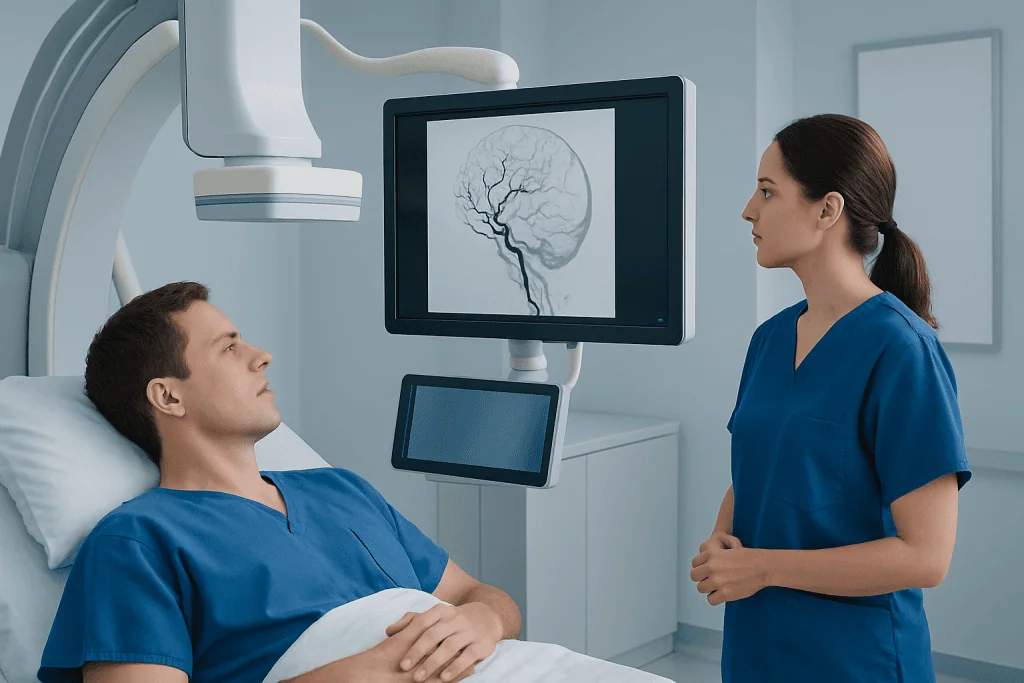
Interventional neurology is commonly used for disorders in which blood flow to or from the brain is blocked, weakened, or abnormal. The most urgent example is ischemic stroke caused by a clot blocking a major brain artery. In selected patients, a catheter-based procedure may remove the clot and help restore circulation.
Other conditions are treated in a more planned setting. These include aneurysms, where a weakened part of a blood vessel wall may need sealing from inside the vessel; arteriovenous malformations or fistulas, where abnormal vessel connections may be closed; and carotid artery disease, where narrowing in the neck arteries can reduce blood flow to the brain. Some patients may also need evaluation for carotid artery disease or treatment related to brain aneurysm.
Symptoms vary by condition, but warning signs can include sudden weakness, facial drooping, speech difficulty, severe unusual headache, vision changes, dizziness, loss of balance, numbness, or episodes resembling mini-strokes. Not every symptom means a brain vessel disorder is present, but sudden neurological symptoms should always be assessed urgently.
- Acute ischemic stroke
- Brain aneurysms
- Arteriovenous malformations and fistulas
- Carotid artery stenosis
- Some venous and spinal vascular abnormalities
What to Look for When Choosing a Hospital

Choosing a hospital for interventional neurology in Turkey involves several practical and medical considerations. A strong program usually has neurointerventional specialists working closely with neurologists, neurosurgeons, neuroradiologists, anesthesiologists, intensive care physicians, and rehabilitation teams. Complex brain vessel conditions often require decisions to be made quickly and collaboratively.
One of the most important factors is whether the hospital can provide round-the-clock emergency stroke and neurovascular care. Acute stroke treatment depends on time, and delays can affect outcome. Patients and families may wish to ask whether the hospital has 24/7 angiography services, emergency brain imaging, neurocritical care, and established pathways for rapid triage and transfer.
Technology and support services also matter. Useful features include high-quality CT, MRI, CT angiography, MR angiography, digital subtraction angiography, modern catheterization laboratories, and post-procedure monitoring in a dedicated ICU. In planned cases, it can also help if the center offers comprehensive diagnostics and related services such as angiography and advanced MRI.
Beyond equipment, communication is essential. Patients traveling from abroad may benefit from a hospital that can explain the diagnosis clearly, coordinate records in advance, discuss likely benefits and limits of treatment, and organize follow-up after discharge. A transparent and organized care pathway often makes the experience more manageable for both patients and families.
How Hospitals Evaluate Brain Vessel Disorders
Diagnosis begins with a careful neurological assessment and a review of symptoms, timing, medical history, and current medications. In emergency stroke care, speed is especially important because doctors need to decide whether a blocked vessel, bleeding, or another condition is causing the symptoms.
Imaging is central to this process. Depending on the clinical situation, the team may use non-contrast CT to look for bleeding, CT angiography or MR angiography to assess blood vessels, perfusion imaging to study blood flow, and catheter angiography for highly detailed vascular mapping. In planned treatment, these tests help show the exact anatomy and guide the safest strategy.
Hospitals experienced in interventional neurology generally also assess general health before treatment. This may include blood tests, heart rhythm evaluation, blood pressure review, kidney function checks, and anesthesia assessment. Because many patients with vascular disease have other medical conditions, a thorough pre-procedure review helps reduce avoidable risks.
During the consultation stage, it is reasonable to ask what the diagnosis is, why a catheter-based treatment is recommended, whether surgery or medical therapy is an alternative, what the expected goals are, and what kind of recovery or monitoring may be needed afterward. Clear answers support informed decision-making.
Common Treatment Options in Interventional Neurology
Treatment depends on the condition, its urgency, and the patient’s overall health. In acute ischemic stroke caused by a large-vessel blockage, specialists may perform a thrombectomy, which means removing the clot through a catheter. In some cases, treatment may also include medicines to dissolve clots if the patient arrives within an appropriate time window and meets the necessary criteria. Patients comparing services may come across terms such as stroke treatment when reviewing options.
For aneurysms, treatment may involve placing tiny coils, flow-diverting devices, or other implants inside the vessel to reduce pressure on the weakened area and lower the risk of bleeding. Abnormal vessel connections such as arteriovenous malformations or fistulas may be treated by embolization, which blocks the abnormal blood flow using specialized materials delivered through a catheter.
In carotid disease, selected patients may benefit from angioplasty and stenting to widen a narrowed artery, especially when anatomy and risk profile make this approach suitable. Some people may need open surgery instead, and a balanced hospital team should be able to explain why one approach is preferred over another.
No procedure is risk-free. Potential complications vary by treatment and may include bleeding, vessel injury, clot formation, contrast reactions, infection, or neurological worsening. A reliable hospital will explain both the possible benefits and the known risks in a clear, measured way, while also outlining the monitoring and safety steps used to reduce complications.
Recovery, Rehabilitation, and Follow-Up Planning
Recovery after interventional neurology procedures varies widely. Some patients are discharged within a short time after a planned procedure, while others, especially after stroke or bleeding, may need intensive care, inpatient monitoring, and a longer rehabilitation period. The condition being treated often matters more than the procedure itself.
After treatment, doctors monitor neurological status, blood pressure, the catheter entry site, and follow-up imaging where needed. Medications may be adjusted, particularly if a stent has been placed or if stroke prevention is the goal. Because each case is different, patients should follow the treating team’s advice carefully rather than relying on general timelines.
Rehabilitation can be an important part of recovery, especially after stroke. Depending on the patient’s needs, this may include physical therapy, occupational therapy, speech and swallowing therapy, and cognitive support. If travel is involved, it is helpful to discuss in advance whether rehabilitation should begin immediately at the treating center or continue closer to home.
Follow-up plans should be clearly documented before discharge. This may include repeat imaging, medication review, warning signs to watch for, and a contact point for questions after returning home. A hospital that thinks ahead about continuity of care can make international treatment more practical and reassuring.
Questions Patients and Families Can Ask Before Deciding
Patients do not need to be medical experts to ask useful questions. In fact, simple and practical questions often reveal how experienced and organized a hospital is. Asking about emergency readiness, imaging availability, ICU support, rehabilitation, and who will lead the case can help families understand how care will actually be delivered.
Helpful topics include how often the team manages the specific condition, whether treatment decisions are reviewed by a multidisciplinary board, what alternatives exist, how long hospital stay might be, and what kind of follow-up is arranged for international patients. It is also reasonable to ask how the hospital handles complications should they arise.
- Is specialist cover available 24/7 for emergency stroke and neurovascular procedures?
- Which imaging tests are performed on site, and how quickly can they be arranged?
- Will a neurologist, neurosurgeon, and neurointerventional specialist all be involved if needed?
- What level of ICU and rehabilitation support is available?
- How will records, scans, and follow-up be shared after discharge?
Near the end of the decision process, patients may also consider practical matters such as language support, airport transfer planning, accommodation for relatives, and estimated recovery time before flying home. At centers such as Acibadem International, multidisciplinary specialists in JCI-accredited hospitals diagnose and treat complex brain vessel conditions for international patients, with care planning that can include diagnostics, intervention, and follow-up coordination.
Frequently asked questions
What is interventional neurology?
Interventional neurology is a medical specialty that treats certain brain and spinal blood vessel conditions using image-guided catheters. It is often used for stroke, aneurysms, carotid narrowing, and some abnormal vessel connections.
How is interventional neurology different from brain surgery?
Interventional neurology usually works from inside the blood vessels through a small access point in the wrist or groin, rather than through an open surgical incision. In some cases it can reduce recovery time, but the best option depends on the specific condition and the patient's overall health.
Why does hospital choice matter so much for complex brain vessel care?
These conditions often need rapid diagnosis, advanced imaging, and coordinated treatment by several specialists. A hospital with 24/7 neurovascular capability, intensive care support, and rehabilitation services is generally better equipped to manage both routine care and unexpected complications.
Is interventional neurology in Turkey only for emergency stroke?
No. Although stroke is a major part of neurointerventional care, hospitals may also treat aneurysms, vascular malformations, carotid disease, and other cerebrovascular conditions. Some treatments are urgent, while others are carefully planned after detailed imaging and consultation.
What tests are commonly used before treatment?
Doctors may use CT, MRI, CT angiography, MR angiography, and catheter angiography to understand the blood vessels in detail. Blood tests and a general medical assessment are also commonly needed to help plan safe treatment.
How long is recovery after a neurointerventional procedure?
Recovery can range from a short hospital stay after a planned procedure to a longer period of monitoring and rehabilitation after stroke or bleeding. The underlying condition, the procedure performed, and the patient's neurological status all influence recovery time.
References
- World Stroke Organization
- American Heart Association
- National Institute of Neurological Disorders and Stroke
- Society of NeuroInterventional Surgery
- European Stroke Organisation
This article is for general information only and is not a substitute for professional medical advice. Please consult a qualified doctor about your individual situation.
Interventional Neurology in Turkey — costs, top hospitals & a free quote
JCI-accredited · board-certified surgeons · reply within 24h
Add us as a Preferred Source to see more of our trusted health content across Google Search, AI Overviews and Discover.