

How to Choose Between Hospital Stay and Outpatient Treatment in Turkey

Hospital stay vs outpatient treatment in Turkey depends on your procedure, health, support and travel plans. Choose the safer, smoother option for recovery.
Choosing between a hospital stay and outpatient treatment in Turkey is usually about safety, comfort, and practical recovery needs rather than preference alone. This guide helps you understand what to ask, what to plan, and how to decide what will work best for you once you arrive.
At a glance
- Best for: Patients deciding whether they need overnight monitoring or same-day discharge in Turkey
- Main decision factors: Procedure type, medical history, pain control, mobility, and support after discharge
- Travel impact: Outpatient care may shorten your stay, but you still need safe recovery time before flying
- Who can help: Your specialist, anesthesiology team, nursing staff, and international patient coordinators
- Common mistake: Choosing the shortest stay for convenience instead of the safest plan for recovery
What this decision really means for you
When you are planning treatment abroad, the choice between an overnight hospital stay and outpatient treatment can feel like a travel decision. In reality, it is first a medical and recovery decision. The safest option depends on how complex your procedure is, how your body is expected to respond afterward, and how much observation or support you may need in the first hours after treatment.
Outpatient treatment usually means you have your procedure, recover for a period in the hospital or clinic, and go back to your hotel, apartment, or home the same day. A hospital stay means you remain under nursing and medical supervision overnight or longer. Neither option is automatically better; what matters is whether you can recover safely, manage pain, move around, eat and drink, and recognize any warning signs after discharge.
If you are traveling to Turkey as an international patient, practical issues also matter. You may be in an unfamiliar city, you may not speak Turkish, and your companion may not know what is normal after treatment. That is why it helps to work closely with your treating team and international patient services. At Acibadem International, for example, patients often use interpreters, transport coordination, and accommodation guidance to make the transition from hospital to hotel much smoother.
When an outpatient plan may make sense
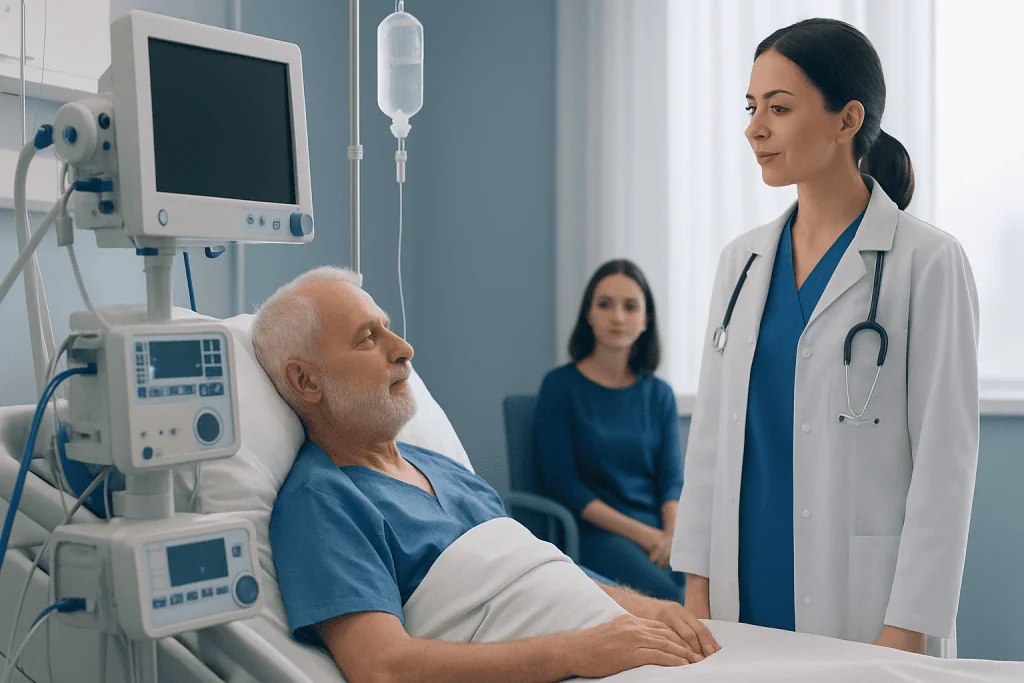
Outpatient care can be a good fit when your treatment is relatively minor, your vital signs are expected to be stable soon afterward, and your doctor believes you can recover safely without overnight monitoring. Many diagnostic procedures, some minimally invasive treatments, and certain day-case surgeries fall into this category. For many patients, going back to a comfortable room the same day feels less disruptive and can make the overall trip easier.
You may also be a stronger candidate for outpatient treatment if you are generally healthy, able to walk independently, tolerate food and fluids well, and have a reliable adult companion with you. Good outpatient candidates usually understand discharge instructions, can take medicines correctly, and can return quickly to the hospital if needed.
That said, outpatient treatment is not the same as “light” treatment. You may still feel tired, sore, sleepy, or limited for a few days. Before agreeing to same-day discharge, ask exactly how long you will need observation after the procedure, when you can shower or eat normally, whether you will need help getting to the bathroom, and who to call at night if symptoms change.
When staying in hospital is often the better option

An overnight hospital stay is often the safer choice if your procedure is more complex, you will have anesthesia or sedation that may affect you for longer, or your team expects that pain control, mobility, bleeding, nausea, or fluid intake need closer observation. Hospital stays are also common when the first night is the period when complications, although still uncommon, are most important to monitor promptly.
Your personal health background matters just as much as the procedure itself. You may benefit from staying in hospital if you have heart or lung disease, diabetes, sleep apnea, a history of anesthesia-related issues, limited mobility, or if you take medications that increase bleeding risk. Age alone does not decide this, but frailty, balance problems, or needing extra support with daily activities can make overnight observation more appropriate.
For international patients, a hospital stay can also reduce stress when you are not yet ready to manage recovery in a hotel setting. In a JCI-accredited hospital such as those within Acibadem International, nursing teams, specialists, and support services can monitor your first recovery phase closely. This can be especially reassuring if your companion is elderly, traveling with children, or not confident helping with early recovery tasks.
Questions to ask before you decide
The most helpful way to make this choice is to ask specific, practical questions rather than simply asking whether same-day discharge is possible. Ask your doctor what usually determines discharge for your treatment: pain control, mobility, urination, eating, wound checks, stable vital signs, or test results. This helps you understand whether discharge depends on a timetable or on meeting clear safety criteria.
You should also ask what your first 24 to 48 hours will realistically look like. Will you be able to walk alone? Will you need help getting dressed or using the bathroom? Can you take oral pain relief, or might you need intravenous medication? If you feel unwell at your accommodation, should you call the international patient team, return directly to the hospital, or go to the emergency department?
It can help to write down your questions in advance, such as:
- What symptoms are expected, and what symptoms are urgent?
- How far from the hospital can I safely stay after discharge?
- When is my first follow-up, and does it need to be in person?
- How soon can I travel by car or fly after treatment?
- Will I need dressing changes, drains, injections, or mobility assistance?
If you are comparing options between providers, ask each one the same questions. The best plan is the one that feels medically sensible and logistically realistic for your trip, not the one that simply sounds fastest.
Travel, accommodation, and companion planning
Where you will recover matters almost as much as where you will be treated. If you are considering outpatient treatment in Turkey, choose accommodation that is clean, quiet, close enough to the hospital, and easy to access without stairs or long walks if your mobility may be reduced. Confirm whether there is an elevator, a walk-in shower, room service, and a comfortable bed that allows you to rest and reposition easily.
Your companion’s role is also important. Even after a routine day-case procedure, you may be groggy, sore, or less steady on your feet. A companion should ideally be able to help with meals, medication reminders, transport, communication, and contacting the hospital if you are too tired or uncomfortable to do so yourself. If you are traveling alone, discuss this early with the hospital, because staying overnight may be safer than being discharged without support.
International patient departments can make this planning much easier. Acibadem International supports many patients with appointment coordination, interpreter services, airport and hospital transfers, and accommodation guidance. These services do not replace medical advice, but they can remove practical stress so you can focus on a safe recovery plan.
How to balance comfort, cost, and safety
It is natural to think about budget and trip length, especially when you are arranging flights, accommodation, and time away from work or family. Outpatient treatment may reduce hospital-related costs and shorten your time in the hospital environment. However, if you are discharged too early for your situation, you may end up needing extra support, additional transfers, or an unplanned return for reassessment, which can be more stressful and less efficient overall.
Hospital stays can feel less flexible, but they may offer better value in situations where you are likely to need close nursing care, intravenous medication, repeated checks, or early rehabilitation support. The right comparison is not just “one night in hospital versus one night in a hotel.” It is “which option gives me the safest first stage of recovery with the least avoidable stress?”
Try not to choose based only on convenience or assumptions from previous treatment experiences. Even if you have had outpatient care before, a different procedure, different anesthesia plan, or different travel situation may change what is appropriate this time. The safest plan is the one your clinical team recommends after reviewing your procedure, your medical history, and your travel arrangements.
A simple way to make your final decision
If you are still unsure, think in four categories: medical needs, immediate recovery needs, travel logistics, and personal support. Medical needs include the type of procedure, anesthesia, and your health conditions. Immediate recovery needs include pain control, nausea, mobility, wound care, and how likely you are to need observation overnight.
Travel logistics include how far your accommodation is from the hospital, whether you can avoid stairs, whether you have a private bathroom, and when you plan to fly home. Personal support means whether a capable adult will stay with you, understand the instructions, and help if you become dizzy, uncomfortable, or worried after discharge.
If one or more of these areas looks weak, an overnight stay may be the smarter choice. If all four look strong and your doctor agrees, outpatient treatment may work very well. Either way, ask for written discharge instructions, emergency contact details, and a clear plan for follow-up before your treatment day begins.
Step by step
- Start with the medical recommendation. Ask your treating doctor whether your procedure is usually done as outpatient care, inpatient care, or either depending on the patient. Then ask what specific factors in your own case make one option safer or more practical.
- Review your health history honestly. Tell your team about chronic conditions, medications, allergies, sleep apnea, mobility issues, and any past problems with anesthesia or recovery. Small details can change whether same-day discharge is appropriate.
- Map out your first 24 hours after treatment. Think beyond the procedure itself and plan where you will sleep, who will stay with you, how you will get back, and what help you may need. If any part of that feels uncertain, ask whether a hospital stay would reduce risk.
- Check your accommodation and transport. Choose a place that is close to the hospital and easy to manage if you are tired or sore. Confirm how you will travel back after treatment and whether you may need wheelchair assistance or a private transfer.
- Understand discharge criteria and warning signs. Before treatment day, ask what needs to happen before you can safely leave. Also ask which symptoms are expected and which require you to call the hospital or return urgently.
- Plan follow-up before you arrive. Know when your first review will be, whether dressings or medications need checking, and how soon you can fly or travel longer distances. This helps you book accommodation and return flights more safely.
- Choose the option that fits safety first. If outpatient care is medically suitable and your support arrangements are strong, it may be a convenient choice. If there is any doubt about observation, pain control, mobility, or support, an overnight stay is often the wiser plan.
Your checklist
- I know whether my procedure is commonly outpatient, inpatient, or case-dependent.
- My doctor has reviewed my medical history and current medications.
- I understand the expected recovery pattern for the first 24 to 48 hours.
- I have safe accommodation close to the hospital if I am discharged the same day.
- A responsible adult can stay with me after treatment if needed.
- I know the discharge criteria and warning signs to watch for.
- I have emergency contact numbers and follow-up details in writing.
- My return flight or onward travel allows enough recovery time.
- I have arranged translation or international patient support if needed.
Key takeaways
- The right choice depends on your procedure, health status, recovery needs, and support after discharge.
- Outpatient treatment can work well, but only if you can recover safely outside the hospital.
- An overnight stay is often better when observation, pain control, mobility support, or complex care is likely.
- For international patients in Turkey, accommodation, transport, language support, and companion availability matter a lot.
- Ask clear questions about discharge criteria, warning signs, and follow-up before treatment day.
Frequently asked questions
Is outpatient treatment in Turkey always the easier option?
Not always. It may be simpler on paper, but it is only easier if your recovery is likely to be stable and you have the right support, accommodation, and transport. If you are likely to need closer observation or help overnight, a hospital stay may actually be the smoother option.
How do doctors decide if I need to stay overnight?
They usually look at the procedure itself, the type of anesthesia or sedation, your medical history, and how you are expected to recover in the first hours afterward. They also consider practical issues such as mobility, pain control, and whether you will have support after discharge.
Can I ask for a hospital stay even if the treatment is usually outpatient?
You can raise the question and explain your concerns, especially if you are traveling alone, have medical conditions, or feel uneasy about recovering in a hotel. The final plan should still follow clinical judgment, but your comfort, support needs, and travel situation are important parts of the discussion.
What if I am traveling to Istanbul alone for treatment?
Traveling alone does not automatically mean you need admission, but it does make discharge planning more important. Let the hospital know early so the international patient team can advise on support options, transfers, interpreters, and whether an overnight stay would be safer.
How close should my hotel be if I am discharged the same day?
There is no single rule, but being reasonably close to the hospital is usually more reassuring, especially on the first night. Ask your care team what distance they consider appropriate for your procedure and whether you should avoid stairs, long walks, or busy public transport.
Does staying overnight mean my treatment is more serious?
Not necessarily. Sometimes an overnight stay is simply the most sensible way to monitor recovery, control symptoms, or make sure you are comfortable before discharge. It can be a practical precaution rather than a sign that something is wrong.
How can Acibadem International help with this decision?
Acibadem International can help coordinate communication between you and your medical team, explain practical next steps, and support logistics such as interpreters, transfers, and accommodation planning. In its JCI-accredited hospitals, international patients can also benefit from structured inpatient and discharge processes designed to support safe recovery.
Add us as a Preferred Source to see more of our trusted health content across Google Search, AI Overviews and Discover.
More Patient Guides

Managing Prescription Refills During a Treatment Stay in Turkey
Manage prescription refills during treatment in Turkey by bringing medication records, speaking with your care team early and using licensed pharmacies.
8 min read
Unexpected ICU Stay in Turkey: What Patients and Families Should Expect
Unexpected ICU stay in Turkey: learn what patients and families can expect, from communication and visiting to care updates and travel support.
8 min read
Choosing a Hospital Room in Turkey: Private Room, Companion Stay, and Practical Questions
Choosing a hospital room in Turkey is easier when you ask about privacy, companion stays, amenities, visiting rules and discharge planning early.
8 min read