5000 Grafts Hair Transplant: Coverage, Cost Factors, and What to Expect

A 5000 grafts hair transplant may restore a large area, but coverage varies by hair thickness, curl, color contrast, and donor density. This graft count is often used for advanced hair loss, especially when the frontal scalp, mid-scalp, and crown all need attention.
Key Takeaways
- A 5000 grafts hair transplant may restore a large area, but coverage varies by hair thickness, curl, color contrast, and donor density.
- This graft count is often used for advanced hair loss, especially when the frontal scalp, mid-scalp, and crown all need attention.
- Not everyone is a candidate for 5000 grafts in one session; safety and donor preservation guide the plan.
- Cost factors usually include technique, case complexity, number of sessions, and postoperative care rather than graft count alone.
- A specialist assessment helps determine whether one large session or a staged approach is more appropriate.
A 5000 grafts hair transplant is usually considered a large session used to restore extensive thinning or balding when the donor area is strong enough. Coverage, appearance, and the overall treatment plan depend less on the number alone and more on hair characteristics, scalp health, and realistic design goals.
Overview: What a 5000 Grafts Hair Transplant Means
A 5000 grafts hair transplant generally refers to transplanting about 5,000 follicular units from the donor area, most often the back and sides of the scalp, into thinning or bald areas. Because each graft may contain one to several hairs, the total number of transplanted hairs is usually much higher than 5,000. In practical terms, this is considered a large procedure and is typically planned for people with moderate to extensive hair loss.
The main question many people ask is how much area 5,000 grafts can cover. The answer depends on the pattern of hair loss and the cosmetic goal. In some individuals, 5,000 grafts may be used to create stronger density in the hairline and frontal scalp while also improving the mid-scalp. In others, the same number may need to be spread across a larger area, which can produce broader coverage but lighter density.
For this reason, surgeons usually focus on visual outcome rather than graft count alone. Hair caliber, curl, natural color contrast between hair and scalp, and the condition of the donor area all affect how full the result appears. A personalized consultation is more useful than comparing raw numbers with another person’s case.
Patients exploring hair transplant treatment often benefit from learning how graft counts relate to pattern severity, including the Norwood scale and expected hair transplant recovery.
How Much Coverage Can 5000 Grafts Provide?
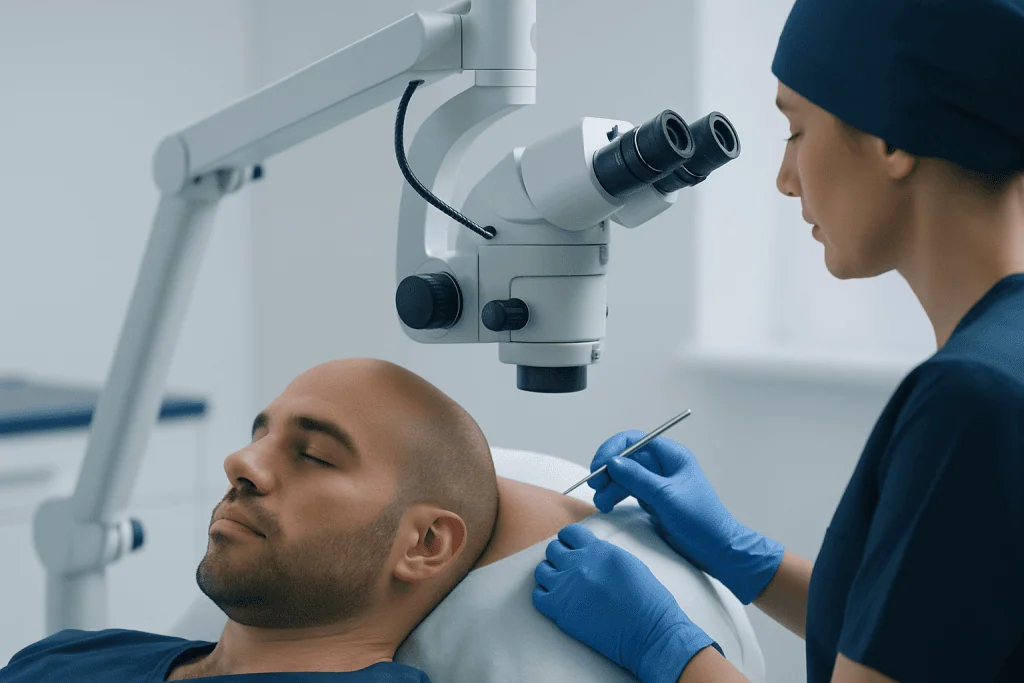
Coverage with 5,000 grafts is best understood as a balance between surface area and density. If the surgeon concentrates grafts in a smaller region, the result may look denser. If the same grafts are distributed over the hairline, top of the scalp, and crown, the appearance may be more even overall but less dense in each individual zone. This is why planning is often based on priorities, such as rebuilding the frontal hairline first and addressing the crown later.
Several factors change how far 5,000 grafts can go. Thick or curly hair generally creates the appearance of greater fullness than fine, straight hair. Dark hair on a light scalp tends to show contrast more clearly, so more grafts may be needed for the same visual density. A healthy scalp and good donor quality also support better placement and long-term outcomes.
Hair loss pattern matters as well. A person with recession mainly at the temples and front may achieve a very noticeable change with 5,000 grafts. Someone with advanced diffuse loss across the full top of the scalp may need a more conservative density goal or a staged plan. The aim is to create a natural look that respects the limited donor supply available over a lifetime.
- Frontal hairline and temples often receive priority because they frame the face.
- Mid-scalp restoration can improve the sense of overall fullness.
- The crown usually requires many grafts and may be treated in the same session or later.
- Donor preservation is essential in case future hair loss continues.
Who May Be a Candidate for 5000 Grafts?

A 5000 grafts hair transplant is not suitable for every patient. Candidacy depends first on the donor area. The surgeon assesses donor density, hair thickness, scalp flexibility when relevant, and the likelihood that enough follicles can be removed without making the donor zone appear thin. Even when a patient wants maximum coverage, the procedure should not compromise donor health.
The cause of hair loss also matters. Many candidates have androgenetic alopecia, also called male pattern baldness, or female pattern hair loss in selected cases. However, hair transplantation may not be appropriate until active scalp disease, inflammation, or non-pattern shedding has been evaluated. In some people, medical treatment is recommended before or alongside surgery to stabilize ongoing loss.
Age, expectations, and long-term planning are also important. Younger patients may still lose native hair over time, so an aggressive hairline design can look unnatural later. A conservative, age-appropriate plan often produces the most durable result. Some people are better served by staging treatment into two sessions rather than pursuing a very large one at once.
Assessment may include a scalp examination, review of family history, medication history, and photographs. The goal is to confirm that the transplanted hair is likely to survive well and that the remaining donor reserve is being used wisely.
Procedure Planning and What to Expect on the Day
Before the procedure, the treatment team usually maps the donor and recipient areas, discusses hairline design, and estimates how many grafts can be harvested safely. A large case such as 5,000 grafts may take many hours and requires careful handling of follicles to maintain graft quality. The most common modern technique is follicular unit extraction, often called FUE, though the best method depends on the individual case.
During the procedure, local anesthesia is typically used to keep the scalp comfortable. Grafts are removed from the donor area, sorted, and then placed into tiny recipient sites created at planned angles and directions. This artistic aspect is important because natural growth pattern matters as much as graft survival. The frontal hairline usually uses single-hair grafts for softness, while multi-hair grafts may be placed farther back for volume.
Some patients can undergo 5,000 grafts in one session, while others may be advised to split treatment into stages. This decision is based on patient comfort, surgical time, donor management, and the extent of baldness. Staging can sometimes improve precision and allow better planning for crown coverage later.
Patients considering FUE hair transplant or related sapphire FUE hair transplant approaches should know that technique choice is only one part of the outcome. Surgeon experience, donor evaluation, and realistic design goals are equally important.
Recovery, Timeline, and Early Results
Recovery after a 5000 grafts hair transplant usually involves temporary redness, mild swelling, small crusts, and scalp tenderness. These early effects generally improve over days to a couple of weeks, depending on the person and the size of the session. Patients are commonly advised to protect the scalp, avoid friction, and follow washing instructions closely during the first phase of healing.
It is normal for many transplanted hairs to shed after the procedure. This early shedding does not mean the transplant has failed; the follicles remain in place beneath the skin and later begin a new growth cycle. Visible regrowth often starts gradually after several months, with ongoing improvement in density and texture over time.
Results from a large session take patience. Hair usually does not grow all at once, and the crown may mature more slowly than the frontal scalp. Final appearance can continue to refine for up to a year or longer in some individuals. Because native non-transplanted hair may still thin with age, maintenance treatment may also be discussed.
Clear expectations are especially important with larger graft counts. A good result is not simply about maximum numbers; it is about a natural hairline, balanced density, and a donor area that continues to look healthy.
Cost Factors and Treatment Planning
There is no single standard price for a 5000 grafts hair transplant, and cost should be viewed in relation to medical planning rather than as an isolated number. Factors that commonly affect overall cost include the complexity of the hair loss pattern, the technique used, whether the procedure is completed in one session or more than one, the size and expertise of the surgical team, and the level of follow-up care provided.
Additional considerations may include preoperative evaluation, laboratory testing when needed, postoperative medications, and travel or accommodation for patients coming from outside the area. Cases involving repair of a previous transplant or difficult donor characteristics can also require more advanced planning and time. For these reasons, a quote based only on graft count may not reflect the full clinical picture.
Patients often compare options by asking how many grafts are included, but this can be misleading if donor limits, graft quality, and long-term strategy are not discussed. A careful consultation should explain what the surgeon expects to cover, where density will be prioritized, and whether future sessions may be needed. This approach supports safer decision-making and more realistic expectations.
Near the end of the planning process, some international patients choose to consult Acibadem International, where multidisciplinary specialists in JCI-accredited hospitals evaluate hair loss and provide individualized treatment planning.
Self-care, Long-Term Maintenance, and When to Seek Medical Care
After transplantation, self-care plays an important role in healing and long-term appearance. Patients are usually advised to sleep with the head elevated for a short period, avoid smoking if possible, protect the scalp from direct sun, and postpone strenuous exercise until cleared by the medical team. Gentle washing and adherence to aftercare instructions help reduce crusting and support a smooth recovery.
Long-term maintenance may include medical treatment for ongoing pattern hair loss, because transplantation redistributes existing follicles rather than stopping future thinning in untreated areas. A specialist may discuss options such as medications or supportive therapies based on scalp health, age, and the pattern of loss. Continued follow-up can help preserve a balanced look as hair changes over time.
Medical advice should be sought promptly if there is increasing pain, spreading redness, pus, fever, unusual bleeding, or swelling that worsens rather than improves. Patients should also contact their doctor if they are unsure whether postoperative shedding is normal or if they notice patchy loss in the donor area. Early review can help distinguish expected healing from a problem that needs treatment.
Anyone considering a 5000 grafts procedure should seek specialist care before surgery if hair loss is sudden, patchy, associated with itching or scaling, or accompanied by other symptoms. These signs may suggest a scalp disorder that should be diagnosed before transplantation is planned.
Frequently asked questions
Is 5000 grafts a lot for a hair transplant?
Yes. A 5000 grafts hair transplant is generally considered a large session and is often used for more advanced hair loss. Whether it is appropriate depends on donor density, scalp health, and the overall treatment plan.
How many hairs are in 5000 grafts?
A graft is a follicular unit, not a single hair. Because each graft may contain one to several hairs, 5,000 grafts usually represent many more than 5,000 individual hairs. The exact total varies from person to person.
Can 5000 grafts cover the whole scalp?
Usually not at high density across the entire scalp if hair loss is extensive. In many cases, 5,000 grafts can provide strong improvement, but surgeons often prioritize the front and mid-scalp because these areas have the greatest visual impact.
Is one session enough for 5000 grafts?
Sometimes, but not always. Some patients can safely undergo 5,000 grafts in one long session, while others may be advised to split treatment into stages for comfort, graft quality, or donor preservation.
How long does it take to see results after a 5000 grafts hair transplant?
Early healing usually happens within days to weeks, but visible growth takes longer. Transplanted hairs often shed first, then begin regrowing over the following months. Results continue to improve gradually, and the final appearance may take up to a year or more.
Does a higher graft count always mean a better result?
No. A better result depends on natural hairline design, correct graft placement, donor management, and realistic density planning. A lower number used strategically may look better than a larger number spread too thinly.
References
- American Academy of Dermatology
- International Society of Hair Restoration Surgery
- British Association of Dermatologists
- American Society of Plastic Surgeons
This article is for general information only and is not a substitute for professional medical advice. Please consult a qualified doctor about your individual situation.
Hair transplant in Turkey — costs, graft counts & a free assessment
JCI-accredited · board-certified surgeons · reply within 24h
Add us as a Preferred Source to see more of our trusted health content across Google Search, AI Overviews and Discover.