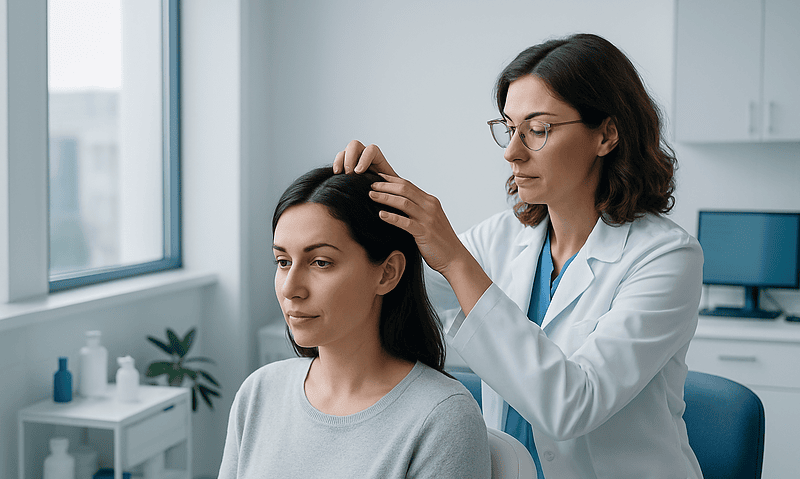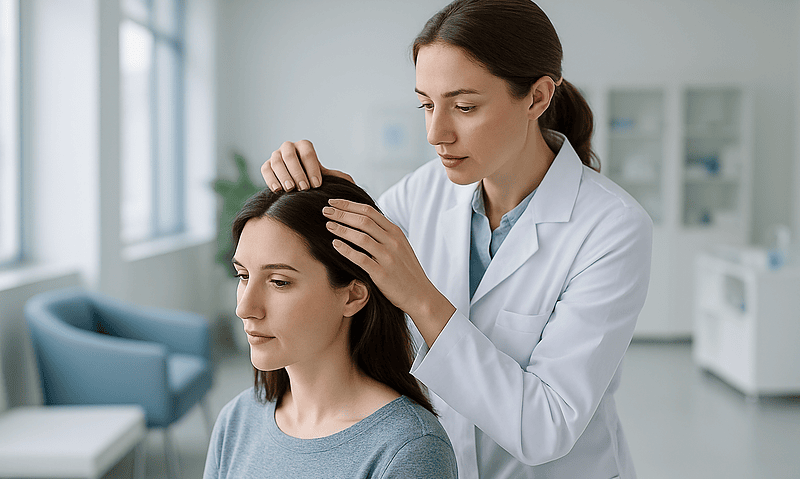
The Donor Area: How It Is Chosen, How It Heals, and Whether Hair Grows Back
The donor area is the band of scalp, usually across the back and sides of the head, where hair follicles are genetically resistant to…
Read article

Articles on hair transplant surgery: how FUE and DHI differ, how grafts are planned, what the healing timeline looks like month by month and how to judge a clinic before you commit.
The donor area is the band of scalp, usually across the back and sides of the head, where hair follicles are genetically resistant to…
No. Wearing a hat does not cause a receding hairline. Mainstream medical evidence attributes a receding hairline mainly to androgenetic alopecia, a genetic, hormone-driven…
A no-shave hair transplant keeps most of your hair at its existing length, while a shaved transplant trims the donor area, and often the…
Braids, locs and relaxers usually return in stages after an Afro hair transplant, not on one fixed date. Grafts are most fragile in the…
Hair transplants generally work for people with stable pattern baldness and an adequate donor area: surgical literature reports that most transplanted grafts survive and…
To estimate a realistic hair transplant total, start with your graft count, set by your pattern of loss and donor supply, then apply the…
Norwood 3 is the first stage on the Hamilton–Norwood scale that dermatologists generally consider true male-pattern baldness: the temples have receded into a clear…
In a robotic hair surgery procedure, a surgeon-supervised robotic arm uses cameras and software to map follicular units on the back of the scalp,…
FUE hair transplant anesthesia is typically local rather than general: a series of small injections numbs the back and top of the scalp while…
A hair transplant can reshape a widow's peak in either direction. Surgeons can place follicular-unit grafts to rebuild a peak that has thinned with…
A hair transplant abroad can cost substantially less than the same procedure in the UK or US, but the savings only make sense if…
After hair transplant repair, fine crusts around each graft, mild tenderness, scalp tightness and patchy numbness are expected during the first one to two…
Typical ranges run from about 500–1,500 grafts for early hairline recession (Norwood 2–3), 2,000–3,500 for moderate loss (Norwood 4–5), and 4,000–6,000 or more for…
To choose a hair transplant clinic, verify that a licensed physician trained in hair restoration performs or directly supervises every stage, ask exactly who…
Yes, most transplanted hairs shed between roughly two and eight weeks after surgery, and this is normal and expected. The follicles beneath the…
A female hair transplant using unshaven FUE or DHI typically falls in a guide range of EUR 3,250–6,500 for international patients treated in Turkey,…
Most surgical teams ask patients not to shave the transplanted beard area for at least two weeks, and many prefer around four weeks before…
Diffuse unpatterned alopecia (DUPA) thins hair evenly across the entire scalp, including the back and sides that supply grafts for a hair transplant. Because…
Choose which cookies you allow. Essential cookies are always on because the site cannot work without them.