

Hair Transplant Repair for International Patients: Photo Review, Staged Sessions and Follow-Up

Key Takeaways
- Repair planning begins with the donor area, because grafts already removed cannot be replaced and every future session draws on the same finite supply.
- A remote photo review can decide whether a consultation is worthwhile but cannot measure donor density, scalp laxity or detect a scarring alopecia, so an in-person examination comes before any surgical plan.
- Staged sessions exist because transplanted hair sheds within weeks and takes 6 months to a year to show its result, according to the NHS, and operating sooner means judging growth that has not arrived.
- The CDC advises waiting 7 to 10 days before flying after cosmetic procedures because surgery and air travel each raise blood clot risk, and the combination compounds it.
- Grafts placed into scar tissue tend to survive less predictably than grafts placed into normal scalp because scar has poorer blood supply, which is why surgeons space them more widely and avoid promising how much a scar will fade.
- No regulator or systematic review ranks countries or surgeons for hair transplantation; what can be verified is a surgeon's registration, training, who actually operates and whether the facility is licensed.
Hair transplant repair for international patients usually begins with a remote photo review, followed by an in-person examination that checks the donor area, scar tissue and the pattern of ongoing hair loss. Repair is commonly planned in staged sessions spaced months apart so the surgeon can judge growth before operating again. Flying, wound care and follow-up need written arrangements agreed with the treating team before anything is scheduled.
The photographs arrive at midnight, taken in a bathroom mirror with the overhead light casting shadows across a hairline that sits a little too low, a little too straight, with grafts planted in rows that look like a freshly seeded lawn. The person who took them has already spent one recovery period waiting for hair that never quite came. Now they are looking for someone, probably in another country, to make it right.
This is the starting point for most people who search for hair transplant repair for international patients. The request is rarely about vanity. It is about fixing something that is visible every day, and about not repeating the mistakes that led here. Distance adds a layer of difficulty that a first-time patient never faces: the surgeon cannot touch the scalp, the follow-up visits will happen in a different time zone, and the donor hair that funds every future attempt is already partly spent.
What follows is a plain account of how repair is assessed and staged, and what the published evidence does and does not support.
Why hair transplant repair for international patients is a different kind of problem
A first hair transplant works with a scalp that has never been operated on. The donor area, the band of hair at the back and sides that keeps growing for life in most people with pattern hair loss, is intact. Repair starts from a different place. Some of that donor supply has already been removed, and the recipient area contains grafts that may be too large, pointed in the wrong direction or placed where mature hairlines do not naturally sit.
For someone travelling from abroad, three things change the planning. First, the surgeon’s earliest information comes from photographs rather than a hands-on examination, so the initial opinion is always provisional. Second, repair almost never fits into a single visit; the NHS notes that final results of any transplant take 6 months to a year to appear, and a sensible surgeon wants to see that growth before committing more donor hair. Third, early complications such as infection or bleeding tend to show up in the first days, exactly when the patient may be sitting in an airport.
None of this makes repair impossible across borders. It does mean that a good repair plan is as much a logistics document as a surgical one. The patient needs to know who will remove any stitches, who reviews healing photographs at week two, and who they call if the scalp becomes hot and swollen on a Sunday night far from the operating team.
The NHS guidance on cosmetic surgery abroad puts the matter simply: patients should find out in advance what aftercare is included and who will treat them if something goes wrong after they return home. That question matters even more when the surgery is a second attempt.
How hair transplant repair actually works: what happens in the chair
A graft is a small piece of scalp containing one to four hairs growing together; surgeons call that natural grouping a follicular unit. Every modern transplant, including repair, moves follicular units from the donor area to the recipient area under local anaesthetic, which numbs the scalp while the patient stays awake. The NHS describes a session lasting anywhere between 4 and 8 hours depending on how many grafts are moved.
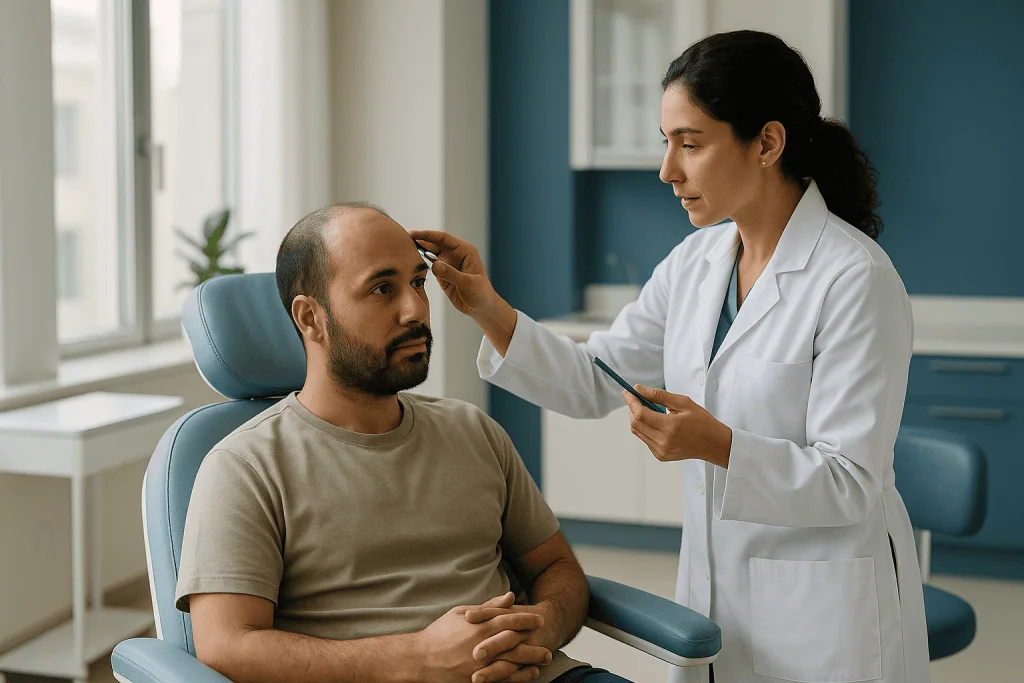
Repair adds steps that a first procedure does not need. The surgeon may remove badly placed grafts one by one using a small punch, a technique sometimes called graft excision, and either discard the scar tissue or dissect the hairs out and re-implant them further back. Older, larger grafts can be split into smaller units. A hairline that sits too low can be softened by removing its front row and placing finer single-hair grafts in an irregular, feathered pattern behind it.
If a previous strip procedure left a wide or stretched scar across the back of the head, the surgeon may excise and re-close it, or implant grafts directly into the scar to camouflage it. Scar tissue has poorer blood supply than normal scalp, so grafts placed into it are often spaced more widely and survival is harder to predict; this is one reason repair surgeons are cautious about promising how much a scar will fade.
Harvesting for the repair itself is done either by follicular unit extraction (FUE), where individual units are removed with a tiny punch, or follicular unit transplantation (FUT), where a strip of scalp is removed and divided under magnification. The choice depends on how much donor hair remains, how the previous donor site healed and whether the patient wears their hair short. These are surgical judgements, and they belong to the operating team after a physical examination.
What a failed hair transplant repair is usually trying to fix
The phrase failed hair transplant covers several quite different outcomes, and the repair plan changes with each one.
Poor growth. Grafts were placed but a disappointing proportion produced hair. Causes include grafts drying out during handling, placement that was too dense for the blood supply, or an underlying scalp condition that was never diagnosed. Repair here is often simply a second, more carefully executed session, provided donor supply allows.
Unnatural hairline design. The hairline is too low, too flat or too symmetrical for the person’s age and facial shape, or it ignores the natural temple recession that almost all adult hairlines have. Fixing this can require removing the front row before adding anything new.
Wrong angle or direction. Hair naturally emerges at a shallow angle and changes direction across the scalp. Grafts planted upright, or against the surrounding flow, look transplanted even when they grow well.
Pluggy or large grafts. Older methods moved clusters of ten or more hairs. These can be excised and redistributed as smaller units.
Donor scarring. A wide strip scar, or a moth-eaten appearance from over-harvested FUE, is visible whenever the hair is cut short. Options include scar revision, grafting into the scar or, for some, scalp micropigmentation, a cosmetic tattooing technique that is not a surgical treatment and does not restore hair.
Continued loss around the grafts. Transplanted hairs are usually resistant to pattern hair loss, but the native hair around them is not. Mayo Clinic notes that hair loss often continues after a transplant, which can leave an island of transplanted hair behind a receding natural hairline. This is a planning failure rather than a surgical one, and it is the reason most teams discuss long-term medical management alongside any repair.
Who is usually a candidate for corrective hair transplant, and who is asked to wait
The most important qualifying factor is not the severity of the first result but the state of the donor area. A person with visible problems at the front and a healthy, dense donor band has options. Someone whose back and sides have already been heavily harvested may be told that further surgery would create a new problem to hide the old one. Honest surgeons say this out loud, even when it means turning away a patient who has travelled.

Candidates who usually proceed after assessment tend to share a few features: pattern hair loss that has stabilised or is being managed, realistic goals that focus on looking natural rather than looking dense, a scalp that has fully healed from the previous procedure, and general health that makes a long local-anaesthetic session safe.
People who are commonly asked to wait include those whose previous surgery was recent. Because the NHS guidance places the visible result of a transplant at 6 months to a year, operating sooner means judging a result that has not finished arriving. Grafts that look dead at month four may well be growing by month ten.
Others are asked to wait, or to see a dermatologist first, because the underlying diagnosis is unclear. Scarring alopecias, a group of inflammatory conditions that destroy follicles and leave smooth shiny skin, can look like a failed transplant and will destroy new grafts too. Mayo Clinic lists these among the causes of hair loss that need diagnosis before any treatment. Active alopecia areata, uncontrolled diabetes, bleeding disorders and heavy smoking also tend to prompt a pause rather than a booking.
A smaller group is advised against further surgery entirely and offered camouflage approaches instead. That advice can be hard to hear after a long search, but it is often the most protective recommendation a surgeon can make.
Why the donor area decides almost everything
Think of the donor area as a savings account that cannot be refilled. Every graft taken is a withdrawal. A first transplant typically spends a portion of it; a poorly executed one may have spent it inefficiently, moving hairs that then failed to grow. Repair has to make the remaining balance cover not only today’s correction but also the loss that pattern baldness will add over the next two decades.
Surgeons assess this in several ways. They look at density, meaning how many follicular units sit in each square centimetre of donor skin, and at the width of the safe zone, the band that is expected to keep its hair for life. They examine how the previous harvest was done. FUE that removed too many units from one patch leaves a thinned, patchy look; a strip scar that stretched reduces how much scalp can be removed in future.
This is where the familiar search question about graft counts falls apart. People ask what a session of three thousand grafts involves, as if the number were a product to be ordered. In repair, the number of grafts is an output of the donor assessment, not an input. A surgeon who quotes a graft number before examining the donor area in person is quoting a guess.
Some repair patients ask about body hair, taken from the beard or chest, as a supplementary donor source. The texture and growth cycle differ from scalp hair, and published evidence on long-term outcomes is thin; most mainstream guidance does not address it. If it is proposed, the patient is entitled to ask what the surgeon’s own experience shows and to hear that the result is less predictable.
The donor area is also where the strongest argument for staged repair lives, which the next sections cover.
How a remote photo review works, and what it cannot tell a surgeon
For a patient abroad, the first contact is almost always a set of photographs or a video call. A useful photo review has a structure. The team asks for images in consistent, natural light, without flash, with hair dry and unstyled: front view, each side, the crown from above and the donor area from behind with hair lifted or trimmed. Close-ups of the hairline and of any scar are requested separately. Many teams ask for the previous surgical record too, including the method used and the number of grafts moved, if the patient can obtain it.
From this a surgeon can usually form a view on the general pattern of loss, whether the hairline design is appropriate, how obvious the previous grafts are and whether the donor area looks depleted or scarred. That is enough to decide whether an in-person consultation is worthwhile.
It is not enough to plan surgery. Photographs cannot measure donor density, assess scalp laxity, which is how much the skin stretches and matters for strip closure, or detect miniaturising hairs that signal where loss will spread next. They cannot distinguish a scarring alopecia from ordinary scarring, and they flatten the three-dimensional angles that make transplanted hair look natural or not. Lighting alone can make a thin area look full.
The NHS advice for anyone considering cosmetic surgery abroad is to have a proper consultation with the surgeon who will operate, not a salesperson, before committing. For repair, that consultation should include a physical examination on a day separate from surgery, with time to go home and think. If the only in-person contact offered is on the morning of the operation, the plan is being built on photographs, and the risks that come with that belong to the patient.
Why repair is planned in staged sessions, and when a hair transplant second session makes sense
A single large repair session is tempting for someone who has flown a long way. It is also the approach most likely to repeat the original error. Staging exists for three reasons, and each is grounded in how transplanted hair behaves.
The first is biology. MedlinePlus describes the typical sequence after any transplant: the moved hairs shed within weeks, the follicles rest, and new growth appears over the following months, with the full picture emerging gradually. Operating again before that cycle completes means adding grafts to an area whose density is unknown.
The second is donor economy. If a first repair session is kept moderate, the surgeon can see how well grafts survive in this particular scalp, including in scar tissue, before spending more of a finite supply. A disappointing yield in session one changes what is wise in session two.
The third is design. Hairlines are easier to soften in stages. Removing the worst grafts and letting the scalp heal, then adding fine grafts in front, produces a more natural edge than trying to do both at once over a recently traumatised area.
A typical staged plan therefore looks like this: a first session focused on removal of misplaced grafts and any scar revision; a review of healing by photograph at around two weeks and again at a few months; then a second session only after growth from the first can be judged, which, following the NHS timeline, often means waiting until roughly a year has passed. Some patients need a third, smaller refinement; others stop after two.
Each interval is a return trip for an international patient. That cost in time and disruption is real, and it should be part of the decision rather than a surprise discovered after the first session.
Comparing the main repair approaches at a glance
No single technique fits every repair. The table below summarises how the common approaches are typically used, drawn from the descriptions of FUE and FUT in NHS and Cleveland Clinic patient material and from general surgical practice. It is a map of options, not a recommendation; the choice belongs to the treating team after examination.
| Approach | What it involves | Typically considered when | Main trade-offs |
|---|---|---|---|
| FUE re-harvest and re-implant | Individual follicular units removed with a small punch and placed in the recipient area | Donor density is adequate; patient wears hair short; previous strip scar present | Each punch leaves a tiny dot scar; over-harvesting thins the donor band |
| FUT (strip) re-harvest | A strip of donor scalp removed and divided into units under magnification | Large graft numbers needed; good scalp laxity; existing strip scar can be included in the new excision | Linear scar; stitches removed at around 10 to 14 days per NHS; longer recovery |
| Graft excision and redistribution | Misplaced or pluggy grafts punched out and re-implanted elsewhere | Hairline too low, wrong angle, large old grafts | Some hairs lost in handling; small scars at removal sites; often staged |
| Scar revision | Wide scar excised and re-closed, sometimes with a different closure technique | Stretched strip scar with good surrounding laxity | New scar may also stretch; does not add hair |
| Grafting into scar | Follicular units placed directly into scar tissue | Visible donor or recipient scar; donor supply available | Lower, less predictable survival in scar; usually lower density |
| Scalp micropigmentation | Cosmetic tattooing of dots to mimic shaved hair | Donor depleted; scar camouflage; patient wears hair very short | Not hair; fades over years; colour may shift |
Two patterns stand out. Approaches that add hair all depend on donor supply, and approaches that do not add hair, such as scar revision or pigmentation, are the ones that remain available when supply is gone. A repair plan that uses the hair-adding methods first, carefully and in stages, keeps the non-surgical options in reserve.
What the first days and weeks after a repair session usually look like
The pattern after repair resembles the pattern after a first transplant, with a few additions where grafts were removed or a scar revised. Cleveland Clinic and NHS patient information describe the typical course, and the ranges below are drawn from those sources rather than from any one surgeon’s promise.
In the first two to three days, the scalp is tender, the recipient area carries small crusts around each graft and the forehead may swell, sometimes drifting down toward the eyes. Mild bleeding or oozing from either site is common. Most teams ask patients to sleep with the head raised, avoid touching the grafts and follow a specific washing routine. These instructions vary; the ones that matter are the ones written by the operating team.
During the first two weeks, crusts lift and fall away with gentle washing. If FUT was used, the NHS notes that stitches are usually removed around 10 to 14 days after surgery, which for an international patient means either staying nearby, having a local clinician remove them or receiving dissolvable sutures by prior arrangement. The NHS also suggests that people who had a strip procedure may need up to two weeks off work, while FUE patients often return sooner.
Between weeks two and eight, the transplanted hairs shed. MedlinePlus describes this expected shedding; it alarms almost everyone the first time and it is not a sign of failure. Numbness or tingling in the donor and recipient areas is common and usually settles over weeks to months.
From around month three, fine new hairs appear and thicken. The NHS places the visible result at 6 months to a year. Scalp hair grows at roughly half an inch a month according to Cleveland Clinic, so even successful grafts need time to become hair that can be styled.
Hair transplant repair for international patients: flying, clots and follow-up planning
Neither the NHS nor the CDC recommends any destination for surgery, and this article does not either. Both publish safety guidance for people who have already decided to have a procedure away from home, and that guidance applies directly to repair patients.
The CDC advises against flying too soon after surgery because air travel and recent surgery each raise the risk of blood clots, and the combination compounds it. For cosmetic procedures, the CDC suggests waiting 7 to 10 days before flying. The NHS cosmetic surgery abroad page makes the same point and adds practical advice: stay well hydrated on the flight, move about the cabin regularly, do calf exercises while seated and discuss individual clot risk with the surgeon, particularly for anyone with a history of clots, obesity, hormone therapy or prolonged immobility.
Hair surgery is less invasive than chest or abdominal operations, but a session can last 4 to 8 hours of sitting still, and the days after involve limited activity. Patients who have travelled a long distance to arrive have already spent hours immobile. Mentioning that travel history during the pre-operative assessment is sensible.
Follow-up is the other half of the plan. Before surgery, a repair patient should have in writing: who removes stitches and when; how and when healing photographs are to be sent; who reviews them and how quickly a reply can be expected; and what happens if a complication needs in-person care after the return home. The NHS specifically advises finding out whether a local doctor would be willing to provide follow-up and whether the overseas team will share records.
Travel insurance often excludes elective surgery abroad and its complications. Reading that policy before booking anything is not pessimism; it is part of informed consent.
Where medicines fit alongside repair, and what the evidence says
Surgery moves hair. It does not stop the biological process that caused the loss. Mayo Clinic describes two medicine classes used for pattern hair loss: a topical vasodilator applied to the scalp, which is thought to prolong the growth phase of follicles, and an oral enzyme inhibitor that lowers levels of the hormone most responsible for follicle shrinkage in men. Both are typically assessed over several months to a year, and both work only while they are being used; stopping tends to return the scalp to its previous trajectory over the following months.
For repair patients, this matters in two ways. First, native hair around the grafts is still vulnerable. If it continues to thin, the transplanted island becomes more obvious, and a surgeon planning a staged repair may ask about medical management before committing more donor hair. Second, some patients had a disappointing first result partly because loss progressed around it, and that is a treatable factor.
Whether any medicine is appropriate, which one, and for how long are decisions for the prescribing clinician, who will weigh side effects, other medications and the patient’s own preferences. Nothing here should be read as encouragement to start, stop or change a prescription.
A separate question arrives in nearly every inbox: what a particular billionaire or celebrity used to regrow their hair. No verified medical record of any public figure’s treatment is available, and photographs cannot establish whether change came from surgery, medicine, styling or lighting. Speculation about famous scalps is not evidence, and it is a poor basis for anyone’s own decisions.
Platelet-rich plasma injections, low-level laser devices and various supplements are also widely marketed around repair. Mainstream guidance describes the evidence for these as limited or mixed; they should be discussed with the care team rather than assumed to work.
What people often get wrong about failed hair transplant repair
Myth: a bad result means the surgeon was incompetent. Sometimes it does. Often, though, the plan was the problem: too much hair placed too far forward in a young patient whose loss then continued. Diagnosing why the first attempt disappointed is the first task of repair, and blame is less useful than understanding.
Myth: there is a number-one country or a best surgeon in the world. People type this into search engines constantly. No regulator, medical society or systematic review ranks countries or surgeons for hair transplantation. Lists that claim to are marketing. What can be checked is specific: a surgeon’s registration with a national medical regulator, their specialty training, whether they personally perform the procedure or delegate it, and whether the facility is licensed for surgery. The NHS guidance on surgery abroad lists exactly these checks.
Myth: more grafts fix more. In repair, excess density placed into a compromised scalp can reduce survival and spend donor hair that will be needed later.
Myth: shedding at week three means the repair has failed. MedlinePlus describes this shedding as the expected course. Judging results before growth returns leads to needless anxiety and sometimes to premature further surgery.
Myth: transplanted hair is guaranteed permanent. The NHS states plainly that a hair transplant may not be permanent and that results can vary. Donor hair is usually resistant to pattern loss, but it is not immune, and grafts placed into scar may not survive.
Myth: scars can be made to disappear. Scar revision and grafting can make scars much less visible. They remain scars. Anyone promising invisibility is promising something no surgeon can control.
Myth: a single long session saves money and time. It saves a trip. It also removes the surgeon’s chance to learn how this scalp responds before committing further.
Questions to ask your care team before any repair session
Repair consultations tend to be emotional. A written list keeps them useful. The following questions are drawn from the NHS checklist for cosmetic surgery and from the specific demands of repair.
- Which surgeon will perform the harvesting and the placement, and what are their qualifications and registration details?
- What do you think went wrong with the previous procedure, and how does the plan address that cause rather than only its appearance?
- How much donor hair remains, how was that measured, and how much of it do you propose to use in this session and in total?
- Why this method of harvesting for my donor area, given how the previous harvest healed?
- How many sessions do you anticipate, how far apart, and what would make you recommend stopping?
- What results do you consider realistic for me, and what will you not be able to improve?
- What are the specific risks for repair into scar tissue, including lower graft survival?
- Who removes stitches, who reviews my healing photographs, and how quickly will someone respond if I report a problem from home?
- What happens, and who pays, if I develop a complication after returning home?
- Will you share the full operative record, including graft numbers and method, so that any future surgeon has it?
- Should I see a dermatologist first to rule out a scarring alopecia or other condition?
- How do you suggest I manage ongoing hair loss around the grafts, and who should prescribe anything needed?
Answers that are vague, that promise specific percentages or that discourage a second opinion are themselves information. The NHS advice to take time between consultation and surgery, and to feel free to walk away, applies with extra force to someone who has already had one disappointing experience.
When to call your doctor
Most recoveries are uneventful, and tenderness, mild swelling, light oozing and crusting in the first week are expected. A smaller set of signs needs prompt medical attention, and for an international patient the plan for who to call should be written down before surgery.
Contact the operating team or a local doctor the same day if the donor or recipient area becomes increasingly red, hot, swollen or painful after the first few days rather than settling; if there is pus or a foul smell from either site; if bleeding does not stop with gentle pressure; or if a fever develops. These can indicate infection, which the NHS lists among the recognised risks of hair transplant surgery and which is far easier to treat early.
Seek urgent care, without waiting for a reply from the surgical team, for signs that are not about the scalp at all. Sudden pain, swelling or warmth in one calf, chest pain, shortness of breath, coughing up blood or a racing heartbeat in the days after surgery and travel can indicate a blood clot in the leg or lung; the CDC and NHS both flag this combination as a risk after any surgery followed by flying. Difficulty breathing, swelling of the face or tongue, widespread rash or feeling faint in the hours after the procedure may indicate a reaction to anaesthetic or another medicine and also needs emergency care.
Less urgent but still worth a message: numbness that is spreading rather than settling, a wound edge that is opening, or new hair loss in a patch away from the operated area, which can occasionally signal an underlying scalp condition that needs a dermatologist.
Every one of these is a reason to be seen, not a reason to search online. The treating team, or the nearest available clinician, makes the call on what is needed.
Frequently asked questions
How long after a bad hair transplant can a corrective hair transplant be done?
Most surgeons prefer to wait until the first result can be fully judged, which the NHS places at 6 months to a year after surgery. Grafts that appear to have failed at month four may still be growing by month ten, and operating earlier risks adding grafts to an area of unknown density. Scar revision or removal of obviously misplaced grafts is sometimes considered sooner, but that is an individual decision for the treating team after examination.
What should I send for a hair transplant repair photo review?
Clear photographs in natural light without flash, hair dry and unstyled: front, both sides, crown from above and the donor area from behind with hair lifted or trimmed, plus close-ups of the hairline and any scar. Include the previous operative record if you can obtain it, with the method and graft number. Remember that photographs allow a provisional opinion only; donor density and scalp condition can only be assessed in person.
Why is a hair transplant second session often recommended rather than one large repair?
Staging lets the surgeon see how grafts survive in your particular scalp, including in scar tissue, before spending more of a finite donor supply. It also allows a hairline to be softened in steps, removing poor grafts and letting the area heal before adding fine ones in front. MedlinePlus describes transplanted hair shedding within weeks and regrowing over months, so the second session is normally timed after that cycle completes.
Which country is the number one country for hair transplants?
There is no such ranking from any medical regulator, professional society or systematic review. Lists claiming a top country or clinic are marketing. The NHS guidance for anyone considering surgery abroad focuses instead on verifiable facts: the operating surgeon’s registration and training, whether they personally perform the procedure, whether the facility is licensed, and what aftercare is arranged if complications arise after you return home.
Who is considered the best hair transplant surgeon in the world?
No credible body ranks individual surgeons, and claims of a world’s best come from advertising rather than evidence. For repair, the relevant questions are specific: does the surgeon regularly perform corrective work, do they personally harvest and place grafts, can they explain what went wrong with your previous procedure, and will they show you their own typical results rather than promises. A second opinion is reasonable and should be welcomed.
How many grafts does a hair transplant repair need?
The number cannot be set before an in-person donor assessment. In repair, the graft count is an output of how much safe donor hair remains and how much needs to be reserved for future loss, not a quantity to be ordered. A figure quoted from photographs alone is a guess. Many repairs also involve removing or redistributing existing grafts, which changes the count further.
How long should I wait to fly after hair transplant repair?
The CDC suggests waiting 7 to 10 days before air travel after cosmetic procedures, because surgery and flying each raise the risk of blood clots. If a strip method was used, the NHS notes stitches are usually removed around 10 to 14 days after surgery, which also affects timing. Your surgeon should set the specific interval for you, taking into account your health history and how long your journey home will be.
What does hair transplant aftercare abroad usually involve for the patient who has gone home?
A written plan agreed before surgery: who removes stitches, how and when to send healing photographs, who reviews them and how fast they reply, and who provides in-person care if a complication develops. The NHS advises asking whether the overseas team will share records with a local doctor and who covers costs if something goes wrong. Travel insurance frequently excludes elective surgery and its complications, so check the policy wording.
What did Elon Musk use to regrow his hair?
No verified medical record of any public figure’s hair treatment is publicly available, so nobody outside their care team knows. Photographs cannot distinguish surgery from medicine, styling or lighting. Mayo Clinic describes the medicine classes commonly used for pattern hair loss and notes they work only while being used; whether any is suitable for you is a question for a prescribing clinician, not something to infer from a celebrity.
Can a wide strip scar from a previous hair transplant be removed?
It can often be made less visible, but not erased. Options include excising and re-closing the scar, placing grafts into it, or cosmetic micropigmentation. Grafts in scar tissue survive less predictably because the blood supply is poorer, and a revised scar can stretch again. Which option fits depends on scalp laxity and remaining donor hair, which the surgeon assesses in person.
References
This article is for general information only and is not a substitute for professional medical advice. Please consult a qualified doctor about your individual situation.

More from the Blog
Hair Transplants for a Receding Hairline: Timing, Design and Realistic Density
A hair transplant can restore a receding hairline by moving follicles from the back of the scalp, where hair is genetically resistant to balding,…

Norwood 5: Planning Coverage When the Bridge Is Going
Norwood 5 describes advanced male pattern hair loss in which the band of hair separating the receded hairline from the thinning crown, the so-called…
Non-Surgical Hair Restoration Results: Why Months of Consistency Matter More Than One Session
Non-surgical hair restoration works with the hair growth cycle, so results unfold over months rather than after a single session. Topical minoxidil typically needs…

When Can Coloring, Heat Styling and Ponytails Resume After a Hair Transplant for Women?
Most surgical teams ask women to wait until the scalp has fully healed before coloring hair after a hair transplant, which usually means several…

Is a Sapphire Transplant Painful? Local Anesthesia, Channel Opening and Scalp Soreness
A sapphire transplant is usually not described as painful during the procedure, because the scalp is numbed with local anesthetic before incisions are made.…
Is a Hair Transplant Permanent? What Stays, What Thins, What Ages
Mostly, yes. Transplanted follicles come from areas of the scalp that are genetically resistant to pattern balding, so they usually keep growing for decades,…