

After a Hair Operation: Normal Swelling vs Signs of Infection Your Clinic Wants to Hear About
Key Takeaways
- Forehead and eye swelling after a scalp procedure is largely injected fluid and inflammation sliding downhill under gravity, which is why it is soft, cool and mostly painless.
- MedlinePlus lists spreading redness, worsening pain, warmth, pus and fever as the core signs of a surgical wound infection, and each one moves in the opposite direction to normal healing.
- Transplanted hairs typically shed within about six weeks and begin regrowing around three months, so a thin-looking scalp in the early months is expected rather than a sign of failure.
- The NHS puts overall recovery at roughly two weeks, new growth at around six months and the full result at twelve to eighteen months, which is why results cannot be judged early.
- Small pimple-like bumps weeks after surgery are usually folliculitis, an inflammation of single follicles, whereas a broad hot red plaque or a single enlarging painful lump needs same-day assessment.
- Skin that turns dusky, purple or black in the donor or recipient area, or confusion and rapid breathing alongside a fever, are the rare signs that call for immediate rather than routine contact.
After a hair operation, soft, painless swelling of the forehead and around the eyes in the first week is usually part of normal healing. Warning signs that point to infection include redness spreading beyond the graft area, pain that worsens after the first few days, warmth, pus or a foul smell, and fever. Report any of these to your surgical team the same day.
Three mornings after his procedure, a man in his forties stands very still in front of the bathroom mirror. His forehead has puffed out overnight, the skin above his eyebrows feels tight, and a faint bruise is creeping toward one eyelid. The scalp itself looks fine: a neat field of tiny crusts, exactly as the nurse described. So which part of this picture matters?
That question sits at the heart of almost every anxious message a surgical team receives in the first week. People are told to expect swelling, then panic when it arrives. People are told to watch for infection, then shrug off the one detail that should have prompted a call. Sorting hair operation warning signs from ordinary healing is not a matter of instinct; it comes down to a handful of specific observations about timing, temperature, color and direction.
This explainer walks through what a hair transplant actually does to the scalp, why the forehead swells when the work happened on the crown, and which changes a clinic genuinely wants to hear about, even when they seem small.
What actually happens during a hair operation, in plain language
A hair transplant moves your own hair from one part of the scalp to another. The hair is taken as follicular units, which are the natural little bundles of one to four hairs that grow together from a single opening in the skin. Because those units come from the back and sides of the head, where hair tends to persist in pattern baldness, they usually keep growing in their new home.
Two harvesting methods are common. In follicular unit extraction, the surgeon removes individual units with a tiny punch, leaving hundreds or thousands of dot-like wounds across the donor area. In the strip method, sometimes called follicular unit transplantation, a narrow band of skin is removed and stitched closed, then divided into grafts under magnification. Either way, the grafts are placed into small incisions in the thinning area. The NHS notes that most procedures are carried out under local anesthetic and take about a day.
Here is the detail that explains almost everything about the first week: a hair operation is not one wound but a large number of very small ones. Each graft site and each donor punch is a micro-injury. On top of that, surgeons usually inject a volume of anesthetic fluid under the scalp so they can work in a firm, numb, relatively bloodless plane. That fluid does not vanish at the end of the day. It sits in the loose tissue beneath the skin and, over the following days, drifts wherever gravity takes it.
Understanding those two facts, many micro-wounds plus a reservoir of fluid, turns a frightening forehead into a predictable one. It also sharpens what should worry you, because infection behaves in ways that fluid and inflammation do not.
Who is usually offered a hair transplant, and who is asked to wait
The typical candidate has stable, patterned hair loss, enough dense donor hair to spare, and a clear idea of what the procedure can and cannot do. Mayo Clinic describes hair transplant as an option for people with permanent hair loss on the top of the head, not for widespread thinning across the whole scalp, and points out that more than one operation may be needed to achieve the desired effect.

Several groups are commonly asked to wait or to consider other routes first. Younger people whose pattern has not yet settled may be advised to hold off, since transplanted hair placed along a hairline that later recedes behind it can look out of place. Anyone with hair loss of unknown cause should have a diagnosis before surgery; some conditions, such as scarring alopecias (a group of disorders in which inflammation destroys the follicle), can flare in transplanted skin. Uncontrolled diabetes, bleeding disorders, active scalp infection and certain medicines that affect clotting are also reasons a team may pause and reassess.
Medicines have a place in this conversation. A topical vasodilator applied to the scalp and an oral 5-alpha reductase inhibitor, which lowers the hormone most closely linked to follicle shrinkage in male pattern loss, are the two drug classes most often discussed alongside surgery. They work by slowing further loss rather than restoring what has gone, and any decision to start, continue or stop them belongs with the prescribing clinician, not with a blog.
Expectation is a clinical criterion too. A person hoping to recover the density of their twenties across a large bald area is unlikely to be a good match for the finite supply of donor hair, and a careful team will say so.
Swelling after hair transplant: what normal usually looks like
Normal post-operative swelling has a signature. It is soft rather than hard, it moves downhill, and it does not hurt much. The fluid injected during surgery, together with the inflammatory response to thousands of small wounds, gathers in the loose layer under the scalp and slides forward and down. That is why a procedure on the crown can produce a puffy forehead, heavy brows and even a bruised look around one or both eyes.
Symmetry is reassuring, although not required. Fluid follows the shape of your face and the way you slept, so one side may look worse. Color tends to be pale or faintly yellow-green as the fluid and bruising break down, not an angry red. The skin may feel tight, but pressing gently should not produce sharp pain, and it should not feel hot compared with your cheek.
Timing matters. This kind of swelling generally appears in the first few days and settles inside the roughly two-week recovery period the NHS describes for the procedure, often well before the end of it. Many teams suggest sleeping with the head raised in the early days so that gravity works for you rather than against you; follow the specific advice you were given.
What normal swelling does not do is keep escalating past the first week, arrive with a fever, or track along a red streak. Nor does it produce pus. If the picture in your mirror is puffy, soft, cool, downhill and easing, it is very likely the ordinary story. The rest of this article is about the moments when the picture changes.
Hair operation warning signs of infection: how it behaves differently
Infection is inflammation with a cause that multiplies. Bacteria on the skin, usually the same organisms that live there harmlessly, find their way into a wound, and the body mounts a response that grows rather than fades. MedlinePlus lists the classic features of a surgical wound infection: redness that spreads, pain that increases, warmth, swelling that worsens, drainage of pus, and fever. Every one of those is directional. Normal healing points down; infection points up.
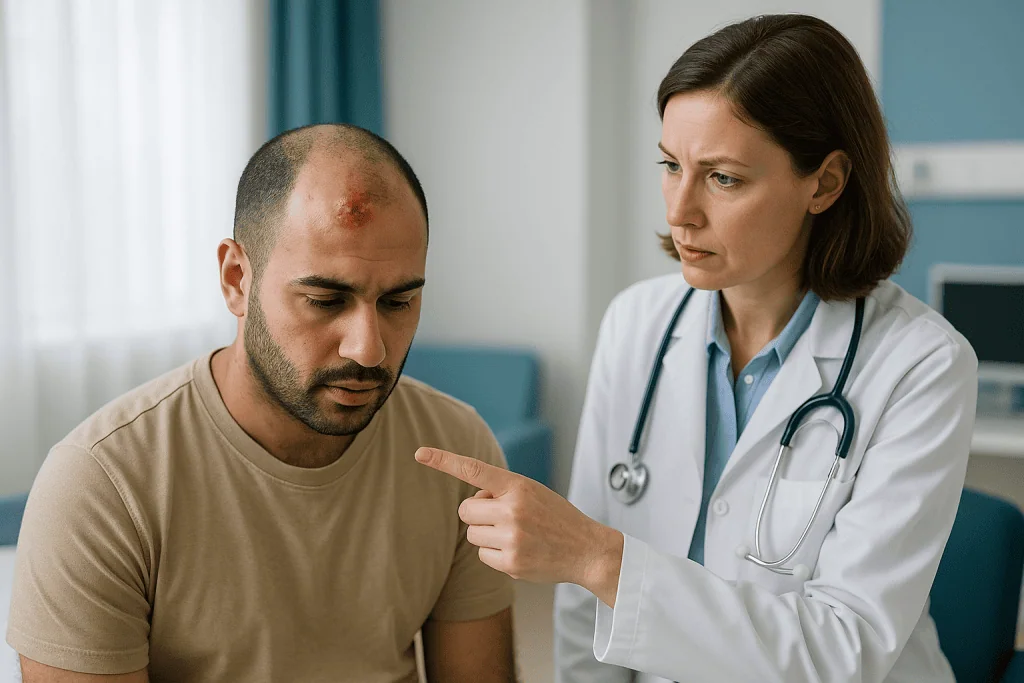
On a transplanted scalp, the earliest change is often color. Pink around each graft site is expected. A patch that deepens to red and creeps outward beyond the treated area, particularly with a defined edge, is a warning sign. So is redness in the donor zone that widens day by day rather than shrinking.
Pain is the second clue. Discomfort typically peaks in the first two or three days and then recedes. Pain that eases and then returns worse, or that concentrates in one spot and throbs, deserves a call. Warmth is the third: place the back of your hand on the area and compare with an untouched part of your head.
Discharge is the fourth. Small amounts of clear or slightly blood-tinged fluid in the first days are common; thick yellow or green material, a bad smell, or crusts that keep reforming over a weeping spot are not. Fever, chills, feeling generally unwell or tender lumps in the neck (swollen lymph nodes, the small glands that filter infection) round out the list.
The NHS names infection among the recognized risks of the procedure. It is not the expected outcome, but it is common enough that every clinic has a protocol for it, and that protocol only works if you make the call early.
Normal healing vs warning sign: a side-by-side guide
Reading a scalp is easier when the two stories are set next to each other. This table is a guide to the pattern, not a tool for diagnosing yourself; when a line lands in the right-hand column, the next step is a message or phone call to your surgical team, who can look at the area and decide what it means.
| Feature | Usually part of normal healing | Reason to contact your team |
|---|---|---|
| Swelling | Soft, drifts to forehead and eyes, eases within the recovery window | Hard, hot, worsening after the first week, or accompanied by fever |
| Color | Pink at graft sites; yellow-green bruising as fluid settles | Deepening red that spreads beyond the treated area or forms a streak |
| Pain | Peaks early, then steadily fades | Returns or intensifies after improving; throbbing in one spot |
| Discharge | Small amount of clear or blood-tinged fluid in the first days | Pus, foul smell, or a spot that keeps weeping and re-crusting |
| Crusts | Tiny scabs at each graft that lift with gentle washing | Thick, wet, or spreading crusts; skin beneath that looks dusky or dark |
| Temperature | Scalp feels similar to surrounding skin | Area noticeably warmer than the rest of the head; body fever |
| General state | Tired, tender, otherwise well | Chills, shaking, confusion, or feeling very unwell |
The direction of travel is the single most useful column of all. Ask yourself each morning whether the area is better, the same or worse than yesterday. Better or the same, held over several days, is the shape of recovery. Worse, on any measure, is the shape of a problem that is easier to treat today than next week.
Hair transplant infection symptoms or just pimples? Folliculitis explained
Somewhere between the second and the sixth week, many people notice small red or white-headed bumps in the transplanted area, and a fresh wave of worry arrives. Most of the time this is folliculitis, which is inflammation of individual hair follicles. MedlinePlus describes it as a common condition that can be caused by bacteria, by irritation, or by a hair that curls back or is trapped beneath the skin, and notes that it often looks like small pimples around the base of hairs.
After a transplant, the trapped-hair version is particularly common. New hairs pushing through healing skin, or shed hair fragments left behind in the follicle, provoke a small localized reaction. Each spot is usually shallow, centered on one follicle, mildly tender and self-limiting. A handful of them scattered across the recipient area is a recognized part of recovery for many people, and MedlinePlus lists small bumps among the expected after-effects of the procedure.
What separates this from the kind of infection your clinic must know about is scale and spread. Folliculitis is dotted and superficial. Cellulitis, an infection of the deeper skin layers, is a broad, hot, spreading red plaque that does not respect follicle boundaries. An abscess, a walled-off pocket of pus, is a single enlarging, painful, fluctuant lump rather than a scatter of pinheads. Fever accompanies the second and third; it rarely accompanies the first.
Even so, do not treat folliculitis as your own to manage. Squeezing spots can dislodge grafts in the early weeks and push bacteria deeper. Photograph the area in good light, send it to your team, and let them judge whether it is watch-and-wait or something they want to see in person.
Hair transplant healing timeline: what the first two weeks usually look like
Day one often ends with a light dressing on the donor area and clear instructions about sleeping position, washing and what to avoid. The recipient area is typically left uncovered so the grafts are undisturbed. Pinpoint bleeding and mild oozing can occur on the first night; steady bleeding that does not slow with gentle pressure is not expected and should be reported.
Days two to four are the swelling days. This is when the forehead fills, the brows feel heavy and bruising may appear near the eyes. Discomfort is usually at its peak here too, especially in the donor area if a strip was taken. Small crusts form over each graft site, giving the scalp a speckled look.
By the end of the first week the swelling has usually begun to drain away and the crusts are starting to loosen. Gentle washing, in whatever manner your team taught you, helps lift them without pulling on the hairs beneath. Itching often peaks now as nerve endings recover and the skin dries; it is a nuisance rather than a warning unless it comes with spreading redness or discharge.
The NHS puts overall recovery at around two weeks, and many people return to desk work sooner than that, with sweating, heavy exertion and direct sun typically restricted for longer on the team’s advice. Numbness in patches of scalp is common and generally improves over months as small nerves regrow; the NHS lists temporary loss of sensation among the recognized effects.
Keep a simple daily log during this fortnight: a photo in the same light, a note on pain, and a temperature if you feel off. That record is worth more to your clinic than any description from memory.
Hair transplant shock loss and the shedding phase: why it is not failure
Of all the moments that send people searching for hair operation warning signs, the shedding phase generates the most needless fear. Somewhere within the first several weeks, the transplanted hairs begin to fall out. MedlinePlus notes that this shedding is normal and typically happens within about six weeks, with new growth starting around three months later. The follicle stays; only the hair shaft goes.
The mechanism is a stress response. Moving a follicle interrupts its blood supply for hours and exposes it to a new environment, so the follicle drops into a resting phase, sheds its shaft, and later restarts growth. A related event, called shock loss, can affect existing native hairs near the incisions, which may also enter a resting phase and fall out for a time. Dermatologists call this pattern telogen effluvium: a temporary, diffuse shedding triggered by a physical stress, in which the follicles remain alive.
The result is the stretch that online communities call the ugly duckling phase. The scalp can look thinner than before surgery. That appearance is expected, and it is not a sign the grafts have died. The NHS describes new hair emerging after around six months and the full result taking twelve to eighteen months; short, fine hairs often appear first and thicken over subsequent cycles.
Shedding is not the same as grafts being lost. A graft that comes out intact in the first few days looks different: a small plug of tissue with a bulb attached, usually after a knock or firm rub, often with a bead of blood. If you see that in the first week, tell your team, and stop touching the area. After the early days, hairs that fall leave nothing behind but a hair, and that is the reassuring version.
What are the early signs that a hair transplant might be failing?
Honesty first: the final answer cannot be read early. Because the NHS describes new growth appearing around six months and the complete result at twelve to eighteen months, no one can look at a scalp at week eight and declare the operation a failure. Thinness at that stage is the expected middle of the story, not its end.
What can be judged early are the events that raise the risk of a poorer result, and these are exactly the hair operation warning signs a clinic wants reported. Grafts physically dislodged in the first week, with visible bleeding or tissue coming away, reduce the number of follicles that survive. Infection in the recipient area, if it takes hold and spreads, can damage grafts and skin. A patch of skin in either the donor or recipient area that turns dusky, purple or black, rather than pink, may signal poor blood supply; this is uncommon but urgent, and it is the one appearance that should prompt a same-day call regardless of how you feel.
In the donor area, the concern is overharvesting, which means removing more follicular units from a region than it can spare, leaving visible thinning or a moth-eaten look when the hair is short. Early cues include noticeable patchiness once the donor hair regrows, or a strip scar that widens over the first months. Neither can be fixed by waiting, so both are worth raising at follow-up.
Later signs are matters of design and density rather than healing: a hairline that sits too low or too straight, hairs angled unnaturally, or grafts that grew but sparsely. These are conversations for the twelve-month review. Until then, the most reliable early indicator of a good trajectory is the boring one: wounds that quietly heal on schedule without any of the red flags above.
What people often get wrong about swelling, redness and recovery
The first misconception is that swelling equals infection. It does not. Swelling that drifts down into the forehead and eyes in the first week is fluid and inflammation obeying gravity. Infection swells too, but it comes with heat, spreading redness, worsening pain or fever, and it does not fade on its own.
The second is that itching means something has gone wrong. Itch is a routine feature of healing skin and recovering nerves. Scratching is the problem, not the itch, because fingernails can dislodge grafts in the early days and introduce bacteria.
The third is that pinkness at three or four weeks means the grafts are struggling. Residual pinkness in the recipient area often lingers for weeks, especially in fair skin, and fades as the tiny wounds mature. The distinction is spread and heat, not the presence of color.
The fourth is that a thin-looking scalp at two or three months is proof the operation failed. As covered above, that is the shedding phase, and MedlinePlus and the NHS both describe it as expected.
The fifth is judging your own progress against images online. Photographs of other people are taken in different light, at different angles, sometimes with styling products or dyes, and with no information about how many grafts were placed or how the person’s native hair behaved. Public figures are an even poorer yardstick; their hair may reflect surgery, medicines, hairpieces, styling, or nothing at all, and nobody outside their own care team actually knows.
The last mistake is silence. People often wait to see whether a red patch settles rather than send a photo. Clinics would far rather review ten harmless pictures than miss the one that mattered.
What happens 10 years after a hair transplant?
Transplanted hair generally behaves like the place it came from, not the place it landed. Follicles from the back and sides of the scalp are relatively resistant to the hormonal signal that shrinks follicles in pattern baldness, and they tend to keep that resistance after relocation. This is why a well-placed graft is expected to keep producing hair for many years. The NHS describes the procedure as a treatment for permanent hair loss in which the moved hair continues to grow, while noting that a proportion of grafts may not take.
The scalp around those grafts, however, keeps aging. Native hairs behind and beside the transplanted zone can continue to thin, so a hairline that looked full at year two may sit in front of a widening gap at year ten. Mayo Clinic notes that more than one surgery may be needed to get the effect a person wants, and that hair loss can progress despite surgery. This is the strongest argument for planning the first procedure with the second in mind, leaving donor hair in reserve.
Ten-year changes fall into a few categories. Gradual thinning of untreated areas is the most common. Transplanted hairs themselves can become finer with age, as all hair does. Strip scars may become more visible if surrounding hair thins or if the person adopts a shorter cut. Donor areas that were harvested heavily can look patchy once the hair around them is less dense.
None of this is an emergency, and none of it belongs in the warning-sign column. It does belong in a frank pre-operative conversation about the finite nature of donor hair, the possible role of medicines to slow ongoing loss, and how a hairline designed at thirty should look at fifty.
When to call your doctor: hair operation warning signs that need same-day contact
Some changes should not wait for the next scheduled check. Contact your surgical team the same day if you notice any of the following, and use emergency services if the last two items apply.
- Redness that spreads outward from the graft or donor area, deepens in color, or forms a streak across the scalp.
- Pain that eases and then returns worse, or that throbs in one concentrated spot.
- The treated area feels distinctly hotter than the rest of your head.
- Thick yellow or green discharge, a foul smell, or a spot that keeps weeping and re-crusting.
- A fever, chills or shaking, or simply feeling unwell in a way that is new since surgery. MedlinePlus lists fever alongside redness, warmth, pain and drainage as the core signs of a surgical wound infection.
- Bleeding that continues despite several minutes of gentle, steady pressure.
- Skin in either area that turns dusky, purple or black rather than pink.
- Swelling that keeps increasing after the first week, or that closes an eye.
- Grafts visibly coming away with tissue attached in the first days.
- Emergency: swelling of the lips, tongue or throat, difficulty breathing, or a widespread rash, which can indicate a serious allergic reaction to a medicine or dressing.
- Emergency: confusion, extreme drowsiness, very fast breathing, mottled or blue-tinged skin, or passing little urine. The NHS identifies these as signs that an infection may be progressing to sepsis, a life-threatening whole-body reaction, which needs immediate hospital care.
When you call, have your daily photos ready and be able to say when the change started and whether it is getting better or worse. If your team cannot be reached and you have a fever or spreading redness, seek urgent care rather than waiting for the office to open. Every decision about examination, wound care or medicines rests with the clinicians who can see you; your role is simply to make sure they get the chance.
Questions to ask your care team before and after the procedure
Good aftercare starts with knowing what your particular team considers normal, because protocols differ in detail. Before surgery, and again before you leave on the day, it is reasonable to ask:
- How much swelling do you expect for me, and by which day should it be clearly improving?
- What exactly would you want to be told about on the same day, and what can wait for the follow-up visit?
- Who do I contact out of hours, and what is the backup if that number is not answered?
- How should I photograph the area so that the images are useful to you?
- What will the donor area look like at one week, one month and one year, and how many grafts did you take relative to what I have left?
- Which activities, positions and products are restricted, and for how long?
- If I am on any regular medicines, including anything that affects bleeding or the immune system, have they been reviewed for this surgery, and who decides about any changes?
- If folliculitis appears, do you want a photo, a visit, or both?
- At what point would you consider a result complete enough to assess, and what would you do if density is lower than planned?
- What is your plan for my remaining donor hair if my native hair keeps thinning?
Notice that most of these questions are about communication rather than technique. The technical skill has already been chosen by the time you are in the chair; what remains within your control is how quickly a concern reaches someone qualified to judge it. Write the answers down. Post-operative memory, under the influence of fatigue, discomfort and a tight forehead, is not reliable, and the moment you most need the out-of-hours number is rarely the moment you feel calm enough to find it.
Regret, risks and alternatives, described neutrally
People frequently ask for a regret rate. There is no robust figure to give. Regret depends on expectations, the skill of the planning, how native hair behaved afterward and how the person feels about a scar or a hairline years later; none of the major guideline bodies publishes a single number, and quoting one from a marketing page would be misleading. What the evidence does support is that regret clusters around mismatched expectations and poor planning far more than around surgical complications.
The recognized risks are consistent across sources. The NHS lists bleeding, infection, crusting, itching, temporary loss of sensation, noticeable scarring and grafts failing to take. Mayo Clinic adds bruising and swelling, and notes that surgical hair restoration does not help everyone, that results may take time and that hair loss can continue despite surgery. Rarer events include skin necrosis from compromised blood supply and reactions to anesthetic or dressings.
Alternatives fall into three broad groups. Medicines, described earlier by class, aim to slow ongoing loss and are prescribed and monitored by a clinician. Non-surgical cosmetic options include scalp micropigmentation (tattooed dots that mimic shaved hair), hairpieces and styling approaches. Doing nothing is also a legitimate choice, and some people who spend a year on it find their view of their hair has changed more than their hair has.
Low-level laser devices and injections of platelet-rich plasma are widely marketed. Mayo Clinic describes evidence for laser therapy as limited and still under study; evidence for platelet injections is similarly mixed and not yet at guideline level. Neither should be presented as proven.
Every one of these paths, including the decision to operate at all, belongs in a discussion with a qualified team who has examined your scalp, taken your history and heard what you actually want. This article can help you ask better questions; it cannot answer them for you.
Frequently asked questions
How long does swelling after hair transplant usually last?
Swelling generally appears within the first few days and eases within the roughly two-week recovery window the NHS describes, often sooner. It tends to gather in the forehead and around the eyes because injected fluid and inflammation drift downward. Swelling that keeps increasing after the first week, feels hot, or arrives with fever is not typical and should be reported to your surgical team.
What are the main hair transplant infection symptoms to watch for?
The key signs are redness that spreads beyond the treated area, pain that worsens after initially improving, skin that feels hotter than the surrounding scalp, thick or foul-smelling discharge, and fever or chills. MedlinePlus lists these as the classic features of a surgical wound infection. Tender lumps in the neck can also signal the body fighting infection. Any of these deserves a same-day call.
What are the early signs that a hair transplant might be failing?
In the first weeks, the concerning events are grafts physically dislodged with bleeding, spreading infection in the recipient area, and skin that turns dusky or dark rather than pink. Beyond that, a thin appearance at two or three months is the expected shedding phase, not failure. The NHS describes new growth around six months and the full result at twelve to eighteen months, so density cannot be judged earlier.
What is the regret rate for hair transplants?
No reliable regret figure exists in guideline-level evidence, and numbers quoted on marketing pages are not a trustworthy substitute. What is consistently observed is that dissatisfaction clusters around unrealistic expectations, poor hairline planning, overharvested donor areas and ongoing loss of native hair, rather than around surgical complications. A frank pre-operative conversation about limits and long-term planning addresses the most common causes.
Can you tell whether a public figure has had a hair transplant?
Not with any confidence. A full head of hair in someone older may reflect surgery, medicines that slow loss, a hairpiece, dye, styling, lighting, or simply genetics, and nobody outside that person’s own care team knows which. Judging your own healing against photographs of celebrities is unhelpful for the same reason: you have no information about grafts, timelines or what else is going on.
What happens 10 years after a hair transplant?
Transplanted follicles usually keep the resistance to pattern loss they had in the donor area, so most continue producing hair. The surrounding native hair, however, often keeps thinning, which can leave a gap behind the transplanted zone. Mayo Clinic notes that more than one procedure may be needed and that loss can progress despite surgery. Scars and heavily harvested donor areas may also become more visible with thinner hair.
Is itching after a hair operation a warning sign?
Itching on its own is a normal feature of healing skin and recovering nerves, and it often peaks around the end of the first week as crusts dry and lift. It becomes a concern only when it accompanies spreading redness, warmth, discharge or fever. The real risk is scratching, which can dislodge grafts in the early days and introduce bacteria, so ask your team how to manage it.
What is the ugly duckling phase in the hair transplant healing timeline?
It is the stretch, usually between the shedding of transplanted hairs and the arrival of visible regrowth, when the scalp can look thinner than it did before surgery. MedlinePlus notes shedding typically happens within about six weeks with new growth starting around three months, and the NHS describes noticeable new hair around six months. The follicles remain alive throughout; only the hair shafts have fallen.
Is hair transplant shock loss permanent?
Usually not. Shock loss describes native hairs near the incisions entering a resting phase and shedding temporarily, a pattern dermatologists call telogen effluvium. The follicles remain intact and typically resume growth over the following months. Hairs that were already miniaturized by pattern baldness may not all return, which is one reason teams assess the surrounding hair carefully before deciding where to place grafts.
Can I sleep normally after a hair transplant?
Most teams ask for a modified sleeping position in the early days, typically with the head raised, so that fluid drains away from the face and the grafts are not rubbed against a pillow. The exact duration and method vary between surgeons, so follow the instructions you were given rather than general advice. Waking with more forehead puffiness than the night before is common in the first few days.
References
- NHS: Hair transplant
- MedlinePlus: Hair transplant
- MedlinePlus: Surgical wound infection – treatment
- MedlinePlus: Folliculitis
This article is for general information only and is not a substitute for professional medical advice. Please consult a qualified doctor about your individual situation.

More from the Blog

Hair Transplant for Women Recovery: Gentle Washing, Sprays and the Shedding Phase Week by Week
Recovery after a hair transplant for women usually follows a predictable arc: swelling and small crusts in the first week, gentle washing and saline…
Sapphire Hair Transplant Step by Step: Extraction, Channel Opening and Graft Placement
A sapphire hair transplant is a follicular unit extraction (FUE) procedure in which the recipient incisions are opened with a blade made of synthetic…
Hair Transplants 10 and 20 Years Later: How Results Age, Honestly
Transplanted hair usually survives for decades because it comes from a donor zone whose follicles resist hormone-driven pattern loss. Ten and twenty years on,…
Is PRP for Hair Loss Suited to Diffuse Thinning? Who Tends to Respond and Who Needs More
PRP for diffuse hair thinning can be a reasonable option when the thinning is early pattern hair loss with living, miniaturized follicles still present.…
What Happens During PRP for Hair Loss: From the Blood Draw to the Scalp Injections
During PRP for hair loss, a clinician draws a small tube of your own blood, spins it in a centrifuge to separate a platelet-rich…
How Surgeons Assess Keloid Risk and Scar Tendency Before an Afro Hair Transplant
Before an afro hair transplant, surgeons assess keloid risk by asking about personal and family scar history, examining existing scars anywhere on the body,…