

Abdominal Etching: How Six-Pack Liposuction Works and Who It Actually Suits
Key Takeaways
- Abdominal etching removes fat in narrow strips over the muscle's natural lines: it reveals a six-pack pattern but does not build, tighten, or strengthen any muscle.
- Removed fat cells don't regrow, yet the cells that remain still enlarge with weight gain, which can leave sharp etched lines sitting oddly on a rounder abdomen.
- Because etching works in the risky superficial fat layer, it carries a higher chance of dents, ripples, and discoloration than standard liposuction, and reversing it usually requires scar release plus fat grafting.
- Insurance covers neither the procedure nor its complications, and etching typically costs more than standard abdominal liposuction because of the operating time and skill involved.
- Swelling hides the true result for months: expect a compression garment for four to six weeks and a near-final contour at three to six months, sometimes up to a year.
- Etching offers zero health benefit: it cannot touch visceral fat, and research shows surgically removing subcutaneous fat does not improve insulin sensitivity or cardiovascular risk markers.
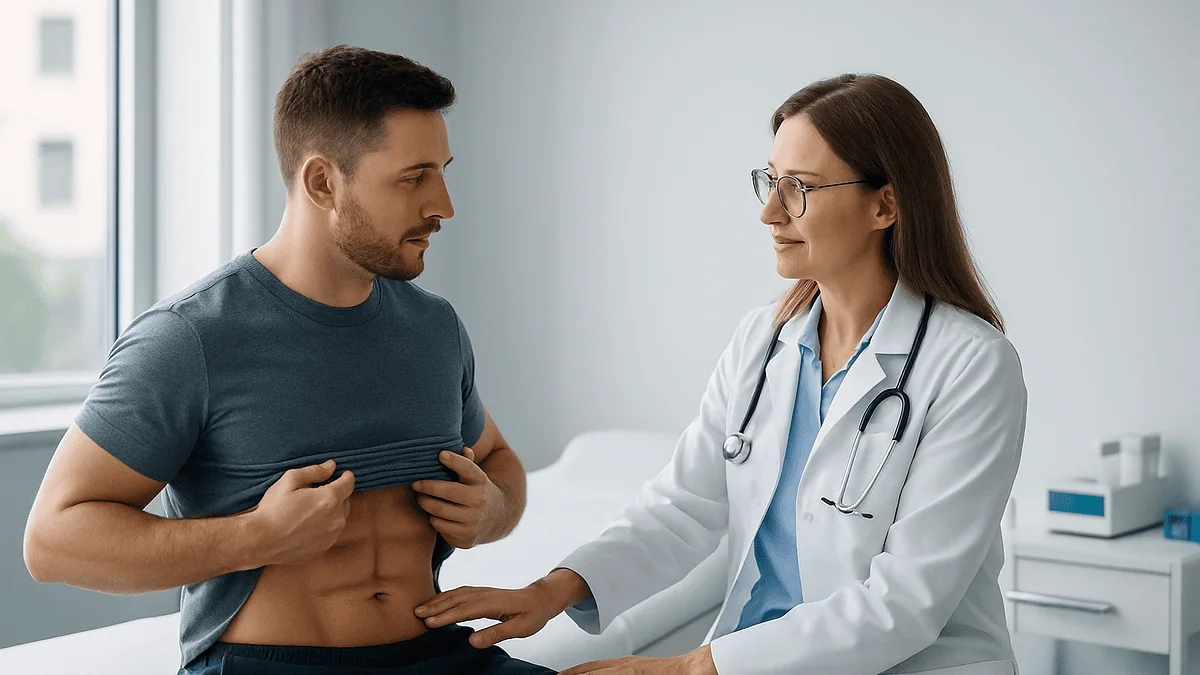
Abdominal etching is a specialized liposuction technique that removes small amounts of fat in precise lines over the abdominal muscles to mimic a six-pack. It suits people who are already lean, weight-stable, and have good skin elasticity. Results can last years if weight stays steady, but the procedure is difficult to reverse, carries a higher risk of contour irregularities than standard liposuction, and offers no health benefit.
There is a particular kind of frustration known to people who train hard: the body-fat scan says 14 percent, the plank record keeps climbing, and yet the mirror shows a smooth, undramatic midsection. Genetics decides where each of us stores our last stubborn layer of fat, and for many people it settles exactly where a six-pack would otherwise show.
That gap between effort and appearance is what abdominal etching was invented to close. First described in the plastic surgery literature in 1993, the technique borrows the tools of liposuction but uses them more like an engraver than a vacuum, carving shallow grooves into the fat layer so the muscle pattern underneath reads through the skin.
Clinic marketing tends to stop there. What it skips, who this actually works for, what happens when weight shifts later, and why undoing it is so hard, is where the honest conversation begins.
What is abdominal etching, exactly?
Abdominal etching is a cosmetic surgical procedure, a refinement of liposuction, designed to make the natural lines of the abdominal muscles visible through the skin. It was introduced in a 1993 case series by plastic surgeons Henry Mentz and colleagues, who called the approach “differential liposuction”: instead of removing fat evenly, the surgeon removes more fat along the natural creases of the abdomen and less over the muscle bellies, creating light and shadow where a six-pack would sit.
Two points deserve emphasis, because they get blurred in advertising. First, etching does not build, tighten, or repair muscle. The rectus abdominis, the paired muscle whose tendinous bands create the six-pack pattern, is untouched. The procedure only sculpts the fat lying on top of it. If the muscle underneath is thin or deconditioned, there is little structure to reveal, and the result depends entirely on artificial grooves.
Second, this is genuine surgery, not a spa treatment. It involves anesthesia, incisions, cannulas passed through the fat layer, weeks in a compression garment, and all the standard risks of liposuction plus a few of its own. The evidence base is also worth naming honestly: published outcomes come mostly from surgeon-reported case series rather than controlled trials, which means satisfaction rates and complication figures reflect experienced hands and carefully selected patients, not the average result across all clinics.
How does six-pack liposuction actually work?
The operation starts before any incision. With the patient standing and flexing, the surgeon marks the abdomen’s real architecture: the vertical midline (linea alba), the curved lines at the outer edge of the six-pack (semilunar lines), and the two or three horizontal bands (tendinous intersections) that divide the muscle into segments. Using the patient’s own anatomy matters, grooves drawn in the wrong place look painted on.
The sculpting itself happens in two layers. Deep to the skin, the surgeon performs conventional liposuction to slim the overall abdominal wall, often extending to the flanks so the waist tapers naturally. Then comes the etching: working in the superficial fat just beneath the skin, the surgeon passes a thin cannula back and forth along the marked lines, removing narrow strips of fat so the skin settles into shallow valleys as it heals.
Many surgeons use energy-assisted devices, ultrasound or power-assisted cannulas, to loosen fat before suction, which they report makes superficial work more precise. Some “high-definition” versions go further, transferring a small amount of the patient’s harvested fat over the muscle bellies to add fullness between the grooves.
The whole process typically takes one to a few hours under general anesthesia or deep sedation, through incisions of a few millimeters hidden in the navel and natural creases. The engraving metaphor is apt in one more way: like an engraving, the pattern is intended to be permanent, for better and, occasionally, for worse.
Who is a good candidate, and who isn't?
The paradox of abdominal etching is that it works best on people who nearly don’t need it. The ideal candidate is already lean, close enough to visible abs that only a thin, stubborn fat layer stands in the way, with well-developed abdominal muscle, skin that snaps back when pinched, and a weight that has been stable for at least six to twelve months.
Skin elasticity is the quiet gatekeeper. After fat is removed in narrow strips, the skin must contract snugly into those valleys. Skin loosened by age, significant prior weight loss, or pregnancy tends to drape unevenly instead, producing ripples rather than definition. Mayo Clinic notes the same principle for liposuction generally: results depend heavily on skin tone and elasticity.
Several situations argue against the procedure. A firm, protruding abdomen often signals visceral fat, fat stored around the organs, beneath the muscle wall, which no liposuction technique can reach. People planning pregnancy are usually advised to wait, since abdominal stretching can distort an etched pattern unpredictably. A separated midline after pregnancy (diastasis recti) or lax skin generally points toward abdominoplasty, a different operation. Surgeons also screen for unstable weight, smoking (which impairs skin healing), significant medical conditions, and unrealistic expectations.
One more filter matters and is too rarely discussed: body image. Someone pursuing surgery to quiet persistent, distressing preoccupation with a perceived flaw may be experiencing body dysmorphic disorder, and evidence consistently shows cosmetic procedures do not relieve it. A thoughtful surgeon screens for this; a thoughtful patient welcomes the question.
Abdominal etching vs. standard liposuction: what's the difference?
Both procedures remove subcutaneous fat with cannulas, and both are cosmetic. The differences lie in where the fat comes out, how much technique tolerance exists, and what happens if you change your mind later.
| Standard abdominal liposuction | Abdominal etching | |
|---|---|---|
| Goal | Flatter, smoother contour | Visible muscle definition |
| Fat layer targeted | Mostly the deep fat layer | Deep layer plus precise superficial strips |
| Typical candidate | Localized fat deposits, near-stable weight | Already lean, muscular, elastic skin |
| Margin for error | Moderate, deep-plane work is forgiving | Narrow, superficial work risks visible irregularities |
| Result with later weight gain | Generally softens proportionally | Etched lines can persist oddly over a rounder abdomen |
| Reversibility | Not reversible, but blends naturally | Difficult; revision may need fat grafting |
The superficial plane is the crux. In routine liposuction, surgeons deliberately leave a protective cushion of fat under the skin, because working too close to the surface invites dents, waves, and discoloration. Etching intentionally enters that risky zone: that is the entire technique. In skilled hands with the right patient, the trade-off pays off; in the wrong hands or the wrong patient, it produces exactly the irregularities standard liposuction is designed to avoid.
That asymmetry explains a blunt rule of thumb: choosing standard liposuction conservatively keeps options open, while choosing etching is closer to a one-way door.
How long does ab etching last?
The honest answer has two layers. At the cellular level, results are permanent: adults do not regenerate fat cells removed by liposuction in meaningful numbers, a point Cleveland Clinic and Mayo Clinic both make about the procedure generally. The grooves also heal with a degree of internal scar adhesion between skin and muscle layer, which helps the lines hold their position over time.
At the mirror level, longevity depends almost entirely on what the rest of the body does. Three forces work against an etched six-pack over the years. Weight gain enlarges the fat cells that remain, including those between the grooves, softening or distorting the pattern. Aging gradually reduces skin elasticity, so lines that once looked crisp can blur as skin thins and loosens. And visceral fat, which liposuction never touches, can accumulate behind the abdominal wall and push the whole midsection forward, an effect no surface sculpting can offset.
Published long-term data are thin. The original technique papers and later high-definition liposuction series report results holding up well over several years in weight-stable patients, but these are self-selected groups followed by the surgeons who operated on them. No independent study has tracked etched abdomens across decades.
A fair summary: with stable weight, consistent training, and reasonably youthful skin, the definition can last many years. Treating the surgery as a substitute for those habits, rather than a complement to them, is the most reliable way to lose the result.
Is it normal to gain weight after abdominal etching?
Yes, and this may be the most misunderstood part of the entire procedure. Liposuction of any kind changes where fat is stored, not how much energy the body consumes or burns. Appetite, metabolism, and daily habits continue exactly as before, so weight drifts upward after surgery for the same reasons it drifts upward for everyone else. Some patients also gain a little in the first months simply from reduced activity during recovery.
What changes is where new weight shows up. The abdomen has fewer fat cells than before, so it enlarges less than it used to, but the remaining cells there, including those forming the “muscle” mounds between the etched grooves, still expand. Meanwhile, research on liposuction has suggested that regained fat may distribute disproportionately to untreated areas, such as the upper body, arms, or thighs, though study findings vary and the effect is not fully settled.
The specific problem for etching is aesthetic. Because the grooves are partly anchored by internal scar tissue, they tend to persist even as the surrounding fat plumps. Moderate weight gain can therefore produce a distinctly unnatural look, sharp lines carved into an otherwise soft, rounded abdomen, that neither diet nor further surgery fixes easily.
The practical takeaway is not fear but arithmetic: surgeons generally advise being within a few pounds of your long-term maintainable weight before etching, precisely because the result assumes you will stay near it. If your weight history swings by fifteen or twenty pounds a year, that pattern deserves attention before any cannula does.
Can you reverse abdominal etching?
Not cleanly, and anyone considering the procedure should sit with that fact for a moment. Standard liposuction that turns out too aggressive is hard enough to correct; etching adds a second obstacle, because the grooves heal with fibrous adhesions that tether the skin down along each line. Simply regaining weight does not erase them: it often makes them stranger, as fat rises around channels that cannot expand.
Revision is possible, but it is reconstructive work rather than an undo button. The usual approach combines several steps: surgically releasing the scar adhesions beneath each groove, grafting small amounts of the patient’s own fat into the valleys to raise them, and sometimes feathering the surrounding fat with additional gentle liposuction to blend the transitions. Fat grafting has a known limitation, a variable portion of transferred fat does not survive long term, so more than one session may be needed, and the final surface may never be perfectly smooth.
This is why the decision deserves more deliberation than its social-media framing suggests. A useful mental test: imagine your body at fifty-five or sixty-five, at whatever weight and activity level honestly seems likely, and ask whether permanently engraved abdominal lines fit that picture. Some people answer yes with confidence. Others realize they want an option that ages more quietly, a conservative standard liposuction, or no surgery at all, and that realization is worth far more before the operation than after it.
What is recovery really like, week by week?
Recovery from etching resembles recovery from abdominal liposuction, with one addition: many surgeons place shaped foam pads inside the compression garment, pressing the skin into the freshly carved grooves so it heals in the intended pattern.
The first several days bring swelling, bruising, soreness often compared to an intense abdominal workout, and drainage of blood-tinged fluid from the small incisions, expected and usually brief. Cleveland Clinic notes that most liposuction patients manage discomfort with short-term measures and are walking the same day, which helps circulation and lowers clot risk.
Over the first two weeks, most people with desk jobs return to work within about five to ten days, still wearing the compression garment. Physically demanding jobs need longer. The garment itself is typically worn for four to six weeks, and surgeons treat it as non-negotiable: consistent, even pressure is what discourages fluid pockets and helps define the etched lines. Some practices recommend manual lymphatic drainage massage during this period; the supporting evidence is modest, but many patients find it eases swelling and tightness.
Light cardio usually resumes around weeks three to four, with strength training and direct abdominal work closer to six weeks, always on the surgeon’s individual clearance. Then comes the part nobody photographs: waiting. Swelling obscures the result for months, and the abdomen often looks puffy or even lumpy at week six. Most patients see their near-final contour at three to six months, with subtle refinement continuing up to a year. Judging the outcome earlier than that is a reliable recipe for unnecessary worry.
What are the risks, including the ones brochures skip?
Etching carries every risk of liposuction, plus extra exposure that comes from working close to the skin. The general list, as outlined by Mayo Clinic and MedlinePlus, includes fluid accumulation under the skin (seroma), infection, numbness that is usually temporary but occasionally lasting, uneven contours, and reactions to anesthesia. Rare but serious complications include fat embolism, fragments of fat entering the bloodstream and lodging in the lungs, internal organ puncture, significant fluid shifts affecting the heart and kidneys, and blood clots. Risk rises when large volumes are removed or multiple procedures are combined in one session.
The etching-specific risks cluster around the superficial plane. Removing fat just beneath the skin can injure its blood supply, and the possible consequences include visible ripples and dents, darkened or discolored lines along the grooves (more common in deeply pigmented skin), asymmetric or misplaced “abs,” firm scar bands, and, rarely, patches of skin breakdown. Unlike deep-plane irregularities, superficial ones sit in full view and are difficult to camouflage.
Surgeon selection is therefore the single biggest modifiable risk factor. Superficial sculpting is a niche skill even among board-certified plastic surgeons, and reasonable questions at consultation include how many etching procedures the surgeon performs yearly, their personal revision rate, whether the facility is accredited, and who manages complications after hours. The NHS gives similar advice for cosmetic surgery generally: verify credentials, insist on a cooling-off period, and be especially cautious about traveling abroad for discounted procedures, where follow-up care is hardest to arrange.
How expensive is ab etching?
Because abdominal etching is purely cosmetic, health insurance does not cover it, nor, as Mayo Clinic notes for liposuction generally, does it cover the treatment of complications that may follow. Every dollar is out of pocket, which makes understanding the full price structure important.
Quotes vary widely by region, surgeon experience, and how much work is planned, but etching consistently costs more than standard abdominal liposuction because it demands more operating time and a rarer skill set. In the United States, all-in quotes commonly run from several thousand dollars into the low five figures, particularly when the flanks are treated in the same session or fat grafting is added. A complete quote should itemize the surgeon’s fee, anesthesia, facility charges, compression garments, and follow-up visits, and it is worth asking directly how revisions are priced, since touch-up policies differ dramatically between practices.
Two financial cautions deserve space. First, unusually low prices warrant more scrutiny, not less; superficial liposuction is precisely the technique where inexperience becomes visible and expensive. Correcting a poor etching result through adhesion release and staged fat grafting can ultimately cost more than the original operation. Second, medical tourism compounds the problem: the NHS cautions that traveling for cosmetic surgery complicates safety verification and leaves patients far from their surgeon when swelling, asymmetry, or infection appears weeks later.
A grounded way to frame the decision: budget not just for the surgery, but for the possibility of a revision and for the time off work that recovery genuinely requires.
Will the results look natural?
Sometimes remarkably so; sometimes not, and the difference usually comes down to three choices made before surgery.
The first is depth. Surgeons distinguish between soft etching, which creates a subtle athletic shadow that reads as “very fit,” and high-definition etching, which carves a fully delineated six-pack. The deeper version photographs impressively but behaves less naturally in real life, which brings up the second issue: real abdominal definition is dynamic. A natural six-pack deepens when the muscles contract and softens when they relax, sharpens after a training block and fades over the holidays. Etched lines are static. They look the same slouched on the couch as mid-crunch, and observant eyes sometimes register that constancy as slightly off, particularly with aggressive etching on a relaxed body.
The third is anatomical honesty. Nature rarely produces perfectly symmetric abs, tendinous intersections are often staggered or tilted, so a surgeon who follows the patient’s genuine muscle anatomy, marked while flexing, produces far more convincing results than one who imposes an idealized grid.
Time is the final variable. Skin loses elasticity with each decade, and grooves that suited a taut thirty-year-old abdomen can look incongruous on sixty-year-old skin. None of this argues against the procedure; it argues for restraint. Across the published case series, the most durable satisfaction tends to follow conservative etching on well-chosen candidates, enhancement of what exists rather than fabrication of what doesn’t.
What abdominal etching can't do: the health question nobody asks
Here the evidence is unusually clear, and it deserves a blunt statement: abdominal etching improves how the midsection looks, and nothing else. It is not a weight-loss procedure, the total fat removed is modest, typically a few pounds at most, and it confers no measurable health benefit.
The reason is anatomical. Liposuction can only reach subcutaneous fat, the layer between skin and muscle. The fat most strongly linked to health risk is visceral fat, stored deep in the abdomen around the organs, where Harvard Health notes it actively secretes inflammatory compounds associated with cardiovascular disease and type 2 diabetes. No cannula reaches it. Research bears this out: studies in which substantial subcutaneous fat was surgically removed found no meaningful improvement in insulin sensitivity, blood pressure, or other cardiometabolic markers afterward. The body’s metabolic risk, it turns out, does not live in the layer surgeons can suction.
The procedure also cannot strengthen the core, repair a separated midline after pregnancy, tighten genuinely loose skin, or prevent future fat gain. Each of those problems has its own appropriate answer, training, physical therapy, abdominoplasty, or sustained lifestyle change, and etching substitutes for none of them.
Why belabor this? Because “six-pack surgery” invites a quiet mental swap in which looking healthy stands in for being healthy. Exercise reduces visceral fat, improves insulin sensitivity, and lowers cardiovascular risk even when the mirror changes slowly. Etching does the opposite: it changes the mirror while leaving the physiology untouched. Both facts can be true; confusing them is the real risk.
Are there realistic alternatives to six-pack surgery?
Several, and the right comparison depends on which problem is actually being solved.
For most people, the non-surgical route remains body-fat reduction plus muscle building. Visible abdominal definition typically emerges somewhere around 10 to 14 percent body fat in men and 16 to 20 percent in women, though genetics shifts those thresholds in both directions. Progressive resistance training thickens the rectus abdominis so it shows at slightly higher body fat; a sustained modest calorie deficit does the uncovering. This path is slower and less certain than surgery, but it is free of scalpel risk, fully reversible, and, unlike etching, improves cardiovascular and metabolic health along the way.
For someone lean everywhere except a stubborn lower-abdominal pocket, conservative standard liposuction may achieve a flat, athletic look without entering the high-risk superficial plane, leaving future options open. Non-surgical fat-reduction technologies, such as controlled cooling of fat cells, also exist; they produce gradual, modest reductions over months and cannot create defined lines, but they avoid anesthesia and downtime.
For post-pregnancy changes, lax skin, a separated midline, the honest answer is usually abdominoplasty, sometimes combined with liposuction, because no amount of fat removal tightens skin or repairs muscle separation. And for anyone whose real burden is distress about their appearance rather than the appearance itself, a conversation with a primary care clinician or mental health professional is the alternative most likely to help, and the one least often suggested.
When should you see a doctor?
Two situations call for medical input: before surgery, and, urgently, if warning signs appear, after it.
Beforehand, a consultation with a board-certified plastic surgeon should feel like an evaluation, not a sales meeting. Expect a review of your health history, medications and supplements, weight history, and skin quality, plus a frank discussion of what your anatomy realistically allows. It is also wise to loop in your primary care clinician, especially with conditions such as diabetes, heart or lung disease, clotting disorders, or a history of poor wound healing, all of which change the risk calculation.
After surgery, most recoveries are uneventful, but certain symptoms need same-day contact with the surgical team: fever above roughly 101°F (38.3°C), spreading redness or warmth around incisions, foul-smelling or increasing drainage, one area of rapidly worsening pain or swelling, or a large fluid pocket forming under the skin.
A shorter list demands emergency care, call 911 rather than waiting for a callback: sudden shortness of breath, chest pain, coughing up blood, confusion, or fainting, which can signal fat embolism or a blood clot traveling to the lungs; and pain or swelling in one calf, a possible deep vein thrombosis. These complications are rare, but the first hours matter enormously.
Finally, see a doctor for the quieter problem: if thoughts about your abdomen consume significant time each day, or no result ever feels adequate, that pattern deserves compassionate clinical attention before any operating room does. Good surgeons will say the same.
Frequently asked questions
How long does ab etching last?
The removed fat cells are gone permanently, so in weight-stable patients the definition can last many years. However, remaining fat cells enlarge with weight gain, skin loses elasticity with age, and visceral fat can push the abdomen forward, all of which blur or distort the lines over time. Long-term independent data are limited; published results come mainly from surgeon-reported case series of carefully selected patients.
Can you reverse abdominal etching?
Not easily. The etched grooves heal with internal scar adhesions that tether skin to the deeper tissue, so they persist even with weight gain. Revision typically means surgically releasing those adhesions, grafting your own fat into the grooves, and blending the surrounding area, often over more than one session, since grafted fat survives unpredictably. Results improve the situation but rarely restore a perfectly smooth abdomen, which is why candidacy decisions matter so much upfront.
How expensive is ab etching?
Costs vary widely by region and surgeon, but etching consistently costs more than standard liposuction, commonly several thousand dollars up to the low five figures in the US, especially when flanks or fat grafting are included. Because the procedure is cosmetic, insurance covers neither the surgery nor treatment of any complications. Ask for an itemized quote covering surgeon, anesthesia, facility, garments, and follow-ups, and clarify how revisions are priced before committing.
Is it normal to gain weight after abdominal etching?
Yes. The surgery changes where fat is stored, not your metabolism or appetite, so weight behaves exactly as it did before. New fat enlarges the remaining abdominal fat cells and, some research suggests, may distribute disproportionately to untreated areas like the arms or thighs. Meaningful gain is the main way etched results deteriorate, since the carved lines persist over a softer abdomen. Surgeons generally advise reaching a stable, maintainable weight before considering the procedure.
Does abdominal etching hurt?
The procedure itself is performed under anesthesia, so you won’t feel it. Afterward, most patients describe soreness similar to a very intense abdominal workout, plus tightness, swelling, and bruising that peak in the first several days and ease over two to three weeks. Numbness or tingling in the treated skin is common and usually temporary. Discomfort is generally managed with short-term measures your surgical team recommends, along with early gentle walking.
How much time off work do I need after abdominal etching?
Most people with desk jobs return within about five to ten days, wearing a compression garment under clothing. Physically demanding jobs, lifting, prolonged standing, manual labor, usually require two to four weeks. Light cardio typically resumes around weeks three to four, with strength training and direct core work closer to six weeks, always on your surgeon’s individual clearance. Plan for the garment itself to be part of daily life for four to six weeks.
Can women get abdominal etching?
Yes. The technique is the same, though the aesthetic goals often differ: many women request softer definition: a visible vertical midline and gently framed waist rather than a deeply carved six-pack. Candidacy criteria are identical: lean, weight-stable, elastic skin, developed underlying muscle. One important caveat is pregnancy planning, since abdominal stretching can distort etched lines unpredictably; most surgeons advise completing planned pregnancies before considering the procedure.
Does abdominal etching leave scars?
The skin incisions are small, typically a few millimeters, and hidden in the navel and natural creases, so external scars usually fade to near-invisibility. The more relevant scarring is internal: the etched grooves heal with fibrous adhesions between skin and deeper tissue, which is partly what holds the lines in place. Visible surface problems such as ripples, dents, or darkened lines along the grooves are complications of technique rather than scars from the incisions themselves.
What body fat percentage do you need for abdominal etching?
There’s no official cutoff, but surgeons generally look for patients already lean enough that muscle is nearly visible, often roughly under 15 to 18 percent body fat for men and somewhat higher for women, with individual anatomy mattering more than any number. Equally important are stable weight for six to twelve months, good skin elasticity, and developed abdominal muscle. Someone with substantial fat to lose is typically advised to reach a maintainable weight first.
Is abdominal etching safe?
In experienced hands and well-selected patients, serious complications are uncommon, but this is real surgery with real risks: fluid collections, infection, numbness, contour irregularities, and, rarely, fat embolism, blood clots, or organ injury. Etching adds superficial-plane risks such as visible ripples and discoloration that standard liposuction deliberately avoids. Safety depends heavily on surgeon skill, an accredited facility, honest candidacy screening, and prompt attention to warning signs like fever, spreading redness, chest pain, or calf swelling.
References
This article is for general information only and is not a substitute for professional medical advice. Please consult a qualified doctor about your individual situation.

More from the Blog
How Bichectomy (Cheek Reduction) Is Performed: The Incision Inside the Mouth Explained
A bichectomy procedure, also called buccal fat removal, slims the lower cheeks by removing part of the buccal fat pad through a small incision…

Blood Thinners, Smoking and Rhytidectomy: What Surgeons Ask You to Stop Before a Facelift
Before a facelift, surgeons usually ask patients to stop anything that raises bleeding risk or starves healing skin of oxygen. That typically means blood-thinning…

Neck Lift Complications Explained: Hematoma, Nerve Weakness and Contour Irregularities
Neck lift complications are unwanted events caused by the surgery itself, as opposed to expected effects such as bruising and swelling. The three most…

What to Ask a Surgeon Before Prominent Ear Surgery: Technique, Symmetry and Timing
Before prominent ear surgery (otoplasty), ask the surgeon which technique they plan to use on your cartilage and why, how they measure and judge…

Questions to Ask Before a Rhytidectomy: Technique, Scars and What a Facelift Will Not Change
Before a rhytidectomy, ask which facelift technique the surgeon proposes and why, where the incisions will sit, how scars usually mature, what the operation…
How Ear Reconstruction Works: Rib Cartilage Framework, Staged Surgery and Skin Coverage
Rib cartilage ear reconstruction rebuilds a missing or underdeveloped outer ear using the patient's own rib cartilage. A surgeon removes cartilage from several ribs,…