

Accompanying Someone to Urodynamic Testing: Privacy, Timing and the Journey Home

Key Takeaways
- Most urodynamic testing takes about 30 to 60 minutes, but appointments are often booked for up to two hours to allow for check-in, bladder filling and a debrief.
- Sedation is normally avoided because the patient's real-time reports of bladder sensation are the data, which also means most adults can drive themselves home.
- Companions are usually welcome in the waiting area and the debrief, but many units ask them to step out during catheter placement and filling unless the patient asks otherwise.
- Arriving with a comfortably full bladder is standard preparation; a painfully full bladder can distort the first part of the test.
- Mild burning on urination and a pink tinge to the urine are common for a few hours afterward and are eased by increased fluids, while fever, inability to urinate or worsening pain are reasons to call the same day.
- Whether to pause bladder medicines before the study is a decision for the prescribing clinician, because the right answer depends on what the team wants to measure.
A companion can usually come to a urodynamic test, sit with the person in the waiting area and help with the journey home, but most units ask them to step out while thin catheters are placed, unless the patient asks for them to stay. The test typically takes 30 to 60 minutes, sedation is rarely used, and mild burning or pink urine for a short time afterward is common. Policies vary, so ask the ordering team in advance.
The text arrives the night before: “Can you come with me tomorrow? It’s that bladder test. I don’t really know what they’re going to do.” You say yes before you have read the appointment letter, which mentions catheters, a full bladder and “please allow up to two hours.” Now you have questions of your own. Will you be in the room? Should you be? What exactly happens behind that door, and will the person you love want a hand to hold or a hallway to themselves?
Being a urodynamic test companion is a quieter job than driving someone to surgery, and in some ways a more delicate one. The test is not dangerous, and it is not usually painful, but it is intimate in a way that few other outpatient appointments are. The person is awake, undressed from the waist down, and asked to urinate while people watch a screen.
This explainer walks through what happens, where privacy begins and ends, how to time the day, and what the ride home and the following days tend to look like, grounded in what mainstream medical sources actually say.
What is a urodynamic test, and why do people want a companion?
Urodynamics is a family of tests that measure how well the bladder stores urine and how well it empties. The name sounds mechanical because it is: the tests record pressure, flow and volume, much as an engineer might measure a pump and a pipe. Clinicians order them when the story a patient tells (leaking, urgency, a weak stream, repeated infections, difficulty emptying) does not match what a simple urine test or examination reveals, or when a treatment decision such as surgery depends on knowing exactly what the bladder is doing.
The NIDDK describes several components. Uroflowmetry measures how fast urine comes out, using a special toilet or funnel. A post-void residual check measures how much is left in the bladder afterward, by ultrasound or by a catheter, which is a thin flexible tube passed through the urethra. Cystometry fills the bladder slowly with sterile fluid and records its pressure. A pressure-flow study measures pressure during urination. Electromyography (EMG) uses small sticky electrodes near the pelvic floor to record muscle activity. Video urodynamics adds X-ray imaging while the bladder fills and empties.
Why bring someone? Not because the test is risky. The reason is closer to the reason people bring a friend to a dental appointment they dread: company in the waiting room, a second pair of ears when results or next steps are explained, and someone else to think about parking, bathrooms and the drive home. For patients with mobility limits, cognitive impairment, anxiety or language needs, a companion can be the difference between a test that works and a test that has to be repeated.
What a companion is not is a second patient. The person on the table sets the terms for who is present and when. Everything below should be read with that in mind.
How urodynamic testing actually works, step by step
Picture the room as a small clinic space with an examination couch, a specialized commode or chair, a computer with pressure lines, and sometimes an X-ray unit. The staff are typically a urology or urogynecology nurse or technologist, sometimes with a doctor present or reviewing afterward.
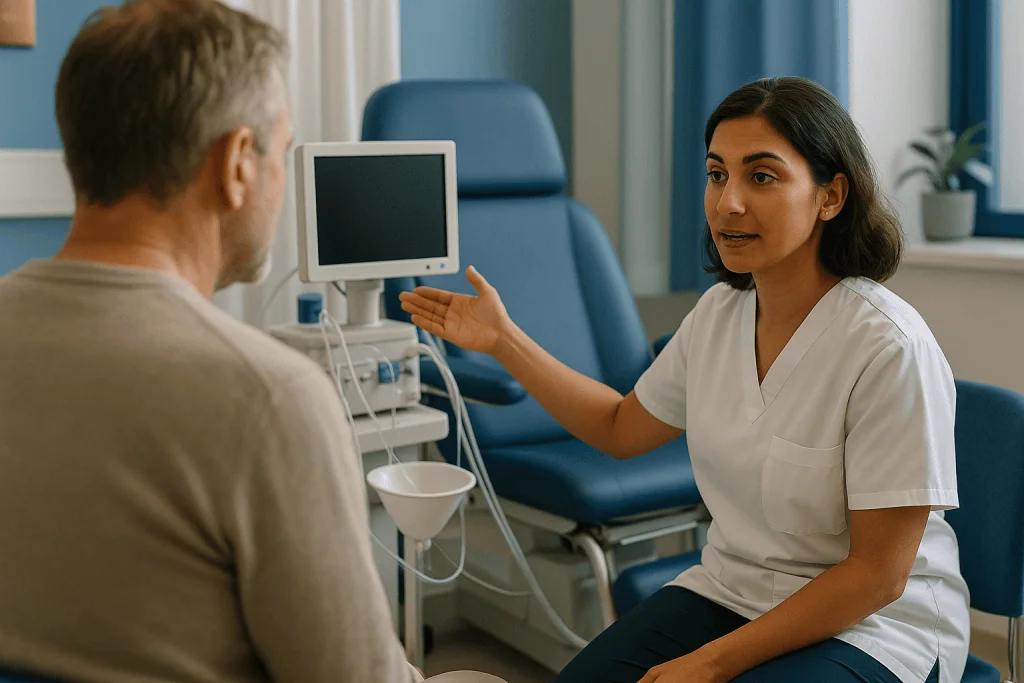
The appointment usually opens with the easiest part. The patient is asked to arrive with a comfortably full bladder and to urinate into the uroflow toilet, which records the stream. The NIDDK notes that patients may be asked to drink fluids beforehand so the bladder is full enough for this. A bladder ultrasound or a brief catheterization then checks how much remains.
Next comes the part most people worry about. After a local anesthetic gel is applied, a very thin catheter is placed through the urethra into the bladder. It is narrower than the tubes used for drainage after surgery. A second small catheter, usually in the rectum or sometimes the vagina, measures pressure inside the abdomen so the computer can tell the difference between the bladder squeezing and the patient coughing or straining. Sticky EMG pads may be placed on the skin near the anus.
The bladder is then filled slowly with sterile water or saline through the catheter. The patient’s job is to talk: to say when they first notice fluid, when they would normally go, when the urge becomes strong, and whether they feel any leaking. The clinician may ask them to cough or bear down to provoke leaks. Finally, the patient urinates with the catheters still in place so pressure and flow can be recorded together. The catheters are removed, and that is the test.
Everything depends on honest, real-time feedback. That is why sedation is generally avoided: anesthetic agents change bladder pressures and sensation, which would make the readings less reliable.
Who the urodynamic test companion is usually for, and who is asked to wait
Nearly every outpatient unit welcomes a companion in the building and the waiting area. What differs is whether anyone other than staff is present in the testing room, and this is where expectations most often collide with practice.
Companions are most commonly allowed, and sometimes actively encouraged, in these situations:
- Children and teenagers, where a parent or guardian typically stays throughout. Pediatric urodynamics is designed around a caregiver being present to reassure and distract.
- Adults with cognitive impairment, learning disability or dementia, where a familiar person helps the patient understand instructions and report sensations.
- Patients who need an interpreter and prefer a family member to a professional interpreter, though many units provide one.
- Patients with significant anxiety, prior trauma or a history that makes intimate examinations distressing, who have asked in advance for a support person.
- Patients with mobility limits who rely on a companion for transfers, although staff usually handle transfers themselves during the test.
Companions are usually asked to wait outside during catheter placement and the filling phase for an otherwise independent adult, for three reasons. The room is small and crowded with equipment. The patient’s dignity is better protected with fewer eyes in the room. And a companion can unintentionally change the result by talking, reassuring or asking questions at moments when the patient needs to concentrate on what their bladder is telling them.
Many units offer a middle path: the companion sits in during the explanation and the uroflow, steps out for catheters and filling, then returns for the debrief. A chaperone, meaning a trained staff member present to support the patient during an intimate procedure, is offered as standard in NHS and many US settings regardless of whether a companion is present. Whatever the local pattern, the patient’s stated preference is the deciding factor, and asking the ordering clinic beforehand avoids a hallway negotiation on the day.
Privacy in the testing room: what the gown, the curtain and the door really cover
People ask about privacy obliquely. They ask what to wear, whether there is a bathroom, whether “a lot of people” will be there. Underneath is one question: how exposed will I be, and for how long?
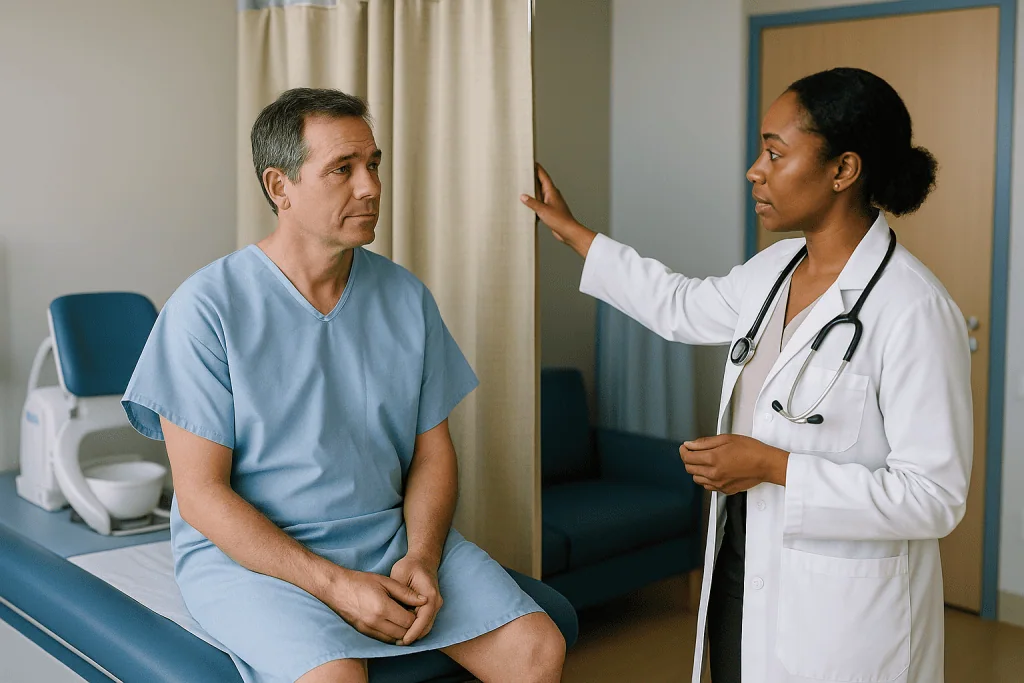
Here is the honest picture. The patient undresses from the waist down and wears a gown or is covered with a sheet. Exposure happens during catheter placement, EMG pad placement and the pressure-flow voiding phase, which together usually take a fraction of the appointment. During filling, the patient is typically covered and seated or semi-reclined. Doors are closed and curtains drawn; good units have a privacy sign on the door and a bathroom within steps.
Staff numbers are small. One or two people run the test; a trainee may be present if the patient agrees, and consent to a trainee’s presence can be declined without affecting care. If the test includes X-ray imaging, the imaging staff are behind a screen for most of the recording.
Some privacy details worth knowing in advance:
- Patients can ask for a clinician of a particular gender. It cannot always be guaranteed, but the request is reasonable and common.
- The sound of urination into the uroflow device is part of the test. Running tap water or a fan is sometimes used to help people who find it hard to start on request.
- Patients can ask what will be recorded and who sees the trace. The data are pressure lines and volumes, not photographs of the person, unless video urodynamics is used, in which case the images are X-ray silhouettes of the bladder.
For a companion, respecting privacy means something simple: take your lead from the patient about whether to be present, and never ask afterward for details the person has not offered. Some people want to narrate the whole thing on the drive home. Others want to talk about anything else.
How long does urodynamic testing take, and how to plan the day around it
The test itself is shorter than the appointment. According to the NIDDK, most urodynamic testing takes about 30 minutes to an hour, with the filling phase being the longest single component because the bladder is filled slowly, often at a rate that mimics natural filling so the results are realistic. Cleveland Clinic gives a similar estimate of roughly an hour for the full study.
The appointment letter will usually ask the patient to allow longer, commonly up to two hours, because the day includes check-in, a review of the bladder diary if one was requested, time for the bladder to be comfortably full for uroflow, the test, a chance to use the bathroom afterward, and sometimes a short explanation of what was seen. Units that add video imaging or that run several patients in sequence can also run late.
Timing matters in practical ways for a companion:
- The patient needs to arrive with a full but not uncomfortable bladder. Plan the journey so there is no 40-minute search for parking with a bladder at bursting point; a too-full bladder can be painful and can affect the uroflow.
- Expect a wait during the test if you are not in the room. Bring something to do, and ask the receptionist roughly when to return rather than hovering outside the door.
- Leave a buffer afterward. Many people want to use the bathroom, sit for a few minutes and have a drink before travelling.
- Avoid scheduling anything demanding immediately afterward. The test is not exhausting physically, but the mental effort of concentrating on bladder sensations and the mild urethral irritation afterward make a quiet afternoon more pleasant.
If the patient has mobility needs or incontinence that makes long waits difficult, phoning ahead to ask about the schedule, bathroom access and a chair near the door is a small act that smooths the entire day.
Is there any prep for a urodynamic study? What a companion can help with
Preparation is lighter than for most hospital tests, which surprises people who expect fasting or bowel preparation. There is no general anesthetic, so eating and drinking normally is usually fine, and in fact drinking is encouraged so the bladder is full on arrival. Specific instructions vary by unit, and the appointment letter overrides anything written here.
Common requests from the ordering team include:
- A bladder diary for a few days beforehand, recording what the person drinks, how often they urinate, roughly how much and when leaks happen. The NHS describes this diary as part of the assessment of urinary incontinence, and it helps the team interpret what they see on the day.
- A urine sample in advance or on arrival to check for infection. Testing is usually postponed if an active urinary tract infection is found, because infection changes bladder behavior and raises the risk of a more serious infection after catheterization.
- Arriving with a comfortably full bladder, as described above.
- Guidance about bladder medicines. Some clinicians ask patients to pause medicines that relax the bladder, such as anticholinergic drugs or beta-3 agonists, for a period before the test so the untreated bladder can be studied. Others want the test done on treatment to see how well it is working. This is a decision for the prescribing clinician alone; nobody should stop, start or change a prescribed medicine on their own initiative or on a companion’s advice.
- Occasionally, a single preventive antibiotic, decided case by case by the treating team.
A companion’s role in preparation is mostly logistical: helping keep the diary honest, confirming the appointment time, checking parking and bathroom locations, and making sure the letter, medication list and any questions are in the bag. For someone with memory problems, reading the instructions together the evening before, rather than in the car, is kinder and more effective.
What to wear for a urodynamics test, and what to bring
This is one of the most searched questions about the test, and the answer is practical rather than medical. The patient will undress from the waist down, so clothing that comes off and goes back on easily, without a struggle, reduces both time and awkwardness. Loose trousers or a skirt with an elastic waist, slip-on shoes and socks that stay on are sensible choices. Tight jeans, bodysuits, tights or complicated belts are not.
Underwear is likely to come into contact with a little lubricating gel or a small amount of leaked fluid afterward, and some people notice a few drops of pink-tinged urine for a short time. Bringing a spare pair of underwear and an absorbent pad, whether or not the person normally uses one, is a quiet form of insurance that prevents a small issue from spoiling the journey home.
Items worth packing for the patient:
- The appointment letter, photo identification and the completed bladder diary if requested.
- A current medication list, including anything bought without a prescription and any supplements, since some affect bladder function.
- A bottle of water for after the test. Increased fluid intake afterward is widely recommended to flush the urethra and bladder.
- A pad and spare underwear, as above.
- A written list of questions, because people reliably forget them in the room.
Items worth packing for the companion: a charged phone, something to read, change for parking, and patience. If the patient uses a wheelchair or walking aid, check in advance that the unit has a transfer-friendly couch or hoist; most urology units do, but asking costs nothing.
One small thing people rarely mention: the room can be cool, and the patient sits partly uncovered. A cardigan or sweater that can be worn over the gown makes the filling phase noticeably more comfortable.
Is urodynamic testing painful? An honest answer about discomfort
Most people describe urodynamics as uncomfortable and strange rather than painful, and that is also how the major sources describe it. The NIDDK says most tests cause little or no discomfort, with the possibility of mild discomfort for a few hours afterward and slight burning on urination. Cleveland Clinic similarly notes that the catheter can feel uncomfortable going in and that patients may feel a strong urge to urinate during filling, but that the test is not generally painful.
Three moments account for most of the unpleasantness:
- Catheter placement. Anesthetic gel is used, and the tube is thin, but the sensation of something passing through the urethra is unfamiliar. It lasts seconds. Men sometimes find it more noticeable because the urethra is longer; people with pelvic pain conditions or urethral scarring may find it more uncomfortable.
- The strong-urge phase of filling. The bladder is deliberately filled until the urge is strong, and holding on while reporting sensations can feel like an exaggerated version of needing a bathroom with none in sight. This is the point of the test, and the staff stop when the patient says they cannot hold more.
- Urinating with the catheter in place. It is awkward, and some people find they cannot start on request. This is common, not a failure, and staff have strategies for it.
Afterward, mild stinging on urination and a slightly pink tint are common for a short period and settle as fluids are increased. Pain that is severe, worsening or accompanied by fever is not expected and is covered in the red-flag section below.
A companion helps most here by not catastrophizing. Describing the test beforehand as “nothing” sets the patient up to feel foolish when it is uncomfortable; describing it as “awful” creates fear the evidence does not support. “Odd, a bit uncomfortable, and over in under an hour” is closer to what the sources say and to what most patients report.
Urodynamics vs cystoscopy: which feels worse?
People searching this question are usually facing both tests, or trying to decide whether to dread one more than the other. Cystoscopy is a different procedure: a thin camera, rigid or flexible, is passed through the urethra so the clinician can look directly at the lining of the urethra and bladder. Urodynamics measures function; cystoscopy looks at structure. They answer different questions, and one does not replace the other.
Neither mainstream source ranks them on a pain scale, and individual experience varies enough that a confident answer would be dishonest. What can be compared fairly is what each involves.
| Feature | Urodynamic testing | Flexible cystoscopy |
|---|---|---|
| Purpose | Measures bladder pressure, flow and sensation | Visual inspection of urethra and bladder lining |
| What is inserted | Very thin pressure catheter, plus a small rectal or vaginal catheter | A thin flexible telescope with a camera |
| Anesthesia | Local anesthetic gel; sedation avoided so sensations are reported accurately | Local anesthetic gel; sedation or general anesthesia used for some rigid procedures |
| Typical duration | About 30 to 60 minutes (NIDDK) | Usually shorter; a few minutes for the inspection itself |
| Patient’s role | Active: reporting sensations, coughing, urinating on request | Mostly passive: lying still, relaxing the pelvic floor |
| Common after-effects | Mild burning, pink urine, urgency for a short period | Mild burning, pink urine, urgency for a short period |
| Companion in room | Varies; often asked to wait during catheter and filling phases | Varies; often asked to wait during the procedure |
The practical upshot: cystoscopy is briefer but involves a slightly wider instrument; urodynamics is longer and asks more of the patient’s attention and bladder. People who hate the feeling of a very full bladder tend to find urodynamics harder. People who find instrumentation itself distressing tend to find cystoscopy harder. Both are routinely done awake, and both are usually followed by a normal drive home.
The journey home: driving, bathrooms and the first few hours
Because sedation is not normally part of urodynamics, most adults are medically able to drive themselves home. The reason a companion is useful on the journey is comfort rather than safety: the patient may feel urgency, mild stinging, or simply drained after an hour of concentrating on an intimate and slightly embarrassing task. Having someone else behind the wheel means the patient can shift position, drink water and ask for a bathroom stop without negotiating traffic.
Plan the route with bathrooms in mind. The bladder has just been filled, drained and irritated, and the sensible advice to drink extra fluids afterward means a full bladder may return sooner than usual. A 90-minute drive with no planned stop is a bad idea for the first few hours. If the patient wears a pad, this is the time to have a spare within reach rather than in the trunk.
On arriving home, the first few hours tend to look like this:
- Several trips to the bathroom, often with a brief sting at the start of the stream.
- A slight pink tinge to the urine in some people, which fades as fluids increase.
- A feeling of urgency or mild pelvic ache, similar to the early feeling of a bladder infection, that settles over the evening.
- Tiredness out of proportion to the physical demands of the test.
The NIDDK recommends increasing water intake for a couple of hours after the test to help flush the urinary tract, and notes that a warm bath or a warm cloth over the urethral opening may ease discomfort. Some clinicians give a preventive antibiotic; whether that applies is a decision for the treating team, and any medicine given should be taken exactly as the team has explained, not adjusted at home.
A companion’s most useful contribution on the way home is usually a quiet car, a planned bathroom stop and no questions the patient has not invited.
What the next few days usually look like
Recovery from urodynamics is measured in hours rather than days, which is one of its advantages over many diagnostic procedures. The mild urethral irritation and burning that follow catheterization typically settle within a day, and most people return to work, driving, exercise and sexual activity the same day or the next, unless the treating team has advised otherwise for an unrelated reason.
A few things are worth watching in the first 48 hours, not because problems are likely but because the two most common complications, infection and difficulty emptying, declare themselves in that window:
- Burning that gets better, not worse. Stinging that is fading by the second day is the expected pattern. Stinging that intensifies, or that is joined by cloudy or foul-smelling urine, suggests infection rather than irritation.
- Urine that clears. A pink tint should fade within a day with fluids. Bright red urine, clots or bleeding that persists is not typical.
- Normal emptying. A small number of people, particularly those whose test showed the bladder empties poorly, find it harder to urinate for a short time after the catheters are removed. Being unable to pass urine at all is a reason to seek care the same day.
- No fever. A temperature, chills or feeling generally unwell after a catheter procedure should always be reported.
Results arrive on a separate timeline. Uroflow and residual volume are usually visible immediately. The full cystometry and pressure-flow interpretation, according to the NIDDK, may take a few days, because the trace has to be reviewed against the patient’s symptoms and diary. Video studies take longer still. Many units arrange a follow-up appointment or telephone call to discuss findings and options, which may include pelvic floor training, bladder training, medicines, procedures or, often, simply reassurance that the bladder is behaving normally.
A companion can usefully attend that follow-up too. Hearing the explanation together reduces the chance of a garbled retelling over dinner.
The emotional side: dignity, embarrassment and how to help without hovering
Bladder problems are among the most under-reported symptoms in medicine. The NHS and Mayo Clinic both note that many people live with incontinence for years before raising it, out of embarrassment or a belief that it is simply part of ageing or childbirth. By the time someone reaches urodynamics, they have already overcome that barrier, and the test asks them to go further: to leak, strain and urinate on request while being observed.
That context shapes what helpful companionship looks like. The useful contributions are modest and practical. Being on time so the patient is not anxious before they start. Knowing where the bathroom is. Taking the bag, the coat and the parking ticket so the patient has nothing to manage. Sitting where the patient can see you when they come out. Having a drink ready.
The unhelpful contributions are equally recognizable. Insisting on being in the room when the patient has not asked. Asking the staff questions over the patient’s head. Making jokes about leaks, catheters or the sound of urination, however gently meant. Narrating your own medical experiences. Checking your phone when the patient emerges and wants a face.
Language matters more than people expect. Some patients want the test described clinically, with bladders, catheters and pressures. Others prefer not to hear the details repeated. Some want to laugh about it afterward; others want it filed away and never mentioned. Following the patient’s lead, rather than deciding how they should feel, is the whole skill.
Finally, remember that a companion’s discomfort is real but secondary. If the idea of the test makes you squeamish, keep that to yourself until the patient is home and settled. They have enough to carry through that door without your nerves added to the load.
What people often get wrong about urodynamic testing
Misunderstandings cluster around a few themes, and correcting them in advance saves anxiety on the day.
“They’ll put me to sleep.” Sedation and general anesthesia are avoided for standard adult urodynamics because the patient’s reported sensations are the data. Anesthetic agents alter bladder pressures and dampen sensation, making the trace less useful. The exception is some pediatric studies and rare adult cases, decided by the treating team.
“It’s a scan.” Urodynamics is a functional test, not an image. It records pressures and flow. Video urodynamics adds X-ray pictures, but the heart of the study is the trace on the screen, not a photograph of the bladder.
“If I can’t urinate on request, the test has failed.” Difficulty starting with catheters in place and observers nearby is common. Staff expect it and have ways to help. Even when the voiding phase is incomplete, the filling data are still valuable.
“I should hold on as long as I can to get a good result.” Arriving with a bladder so full it hurts can distort the uroflow and make the first part of the test miserable. “Comfortably full” is the instruction for a reason.
“I should stop my bladder medicine so the test is accurate.” Whether to pause medicines before the study is a clinical decision made by the person who prescribed them, and the answer differs depending on what the team wants to learn. Stopping on your own, or on a well-meaning companion’s advice, can confuse the results and leave the patient with worse symptoms in the meantime.
“A normal result means nothing is wrong.” A normal urodynamic trace rules out certain bladder behaviors but does not invalidate the symptoms. It redirects the search, often toward pelvic floor, lifestyle, fluid or other causes.
“My companion has a right to be in the room.” Companions are there at the patient’s invitation and within the unit’s policy. The patient’s preference is what counts.
Questions to ask your care team before the appointment
A ten-minute telephone call or a message through the patient portal in the days before the test can resolve most of what this article has raised. These are the questions that tend to matter most, phrased so they can be asked as written.
- Can my companion stay in the room during the test, or will they be asked to wait during catheter placement and filling? Can I change my mind on the day?
- Will a chaperone be offered, and can I request a clinician of a particular gender?
- Should I keep taking my bladder medicines, or do you want them paused before the test? For how long, and when should I restart? (The answer should come from the prescribing clinician, not from the companion or the internet.)
- Do you need a bladder diary, and for how many days?
- Should I give a urine sample beforehand to check for infection, and what happens if one is found?
- How full should my bladder be when I arrive, and when should I start drinking?
- Roughly how long should I allow for the whole appointment, including waiting?
- Will the test include X-ray imaging? Is there anything I should tell you about pregnancy or previous imaging?
- Is a preventive antibiotic part of your routine, and does it apply to me?
- What after-effects should I expect, and which ones should prompt a call?
- When and how will I get the results, and will a follow-up appointment be arranged?
- Is the unit accessible for a wheelchair or walking aid, and is there a bathroom close to the testing room?
Writing the answers on the appointment letter, where they will be found on the day, is more reliable than trusting memory. A companion can be the note-taker during that call, which is a genuinely useful role that intrudes on nobody’s privacy.
When to call your doctor: red-flag signs after urodynamic testing
Serious complications after urodynamics are uncommon, and the great majority of people have nothing more than a few hours of stinging. The two problems that do occur, urinary tract infection and temporary difficulty emptying, are recognizable early and are treatable when reported promptly. A companion who knows these signs is a safety net for a patient who may be inclined to tough it out.
Contact the testing unit, the ordering clinician or an urgent care service the same day if any of the following appear:
- Fever, chills, shaking or feeling generally unwell, at any point in the days after the test.
- Inability to pass urine, or passing only small dribbles with a painful, full feeling in the lower abdomen.
- Burning on urination that is getting worse rather than better after the first day, especially with cloudy or foul-smelling urine.
- Bright red urine, blood clots, or bleeding that continues beyond the first day rather than fading to clear.
- Pain in the lower back or side (the flank), which can indicate infection spreading toward the kidneys.
- Severe or worsening pelvic pain not relieved by the measures the team suggested.
- Nausea, vomiting or confusion alongside any of the above, particularly in an older person, since infection can present this way.
Seek emergency care without delay if the patient cannot pass urine at all and is in increasing pain, if there is heavy bleeding, or if fever is accompanied by rapid breathing, a racing heart, drowsiness or confusion, which can signal a serious infection.
Mild stinging, a brief pink tinge, urgency and tiredness on the day of the test do not need a call unless they are worrying the patient, in which case calling is always acceptable. Units expect these questions and would rather hear from a patient than not.
Every decision about treatment, including whether an antibiotic is needed, whether a catheter should be placed temporarily, and what the test results mean for next steps, sits with the treating team. The companion’s job is to help the patient make the call, not to make the decision.
Frequently asked questions
What is a urodynamic test, in plain language?
A urodynamic test is a set of measurements of how the bladder fills, stores and empties urine. Thin catheters record pressure while the bladder is slowly filled with sterile fluid, a special toilet measures the flow of urine, and small skin electrodes may record pelvic floor muscle activity. The patient stays awake and describes what they feel, so the team can match sensations and leaks to the pressures on the screen.
How uncomfortable is urodynamic testing?
Most people find it uncomfortable and odd rather than painful. The NIDDK describes little or no discomfort for most patients, with possible mild discomfort and slight burning for a few hours afterward. The moments people notice most are catheter placement, which lasts seconds and uses anesthetic gel, and the strong-urge phase when the bladder is deliberately filled. Severe or worsening pain is not expected and should be reported.
Is there any prep for a urodynamic study?
Preparation is usually light. There is no fasting, because no anesthetic is given. The team may ask for a bladder diary for a few days, a urine sample to rule out infection, and a comfortably full bladder on arrival. Some clinicians ask patients to pause certain bladder medicines beforehand and others do not; follow the specific written instructions and never change a prescribed medicine without the prescriber’s guidance.
Which is more painful, urodynamics or cystoscopy?
Neither major medical source ranks them, and experience varies between people. Cystoscopy passes a slightly wider camera through the urethra but is usually brief and passive. Urodynamics uses thinner catheters but takes longer and asks the patient to tolerate a very full bladder and to urinate on request. People who dislike strong bladder fullness tend to find urodynamics harder; those who find instruments distressing tend to find cystoscopy harder.
What should I wear for a urodynamics test?
Wear clothes that are easy to take off and put back on from the waist down: loose trousers or a skirt with an elastic waist and slip-on shoes. A sweater or cardigan helps because the room can feel cool while you are partly uncovered. Bring spare underwear and an absorbent pad, since a little lubricating gel or a few drops of pink-tinged urine afterward are common.
How long does urodynamic testing take from start to finish?
The test itself usually takes about 30 minutes to an hour according to the NIDDK, with the slow bladder-filling phase taking the longest. The whole visit is often booked for up to two hours to include check-in, time for the bladder to fill, the test, a bathroom visit afterward and a short explanation. Video studies and busy clinic days can add time, so build in a buffer.
Can my companion be in the room with me?
Often partly. Most units welcome a companion in the waiting area and for the explanation and debrief, and many ask them to step out during catheter placement and bladder filling to protect privacy and avoid distracting the patient. Children usually have a parent present throughout, and adults with cognitive impairment, anxiety or language needs can usually request a support person. Ask the clinic in advance so the plan is clear.
Can I drive home after a urodynamic test?
Usually yes, because standard adult urodynamics is done without sedation or general anesthesia. The reason to bring a driver is comfort rather than safety: afterward you may feel urgency, mild stinging or simply tired, and having someone else drive lets you drink water and stop for a bathroom without worrying about traffic. If sedation was used, which is uncommon, the team will tell you not to drive.
What are normal after-effects, and what is not normal?
Mild burning when you urinate, a slight pink tinge to the urine and a feeling of urgency for a few hours are common and ease with extra fluids. Not normal are fever or chills, being unable to pass urine, burning that worsens after the first day, bright red urine or clots, or pain in your side or lower back. Those signs warrant a same-day call to the clinic or an urgent care service.
When will I get the results of my urodynamic test?
Some parts, such as flow rate and the amount left in the bladder, are visible immediately. The full interpretation of the pressure recordings may take a few days according to the NIDDK, because the trace is reviewed alongside your symptoms and bladder diary. Video studies can take longer. Most units arrange a follow-up appointment or call to explain what was found and discuss next steps with you.
References
- Urodynamic Testing – National Institute of Diabetes and Digestive and Kidney Diseases (NIH)
- Cystometric study – MedlinePlus Medical Encyclopedia
- Urinary incontinence – Diagnosis – NHS
This article is for general information only and is not a substitute for professional medical advice. Please consult a qualified doctor about your individual situation.

More from the Blog
ESWL vs Ureteroscopy for Kidney Stones: Why Stone Size, Location and Hardness Decide
ESWL breaks kidney stones from outside the body with focused shock waves and relies on the fragments passing naturally; ureteroscopy passes a thin scope…

How Interstitial Cystitis Is Diagnosed: Ruling Out Other Causes, Bladder Diary and Cystoscopy
Interstitial cystitis is diagnosed by exclusion; no single test confirms it. A clinician takes a detailed history of bladder pain, pressure and urgency lasting…

How Long Does Epididymitis Take to Settle? A Week-by-Week View of Treatment and Recovery
Epididymitis usually begins to settle within about three days of starting an appropriate antibiotic, and most people feel largely better within two weeks, according…

Nerve-Sparing in Robotic Prostate Surgery: What the Robotic Approach Actually Changes
Nerve-sparing in robotic prostate surgery means removing the prostate while trying to preserve the neurovascular bundles that run along its sides and carry the…
Cystitis in Pregnancy: Why a Bladder Infection Is Treated Promptly and Monitored Closely
A bladder infection during pregnancy is treated promptly because hormonal and physical changes make it easier for bacteria to climb from the bladder to…

Questions to Ask Your Surgeon Before Robotic Prostate Surgery: Stage, Plan and Follow-Up
Before robotic prostatectomy, ask your surgeon to explain your stage, grade group and PSA in plain words; whether active surveillance or radiation are reasonable…