

ACL Reconstruction Over Forty: When Age Matters Less Than Activity and Knee Stability

Key Takeaways
- Mayo Clinic's criteria for recommending ACL reconstruction (pivoting sport, multiple ligament injury, repairable meniscus tear, buckling during daily life) do not include an age limit.
- A randomized trial in the New England Journal of Medicine found that 51 percent of active adults assigned to rehabilitation first never needed ACL surgery, with equal knee function at two years.
- The torn ACL does not heal on its own because it sits in joint fluid with poor blood supply; muscles can compensate, but the ligament does not reunite.
- Surgeons often consider donor (allograft) tendon more readily in lower-demand adults over 40 because graft failure is driven mainly by how hard the knee is loaded, not by age itself.
- The NHS cites around six months and Mayo Clinic up to a year or more before return to sport; return is increasingly decided by strength and hop testing rather than the calendar.
- The raised long-term risk of knee osteoarthritis after an ACL injury persists whether or not the ligament is reconstructed, so surgery is for stability, not cartilage protection.
Age alone is rarely what decides ACL reconstruction over 40. Surgeons weigh how often the knee gives way, how active you want to be, whether the meniscus or cartilage is also damaged, your general health, and how a trial of structured rehabilitation goes. Many people over 40 manage well without surgery; others with persistent instability are offered reconstruction. The choice always rests with you and your treating team.
She was 47, a weekend soccer goalkeeper for two decades, and the injury happened on a staircase, not a pitch. One missed step, a twist, a pop she felt in her teeth. Within three hours the knee was the size of a grapefruit. The emergency physician said the words anterior cruciate ligament, and the first question out of her mouth was not about surgery. It was: am I too old for this to matter?
That question sits at the heart of ACL reconstruction over 40. For years, a birthday was treated as an informal cutoff: under it you were a surgical candidate, over it you were handed a brace and a leaflet. The evidence has moved on. What matters now is how the knee behaves when you ask something of it, and what you want to ask of it for the next thirty years.
This explainer walks through the decision as an orthopedic team actually frames it: stability first, activity second, age a distant third.
What the ACL does, and why a torn knee gives way
The anterior cruciate ligament, or ACL, is one of two ligaments that cross in the center of the knee like the strands of an X. It runs from the back of the thigh bone to the front of the shin bone, and its job is narrowly defined: stop the shin sliding forward and control rotation when you pivot, cut or land. According to Cleveland Clinic, ACL injuries are among the most common knee injuries in the United States, with roughly 100,000 to 200,000 occurring each year.
Most tears are noncontact. The foot plants, the body turns, the knee stays behind. Skiers feel it when a binding fails to release. Recreational athletes feel it on a sudden stop. Plenty of people over 40 feel it on a curb, a wet floor or a trampoline at a child’s birthday party. The classic story is a pop, rapid swelling as blood fills the joint, and a sense that the knee cannot be trusted.
Here is the biological problem that drives every later decision. The ACL lives inside the joint, bathed in synovial fluid, with a poor blood supply. When it tears, the two ends retract and the fluid washes away the clot that would normally form a scaffold for healing. Cleveland Clinic puts it plainly: a torn ACL cannot heal itself. Muscles around the knee can learn to compensate, but the ligament does not knit back together the way an ankle sprain does.
A clinician confirms the diagnosis through specific physical tests and usually magnetic resonance imaging, which also shows whether the meniscus (the C-shaped cartilage cushions) or the joint surfaces are damaged. In adults past 40, those associated findings matter at least as much as the ligament itself, because they shape what surgery can realistically fix.
Is there an age limit for ACL reconstruction over 40?
Short answer: mainstream guidance does not set one. Mayo Clinic lists the situations in which reconstruction is generally recommended: you are an athlete who wants to continue in a sport that involves jumping, cutting or pivoting; more than one ligament is injured; a meniscus tear needs repair; or the injury causes the knee to buckle during everyday activity. Not one of those criteria mentions a birth year.
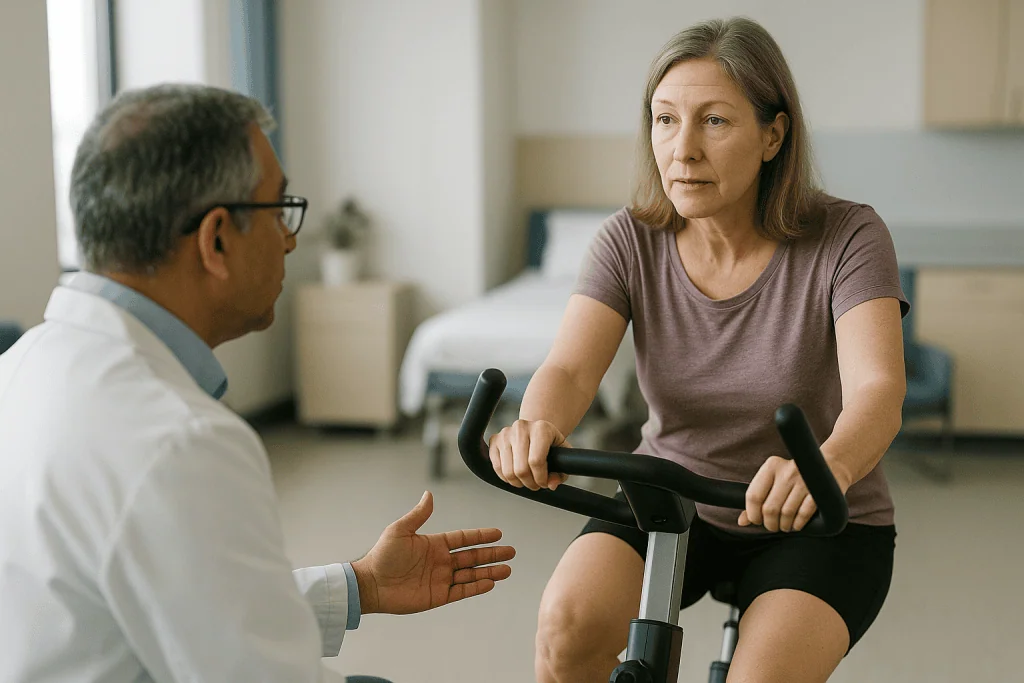
So where did the 40 cutoff come from? Partly from older surgical habits, when rehabilitation was slower and surgeons worried about stiffness in older knees. Partly from research recruitment: the landmark trials of ACL treatment enrolled young, active adults, which left the over-40 population under-studied rather than ruled out. An absence of evidence was quietly read as evidence of a limit.
What age genuinely changes is context. Healing tissue remodels more slowly in a 55-year-old than in a 20-year-old. Pre-existing cartilage wear is more common, and an ACL reconstruction cannot reverse arthritis that was already there. Other health conditions, from diabetes to clotting risk, enter the conversation. Goals shift too: fewer people over 40 need to land from a volleyball block, but a great many want to ski, hike uneven ground, chase a toddler or simply walk downstairs without bracing for collapse.
What age does not change is mechanics. A knee that shifts forward and rotates abnormally every time it is loaded behaves the same way at 52 as at 22, and every episode of giving way is a chance to damage a meniscus or cartilage that was intact after the original injury. That is why orthopedic teams now talk about physiologic age, meaning the condition of your tissues and your fitness, rather than the number on your driver’s license.
Who is usually offered surgery, and who is usually asked to wait
Nearly everyone is asked to wait at first, and that surprises people. The NHS notes that reconstruction is usually delayed until swelling has settled and the knee has regained motion, often a matter of weeks, because operating on a hot, stiff joint raises the risk of long-term stiffness. This waiting period doubles as prehabilitation: restoring full extension, waking up the quadriceps and seeing how the knee copes.
After that, the people most often offered reconstruction share a few features. Their knee keeps giving way despite good rehabilitation. They play or work in ways that demand pivoting, from tennis to roofing. Imaging shows a repairable meniscus tear, which surgeons generally prefer to fix at the same operation, since a stable knee protects the repair. Or more than one ligament is torn, which rarely settles with rehab alone.
The people most often steered toward rehabilitation first look different. Their activities are mostly straight-line: walking, cycling, swimming, the gym. Their knee feels sore but not untrustworthy. Their scans show established arthritis, where reconstruction may not improve pain and may not be the operation that helps. Or they cannot realistically commit to the months of supervised physical therapy that make surgery worthwhile; a graft without rehabilitation tends to disappoint.
Medical factors sit alongside these. Poorly controlled diabetes, active smoking, obesity and prior clotting problems do not automatically rule surgery out, but they change the risk conversation and sometimes the timing.
None of this is a judgment about who deserves an operation. It is an attempt to match the intervention to the knee and the life it has to carry. Some people who begin with rehabilitation later choose surgery when instability persists; that is a legitimate pathway, not a failure.
What actually happens during ACL reconstruction
Two words trip people up, so let’s define them. Repair means stitching your own torn ligament back together, which is rarely possible for a mid-substance ACL tear. Reconstruction, the standard operation, means replacing the ligament with a graft, a strip of tendon that is positioned where the ACL used to be and gradually turns into a ligament-like structure.

The procedure is arthroscopic, performed through small incisions using a pencil-thin camera, and according to Mayo Clinic is usually done as an outpatient, meaning you go home the same day. Anesthesia may be general, or a spinal anesthetic that numbs you from the waist down, often combined with a nerve block that keeps the knee numb for hours afterward.
Inside the joint, the surgeon first inspects everything: the meniscus, the cartilage surfaces, the other ligaments. Torn ACL remnants are trimmed. Any meniscus damage is addressed, by repair where the tissue will heal and by trimming where it will not. Then come the tunnels: narrow channels drilled into the thigh bone and shin bone at the ligament’s natural attachment points. The graft is threaded through these tunnels and anchored at each end with screws, buttons or other fixation devices. Over the following months, bone grows into the graft within the tunnels, and the graft itself undergoes a biological makeover that surgeons call ligamentization.
If the graft is taken from your own body, the harvest happens at the start of the operation through a separate small incision. If donor tissue is used, it is prepared on the back table while the knee is assessed.
You wake in recovery with a bandaged knee, sometimes a brace, and usually crutches by your bedside. MedlinePlus describes the typical path as home within hours, with physical therapy beginning almost immediately.
ACL graft options for older adults: autograft or allograft?
The graft question is where age enters the operating room most directly. An autograft comes from your own body; an allograft comes from a deceased donor. Mayo Clinic lists the common autograft sources as the patellar tendon (with a plug of bone at each end), the hamstring tendons, and the quadriceps tendon.
| Graft | Source | Points often discussed for adults over 40 |
|---|---|---|
| Patellar tendon | Middle third of the tendon below the kneecap, with bone plugs | Strong bone-to-bone healing; higher chance of pain at the front of the knee and with kneeling |
| Hamstring tendon | Tendons from the inner back of the thigh | Smaller incision, less kneeling pain; some persistent hamstring weakness is possible |
| Quadriceps tendon | Tendon above the kneecap | Thick graft, increasingly used; a smaller body of long-term data than older options |
| Allograft | Donor tendon, screened and processed | No harvest-site pain, shorter operation; slower biological incorporation; small risk of disease transmission; higher failure rates reported in young, high-demand athletes |
Why does age tilt the discussion? Graft failure, meaning re-tear, is driven largely by how violently and how often the knee is loaded. Younger pivoting athletes stress a graft hard before it has fully matured, which is why allografts have performed less well in that group. Many adults over 40 return to lower-impact activity and load the knee more gently, so surgeons often consider allograft a reasonable option that spares the harvest-site pain and weakness that can slow an older patient’s recovery.
That reasoning is sound but not a rule. A 44-year-old marathoner who plays competitive squash has a young athlete’s demands. The right graft is the one matched to your activity, your anatomy and your surgeon’s experience, and the decision belongs in that consultation.
ACL tear treatment without surgery: what the evidence shows
The most-cited evidence on this question is a randomized trial published in the New England Journal of Medicine. Researchers in Sweden enrolled 121 active adults with acute ACL tears and assigned half to early reconstruction plus rehabilitation, and half to rehabilitation with the option of delayed reconstruction if the knee remained unstable. At two years, patient-reported knee function was no different between the groups, and 51 percent of those in the rehabilitation-first group had not needed an operation.
Two honest caveats. The participants were 18 to 35 years old, so the trial does not directly describe outcomes over 40. And the rehabilitation was structured and supervised, not a leaflet and good wishes. Still, the message travels well: a strategy of rehabilitation first, with surgery held in reserve, is a legitimate evidence-based pathway rather than a consolation prize.
How does a knee function without its ACL? The ligament never regrows, but the hamstrings, quadriceps and hip muscles can be trained to stabilize the joint, and the nervous system can relearn how to control it. Clinicians call people who achieve this copers. Those who continue to experience giving way, particularly during twisting, are called non-copers, and they are the group for whom reconstruction most clearly earns its place.
The trade-off is the cost of each instability episode. A knee that buckles can tear a meniscus or bruise cartilage that survived the original injury. This is why a rehabilitation-first approach is not a wait-and-see approach. It involves a structured program, a defined review point, and a willingness to change course if the knee keeps failing you. Braces may help confidence during this period; the evidence that they prevent further injury is weaker than their popularity suggests.
Is ACL reconstruction a high risk surgery?
In the language of anesthesiologists, no. ACL reconstruction is an elective operation on a limb, usually done as a day case, in people who are mostly otherwise well. Life-threatening complications are uncommon. That does not make it trivial, and the risks deserve to be named rather than minimized.
Mayo Clinic lists the main surgical complications: bleeding, infection, blood clots in the leg, pain or stiffness in the knee, and failure of the graft, meaning it stretches or re-tears. To these clinicians usually add numbness around the incisions, which can be permanent, and the possibility of further surgery, whether to remove scar tissue or to revise a failed graft.
Arthrofibrosis is worth a plain definition: excessive scar tissue that forms inside the joint and limits bending or, more troublingly, straightening. It is the complication most closely tied to operating on a swollen, stiff knee, which is why teams insist on regaining motion before surgery and start physical therapy within days afterward.
What shifts over 40 is the medical risk profile rather than the surgical one. Venous thromboembolism, a clot in the deep veins of the leg that can travel to the lungs, becomes more likely with age, reduced mobility, obesity, smoking, hormone therapy and a personal or family history of clots. Your team will assess this and may discuss mechanical prevention such as compression and early walking, or medicines that reduce clotting; the choice and duration are theirs to make with you. Anesthesia risk also rises with heart and lung conditions, which is why a pre-operative assessment is standard.
Measured against the risk of the alternative, repeated instability with progressive meniscus and cartilage damage, most teams frame reconstruction as a moderate commitment with a predictable complication list, not as a gamble.
Is ACL surgery one of the most painful operations?
It has that reputation, and the reputation is only partly earned. The first two or three days are genuinely uncomfortable. Bone tunnels have been drilled, the joint is swollen, and if a tendon was harvested there is a second sore site competing for attention. People who have had a patellar tendon graft often describe the front of the knee as the worst of it; those with hamstring grafts tend to notice the back of the thigh.
Modern pain management is layered, and understanding the layers helps. A regional nerve block placed before surgery numbs the leg for hours, so the first night is often easier than the second day when it wears off. Acetaminophen and anti-inflammatory medicines, taken on a schedule set by the prescriber, form the background. A short course of a stronger opioid analgesic may be prescribed for breakthrough pain in the first days; the trend across guidelines is to keep this brief. Ice, elevation above heart level and a compression bandage do far more than people expect. How any medicine is used, and for how long, is a conversation with your prescribing clinician, not something to adjust on your own.
What surprises people over 40 is not the intensity but the duration of a different kind of discomfort: the deep ache of a joint being asked to bend further each week, the fatigue of muscles relearning their job. MedlinePlus and the NHS both describe pain and swelling easing over the first few weeks as motion returns.
Compared with other orthopedic operations, ACL reconstruction sits in the middle. It is more demanding than a simple arthroscopy and generally less so than a joint replacement. The best predictor of a manageable experience is a well-prepared knee and a clear plan written down before you leave the recovery room.
What the first days and weeks usually look like
You will almost certainly go home the same day, on crutches, with the knee wrapped and possibly braced. The first job is unglamorous: keep the swelling down and get the knee fully straight. Full extension, the ability to lock the knee out flat, is the single most important early milestone, because a knee that loses it tends to stay bent and walks with a limp for months.
Physical therapy typically starts within the first few days. Mayo Clinic describes a program that begins with range of motion and swelling control, then progresses to strengthening and, much later, sport-specific drills. Early sessions look modest: heel slides, quadriceps squeezes, ankle pumps that also help prevent clots. Modest is correct. Overdoing it in week one is how joints get angry.
Weight-bearing rules depend on what else was done. A reconstruction alone usually allows walking with crutches as comfort permits; a meniscus repair often means protected weight-bearing and limits on bending for several weeks, because the stitched cartilage needs a quiet environment to heal. Your surgeon’s instructions override any general timeline you read, including this one.
Wound care is simple: keep the dressings clean and dry, watch for the warning signs listed later in this article, and attend the follow-up visit where sutures are checked and the plan is updated. Showering is usually permitted once the team confirms the wounds are sealed.
By the end of the first few weeks, most people are weaning off crutches, bending the knee past a right angle, and walking around the house without thinking too hard about it. Driving returns when you can control the pedal leg promptly and are no longer taking medicines that impair reaction time; your team will give you a specific go-ahead. Returning to a desk job is usually measured in weeks, a physical job in months.
ACL surgery recovery time over 40: months three to twelve
Here is the part the leaflets compress into a sentence and real life stretches into most of a year. The NHS puts a typical return to sport at around six months after reconstruction. Mayo Clinic is more cautious, noting that it may take a year or more before athletes return to their sport. Both are right, because they are describing different sports and different definitions of return.
The middle months are about strength. The quadriceps on the operated side shrinks with alarming speed after surgery and rebuilds slowly, which is why so many protocols hold off on running until strength tests show the operated leg approaching the healthy one. Cycling, pool work and gym-based loading fill this period. A graft is also at its weakest a few months in, when the original tendon tissue has partly broken down and the new ligament-like structure is still immature, so this is not the time for a celebratory game of pickup basketball.
Does being over 40 slow things down? The evidence does not show that age alone sets the pace. What tends to slow older adults is practical: less time to train, more competing responsibilities, a cautious instinct that under-loads the knee, and occasionally arthritis that flares when loading increases. The counterweight is that many adults past 40 are more disciplined with homework than teenagers are.
Return-to-sport decisions have moved away from the calendar and toward criteria: symmetrical strength, hop tests, confidence measures, and sport-specific movement quality. For straight-line activities such as jogging, cycling and swimming, clearance tends to come earlier in that window. For pivoting sports and skiing, later. A graft that is protected for a full year is a graft given its best chance.
Will I be 100 percent after ACL surgery?
People ask this in the consulting room more than any other question, and honest surgeons answer it carefully. For stability in everyday life, the great majority of people who complete reconstruction and rehabilitation get a knee they can trust again. That is the operation’s core promise, and it is a realistic one.
One hundred percent is a slipperier target. Years later, many people notice small things: a reluctance to kneel on the graft-harvest side, a quadriceps that never quite matches its partner, a stiffness after long car journeys, a hesitation on the first cut of the season that is more psychological than mechanical. Fear of re-injury is real and measurable, and it is one reason some people choose not to return to the sport that injured them even when their knee has been cleared.
Then there is arthritis. Both Mayo Clinic and Cleveland Clinic note that people who have injured an ACL face a higher risk of developing osteoarthritis in that knee later in life, and that this appears to hold whether or not the ligament is reconstructed. Reconstruction restores stability and may protect the meniscus from further damage, but it has not been shown to prevent the cartilage changes set in motion by the original injury. For someone over 40 who already has early wear, that is a central conversation to have before surgery.
So is ACL surgery life changing? For a person whose knee has been collapsing on stairs, a reliable joint changes daily life in a way that is hard to overstate. For a person whose knee was mostly fine and who hoped surgery would make it feel 20 again, the result can disappoint. The gap between those two experiences is mostly about expectations set before the first incision.
What people often get wrong about ACL reconstruction after 40
Myths cluster around this operation, and several of them push people toward the wrong decision in both directions.
The first is that 40 is too old. Mainstream guidance contains no upper age limit; candidacy is about instability, activity, associated injury and health. The second is the mirror image: that everyone with a torn ACL needs surgery. The randomized evidence described earlier shows that around half of young active adults managed without an operation when given structured rehabilitation first, and many adults over 40 with straight-line lifestyles do the same.
A third misconception is that waiting a few weeks before surgery is harmful. The opposite is closer to the truth: operating on a swollen, stiff knee raises the risk of long-term stiffness, which is why the NHS describes delaying surgery until motion returns.
Fourth, that rest will heal the ligament. It will not. Swelling settles and pain fades, which can feel like healing, but the ligament ends do not reunite. The knee may function well through muscular control; that is compensation, not repair.
Fifth, that reconstruction protects against arthritis. Current evidence says the raised long-term risk of osteoarthritis after ACL injury persists regardless of treatment. Surgery is for stability, not for cartilage insurance.
Sixth, that allograft is inherently second-rate. In young pivoting athletes it has had higher failure rates; in lower-demand adults it is a widely used and reasonable choice, with trade-offs your surgeon can describe.
And last, that rehabilitation finishes when the brace comes off or the physical therapy referral runs out. The graft is still maturing well into the second half of the first year. The people who do best treat that whole year as the recovery, not the first six weeks.
Questions to ask your care team
A good consultation is a two-way exchange, and arriving with questions changes its shape. These are the ones that tend to produce the most useful answers for adults over 40.
- Based on my examination and imaging, how unstable is this knee, and is there meniscus or cartilage damage that changes the picture?
- If I committed to structured rehabilitation first, what would we look for at the review point that would push us toward surgery?
- Which graft would you suggest for me, and why that one given my age, my sports and my job?
- If my meniscus needs repair at the same time, how does that change my weight-bearing and bending restrictions afterward?
- Is there arthritis already present, and how might that affect what surgery can and cannot improve?
- What is my personal risk of a blood clot, and what prevention do you recommend?
- What does your rehabilitation protocol look like month by month, and how will we decide when I can run, pivot or ski?
- What would make you consider my recovery off track, and how would I reach you if that happened?
- Which of my current medicines or supplements should we discuss before the operation?
- If I choose not to have surgery, what activities would you advise I approach with caution, and would a brace be useful?
Write the answers down or bring someone who will. Ask for the written rehabilitation protocol rather than a verbal summary. And if the recommendation feels like a template rather than a response to your knee and your life, say so. A seasoned team will welcome the question, and a second opinion is a normal part of planning an elective operation, not a vote of no confidence.
When to call your doctor
Most recoveries are uneventful. A short list of warning signs separates the ordinary aches of rehabilitation from problems that need prompt attention, and knowing them in advance makes the difference between a quick phone call and a sleepless night.
Call your surgical team the same day if you notice a fever or chills; increasing redness, warmth or spreading swelling around the incisions; cloudy or foul-smelling fluid leaking from a wound; pain that is getting worse rather than better after the first few days despite your prescribed plan; a knee that suddenly cannot straighten or locks in one position; or numbness or weakness in the foot that is new or worsening after the nerve block should have worn off.
Call emergency services, or go to the nearest emergency department, if you develop chest pain, sudden breathlessness, coughing up blood, or a racing heart. These can signal a clot that has traveled to the lungs. Also seek urgent care for new calf pain, tightness or swelling in either leg, which may indicate a deep vein clot, and for a sudden pop or giving way in the operated knee followed by rapid swelling, which may mean the graft has been injured.
Before surgery, or if you are managing without it, seek care promptly if the knee locks and will not move, if you cannot bear any weight, or if instability episodes are becoming more frequent. Each of these can indicate meniscus damage that benefits from early assessment.
When in doubt, call. Teams would far rather field a cautious question than meet a complication late. Your treating team knows the details of your operation and your health; their advice replaces any general guidance here.
Frequently asked questions
Is ACL surgery worth it at 45?
It can be, if the knee keeps giving way or you want to return to pivoting activity; it may not be if the knee feels stable with rehabilitation or arthritis is already established. Mainstream guidance frames the decision around instability, activity and associated meniscus damage rather than age. A structured trial of rehabilitation with a defined review point is a common and evidence-supported first step.
Is ACL surgery life changing?
For someone whose knee has been collapsing on stairs or during sport, regaining a trustworthy knee changes daily life substantially. For someone whose knee was already stable, surgery is a long project with modest gains. The difference lies in why the operation is being done. Teams reserve reconstruction for persistent instability or combined injuries for exactly this reason.
Will I be 100 percent after ACL surgery?
Most people regain a stable knee for everyday life and return to many activities, but small long-term differences are common: kneeling discomfort, slight quadriceps weakness, or hesitation during cutting. Mayo Clinic and Cleveland Clinic also note a raised long-term risk of osteoarthritis after ACL injury regardless of treatment. Realistic expectations set before surgery predict satisfaction better than any technical factor.
Is ACL surgery one of the most painful operations?
The first days are uncomfortable, especially after a patellar tendon graft, but nerve blocks, scheduled non-opioid medicines, ice and elevation keep most people comfortable enough to begin physical therapy quickly. MedlinePlus and the NHS describe pain and swelling easing over the first few weeks. It sits between a simple arthroscopy and a joint replacement in intensity.
Is ACL reconstruction a high risk surgery?
It is an elective, usually day-case limb operation with uncommon life-threatening complications. Mayo Clinic lists the main risks as bleeding, infection, blood clots, knee stiffness or pain, and graft failure. Over 40, clot and anesthesia risk depend more on general health than the operation itself, which is why a pre-operative assessment and clot-prevention plan are standard.
How long is ACL surgery recovery time over 40?
Walking without crutches typically returns within the first few weeks, desk work in weeks and physical work in months. The NHS puts return to sport at around six months; Mayo Clinic notes it may take a year or more. Age alone does not appear to dictate pace; consistency with rehabilitation and the presence of arthritis matter more.
Can an ACL tear be treated without surgery?
Yes. Structured rehabilitation that strengthens the hamstrings, quadriceps and hips can allow many people to function well without the ligament. In the randomized trial published in the New England Journal of Medicine, 51 percent of those assigned to rehabilitation first never needed reconstruction. Persistent giving way, especially with twisting, is the main reason people later choose surgery.
Which graft is best for older adults having ACL reconstruction?
There is no single best graft. Patellar tendon, hamstring and quadriceps tendon autografts use your own tissue; allograft uses donor tendon and avoids harvest-site pain. Surgeons often consider allograft more readily for lower-demand adults, because higher failure rates have been seen mainly in young pivoting athletes. The choice depends on your activities, anatomy and your surgeon’s experience.
Does ACL reconstruction prevent arthritis later?
Current evidence says no. Mayo Clinic and Cleveland Clinic both note that people who injure an ACL face a higher long-term risk of knee osteoarthritis whether or not the ligament is reconstructed. Surgery restores stability and may protect the meniscus from further tears, which matters, but it should not be chosen as cartilage insurance.
Why do surgeons wait weeks before operating on a torn ACL?
Because operating on a swollen, stiff knee raises the risk of arthrofibrosis, excessive scar tissue that limits motion. The NHS describes delaying reconstruction until swelling settles and movement returns. That period also serves as prehabilitation and gives you and your team a chance to see how the knee copes, which informs whether surgery is needed at all.
References
This article is for general information only and is not a substitute for professional medical advice. Please consult a qualified doctor about your individual situation.

More from the Blog
Returning to Work After Arthroscopy: Desk Jobs, Standing Jobs and Manual Work Compared
Most people can return to work after arthroscopy within a few days to a few weeks for seated desk work, several weeks for jobs…
How Tendon Repair Surgery Works: Stitching Torn Ends, Grafts and Protecting the Repair
Tendon repair surgery reconnects the two ends of a torn tendon, usually by stitching them together with a strong core suture and a finer…
The First Days Home After Meniscus Surgery: Crutches, Bracing and How a Companion Can Help
In the first days after meniscus surgery, most people manage at home with crutches, a cold pack, elevation and the pain plan their surgical…

When Does Bursitis Need a Doctor? Rest and Ice First, Then the Signs That Call for a Visit
Most bursitis settles with rest, ice, padding and avoiding the movement that caused it, usually within a few weeks. See a doctor if pain…

When to See a Doctor for a Sprain or Strain: The Signs That Call for a Specialist Assessment
See a doctor for a sprain or strain if you cannot bear weight on the joint, the limb looks misshapen, you felt or heard…

Rotator Cuff Repair vs Reverse Shoulder Replacement: How Surgeons Decide for Massive Tears
For a massive rotator cuff tear, surgeons usually attempt repair when the torn tendons can still be brought back to bone and the muscles…