

AI Medical Diagnosis: How Accurate Are the Systems, Study by Study?
Key Takeaways
- In the 2020 Nature mammography study, an AI reader cut false negatives by 9.4 percent on US scans and 2.7 percent on UK scans compared with original radiologist readings, in retrospective data.
- A 2024 randomized trial found physicians scored 76 percent on diagnostic cases with a chatbot and 74 percent without, while the chatbot alone scored about 16 points higher than either group.
- An NIH-supported 2024 study found a multimodal model matched physicians on image quizzes but gave flawed reasoning in a substantial share of cases even when its answer was right.
- Symptom checker apps place the correct condition first in roughly a third of standardized test cases and in the top three about half the time, with triage advice that leans toward over-referral.
- A tool with 95 percent sensitivity and specificity screening for a condition affecting 1 in 100 people will produce more false positives than true positives, because prevalence drives the arithmetic.
- No regulator in the US, UK or EU has approved a general-purpose chatbot as a diagnostic device; cleared AI tools are almost all narrow imaging aids intended to assist a clinician who signs the report.
AI medical diagnosis systems can be highly accurate on narrow, well-defined tasks such as reading mammograms or classifying skin lesions, where some tools match or modestly beat specialists in retrospective studies. General chatbots score well on textbook cases but make confident errors, and prospective trial evidence remains limited. Today these tools work best as a second reader alongside a clinician, not as a replacement.
A friend texted me a screenshot last week: a chatbot had listed four possible causes for her toddler’s rash, ranked them, and signed off with a cheerful “hope this helps!” Two of the four were plausible. One was wrong in a way that would have sent her to the emergency department at 2 a.m. for no reason.
That mix of impressive and unsettling is why ai medical diagnosis is trending again as of June 2026. A run of head-to-head studies, in which language models outscored physicians on written case puzzles, has gone viral on social media, while a large screening trial in the UK is testing AI on hundreds of thousands of mammograms. Headlines read “AI beats doctors.” The studies themselves say something more careful.
So let’s do what the headlines won’t: go study by study, name the task each system was asked to do, and grade how strong the evidence really is.
What changed recently in AI medical diagnosis
Three developments explain the current surge of interest, and each is tied to a dated, published source.
In January 2024 the World Health Organization issued guidance on large multimodal models in health, the first international document to treat chatbots that read text and images as a distinct category needing their own safety rules. A large language model, or LLM, is software trained on enormous amounts of text to predict the next word; a multimodal model can also take in pictures. WHO’s core message was that these systems should be evaluated in the setting where they will be used, not assumed to transfer from a benchmark to a bedside.
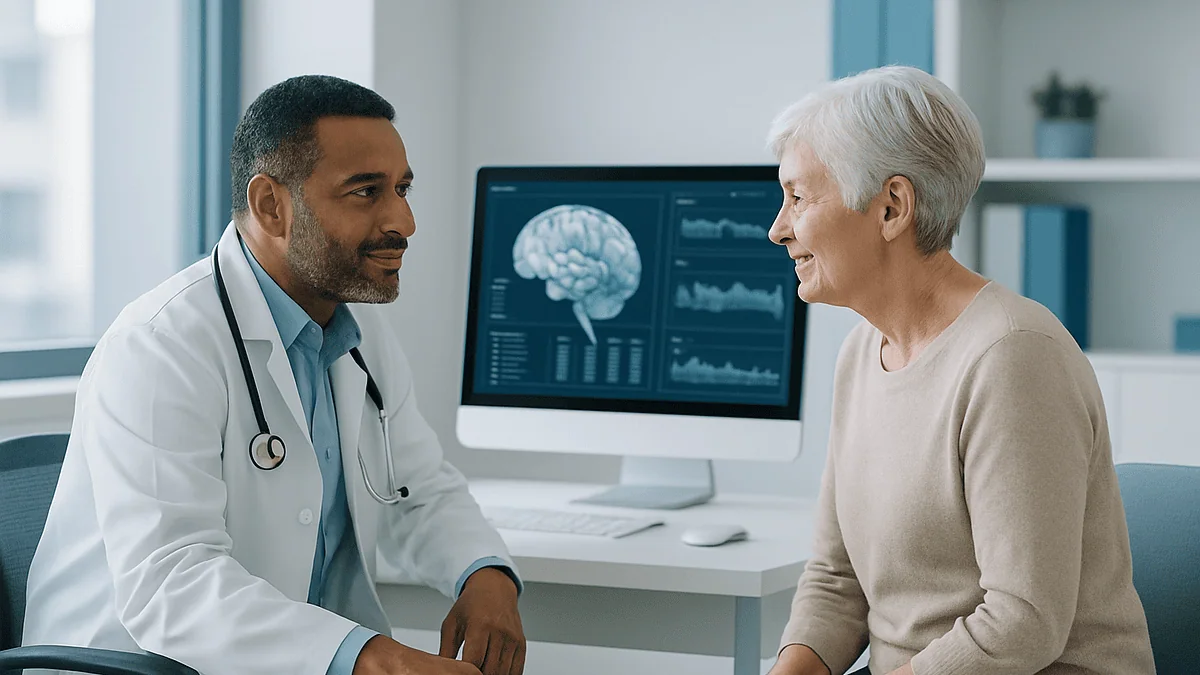
In July 2024 the National Institutes of Health reported a study in which a multimodal model answered quiz-style image cases from a medical journal about as often correctly as physicians did, yet frequently gave flawed explanations for its right answers. The researchers’ phrase was that the model “did not understand” the images the way a clinician would.
In October 2024 a randomized study published in JAMA Network Open gave 50 physicians access to a chatbot while working through diagnostic cases. Their scores barely moved, 76 percent with the chatbot versus 74 percent without. The chatbot working alone scored higher than either group. That single finding, that the tool was good but doctors did not know how to use it, is the one most worth remembering.
Since then, screening programs have moved from pilots toward large prospective trials, meaning studies that enroll patients going forward rather than re-analyzing old scans. Results from those trials will decide whether the retrospective promise holds up. As of this writing, most have not reported final outcomes.
Can AI do medical diagnosis? First, what a machine is actually doing
Ask whether AI can diagnose and you are really asking three different questions, because “AI” covers three very different kinds of software.
The first kind is a narrow classifier. It is trained on one task, say spotting diabetic eye disease in retinal photographs, using deep learning, a method in which layered mathematical networks learn patterns from thousands of labeled examples. These tools do not reason. They recognize. On their one task they can be excellent; on anything else they are useless.
The second kind is a symptom checker, usually a rules-based or probabilistic engine that walks you through questions and outputs a ranked list of conditions. These have existed for two decades and were studied long before chatbots arrived.
The third kind is the general-purpose chatbot. It can discuss any condition because it has read about all of them, which is both its strength and its central weakness: it produces fluent text whether or not the underlying claim is true.
A diagnosis in clinical practice is not a label. It is a working hypothesis built from history, examination, test results, the patient’s prior probability of each condition, and a decision about what would be dangerous to miss. Software can contribute to several of those steps. No current system performs all of them, and none takes legal or ethical responsibility for the answer.
Keep that framing as you read the studies below. When a paper reports that a model “diagnosed” something, check which of the three kinds of software it tested and how much of the real diagnostic process it was handed in advance.
AI in medical imaging: the studies with the strongest numbers
Imaging is where AI medical diagnosis has its best evidence, and the reason is simple: an image is a fixed input with a reasonably fixed ground truth.
The landmark paper came in January 2020 in Nature. A deep learning system was trained on mammograms and then tested on more than 25,000 women in the UK and 3,000 in the US whose cancer outcomes were already known. Compared with the original radiologist readings, the AI cut false positives by 1.2 percent in the UK set and 5.7 percent in the US set, and cut false negatives by 2.7 percent and 9.4 percent respectively. A false positive is a scan flagged as suspicious that turns out benign; a false negative is a cancer that was missed. In a simulated double-reading workflow, the AI replaced the second radiologist with no loss in accuracy.
Two caveats matter. The study was retrospective, meaning it re-read old scans rather than guiding live decisions. And the comparison was against single readers in the US, where single reading is standard, but against the first of two readers in the UK, which flatters the AI less than the headline numbers suggest.
Dermatology produced a similar story earlier. A 2017 Nature study trained a classifier on roughly 130,000 skin images and found it matched 21 board-certified dermatologists at distinguishing malignant from benign lesions on test photographs. Again, retrospective, again on curated images.
Since then, prospective screening trials have begun to report. In a Swedish randomized screening trial published in 2023, AI-supported reading detected a modestly higher cancer rate than standard double reading while reducing the radiologists’ screen-reading workload by nearly half, with no rise in false positives. That is the kind of evidence, randomized and forward-looking, that moves a tool from promising to trustworthy.
Chatbots versus doctors: what the viral case studies measured
The studies that spread fastest online tested language models on written cases. The results are real, but the task was narrower than the headlines implied.
Take the April 2023 study in JAMA Internal Medicine that compared chatbot replies with physician replies to 195 patient questions posted on a public forum. Blinded evaluators preferred the chatbot’s answer in 78.6 percent of comparisons and rated it higher for both quality and empathy. Notice what was being graded: the written answer to a question, not a diagnosis, and not a patient the responder could examine. Physicians answering a forum in spare minutes were competing with a model producing long, polished paragraphs.
The October 2024 JAMA Network Open trial is more instructive. Fifty physicians, half attending and half residents, worked through six diagnostic vignettes, structured written cases with history and findings. Half had chatbot access. Diagnostic reasoning scores were 76 percent with the tool and 74 percent without, a difference that was not statistically meaningful. The model alone, prompted by the researchers, scored about 16 points higher than either physician group. The authors’ interpretation: the tool had something to offer, but clinicians either did not consult it or did not trust it when its answer differed from their own.
Then the NIH-supported image study from July 2024. A multimodal model answered journal image quiz questions with accuracy comparable to physicians, yet when the researchers read its step-by-step reasoning, the explanation was flawed in a substantial share of cases even when the final answer was right. A right answer reached by wrong logic will not stay right when the picture changes.
Across these studies the pattern holds: strong performance on clean, complete, written cases; weaker reliability in the explanation layer; and no evidence yet that patients whose care involved a chatbot ended up healthier.
What the evidence actually says, graded by strength
Here is the honest grading, using the standard hierarchy in which randomized controlled trials outrank observational studies, which outrank expert opinion. A randomized controlled trial assigns participants to one approach or another by chance, so differences in outcome can be attributed to the approach itself.
Imaging classifiers for screening: moderate to strong. Multiple large retrospective datasets, several prospective studies, and at least one randomized screening trial. The direction is consistent. What remains unproven is whether AI-assisted screening changes mortality, the outcome that matters most, which takes a decade to measure.
Narrow classifiers for specific findings: fracture detection, diabetic retinopathy, stroke on CT. Moderate. Many have cleared regulatory review on the basis of standalone accuracy studies. Fewer have randomized evidence that patients did better.
Chatbots as a diagnostic aid for clinicians: weak to moderate. A handful of small randomized studies on written vignettes, no trials measuring patient outcomes, and clear evidence that the way the tool is prompted and integrated changes the result.
Chatbots used directly by patients to self-diagnose: weak. Observational comparisons of answer quality, essentially no trials, and documented failures in triage, meaning the judgment of how urgently someone needs care.
Symptom checker apps: weak to moderate. Repeated vignette studies over fifteen years show the correct condition appears in the top three suggestions somewhere between a third and two thirds of the time depending on the app and the case mix, with triage advice that leans toward sending people in unnecessarily.
My view, grounded in these grades: the strongest case for AI today is as a tireless second reader in imaging and as a prompt for a clinician to reconsider. The weakest case, and the one most people are actually trying, is a chatbot replacing a visit.
AI medical diagnosis accuracy at a glance: study-by-study summary
The table below pulls the key studies into one place. Read the “what was tested” column as carefully as the numbers.
| Study (year, journal) | What was tested | Headline result | Evidence type |
|---|---|---|---|
| Esteva et al. (2017, Nature) | Skin lesion photos, malignant vs benign | Classifier matched 21 dermatologists on test images | Retrospective, curated images |
| McKinney et al. (2020, Nature) | Screening mammograms, UK and US | False negatives cut 2.7% (UK) and 9.4% (US); false positives cut 1.2% and 5.7% | Retrospective, large datasets |
| Ayers et al. (2023, JAMA Intern Med) | Written answers to 195 public forum questions | Chatbot preferred in 78.6% of comparisons | Observational, blinded raters |
| Swedish screening trial (2023, Lancet Oncology) | AI-supported mammography reading, live screening | Similar or higher cancer detection, workload reduced ~44% | Randomized, prospective |
| NIH-supported study (2024, npj Digital Medicine) | Multimodal model on journal image quizzes | Accuracy comparable to physicians; reasoning often flawed | Observational, benchmark |
| Goh et al. (2024, JAMA Netw Open) | Physicians with vs without chatbot on 6 vignettes | 76% vs 74%, no meaningful gain; model alone higher | Randomized, small, vignettes only |
Two things stand out. The imaging studies measured errors in a way that maps directly onto patient harm: a missed cancer, an unnecessary biopsy. The chatbot studies mostly measured preference or score on written exercises, which is a reasonable first step and a poor basis for deciding whether to skip an appointment.
The other pattern is time. Each imaging tool took years of retrospective work before anyone randomized it. Chatbots arrived in clinical conversation within months of release, and the evidence base is still catching up to the enthusiasm.
Can you use ChatGPT for medical diagnosis?
You can type symptoms into a general chatbot and it will answer. Whether that counts as diagnosis is the question.
What the tool does well: it explains terminology, lists conditions associated with a cluster of symptoms, and helps you organize a story to tell a clinician. For understanding a diagnosis you have already received, it can be genuinely useful, roughly like a well-read friend who never tires of questions.
What it cannot do is examine you, order a test, see your records, or weigh how likely each condition is for a person of your age, history and location. Studies of chatbot answers consistently find two failure modes. The first is confident fabrication: an invented statistic, a drug interaction that does not exist, a citation to a paper that was never written. The second is miscalibrated urgency, either reassuring someone who should be seen today or alarming someone who should rest and hydrate.
There is also a privacy point that is easy to forget at midnight. A general chatbot is not a medical record system, and what you type may be stored or used for training depending on the service’s terms. Names, dates of birth and insurance details do not belong in that box.
The NIH-supported image study gives a useful mental model. The model got many answers right, but when asked to show its work, the work was wrong often enough that the authors warned against relying on it unsupervised. Treat a chatbot the same way: a draft to bring to a human, never a verdict.
If you do use one, give it complete information, ask it to list what it is unsure about, and ask what signs would mean the situation is urgent. Then make the actual decision with someone who can see you.
Is there an AI app for medical diagnosis? AI symptom checker accuracy explained
Dozens of apps describe themselves as AI symptom checkers, and the honest answer about their accuracy comes from vignette studies, in which researchers feed each app a standardized case and see what comes out.
The pattern across these studies, which go back to 2015 and have been repeated several times since, is consistent. The correct condition appears first in the app’s list somewhere around a third of the time, and within the top three suggestions roughly half the time, with wide variation between apps. Triage advice, the judgment of whether to call emergency services, see a doctor soon or self-care, is correct more often than diagnosis, but errs on the side of sending people in. From a safety standpoint that bias is the right direction. From a health system standpoint it generates unnecessary visits.
Newer checkers built on language models score higher on the same vignettes, in some reports placing the right diagnosis in the top three two thirds of the time or more. Two cautions apply. Vignettes are clean; real patients give incomplete, out-of-order, sometimes contradictory histories. And an app that is accurate for common conditions can still be dangerously wrong for rare ones, which are precisely the cases where a missed diagnosis costs most.
Regulatory status matters here. In the US and UK, software intended to diagnose or guide treatment is regulated as a medical device and must demonstrate performance for its stated use. Many consumer apps avoid that pathway by describing themselves as informational. The wording in an app’s own disclaimer tells you what its makers were willing to stand behind.
Use a symptom checker the way you would use a map’s traffic estimate: helpful for planning, not a reason to ignore the road in front of you.
Is there a free AI doctor? What the term hides
Searches for a free AI doctor have climbed alongside the viral studies, so it is worth saying plainly what exists and what does not.
No regulator in the US, UK or European Union has approved a general-purpose AI system to act as a physician. Some apps offer free chatbot conversations about symptoms; some health systems have deployed AI assistants that answer logistical questions or draft messages for a clinician to review; some telehealth services use AI to gather history before a human visit. None of these is a doctor, and the ones that work best are explicit about that.
What the phrase usually means in practice is a chatbot you do not pay for. Here the evidence from the previous sections applies directly: good at explanation, inconsistent at diagnosis, unreliable at urgency, and with no accountability if it is wrong. A physician who misses a diagnosis has a license, a record and a duty of care. Software has a terms-of-service page.
There is a fairness dimension that WHO’s 2021 guidance raised early. Models trained mostly on data from wealthy, English-speaking populations perform less well on others, and the people most likely to rely on a free tool instead of a visit are often those with least access to care. An inaccurate tool therefore risks widening gaps rather than closing them, a point the guidance makes without hyperbole and with reference to published performance differences across skin tones and languages.
If cost or access is the reason you are searching, local community health centers, nurse advice lines and pharmacist consultations are human options that exist in most regions. A chatbot can help you prepare for those conversations. It is not a substitute for them.
Why a single accuracy number can mislead you
A claim like “95 percent accurate” sounds definitive. It usually tells you less than you think, for reasons that apply to every AI medical diagnosis study.
Start with two terms. Sensitivity is the share of people with a condition that the test correctly flags. Specificity is the share of people without it that the test correctly clears. A tool can be tuned toward either, and the trade-off is real: catch more cancers and you will also recall more healthy women for unnecessary workups. The 2020 mammography study reported both numbers precisely because improving one without worsening the other is the actual achievement.
Then consider prevalence, how common the condition is in the group being tested. Imagine a tool with 95 percent sensitivity and 95 percent specificity screening 10,000 people for a disease that 1 in 100 has. It will correctly flag about 95 of the 100 true cases. It will also wrongly flag about 495 of the 9,900 healthy people. More than four in five positive results will be false. Nothing about the tool changed; the arithmetic of a rare condition did.
This is why a chatbot that performs well on a quiz where every case has a diagnosis performs differently on a population where most people with a headache have nothing serious. The quiz removed the hardest part of the job, deciding whether anything is wrong at all.
A final distortion is the test set. Models evaluated on images from the same hospitals that trained them look better than they will elsewhere, a problem called distribution shift: the data in the real world drifts from the data the model learned on. Good studies test on outside data. The 2020 mammography paper did, moving a UK-trained model onto US scans. Many smaller studies do not.
Where AI diagnosis goes wrong: bias, drift and automation bias
The failure modes of AI medical diagnosis are well documented, and knowing them is more useful than any accuracy figure.
Bias in training data comes first. Dermatology classifiers trained mostly on lighter skin perform worse on darker skin, because melanoma and many rashes look different and the examples were scarce. Chest X-ray models have been shown to learn shortcuts, such as recognizing the type of portable scanner used for sicker patients rather than the disease itself. The model’s output was “accurate” on the training hospital and meaningless elsewhere.
Distribution shift, introduced above, is the slow version of the same problem. A model validated in 2020 encounters new scanner models, new patient demographics and new disease patterns by 2026. Without ongoing monitoring, performance degrades silently.
Automation bias is the human failure. It is the tendency to accept a machine’s suggestion even when your own judgment disagrees, and it has been measured in radiologists, pharmacists and pilots. In reader studies, radiologists shown an incorrect AI flag were more likely to make the same error than readers given no AI at all. The 2024 physician trial hints at the mirror image: clinicians who ignored a good tool. Both are integration problems, not model problems, and neither shows up in a standalone accuracy study.
Then there is the explanation gap. The NIH-supported study found a multimodal model giving right answers with wrong reasoning. A clinician cannot check logic that is not sound, and a patient cannot know which parts to trust.
None of this means the tools are useless. It means that “how accurate is it” is the wrong first question. The better ones are: accurate on whom, compared with what, checked by whom, and monitored how often.
How regulators and WHO are handling AI diagnostic tools
The regulatory picture is steadier than the headlines, and it explains why hospital tools and consumer chatbots are in such different positions.
In the United States, the Food and Drug Administration has cleared several hundred AI-enabled medical devices over the past decade, the large majority in radiology. Clearance means the maker showed performance for a specific intended use, say flagging possible large-vessel stroke on a CT scan for a radiologist to review. It does not mean the tool diagnoses independently, and most clearances are explicitly for assisting a clinician. The UK’s regulator applies similar logic under its medical device rules, and the NHS runs a dedicated AI lab that funds evaluations of tools before wider rollout.
General chatbots sit outside this system. They are not marketed as devices, their makers describe them as informational, and no regulator has reviewed their diagnostic performance. That is the single most important difference for a reader deciding how much to trust an answer.
WHO’s 2021 ethics guidance set six principles, including protecting autonomy, promoting human well-being and safety, ensuring transparency and explainability, fostering accountability, ensuring inclusiveness and equity, and promoting responsive and sustainable AI. The 2024 guidance on large multimodal models added specifics: these systems should be evaluated in the context of use, their training data documented, and their deployment accompanied by monitoring for harms, with particular attention to populations under-represented in training data.
What this means in practice: a tool used inside a screening program has been through a review, carries a defined role, and sits within a workflow where a human signs the report. A chatbot on your phone has been through none of that. Same word, AI; very different accountability.
Common myths about AI medical diagnosis, corrected
The viral claims cluster around a few recurring ideas. Each has a grain of truth and a larger misreading.
“AI now diagnoses better than doctors.” On specific tasks with fixed inputs, some tools match or edge past specialists in retrospective data, and a few have randomized support in screening. On the full diagnostic process, no study has shown that. The chatbot studies that fuel this claim graded written answers or vignettes, not care of real patients.
“If it got the answer right, it understood the case.” The 2024 NIH-supported study is the clearest refutation: right answers, flawed reasoning, in a substantial share of cases. Pattern-matching can land on the correct label without the understanding that would keep it correct on a slightly different case.
“AI is objective; it has no bias.” Models learn the biases of their training data, including under-representation of darker skin, older adults, and non-English speakers, and sometimes learn shortcuts unrelated to disease. Objectivity is a property of the evaluation, not of the software.
“Doctors are hiding AI because it threatens them.” The 2024 physician trial suggests the opposite problem: clinicians given a capable tool mostly did not change their reasoning. Adoption is limited by training, workflow and liability, not conspiracy.
“A free AI doctor is just as good.” No approved product of that description exists. Free chatbots have real uses for explanation and preparation, with no accountability for errors and no ability to examine you.
“AI will replace radiologists within a few years.” This prediction was made publicly in 2016. A decade later, the strongest evidence supports AI as a second reader reducing workload, with radiologists still responsible for the report. Replacement remains a forecast, not a finding.
How to use AI diagnostic tools safely as a patient
Used well, these tools can make you a better-prepared patient. The evidence points to a few practical habits.
Use AI for understanding, not for deciding. Ask it to explain a diagnosis you have received, define terms on a lab report, or list questions worth raising at an appointment. These are tasks where fluent, well-read text is exactly what you need and where an error is easy for your clinician to catch.
Give complete information and ask for uncertainty. A model fed a half-story produces a confident half-answer. Tell it your age, relevant history and how long symptoms have lasted, then ask directly what it is unsure about and what would make the situation urgent. Studies of chatbot answers find that asking for uncertainty improves the usefulness of the reply.
Treat any list of possible conditions as a list, not a ranking you can trust. The top suggestion from symptom checkers is correct roughly a third of the time in vignette studies. The right diagnosis is often further down, and the dangerous one may not be on the list at all.
Protect your data. Keep names, dates of birth, insurance numbers and other identifiers out of general chatbots. A tool offered through a health system or clinic typically operates under health privacy law; a general consumer chatbot usually does not.
Bring the output to a human. The most constructive use of a chatbot’s suggestion is as a prompt: “I read this might be X; does that fit?” Clinicians generally welcome a prepared patient and can quickly rule something in or out.
Never change or stop a prescribed medicine on the basis of an AI answer. Every medicine decision belongs to the clinician who prescribed it and knows your full history. The same applies to delaying a test or a visit a clinician has recommended.
When to see a doctor: red flags no AI should triage for you
Whatever an app or chatbot tells you, some symptoms need a human assessment the same day, and some need emergency services immediately. This is the part of diagnosis where software is least reliable and the cost of error is highest.
Call emergency services or go to the nearest emergency department for any of the following:
- Chest pain or pressure, especially with shortness of breath, sweating, or pain spreading to the arm, neck or jaw.
- Sudden weakness or numbness on one side of the body, facial drooping, trouble speaking or understanding, or sudden severe headache.
- Difficulty breathing, blue or gray lips, or inability to speak in full sentences.
- Severe allergic reaction with swelling of the face or throat.
- Confusion, fainting, a seizure, or a fever with a stiff neck or a rash that does not fade under pressure.
- Heavy bleeding that does not stop, a serious injury, or any thought of harming yourself.
Arrange to see a clinician promptly, within a day or two, if you have a fever lasting more than a few days, unexplained weight loss, a lump that is new or growing, a mole that is changing, blood in urine or stool, symptoms in a young child or an older adult that are worsening, or any symptom that an AI tool has flagged as potentially serious.
See your regular clinician for anything persistent, recurring, or affecting daily life, and for any question about a medicine, screening or test. Bring the AI output if it helps you explain your concern; let the clinician decide what it means.
Two final points. A reassuring answer from a chatbot is not evidence that you are well. And if your instinct says something is wrong, that instinct has outperformed symptom checkers in more than one study. Act on it.
Frequently asked questions
Can AI do medical diagnosis on its own?
Not reliably, and not legally, as of today. Narrow AI tools can classify images such as mammograms or skin lesions with accuracy comparable to specialists in retrospective studies, and a few have randomized support as a second reader. No system has been shown to carry out the full diagnostic process, which includes examination, test ordering and judging urgency, without a clinician. Approved tools are intended to assist, not replace, the person responsible for the diagnosis.
Can you use ChatGPT for medical diagnosis?
You can use it to understand symptoms and prepare questions, but not as a diagnosis you act on. Studies show general chatbots produce fluent, often well-rated explanations while also making confident factual errors and misjudging how urgent a situation is. They cannot examine you or see your records. Treat the output as a draft to discuss with a clinician, keep personal identifiers out of the conversation, and never change a prescribed medicine based on a chatbot’s answer.
Is there a free AI doctor?
No regulator has approved any AI system to act as a doctor, free or paid. What exists are free chatbots that discuss symptoms, AI assistants inside some health systems that handle logistics for a human to review, and AI intake tools that gather history before a telehealth visit. None carries the accountability or examination ability of a clinician. If access or cost is the concern, nurse advice lines, pharmacists and community health centers are human options in most regions.
Is there an AI app for medical diagnosis that is accurate?
Several apps call themselves AI symptom checkers, and their accuracy has been measured with standardized cases. The right condition appears first about a third of the time and within the top three about half the time, with wide variation between apps; newer language-model versions score higher. Triage advice tends to over-refer, which is safer than under-referring. In the US and UK, software intended to diagnose is a regulated device, and many consumer apps avoid that pathway by calling themselves informational.
How accurate is AI in medical imaging compared with radiologists?
On specific screening tasks, comparable or modestly better in the best studies. The 2020 Nature mammography study found an AI reader reduced both false positives and false negatives versus original radiologist readings, and a 2023 Swedish randomized screening trial found AI-supported reading detected a similar or higher cancer rate while reducing reading workload by roughly 44 percent. These results apply to the trained task on screening images; they do not generalize to other scans or diseases.
Why did doctors with AI not score higher in the 2024 trial?
The study’s authors suggested clinicians either did not consult the chatbot fully or did not trust its answer when it conflicted with their own reasoning. Physicians scored 76 percent with the tool and 74 percent without, while the model alone scored higher than both groups. The finding points to an integration problem, how tools are prompted and how clinicians are trained to use them, rather than a limit on the model’s accuracy on written vignettes.
Can AI diagnose diseases better than a doctor for rare conditions?
The evidence is thin and mixed. Language models have read about rare diseases and can suggest them on written cases, which may help a clinician consider possibilities. But symptom checkers and chatbots perform worst on rare and atypical presentations, where training examples are few and the cost of a miss is high. A suggestion from an AI tool can be a useful prompt for a specialist referral; it is not a reliable basis for concluding you have or do not have a rare condition.
What is automation bias and why does it matter for AI diagnosis?
Automation bias is the tendency to accept a machine’s suggestion even when your own judgment disagrees. In reader studies, radiologists shown an incorrect AI flag were more likely to repeat that error than readers with no AI at all. It matters because standalone accuracy studies do not capture it; a tool that is right 95 percent of the time can still lower overall accuracy if humans stop checking the other 5 percent. Good deployments train clinicians to treat AI output as one input, not a verdict.
Does WHO support using AI for medical diagnosis?
WHO supports AI in health when it is developed and used under clear safeguards. Its 2021 guidance set six principles, including protecting autonomy, ensuring transparency, fostering accountability and promoting equity. The 2024 guidance on large multimodal models adds that chatbots should be evaluated in the setting where they will be used, with documented training data and ongoing monitoring for harm, and warns about reduced performance in populations under-represented in training data.
Should I tell my doctor that I used an AI tool to check my symptoms?
Yes. Bringing the output to your appointment is the most constructive use of these tools. Explain what you entered and what the tool suggested, and ask whether it fits. Clinicians can quickly rule possibilities in or out with an examination and history, which the software could not do. Avoid acting on the output first, especially by delaying a recommended test, stopping a medicine, or deciding a worrying symptom is not urgent because an app reassured you.
References
- WHO: Ethics and governance of artificial intelligence for health: guidance on large multi-modal models (2024)
- WHO: Ethics and governance of artificial intelligence for health (2021)
This article is for general information only and is not a substitute for professional medical advice. Please consult a qualified doctor about your individual situation.

More from the Blog
Immunotherapy for Cancer: What It Is, Who Qualifies and How It Is Given
Immunotherapy for cancer is a group of treatments that help a person's own immune system recognize and attack cancer cells, rather than killing those…
Smart Scales and Bioimpedance: How Accurate Is Your Body Fat Reading?
Bioimpedance (BIA) smart scales estimate body fat by sending a tiny electrical current through the body, and they are moderately accurate at best. For…
How a Pacemaker Works and How It Is Fitted
A pacemaker is a small battery-powered device placed under the skin near the collarbone and connected to the heart by thin wires called leads.…

Period and Fertility Apps: How Accurate Are Their Predictions and Who Sees Your Data?
A period tracking app is usually accurate to within a day or two for people with regular cycles, but predictions drift when cycles vary,…
AI Medical Diagnosis: How Accurate Are the Systems, Study by Study?
AI medical diagnosis tools can match specialists on narrow, image-based tasks such as reading retinal photographs or mammograms, with sensitivity above 90% in large…
Smart Baby Monitors: What Oxygen and Breathing Sensors Can and Cannot Do
Smart baby monitors with oxygen or breathing sensors can track a sleeping infant's pulse, blood oxygen level or body movement and send alerts to…