

AI Medical Diagnosis: How Accurate Are the Systems, Study by Study?
Key Takeaways
- In the MASAI randomized trial of about 80,000 women, AI-supported mammography found 6.1 cancers per 1,000 versus 5.1 with standard double reading, at the same 1.5% false-positive rate.
- The 2016 retinal screening algorithm reached an AUC near 0.99, with sensitivity about 97% and specificity about 93% on independent validation images.
- The widely quoted 2023 chatbot-versus-physician study rated empathy and quality of written answers; it never measured whether either answer was correct.
- An NIH-reported 2024 study found a multimodal model often chose the right diagnosis from medical image quizzes while giving a flawed explanation for it.
- A 2019 systematic review found that most deep-learning diagnosis studies lacked external validation, and where comparisons with clinicians were fair, performance was roughly equal.
- Dermatology models trained mainly on lighter skin have not been shown to perform equally on darker skin, a documented example of training-data bias.
AI medical diagnosis tools can match specialists on narrow, image-based tasks such as reading retinal photographs or mammograms, with sensitivity above 90% in large studies. Outside those tasks, especially general-purpose chatbots answering free-text symptoms, accuracy is inconsistent and reasoning errors are common. No AI system replaces a clinical assessment; every result still needs a clinician to confirm.
A screenshot does the rounds every few weeks now: someone pastes months of symptoms into a chatbot, it names a rare condition, and the caption reads “three doctors missed this.” The posts travel fast because the story is satisfying. The data behind them travels slower, and it tells a more interesting tale.
As of early 2026, interest in ai medical diagnosis has spiked for two reasons at once. The first randomized trial of AI-supported cancer screening has reported, and public health bodies have published formal guidance on large language models in care. At the same time, consumer chatbots have become good enough at sounding medical that people are using them as a second opinion before anyone asks them to.
So what do the studies actually show, one by one? Where does the machine hold its own, where does it stumble, and how should a patient read the next viral claim? That is the whole purpose of this piece.
What changed recently in AI medical diagnosis
Three dated developments explain why this topic has moved from research seminars to kitchen-table conversation.
In August 2023, a Swedish screening program published the MASAI trial in The Lancet Oncology. It was the first randomized comparison of AI-supported mammography reading against the usual two-radiologist standard, enrolling more than 80,000 women. Randomized means participants were assigned by chance to one approach or the other, which is the fairest way to compare them. The AI-supported arm found more cancers at the same false-positive rate while cutting reading workload by roughly 44%.
In April 2023, a study in JAMA Internal Medicine compared chatbot answers with physician answers to real patient questions posted on a public forum. Independent evaluators preferred the chatbot response in about 79% of comparisons. That single finding launched a thousand headlines, and it deserves a closer look later.
In January 2024, the World Health Organization issued guidance on large multi-modal models in health, the type of AI that can read text and images together. The document is careful rather than alarmist: it lists diagnosis and clinical care as promising uses, then sets out the risks, including false or biased outputs and automation bias, which is the human habit of trusting a machine’s answer more than it has earned.
Then in July 2024, the National Institutes of Health reported a study in which a multimodal model answered medical image quiz questions at a high rate but frequently gave flawed explanations even when it picked the correct diagnosis. A right answer with wrong reasoning is a pattern worth remembering.
Put those four facts together and you have the current state of play: narrow tools proven in trials, general chatbots that impress and mislead in equal measure, and regulators drawing lines in real time.
Can AI diagnose disease? What "diagnosis" means to a machine
Ask a physician what a diagnosis is and you will hear about history, examination, pattern recognition, probability and judgment. Ask an engineer what an AI system does and you will hear about inputs, outputs and a score. The gap between those two answers is where most confusion about ai medical diagnosis lives.

Nearly every AI system that has been tested rigorously does one of three things. It classifies an image, answering a question such as “does this retinal photograph show sight-threatening disease, yes or no?” It flags a signal in structured data, such as a pattern in blood results that suggests early kidney injury. Or it generates text in response to a prompt, which is what a chatbot does.
Only the first two have been evaluated the way medicines are evaluated: a defined task, a defined reference standard, and performance measured against it. The third category is far harder to test, because a free-text symptom story has no single correct answer sheet.
That distinction matters when someone asks whether AI can diagnose disease. The honest answer is yes for a specific list of narrow tasks, where the tool has been trained on tens or hundreds of thousands of labeled examples and then checked on new patients it has never seen. External validation, meaning testing on data from a different hospital or population than the training set, is the step that separates a promising prototype from a dependable tool.
For the open-ended question a worried person types at midnight, the evidence is thinner and the error rate higher. A chatbot can produce a plausible list of possibilities. Producing a list is not the same as weighing it, and weighing it is the part that keeps people safe.
How AI diagnosis systems work, in plain terms
Two families of technology sit behind almost everything in this article, and they behave very differently.
Deep learning is a method in which software learns to recognize patterns by studying enormous numbers of labeled examples, rather than following rules a programmer wrote. Feed it 100,000 retinal photographs that eye doctors have already graded, and it learns which pixel patterns go with disease. It never understands what a retina is. It becomes extremely good at one specific sorting job.
A large language model is software trained on vast amounts of text to predict the most likely next words. Given a symptom description, it produces fluent, medically styled prose. Fluency is its strength and its trap: the sentence that sounds most confident is simply the most statistically likely sentence, not the most verified one.
Judging either type uses the same vocabulary. Sensitivity is the share of people with the condition that the test correctly flags. Specificity is the share of people without it that the test correctly clears. Area under the curve, usually written AUC, combines both into a single number between 0.5 (coin toss) and 1.0 (perfect). A reported AUC of 0.99 sounds flawless, but a tool tuned for high sensitivity will still produce false alarms, and the balance has to be chosen for the setting.
One more term earns a definition because it explains so many disappointing results. Overfitting happens when a model learns the quirks of its training data, such as the scanner brand at one hospital, instead of the disease. It performs brilliantly in the lab and falls over in a new clinic. That is why the best studies always report results from a second, independent dataset.
The first landmark: diabetic retinopathy in 2016
If you want to see what a well-run AI diagnosis study looks like, start with the retina.
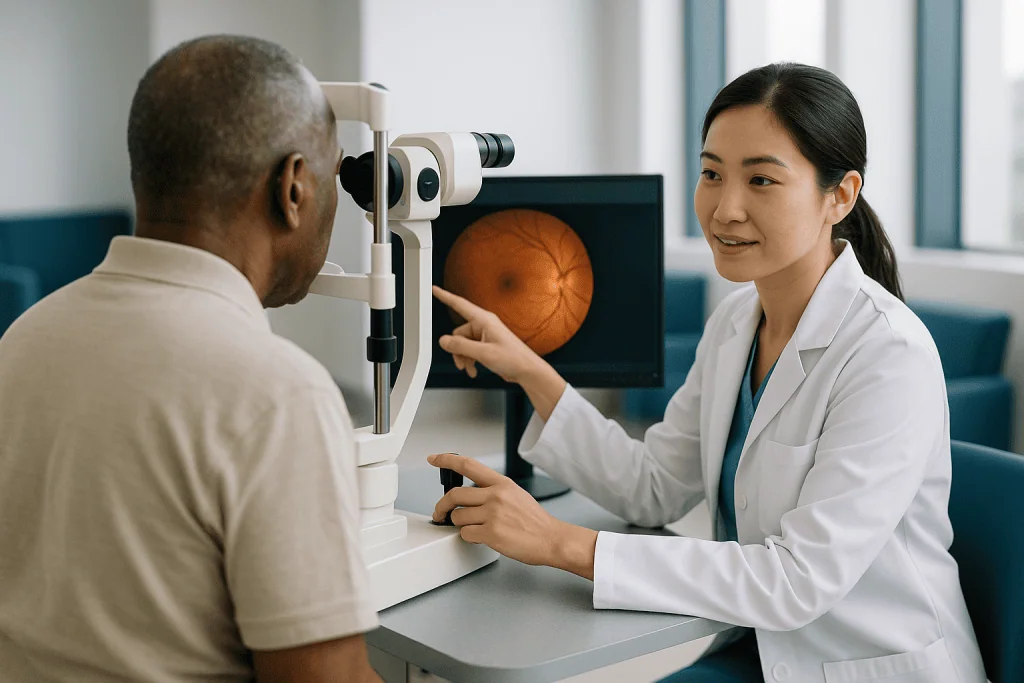
Diabetic retinopathy is damage to the blood vessels at the back of the eye caused by diabetes, and it is a leading cause of preventable blindness. Screening works because photographs of the retina can show the damage before vision changes. The bottleneck has always been the number of specialists available to read those photographs.
In 2016, a research team published in JAMA a deep-learning algorithm trained on roughly 128,000 retinal images, each graded by multiple ophthalmologists. They then tested it on two separate validation sets totaling nearly 12,000 images. For detecting referable disease, the algorithm reached an AUC of about 0.99. At the operating point chosen for high sensitivity, it caught around 97% of referable cases while correctly clearing about 93% of normal eyes.
Three design features explain why this study still anchors the field. The reference standard was a panel of specialists, not a single reader. The validation images came from different sources than the training images. And the task was deliberately narrow: not “diagnose this patient” but “should this photograph be referred to a specialist?”
What the study did not show matters just as much. It did not test whether patients flagged by the algorithm actually received care sooner, or whether sight was saved. Those outcome questions require prospective trials, and later real-world deployments found that image quality, lighting and patient flow could all drag performance below the lab numbers.
Still, this is the template. When someone claims an AI matches doctors, ask whether the study looks like this one: large training set, independent validation, specialist reference standard, narrow task, honest operating point.
Breast screening: from retrospective promise to a randomized trial
Mammography is the most studied domain in AI diagnosis, and it shows the full arc from hopeful retrospective data to a genuine trial.
In January 2020, a paper in Nature reported an AI system evaluated on screening mammograms from the United Kingdom and the United States. Compared with the original radiologists’ decisions, the AI reduced false positives by about 5.7% in the US set and 1.2% in the UK set, and reduced false negatives by about 9.4% and 2.7% respectively. In a separate reader study, it outperformed six radiologists on average.
Encouraging, but retrospective. Retrospective means the images were already collected and the outcomes already known, so the system was graded with the answer key in hand. Retrospective studies can overstate real performance because they exclude the messy cases, the recalls that never happened, and the human factors of a working clinic.
The MASAI trial, published in August 2023, took the next step. Just over 80,000 women attending routine screening in Sweden were randomized to either standard double reading by two radiologists or an AI-supported pathway in which the AI triaged scans by risk and radiologists read accordingly. The AI-supported arm detected cancer in about 6.1 women per 1,000 versus 5.1 per 1,000 under standard reading, with the same false-positive rate of roughly 1.5%. Radiologists’ screen-reading workload fell by about 44%.
This is the strongest evidence available for any AI diagnosis tool, and even it has limits. It was a safety analysis from one country’s program with one AI product. Whether the extra cancers found are the ones that matter, rather than slow-growing tumors that would never have caused harm, requires the longer follow-up for interval cancers that the trial is designed to report. That question, overdiagnosis, is the same one that has shadowed screening since long before AI arrived.
Skin, lungs and pathology: image tasks beyond the big two
Once a method works on one kind of picture, researchers try it on every kind of picture. The results form a consistent pattern.
Dermatology came early. A 2017 study in Nature trained a deep-learning model on about 129,000 clinical images and compared it with 21 board-certified dermatologists on classifying skin lesions as malignant or benign. The algorithm performed on par with the specialists. The catch, pointed out repeatedly since, is that the images were overwhelmingly of lighter skin tones, and performance on darker skin was not established. A tool that learned from one population cannot be assumed to serve another.
Chest imaging followed. Deep-learning systems have been shown to detect lung nodules, pneumonia patterns and tuberculosis on X-rays and CT scans with sensitivity in the high 80s to 90s in many studies. The World Health Organization has, since 2021, accepted computer-aided detection as an option for tuberculosis screening on chest X-rays in settings short of trained readers, which is a notable endorsement of a narrow tool for a specific gap.
Pathology, the microscopic examination of tissue, is where AI may eventually have the largest effect, because a single slide contains billions of pixels and a pathologist cannot look at all of them equally. Studies have shown algorithms detecting metastatic cancer in lymph node slides with accuracy comparable to pathologists under time pressure.
Across all three, a 2019 systematic review in The Lancet Digital Health delivered a sobering summary. Of more than 80 deep-learning studies comparing algorithms with clinicians, only a minority used external validation, and very few compared the two on the same test set under the same conditions. Where comparisons were fair, performance was roughly equivalent. Headlines of superhuman accuracy, in other words, often rested on unfair contests.
Chatbots answering patient questions: the 2023 study everyone quotes
The April 2023 JAMA Internal Medicine study is the one your relatives have heard about, so it is worth describing precisely.
Researchers collected 195 real questions that members of the public had posted on an online medical forum, along with the answers verified physicians had written there. They fed the same questions to a general-purpose chatbot. Then a panel of licensed clinicians, blinded to which was which, rated each pair on quality and empathy.
The evaluators preferred the chatbot’s answer in about 79% of the 585 comparisons. Chatbot answers were rated good or very good in quality about 3.6 times more often than physician answers, and empathetic or very empathetic nearly 10 times more often.
Here is what the study did not measure. It did not check whether either answer was correct against a reference standard. It did not involve any real patient receiving care. The physician answers were short forum posts written for free in spare time, not consultations. And chatbot answers were on average four times longer, which tends to score well on rubric-based ratings regardless of substance.
So the honest reading is this: a chatbot can produce patient-facing text that clinicians find readable and kind, which is genuinely useful for drafting responses or explaining a known condition. The study says nothing about diagnostic accuracy. Yet it is routinely cited as proof that AI diagnoses better than doctors, which is a claim it was never designed to test.
Later studies have tried to fill the gap. A 2024 randomized study of physicians solving diagnostic cases found that access to a chatbot did not meaningfully improve their accuracy, even though the chatbot alone scored higher. The lesson there is about teamwork between human and machine, and it is not yet a solved problem.
The NIH study: a right answer with the wrong reasoning
In July 2024, the National Institutes of Health announced findings from a study in NEJM AI that should be required reading for anyone tempted to treat a chatbot as a diagnostician.
Researchers tested a multimodal language model, meaning one that accepts images as well as text, on a series of published medical image quiz questions of the kind physicians use to sharpen their skills. Each question showed a clinical image, gave a brief history, and offered multiple-choice answers. Physicians answered the same questions.
The model chose the correct diagnosis at a high rate, broadly comparable to the clinicians on the multiple-choice score. The striking finding came when the researchers read the explanations. Even in cases where the model picked the right answer, its rationale was frequently flawed: it misdescribed what was visible in the image, misapplied medical knowledge, or reached the correct conclusion through incorrect steps.
Why does that matter if the final answer is right? Because in real care the “answer” is not a label chosen from four options. The reasoning is the product. A clinician who gets the right diagnosis for the wrong reason will get the next, slightly different, case wrong. A model that cannot explain itself reliably cannot be checked, and a tool that cannot be checked cannot be safely delegated to.
The NIH authors framed the result as a case for treating such models as supports that require human verification rather than as decision-makers. That framing matches the WHO guidance from the same year, which named automation bias, the tendency to defer to a confident machine, as a primary hazard.
If you take one idea from this section, take this: confidence and correctness are separate properties, and language models are built to maximize the first.
What the evidence actually says, graded by strength
Medicine grades evidence by how well a study design can rule out luck and bias. Applying that same ladder to ai medical diagnosis produces a clear picture.
Randomized controlled trials (strongest). There is essentially one large completed example: AI-supported mammography screening, which increased cancer detection with no rise in false positives and cut reading workload. Smaller randomized studies exist for AI-assisted colonoscopy polyp detection, several showing higher detection rates. This tier is thin but real, and it is growing.
Prospective validation studies (strong). Tools tested on new patients as they arrive, rather than on archived data. Diabetic retinopathy screening algorithms have been tested this way in primary care clinics, generally confirming high sensitivity but revealing that image quality and workflow erode specificity in the real world.
Retrospective validation on external data (moderate). This is where most of the celebrated image studies sit: retina in 2016, skin in 2017, mammography in 2020. Performance is often specialist-level on the chosen task. These studies cannot tell you whether patients fare better, and they can overstate accuracy because the hard, ambiguous cases are sometimes excluded.
Retrospective validation on internal data only (weak). A majority of published deep-learning studies. Impressive numbers, limited meaning, because the model may have learned the hospital rather than the disease.
Chatbot comparisons and quiz benchmarks (weak for diagnosis). Studies rating chatbot answers for quality, or scoring them on exam questions. They demonstrate fluency and recall. They do not establish diagnostic accuracy in real patients and have never been linked to a patient outcome.
Expert opinion and viral anecdotes (weakest). Individual stories of a chatbot catching a missed diagnosis. These are real experiences and sometimes life-changing for one person. They cannot tell you how often the same chatbot sends someone chasing a condition they do not have.
The grade for the field as a whole is therefore uneven: strong for a short list of imaging tasks, weak for open-ended symptom diagnosis.
AI diagnosis accuracy, study by study: the numbers at a glance
Numbers from different studies are not directly comparable, because each used its own task, population and reference standard. The table is a map, not a league table.
| Study (year, journal) | Task | Design | Headline result | Main limitation |
|---|---|---|---|---|
| Retinal screening (2016, JAMA) | Flag referable diabetic retinopathy on photographs | Retrospective, two external validation sets | AUC about 0.99; sensitivity about 97%, specificity about 93% at high-sensitivity setting | No patient outcomes; real-world image quality lower |
| Skin lesions (2017, Nature) | Classify lesions malignant vs benign | Retrospective reader comparison, 21 dermatologists | Performance on par with specialists | Few images of darker skin tones |
| Mammography (2020, Nature) | Detect cancer on screening mammograms | Retrospective, UK and US datasets | False positives down 1.2–5.7%; false negatives down 2.7–9.4% | Graded against known outcomes, not live screening |
| MASAI (2023, Lancet Oncology) | AI-supported vs standard double reading | Randomized, about 80,000 women | 6.1 vs 5.1 cancers per 1,000; same false-positive rate; workload down 44% | One country, one product; interval-cancer follow-up pending |
| Chatbot vs physician answers (2023, JAMA Internal Medicine) | Rate quality and empathy of written answers | Blinded rating of 195 forum questions | Chatbot preferred in about 79% of comparisons | Accuracy never measured; forum posts, not care |
| Multimodal model on image quizzes (2024, NEJM AI, NIH) | Choose diagnosis from clinical image and vignette | Benchmark comparison with physicians | High multiple-choice score | Explanations often flawed even when answer correct |
Read down the design column and the pattern is plain. The further a study sits from a randomized trial, the more cautiously its headline number should be quoted. Read down the limitation column and you see the same three themes recur: no outcome data, narrow populations, and reasoning that cannot be audited.
One number is missing from this table on purpose. There is no credible published figure for the overall accuracy of a general chatbot diagnosing a real patient from a free-text description, because no study has been able to define that task well enough to measure it fairly.
Can you use ChatGPT for medical diagnosis?
People do, every day, so the useful question is what it is good for and where it bites.
A general-purpose chatbot is a language model. It has read a staggering amount of medical text, which is why it can explain what a thyroid does, translate a radiology report into everyday words, or list the conditions that commonly cause night sweats. For understanding a diagnosis you already have, or preparing questions before an appointment, that is a real service, and the 2023 empathy study suggests the explanations are often clear and kind.
Diagnosis is a different job. A clinician gathers information you do not know is relevant: the medicine you forgot to mention, the subtle swelling you have not noticed, the family history you consider unrelated. A chatbot can only reason about what you typed, and people describing their own symptoms systematically leave out the most discriminating details.
Then there is the failure mode specific to language models. Hallucination is the term for an AI producing a confident, fluent statement that is false. In medicine that can mean inventing a syndrome, misattributing a symptom, or citing a study that does not exist. The NIH quiz study found flawed reasoning behind correct answers at a worrying rate; in a conversation with no answer key, you have no way to tell which is which.
There is also a privacy point. Text entered into a consumer chatbot is generally not protected the way information shared with a clinician is. The WHO guidance flags data protection as a core risk of these tools in health.
So the measured answer: use a chatbot to understand, to prepare and to translate. Do not use it to decide. If its output worries you, that is a reason to see a clinician sooner, not a reason to self-manage.
Is there a free AI doctor or an AI symptom checker app you can trust?
Search for an “AI doctor” and you will find dozens of apps, most free to download. They fall into categories that deserve different levels of trust.
Symptom checkers have existed since before the current AI wave. An AI symptom checker asks structured questions and returns a ranked list of possible causes with a suggested urgency level. Studies over the past decade, including one widely cited audit of 23 checkers, found that the correct diagnosis appeared first in roughly a third of standardized test cases and somewhere in the top three in about half. Triage advice, the recommendation about how urgently to seek care, was correct in around half to two-thirds of cases, and the tools tended to err toward caution, which generates unnecessary visits but rarely dangerous delay.
Chatbot-style apps built on language models are newer and less studied. Some are marketed with claims of accuracy drawn from exam benchmarks, which, as the earlier sections explained, do not translate into real-world diagnostic performance.
Regulated clinical tools form a separate world. In the United States, software intended to diagnose or guide treatment is regulated as a medical device, and several hundred AI-enabled devices have been authorized, overwhelmingly in radiology. These are the retinal screeners and mammography readers from the studies above. They are used under clinical supervision, inside a care pathway, and they are not consumer apps.
How to tell them apart: a regulated tool will state its intended use narrowly and name the regulator. A consumer app will usually say in small print that it does not provide medical advice. That sentence is accurate, and it is the most honest thing in the app.
A free symptom checker can be a reasonable way to decide whether something needs attention today or can wait for a routine appointment. It is not a substitute for the appointment.
Common myths about AI medical diagnosis, corrected
The viral claims cluster around a handful of ideas. Each has a grain of truth and a larger shell of misunderstanding.
“AI is more accurate than doctors.” On specific image tasks, under study conditions, some systems match or edge past specialists. The 2019 systematic review found that when comparisons were fair, performance was roughly equal. No study has shown an AI outperforming a clinician across the open-ended work of diagnosing a whole patient.
“If the chatbot is confident, it is probably right.” Language models are built to produce fluent text, and fluency reads as confidence. The NIH study documented correct answers with incorrect reasoning; confidence carries no information about accuracy.
“AI caught what three doctors missed, so doctors are obsolete.” Single stories are real and sometimes important. They are also survivorship bias in action: nobody posts the screenshot where the chatbot sent them chasing a disease they did not have. Without a denominator, an anecdote cannot tell you the error rate.
“AI has no bias.” It has exactly the bias of its training data. Dermatology models trained mainly on lighter skin perform worse on darker skin. Models trained in one health system can underperform in another. The WHO guidance names bias and inequity among the principal harms.
“AI diagnosis tools are all approved and regulated.” The regulated ones are narrow clinical devices used by professionals. General chatbots are not regulated as medical devices and say so.
“AI will cut costs and waiting times immediately.” The MASAI trial’s 44% workload reduction is a genuine efficiency signal. Translating that into shorter waits depends on how a health system reorganizes around it, which is a question no trial has yet answered.
The myth that does the most harm is the second one, because it is the one that persuades a person with chest tightness to go back to bed.
When to see a doctor, whatever the AI said
Every AI diagnosis tool, from a regulated mammography reader to a free chatbot, has the same boundary: it cannot examine you, it cannot order a test, and it cannot take responsibility for being wrong. Those are the three things a clinician does. So the rule is simple. An AI result is a reason to see a doctor, never a reason not to.
Seek emergency care immediately, without stopping to consult any app, for chest pain or pressure, sudden difficulty breathing, signs of stroke such as face drooping, arm weakness or slurred speech, sudden severe headache, confusion or loss of consciousness, heavy bleeding that will not stop, a severe allergic reaction with swelling of the face or throat, or thoughts of harming yourself. These are red flags in every clinical guideline, and minutes matter.
Book a prompt appointment if a symptom checker or chatbot suggests a serious condition, if a symptom is new and persistent beyond a couple of weeks, if you have unexplained weight loss, a lump that is growing, blood where it should not be, a mole that has changed, or a fever that keeps returning. Bring the AI output with you if you like; a clinician can tell you quickly whether it fits.
If an AI tool was used in your care, for instance to read a screening scan, you are entitled to ask how. Reasonable questions include whether a clinician reviewed the result, what the tool is designed to detect and what it is not, and what the next step is if the result is uncertain.
Never change, stop or start a medicine because of something an AI suggested. If a chatbot raises a concern about a prescription, that concern belongs in a conversation with the prescriber, who knows your history and can weigh it properly.
Above all, trust the pattern in the evidence. The strongest AI results exist precisely where a clinician remains in the loop. Keep yourself in that loop too.
Frequently asked questions
Can AI do medical diagnosis on its own?
Not safely for a whole patient. AI systems have proven accuracy on narrow, defined tasks such as flagging diabetic retinopathy on retinal photographs or triaging mammograms, and in those settings they work alongside clinicians inside a care pathway. For open-ended diagnosis from symptoms, no AI tool has demonstrated reliable accuracy in real patients, and professional guidance treats such tools as supports that require human verification.
Can you use ChatGPT for medical diagnosis?
You can use it to understand medical terms, prepare questions and make sense of a diagnosis you already have, but it should not be used to decide what is wrong with you. General chatbots can produce confident, fluent statements that are false, and studies have found flawed reasoning even behind correct answers. Treat a worrying chatbot output as a prompt to see a clinician, not as a conclusion.
How accurate is AI diagnosis compared with doctors?
It depends entirely on the task. On specific image-reading jobs in controlled studies, some systems match or slightly exceed specialists; a 2019 review found roughly equal performance when comparisons were fair. For general diagnosis, there is no credible overall accuracy figure, because the task cannot be defined well enough to test. Claims of AI beating doctors across the board are not supported by published evidence.
Is there a free AI doctor?
There are many free apps marketed that way, but none is a doctor and none is regulated as one. Free AI symptom checkers can give a rough idea of urgency and a list of possibilities, with the correct diagnosis appearing in the top three in roughly half of standardized test cases in past audits. They cannot examine you, order tests or take responsibility for an error.
Is there an AI app for medical diagnosis that is approved?
Approved AI diagnosis tools exist, but they are clinical devices rather than consumer apps. Regulators have authorized several hundred AI-enabled medical devices, mostly in radiology, such as retinal screeners and mammography readers. These are used by trained professionals within a supervised pathway. Apps available to download generally state that they do not provide medical advice, and that statement is accurate.
How well does an AI symptom checker work?
Moderately, and best for triage rather than diagnosis. Audits of symptom checkers have found the correct condition listed first in about a third of test cases and in the top three in about half. Advice on how urgently to seek care was correct roughly half to two-thirds of the time, usually erring toward caution. A checker can help you decide whether to seek care today, not what you have.
What does the chatgpt medical diagnosis research actually show?
It shows strong performance on exam-style questions and highly rated written explanations, not diagnostic accuracy in real patients. The 2023 study that found clinicians preferred chatbot answers about 79% of the time rated quality and empathy, never correctness. A 2024 NIH-reported study found a multimodal model frequently reached correct answers through flawed reasoning. Fluency and recall are established; reliable diagnosis is not.
Can AI diagnose disease from a photo of a mole or rash?
Research models have matched dermatologists at classifying lesions in study conditions, but consumer apps have not been validated to the same standard, and performance on darker skin tones is poorly established because training datasets were dominated by lighter skin. A changing, bleeding, irregular or growing mole should be assessed by a clinician regardless of what an app reports.
Why did the AI get the right answer but explain it wrongly?
Because language models generate the most statistically likely text rather than reasoning from verified facts. In the NIH-reported quiz study, the model often selected the correct diagnosis while misdescribing the image or misapplying medical knowledge. In a multiple-choice test that still scores as correct. In real care, where the reasoning is the product, a right answer reached wrongly cannot be trusted on the next case.
Should I tell my doctor that an AI suggested a diagnosis?
Yes. Bring the output along; a clinician can usually tell within a few questions whether the suggestion fits your history, examination and test results. Clinicians increasingly expect patients to arrive with AI-generated possibilities and can use them as a starting point for discussion. What matters is that the final decision, including any change to medicines, rests with the treating clinician who knows your full picture.
This article is for general information only and is not a substitute for professional medical advice. Please consult a qualified doctor about your individual situation.

More from the Blog
Smart Baby Monitors: What Oxygen and Breathing Sensors Can and Cannot Do
Smart baby monitors with oxygen or breathing sensors can track a sleeping infant's pulse, blood oxygen level or body movement and send alerts to…
Garmin Body Battery and HRV Status: What the Scores Actually Mean
Garmin Body Battery is a 5-to-100 estimate of your energy reserves, modeled from heart rate, heart rate variability, stress and sleep rather than measured…

AI Scribes: Why Your Doctor’s Note Is Now Written by Software, and What It Means for You
An AI scribe is software that listens to a medical visit, usually through a phone or room microphone, and drafts the clinical note the…
Chest Strap vs Wrist Heart Rate: Why the Strap Still Wins for Accuracy
A chest strap heart rate monitor reads the heart's electrical signal through electrodes on the skin, so it typically tracks within about one beat…
Apple Watch ECG and AFib Alerts: What a Single-Lead Trace Can and Cannot Detect
The Apple Watch ECG records a single-lead electrocardiogram from the wrist and fingertip in 30 seconds and can classify the rhythm as sinus rhythm,…
AI in Healthcare: What It Already Does in Hospitals, and Where It Falls Short
AI in healthcare currently helps hospitals read medical images, flag patients at risk of deterioration such as sepsis, draft clinical notes from recorded visits,…