

All On 4 Myths: Are the Teeth Removable, and Do They Feel Like Dentures?
Key Takeaways
- A standard All-on-4 bridge is screw-retained and comes off only in the dental chair; the wearer never removes it, which separates it from an implant-retained overdenture that clips on and off daily.
- Because the load passes into bone through implants rather than onto the gums, and the palate is usually left uncovered, most people find the feel closer to natural teeth than to a denture.
- Implants have no periodontal ligament, so bite feedback is blunter and unnoticed clenching can overload the bridge; night guards are often discussed for grinders.
- A systematic review on PubMed reports implant survival above 95 percent in most included series, but follow-up was largely under five years and data came mainly from experienced centers.
- Smoking, uncontrolled diabetes, untreated gum disease and bruxism are the risk factors most consistently tied to implant loss, and several can be addressed before surgery.
- The provisional bridge fitted on surgery day is not the final one; the bone needs several months to integrate before a definitive bridge is made from fresh impressions.
In standard All-on-4 treatment, the full-arch bridge is screwed onto four implants and cannot be taken out by the wearer; only a dentist removes it, usually with a driver at maintenance visits. Because it does not rest on the gums or cover the palate, most people describe it as closer to natural teeth than to a conventional denture, although adjustment to chewing and speech still takes time.
The question usually comes out sideways, after the scans and the talk about bone. Someone leans forward and asks whether the new teeth will sit in a glass at night like their mother’s did. It is a fair question. For a lot of people, the word denture carries decades of memory: the clicking at Sunday dinner, the adhesive tube in the bathroom cabinet, the way a grandparent stopped laughing with their mouth open.
All on 4 myths tend to grow in exactly that gap between what people remember and what the treatment actually involves. The name itself invites confusion. It sounds like a product, and in fact it describes a surgical and prosthetic approach: a full arch of fixed teeth supported by four implants, with the back two angled to make the most of available bone.
This explainer walks through what is fixed and what is not, what the teeth tend to feel like in the first weeks and the first year, where the evidence is solid and where it is thin, and the questions worth bringing to your own care team before anything is drilled.
What All-on-4 actually is, in plain language
Start with the vocabulary, because half the myths come from the words. A dental implant is a small titanium or ceramic post placed in the jawbone to act as an artificial tooth root. A prosthesis is the replacement teeth that attach to it. Edentulous simply means having no natural teeth in an arch, upper or lower.
All-on-4 is a treatment concept for a fully edentulous arch. Four implants are placed in one jaw: two near the front, roughly upright, and two further back, tilted at an angle. A full set of replacement teeth, built as one connected bridge, is then screwed onto those four posts. The tilt is not a gimmick. Angling the rear implants forward lets them sit in the denser bone toward the front of the jaw while still supporting teeth further back, which can sidestep the maxillary sinus in the upper jaw and the nerve canal in the lower jaw.
The Mayo Clinic describes implant treatment as a staged process in which the implant fuses with bone over several months, a process called osseointegration, before a permanent prosthesis is fitted. Full-arch approaches follow the same biology; they simply organize it differently, with a provisional bridge often placed within a day or two of surgery and a definitive one made later.
What All-on-4 is not: it is not a brand of teeth, not a guarantee of four implants for everyone, and not the same as a removable denture that happens to snap onto implants. Some people end up with five or six implants under a fixed bridge, and clinicians may still loosely call it the same approach. The defining features are a fixed, full-arch prosthesis and a small number of strategically angled implants.
How the treatment works, step by step
Imagine a tabletop resting on four legs, two of them splayed outward for stability. That is the mechanical idea. The clinical sequence usually runs like this.
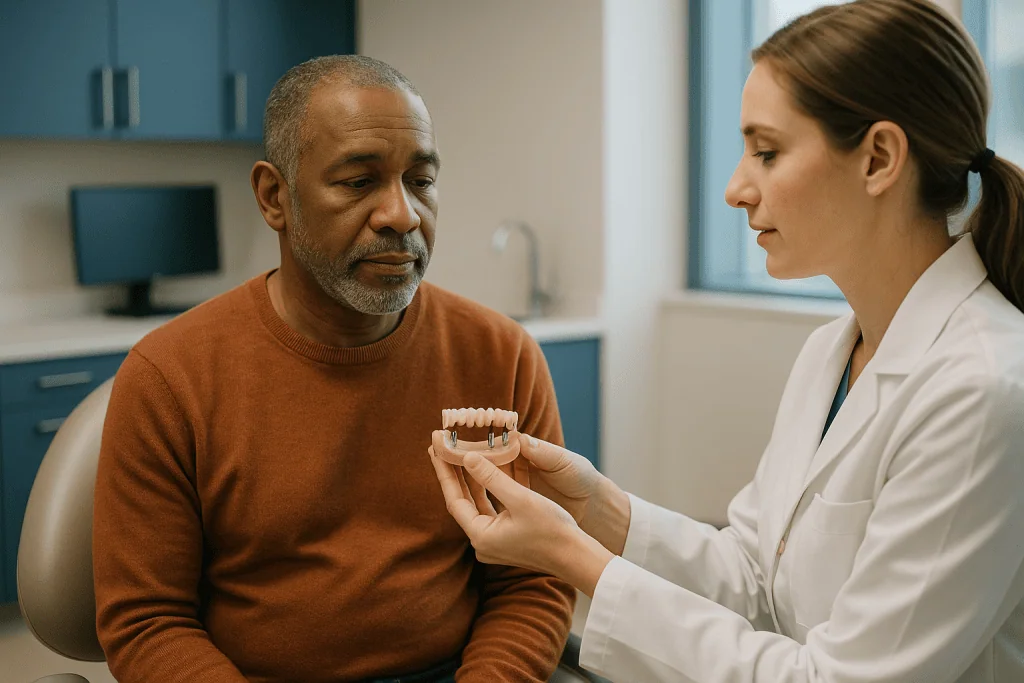
Planning comes first. A three-dimensional cone-beam CT scan maps bone height, width and density, the position of the sinuses and nerves, and where the implants can be anchored. Gum disease, which the National Institute of Dental and Craniofacial Research defines as infection and inflammation of the tissues that hold teeth in place, is assessed and treated, since active infection around implants is a known risk factor for later problems.
Surgery follows. Any remaining failing teeth in the arch are removed, the bone is shaped where needed, and the four implants are placed. Because the rear implants are tilted, extensive bone grafting (adding bone material to rebuild a thin jaw) is often avoided, though not always.
Then comes the part people find surprising. In many cases a provisional, lighter bridge is attached to the implants within hours or days, a practice called immediate loading. Mayo Clinic notes that the bone still needs several months to grow onto the implant surface, so this first bridge is deliberately designed for softer function while healing happens underneath.
Months later, once the implants are integrated and the gums have settled, impressions or digital scans are taken and a definitive bridge is made, commonly from acrylic on a titanium frame, or from zirconia, a tough dental ceramic. It is screwed down through small access holes that are then sealed. From that point the teeth are fixed, and the only person who takes them off is the dentist.
All on 4 myths, number one: are the teeth removable?
No, not by you. This is the single most common misunderstanding, and it deserves a plain answer. A conventional All-on-4 bridge is screw-retained. Each implant carries a small connector called an abutment; the bridge sits on those abutments and is held by screws torqued to a set tightness. There is no clip, no suction, no adhesive and no bedtime routine involving a glass of water.
Why does the myth persist? Three reasons, mostly.
First, the provisional bridge. In the early months, clinicians sometimes remove and adjust it, or swap it for the definitive one, so people see it come off and assume it always will. Second, the language. Dentists talk about a bridge being removable at the chairside, meaning retrievable for cleaning or repair; patients hear removable and picture a denture. Third, a genuinely different treatment exists and often gets lumped in: the implant-retained overdenture. That is a removable denture that snaps onto two or more implants with locator or bar attachments. It is a sound option for many people, and it is also precisely what All-on-4 is not.
There is a nuance worth holding onto. Retrievability is a feature, not a flaw. Because the bridge can be unscrewed by a professional, a chipped tooth can be repaired in a lab, the implants can be inspected, and the undersurface can be thoroughly cleaned at maintenance visits. A permanently cemented bridge would make those tasks harder. So the honest sentence is this: the teeth are fixed for daily life and removable only in a clinical setting, by design.
Do All-on-4 teeth feel like dentures?
Mostly not, with caveats that matter. A conventional complete denture is a plate that rests on the gums and, in the upper jaw, covers the roof of the mouth. The NHS describes dentures as replacements that sit on the gums and may need adhesive, and notes that eating and speaking take time to adjust to. That gum contact is the origin of nearly every denture complaint: sore spots, movement when chewing, food trapped underneath, muffled taste because the palate is covered.

A fixed full-arch bridge changes the physics. The load goes through the implants into bone rather than onto soft tissue, the palate is usually left open, and the teeth do not shift when you bite into something firm. People often describe the sensation as solid or part of me rather than sitting on top of me.
Two things still feel different from natural teeth, and clinicians should say so. Implants have no periodontal ligament, the thin cushion of fibers around a natural root that gives you fine feedback about pressure. Bite awareness is blunter, which is one reason people can overload the bridge without noticing. And the bridge has a flange, a ridge of pink material that replaces lost gum and bone. The tongue and cheeks notice it in the first weeks, and lip support changes, usually for the better where bone loss had sunk the face.
Speech also deserves a candid word. Some sounds, especially s and t, may lisp slightly at first while the tongue learns the new contours. For most people this settles over weeks of ordinary talking, though a bridge that is bulky in the wrong place sometimes needs reshaping. Mention it; it is adjustable.
Who All-on-4 is usually for, and who is usually asked to wait
The approach was developed for people with no teeth in an arch, or with teeth so compromised that removing them all is the realistic path. That typically means advanced gum disease, widespread decay, fractured teeth, or a long-standing denture that no longer fits because the jaw has shrunk. It is also considered when someone wants fixed teeth but has too little bone in the back of the jaw for conventional upright implants.
Equally important is who is usually asked to pause. Mayo Clinic lists factors that increase implant risk: smoking, uncontrolled diabetes, certain bone conditions, heavy teeth grinding (bruxism), and some medicines that affect bone turnover. None is an automatic exclusion; each is a conversation.
Common reasons a surgeon suggests waiting or choosing a different route:
- Active, untreated gum infection, which raises the chance of inflammation around implants later.
- Current smoking. The Centers for Disease Control and Prevention notes that smoking weakens the body’s ability to fight gum infection and slows healing of oral tissues.
- Poorly controlled blood glucose, which impairs wound healing and immune response.
- A history of radiation to the jaws or treatment with intravenous bone-modifying drugs, where bone healing is unpredictable and specialist input is needed.
- Bone so thin in the front of the jaw that even tilted implants cannot be anchored; here grafting or longer implants anchored in the cheekbone (zygomatic implants) are discussed.
- Unrealistic expectations, which sounds blunt but is a legitimate clinical reason to slow down.
The decision rests with the surgeon and restorative dentist together, informed by the scan, the medical history and a frank talk about what daily cleaning will involve.
All on 4 vs dentures vs overdentures: a side-by-side look
Three options are routinely confused, and a table does the job better than paragraphs. An implant-retained overdenture, for reference, is a removable denture that clips onto implants for stability but still rests partly on the gums.
| Feature | Conventional complete denture | Implant-retained overdenture | Fixed full-arch bridge (All-on-4 type) |
|---|---|---|---|
| Removable by the wearer | Yes, daily | Yes, daily for cleaning | No; removed only by a dentist |
| Support | Gums and palate | Implants plus gums | Implants only |
| Covers the palate (upper) | Usually | Often reduced | Usually not |
| Surgery required | None (extractions only if needed) | Two or more implants | Four or more implants, often with bone shaping |
| Movement when chewing | Common | Reduced | Minimal |
| Home cleaning | Brush denture out of mouth | Clean denture and attachments separately | Brush, floss threaders or water flosser under the bridge |
| Typical maintenance | Relines as the jaw changes | Attachment parts wear and are replaced | Screw checks, bridge removal for cleaning, occasional repairs |
| Bone preservation | Jaw continues to shrink | Partial, around implants | Load through implants helps maintain bone locally |
A few honest notes on the table. The NHS points out that even well-made dentures may need adjusting or replacing as the gums change shape over time; that is the reline row. Overdentures are often a good middle path for people who want stability but prefer something they can take out to clean, or who cannot have four implants placed. And a fixed bridge is only as good as the hygiene underneath it; a line in a table cannot convey how much that matters, so the sections that follow do.
What the first days and weeks usually look like
Day one is surgical, and it feels surgical. Expect swelling that peaks around the second or third day, some bruising along the jaw, and discomfort managed with whatever the surgeon prescribes or recommends. Any extracted sockets are healing at the same time as the implants, so the mouth is tender in more than one place. Mayo Clinic lists typical post-operative effects as swelling of the gums and face, bruising, pain at the implant site and minor bleeding.
If a provisional bridge was fitted, you leave with teeth, which is psychologically enormous and physically deceptive. The bone has not yet grown onto the implants. For that reason a soft diet is usually asked for throughout the healing months: foods you can cut with a fork, nothing that requires tearing or grinding. Mayo describes the bone-healing phase as taking several months; your surgeon will give a specific window for your case.
Week one to two: stitches may dissolve or be removed, swelling recedes, speech starts to normalize. Many people are back at desk-based work within days, though heavy exertion is commonly limited at first.
Weeks three to twelve: the gums remodel and shrink slightly as they heal, which can leave a small gap under the provisional bridge. That is expected and is one reason the definitive bridge is made later, from fresh impressions.
Then the definitive fitting, usually after the surgeon confirms integration. Bite checks follow, sometimes over two or three visits, because a fixed bridge with no ligament feedback must be balanced carefully. After that, the rhythm becomes a maintenance one: professional cleaning and screw checks at intervals the team sets, often every three to six months in the first years, plus daily cleaning at home.
What people often get wrong about All-on-4
Here are the misconceptions that come up most, each with the correction the evidence supports.
You never have to clean them because they are not real teeth. Wrong, and dangerously so. The gum around an implant can become inflamed (peri-implant mucositis) and, if plaque persists, the bone can be lost (peri-implantitis). The bridge has an undersurface that traps food. Water flossers, floss threaders and interdental brushes are not optional extras; they are the treatment’s maintenance plan.
Four implants means four points of failure, so it must be fragile. The engineering is deliberately distributed, and the tilted rear implants are longer and anchored in denser bone. The published series behind the concept, summarized in a systematic review indexed on PubMed, reported implant survival in the mid to high nineties percent across follow-up periods that were mostly under five years. That is reassuring but it is not a lifetime guarantee, and losing one implant can compromise the whole bridge until it is addressed.
The teeth you get on surgery day are the final teeth. Usually not. The provisional is lighter, often acrylic, and designed for the healing phase.
It is permanent and maintenance-free. Acrylic teeth wear and chip; screws occasionally loosen; the pink flange can stain. Repairs and eventual replacement of the bridge are normal parts of long-term care.
It is only for older people. Age is not the criterion; a fully failing dentition is.
Anyone can have it. See the section on who is asked to wait. Even the originators of the concept have been clear that bone anatomy, habits and health set limits.
All on 4 disadvantages: the negatives nobody puts on the brochure
A treatment this invasive deserves its downsides stated without softening.
It is irreversible. Any remaining teeth in the arch are removed, and bone is usually shaped to make room for the bridge. There is no going back to natural teeth.
Hygiene is harder than with dentures. A removable denture can be scrubbed at the sink. A fixed bridge must be cleaned in place, underneath and around each implant, and the gap between bridge and gum is awkward to reach. People with limited dexterity or reduced vision may find this genuinely difficult.
Blunted bite feedback. Without a periodontal ligament, people can clench or grind harder than they realize. Bruxism is a recognized risk factor for fractures of the prosthesis and overload of implants, which is why night guards are often discussed.
Speech and bulk. The flange and the thicker palate-side contour take adjustment, and not everyone fully adapts.
Repairs and replacement. Acrylic bridges chip and wear; zirconia bridges chip less but can fracture catastrophically and are heavier. Either way, the bridge is a mechanical component with a service life, not a one-time fix.
Surgical and biological risks. Mayo Clinic lists infection at the implant site, injury to surrounding structures, nerve damage with numbness or tingling, and sinus problems with upper-jaw implants. Peri-implantitis can develop years later, particularly in smokers and people with a history of gum disease.
Dependence on one arch of four posts. If an implant fails during healing, the whole plan may need revision, sometimes to a different design.
None of this means the treatment is wrong for you. It means the comparison should be made with eyes open, against the alternatives in the next sections.
All on 4 failure rate: what the evidence actually shows
People search this phrase hoping for one number. The honest answer is a range, with caveats about how the numbers were produced.
A systematic review of the all-on-four treatment concept, indexed on PubMed, pooled clinical studies and found implant survival rates reported above 95 percent in most included series, with the majority of follow-up data covering fewer than five years, and prosthesis survival reported even higher once early implant losses were managed. The review also flagged the limits of that evidence: many studies were retrospective, came from a small number of centers with deep experience in the technique, and used different definitions of failure. Those are exactly the conditions under which published figures tend to look better than everyday practice.
Failure also has two meanings that get muddled. Implant failure means an implant loses integration and must be removed, most often in the first months, or later from peri-implantitis. Prosthetic failure means the bridge fractures, teeth chip, or screws loosen; the implants are fine but the teeth need work. The second is far more common than the first and is better described as maintenance than failure.
Factors associated with higher implant loss across the implant literature summarized by Mayo Clinic and the Cleveland Clinic include smoking, uncontrolled diabetes, poor oral hygiene, bruxism and insufficient bone at placement. Some are modifiable before surgery, which is why pre-treatment preparation is not a formality.
What a careful clinician can tell you: the technique has a reasonable track record over a decade or more in experienced hands, early losses happen in a small minority, and long-term outcomes depend heavily on hygiene and habits. What no one can promise: that your implants will last a specific number of years. Treat any such promise as a warning sign rather than a selling point.
What is better than All-on-4? The alternatives, neutrally
Better depends on what you are optimizing for: fixed teeth, lower surgery, easier cleaning, lower risk, or preserving natural teeth. Each alternative wins on at least one of those.
Saving your own teeth. If some teeth are restorable, periodontal treatment, root canal therapy and crowns may keep them for years. A natural tooth with a healthy ligament gives feedback no implant can. The NIDCR notes that gum disease can be treated and its progression slowed with professional care and good home hygiene, which sometimes changes the whole calculation.
More implants under a fixed bridge. Six or eight upright implants, sometimes with bone grafting or a sinus lift (raising the sinus floor to add bone in the upper back jaw), spread load more widely and can allow separate shorter bridges rather than one full arch. More surgery, more time, potentially more resilience if one implant fails.
Implant-retained overdenture. Two to four implants holding a removable denture. Less surgery, easier cleaning, lower complexity, and a good option for people with dexterity limits. The trade-off is some gum support and daily removal.
Zygomatic implants. For severely resorbed upper jaws, long implants anchored in the cheekbone can support a fixed bridge without grafting. Highly specialized, with its own risk profile around the sinus.
Conventional dentures. No surgery, reversible, lowest biological risk. The NHS describes them as a standard option, with the known downsides of movement, relines and ongoing jaw shrinkage.
A well-run consultation presents at least two of these with their trade-offs rather than steering you to one. If you hear only a single option, ask why.
What I wish I knew before dental implants: the practical realities
Ask people a year or two after a full-arch bridge and a few themes repeat. None appear in glossy summaries.
Cleaning is a daily ten-minute job. Under the bridge, around each implant, with a water flosser and interdental brushes, every day. Plaque that is left behind does not cause cavities, since there are no natural teeth, but it causes inflammation in the gum and eventually bone loss around the implant. People who did well tend to describe it as part of brushing, not a chore added to it.
The provisional months are a long soft-food season. Steak, crusty bread and nuts wait. Several months of cutting food small tests patience more than people expect.
The teeth will need work. A chipped acrylic tooth, a loose screw, a stained flange: expect them, budget time for them, and understand that the bridge comes off at the surgery for repairs.
Night grinding becomes visible. Many people only learn they clench once an acrylic bridge shows the wear pattern. A night guard is a common recommendation.
Taste and temperature return. For former upper-denture wearers, an uncovered palate is often the single most-appreciated change.
Facial support changes. The flange can restore lip and cheek support lost to bone shrinkage; occasionally it is too bulky and needs trimming. Say so early.
Follow-up is lifelong. Professional cleaning, screw torque checks and periodic X-rays to monitor bone levels are part of the deal. Skipping them is how small problems become bridge-threatening ones.
Finally, people wish they had asked more questions at the first visit. The next section is a starting list.
Questions to ask your care team
Bring these to the consultation, and notice how they are answered. Direct, specific replies are a good sign.
- Which teeth, if any, could be saved, and what would that path involve instead?
- Will my bridge be screw-retained and removable only by you, or are you proposing an overdenture I take out myself?
- How much bone do I have, and will the tilted implants avoid grafting in my case?
- What is the plan if one implant does not integrate during healing?
- Will I have provisional teeth on the day of surgery, and what diet restrictions come with them, for how long?
- What material will the definitive bridge be made from, and what are the known wear and fracture issues with that choice?
- How will I clean under the bridge, and can you show me on a model before surgery?
- Do I grind my teeth, and would you recommend a night guard?
- How do my smoking, blood sugar, medicines or medical history affect my risk, and what should change before surgery?
- Who places the implants and who makes the teeth, and how do those two people coordinate?
- What is your maintenance schedule in the first two years, and what does a long-term check include?
- What signs after surgery should make me call you the same day?
- What happens in ten or fifteen years when the bridge wears out?
One more worth asking yourself rather than the team: am I choosing this because it fits my mouth and my habits, or because it sounds like the most complete answer? Mayo Clinic frames implant treatment as a decision made jointly with your dentist based on your bone, health and expectations. The team should be equally comfortable recommending something simpler if that fits you better.
When to call your doctor
Some discomfort after surgery is expected. Certain signs are not, and should prompt a same-day call to the surgical team or, when severe, emergency care.
In the first days and weeks:
- Bleeding that does not slow with steady pressure on gauze, or that restarts heavily after it had stopped.
- Swelling that keeps increasing after day three, spreads toward the eye or neck, or makes swallowing or breathing difficult. Swelling affecting the airway is an emergency.
- Fever, chills, or a foul taste or discharge from the surgical site, which may indicate infection.
- Numbness or tingling of the lip, chin or tongue that persists beyond the anesthetic wearing off, which can signal nerve involvement in the lower jaw.
- Nosebleeds, sinus pressure or fluid passing between mouth and nose after upper-jaw implants.
- A bridge that feels loose, moves, or clicks; do not try to tighten anything yourself.
Months or years later:
- Bleeding, redness or pus around an implant when cleaning, or a bad taste that keeps returning.
- Pain on chewing, a change in how the bite meets, or visible gum recession exposing the metal of an implant.
- A cracked or fractured bridge, or a tooth that has chipped away from the frame.
- Any sense that an implant is mobile.
Mayo Clinic notes that complications such as infection, nerve injury and sinus problems are uncommon but recognized, and that early assessment improves the chance of addressing them simply. Peri-implantitis in particular is far easier to manage when caught at the inflamed-gum stage than after bone has been lost. Keep the team’s after-hours number somewhere you can find it, and err on the side of calling.
Frequently asked questions
Are All on 4 teeth removable by the patient?
No. A conventional All-on-4 bridge is held to the implants by screws and is only removed by a dentist, typically at maintenance visits or for repairs. If a clinician describes your proposed teeth as something you take out nightly to clean, that is an implant-retained overdenture, a different and also legitimate treatment. Ask which design is planned, since the cleaning routine and daily experience differ considerably between the two.
Do All on 4 teeth feel like dentures?
For most people, no. The bridge does not rest on the gums or cover the palate, so there is no movement, no adhesive and no muffled taste. It does feel different from natural teeth: bite sensation is less precise because implants lack a periodontal ligament, and the pink flange takes weeks for the tongue and lips to accept. Early lisping on some sounds is common and usually settles with ordinary speaking.
What is the failure rate of All-on-4 dental implants?
A systematic review of the concept indexed on PubMed found implant survival reported above 95 percent in most included studies, with most follow-up shorter than five years and data concentrated in experienced centers. Early loss during healing affects a small minority; later loss is usually linked to peri-implantitis, smoking, diabetes or heavy grinding. Prosthetic problems such as chipped teeth or loose screws are more frequent and are treated as maintenance rather than failure.
What are the main all on 4 disadvantages?
The treatment is irreversible, since remaining teeth are removed and bone is reshaped. Cleaning under a fixed bridge is harder than cleaning a denture at the sink. Bite feedback is blunted, which can lead to unnoticed overloading. The bridge wears, chips and eventually needs replacement. Surgical risks listed by Mayo Clinic include infection, nerve injury and sinus complications, and losing one implant can compromise the whole arch until it is repaired.
How does all on 4 vs dentures compare for chewing?
A fixed bridge transfers chewing force through implants into bone, so it does not shift or lift when biting into firm food, while a conventional denture rests on the gums and can move, trap food and cause sore spots. The NHS notes that dentures take time to adjust to for eating. During the healing months, however, a provisional All-on-4 bridge requires a soft diet, so the chewing advantage arrives after integration, not on surgery day.
What is better than All-on-4 implants?
It depends on the goal. Saving restorable natural teeth preserves feedback no implant provides. Six or more upright implants with grafting may spread load more widely. An implant-retained overdenture needs less surgery and is easier to clean. Zygomatic implants suit severely resorbed upper jaws. Conventional dentures avoid surgery entirely. A thorough consultation should present at least two options with trade-offs, and the choice belongs to you and your treating team.
What do people wish they knew before dental implants?
Most often: that daily cleaning under the bridge is non-negotiable, that the soft-food phase lasts for months of bone healing, that the surgery-day teeth are provisional, and that the bridge will need repairs over its life. Many also discover they grind their teeth only after an acrylic bridge shows wear. Lifelong follow-up with screw checks and X-rays to monitor bone levels is part of the treatment, not an optional extra.
How long does the whole process take?
Mayo Clinic describes implant treatment as taking many months, mainly because bone must grow onto the implant surface before a definitive prosthesis is fitted. With a full-arch approach, surgery and a provisional bridge often happen within a day or two, then several months of healing follow, then the definitive bridge is made over a few visits. Your surgeon will give a timeline specific to your bone quality, health and whether extractions were needed.
Can I get All-on-4 if I smoke or have diabetes?
Possibly, but both are recognized risk factors for implant loss and slower healing, as noted by Mayo Clinic and the CDC. Many surgeons ask smokers to stop well before and after surgery, and ask that blood glucose be brought under good control first. Neither condition is an automatic exclusion. The decision rests with the surgical team after reviewing your history, and the discussion is an opportunity to change factors that also affect general health.
What happens if one of the four implants fails?
If an implant fails during healing, the bridge may lose support on one side and the plan usually needs revision: the failed implant is removed, the site heals, and a replacement implant is placed later or the design is changed, sometimes to more implants or an overdenture. A failure years later is more often from peri-implantitis and is managed by treating the inflammation and assessing the remaining implants. Ask your team about this contingency before surgery.
References
- Cleveland Clinic: Dental implants
- NHS: Dentures (false teeth)
- NIH National Institute of Dental and Craniofacial Research: Gum (periodontal) disease
- CDC Tips From Former Smokers: Smoking and periodontal (gum) disease
This article is for general information only and is not a substitute for professional medical advice. Please consult a qualified doctor about your individual situation.
Add us as a Preferred Source to see more of our trusted health content across Google Search, AI Overviews and Discover.

Planning This Treatment in Turkey
Our full guide for international patients: techniques, hospital stay, recovery and cost.
More from the Blog

All On 6 Anesthesia and Pain: Sedation Choices and Managing Discomfort in the First Days
All-on-6 pain is usually moderate rather than severe. The surgery itself is done under local anesthesia, often with sedation or general anesthesia, so the…

How Implantology Plans Treatment: Bone Volume, Bite and Timing Decide the Approach
Implantology plans treatment by measuring three things before anything is placed: how much jawbone is available in height, width and density; how the bite…

How Dentists Weigh a Sinus Lift Against Short Implants and Other Upper Jaw Alternatives
Dentists choose between a sinus lift or short implants mainly by measuring how much bone remains under the sinus floor in the upper back…

What a CT Scan Shows Before Zygomatic Implants: Cheekbone Volume, Sinus Anatomy and the Path
A CT scan for zygomatic implants gives the surgical team a three-dimensional map of the upper jaw and cheekbones. It shows how much bone…

Preparing for All On 4: Imaging, Bite Records, Infection Control and What to Pause Beforehand
All on 4 preparation usually involves a medical and dental history review, a three-dimensional CBCT scan of the jaws, photographs and bite records that…

How Grinding and Erosion Lead to Full Mouth Reconstruction: Bite Collapse and Tooth Wear
Tooth wear bite collapse happens when years of grinding (bruxism) or acid erosion shorten the teeth enough that the jaws close too far, straining…