

All On 6 Anesthesia and Pain: Sedation Choices and Managing Discomfort in the First Days

Key Takeaways
- Every All-on-6 surgery is done under local anesthesia; sedation and general anesthesia change what you remember of the day, not how sore you are on day two.
- Swelling and soreness typically peak around the second or third day after implant surgery and ease over about a week, so comfort plans work best when started before the numbness wears off.
- Non-opioid combinations, pairing an NSAID that targets inflammation with acetaminophen that acts centrally, are the mainstream first line for implant pain, with opioids held as a limited backup if used at all.
- Osseointegration, the bone bonding to titanium, is painless and takes several months, which is why soft-diet rules outlast the uncomfortable part of recovery.
- Pain that worsens after day three, or that improves and then returns, breaks the normal pattern and is the classic early signal of infection.
- Persistent numbness or tingling in the lower lip or chin beyond surgery day should be reported promptly, as it can indicate nerve irritation in the lower jaw.
All-on-6 pain is usually moderate rather than severe. The surgery itself is done under local anesthesia, often with sedation or general anesthesia, so the operation is not felt. Discomfort, swelling and bruising typically peak over the first two to three days and ease across the following week, managed with non-opioid medicines, cold packs and a soft diet. Worsening pain, fever or spreading swelling warrants a call to your care team.
The folder sits open on the kitchen table: the treatment plan, the consent form, the aftercare sheet with its tidy list of soft foods. The person reading it has already decided to replace a full arch of failing teeth. What keeps them up is a smaller, more personal worry. Six implants in one morning sounds like a lot. Will it hurt? Will I be awake? What do the first few days really feel like?
The honest answer to the all on 6 pain question is reassuring but not glib. The surgery itself is numb; that part is not in dispute. The days afterward are where expectations go wrong, in both directions. Some people brace for agony and get a sore jaw and a swollen cheek. Others expect nothing and are startled by day two.
This explainer walks through what actually happens, the sedation choices on the table, how pain relief works at the level of mechanism, and the signs that mean you should pick up the phone.
All on 6 pain: what patients actually feel, and why it is usually less than feared
Start with the distinction that matters most. There is pain during a procedure, and there is discomfort after it. For All-on-6, the first is prevented by local anesthesia, a numbing medicine injected near the nerves that supply the jaw, regardless of whether sedation is added on top. The second is a normal inflammatory response to surgery on bone and gum, and it follows a fairly predictable arc.
Mayo Clinic describes the usual aftermath of implant surgery as swelling of the gums and face, bruising of the skin and gums, pain at the implant sites and minor bleeding. Notice what is absent from that list: nothing about unbearable pain, nothing about the ache lasting for weeks. The sensation most people report is a deep, dull soreness in the jaw, tightness in the cheeks, and tenderness when the lips are stretched. Sharp or stabbing pain is not expected and is worth reporting.
Why is a six-implant procedure not six times as painful as a single implant? Because the body responds to surgery as a whole region, not as a tally. Inflammation in the jaw is governed by blood flow and swelling in one connected area. Six implants placed in the same arch produce a bigger surgical field than one, but the sensation is still a single sore jaw rather than six separate hot spots.
Individual variation is real. Bone density, whether extractions were done the same day, how long the surgery took, anxiety levels and prior pain experiences all shift the dial. Someone who had several teeth removed and bone contoured before the implants went in will usually have more swelling than someone whose teeth were already missing. None of this is a reason for dread. It is a reason to plan the first three days properly, which is the heart of this article.
What actually happens during All-on-6 surgery
All-on-6 is a way of replacing every tooth in one jaw with a single fixed bridge supported by six implants, which are titanium posts placed into the jawbone to act as artificial roots. Many versions of the procedure attach a provisional set of teeth on the same day, an approach sometimes called immediate loading, meaning the implants are put under light function straight away rather than left to heal untouched.
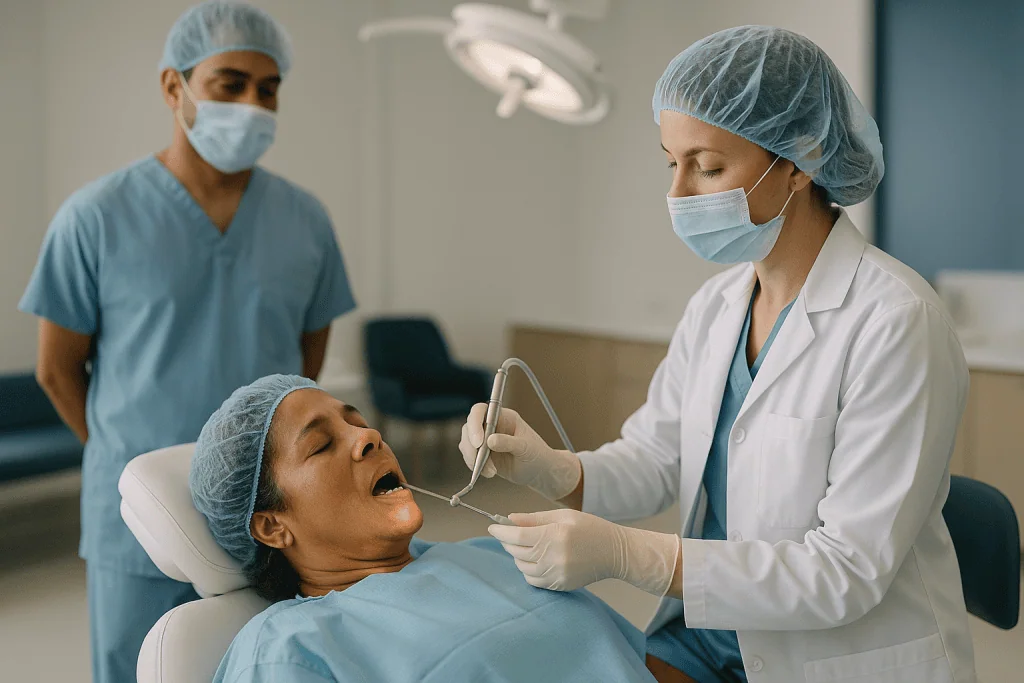
A typical surgical morning runs in stages. Once the chosen anesthesia or sedation is working, any remaining teeth in the arch are removed. The surgeon then opens the gum to expose the bone, smooths or reshapes the ridge if needed, and prepares six sites with a sequence of drills. The implants are threaded into place, usually with the back ones angled to avoid the sinus in the upper jaw or the main nerve canal in the lower jaw. Small connectors are attached, the gum is closed with stitches, and impressions or scans are taken so the provisional bridge can be fitted the same day or soon after.
Timing varies with how many extractions are needed and how much bone work is involved, and your surgeon is the right person to estimate it for your case rather than any general figure. What matters for the pain conversation is that the procedure is dominated by work on bone, which does not have pain fibers in the way skin does, but whose surrounding tissues respond with swelling afterward.
Mayo Clinic frames implant treatment as a series of steps with healing between them, and even same-day teeth do not change the biology underneath. The visible teeth may be there when you wake up; the bone around the implants still has months of quiet work ahead, which later sections cover under osseointegration.
All on 6 sedation options: local anesthesia, oral sedation, IV sedation and general anesthesia
Every All-on-6 surgery uses local anesthesia. The choice your team discusses is what, if anything, to layer on top of it. Cleveland Clinic groups the options into a ladder of increasing depth, and it helps to see them that way.
Local anesthesia alone keeps you fully awake and aware. You feel pressure and vibration but not pain. Some people prefer this for control and a quick recovery, though a long full-arch procedure awake is a lot to ask of most.
Minimal sedation, often with inhaled nitrous oxide, takes the edge off anxiety while you remain alert and responsive. Its effects fade within minutes of stopping the gas.
Moderate sedation, sometimes called conscious sedation, uses an oral medicine or an intravenous one from the benzodiazepine class. MedlinePlus describes this level as relaxed and drowsy but able to respond to instructions, with little memory of the procedure afterward. An intravenous line allows the sedation to be adjusted minute by minute, which is why IV sedation is commonly used for longer dental surgery.
General anesthesia means you are fully unconscious, breathing supported by an anesthesia professional, usually in a hospital or a surgical center equipped for it. Mayo Clinic notes that recovery can include grogginess, nausea, a sore throat from the breathing tube and, in older adults, temporary confusion.
A common misunderstanding: sedation is not pain relief. The local anesthetic does that job. Sedation manages awareness and anxiety, and it has nothing to do with how sore you are on day two. Choosing deeper sedation buys a calmer, less remembered morning, not an easier recovery, and it brings its own trade-offs in monitoring, fasting rules and the need for someone to take you home.
Which sedation level fits you, and who is usually asked to wait
The right depth of sedation is a shared decision between you, the surgeon and whoever provides the anesthesia. It rests on three things: how long and complex the surgery will be, your medical history, and how you cope with dental treatment.

| Option | Awareness during surgery | Typical fit | Main considerations |
|---|---|---|---|
| Local anesthesia only | Fully awake | Shorter cases, strong preference to stay alert | Long procedures can be tiring; no fasting or escort needed |
| Nitrous oxide | Awake, relaxed | Mild anxiety | Wears off quickly; can usually drive afterward per team advice |
| Oral or IV moderate sedation | Drowsy, responsive, little memory | Most full-arch surgery, moderate anxiety | Fasting, monitoring, escort home, no driving for the day (MedlinePlus) |
| General anesthesia | Unconscious | Very long cases, severe dental phobia, inability to cooperate | Anesthesia professional, airway support, longer recovery (Mayo Clinic) |
Who is usually asked to wait, or steered toward a lighter option? Mayo Clinic lists uncontrolled chronic conditions, heavy smoking and recent head-and-neck radiation among factors that need individual assessment before implant surgery at all. For sedation specifically, teams weigh sleep apnea, heart or lung disease, pregnancy, liver or kidney function, and interactions with medicines you already take. Someone whose blood pressure or blood sugar is not yet stable may be asked to work with their physician first. Someone on blood-thinning medicines needs a plan agreed between dentist and prescriber, never a self-made decision to stop.
None of this is a verdict on whether you can have All-on-6. It is the team matching the depth of sedation to the person in the chair, with safety as the first filter and comfort as the second.
Why the first 72 hours set the tone for all on 6 pain
Surgical pain is not a flat line. It rises, peaks and falls, and the shape of that curve explains most of the surprises people report.
In the first hours after surgery, the local anesthetic is still working. You may feel almost nothing, which lulls some patients into skipping the plan their team gave them. Then the numbness wears off, and the inflammatory response, the body’s standard reaction to tissue injury, gets properly underway. Blood vessels widen, fluid leaks into the tissues, immune cells arrive, and chemical messengers sensitize nerve endings. The result is the swelling and dull ache that aftercare guidance from Mayo Clinic and Cleveland Clinic describes as normal after implant placement.
Swelling typically builds through the first day and peaks around the second or third, then begins to subside over roughly a week. This is why many people say day two was harder than the day of surgery. It is not a complication. It is the curve.
The practical lesson is that comfort in this window comes from staying ahead of the curve rather than chasing it. Pain that is prevented is easier to manage than pain that has already flared, because once nerve endings are sensitized they amplify every signal. Teams usually ask patients to begin their prescribed comfort plan before the anesthetic fully wears off and to keep to the schedule they were given, rather than waiting to see how bad it gets.
Sleep matters here too. Lying flat increases blood flow to the head and worsens swelling, so sleeping propped on extra pillows for the first few nights is standard advice. Expect the jaw to feel stiff on waking; gentle movement, warm fluids and the next scheduled step in your plan usually ease it within the hour.
How pain relief medicines work after implant surgery (and why timing matters)
This section explains mechanisms and timelines only. What you take, how much and for how long is the prescribing clinician’s decision, based on your health and your surgery.
Most post-implant comfort plans are built on two non-opioid classes used together, an approach often called multimodal analgesia, meaning more than one mechanism is used at once so each can be kept at a sensible level. The first class is non-steroidal anti-inflammatory drugs (NSAIDs), which block the enzymes that produce prostaglandins, the chemical messengers that drive swelling and sensitize nerves. By acting on inflammation itself, NSAIDs address the cause of the ache rather than only the signal. They are not suitable for everyone; stomach, kidney, heart and bleeding considerations mean some patients are directed elsewhere.
The second is acetaminophen, which works centrally on pain signaling in the brain and spinal cord rather than on inflammation at the site. Because the two classes act in different places, combining them tends to control surgical pain better than either alone, which is why many teams alternate or pair them on a schedule.
Opioids act on receptors in the nervous system to blunt the perception of pain. Mainstream guidance has moved firmly toward keeping them as a short, limited backup for pain that non-opioid options cannot control, because of side effects such as nausea, constipation and drowsiness, and because of dependence risk even with brief use. Many All-on-6 patients never need them.
Antibiotics, when prescribed, are not pain medicines. They reduce the chance of infection at the surgical sites. A short course of a corticosteroid is sometimes used to limit swelling by dampening the inflammatory cascade. Local anesthetics with longer action may be used at the end of surgery to delay the first wave of discomfort.
Whatever your plan contains, two rules hold: take it as directed, and tell the team about every other medicine and supplement you use before surgery.
Cold, elevation and a soft diet: the comfort measures that do real work
Medicines get the attention, but much of the difference between a tolerable first week and a miserable one comes from simple physical measures that act directly on swelling.
Cold is the first. Applying a cold pack wrapped in a cloth to the cheeks over the surgical area narrows blood vessels and slows the leak of fluid into tissues, which blunts the swelling peak. Teams typically advise cycles of on and off during the first day or two rather than constant contact, to protect the skin. After that early window, some surgeons switch to gentle warmth to encourage circulation and ease stiffness; follow what yours recommends.
Head elevation is the second. Sleeping and resting with the head higher than the heart reduces the pressure that pushes fluid into the face. Two or three pillows, or a reclining chair, is enough.
Diet is the third, and it is where people most often go wrong. Mayo Clinic advises soft foods while the surgical sites heal. In the first days that means lukewarm, smooth foods: yogurt, blended soups, mashed vegetables, scrambled eggs, smoothies eaten with a spoon. Hot foods and drinks increase bleeding and swelling. Crunchy, chewy or seeded foods risk disturbing the stitches or wedging into the surgical sites. Even with a provisional bridge in place, the implants beneath it are not ready for chewing force; the soft diet protects the bone-to-implant interface as much as it protects your comfort.
Hydration keeps tissues healthy and helps with the dry mouth that follows sedation. Alcohol should be avoided while on prescribed medicines and during early healing. Smoking is the single habit most consistently linked to poor implant outcomes in Mayo Clinic’s risk guidance, and the first weeks are the worst possible time to resume it.
Gentle oral hygiene continues from the first day, usually with a prescribed antiseptic rinse and careful brushing of the areas the team shows you.
All on 6 recovery time: what the first two weeks usually look like
Recovery is individual, and the ranges below are typical patterns described in Mayo Clinic and Cleveland Clinic aftercare guidance rather than promises. Your surgeon’s own instructions take precedence.
- Surgery day. Numb, groggy if sedated, gauze in place for oozing. Begin the comfort plan before the anesthetic fades. Cold packs, rest, head elevated, fluids and very soft food.
- Days 1–3. Swelling and bruising rise and peak. The jaw aches, the cheeks feel tight, speech may be thick. This is the window where staying on schedule with pain relief matters most. Minor bleeding or pink saliva is normal; steady fresh bleeding is not.
- Days 4–7. Swelling visibly recedes. Bruising may migrate down the neck and turn yellow-green as it resolves. Many people reduce or stop pain relief during this stretch with their team’s agreement. Diet gradually moves from liquids to soft solids.
- Week 2. Stitches are checked or removed if not dissolvable. Residual tenderness lingers at the surgical sites, especially where extractions were done. Most people are back to work and daily routines well before this point, depending on the job and the sedation used.
Numbness that persists beyond the day of surgery, particularly in the lower lip or chin, should be reported promptly, as it can indicate irritation of the nerve that runs through the lower jaw. Mayo Clinic lists nerve injury among the recognized risks of implant surgery, and early assessment matters.
Two weeks is not the end of recovery. It is the end of the uncomfortable part. The biology underneath, covered next, continues for months, and the soft-diet rules usually extend well beyond the point at which you feel fine.
All on 6 healing stages: what osseointegration means for your new teeth
Osseointegration is the process by which living bone grows onto and around the surface of a titanium implant, locking it in place without any intervening soft tissue. It is the reason implants work at all, and it is the reason the soft-diet period lasts longer than the sore period.
In the hours after placement, blood clots around the implant threads. Over the following days, immune cells clear debris and the body lays down a scaffold of early connective tissue. Within weeks, specialized bone-forming cells begin depositing new, immature bone onto the implant surface. Over the following months, that woven bone remodels into dense, organized bone. Mayo Clinic describes this healing as taking several months, during which the implant becomes a stable foundation.
Why does this matter for pain? Because osseointegration is silent. You will not feel it happening, and the absence of pain is not evidence that the bone is ready. A provisional bridge attached on the day of surgery is designed to splint the implants together and keep forces low; it is not an invitation to bite into an apple at week three. Chewing forces that are too high too early can create tiny movements at the bone interface, and the body responds to movement by forming scar-like tissue instead of bone. That is the mechanism behind early implant failure, and it is painless until it is not.
The All-on-6 healing stages, broadly, are: the surgical and inflammatory phase in the first week or two, the bone-forming phase over the following weeks, the remodeling phase over several months, and finally the fitting of the definitive bridge once the surgeon has confirmed stability. Each handover is the team’s call, based on examination and sometimes imaging, not on the calendar alone.
Think of the provisional teeth as a cast on a healing bone: functional, protective, and temporary.
How to heal faster after dental implants: what helps and what is marketing
Search this question and you will find a lot of confident advice. Some of it is sound, some of it is harmless, and some of it is sold rather than shown. Here is how the evidence sorts it.
What genuinely helps is unglamorous. Not smoking is first; Mayo Clinic names tobacco use as a factor that can interfere with healing and raise the risk of implant failure. Keeping blood sugar controlled if you have diabetes supports wound healing across all surgery. Following the soft-diet period in full protects osseointegration. Taking prescribed antibiotics exactly as directed, if they were prescribed, reduces infection risk. Keeping every follow-up appointment lets the team catch small problems before they become large ones. Good sleep and adequate protein give the body the raw materials for tissue repair.
What is plausible but unproven for implants specifically includes most supplements marketed for healing. Vitamin D and calcium are important for bone health in general, and a documented deficiency is worth correcting with your physician, but there is no strong evidence that extra amounts in someone with normal levels speed implant integration. Light therapy devices, oral probiotics and herbal rinses sold for faster healing fall into the same category: not shown to be effective in mainstream evidence, and in the case of some herbal products, potentially interacting with prescribed medicines.
What can actively hurt is rushing. Returning to a normal diet because the soreness has gone, resuming vigorous exercise in the first days when raised blood pressure can restart bleeding, or stopping an antibiotic course early because you feel fine, all trade short-term convenience for long-term risk.
The honest summary: you cannot meaningfully speed osseointegration, but you can avoid slowing it. Patience, protection and the habits above are the real accelerants.
What is the most common complication of dental implants, and how does pain signal it?
Mayo Clinic lists the main risks of implant surgery as infection at the implant site, injury or damage to surrounding structures such as other teeth or blood vessels, nerve damage causing pain, numbness or tingling, and sinus problems when upper implants protrude into the sinus cavity. Among these, infection is the one most people will ask about, and over the longer term, inflammation of the tissues around an implant, called peri-implantitis, is the most widely recognized reason implants are lost after they have integrated.
Pain is a useful messenger here, provided you know what normal looks like. Expected discomfort follows the curve described earlier: worst around day two or three, then steadily better. Infection breaks the pattern. Pain that improves and then returns, or that worsens after day three instead of easing, is the classic signal. Swelling that keeps growing rather than shrinking, warmth and redness of the overlying skin, a bad taste or discharge from the surgical site, and a fever all point the same way.
Nerve irritation announces itself differently: persistent numbness, tingling or an electric sensation in the lower lip, chin or tongue beyond the day of surgery. Sinus involvement in the upper jaw may bring congestion, pressure, or fluid passing from the mouth to the nose when drinking.
Much later, peri-implantitis is often painless in its early stages, which is why it is caught at check-ups rather than by symptoms. Bleeding when brushing around the bridge, bad breath that does not resolve, or a sense of looseness are the signs that bring people in. Regular professional cleaning and hygiene visits are the main defense, and they continue for the life of the implants.
Complications are a minority of cases, but every one of the signs above is a reason to contact the team rather than wait.
Is All-on-6 the most painful dental procedure?
People ask search engines which dental procedure hurts most, and the honest answer is that no reliable ranking exists, because pain is measured by the person feeling it and shaped by anxiety, past experience and expectation as much as by what the dentist is doing.
What can be said with confidence is that the procedures with the fiercest reputations, root canals and extractions, earned them in an era before modern local anesthesia and from the toothache that preceded treatment rather than the treatment itself. A tooth with an abscess hurts; the procedure that resolves it, done under adequate anesthesia, generally does not. The same logic applies to All-on-6. Many candidates arrive after years of infected, loose or broken teeth. For a meaningful number, the dull ache of the first postoperative days is less than the chronic discomfort they were living with.
Full-arch surgery is bigger than a single filling, so the postoperative swelling is more noticeable and the recovery longer than a routine visit. In that limited sense it ranks higher. But bigger is not the same as agonizing. The pain is of the deep, bruised kind that responds well to anti-inflammatory measures, not the sharp, pulsing pain of an exposed nerve.
Anesthesia choice shifts the experience of the day, not the recovery. Someone who chooses IV sedation remembers little and wakes to a numb mouth; someone who chooses general anesthesia may spend the first hours dealing with nausea or a sore throat, as Mayo Clinic notes, before the jaw discomfort becomes the main event. Neither path makes day two easier or harder.
If pain tolerance or dental anxiety is a genuine concern for you, say so plainly in the consultation. It changes the plan in sensible ways and is never treated as a weakness.
What people often get wrong about All-on-6 pain and sedation
Myths about this procedure travel fast online. These are the ones that cause the most trouble.
“If I’m sedated, I won’t feel anything afterward.” Sedation ends when the drug wears off. Postoperative soreness is driven by inflammation, which does not care how deeply you slept. Plan for the first three days regardless of sedation choice.
“Same-day teeth mean same-day chewing.” The provisional bridge protects the implants and lets you smile and speak. It is not a signal that the bone has healed. Mayo Clinic describes integration as taking several months, and soft-diet rules exist to protect that process, not your comfort.
“Six implants will hurt six times more than one.” The jaw responds as one region. Swelling and soreness are greater for a full arch than a single site, but they do not multiply.
“Strong pain medicine means a better recovery.” Non-opioid combinations address the inflammatory cause of surgical pain and are the mainstream first line. Opioids carry side effects and dependence risk and are reserved as a limited backup, if used at all.
“No pain means no problem.” Early peri-implantitis and early loss of integration are often painless. Follow-up visits exist precisely because feeling fine is not a diagnostic test.
“General anesthesia is the safest way to avoid stress.” It is the right choice for some, but it carries its own risks and a longer, sometimes rougher recovery. Moderate IV sedation delivers a calm, largely unremembered procedure for most full-arch patients, with faster recovery and fewer airway considerations. The choice belongs to you and the anesthesia team together.
“Supplements will speed osseointegration.” Correcting a diagnosed deficiency is sensible. Beyond that, the evidence does not support extra supplementation as an accelerator.
Questions to ask your care team before surgery day
A good consultation is a conversation, and the pain and sedation plan deserves specific questions. Bring these, and write down the answers.
- Which level of sedation do you recommend for my case, and why that one rather than a lighter or deeper option?
- Who will provide and monitor the sedation or anesthesia, and what training do they have for this?
- Do I need to fast, and for how long? Which of my regular medicines should I take or hold on the morning, and who decides that with my prescribing doctor?
- Will any teeth be extracted the same day, and how does that change the expected swelling and soreness?
- What will my comfort plan look like, which medicine classes will it use, and when should I start it in relation to the anesthetic wearing off?
- Are there medicines in the plan I should not combine with what I already take?
- Will I be given a longer-acting local anesthetic at the end of surgery?
- What is normal swelling and bleeding for the first three days, and what crosses the line into something I should call about?
- How will I reach the team out of hours, and who answers?
- How long will the soft-diet period last, and what does the progression look like from liquids to soft solids to normal food?
- When will you check the implants for stability, and what are you looking for before the definitive bridge is made?
- What would make you decide to delay or change the plan on the day?
One more, less comfortable question is worth asking: what happens if an implant does not integrate? Knowing the contingency plan in advance removes a layer of worry from the weeks of waiting, and a team that answers it calmly is a team that has thought it through. Every decision on sedation, medicines and timing sits with them; your job is to be informed enough to take part.
When to call your doctor
Most All-on-6 recoveries follow the curve: worst around day two or three, then steadily better. Contact your surgical team the same day if that pattern breaks or if any of the following appears.
- Pain that worsens after the third day, or that eases and then returns, rather than steadily improving.
- Swelling that keeps increasing after day three, spreads toward the eye or down the neck, or makes it hard to swallow or open the mouth.
- Fever, chills, or feeling generally unwell beyond the expected tiredness.
- Bleeding that is steady and bright red rather than slow oozing, or that does not settle with firm pressure on gauze as you were instructed.
- Pus, a persistent foul taste, or discharge from a surgical site.
- Numbness, tingling or burning in the lip, chin or tongue that persists beyond the day of surgery.
- In upper-jaw cases, nasal congestion with pressure, nosebleeds, or fluid passing from mouth to nose when drinking.
- A provisional bridge that feels loose, moves, or has a visible crack.
- Nausea or vomiting that prevents you keeping fluids or prescribed medicines down.
- A rash, itching, swelling of the lips or face, or wheezing after taking a prescribed medicine, which may indicate an allergic reaction.
Seek emergency care immediately, rather than waiting for a callback, if you have difficulty breathing or swallowing, swelling that is closing the airway, uncontrolled bleeding, chest pain, confusion, or signs of a severe allergic reaction. Mayo Clinic lists infection and nerve injury among recognized implant risks, and both are far easier to manage when assessed early.
If you are unsure whether something is normal, that uncertainty is itself a reason to call. Surgical teams would rather hear from ten patients with routine questions than miss one with a developing problem. The decision on what to do next is theirs; your part is to report it.
Frequently asked questions
How painful is All-on-6 compared with having a single implant?
All-on-6 is more uncomfortable than a single implant but not six times so, because the jaw responds to surgery as one region rather than as separate sites. Expect a deeper, longer-lasting ache and more visible swelling, especially if extractions were done the same day. Mayo Clinic describes swelling, bruising, soreness and minor bleeding as the usual aftermath of implant placement; sharp or escalating pain is not expected and should be reported.
What are the All-on-6 sedation options, and do I have to be put to sleep?
You do not have to be put fully to sleep. Options range from local anesthesia alone, through nitrous oxide, to oral or intravenous moderate sedation, and finally general anesthesia. Most full-arch patients have IV sedation, which keeps you drowsy and responsive with little memory of the procedure, as MedlinePlus describes. General anesthesia is reserved for very long cases, severe phobia or specific medical needs, and the decision is made with the anesthesia team.
What is the All-on-6 recovery time before I feel normal?
The uncomfortable phase usually lasts about a week, with swelling peaking around day two or three and receding over the following days, according to Mayo Clinic and Cleveland Clinic aftercare guidance. Most people return to work and routines within one to two weeks depending on the job and the sedation used. Full healing of bone around the implants continues for several months, so dietary restrictions last well beyond the point at which you feel fine.
What are the All-on-6 healing stages after surgery?
Healing runs through four broad stages: the surgical and inflammatory phase in the first one to two weeks, an early bone-forming phase over the following weeks, a remodeling phase over several months in which immature bone matures around the implants, and finally the fitting of the definitive bridge once the surgeon confirms stability. Mayo Clinic describes the bone-to-implant integration as taking several months, and each handover is a clinical decision rather than a fixed date.
What is osseointegration in the context of dental implants?
Osseointegration is the process by which living jawbone grows directly onto the surface of a titanium implant, locking it in place without any soft tissue in between. It begins with a blood clot around the implant, progresses to new immature bone within weeks, and matures into dense bone over several months. It is silent and painless, which is why the absence of discomfort is not evidence that an implant is ready for full chewing force.
How can I heal faster after dental implants?
You cannot meaningfully speed osseointegration, but you can avoid slowing it. Not smoking is the single most important factor Mayo Clinic highlights, followed by keeping blood sugar controlled if you have diabetes, following the soft-diet period in full, taking any prescribed antibiotics as directed, keeping follow-up appointments and sleeping well. Supplements and devices marketed for faster implant healing are not supported by strong evidence unless they correct a diagnosed deficiency.
What is the most common complication of dental implants?
Infection at the implant site is the complication most often discussed in the early weeks, and Mayo Clinic lists it alongside injury to surrounding structures, nerve damage and sinus problems. Over the longer term, peri-implantitis, inflammation and bone loss around an integrated implant, is the most widely recognized cause of implant loss. Early infection typically shows as pain that worsens after day three, growing swelling, fever or discharge; peri-implantitis is often painless and caught at check-ups.
Is All-on-6 the most painful dental procedure?
No reliable ranking of dental procedures by pain exists, because pain is individual and shaped by anxiety and expectation. All-on-6 involves more surgery than a filling or a single extraction, so swelling is more noticeable and recovery longer, but the discomfort is a deep, bruised ache that responds well to anti-inflammatory measures rather than sharp nerve pain. Many patients arriving after years of failing teeth describe the recovery as less than the chronic discomfort they had before.
Why did day two hurt more than the day of surgery?
Because inflammation follows a curve. On surgery day the local anesthetic is still working and the swelling has not yet built. Over the first 48 to 72 hours, blood vessels widen, fluid collects in the tissues and chemical messengers sensitize nerve endings, so the ache and tightness peak around the second or third day before easing, a pattern described in Mayo Clinic and Cleveland Clinic aftercare guidance. Staying on the prescribed comfort schedule through this window matters most.
Does general anesthesia make All-on-6 recovery easier?
No. General anesthesia changes the experience of the procedure, not the recovery. Postoperative soreness is driven by inflammation at the surgical sites and follows the same curve whatever sedation was used. Mayo Clinic notes that general anesthesia can add its own recovery effects, including grogginess, nausea, a sore throat from the breathing tube and, in older adults, temporary confusion. It is the right choice for some patients, decided with the anesthesia team on medical grounds.
References
This article is for general information only and is not a substitute for professional medical advice. Please consult a qualified doctor about your individual situation.
Add us as a Preferred Source to see more of our trusted health content across Google Search, AI Overviews and Discover.

More from the Blog

How Implantology Plans Treatment: Bone Volume, Bite and Timing Decide the Approach
Implantology plans treatment by measuring three things before anything is placed: how much jawbone is available in height, width and density; how the bite…

How Dentists Weigh a Sinus Lift Against Short Implants and Other Upper Jaw Alternatives
Dentists choose between a sinus lift or short implants mainly by measuring how much bone remains under the sinus floor in the upper back…

What a CT Scan Shows Before Zygomatic Implants: Cheekbone Volume, Sinus Anatomy and the Path
A CT scan for zygomatic implants gives the surgical team a three-dimensional map of the upper jaw and cheekbones. It shows how much bone…

Preparing for All On 4: Imaging, Bite Records, Infection Control and What to Pause Beforehand
All on 4 preparation usually involves a medical and dental history review, a three-dimensional CBCT scan of the jaws, photographs and bite records that…

How Grinding and Erosion Lead to Full Mouth Reconstruction: Bite Collapse and Tooth Wear
Tooth wear bite collapse happens when years of grinding (bruxism) or acid erosion shorten the teeth enough that the jaws close too far, straining…

Who Is a Candidate for All On 6? Bone Volume, Bite Force and When Six Implants Are Advised
An all on 6 candidate is usually an adult missing most or all teeth in one jaw, with enough jawbone in the back of…