

All On 6 Surgery Explained: Implant Positions, Same-Day Temporary Bridge and the Final Teeth
Key Takeaways
- The all on 6 procedure anchors one fixed full-arch bridge to six implants, with the rear pair placed farther back than in a four-implant design to shorten the unsupported overhang.
- A same-day temporary bridge is a lightweight splint that protects healing implants; the durable final bridge is made only after bone has fused to the implants over several months, per Mayo Clinic.
- Insertion torque, the firmness of bone grip at placement, is the main factor that decides whether a surgeon attaches teeth the same day or fits a removable denture during healing.
- Mayo Clinic lists infection, nerve injury causing lip or chin numbness, and sinus problems as recognized implant surgery risks, and six sites means six places they can occur.
- Implants can last many years or decades with good care, according to Cleveland Clinic, while the bridge on top is a wearing part that may need repair or replacement.
- Peri-implantitis, inflammation of gum and bone around an implant, is a leading cause of late implant loss and is largely prevented by daily cleaning beneath the bridge and regular professional maintenance.
The all on 6 procedure replaces a full upper or lower row of teeth with a single fixed bridge anchored to six dental implants placed in the jawbone. Surgery usually happens in one visit, often with a light temporary bridge fitted the same day; the stronger final bridge is made after the implants fuse with bone over several months. Suitability, timing and outcomes are decided by the treating dental team.
The moment usually arrives over something ordinary. A woman in her sixties tells her dentist she has stopped ordering apples with her lunch because her lower denture lifts when she bites. A man in his fifties, who has quietly lost eleven teeth to gum disease, admits he covers his mouth when he laughs at his grandson’s jokes. Neither is asking for a new smile so much as for a mouth that stays put.
That is the conversation in which the phrase all on 6 procedure tends to come up. It sounds like a brand, and it is often marketed like one, but underneath is a well-described surgical idea: six titanium implants supporting one fixed row of teeth. What patients rarely get is an honest, unhurried account of where those six posts go, what “teeth in a day” really delivers, and why the teeth you leave the clinic with are not the teeth you keep.
This article is that account, drawn from mainstream dental and surgical sources, with the decisions left where they belong: with you and your care team.
What is the all on 6 procedure, in plain language?
Start with the parts. A dental implant is a small screw-shaped post, usually titanium, placed into the jawbone to act as an artificial tooth root (Mayo Clinic). A full-arch bridge is one connected row of artificial teeth that replaces every tooth in the upper or lower jaw. Put six of the first under one of the second and you have the all on 6 procedure: a complete arch of teeth fixed to six implants, screwed in place rather than glued or clipped, so it does not come out at night.
The idea grew from an older observation. Dentists learned that a full row of teeth does not need an implant under every single tooth. A handful of well-spread anchors, joined by a rigid bridge, share chewing load the way six posts share the weight of a long deck. The four-implant version of this concept became widely known first; six implants is a variation that adds two anchors, usually toward the back of the arch, where chewing forces are greatest.
Three features define it. The bridge is fixed, so it is cleaned in the mouth rather than in a cup. The implants are placed in a single surgical session per arch. And in many cases a lightweight temporary bridge is attached within hours of surgery, a technique called immediate loading, which simply means putting teeth on the implants before the bone has finished healing around them.
Notice what the definition does not include: it says nothing about who is a good candidate, how long healing takes for a given person, or what the teeth will feel like. Those depend on bone, health, habits and the skill and judgment of the team, which is why the rest of this article spends more time on trade-offs than on promises.
How does the all on 6 procedure actually work, step by step?
Picture a single long appointment rather than a series of small ones. After local anesthesia, often combined with sedation, the surgeon removes any remaining teeth in that arch. Failing teeth are not left in place, because infected roots would sit beside fresh implants (Mayo Clinic).
The gum is opened to expose the bone. Where the ridge is uneven or has sharp peaks left by lost teeth, it is smoothed. This reshaping matters more than it sounds: a flat, level bone surface lets the bridge sit close to the gum without a visible gap, and it removes thin bone that would not hold an implant well.
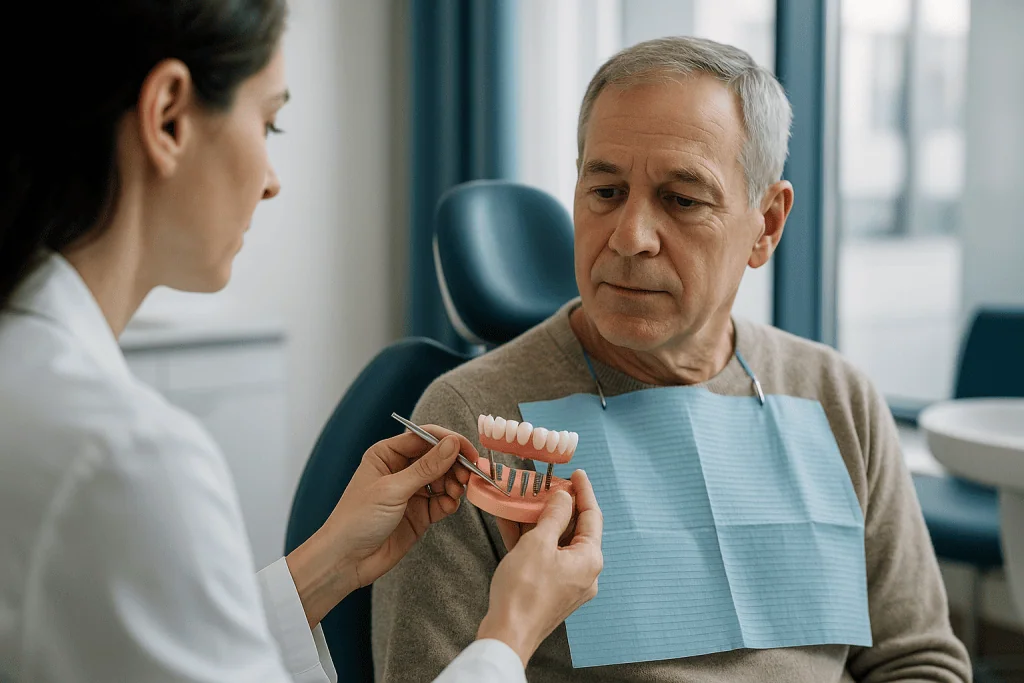
Six sites are then prepared with progressively wider drills, guided either by a printed surgical template made from the pre-operative scan or by the surgeon’s measurements. Each implant is threaded into its site and its tightness, called insertion torque, is recorded. Torque is a measure of how firmly the bone grips the implant at the moment of placement; a firm grip is the main reason a surgeon may feel comfortable attaching a temporary bridge the same day, while a soft grip is a common reason to wait.
Connectors called abutments are attached. An abutment is the small collar that sits above the gum and joins the implant to the bridge. The gum is closed with stitches around them. Impressions or a digital scan capture the exact positions, and a dental technician converts the temporary bridge so it fits those six points. Later that day, or occasionally the next morning, it is screwed on.
Total chair time varies with how many teeth need removing and whether the upper, lower or both arches are treated, so the honest answer to “how long is the surgery” is: your surgeon’s estimate for your case, not a number from a brochure.
Where do the six implants go, and why does position matter?
Spread six pins across a horseshoe and you have roughly the map. Two implants usually sit toward the front, in the region of the canine or incisor roots, where bone is typically dense. Two sit in the premolar zone on each side. The final pair sits farther back, near the first molar position, and this is the pair that most distinguishes the all on 6 procedure from its four-implant sibling.
Position is really about two constraints. The first is anatomy. In the lower jaw, a nerve runs through a canal beneath the back teeth and exits near the premolars; drilling into it can cause lasting numbness of the lip and chin, a recognized risk of implant surgery (Mayo Clinic). In the upper jaw, the air-filled maxillary sinus sits directly above the molar roots and can be entered if an implant is placed too high. Surgeons often tilt the rear implants at an angle, anchoring their tips in solid bone farther forward while still supporting the bridge farther back. Tilting is a planning choice, not a flaw.
The second constraint is mechanics. A bridge is strongest where it sits directly over an implant and weakest where it hangs past the last one, an overhang called a cantilever. Every millimeter of cantilever acts like a lever on the rearmost anchor. Six implants generally let the surgeon place the last support farther back, shortening or eliminating that overhang, which is the central engineering argument for six over four.
Whether that argument applies to you depends on how much bone remains toward the back of your jaw. If it has resorbed, six well-placed implants may need grafting first, or four tilted implants may be the more realistic plan. The scan decides; the name of the procedure does not.
Same-day temporary bridge: what "teeth in a day" really means
The phrase is true and misleading at the same time. True, because many people do leave the surgical appointment with a fixed row of teeth. Misleading, because those teeth are a provisional bridge, a temporary appliance built to protect healing implants, not the durable final teeth.

The provisional is usually made of acrylic reinforced with a metal or fiber bar. It is deliberately light, and it is trimmed short at the back so that no part hangs beyond the rear implants. Its main job is not eating; it is holding the six implants rigidly together so that none of them moves while bone grows onto their surfaces. That fusion, called osseointegration, is the biological event everything depends on, and Mayo Clinic describes it as taking several months (Mayo Clinic). An implant that wobbles during this window can end up wrapped in soft scar tissue rather than bone, which is one way implants fail.
This is also why the diet advice after immediate loading is so strict. Mayo Clinic advises soft foods while the surgical site heals; with a provisional bridge that advice stretches across the whole integration period, because every hard bite is a small test of anchors that have not yet finished setting.
Not everyone gets same-day teeth. If insertion torque is low, if bone grafting was needed, or if a medical condition slows healing, the surgeon may cover the implants and fit a removable denture instead for the healing months. Patients sometimes experience this as a failure. It is closer to a seatbelt: a judgment that, in this mouth, protecting the implants outweighs the convenience of immediate fixed teeth. Ask in advance what your team’s threshold is and what the fallback plan looks like, so the decision on the day is not a surprise.
Who is all on 6 usually for, and who is asked to wait?
The typical candidate has lost, or is about to lose, most or all teeth in one jaw, often after years of gum disease, decay, fracture or a failing denture, and has enough bone to seat six implants without major reconstruction. Mayo Clinic frames the general implant candidate as someone with a fully grown jawbone, adequate bone or the ability to have a graft, healthy oral tissues and no health conditions that would impair bone healing (Mayo Clinic).
Being asked to wait is common and rarely permanent. The reasons cluster into a few groups:
- Active infection. Untreated gum disease around remaining teeth raises the bacterial load in the mouth; teams usually want it controlled first (NHS).
- Bone volume. Where the ridge is too thin or short, grafting comes first, and Mayo Clinic notes graft healing can itself take several months before implants are placed.
- Medical factors. Poorly controlled diabetes, certain bone-affecting medicines, prior radiation to the jaws and heavy smoking are all listed by mainstream sources as conditions that can impair healing or raise complication risk. None is an automatic exclusion; each is a conversation with the surgeon and, often, the physician who manages the condition.
- Uncertain expectations. A person who expects the provisional bridge to feel like natural teeth on day one is set up for disappointment. Good teams slow down here, not because of the mouth but because of the mismatch.
Age itself is not a barrier once jaw growth is complete. What matters is the ability to heal, to keep the bridge clean and to attend follow-ups. The right person for this procedure is not the one who wants it most but the one whose mouth, health and habits give six implants a fair chance.
All on 4 vs all on 6, and how both compare with other options
Choosing among full-arch options is less about which is “best” and more about which constraint you are willing to live with. The table below compares the main routes in neutral terms; the specifics for your jaw come from your team.
| Option | Anchors | Fixed or removable | Typical strengths | Typical trade-offs |
|---|---|---|---|---|
| Four-implant fixed bridge | 4 implants, rear pair often tilted | Fixed | Fewer implants; may avoid grafting in resorbed jaws | Longer rear overhang; less redundancy if one implant fails |
| Six-implant fixed bridge (all on 6) | 6 implants | Fixed | Shorter or no overhang; spare capacity if one anchor is lost | Needs more bone toward the back; more surgical sites |
| Implant-retained overdenture | Usually 2 to 4 implants | Removable, clips onto implants | Easier to clean; simpler surgery | Still a denture; clips and liners wear |
| Conventional complete denture | None | Removable | No surgery | Relies on suction and gum ridge; bone continues to shrink beneath it |
| Individual implants and crowns | Often 8 or more per arch | Fixed | Most tooth-like segmentation | Most surgery and bone required; rarely practical after long-term tooth loss |
Two points deserve emphasis. First, the difference between four and six implants is smaller than the marketing suggests; both rest on the same principle of spreading load across a rigid bridge, and the choice usually turns on how much bone exists behind the premolars. Second, removable options are not consolation prizes. An implant-retained overdenture can be a reasonable choice for someone whose dexterity, health or preference makes daily cleaning of a fixed bridge difficult (NHS). The question to bring to the consultation is not “can I have six” but “what does my bone allow, and what will I realistically keep clean.”
Before surgery: scans, planning and the medical questions you will be asked
The most important hour of an all on 6 procedure often happens weeks earlier, in front of a monitor. A cone-beam CT, a low-dose three-dimensional X-ray of the jaws, shows bone height and width, the path of the lower jaw nerve and the floor of the sinuses in a way flat X-rays cannot (Mayo Clinic). On that scan the team plans each implant’s length, angle and position, and may print a surgical guide to reproduce the plan in the mouth.
Expect a long medical history. Mayo Clinic lists the review of medical conditions and medicines as a standard part of implant assessment, with attention to anything affecting bone healing, bleeding or infection risk. Common topics include diabetes and its control, blood thinners, medicines that affect bone turnover, previous radiation to the head and neck, and smoking. None of these questions is a judgment; each shapes how and whether surgery is timed. If you take a prescribed medicine, the decision about whether to pause or adjust it belongs jointly to the surgeon and the prescribing clinician, never to the patient alone.
You will also meet the restorative side of the team, often a prosthodontist, a dentist who specializes in replacing teeth. They decide how the new teeth will look and function: tooth length, the amount of gum-colored material, how the upper and lower rows meet when you bite (the occlusion) and how much lip support you need. Bring photographs of your natural teeth if you have them; they are useful references for shade and shape.
Practical preparation is straightforward. Arrange a driver if sedation is planned, stock soft foods, and clear the following few days. Ask, before the day, what the plan is if bone quality turns out weaker than the scan suggested, so you understand the fallback rather than discovering it while numb.
How painful is all on 6 dental implants surgery, honestly?
The surgery itself is not felt. Local anesthesia numbs the jaw completely, and most full-arch cases add intravenous or oral sedation so the patient is drowsy and often remembers little (Mayo Clinic). Pressure and vibration during drilling are common sensations under local anesthesia alone; sharp pain is not expected and should be reported immediately.
Afterward is a different story, and it deserves plain language. Removing a full row of teeth and reshaping bone is real surgery. Mayo Clinic lists swelling of the gums and face, bruising, pain at the surgical sites and minor bleeding as typical after implant placement. People who have had both a single extraction and a full-arch procedure often describe the latter as more swelling than pain: a puffy, tight, bruised feeling that peaks in the first days and then recedes. Cleveland Clinic describes recovery from implant surgery as generally taking a few days to a week for most people (Cleveland Clinic), though a full arch sits at the heavier end of that range.
Pain control is planned before surgery, not improvised after. The surgeon will prescribe or recommend medicines suited to your health and other prescriptions; how much and how often is their instruction to follow, and any change should go back to them. Cold packs on the cheeks in the first day and sleeping with the head raised are standard, low-tech measures that reduce swelling.
Two warning signs matter. Pain that improves and then worsens again after several days, or pain that is escalating rather than easing by the end of the first week, is not the normal curve and should be assessed. So should numbness that does not fade once the anesthetic should have worn off; Mayo Clinic identifies nerve injury as a known complication, and early reporting helps the team evaluate it.
All on 6 recovery time: what the first days and weeks usually look like
Recovery has two clocks running at once: the visible one, measured in swelling and stitches, and the invisible one, measured in bone.
The first two to three days. Swelling and bruising are at their most obvious; Mayo Clinic notes these are expected after implant surgery and generally settle over the following days (Mayo Clinic). Speech feels clumsy with a new bridge and a swollen tongue. Food is cool and soft: yogurt, smooth soups, mashed vegetables. Oozing of a little blood into saliva is common; steady bleeding is not.
The first two weeks. Stitches dissolve or are removed. Most people return to desk work within the recovery window Cleveland Clinic describes (Cleveland Clinic), though heavy exertion is usually postponed a little longer because it raises blood pressure in the healing sites. The team checks that the bridge is stable and that the gum is closing cleanly around the abutments.
Weeks three to twelve and beyond. The face looks normal. The mouth feels almost normal. This is exactly when people stop being careful, and it is the wrong moment to do so. Osseointegration, the fusion of bone to implant, is still underway; Mayo Clinic describes it as taking several months, and Cleveland Clinic gives a commonly quoted window of a few months. Soft-to-medium diet continues until the team clears you. Hygiene shifts from rinsing to gentle brushing of the bridge and cleaning beneath it with the tools your hygienist demonstrates.
Follow-up. Expect several visits in this period to check tightness of the bridge screws, gum health and bite. As the gum shrinks slightly during healing, small gaps can appear under the provisional; these are normal and are addressed when the final bridge is made. Recovery is finished not when you feel fine but when the surgeon confirms the implants are firm.
The final teeth: from provisional bridge to definitive bridge
The teeth you eventually keep are made, not delivered. Once the surgeon confirms the six implants have integrated, the restorative dentist begins a sequence that usually spans several appointments.
First comes a fresh record of the implant positions, by impression or digital scan, now that the gums have healed into their settled shape. Then a trial. A wax or printed mock-up of the final teeth is placed in the mouth so you can check length, shade, how much tooth shows when you smile, and how your lips rest. This is the stage to speak up; changing a design is easy in wax and hard in ceramic.
Materials vary, and each has a personality. Acrylic teeth on a titanium bar are lighter and simpler to repair but wear faster. Zirconia, a very hard white ceramic, resists wear and staining but is heavier and, if it chips, is repaired differently. Porcelain fused to a metal framework sits between them. No material is universally superior; the choice weighs your bite force, the opposing teeth, aesthetics and maintenance. Cleveland Clinic notes that while implants themselves can last many years with good care, the restorations attached to them are subject to wear and may need repair or replacement over time (Cleveland Clinic).
The final bridge is screwed to the abutments and the screw access holes are sealed. It is usually designed to be removed by the dentist for professional cleaning or repair, but not by you. Your bite is checked and adjusted; a fixed bridge that hits too hard on one side loads the implants unevenly, and small adjustments at this stage protect them for years.
Then comes the part no brochure mentions: learning to eat again. Fixed teeth transmit pressure differently from natural teeth, which have a cushioning ligament. Most people adapt, but the first steak is a milestone, not a day-one event.
What are the cons of all on 6 dental implants? Risks and trade-offs
Any procedure worth having is worth describing honestly. Mayo Clinic lists the recognized complications of implant surgery as infection at the implant site, injury to neighboring structures, nerve damage causing pain or numbness of the lip, gums or chin, and sinus problems when upper implants protrude into the sinus (Mayo Clinic). With six sites rather than four, there are simply more places for these to occur.
Beyond surgical risk sit the everyday trade-offs:
- Cleaning is harder than it looks. A fixed bridge has a long underside against the gum where food and plaque collect. Cleaning it requires floss threaders, water irrigators or interdental brushes daily. Neglect leads to peri-implantitis, an inflammation of the gum and bone around an implant that can loosen it, described by Cleveland Clinic as a leading cause of late implant loss (Cleveland Clinic).
- Healthy teeth may be removed. A full-arch plan often sacrifices a few salvageable teeth for the sake of one predictable bridge. That is a genuine loss, and it should be discussed rather than assumed.
- Bulk and speech. Replacing bone as well as teeth means the bridge includes pink material where gum used to be. Some people notice altered speech sounds for weeks; a few notice it longer.
- Repairs are not trivial. A chipped tooth on a one-piece bridge may mean removing the whole bridge to fix it.
- Bone continues to change. Implants preserve bone directly around them, but the jaw still ages, and the fit of the bridge can change over the years.
None of these is a reason to avoid the procedure. They are reasons to choose it with open eyes, and to prefer a team that lists them unprompted.
What is the average lifespan of all on 6 dental implants?
Two different things are being asked here, and they have different answers.
The implants, the titanium posts in bone, are the durable part. Cleveland Clinic states that with good oral hygiene and regular dental care, dental implants can last many years and often decades (Cleveland Clinic). Mayo Clinic makes the same point in reverse: most implants succeed, and the ones that do not usually fail because bone did not fuse to them, which is why smoking, poor healing and uncontrolled disease matter so much (Mayo Clinic). This article does not quote a survival percentage, because those figures come from studies with varied follow-up, patient selection and definitions of “success,” and a single number would flatten that honestly messy picture.
The bridge, the teeth themselves, has a shorter life. Acrylic teeth wear with chewing and can stain; zirconia resists both but can chip. Screws that hold the bridge can loosen and need tightening. Cleveland Clinic notes that restorations on implants may need repair or replacement over time even when the implants beneath them remain sound. A useful mental model: the implants are the foundation, the bridge is the house, and houses need maintenance.
What extends lifespan is unglamorous. Daily cleaning beneath the bridge. Professional cleaning and check-ups at the interval your team sets, during which the bridge may be removed and the implants inspected. A night guard if you grind. Not smoking, which mainstream sources consistently link to higher implant failure. Reporting a loose feeling, a bad taste or bleeding early, when the fix is small.
The realistic answer, then: the implants can last a very long time if the mouth around them is kept healthy, and the teeth on top will need attention along the way. Anyone quoting you a guaranteed number of years is selling, not informing.
How much does all on 6 implants cost? Why this article gives no figures
It is one of the most searched questions about this treatment, and it will not be answered with a number here, for a reason worth explaining rather than dodging.
Price for a full-arch implant bridge is not a single item. It bundles imaging, extractions, bone reshaping or grafting, six implants and their components, sedation, the provisional bridge, the final bridge in whatever material is chosen, and a series of follow-up visits stretching across months. Two people can receive treatment called the same thing and have very different lists underneath. Quoting an average would be less informative than it looks and, in a magazine that does not sell anything, inappropriate.
What can be said is what shapes the variation, so you can read a written estimate intelligently:
- Bone. Grafting or sinus work adds procedures and months (Mayo Clinic).
- One arch or two. Upper and lower are separate surgeries in scope even when done the same day.
- Final material. Acrylic, layered ceramic and monolithic zirconia differ in laboratory work and durability.
- What is included afterward. Some plans cover adjustments, a replacement provisional and a defined maintenance period; some do not.
- Coverage. The NHS describes implants as generally not available on the health service except in specific medical circumstances (NHS); in the US, dental insurance varies widely in what, if anything, it contributes.
Ask for an itemized written plan rather than a headline figure, ask what happens if an implant fails to integrate, and ask what routine maintenance will involve in years to come. A number that seems attractive without those answers is not yet a number you understand.
What people often get wrong about the all on 6 procedure
Misunderstandings cluster around the same few ideas, and each has a simple correction.
“Six is always better than four.” Not necessarily. Six implants offer shorter overhang and spare capacity, but they require bone in the rear jaw that many long-term denture wearers have lost. Forcing six into thin bone is worse than placing four well. The scan, not the number, should drive the plan.
“Teeth in a day means done in a day.” The provisional bridge arrives quickly; the final teeth follow only after osseointegration, which Mayo Clinic describes as taking several months (Mayo Clinic). Total treatment is a season, not a day.
“Implants cannot get gum disease.” Titanium does not decay, but the tissue around it can become inflamed and the bone can recede, a condition Cleveland Clinic names peri-implantitis (Cleveland Clinic). Fixed bridges need more diligent cleaning than natural teeth, not less.
“I can eat anything once the temporary is on.” The provisional is a splint that happens to look like teeth. Hard or chewy food during integration is the single most controllable risk to the implants.
“The bridge is permanent.” The implants may last decades; the bridge is a wearing part, retrievable by the dentist for repair and eventually replacement.
“Older people are not candidates.” Age alone is not listed as a barrier by mainstream sources; healing capacity, medical conditions and the ability to maintain hygiene are what count.
“If one implant fails, everything fails.” A design with six anchors can sometimes carry the bridge on five while a replacement is planned. That redundancy is one of the genuine advantages, though it is a safety net, not a plan.
Questions to ask your care team before the all on 6 procedure
A good consultation is a two-way examination. These questions, grouped by stage, tend to surface the information that matters most.
About your suitability
- What does my scan show about bone in the rear of the jaw, and is six implants realistic there without grafting?
- Are any of my remaining teeth worth keeping, and what would that alternative plan look like?
- Which of my medical conditions or medicines affect healing, and who will coordinate with my physician about them?
About the surgery
- Will you use a printed surgical guide, and how do you handle it if bone quality differs from the scan?
- What insertion torque do you need before attaching a same-day bridge, and what is the fallback if it is not reached?
- Who performs the surgery, who makes the teeth, and how do they communicate?
About recovery and the final teeth
- How long will I be on a soft diet, and what are the signs you will use to decide the implants have integrated?
- What material do you recommend for my final bridge, and why that one for my bite?
- Can I see and adjust a trial version before the final teeth are made?
About the long term
- What daily cleaning tools will I need, and will someone teach me to use them?
- How often will the bridge be removed for professional cleaning?
- If a tooth chips or a screw loosens, what is the repair process?
- What is the plan if one implant fails during healing or years later?
The answers matter, but so does the manner. A team that welcomes these questions, explains trade-offs unprompted and describes what happens when things do not go to plan is telling you something about how they will behave if yours does not. Mainstream guidance consistently frames implant treatment as a shared decision with the treating team (MedlinePlus); these questions are how you take your seat at that table.
When to call your doctor or dental surgeon after all on 6 surgery
Most recovery worries resolve with a phone call and reassurance. A few signs need same-day assessment, and knowing them in advance keeps a manageable problem from becoming a serious one.
Contact your surgical team the same day if you notice:
- Bleeding that soaks through gauze and does not slow with steady pressure after twenty to thirty minutes, or that restarts heavily after the first day.
- Swelling that keeps increasing after the first few days rather than easing, or that spreads toward the eye, under the jaw or into the neck.
- Pain that worsens after initially improving, or that is escalating at the end of the first week; Mayo Clinic lists infection at the implant site as a recognized complication (Mayo Clinic).
- Fever, chills or a foul taste or discharge from the surgical area.
- Numbness or tingling of the lip, chin or tongue that persists well beyond the time the anesthetic should have worn off, since nerve injury needs early evaluation.
- A bridge that feels loose, clicks or shifts when you bite, or an implant you can feel moving; movement during healing threatens integration.
- Fluid or air passing between mouth and nose, nosebleeds or sinus pressure after upper-jaw surgery, which can signal sinus involvement.
Seek emergency care immediately if you have:
- Difficulty breathing or swallowing, or swelling of the floor of the mouth or throat.
- Rapidly spreading facial swelling with high fever.
- Uncontrolled bleeding.
- Chest pain, fainting or a severe allergic reaction to any prescribed medicine.
In the months after the final bridge is fitted, bleeding when you clean beneath it, a persistent bad taste, gum that looks red or receded around an abutment, or a new gap under the bridge are all reasons to bring your appointment forward rather than wait for the scheduled one. Early peri-implant inflammation is far easier to manage than established bone loss (Cleveland Clinic). Every one of these judgments, from whether to adjust a medicine to whether an implant should be removed, rests with the treating team; your job is to report early and clearly.
Frequently asked questions
How painful is all on 6 dental implants surgery?
The operation itself is not felt because of local anesthesia, usually combined with sedation. Afterward, Mayo Clinic lists swelling, bruising, soreness and minor bleeding as typical, and most people describe the first few days as more swollen and tight than sharply painful. Pain control is planned by the surgeon before surgery. Pain that worsens after improving, or is still escalating at the end of the first week, should be reported to the team.
What is the average lifespan of all on 6 dental implants?
The implants and the bridge age differently. Cleveland Clinic notes implants can last many years and often decades with good hygiene and regular care, while the teeth attached to them wear and may need repair or replacement. No guaranteed figure applies to an individual, because smoking, gum health, grinding and medical conditions all influence outcomes. Daily cleaning beneath the bridge and scheduled professional maintenance are what extend the life of both parts.
What are the cons of all on 6 dental implants?
The main drawbacks are surgical risk at six sites, including infection, nerve injury and sinus problems listed by Mayo Clinic; the daily effort of cleaning beneath a fixed bridge; the possibility that some salvageable teeth are removed for the sake of one bridge; altered speech while adapting; and repairs that may require removing the whole bridge. It also needs adequate rear-jaw bone, which many long-term denture wearers have lost.
How much does all on 6 implants cost?
This article does not quote prices, because a full-arch bridge bundles imaging, extractions, possible grafting, six implants, sedation, a provisional bridge, a final bridge and months of follow-up, and those items vary widely between mouths. Ask for an itemized written plan, what material the final bridge will be, what happens if an implant fails to integrate, and what long-term maintenance involves. A headline figure without those answers is not yet understood.
What is the all on 6 recovery time?
Visible recovery is fairly quick: Cleveland Clinic describes a few days to a week for most implant surgery, with a full arch at the heavier end, and swelling and bruising settling over the first days per Mayo Clinic. Biological recovery is slower. Bone fuses to the implants over several months, and during that time a soft diet and careful hygiene continue even though you feel well. Recovery ends when the surgeon confirms the implants are firm.
All on 4 vs all on 6: which is better?
Neither is universally better; both rest on the same principle of spreading load across a rigid bridge. Six implants allow the rear supports to sit farther back, shortening the unsupported overhang and offering a spare anchor if one fails, but they require more bone toward the back of the jaw. Four tilted implants may suit a resorbed jaw without grafting. The three-dimensional scan, not the number, should drive the choice your team recommends.
Do I really get teeth the same day?
Often, yes, but they are a provisional acrylic bridge, not the final teeth. Its job is to hold the implants rigid and protect them while bone fuses to their surfaces over several months, which is why hard foods are avoided throughout. If bone grip at placement is weak, or grafting was needed, the surgeon may instead fit a removable denture for the healing period. The final bridge is made after integration is confirmed.
Can all on 6 implants get gum disease?
Yes. Titanium does not decay, but the gum and bone around an implant can become inflamed, a condition Cleveland Clinic calls peri-implantitis, which can loosen an implant if untreated. A fixed bridge has a long underside where plaque collects, so daily cleaning with floss threaders, interdental brushes or a water irrigator, plus professional cleaning at the interval your team sets, matters more than with natural teeth. Bleeding or a bad taste should prompt an earlier visit.
Am I too old for the all on 6 procedure?
Age by itself is not a barrier once jaw growth is complete. Mayo Clinic frames candidacy around adequate bone or the ability to graft it, healthy oral tissues, and the absence of conditions that impair bone healing. Controlled diabetes, certain bone medicines, prior jaw radiation and smoking are discussed individually with the surgeon and, where relevant, your physician. The ability to keep the bridge clean and attend follow-ups counts for more than the number on your birth certificate.
What happens if one of the six implants fails?
It depends on when. During healing, a failed implant is usually removed, the site is allowed to heal, and a new implant is placed later; the bridge may be adjusted to rest on the remaining anchors meanwhile. Years later, a six-implant design can sometimes carry the bridge on five while a replacement is planned, which is one genuine advantage over four. The decision in every case rests with the treating team after examination and imaging.
References
- Cleveland Clinic: Dental Implants
- NHS: Dentures (false teeth)
- NHS: Gum disease
- MedlinePlus: Dental Health
This article is for general information only and is not a substitute for professional medical advice. Please consult a qualified doctor about your individual situation.

More from the Blog

Is All On 4 Possible With Bone Loss? How Angled Implants Use the Bone You Still Have
Often, yes. All-on-4 with bone loss is frequently possible because the technique places four implants where bone usually remains, at the front of the…
Which Zirconium Crown Suits Front or Back Teeth? Layered vs Monolithic Zirconia Compared
For most back teeth, a monolithic zirconia crown, milled from a single block with no porcelain layer, is usually preferred because there is no…
How Removable Dentures Are Made: Impressions, Bite Records, Try-In and the Final Fitting
Removable dentures are made over several appointments, usually spread across a few weeks. The dentist takes preliminary and then detailed impressions of the gums,…

Implant-Supported Dentures: Fixed vs Removable: the Honest Comparison
Implant-supported dentures replace a full arch of teeth using implants anchored in the jawbone. Removable (snap-in) overdentures usually rest on two to four implants,…
Porcelain Crowns for People Who Grind Their Teeth: Night Guards, Materials and Bite Checks
People who grind their teeth can have porcelain crowns, but material choice, design and follow-up matter more than usual. Dentists often favor tougher ceramics…
Which Dental Prosthetic Fits Your Situation? From a Single Missing Tooth to a Full Arch
The dental prosthetic you need depends mainly on how many teeth are missing, where they sit, the health of the neighboring teeth and jawbone,…