

Are All Babies Born with Blue Eyes? How Eye Colour Develops and When It Settles
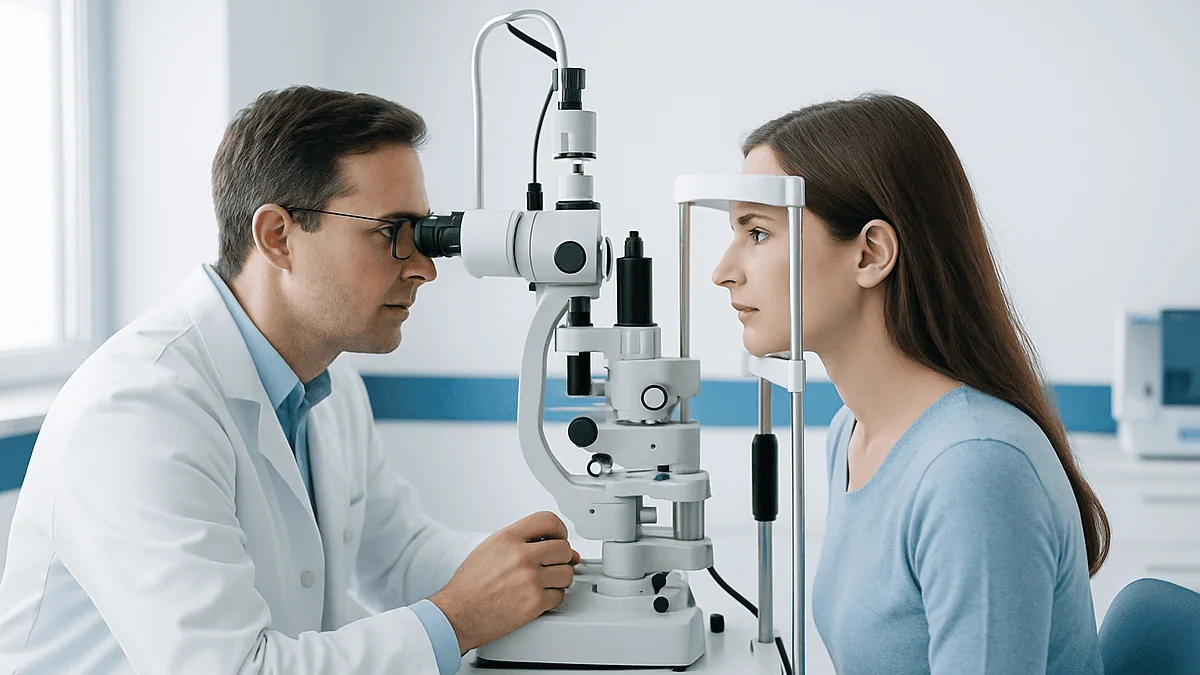
Key Takeaways
- In a 2016 study of 192 newborns, about 63% had brown eyes and only around 21% had blue, so brown, not blue, was the most common newborn eye color.
- Blue eyes contain no blue pigment; the color comes from light scattering off a low-melanin iris, the same physics that makes the sky look blue.
- As many as 16 genes influence eye color, with OCA2 and HERC2 on chromosome 15 doing most of the work, which is why the old one-gene brown-beats-blue rule fails.
- Most visible color change happens in the first 6 to 9 months, and subtle deepening can continue until about age 3, after which eye color is largely fixed.
- Blue eyes can turn brown as melanin accumulates, but brown eyes do not turn blue under normal development because iris pigment builds up rather than disappears.
- A white or cloudy pupil, a sudden color change in one eye, constant eye wobble, or failure to track faces by 3 to 4 months are red flags that warrant a same-week medical assessment.
No. The idea that all babies are born with blue eyes is a myth. Most newborns worldwide have brown eyes, because eye color depends on melanin and many babies already carry plenty of it at birth. Babies with little iris pigment, often of European ancestry, may start out blue or gray and darken as melanin builds over the first 6 to 12 months, with most eye color settled by about age three.
Somewhere in nearly every maternity ward, a grandparent leans over a bassinet, studies a squinting face and announces the verdict: those eyes will change. Sometimes they are right. Often they are not, and the confident prediction rests on a piece of folklore that has survived for generations without much evidence behind it.
The folklore says every human being arrives with blue eyes. Yet walk the same ward and you will see newborns with deep brown irises, newborns with slate-gray ones, and a fair number whose color is simply too murky to call on day one. The truth is more interesting than the myth, and it hinges on one pigment, a handful of genes and a slow biological process that keeps running long after the hospital bracelet comes off.
Here is what the research actually shows about newborn eye color, why it shifts, how long the shifting takes, and the small number of situations where an eye that looks unusual deserves a clinician’s attention.
So, are all babies born with blue eyes?
The short answer is no, and it is not a close call. When researchers in Northern California examined 192 newborns as part of a broader eye-screening study published in 2016, they found that roughly 63% had brown eyes at birth, about 21% had blue, a small group had green or hazel, and around one in ten had irises too indeterminate to classify. Those figures are summarized by Cleveland Clinic, and they flatten the myth in a single sentence: brown, not blue, was the most common newborn eye color in that group.
Where did the idea come from? Most likely from the fact that it is partly true for one population. Babies of European ancestry frequently do start with blue or gray eyes that darken later, and older parenting books written for those families turned a regional observation into a universal rule. Babies of African, Asian, Hispanic, Middle Eastern and Indigenous heritage are commonly born with brown eyes that stay brown.
There is a second half to the myth worth correcting. Even among light-eyed newborns, the color is rarely the clear sky-blue of a picture book. Neonatal irises often read as gray, steel or a cloudy blue-gray in the first weeks, because the eye is not yet finished doing the chemistry that produces its adult shade. The color you see at birth is a starting point, not a forecast.
What color are newborns' eyes, really?
Newborn eye color is a snapshot of how much melanin a baby has managed to deposit in the iris before birth. In the 2016 newborn study, brown dominated, and the distribution tracked closely with the parents’ ancestry: babies with two parents of European background were far more likely to have blue irises, while babies with parents of Asian, Hispanic or African heritage were overwhelmingly brown-eyed from the first day.
The gray, murky look that confuses so many families has a practical explanation. Melanin production in the iris is well underway at birth but incomplete, and the front layer of the iris, the stroma, is still thin and translucent. Light entering that layer scatters back toward you without much pigment to absorb it, producing a color that photographs as blue one hour and gray the next, depending on the room and the light.
Two more everyday factors muddy the picture. Newborns keep their eyes closed or half-closed for much of the day, and the eyelids are often puffy from delivery, so parents catch only brief glimpses. Newborn vision also focuses best at roughly 8 to 12 inches, according to Mayo Clinic, so the baby is not gazing steadily at anything, which makes it hard to hold their attention long enough to judge the shade. A calmer look in good daylight at the two-month checkup usually tells you more than day one ever could.
Why so many newborn eyes look blue or gray
There is no blue pigment in a blue eye. That single fact explains most of what happens in a baby’s first year. The iris has two layers that matter for color: a thin front layer called the stroma and a back layer that is packed with melanin in nearly everyone regardless of eye color. What varies between people is how much melanin sits in the stroma.
When the stroma holds little pigment, incoming light is scattered by the collagen fibers in the tissue, and the shorter blue wavelengths bounce back more strongly than the longer red ones. It is the same physics that makes a clear sky blue and clear water look blue in a white bathtub. Add melanin to the stroma and the effect fades: moderate amounts absorb some scattered light and produce green or hazel, and larger amounts absorb most of it, giving brown.
A newborn’s stroma has usually not finished accumulating whatever melanin its genes call for. Melanocytes, the pigment-producing cells, are present and working, but the buildup is gradual and continues after birth. A baby genetically destined for brown eyes may look dark from the start because pigment deposition ran ahead of schedule in the womb, or may look gray-blue for a few months while the cells catch up. A baby destined for blue eyes will simply stay pale, because the melanocytes were never programmed to add much.
This is also why eye color cannot be assessed the way a birth weight can. It is not a fixed measurement at birth; it is a process in progress.
How eye color actually works: one pigment, many shades
Every shade of human eye, from the palest gray to the darkest brown, comes down to the quantity and type of a single family of pigments. According to MedlinePlus Genetics, most of the genes tied to eye color are involved in producing, transporting or storing melanin inside the specialized cells of the iris. More melanin means a darker iris; less means a lighter one.
Melanin comes in two main forms. Eumelanin is brown-black and does most of the darkening work. Pheomelanin is reddish-yellow and, in small quantities in the iris, contributes warmth to hazel and amber tones. Green eyes are usually a mix: a modest amount of melanin over the scattering effect that on its own would read as blue.
The pigment sits inside tiny packages called melanosomes. Genes influence how many melanosomes a cell makes, how densely they are filled and how they are distributed, and small differences in any of those steps shift the final color. That layered control is why eye color behaves as a spectrum rather than a set of three or four boxes, and why siblings with the same parents can land on quite different shades.
One consequence matters for anxious parents: melanin in the iris tends to accumulate rather than disappear. Under normal development, eyes get darker or stay the same. They do not, as a rule, lighten, which is why the common worry that a brown-eyed baby will turn blue can be put to rest.
Which genes decide a baby's eye color?
For most of the twentieth century, schoolchildren learned that eye color followed a simple rule: brown dominant, blue recessive, one gene, done. It made for a tidy diagram and a wrong answer. Modern genetics shows that as many as 16 genes influence eye color, MedlinePlus Genetics notes, and the two heaviest hitters sit side by side on chromosome 15.
The first is OCA2, which produces a protein involved in melanin production in the iris. Variants that reduce its output lead to less pigment and lighter eyes. The second is HERC2, which contains a stretch of DNA that acts as a switch controlling how active OCA2 is. A common change in that switch turns the pigment gene down and is strongly linked to blue eyes in people of European descent.
Beyond that pair, a supporting cast of genes fine-tunes the result, nudging the shade toward green, hazel, amber or a lighter brown. Each contributes a small effect, and the combination is what makes prediction so slippery. Two blue-eyed parents produce blue-eyed children most of the time, but not always, because variants in those other genes can tip a child into green or even light brown.
The genetic story also explains the geography of eye color. Brown is the most common color worldwide, and lighter colors are found almost exclusively among people with European ancestry, a pattern consistent with the HERC2 variant having arisen and spread in that population.
When do babies' eyes change color? A realistic timeline
Eye color develops on a schedule that is loose but recognizable. Most of the visible change happens in the first six to nine months, according to Cleveland Clinic, with subtle shifts possible up to about age three. Very rarely, minor deepening continues into early childhood, but a dramatic change after the third birthday is unusual enough to mention at a checkup.
| Age | What parents typically see | What is happening in the iris |
|---|---|---|
| Birth to 1 month | Brown in most babies; gray, slate or cloudy blue in babies with little pigment | Melanin present but incomplete; thin, translucent stroma scatters light |
| 1 to 3 months | Color begins to look more definite as eyes open longer and the baby fixes on faces | Melanocytes continue depositing pigment; lids and cornea clear |
| 3 to 6 months | The biggest visible shifts; blue-gray may warm toward green, hazel or brown | Rapid melanin accumulation in genetically darker-eyed babies |
| 6 to 12 months | Most babies show their broad adult category | Pigment deposition slows |
| 1 to 3 years | Fine-tuning only; light hazel may deepen, blue may pick up a green cast | Small residual changes; color largely fixed |
Two caveats keep this honest. First, the timeline is for eyes that are lightening or darkening within the normal range; a sudden change in one eye, at any age, is a different matter covered later. Second, the pace is uneven. Some babies flip from gray to brown almost overnight around four months. Others hover in an undecided hazel for a year. Neither pattern signals a problem.
How long do a baby's eyes stay blue after birth?
It depends entirely on what the genes have in store, and the honest answer is that nobody can tell you from the delivery room. A newborn whose irises look blue may keep them for life, may drift to green or hazel by the first birthday, or may turn a clear brown by six months. The blue at birth is the same physical effect in all three babies; what differs is how much melanin the iris is about to add.
Cleveland Clinic offers a useful rule of thumb. Color that is still blue at nine months to a year is likely to stay in the blue-to-gray family, though it can deepen or pick up a green tint over the next two years. Color that is going to become brown usually shows clear warming, often a yellowish or hazel cast spreading outward from the pupil, well before the first birthday.
Parents sometimes report that their baby’s eyes look different from week to week, and in the early months they are not imagining it. Lighting changes the appearance of a low-pigment iris dramatically. Overcast daylight and pale clothing push it toward blue; warm indoor bulbs and a brown blanket push it toward gray or greenish. Emotion plays a small role too, because crying and excitement change pupil size, altering how much iris is visible and how it catches light.
If you want a fair comparison over time, photograph the eyes in the same spot, at the same time of day, once a month. The trend will be far more informative than any single glimpse.
Can a baby with blue eyes turn brown? Can brown turn blue?
Blue to brown, yes, and it happens constantly. Brown to blue, essentially no. The asymmetry follows directly from the biology: under normal development, melanocytes in the iris add pigment over the first years of life, and they do not remove it. An eye can only get darker or stay where it is.
That is why a brown-eyed newborn is the one case where the grandparent’s prediction can be answered with confidence. If the irises are clearly brown at birth, they will be brown at three, at thirteen and at thirty. The shade may deepen a little as childhood pigment settles, but the category will not change.
A blue-eyed or gray-eyed newborn is the open question. Roughly speaking, the more warmth you can see near the pupil in the first six months, the more likely the final color lies in the hazel-to-brown range. A flat, cool blue that persists past nine months usually stays.
What about adults who insist their eyes changed color later in life? A few explanations are legitimate. Hazel and green eyes shift in apparent hue with lighting, clothing and pupil size. Pigment can also gradually lighten with age, alongside the changes in the cornea and lens that come with years. Certain medical conditions and some eye medicines can alter iris pigment, which a clinician would evaluate case by case. None of those are the same as the developmental darkening of infancy, and none turn a brown baby into a blue toddler.
Are all white kids born with blue eyes?
No, though the myth is closest to true here, which is probably where it started. Babies of European ancestry are more likely than any other group to be born with low iris pigment, so a large share do begin with blue or, more often, gray-blue eyes. But a meaningful number of white newborns have brown, hazel or dark gray eyes from the first day, particularly when one or both parents are brown-eyed.
The 2016 newborn study makes the point in numbers. Blue was strongly associated with white ancestry, yet even in that population it was not universal, and a portion of babies fell into the brown, green-hazel or indeterminate groups. Ancestry shifts the odds; it does not write the rule.
Family patterns help more than skin color. Two blue-eyed parents usually have blue-eyed children, but because more than a dozen genes contribute, a green or light-brown result is possible. Two brown-eyed parents can have a blue-eyed baby if each carries low-pigment variants, which is common in families with European heritage. A brown-eyed parent and a blue-eyed parent can produce either outcome, with hazel a frequent compromise.
One practical note for mixed-heritage families, who often get the most confident and least accurate predictions from relatives: the child’s eye color is drawn from the whole combined pool of variants, not from a fixed rule about which side wins. A baby with one European and one East Asian parent may be born with any shade from gray to deep brown, and the color at birth is no more predictive than it is for anyone else.
What is the rarest baby eye color?
Among everyday colors, green is generally regarded as the least common, followed by gray, with hazel and blue more frequent and brown by far the most common worldwide. Mainstream medical sources, including MedlinePlus Genetics, note that lighter shades are found almost exclusively among people of European descent, which is why green is so uncommon on a global scale even though it is familiar in some regions.
Newborn rarity is a slightly different question, because green usually is not visible at birth. A baby who will grow up green-eyed typically starts gray or blue and acquires the green tint as a modest amount of melanin settles into the stroma over the first year or two. Truly green newborn eyes are therefore rarer than green adult eyes.
Beyond the usual palette sit colors that reflect specific medical conditions rather than ordinary variation. Very pale, almost pinkish or violet-looking irises, which let light reflect off the blood vessels at the back of the eye, are seen in oculocutaneous albinism, a group of inherited conditions in which melanin production is greatly reduced, as described by MedlinePlus Genetics. Two eyes of different colors, or one iris with a wedge of a different shade, is called heterochromia; it is uncommon and usually harmless, but it is one of the findings a clinician will want to look at.
Amber, a clear golden-brown with no green, is uncommon in most populations and is sometimes lumped in with hazel. It is a normal variant and not a cause for concern.
Can you predict your baby's eye color from the parents?
You can estimate the odds. You cannot make a promise, and any chart that claims otherwise is selling simplicity rather than science. The old classroom model, with one gene and brown beating blue, produces confident predictions that are wrong often enough to be useless; it cannot explain how two blue-eyed parents have a brown-eyed child, which does happen.
A fairer way to think about it is probabilistic. Two blue-eyed parents have a high chance of a blue-eyed child, with green or hazel as the most likely exceptions. Two brown-eyed parents most often have brown-eyed children, but if both carry low-pigment variants in OCA2 or HERC2, a blue-eyed baby is fully possible. One brown-eyed and one blue-eyed parent see a broad spread, with brown and hazel somewhat more likely than blue.
Grandparents’ eye colors can sharpen the estimate because they hint at which variants the parents may be carrying silently. A brown-eyed parent with two blue-eyed parents of their own is very likely carrying a blue variant.
Commercial genetic tests that report eye color are reading a handful of the known variants and returning a probability, not a certainty; they tend to do well at distinguishing blue from brown and poorly at the middle shades. There is no medical reason to seek such a test for a healthy baby, and the most reliable predictor remains the least glamorous one: wait until the first birthday and look.
Two different colored eyes, very pale eyes and other surprises
Most newborn eye color is unremarkable. A few patterns are worth understanding so they neither frighten you nor get overlooked.
Heterochromia means the two irises differ in color, or one iris contains a patch of a different color. MedlinePlus explains that it is often present from birth and frequently has no other consequences, but it can occasionally accompany inherited conditions. Waardenburg syndrome, for example, combines striking iris color differences or very bright blue eyes with hearing loss and a white forelock of hair. Because newborn hearing screening is routine, the combination is usually caught early, but a baby with clearly mismatched eyes should have the finding noted by a pediatric clinician.
Oculocutaneous albinism greatly reduces melanin in the skin, hair and eyes. The irises may look very light blue, gray or even pinkish as light reflects off the retina, and affected babies often have involuntary side-to-side eye movements, called nystagmus, and heightened light sensitivity. The condition itself is lifelong and manageable, and the priority is early vision assessment rather than the color.
Aniridia, a partial or complete absence of the iris, makes the pupil look unusually large and dark. It is rare and is associated with other eye and, in some cases, kidney concerns, so it is always evaluated.
Finally, a fine sprinkle of darker flecks in a light iris, or a darker ring around the outer edge, is normal texture, not a warning sign. The iris is a fibrous, pigmented structure and its surface is rarely a uniform color.
When to see a doctor about your baby's eyes
Color changes within the normal range, blue to hazel, gray to brown, gradual deepening over months, do not need medical attention. A handful of findings do, and they have little to do with shade and a great deal to do with how the eye is built and how it works.
Seek prompt advice if you notice a white, gray or cloudy appearance in the pupil rather than the normal black, especially if it shows up in photographs where one pupil reflects white while the other reflects red. This can indicate a cataract or, rarely, a tumor, and it is one of the specific things the newborn physical examination looks for, according to the NHS. Contact a clinician the same day if an eye suddenly changes color, if one iris darkens or lightens abruptly while the other does not, or if the eyes look markedly different in size.
Other red flags include eyes that constantly wobble or drift, a persistent inward or outward turn beyond the first few months, extreme sensitivity to ordinary light, excessive tearing with a cloudy or enlarged-looking cornea, or an iris that appears to be missing or misshapen. Developmental cues matter too: CDC milestones expect a baby to look at your face and follow you with their eyes by around two months, and a baby who never fixes on faces or tracks movement by three to four months should be assessed.
Trust your eyes as a parent. You look at your baby more than anyone else, and a change that strikes you as odd is reason enough to ask.
What newborn and well-child eye checks actually look for
Nobody at a routine appointment is grading your baby’s eye color. What clinicians examine is structure and function, and the schedule is designed to catch problems that benefit from early treatment.
In the United Kingdom, the NHS newborn physical examination, offered within 72 hours of birth and repeated at six to eight weeks, includes a check of the eyes. The examiner looks at the appearance and movement of the eyes and uses a light to check the red reflex from the back of each eye, the same reflection you see in flash photographs. A dull or white reflex can point to a cataract, which is why the test is performed so early. Pediatric well-child visits in the United States and elsewhere follow a similar pattern, adding checks of how well the eyes align and move together as the baby grows.
Across the first year, clinicians track whether the baby fixes on faces, follows objects, and reaches accurately, all of which reflect visual development. Alignment is watched closely because a persistent turn in one eye can lead the brain to favor the other, a condition that responds far better to treatment when identified early in childhood.
Formal vision screening with pictures or symbols usually starts in the preschool years. Until then, the most valuable contribution parents make is observation: noting how the eyes look in different light, whether they move together, and whether anything about them changes suddenly. Eye color will sort itself out on its own timeline. The structure behind it is what deserves the checkups.
Frequently asked questions
Are all babies born with blue eyes?
No. Most babies worldwide are born with brown eyes because their irises already contain substantial melanin at birth. Blue or gray newborn eyes are common mainly in babies of European ancestry, whose irises start with little pigment and may darken over the first year. In a 2016 study of 192 newborns, brown was the most common color at birth and blue accounted for roughly a fifth.
How long do a baby's eyes stay blue after birth?
It varies from a few months to a lifetime, depending on how much melanin the baby’s genes will deposit in the iris. Blue or gray eyes that are going to turn brown usually show clear warming by six months. Eyes that are still blue at nine to twelve months tend to stay in the blue-to-gray family, though they may pick up a green cast or deepen slightly until about age three.
Can a baby with blue eyes turn brown?
Yes, and it is common. Blue newborn eyes reflect a low starting level of iris melanin, and as pigment-producing cells add more over the first six to twelve months, the color can shift through hazel to brown. The reverse does not happen under normal development, because the iris accumulates pigment rather than losing it, so brown eyes at birth stay brown.
Are all white kids born with blue eyes?
No. Babies of European ancestry are the group most likely to be born with blue or gray eyes, which is probably where the myth began, but many white newborns have brown, hazel or dark gray eyes from day one, especially when one or both parents are brown-eyed. Ancestry changes the odds of a light-eyed newborn; it does not guarantee one.
What is the rarest baby eye color?
Among ordinary colors, green is generally considered the least common, and it is rarer still in newborns because the green tint usually develops over the first year or two as a small amount of melanin settles into a blue-gray iris. Brown is by far the most common color worldwide. Very pale pinkish or violet-looking irises are uncommon and are associated with albinism, which a clinician would evaluate.
When do babies' eyes change color the most?
The largest visible shifts usually happen between about three and six months, when melanin accumulation in the iris is most rapid. By nine to twelve months most babies show their broad adult category, and only fine-tuning, such as hazel deepening or blue gaining a green tone, continues to around age three. A dramatic change after that, or a change in one eye only, should be checked.
Why do my baby's eyes look gray instead of blue?
Gray is a very common newborn appearance for a low-pigment iris. The front layer of the iris is thin and only partly pigmented at birth, so it scatters light without a strong blue return, and warm indoor lighting, dark clothing and a puffy newborn eyelid all push the look toward gray. As the iris develops over the first months the color usually resolves into a clearer blue, green, hazel or brown.
Can two brown-eyed parents have a blue-eyed baby?
Yes. Eye color is shaped by as many as 16 genes, and brown-eyed parents can each carry low-pigment variants in genes such as OCA2 and HERC2 without showing them. If a child inherits those variants from both sides, blue eyes result. This is more common in families with European heritage, and a blue-eyed grandparent on each side makes the outcome more likely.
Is it normal for a baby to have two different colored eyes?
It can be. Heterochromia, a difference in color between the two eyes or within one iris, is often present from birth and frequently has no other effects. Because it occasionally accompanies inherited conditions, including some that affect hearing, it is worth having a pediatric clinician note the finding and confirm that routine hearing and eye checks are complete. A sudden color difference appearing later needs prompt assessment.
When should I worry about my baby's eye color or eyes?
Gradual darkening or shifting within normal colors is not a concern. Seek prompt medical advice for a white, gray or cloudy pupil, a white reflection in one pupil in flash photos, a sudden change in the color of one eye, constant eye wobbling, marked light sensitivity, a persistent eye turn after the first few months, or a baby who does not look at faces or follow movement by three to four months.
References
- MedlinePlus Genetics: Is eye color determined by genetics?
- MedlinePlus Medical Encyclopedia: Heterochromia
- MedlinePlus Genetics: Oculocutaneous albinism
- NHS: Newborn physical examination
This article is for general information only and is not a substitute for professional medical advice. Please consult a qualified doctor about your individual situation.

More from the Blog

What a Pediatric Physical Therapy Session Looks Like: Play, Strength Work and Skill Practice
A pediatric physical therapy session usually blends structured play with strength work and repeated practice of movement skills such as rolling, sitting, walking or…

Cradle Cap, Baby Eczema and Diaper Rash: The Three Baby Skin Problems, Sorted
Cradle cap is a harmless, common form of seborrheic dermatitis that causes greasy yellow or white scales on a baby's scalp in the first…

Supporting a Child Emotionally Through Pediatric Plastic Surgery: Words and Routines
Supporting a child emotionally before surgery works best when honest, age-matched words are paired with steady routines. Tell younger children a day or two…
Tummy Time and Flat Head: How Much, How Early and When a Helmet Is Discussed
Tummy time can begin in the first days at home, in short supervised sessions of a few minutes, building toward roughly 30 minutes spread…
How Do Pediatric Ophthalmologists Choose Between Laser and Injection Treatment for ROP?
Pediatric ophthalmologists choose between laser and anti-VEGF injection for retinopathy of prematurity based mainly on where the disease sits in the retina, how aggressive…

How Pediatric Plastic Surgery Is Timed: Growth, Function and Why Some Repairs Are Staged
There is no single right age for pediatric plastic surgery. Surgeons time each operation around growth and function: cleft lip is commonly repaired at…