

Arm Liposuction Recovery: Compression Sleeves, Bruising and When Lifting Feels Normal Again

Key Takeaways
- Swelling after arm liposuction typically peaks between roughly day three and the end of week two, so arms often look larger before they look smaller.
- Bruises usually progress from purple through green to yellow and fade within about two weeks, though the larger bruising from liposuction can linger longer.
- NHS guidance commonly cites around six weeks of compression garment wear and four to six weeks away from strenuous activity, with the surgeon's own protocol taking precedence.
- Liposuction removes fat cells but does not tighten skin; arms with poor skin elasticity may be better suited to a skin-removal procedure called brachioplasty.
- Remaining fat cells can enlarge with later weight gain, so weight stability, not the procedure itself, preserves the contour.
- Sudden one-sided calf pain, chest pain, or shortness of breath after surgery are emergency signs of a possible blood clot and need immediate care.
Arm liposuction recovery usually unfolds over weeks, not days. Soreness and bruising tend to peak in the first few days, swelling is often most noticeable in the first one to two weeks, and light daily activity typically resumes quickly. Many surgical teams advise a compression sleeve for several weeks and ask patients to avoid strenuous lifting for roughly four to six weeks, with the final contour settling over several months.
The first thing most people notice is not the arms at all. It is the sleeve. Pulling a fitted compression garment over tender, taped skin on the morning after surgery takes a surprising amount of patience, and it is usually the moment the reality of arm liposuction recovery lands: this is going to be a process, and the body sets the pace.
Then come the small negotiations. Can I wash my hair? Is this bruise supposed to be that color? Why do my arms feel heavier today than yesterday? And, for anyone who lifts groceries, toddlers, or barbells, the question that matters most: when will my arms feel like mine again?
This guide walks through what happens under the skin, why compression and bruising behave the way they do, and what the evidence says about typical timelines. Where the research is thin, we say so plainly. Every decision about your own recovery belongs with the team that operated on you.
What actually happens during arm liposuction?
Liposuction is a surgical procedure that removes fat from beneath the skin using suction through a thin hollow tube called a cannula. On the upper arm, the target is usually the soft tissue along the back and underside, between the shoulder and the elbow, where fat tends to persist regardless of training.
Most modern techniques begin with a tumescent step. Tumescent means the surgeon injects a large volume of dilute fluid into the fat layer. That fluid contains a local anesthetic to numb the area and a medicine that narrows small blood vessels, which limits bleeding and, in turn, bruising. The tissue swells and firms up, which makes it easier to remove fat evenly. Some surgeons add energy from ultrasound or laser devices to loosen fat before suction; the Mayo Clinic notes these variations exist, but the basic principle, fluid in and fat out through small openings, is shared across approaches.
The incisions themselves are small, often near the elbow crease or toward the armpit, chosen so scars sit in natural folds. Through these ports the surgeon moves the cannula back and forth, creating a network of tiny tunnels in the fat. This tunneling matters for recovery. Those tunnels fill with fluid and blood in the first days, then gradually collapse and heal, which explains why arms feel firm and uneven for a while before they soften.
Anesthesia varies. Smaller areas may be done under local anesthetic with or without sedation; larger or combined procedures are often performed under general anesthetic, according to Mayo Clinic and NHS guidance. The choice affects the first day of recovery, particularly grogginess and nausea, but not the weeks-long process of swelling and healing underneath.
One point worth stating early: liposuction removes fat cells, but it does not tighten skin in any dependable way. How the arm looks afterward depends heavily on how elastic the skin was before surgery.
Who is arm liposuction usually for, and who is asked to wait?
Surgeons generally consider arm liposuction for adults whose weight is stable and whose skin has enough elasticity to shrink back after fat is removed. The Mayo Clinic describes liposuction as a body-contouring procedure for people close to their target weight, not a treatment for obesity or a substitute for weight loss. The NHS makes the same point in stronger terms: it is not a weight-loss method and does not remove cellulite or stretch marks.

Arms are a distinctive case because the skin on the back of the upper arm is thin and loses elasticity relatively early with age, sun exposure, and weight fluctuation. When skin is loose, removing the fat beneath it can leave the arm looking deflated rather than slimmer. In that situation many surgeons discuss skin-tightening surgery, called brachioplasty, either instead of or alongside liposuction, and a consultation often turns on a simple pinch test of how quickly the skin recoils.
People are commonly asked to wait, or advised against the procedure, when:
- Weight is still changing significantly, since results are shaped around current body composition.
- They smoke or use nicotine, because nicotine narrows blood vessels and slows wound healing; most teams ask for a nicotine-free period before and after surgery.
- They have poorly controlled diabetes, heart disease, bleeding disorders, or a weakened immune system, all of which raise surgical risk according to Mayo Clinic guidance.
- They are pregnant or recently postpartum, when tissue and fluid balance are still shifting.
- Their expectations center on skin tightening or dramatic size change, which liposuction cannot reliably deliver.
Age itself is not a cutoff. Skin quality and overall health matter far more than the number on a birth certificate. The assessment, and any decision to proceed, defer or choose a different procedure, sits with the operating team.
How painful is arm lipo recovery, honestly?
Most people describe the sensation less as sharp pain and more as a deep, bruised ache, the feeling of having done far too many push-ups the day before, spread across the whole upper arm. It tends to be worst in the first two to three days, then settles into soreness that flares with movement and eases with rest.
Why arms specifically can feel intense: the upper arm has little room for swelling to spread. Fluid is trapped between skin, muscle, and the compression garment, so pressure builds quickly. Add the fact that arms move with nearly every daily task, from brushing teeth to opening doors, and the area gets no real rest in the way an abdomen or thigh might.
Pain control is typically layered. Surgeons commonly prescribe or recommend medicines from a few classes: acetaminophen, anti-inflammatory drugs, and sometimes a short course of stronger analgesics for the first days. Which combination, and for how long, is decided by the prescribing clinician based on your health history and what else you take. Ice wrapped in cloth over the garment, arm elevation on pillows, and keeping the compression sleeve smooth and correctly placed often reduce discomfort more than people expect.
The tumescent fluid also plays a role. Its local anesthetic can keep the area partially numb for many hours after surgery, which sometimes means the first evening feels deceptively easy and the second morning feels harder. That is a common pattern, not a sign something has gone wrong.
Two sensations deserve special mention because they worry people. A tight, burning feeling under the skin, sometimes described as sunburn from the inside, is typical as nerves recover. Sharp, one-sided, rapidly worsening pain, especially with spreading redness or a hot arm, is not, and belongs in the red-flag section below.
The first 72 hours: leaking fluid, dressings and the sleeve going on
Expect the unexpected in the first three days, and expect fluid. The tumescent solution injected during surgery does not all come out with the fat. A pink, watery mix of leftover fluid and small amounts of blood drains from the incision sites for roughly a day or two, sometimes longer. It can look alarming on a pillowcase. Surgical teams typically place absorbent pads under the garment and advise dark towels on bedding for this reason. The Mayo Clinic lists temporary fluid drainage among the expected early experiences after liposuction.
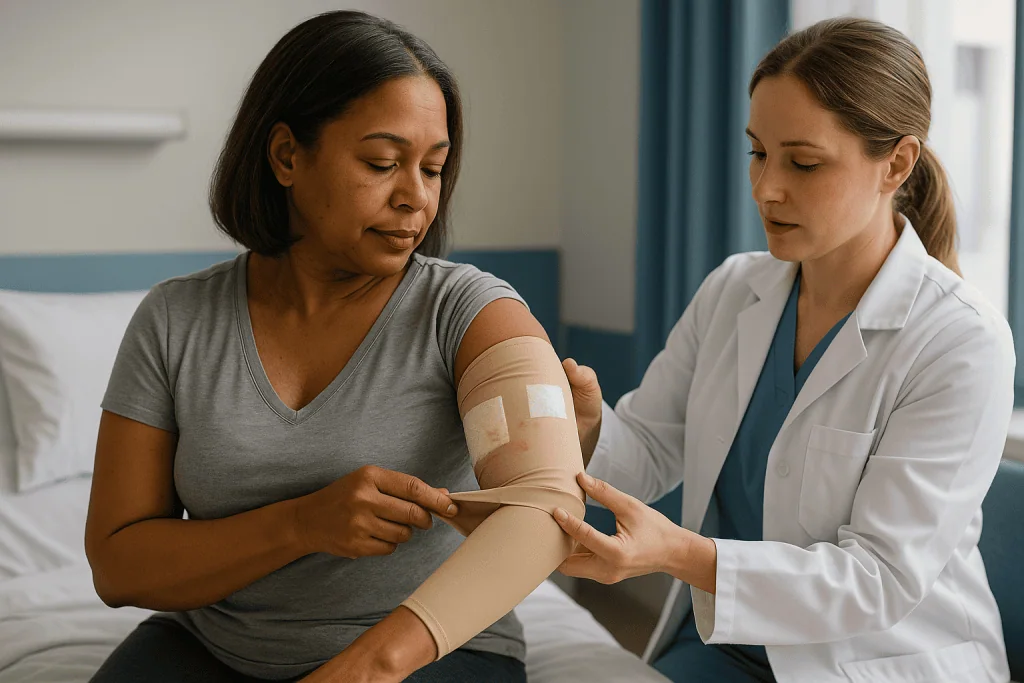
Dressings vary. Some surgeons close incisions with a stitch, others leave them open to drain, and many use skin glue or small adhesive strips. Your written instructions will say whether the dressings stay dry, when they can be changed, and when showering is allowed; for many teams that is after 24 to 48 hours once drainage slows, but the specific timing comes from your team, not a general article.
The compression sleeve usually goes on in the operating room or recovery area and, in many protocols, stays on around the clock during this phase. Its jobs in the first days are to limit fluid accumulation, support bruised tissue, and encourage the tunnels created by the cannula to close flat.
Practical realities that catch people out:
- Lifting arms overhead to dress or wash hair is difficult; front-opening tops and a helper for the first two days make a real difference.
- Fingers and hands may look puffy as fluid tracks downhill, particularly when arms hang at the sides.
- Light-headedness on standing is common after fluid shifts and anesthesia; rising slowly and drinking regularly help.
- Short, frequent walks around the home are encouraged from day one to keep blood moving in the legs.
By the end of day three, leaking has usually stopped, soreness has plateaued, and the swelling phase, rather than the drainage phase, takes over.
Compression sleeve after arm liposuction: what it does and how long people wear it
A compression sleeve is a snug, elasticated garment that applies steady pressure to the operated area. After arm liposuction it usually runs from wrist or forearm to the shoulder, sometimes as a vest with sleeves so the pressure does not stop abruptly at the armpit and create a ridge.
Mechanically, compression does three things. It reduces the space where fluid can collect, lowering the chance of a seroma, a pocket of clear fluid that can form under the skin after surgery. It supports the tunneled fat layer so that as tunnels heal they do so flat rather than in ridges. And it limits swelling by opposing the pressure of fluid leaking from disturbed capillaries. The MedlinePlus liposuction overview and NHS guidance both describe wearing a compression garment for several weeks as a standard part of recovery.
How long is long enough? Evidence from controlled trials is limited, and practice differs between surgeons. A common pattern, echoed in NHS patient information, is continuous wear for the first few weeks, then daytime-only wear or a lighter garment for several more, with a total of around six weeks frequently cited. Your surgeon’s protocol overrides any generic figure.
Fit matters more than duration. Signs a sleeve is too tight include numb or blue-tinged fingers, deep grooves that persist after removal, or pain that eases dramatically when it is loosened. Signs it is too loose include bunching, rolling at the edges, and visible swelling below the garment line. Both problems should be reported rather than tolerated.
Small habits help: smoothing wrinkles every time the sleeve is repositioned, washing garments as directed so elastic recovers, and owning two if your team advises it, so one can dry while the other is worn. Removing the sleeve for a shower is often permitted early, but reapplying it while arms are still swollen can be a two-person job.
Bruising after arm liposuction: what the colors mean and how long it lasts
A bruise is bleeding trapped under the skin. Liposuction creates thousands of tiny vessel breaks as the cannula moves through fat, so bruising is not a complication; it is the expected trace of the procedure. On arms it often appears in streaks or bands following the direction of the cannula strokes, and gravity pulls it downward, so bruising can show up near the elbow or forearm even when those areas were not treated.
Color is a rough clock. The NHS explains that bruises typically start red or purple, shift to blue or dark purple as hemoglobin loses oxygen, then turn green, then yellow-brown as the body breaks down the pigment, and usually fade within about two weeks. After liposuction the volume of bruising is larger than a typical knock, so the tail end can stretch beyond that, with faint yellow patches lingering into the third or fourth week. Skin tone affects how visible each stage is; on darker skin bruises may look deep brown or nearly black rather than purple.
Several factors influence how heavily someone bruises:
- Medicines and supplements that thin the blood, including some over-the-counter pain relievers, fish oil, and certain herbal products. Surgeons usually review these before surgery; never stop a prescribed medicine on your own.
- Alcohol in the days around surgery, which dilates vessels.
- The technique used and the volume removed.
- Individual variation in vessel fragility.
Arnica and bromelain are widely sold for post-surgical bruising. The evidence is mixed and studies are small, so the honest position is that they have not been convincingly shown to help, and any supplement should be cleared with your surgical team because some interact with anesthesia or bleeding.
What is not routine: a bruise that is rapidly expanding, tense and very painful, or accompanied by a firm swelling that feels like a water balloon. That pattern can indicate a hematoma, a collection of blood under the skin, and warrants a call.
When is swelling the worst after liposuction? The arm lipo swelling timeline
Swelling usually peaks later than people expect. The first day or two can look relatively good because the tissue has not yet mounted its full inflammatory response. Then, somewhere between roughly day three and the end of the second week, arms often reach their puffiest. Many patients describe looking bigger than before surgery at this stage and feeling quietly panicked. This is the single most common cause of early regret, and it is temporary.
Inflammation is the mechanism. Injured tissue releases signals that make capillaries leaky, drawing protein-rich fluid into the space where fat used to be. Lymphatic vessels, the drainage system that normally clears this fluid, are themselves disrupted by the cannula, so clearance is slow. The Mayo Clinic notes that swelling after liposuction can take several weeks to subside and that the treated area may look uneven or lumpy while it does.
A rough pattern, understanding that individuals vary widely:
- Days 1 to 3: moderate swelling, active drainage, arms feel heavy.
- Days 3 to 14: peak swelling, tightness, hands may puff by evening.
- Weeks 2 to 6: steady decline, though evenings and warm weather bring it back.
- Months 2 to 6: residual firmness fades; NHS guidance says it can take up to six months to see the full result.
Arms swell in a particular way. Fluid follows gravity into the forearm and hand when arms hang, so keeping them elevated on pillows while resting and avoiding long periods with arms dangling makes a visible difference. Salt-heavy meals, alcohol, heat, and long flights all encourage fluid retention and can cause a setback that looks worse than it is.
Sudden new swelling in one arm after a period of improvement is a different matter and is discussed under red flags.
How long does arm lipo take to heal? A week-by-week guide
Healing happens in overlapping layers: skin closes in days, deep tissue settles over weeks, and the final shape declares itself over months. The table summarizes typical ranges drawn from NHS and Mayo Clinic patient guidance. They are averages, not promises, and your surgeon’s instructions take precedence.
| Stage | What is usually happening | What most people can do |
|---|---|---|
| Days 1 to 3 | Fluid drainage, soreness peaking, compression worn continuously | Walk around the home, eat and drink normally, rest with arms elevated |
| Days 4 to 7 | Swelling at or near its peak, bruising fully developed | Light self-care, short walks outdoors, desk work if comfortable |
| Week 2 | Bruising shifting to green and yellow, soreness easing | Many return to non-physical work around this point (NHS) |
| Weeks 3 to 4 | Swelling declining, firmness and numbness noticeable | Gentle stretching, longer walks, low-impact cardio if cleared |
| Weeks 4 to 6 | Deep tissue healing continues | Strenuous activity typically avoided until this window closes (NHS) |
| Months 2 to 6 | Residual swelling and firmness fade, scars mature | Progressive return to full training; final result visible by around six months (NHS) |
Two things distort this timeline. First, combined procedures: if arms were treated alongside the back, abdomen, or chest, overall recovery follows the largest area, not the arms. Second, individual biology. People who swell easily, retain fluid, or have slower lymphatic drainage may run weeks behind the table without anything being wrong.
Scars deserve a note. The small incisions typically fade over a year or more. Early on they may look red, raised, or darker than surrounding skin, particularly in people who tend toward pigmentation changes. Sun protection over the scars during the first year is a widely recommended precaution because ultraviolet exposure can darken healing skin.
When does lifting feel normal again after arm liposuction?
For most people, everyday lifting, a kettle, a bag of groceries, a small child onto a hip, becomes comfortable within the first two weeks, though it may still feel odd, tight, or clumsy. Real strength training, overhead pressing, pull-ups, and anything that loads the triceps hard is a different matter, and this is where the four-to-six-week window cited in NHS guidance for avoiding strenuous activity comes from.
Why the wait? Three reasons. Vigorous exercise raises blood pressure and heart rate, which pushes more fluid into healing tissue and increases the risk of bleeding into the surgical space. Repeated stretching of the tunneled fat layer while it is still knitting can encourage fluid pockets and uneven healing. And sweat under a compression garment irritates incisions that are still fragile.
A staged return is what most surgical teams describe, and it typically looks like this:
- Weeks 1 to 2: walking, gentle range-of-motion movements to prevent shoulder stiffness, no resistance.
- Weeks 2 to 4: lower-body work, stationary cycling, brisk walking, still avoiding arm loading and anything that jolts the arms.
- Weeks 4 to 6: light resistance with high repetitions if the surgeon clears it, stopping if swelling increases the next day.
- Beyond week 6: progressive return toward previous loads, guided by how the tissue responds rather than the calendar.
Feeling normal lags behind being allowed. Many people report that arms feel strong enough by week four but that the skin feels tight and the deep tissue feels woody or numb for two or three months. Grip may feel weaker early on, largely because swelling in the forearm and hand limits movement, not because muscle has been affected. Liposuction removes fat above the muscle and does not cut through it.
The signal to respect is next-day swelling. If a session leaves the arm noticeably puffier the following morning, the tissue is asking for more time.
What should I do to recover quickly after liposuction? The realistic version
There is no shortcut through inflammation, but there are habits that keep recovery on track and habits that reliably set it back. The evidence for most of these comes from general surgical recovery guidance rather than liposuction-specific trials, so treat them as sensible support, not accelerants.
Movement is the most useful single habit. Short walks several times a day from the first evening keep blood flowing in the legs, which is the basic measure against deep vein thrombosis, a clot in a deep leg vein that is a recognized risk after any surgery involving anesthesia and reduced mobility. Walking also encourages lymphatic drainage, which helps swelling clear.
Hydration works the opposite way from intuition. Drinking regularly does not increase swelling; it supports kidney function and helps the body process the fluid shifts of surgery. Very salty foods, by contrast, encourage fluid retention and are commonly limited in the first weeks.
Protein and overall nutrition matter because wound healing is a construction project. Skipping meals to see results faster undermines the tissue repair that produces the result.
Nicotine in any form, including vaping and patches, constricts small blood vessels and slows healing. Mayo Clinic guidance identifies smoking as a factor that raises surgical risk, and most teams ask for abstinence for a period on both sides of surgery.
Compression, worn as instructed and refitted when it stops fitting, does more for the final contour than any supplement or device marketed for recovery.
Rest, but not bed rest. Lying flat for days increases clot risk and does nothing for swelling. Rest with arms elevated on pillows above heart level, then get up and walk.
Patience is the unglamorous last item. People who judge their result at week two are looking at swelling. People who judge it at month four are looking at something much closer to the outcome.
Numbness, lumps, firmness and the question of lymphatic massage
Around week two or three, as swelling recedes, many people discover a new set of sensations that were hidden underneath it. The skin may feel numb, tingly, or oddly hypersensitive. The tissue beneath may feel lumpy, ropey, or firm, sometimes described as a bag of marbles or a hardened sponge. None of this is unusual.
Numbness comes from small sensory nerves in the fat layer that are stretched or bruised by the cannula. The Mayo Clinic lists temporary or, less commonly, permanent numbness among the recognized effects of liposuction. In most cases sensation returns gradually over weeks to months, often with a phase of tingling or itching as nerves reconnect.
Firmness and lumps reflect the healing tunnels. As fluid clears, the body lays down early scar tissue along the paths the cannula took. This organized tissue is stiff before it remodels and softens. Unevenness during this phase does not predict the final contour, although persistent contour irregularities are a known risk of liposuction that the Mayo Clinic notes can be permanent, particularly where skin elasticity is poor.
Manual lymphatic drainage, a gentle massage technique intended to move fluid toward functioning lymph nodes, is widely offered after liposuction. The honest summary: high-quality trials in this setting are scarce, and the evidence that it changes the final result is limited. Many patients find it comfortable and report feeling less tight, which is a reasonable goal in itself. Vigorous or deep massage on freshly operated tissue, however, can cause bruising or bleeding, so any hands-on treatment should be cleared with the surgical team first and delivered by someone trained in post-surgical care.
Firmness that is spreading, hot, red, or accompanied by fever is not part of normal remodeling and belongs in the red-flag list. Steady, painless, slowly softening firmness usually is.
What people often get wrong about arm liposuction recovery
Myth: the arms will look thinner immediately. In reality, swelling can make them look larger for the first week or two. The visible reduction emerges over weeks, and NHS guidance puts the full result at up to six months.
Myth: liposuction tightens loose skin. It does not, at least not reliably. Removing fat under loose skin can make laxity more obvious. Skin quality is assessed beforehand precisely because some arms are better served by a skin-removal procedure, brachioplasty, than by liposuction alone.
Myth: fat cannot come back. The fat cells removed do not regenerate, but the Mayo Clinic notes that remaining fat cells can enlarge with weight gain, and new fat can be deposited elsewhere. Stable weight protects the result; the procedure does not.
Myth: more compression, or tighter compression, is better. Excessive pressure can restrict circulation, cause skin creases that heal as ridges, and drive fluid into the hands. The goal is snug and even, not tight.
Myth: pain is a sign the surgery went wrong, and no pain means it went right. Discomfort is expected. What matters is the pattern: steadily improving soreness versus sharp, one-sided, worsening pain.
Myth: exercise speeds recovery. Gentle walking does. Strenuous training before tissue has healed increases swelling and the risk of fluid collections, which is why a four-to-six-week restriction on vigorous activity is standard in NHS guidance.
Myth: lymphatic massage, supplements, or devices can substitute for time. Some may improve comfort. None has strong evidence for changing the final result, and several supplements interact with bleeding or anesthesia.
Myth: it is a weight-loss procedure. Both the NHS and Mayo Clinic state plainly that it is not. The volume removed from arms is modest, and the aim is proportion, not pounds.
Questions to ask your care team before and after arm liposuction
A good consultation leaves you with fewer surprises than a good search engine can. These questions are framed to draw out specifics rather than reassurance.
Before surgery:
- Given my skin elasticity, is liposuction alone likely to give the result I am describing, or would you discuss skin tightening as well?
- What anesthesia do you plan, and how will that shape my first 24 hours?
- Which of my current medicines and supplements should be reviewed before surgery, and who will make those decisions with me?
- What is your specific compression protocol: how many hours a day, for how many weeks, and when does it step down?
- What is your policy on showering, dressings, and when I can remove the garment?
- How do you handle fluid collections or contour irregularities if they occur, and how common are they in your practice?
After surgery:
- What level of swelling and bruising would make you want to see me sooner than my scheduled follow-up?
- Which activities are cleared this week, and what is the next milestone?
- Do you recommend or advise against lymphatic massage, and if so, when and with whom?
- My arm feels lumpy or numb; is this within the range you expect at this stage?
- When will you assess the final result, and what would prompt a discussion about revision?
- Who do I contact out of hours, and what symptoms should trigger that call rather than a wait?
Write the answers down. Post-operative instructions given while you are groggy are easily lost, and having your surgeon’s own protocol in writing is the best defense against generic advice, including the general ranges in this article.
When to call your doctor after arm liposuction
Most of arm liposuction recovery is uncomfortable but uneventful. A small number of problems need prompt attention, and the pattern to watch is change that is sudden, one-sided, or worsening rather than gradual and symmetrical.
Contact your surgical team the same day if you notice:
- Fever, chills, or feeling generally unwell, which can signal infection.
- Spreading redness, warmth, or increasing pain around an incision, or pus-like or foul-smelling drainage.
- A rapidly enlarging, tense, very painful swelling in the arm, which may indicate bleeding under the skin.
- A soft, fluid-filled swelling that sloshes or persists beyond what your team described, which may be a seroma.
- Numbness or color change in the fingers that does not resolve when the compression garment is loosened.
- Bleeding from an incision that does not stop with gentle pressure.
Seek emergency care immediately, without waiting to reach your surgeon, for:
- Chest pain, sudden shortness of breath, coughing up blood, or a racing heartbeat, which can indicate a blood clot that has traveled to the lungs.
- Pain, swelling, warmth, or redness in a calf or thigh, described by the NHS as signs of deep vein thrombosis.
- Confusion, fainting, severe dizziness, or a seizure.
- Sudden severe abdominal pain if other areas were treated at the same time.
The Mayo Clinic lists infection, fluid accumulation, bleeding, fat embolism, and internal injury among liposuction’s recognized risks. They are uncommon, and early recognition changes outcomes, which is why surgical teams would far rather take a call about a symptom that turns out to be normal than miss one that is not. If you are unsure, the right move is to call.
Frequently asked questions
How painful is arm lipo recovery?
Most people describe a deep, bruised ache rather than sharp pain, usually worst in the first two to three days and easing over the following week. Arms can feel more intense than other areas because swelling has little room to spread and the arms move constantly. Pain relief plans vary and are set by the prescribing clinician. Sharp, one-sided, worsening pain with redness or heat is not typical and should be reported.
How long does it take to recover from arm liposuction?
Light daily activity often resumes within days, and NHS guidance suggests many people return to non-physical work after around two weeks. Strenuous activity is typically avoided for four to six weeks, and the final contour can take up to six months to show as residual swelling and firmness fade. Individual healing varies, and combined procedures extend the timeline.
When is swelling the worst after liposuction?
Swelling usually peaks between roughly the third day and the end of the second week, later than most people expect. The first day can look deceptively good before inflammation fully develops. Swelling then declines over weeks, with evenings, heat, salty food, and arms hanging down all making it temporarily worse. The Mayo Clinic notes that swelling can take several weeks to settle.
How long do I wear a compression sleeve after arm liposuction?
Protocols differ between surgeons, but a total of around six weeks is commonly cited in NHS patient guidance, often as continuous wear for the first few weeks followed by daytime wear. The sleeve limits fluid buildup, supports healing tissue, and helps the treated layer settle evenly. Follow your own team’s instructions, and report a garment that causes numb fingers or deep persistent grooves.
What is the arm lipo swelling timeline for hands and fingers?
Hands and fingers often puff up in the first one to two weeks because fluid from the upper arm drains downward with gravity, especially when arms hang at the sides. This usually eases as upper-arm swelling declines and with regular elevation on pillows. Fingers that turn blue, become very numb, or stay swollen when the compression garment is loosened should be reported promptly.
What should I do to recover quickly after liposuction?
There is no true shortcut, but short frequent walks from day one, regular hydration, adequate protein, avoiding nicotine and alcohol, and wearing compression exactly as instructed all support healing. Resting with arms elevated rather than lying flat helps swelling. Strenuous exercise before your team clears it tends to increase swelling and set recovery back rather than speed it up.
How long does bruising last after arm liposuction?
The NHS notes that typical bruises fade within about two weeks, moving from purple to green to yellow-brown as the body clears the trapped blood. Because liposuction causes more extensive bruising than an ordinary knock, faint yellow patches can persist into the third or fourth week. A rapidly expanding, tense, very painful bruise is different and may indicate bleeding under the skin.
Why do my arms feel lumpy and hard weeks after liposuction?
As swelling clears, the tiny tunnels created by the cannula heal with early scar tissue, which feels firm, ropey, or lumpy before it remodels and softens over the following months. This is a normal phase of healing and does not predict the final contour. Firmness that is hot, red, spreading, or accompanied by fever is not typical and should be checked by your surgical team.
Does lymphatic massage help after arm liposuction?
The evidence is limited. Gentle manual lymphatic drainage is widely offered and many people find it relieves tightness, but high-quality trials showing it changes the final result are scarce. Deep or vigorous massage on freshly operated tissue can cause bruising or bleeding. Ask your surgeon whether they recommend it, when it is safe to begin, and who should perform it.
Can fat come back to the arms after liposuction?
The fat cells removed do not regenerate, but the Mayo Clinic notes that remaining fat cells can enlarge with weight gain and new fat may be stored elsewhere in the body. Liposuction reshapes proportions rather than preventing future weight change. Keeping weight stable is what protects the contour over time; the procedure itself offers no ongoing protection.
References
This article is for general information only and is not a substitute for professional medical advice. Please consult a qualified doctor about your individual situation.

More from the Blog

How Fat Transfer Works Step by Step: Harvesting, Purifying and Injecting Your Own Fat
Fat transfer, also called fat grafting, is done in three stages during one procedure. A surgeon removes fat from an area such as the…
Is Body Aesthetics Surgery Right for You? Weight Stability, Skin Quality and Overall Health
A body aesthetics surgery candidate is usually an adult whose weight has held steady for months, who does not smoke, whose long-term conditions are…

Does Hi Def Liposuction Build Muscle? Separating Fact From Marketing on Sculpted Abs
No. Hi def liposuction does not build muscle. It removes fat from the thin layer under the skin and sculpts what remains so that…

CoolSculpting vs Liposuction: What Each Can Remove, Downtime and Who Suits Which Approach
Cryolipolysis (the technique widely known by the trade name CoolSculpting) and liposuction both target pockets of fat under the skin, but they differ in…
Which Patients Suit Fat Grafting? Donor Areas, Skin Quality and Volume Goals Explained
A good fat grafting candidate is generally a healthy, non-smoking adult at a stable weight who has enough surplus fat in a donor area…

Does Laser Liposuction Hurt? Anesthesia Options and Managing Soreness in the First Days
Laser liposuction is usually done under local anesthesia, so most people feel pressure, warmth and tugging rather than sharp pain during the procedure. Soreness…