

Autologous Stem Cell Transplant for Multiple Myeloma: Collection, Conditioning and Recovery

Key Takeaways
- In an autologous transplant the stem cells do not treat the myeloma; they rescue the bone marrow after a single very high dose of chemotherapy that does the anti-cancer work.
- Stem cells are collected from circulating blood by apheresis after growth-factor mobilization, in sessions of roughly three to five hours over one to several days, and many centers store enough for two transplants.
- Engraftment, when new neutrophils appear, typically occurs about two to three weeks after the cell infusion, and the hardest days usually fall between day five and day twelve.
- In the randomized IFM 2009 trial, early transplant extended median progression-free survival to about 50 months versus about 36 months with drug therapy alone, while four-year overall survival was similar because deferred patients could receive transplant later.
- Eligibility is judged on fitness, organ function and personal goals rather than age alone, and deferring transplant to first relapse is a recognized, guideline-supported strategy.
- Feeling fully recovered can take a year or more, childhood vaccines must be repeated on a schedule, and maintenance therapy usually continues for years after the transplant itself.
An autologous stem cell transplant for multiple myeloma uses a person's own blood-forming stem cells, collected after initial chemotherapy, to rescue the bone marrow after a single very high dose of chemotherapy. The cells are returned through a vein, new blood counts typically appear within two to three weeks, and fuller recovery unfolds over several months. It aims to deepen and prolong disease control, not to end the disease permanently.
The folder on the kitchen table is thicker than any homework a family has ever brought home. Consent forms, a calendar with a circled date labeled “day zero,” a list of foods to avoid, a phone number for the after-hours line. The person whose name is on every page has finished four months of induction chemotherapy for multiple myeloma and feels, honestly, better than in a year. And now the team is proposing something that sounds like going backward: a dose of chemotherapy so strong it will wipe out the bone marrow, followed by a rescue with cells collected from their own arm.
That paradox is the heart of an autologous stem cell transplant for myeloma. It is not a transplant in the way most people picture one. There is no donor, no waiting list, no organ. It is a carefully sequenced way of giving chemotherapy that would otherwise be unsurvivable, then handing the body back the tools to rebuild.
This explainer walks through what happens at each stage, what the evidence does and does not show, and the questions worth asking before anyone signs the last page in that folder.
What actually happens in an autologous stem cell transplant for myeloma?
Multiple myeloma is a cancer of plasma cells, the white blood cells in bone marrow that normally make antibodies. In myeloma, one abnormal plasma cell copies itself relentlessly, crowding out healthy marrow and often producing a useless antibody fragment called M protein that can be measured in blood or urine. Plasma cells are sensitive to chemotherapy, and the more chemotherapy they receive, the more of them die. The limiting factor has never been the cancer’s resistance so much as the marrow’s fragility: the dose that would kill the most myeloma would also destroy the stem cells that make every red cell, white cell and platelet a person needs.
The transplant sidesteps that ceiling. Hematopoietic stem cells, the immature cells in bone marrow that mature into all blood cells, are coaxed into the bloodstream and harvested in advance. They are frozen. The person then receives a single, very high dose of chemotherapy, a step called conditioning, which depletes myeloma cells and the marrow together. A day or two later the frozen cells are thawed and infused through a central line, much like a blood transfusion. They find their way back into the marrow spaces and, over roughly two to three weeks, begin producing new blood cells, a milestone called engraftment.
The word autologous simply means “from oneself.” Nothing foreign enters the body, so there is no rejection and no graft-versus-host disease, the complication in which donor immune cells attack the recipient. That is the great advantage of this approach. Its limitation follows from the same fact: because the cells are the patient’s own, there is no new immune system to hunt down residual myeloma. The chemotherapy does all the work, and the stem cells make surviving it possible.
Autologous vs allogeneic transplant: why myeloma teams usually use your own cells
Two broad kinds of stem cell transplant exist, and the distinction matters because they are often confused in conversation. An allogeneic transplant uses cells from a donor, matched as closely as possible by tissue type. An autologous transplant uses the patient’s own cells. For myeloma, the autologous route is standard, and the reasons are practical as much as biological.

| Feature | Autologous (own cells) | Allogeneic (donor cells) |
|---|---|---|
| Source of stem cells | Patient, collected before high-dose chemotherapy | Matched relative or unrelated donor |
| Rejection or graft-versus-host disease | Does not occur | Significant risk, requires long immune suppression |
| Anti-cancer effect from new immune cells | None; relies on chemotherapy alone | Possible “graft-versus-myeloma” effect |
| Treatment-related risk | Lower | Higher, especially in older adults |
| Typical role in myeloma | Standard consolidation for eligible patients | Usually within clinical trials or selected younger, high-risk cases |
The trade-off is honest. Donor cells can attack myeloma, but the same cells attack skin, gut and liver, and the death rate from the procedure itself has historically been much higher. Most people with myeloma are diagnosed in their late sixties or seventies, according to Mayo Clinic, an age at which the allogeneic option is rarely justified. The autologous approach gives a large fraction of the benefit of intensive treatment with a fraction of the danger, which is why guideline bodies across countries describe it as the reference standard for people fit enough to receive it.
One consequence worth understanding early: because no new immune system arrives, the transplant is best thought of as a very deep round of chemotherapy rather than an immune reset. That framing prevents disappointment later, when maintenance treatment is discussed.
Transplant eligibility in myeloma: who is usually offered it, and who is asked to wait
Eligibility is not about a birthday. Older guidelines drew lines around age 65 or 70, but current practice, described in NHS and Mayo Clinic patient information, weighs overall fitness, organ function and the person’s own priorities far more than the number on a driver’s license. Some seventy-five-year-olds proceed comfortably; some fifty-year-olds are advised against it.
The team typically looks at several domains together. Heart and lung function must be able to tolerate fluid shifts, infection and a period of severe anemia. Kidney function matters because myeloma itself commonly injures the kidneys and the conditioning drug is handled by them; reduced function does not always rule out transplant, but it changes the plan. Liver function, control of diabetes, mobility and the presence of a support person at home are all part of the assessment. A frailty score, which combines age, daily-living independence and other illnesses, is increasingly used to guide the conversation.
Who is usually asked to wait, rather than told no? Someone whose myeloma has not yet responded adequately to induction may be given more cycles first. Someone with an active infection, uncontrolled heart failure or recent blood clot will have that problem stabilized before conditioning is scheduled. Someone whose kidneys are recovering from myeloma damage may be given weeks for that recovery to plateau.
Then there is the choice question. In the randomized IFM 2009 trial indexed in PubMed, people who deferred transplant and continued modern drug therapy could still receive the transplant later at relapse, and overall survival at four years was similar between early and delayed strategies. That finding means “eligible” does not always mean “must do it now.” Some people, after a full discussion, choose to collect and store cells and hold the transplant in reserve. Either path is a legitimate, guideline-supported decision made with the treating team.
Induction therapy: the months before collection
No one goes straight from diagnosis to transplant. The first phase, called induction, is a course of combination drug therapy lasting several months, usually three to six cycles. Its job is to shrink the myeloma burden as far as possible before the high-dose step, and the depth of that response influences how long the eventual remission tends to last.
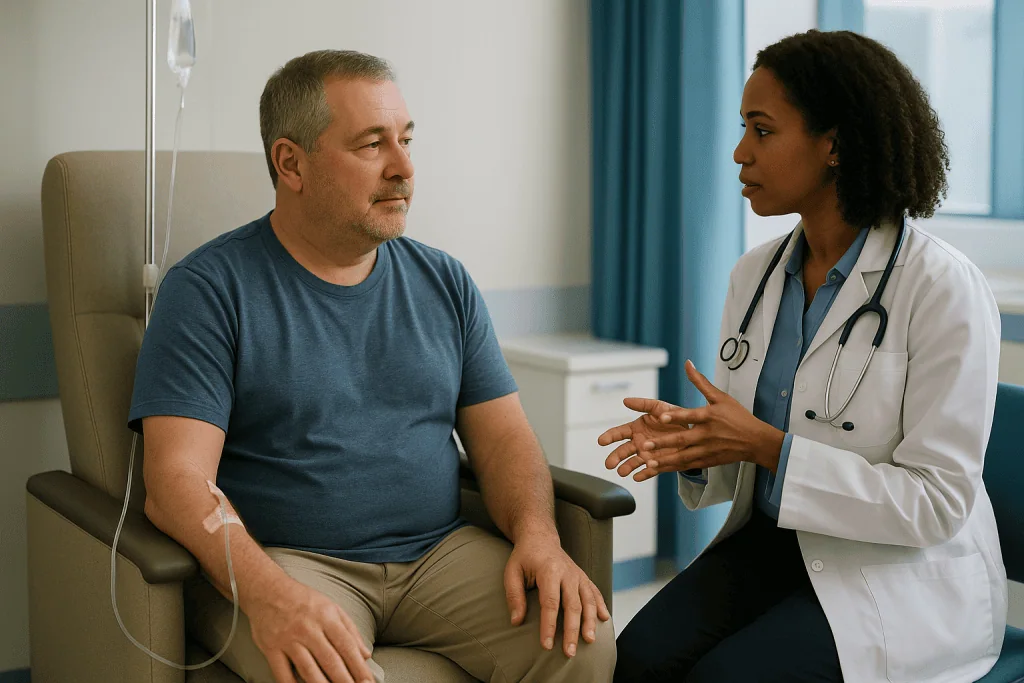
Modern induction regimens typically combine drugs from different classes: a proteasome inhibitor, which jams the cell’s protein-disposal machinery so the antibody-producing myeloma cell chokes on its own output; an immunomodulatory drug, which alters the marrow environment and immune signaling; a corticosteroid, which is directly toxic to plasma cells; and increasingly a monoclonal antibody that tags a surface protein on myeloma cells for immune destruction. Which combination, how many cycles and whether an antibody is included are decisions for the prescribing hematologist, based on the individual’s disease features and organ function.
Induction has a second, less obvious purpose. Some older chemotherapy drugs damage stem cells and make later collection difficult, so regimens for transplant-eligible people are deliberately chosen to spare the marrow. This is one reason a person is asked at the very first appointment whether they might be a transplant candidate, even when the transplant is many months away.
Response is tracked with blood tests for M protein and free light chains, the small antibody fragments myeloma cells release, and sometimes with repeat bone marrow biopsy or imaging. When the team judges the response deep enough and the person fit enough, the calendar shifts to mobilization. Practically, this is the moment to sort out childcare, work leave and who will drive to appointments, because the next eight to twelve weeks are logistically dense.
Stem cell collection by apheresis: how are the cells harvested?
Stem cells live in bone marrow, but almost no one has them drawn from the hip anymore. Instead they are persuaded to move into the bloodstream, a process called mobilization, and then filtered out of circulating blood with a machine, a technique called apheresis.
Mobilization begins with growth-factor injections given under the skin over several days. These drugs mimic a natural hormone that tells the marrow to release stem cells. Some protocols add a second agent that loosens the molecular anchor holding stem cells in place, and some use a moderate dose of chemotherapy first. The team monitors a blood marker, the CD34 count, which estimates how many stem cells are circulating, and schedules collection when it rises. Bone aches, particularly in the lower back and sternum, are common during this phase and are a sign the marrow is responding; the team will advise on managing them.
Apheresis itself is more tedious than painful. Blood leaves through a large intravenous line or a temporary central catheter, passes through a centrifuge that separates cells by density, and returns minus a thin layer rich in stem cells. A session lasts roughly three to five hours, and Mayo Clinic notes that collection may take one to several days to reach the target cell number. People read, nap or watch television. Tingling around the lips and fingertips can occur because the anticoagulant used in the machine binds calcium; it is treated on the spot.
Many centers aim to collect enough cells for two transplants, storing the second bag in liquid nitrogen in case a future transplant is planned. The bags are labeled, tested and frozen with a protective solution. When collection falls short, options include repeating mobilization with a different approach, and that decision rests with the transplant team.
What is conditioning with high-dose chemotherapy, and why melphalan?
Conditioning is the step that makes this a transplant rather than another cycle of treatment. It refers to the high-dose chemotherapy given in the day or two before the stem cells are returned. For myeloma, the drug used almost universally is melphalan, an alkylating agent, meaning it attaches chemical groups to DNA so the cell cannot copy itself and dies. Plasma cells, including malignant ones, are unusually vulnerable to it.
The dose given here is several times higher than could ever be tolerated without a stem cell rescue. It is calculated from body surface area and adjusted for kidney function by the prescribing team; the specifics belong in the clinic, not in a magazine. What a person experiences is a short infusion, often accompanied by anti-nausea medicine, on what the calendar calls day minus two or day minus one.
Two practical rituals accompany conditioning. The first is ice: sucking ice chips or popsicles before, during and after the infusion constricts blood vessels in the mouth and reduces the drug reaching the lining, which lowers the severity of mucositis, the painful inflammation of the mouth and gut lining that peaks about a week later. The second is hydration through the intravenous line, which helps the kidneys clear the drug.
Melphalan does not choose its targets. It damages any rapidly dividing cell, which is why hair thins, the gut lining sloughs, and blood counts fall to near zero over the following week. The stem cells waiting in the freezer are the only reason this is survivable. Some centers offer participation in trials adding a second agent or adjusting intensity; outside a trial, single-agent high-dose melphalan remains the guideline standard described by NHS and Mayo Clinic patient resources.
Day zero and engraftment: what the daily blood counts mean
The infusion of stem cells is anticlimactic to watch and emotionally enormous to receive. On day zero, the frozen bags are brought to the bedside, thawed in a warm water bath and pushed through the central line over perhaps thirty minutes each. The preservative used in freezing has a distinctive smell, often compared to creamed corn or garlic, that others in the room notice for a day or two; the patient may taste it. Mild flushing, nausea or a brief drop in blood pressure can occur and are monitored closely.
Then comes the wait. The infused cells circulate, home to the marrow, and begin dividing. Nothing shows in the blood for a while. Neutrophils, the white blood cells that fight bacteria, fall to almost none by day four or five as the last pre-transplant cells die off. Platelets, which stop bleeding, follow. Hemoglobin, carried in longer-lived red cells, drifts down more slowly. Transfusions of platelets and red cells bridge the gap.
Engraftment is defined by the numbers, usually a neutrophil count staying above a threshold for several consecutive days. Mayo Clinic describes this typically occurring within about two to three weeks of infusion, and a growth-factor injection is sometimes used to shorten the gap. Nurses will announce the first day the count ticks upward, and the change in mood on the ward is palpable.
A simple way to read the chart: falling counts in week one are expected and reflect the chemotherapy, not failure. Flat counts in week two are the quiet phase while new cells mature. Rising counts, however small, signal the graft has taken. Delayed engraftment happens occasionally and is managed with the second stored bag or further growth factor; the team will explain if that becomes relevant.
The first two weeks: neutropenia, mucositis and the hardest days
Ask anyone who has been through it and they will point to roughly days five through twelve. The chemotherapy has done its work on the gut lining, the marrow is empty, and the new cells have not yet arrived. This is the window when support, not treatment, is everything.
Neutropenia, a shortage of infection-fighting white cells, is the central danger. With almost no neutrophils, a minor bacterial breach from the gut or skin can become a bloodstream infection in hours. Fever is therefore treated as an emergency; blood cultures are drawn and broad-spectrum antibiotics started before results return. Preventive antibiotics, antivirals and antifungals are commonly prescribed through this phase at the team’s discretion. Visitors are limited, hands are washed constantly, fresh flowers and certain raw foods are kept out.
Mucositis peaks in the same window. The mouth, throat and sometimes the entire gut lining become raw. Swallowing hurts, taste vanishes or turns metallic, and diarrhea is common. Pain relief, mouth care and intravenous fluids or nutrition are standard supports; the goal is comfort until the lining regenerates, which happens quickly once neutrophils return.
Fatigue during this period is unlike ordinary tiredness. Hemoglobin may be half its normal value, and the body is spending energy on cellular repair. Gentle movement, even a slow lap of the corridor with a walker, is encouraged because it reduces clot risk and pneumonia and preserves muscle. Some centers deliver this entire phase in hospital; others manage selected people as outpatients with daily clinic visits and a caregiver at home. Either way, the person is seen and their blood checked every day. Emotionally, low mood and irritability are common and expected; naming them out loud to the team is not a weakness but part of the plan.
Weeks three to twelve: going home and rebuilding
Discharge usually follows engraftment, once a person can eat and drink enough, is free of fever and has counts that will hold without transfusion. NHS guidance describes a hospital stay of a few weeks as typical for autologous transplants. The relief of leaving is real, and so is the anxiety; the daily reassurance of a nurse checking vitals is suddenly gone.
The immune system at this stage is like a newly planted lawn: technically present, easily damaged. Neutrophil numbers may look normal on paper, but lymphocytes, the cells that handle viruses and remember past vaccines, recover far more slowly, over many months. Practical rules through roughly the first hundred days commonly include avoiding crowds, gardening and construction dust, undercooked meat and unpasteurized dairy, and anyone with a cold. Preventive antiviral medicine is typically continued for a long period because shingles reactivation is common after this treatment.
Energy returns unevenly. A good morning is followed by an afternoon nap that lasts three hours. Cleveland Clinic and Mayo Clinic resources both describe fatigue lasting weeks to months as expected rather than alarming. A useful measure is not how the person feels day to day but whether the distance they can walk each week is inching upward.
Follow-up visits are frequent at first, often weekly, then spaced out. Blood tests track counts and M protein; the first post-transplant disease assessment, usually around day one hundred, tells the team how deep the response is. Appetite and taste return gradually. Hair regrows, sometimes with a different texture. Many people are surprised by the emotional dip that arrives around week six, when the acute drama is over and the slow grind of recovery sets in; counseling and peer support are appropriate to ask for.
Stem cell transplant recovery time: a realistic timeline from months three to twelve
People searching for a recovery timeline usually want one number. The honest answer is a range of milestones, and the table below gathers the typical windows described by Mayo Clinic, NHS and Cleveland Clinic patient resources. Individuals vary, and the team’s guidance overrides any general chart.
| Milestone | Typical window | What it usually involves |
|---|---|---|
| Engraftment | About 2 to 3 weeks after infusion | Neutrophils reappear; transfusion needs fall |
| Hospital discharge | Around 2 to 4 weeks | Eating adequately, no fever, stable counts |
| First disease reassessment | Around day 100 | M protein, light chains, sometimes marrow biopsy |
| Return to desk work or light routine | Often 3 to 6 months | Stamina still limited; naps common |
| Revaccination program begins | Commonly from 3 to 12 months | Childhood-type vaccines repeated, per team schedule |
| Fuller physical recovery | Up to a year or longer | Exercise tolerance, weight and hair largely restored |
Two items in that table surprise people. The first is revaccination: high-dose chemotherapy erases much of the immune memory built over a lifetime, so vaccines against tetanus, pneumococcus, influenza and others are typically repeated on a schedule set by the transplant team, with live vaccines delayed longest. The second is how long “fuller recovery” takes. NHS information notes it can take a year or more to feel fully recovered.
Maintenance therapy, discussed later, usually begins somewhere in months three to four and continues for years, which means the calendar of clinic visits never entirely empties. Many people describe a turning point around month six, when they stop planning the week around rest and start planning rest around the week. That shift, more than any lab value, is what most families mean by recovery.
What is the success rate of autologous stem cell transplant in multiple myeloma?
Here honesty matters more than reassurance. Myeloma is currently considered a treatable but not permanently eliminable cancer, and transplant is one part of a long strategy. The question “did it work?” is therefore answered in degrees: how deep the response, and how long before the disease returns.
The strongest modern evidence comes from randomized trials comparing induction plus transplant against induction plus continued drug therapy. In the IFM 2009 trial published in the New England Journal of Medicine and indexed in PubMed, adults up to age 65 who received transplant had a median progression-free survival of about 50 months, compared with about 36 months in those who continued drug therapy without early transplant. Progression-free survival is the time from treatment until the myeloma measurably grows again. Rates of complete response and of undetectable minimal residual disease, the deepest level of remission measurable by sensitive testing, were also higher in the transplant group.
Those figures describe populations, not individuals. Half the people in the transplant arm went longer than 50 months before progression and half went shorter; where any one person falls depends on genetic features of their myeloma, the depth of response after induction, kidney function and much else. High-risk chromosomal abnormalities, identified in the diagnostic bone marrow, tend to shorten remissions regardless of treatment.
What the transplant reliably adds, across trials, is depth of remission and time before the next treatment is needed. What it has not consistently added, in the era of modern drugs, is longer overall survival, because people who defer transplant often receive it later and because subsequent therapies are effective. Whether a longer first remission is worth several difficult weeks now is a value judgment, and it belongs to the person living with the disease, informed by their team.
What is the life expectancy after a stem cell transplant for myeloma?
Life expectancy is the question people type into search engines at two in the morning, and the statistics they find are almost always out of date. Population survival figures are calculated from people diagnosed years earlier, before several current drug classes existed. They are backward-looking by design.
What can be said responsibly is qualitative and comes from guideline-level sources. Mayo Clinic and MedlinePlus describe myeloma as a disease with an increasing number of effective treatment lines, and typical survival has lengthened substantially over the past two decades as proteasome inhibitors, immunomodulators, monoclonal antibodies and, more recently, cellular and bispecific immunotherapies have arrived. Transplant sits within that sequence, usually as the consolidation step after first induction, and is followed by maintenance.
The most useful predictors for an individual are the ones the team already has: the cytogenetic risk group from the diagnostic marrow, the staging score that combines blood markers of tumor burden and cell turnover, kidney function at diagnosis, and above all the depth of response achieved after transplant. Reaching undetectable minimal residual disease is associated, across many studies, with longer remissions. None of these turns into a single number for one person.
A more grounded way to frame the question with the care team is this: “Based on my risk features and my response so far, what does the first remission tend to look like for people like me, and what would the next options be if and when it ends?” That reframes life expectancy from a verdict into a plan, which is closer to how hematologists actually think. Prognosis discussions deserve a scheduled appointment with time set aside, a second set of ears in the room, and permission to ask again as new results arrive.
Risks, late effects and what maintenance therapy means afterwards
Every honest explainer lists what can go wrong. In the short term, the principal risks of high-dose chemotherapy with stem cell rescue are serious infection during neutropenia, bleeding from low platelets, severe mucositis, dehydration from diarrhea, and, less commonly, heart rhythm disturbance or kidney injury. Death from the procedure itself is uncommon in fit people at experienced centers, but it is not zero, and consent discussions address it directly. The team will quote its own institutional figures, which are more relevant than any national average.
Later effects matter for people who go on to live for years. Melphalan is associated with a small increased risk of a second blood cancer, particularly myelodysplastic syndrome or acute leukemia, emerging years afterward; this risk is also linked to some maintenance drugs and is one reason blood counts are monitored indefinitely. Fertility is usually lost after high-dose conditioning, so fertility preservation should be discussed before mobilization for anyone who might want children. Early menopause, thyroid changes, cataracts and persistent fatigue are recognized long-term issues.
Maintenance therapy is the part of the plan most people underestimate. Because the autologous transplant leaves no new immune system to police residual disease, guideline bodies recommend continuing a low-intensity drug, most often an immunomodulatory agent, for years after transplant to hold the remission. It is taken at home and monitored with periodic blood tests. Side effects such as fatigue, low counts, diarrhea and increased clot risk are managed by dose adjustment or drug change, decisions that rest with the prescribing hematologist and should never be made unilaterally.
Alternatives to transplant exist and are legitimate: continuing multi-drug therapy without high-dose conditioning, entering a clinical trial, or collecting cells and deferring the transplant to first relapse. A good consent conversation lays these side by side without pressure.
What people often get wrong about autologous stem cell transplant for myeloma
Some misunderstandings are so common they deserve their own section.
“It’s the stem cells that treat the cancer.” They do not. The stem cells are a rescue, returned to rebuild marrow destroyed by the chemotherapy. The melphalan does the anti-myeloma work. This is why the procedure is more accurately described as high-dose therapy with autologous stem cell support.
“Once I’ve had the transplant, I’m finished with treatment.” For nearly everyone, maintenance therapy follows and continues for years, and lifelong monitoring is standard. The transplant is a chapter, not the ending.
“It uses embryonic stem cells.” It uses adult blood-forming stem cells from the patient’s own circulation. No embryos, no donor, no ethical controversy about cell source.
“The disease will be gone.” Myeloma is currently managed as a relapsing condition. The realistic aim is the deepest, longest first remission possible and a healthy body ready for later treatments. Anyone promising permanent eradication is not describing current evidence.
“If I’m over seventy, I can’t have one.” Age alone is not the criterion. Fitness, organ function and personal goals decide eligibility, and many people in their seventies proceed safely after assessment.
“Refusing or deferring transplant means giving up.” The IFM 2009 trial found similar four-year overall survival whether transplant was done early or held in reserve, because deferred patients could receive it at relapse. Deferral is a recognized strategy, not a surrender.
“I’ll be in isolation in a bubble.” Isolation rooms with filtered air are used during neutropenia, but visitors, phones, laptops and walks in the corridor are generally allowed within infection-control rules. The picture of a sealed plastic tent belongs to a different era and a different kind of transplant.
Questions to ask your care team before agreeing to transplant
Consent conversations are long and often happen when the person is tired. Writing questions down beforehand, and bringing someone to take notes, changes the quality of the discussion. These are the ones hematology nurses and transplant coordinators say patients most wish they had asked.
- Based on my myeloma’s genetic features and my response to induction, what does the team expect the transplant to add for me specifically, and what are the alternatives, including deferral?
- What are this center’s own recent figures for serious complications and treatment-related death in people of my age and fitness?
- Will the transplant be done in hospital or partly as an outpatient, and what does my caregiver need to be able to do?
- How many cells will you aim to collect, and will a second bag be stored for a possible future transplant?
- What is the plan if collection falls short or engraftment is delayed?
- Should I see a fertility specialist before mobilization?
- What maintenance therapy is planned afterward, for how long, and what monitoring does it require?
- Which of my current medicines, supplements or herbal products need to stop, and when?
- What is the revaccination schedule, and when can I be around children, pets or return to work?
- Who do I call at three in the morning, and what temperature or symptom means I should not wait until morning?
- Is there a clinical trial I qualify for, either instead of or alongside standard transplant?
- Can I speak with someone who has been through this at your center?
Answers should be specific to the person, not generic. If a question cannot be answered on the day, it is reasonable to ask for a follow-up call or a second appointment before signing. Every decision in this pathway, from timing to maintenance, remains with the treating team and the person in the chair, made together.
When to call your doctor: red-flag signs during and after transplant
The transplant team will give a written list and a direct phone line; that list overrides anything general. What follows are the signs that guideline-level patient resources from NHS, Mayo Clinic and MedlinePlus consistently flag as requiring an immediate call or emergency attention, particularly in the weeks around and after engraftment.
Fever is the single most important one. In someone with low or recovering white cells, a temperature at or above the threshold the team specifies, often around 38 degrees Celsius or 100.4 degrees Fahrenheit, is treated as a potential bloodstream infection until proven otherwise. Do not take medicine to lower it and wait; call. Shaking chills, even without a measured fever, deserve the same response.
Other signs that warrant an urgent call include bleeding that does not stop after gentle pressure, blood in urine or stool, a rash of tiny red or purple dots, or new bruising without injury, all of which suggest dangerously low platelets. Shortness of breath at rest, chest pain, a fast or irregular heartbeat, or swelling and pain in one calf may indicate a clot, fluid overload or heart strain. Persistent vomiting or diarrhea with inability to keep fluids down, dizziness on standing, or passing very little urine suggest dehydration or kidney stress. Redness, swelling or discharge around the central line site, or a new cough with colored sputum, point to infection. A painful, blistering rash confined to one side of the body may be shingles. New confusion, severe headache, sudden weakness or a seizure are emergencies.
After discharge, the same list applies, with one addition: any new bone pain, especially in the back or ribs, or numbness and tingling in the legs, should be reported at the next contact or sooner if severe. When in doubt, the after-hours line exists precisely for the call a person is unsure about making.
Frequently asked questions
What is the success rate of autologous stem cell transplant in multiple myeloma?
Success is measured as depth and duration of remission rather than permanent elimination. In the randomized IFM 2009 trial indexed in PubMed, median progression-free survival was about 50 months with early transplant compared with about 36 months with continued drug therapy, and complete-response rates were higher. Individual outcomes depend on genetic risk features, kidney function and depth of response after induction, so the treating team’s estimate for a specific person is more meaningful than any trial average.
What is the life expectancy after a stem cell transplant for myeloma?
No single number applies, and published survival statistics lag years behind current treatment. Myeloma is managed as a relapsing condition with a growing sequence of effective therapies, and transplant is one consolidation step within that sequence. The most informative predictors for an individual are cytogenetic risk group, staging score, kidney function and, especially, whether minimal residual disease becomes undetectable after transplant. Asking the care team about the expected first remission for people with similar features is more useful than a generic figure.
How long does it take to recover from a stem cell transplant for myeloma?
Blood counts usually recover within two to three weeks of the cell infusion, and hospital discharge often follows within two to four weeks. Energy, appetite and immune function return far more slowly. Many people manage light routines by three to six months, while NHS guidance notes that feeling fully recovered can take a year or longer. Revaccination and maintenance therapy continue through that period, so recovery is better viewed as a series of milestones than a single date.
Is a stem cell transplant worth it for multiple myeloma?
For fit people, guideline bodies consider it the standard consolidation after induction because trials show it deepens remission and delays relapse. Whether that benefit outweighs several difficult weeks and the risks of high-dose chemotherapy is a personal judgment. Since overall survival in the IFM 2009 trial was similar whether transplant was early or deferred to relapse, collecting cells and holding the transplant in reserve is a legitimate alternative. The decision belongs to the person and their treating team.
Autologous vs allogeneic transplant: which is used for myeloma and why?
Autologous transplant, using the patient’s own cells, is standard for myeloma. It carries no risk of rejection or graft-versus-host disease and a much lower procedure-related death rate than a donor transplant, which matters because most people with myeloma are diagnosed in their late sixties or seventies. Allogeneic transplant can add an immune attack on myeloma but at considerably higher risk, so it is generally reserved for clinical trials or carefully selected younger, high-risk patients.
How does stem cell collection by apheresis feel, and how long does it take?
Apheresis is tedious rather than painful. Blood leaves through a large vein or central catheter, passes through a centrifuge that skims off stem cells, and returns. A session lasts roughly three to five hours, and collection may take one to several days to reach the target cell number. Tingling around the lips or fingers can occur because the machine’s anticoagulant binds calcium and is treated immediately. Bone aches during the preceding mobilization injections are common and expected.
What decides transplant eligibility in myeloma if not age?
Teams assess heart, lung, kidney and liver function, control of other illnesses such as diabetes, mobility, frailty measures and whether a caregiver is available at home. Response to induction therapy also matters; people whose myeloma has not responded sufficiently may receive more cycles first. Someone with an active infection, recent clot or unstable heart condition is usually asked to wait until that problem is controlled. Many people in their seventies proceed after favorable assessment.
Why is high-dose melphalan used for conditioning?
Melphalan is an alkylating agent that damages DNA so cells cannot divide, and plasma cells, including malignant ones, are unusually sensitive to it. At the very high dose used for conditioning it depletes myeloma cells far more thoroughly than standard chemotherapy can, but it also destroys normal marrow, which is why stored stem cells are returned afterward. Dose is calculated and adjusted for kidney function by the prescribing team. Sucking ice during the infusion helps reduce mouth soreness afterward.
Will I need maintenance therapy after the transplant?
For most people, yes. Because an autologous transplant does not introduce a new immune system to police residual disease, guideline bodies recommend continuing a low-intensity drug, most often an immunomodulatory agent, for years afterward to prolong remission. It is taken at home with periodic blood monitoring. Side effects such as fatigue, low counts or clot risk are managed by the prescribing hematologist, and any change to the plan should come from that team rather than the patient alone.
Do I have to repeat my childhood vaccines after transplant?
Usually yes. High-dose chemotherapy erases much of the immune memory built over a lifetime, so vaccines against tetanus, diphtheria, pneumococcus, influenza and others are typically repeated on a schedule set by the transplant team, commonly beginning several months after transplant. Live vaccines are delayed longest, often until immune recovery is confirmed. Household members are usually encouraged to stay current on their own vaccines to reduce the person’s exposure during the first year.
References
This article is for general information only and is not a substitute for professional medical advice. Please consult a qualified doctor about your individual situation.

More from the Blog
Radioactive Iodine After Thyroid Cancer Surgery: How the Treatment Day Unfolds
Radioactive iodine treatment after thyroid cancer surgery usually means swallowing a single capsule or liquid in a nuclear medicine unit, after one to two…

Daily Life During Leukemia Treatment: Food Safety, Visitors, Energy and Rest
Daily life during leukemia treatment is organized around one fact: treatment lowers the blood cells that fight infection, carry oxygen and stop bleeding. Most…
What to Expect After a Neck Dissection: Numbness, Shoulder Function and How the Scar Settles
After a neck dissection, most people go home within a few days with a drain, a long incision, a stiff and often numb neck,…
What PSA Monitoring After Prostate Cancer Treatment Can and Cannot Tell You
After prostate cancer treatment, PSA tracks whether prostate cells are still active, but the expected level depends on the treatment: close to zero after…

When Targeted Therapy Stops Working: Resistance, Repeat Biopsies and the Next Options
When targeted therapy stops working, it usually means the cancer has found a way around the drug, a process called acquired resistance. The care…
Why Cystoscopy Surveillance Continues for Years After Bladder Cancer Treatment
Cystoscopy surveillance after bladder cancer continues for years because the disease has one of the highest recurrence rates of any solid tumor, and new…