

Bariatric Contouring Recovery: Compression Garments, Early Walking and Lifting Limits

Key Takeaways
- Mainstream patient guidance from Mayo Clinic and the NHS places compression garment use and the ban on strenuous activity after abdominoplasty at roughly six weeks, with body lifts often at the longer end.
- A compression garment controls swelling and fluid collections by closing the space under the lifted skin; it does not shape the result, and over-tight wear can damage skin at the flap edges.
- Immobility after long surgery is a major risk factor for deep vein thrombosis, so short walks several times a day from the first evening do more for safety than any single longer effort.
- Lifting limits protect deep muscle-repair sutures that do not send pain signals proportional to load, which is why feeling fine does not shorten the window.
- After gastric bypass or sleeve, protein and fluid have to be taken in frequent small amounts, and low iron or protein levels are common reasons surgeons postpone contouring.
- Numbness below the navel or on the outer thigh is expected after skin lifting and can take months to a couple of years to improve, so heat pads on those areas are best avoided.
Recovery from body contouring after major weight loss usually centers on three habits: wearing a surgeon-fitted compression garment for several weeks to limit swelling and support healing tissue, walking gently within hours of surgery to lower the risk of blood clots, and avoiding heavy lifting or straining for roughly six weeks so incisions can knit. Exact timings differ by procedure and person, so the surgical team's instructions take precedence.
Maria had done the hard part. Two years after a gastric sleeve she had lost a person’s worth of weight, and the loose skin that once folded over her waistband was finally gone too, removed in a five-hour lower body lift. Then a nurse handed her a beige elastic garment that looked like a wetsuit, told her she would be walking to the door of her room before dinner, and warned her not to pick up her toddler for six weeks. That, she said later, was the moment the recovery felt real.
Bariatric contouring recovery is a different animal from the healing that followed her weight-loss operation. The incisions are long, the stomach is still small, and the body is being asked to close a wound the length of a belt while eating like a bird. Most of what determines a smooth course comes down to a few unglamorous routines done consistently.
This explainer walks through those routines: what the garment is actually for, why the first walk matters so much, how lifting limits are set, and what the weeks ahead typically look like, all grounded in mainstream clinical guidance rather than clinic brochures.
What bariatric contouring recovery actually involves
Body contouring after weight loss is an umbrella term for procedures that remove excess skin and reposition the tissue underneath. An abdominoplasty, often called a tummy tuck, removes a wedge of skin and fat from the lower abdomen and tightens the muscle layer; a lower body lift extends that incision around the back to lift the outer thighs and buttocks; separate operations address arms, inner thighs, breasts and face. MedlinePlus describes abdominoplasty as major surgery, typically performed under general anesthesia, in which the surgeon lifts the skin, tightens the abdominal wall and re-drapes the remaining skin before closing the wound in layers.
Recovery, then, is really wound healing on a large scale. Three things are happening at once. The skin edges are sealing, a process that gives the incision meaningful strength over the first few weeks. The space beneath the lifted skin, where fluid naturally collects, is closing down as the two surfaces stick back together. And the body is coping with the physiological stress of a long anesthetic, reduced mobility and blood loss.
Each of the three headline habits in this article maps onto one of those processes. Compression keeps the lifted skin pressed against the tissue below so fluid has less room to pool. Early walking counteracts the sluggish blood flow that follows hours of lying still. Lifting limits protect the deep sutures in the muscle layer and the skin closure from being pulled apart before they can bear load.
People who have had bariatric surgery bring an extra layer to this. A small stomach limits how much protein and fluid can be taken in at once, and some operations reduce absorption of iron and certain vitamins. Both of those matter for a body trying to build new tissue, which is why nutrition teams are usually involved before and after contouring, not just at the weight-loss stage.
Who is usually ready for contouring after weight loss, and who is asked to wait
Timing is the question surgeons spend the most time on, and it is rarely about the calendar alone. Patient guidance from Cleveland Clinic and Mayo Clinic frames readiness around three markers: weight that has been stable for a sustained period rather than still falling, nutritional status that has recovered from the rapid-loss phase, and general health good enough to tolerate several hours of anesthesia.
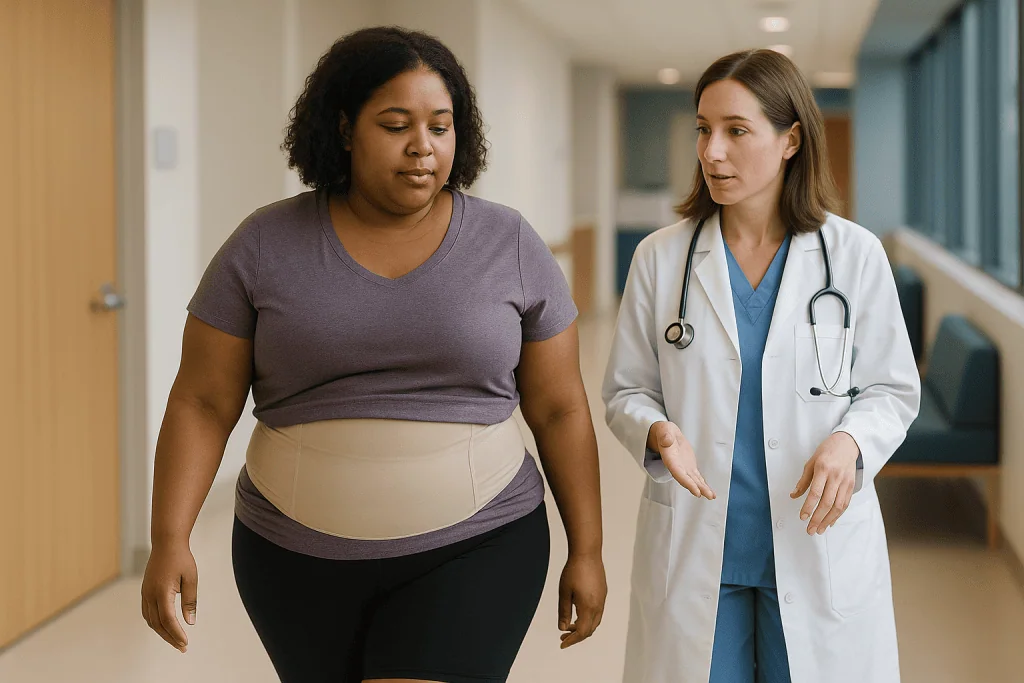
Weight stability matters for a practical reason. If a person is still losing, the tissue tightened today will loosen again as fat volume underneath shrinks. Many teams therefore prefer to see weight hold within a narrow band for a number of months before scheduling, and they often ask patients to reach a plateau that has lasted across seasons and holidays rather than a single good month.
People commonly asked to wait include those who smoke or use nicotine in any form, because nicotine narrows small blood vessels and is linked to wound-edge breakdown after skin-lifting procedures; those with anemia or low protein levels on blood tests; those whose diabetes or blood pressure is not yet controlled; and those who cannot arrange the practical support recovery demands, such as help at home and time off physically demanding work. Some are asked to delay because of active skin infections in the folds that will be operated on.
Body mass index still comes up, though not as a hard line. Very high remaining weight raises anesthetic and clotting risk and tends to limit how much contour improvement the operation can give, so surgeons sometimes recommend further weight loss or a staged plan.
Who decides? The surgeon, in conversation with the bariatric team, the anesthetist and the patient. A readiness assessment can conclude “not yet” without meaning “never”, and that distinction is worth asking about directly.
What happens in the first 48 hours after a body lift after bariatric surgery
The early hours set the tone. Waking from anesthesia after a long contouring operation, most people find themselves already in a compression garment or an abdominal binder, with one or more thin drainage tubes leaving the skin near the incision and a dressing over the wound line. MedlinePlus notes that abdominoplasty patients often stay in hospital for a short period, and lower body lifts, being longer and more extensive, tend to involve an inpatient stay while pain, fluid balance and early mobility are checked.
Pain is real but usually most intense in the first day or two, then eases. Teams typically use a combination approach, pairing regular non-opioid painkillers with short-term stronger medicine if needed, and often local anesthetic placed in the wound during surgery. How that is managed is a decision for the prescribing clinician, and it matters more than usual after bariatric surgery: some anti-inflammatory tablets are avoided after gastric bypass because of ulcer risk at the join between pouch and bowel, and the pharmacy team will know which options apply.
The first walk is a milestone, not an afterthought. Nurses will usually help a patient sit up, dangle legs, then stand and shuffle a few steps on the evening of surgery or the next morning. It feels counterintuitive when everything is pulling, and the posture is a stooped one; surgeons who have tightened the abdominal wall often ask patients to stay slightly bent at the hips for several days to avoid tension on the closure.
Fluid intake is the other early priority. A sleeve or bypass stomach cannot take gulps, so sipping steadily through the day becomes the method, and the team may track output from the drains and the bladder to make sure hydration is keeping pace.
Compression garments: what they do and what they don't
A compression garment is a fitted elastic sleeve, vest or full-body suit designed to press firmly and evenly on the operated area. After a tummy tuck, Mayo Clinic describes it as a supportive abdominal garment or binder worn to help prevent fluid buildup and support the abdomen while it heals. That description is the honest ceiling of what compression can be expected to do.
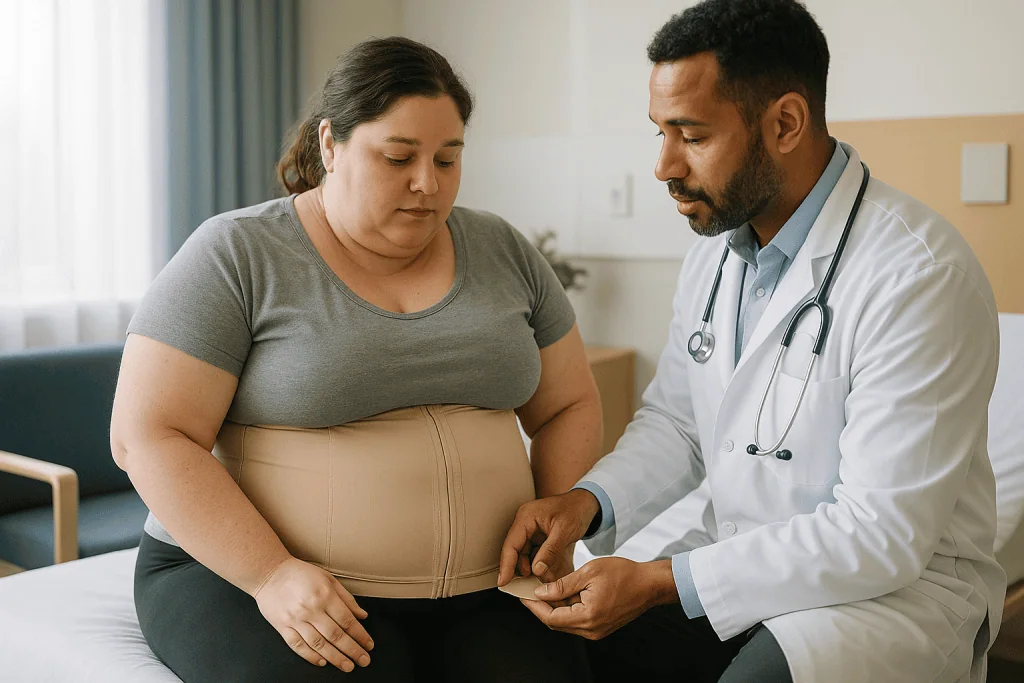
Mechanically, the garment does three useful things. It reduces the dead space between the lifted skin flap and the tissue below, giving fluid less room to collect into a seroma, which is a pocket of clear fluid under the skin. It limits swelling by supporting small lymphatic and venous vessels that were cut during surgery and are slow to reconnect. And it provides a sense of splinting that makes moving, coughing and getting out of a chair less alarming in the first weeks.
What compression does not do is shape the result. The final contour is decided in the operating room by how much skin was removed and how the muscle layer was tightened; a tighter garment will not produce a smaller waist, and over-tight garments cause problems of their own. Skin that is pressed too hard, especially at the edges of a flap where blood supply is thinnest, can lose circulation. Folds or rolled edges can leave pressure marks or blisters. A garment that cuts in at the groin or under the arm can impede the very drainage it is meant to help.
Fit is therefore a clinical matter, not a shopping one. Surgeons usually specify the style and how snug it should feel, check it at follow-up, and change the size as swelling falls. If a garment feels numb, tingling or blanching under it, that is a reason to loosen it and ring the team rather than tough it out.
How long do you wear a compression garment after tummy tuck or body lift?
The most frequently searched question about compression has a fairly consistent answer in mainstream guidance. Mayo Clinic’s patient information on tummy tuck says the supportive abdominal garment is typically worn for about six weeks, and the NHS gives a similar picture, describing a support garment or corset worn for around six weeks after abdominoplasty while swelling settles. Lower body lifts and thigh lifts tend to follow the same broad window, though some surgeons extend it when swelling is slow to resolve.
Within that window, the pattern usually changes rather than staying fixed. In the first two weeks many teams ask for near-continuous wear, removing the garment only to shower and inspect the skin. From roughly the third week the surgeon may allow it off for longer periods, and some switch patients from a firm post-surgical binder to a lighter shapewear-style garment for the final stretch, mainly for comfort and swelling control during the day.
Individual variation is wide, and it depends on the procedure, how much fluid the drains produced, whether a seroma developed, and how the skin flap is settling. Arm lifts often need less time in a sleeve than a circumferential body lift needs in a suit. People whose swelling lingers at the lower abdomen or outer thighs sometimes find the garment helpful for a few extra weeks.
Two practical points repay attention. Having two garments allows one to be washed while the other is worn, since sweat and wound ooze accumulate quickly. And the garment should be put on and taken off carefully, ideally seated, without dragging it across the incision line; many teams show a step-in technique at discharge for exactly this reason. When to stop entirely is the surgeon’s call, made at a follow-up appointment after seeing the wound and the swelling.
Why early walking matters more than almost anything else
If a single recovery habit deserves the word essential, it is walking early and often. The reason is deep vein thrombosis, a clot forming in the deep veins of the leg or pelvis. The NHS lists surgery, especially operations lasting more than an hour or so, and being immobile afterwards among the major risk factors, alongside obesity, and a clot that breaks free can travel to the lung as a pulmonary embolism.
Body contouring stacks several of those risks together. The operations are long, the patient may still carry excess weight, and the incisions make people instinctively want to lie still. Calf muscles act as the pump that pushes blood back up the legs, and that pump switches off when the legs stop moving. Walking, even a slow shuffle to the bathroom and back, turns it on again.
Teams usually layer prevention. Compression stockings or an intermittent pneumatic device on the calves during and after surgery, blood-thinning injections for a period set by the surgeon based on individual risk, and early mobilization work together; the walking part is the one only the patient can do. Frequency beats distance in the first week. Several short walks through the day and evening, with ankle circles and calf pumps while sitting in between, do more than one long effort followed by hours in a recliner.
There is a gait to learn as well. After abdominal wall tightening the natural posture is slightly hunched, and surgeons often want it that way for a few days to protect the closure; straightening comes gradually over the first couple of weeks as tension eases. A walking frame or a steadying arm is common at first, and stairs are usually fine once balance is secure, taken slowly.
Walking also helps the gut wake up after anesthesia and opioid painkillers, which reduces the bloating and constipation that make a fresh abdominal incision feel worse.
Lifting limits: when can I lift after body contouring?
Lifting restrictions exist to protect two layers. The first is the skin closure, which regains strength over weeks rather than days. The second, in abdominoplasty and body lifts, is the repair of the rectus muscles, the paired vertical muscles that often separate after significant weight gain and pregnancy; the surgeon stitches them back toward the midline, and those deep sutures must hold while the tissue heals around them. A sudden strain, such as hoisting a suitcase, can pull on both.
Mainstream guidance converges on a window. Mayo Clinic advises avoiding strenuous activity for about six weeks after a tummy tuck, and the NHS describes a similar period before returning to exercise and heavy work. Within that window, teams usually step the limits. In the first two weeks, the usual instruction is nothing heavier than a kettle or a small bag of groceries, no pushing or pulling, and no reaching overhead after arm or breast procedures. From weeks three to six, light household tasks and brisk walking typically return, still without core straining, twisting or heavy lifting. After the surgeon’s clearance around six weeks, most people begin rebuilding toward normal activity and exercise, adding weight and intensity in stages.
The common sticking points are the ones that do not feel like lifting. Picking up a toddler, hauling a wet laundry basket, pulling a heavy door, lifting a car boot lid, driving before the reaction time and seat-belt comfort allow it. Coughing and straining on the toilet count too, which is why preventing constipation is part of the plan.
Restrictions vary by procedure. A brachioplasty, or arm lift, may carry longer limits on overhead reaching and gripping, while a thigh lift may limit stairs and squatting. The surgeon’s written sheet is the authority, and the date on it is a starting point for a conversation at follow-up, not a fixed promise.
Post bariatric body contouring recovery time: a week-by-week picture
People want a map, and a rough one exists, provided it is read as typical ranges rather than a schedule. The NHS notes that recovery from abdominoplasty takes several weeks, with many people back to non-strenuous work within a few weeks and to full activity around six, and Mayo Clinic gives the same six-week landmark for strenuous activity and garment use. More extensive body lifts sit at the longer end of every range.
| Timeframe | What is usually happening | Compression | Movement and lifting |
|---|---|---|---|
| Days 1–3 | Peak soreness and swelling; drains in place; stooped posture after abdominal repair | Worn continuously | Short assisted walks several times daily; no lifting |
| Days 4–14 | Drains often removed as output falls; bruising fades; numbness common | Off only for showering and skin checks | Independent walks; light tasks at waist height; nothing heavier than a kettle |
| Weeks 3–6 | Swelling slowly retreats; incision strengthening; energy returning | Daytime wear, often lighter garment | Brisk walking; desk work; still no core strain or heavy lifting |
| Weeks 6–12 | Surgeon clearance for exercise; scars still red and firm | Usually discontinued | Graduated return to lifting and sport |
| Months 3–12+ | Residual swelling resolves; scars mature and fade | Optional for comfort | Normal activity |
Two caveats keep this honest. Swelling lasts longer than people expect; lower abdomen and thigh puffiness can linger for months, and the final contour is generally judged at around a year when scars have softened. And fatigue is a legitimate symptom, not a sign of weakness. A body healing a very long wound on limited calories will run out of energy by mid-afternoon for weeks, and planning rest into the day is part of the treatment rather than an indulgence.
Drains, dressings and scars: caring for the incision line
Surgical drains are thin, soft tubes that exit through small holes near the incision and empty into a bulb or bottle. Their job is to remove the fluid the body pours into the space under a lifted skin flap in the first days. MedlinePlus lists drains as a routine part of abdominoplasty aftercare, and teams typically remove them once daily output drops below a threshold the surgeon sets, often within the first one to two weeks. Patients are usually taught to empty and record the volume, keep the exit sites clean, and pin the bulbs to the garment so they cannot tug.
The incision itself is usually closed with dissolving sutures and covered by surgical tape or glue, sometimes with a longer adhesive dressing left in place for the first week or more. Showering is commonly allowed once the team confirms the dressings are waterproof or removed; soaking in a bath or pool is generally deferred until the wound is fully sealed, because standing water carries bacteria into any small gap.
Small areas at the tightest points of a closure, such as the center of a lower body lift or the junction of a T-shaped tummy tuck incision, can open slightly as swelling peaks. This is usually managed with simple dressings and heals over weeks, but it should be seen by the team rather than self-treated.
Scars follow a predictable arc. They are pink and raised in the first weeks, often redden and firm up between the second and fourth month, then soften and fade over the rest of the first year. Sun protection matters throughout, because ultraviolet light darkens immature scars. Silicone tapes or gels are commonly suggested once the wound has closed, though the evidence for them is modest; they appear to help some people flatten and soften scars, and the surgeon will say when it is safe to start.
Nutrition and protein when your stomach is small and your wound is long
Wound healing is expensive. The body needs protein to build new collagen, vitamin C and zinc for the chemistry of that process, iron to carry oxygen to the wound, and enough total energy to fuel it. After gastric bypass or sleeve gastrectomy, all four can be in short supply. Mayo Clinic notes that gastric bypass changes how the body absorbs food and can lead to deficiencies in iron, calcium, vitamin B12 and folate, which is why lifelong supplementation is standard after the operation.
That is the backdrop against which contouring surgery happens, and it explains why most bariatric programs check blood levels before clearing someone for a body lift and ask patients to correct low results first. Anemia in particular raises the risk of wound problems and makes the fatigue of recovery much heavier.
During recovery, the practical challenge is volume. A sleeve or pouch cannot hold a large protein-rich meal, so intake becomes a matter of frequent small portions spread across the day, prioritizing protein at each one and leaning on soft, high-protein foods and, where the dietitian recommends, protein drinks. Fluids need the same steady rhythm, sipped rather than gulped, and separated from meals as bariatric teams usually advise.
Constipation deserves a mention because it collides with the lifting rules. Opioid painkillers, reduced mobility and low fluid intake all slow the gut, and straining on the toilet loads the very sutures the surgeon is trying to protect. Teams often address this proactively with fluid, fiber where tolerated and a bowel regimen chosen by the prescribing clinician.
Alcohol is generally advised against during healing; it thins blood, dehydrates and, after bypass, is absorbed faster than before. The dietitian who guided the weight-loss phase is usually the best person to shape an eating plan for the weeks after contouring.
Pain, swelling and numbness: what is normal
Three sensations dominate the first weeks, and knowing which are expected removes a lot of anxiety. Pain after contouring tends to be a deep pulling ache along the incision and, after muscle repair, a tightness across the abdomen that makes standing straight and coughing uncomfortable. It typically peaks in the first two to three days and then improves steadily, with most people reducing or stopping stronger painkillers within the first week or two under their team’s direction. Pain that climbs rather than falls, or that concentrates in one spot, is the pattern that warrants a call.
Swelling is universal and outlasts pain by a long way. Because lymphatic channels are severed when skin is lifted, fluid drains slowly from the lower abdomen, pubic area and thighs, and the tissue can feel firm or doughy for months. Gravity plays a part; swelling is often worse in the evening and after time on the feet, and better after a night lying down. Compression, walking and elevating the legs when resting all help. Swelling that is sudden, one-sided, hot or accompanied by a fluid wave under the skin is different and should be assessed.
Numbness surprises people most. The skin below the belly button after a tummy tuck, or the outer thigh after a body lift, is often profoundly numb because the small sensory nerves running up through the fat were cut. Sensation returns gradually and incompletely over months to a couple of years, sometimes with phases of tingling, itching or electric twinges as nerves regrow. Numb skin cannot warn of heat or pressure, so hot water bottles and heating pads on the area are best avoided.
Low mood in the second and third week is also common, when the excitement has faded and the mirror still shows swelling and bruising. It usually lifts as energy returns, but persistent low mood is worth raising with the team.
What people often get wrong about bariatric contouring recovery
Some myths survive because they sound plausible. Here are the ones surgical teams hear most.
“A tighter garment gives a better result.” It does not. The contour is set in the operating room; the garment controls swelling and fluid. Excessive pressure can compromise blood flow to the skin edges and cause the wound problems it is supposed to prevent. Fit should be firm and even, and the surgeon decides the level.
“Rest is the safest thing I can do.” Lying still is one of the riskiest, because immobility after long surgery is a major driver of deep vein clots, as the NHS makes clear. Rest between walks, not instead of them.
“If I feel fine, the lifting limit is just a formality.” Deep sutures and healing skin do not send pain signals proportional to the load on them. The six-week window that Mayo Clinic and the NHS describe reflects how tissue regains strength, not how a person feels on a good day.
“Contouring surgery is weight-loss surgery.” Skin removal takes off the weight of the excess tissue and nothing more. Fat loss comes from the bariatric procedure and lifestyle, and continued weight change after contouring will alter the result.
“Scars will disappear.” They fade and flatten over a year or more, but they are permanent, and their length is the trade for the shape. Anyone promising near-invisible scars after a body lift is not describing this operation.
“Swelling that lasts more than a few weeks means something went wrong.” Residual swelling for months is the norm after skin lifting, particularly low on the abdomen and thighs. The pattern to worry about is sudden, hot, painful or one-sided swelling, not slow persistence.
“I can judge the result at six weeks.” Six weeks is a milestone for activity, not for appearance. Most surgeons ask patients to reserve judgment until scars have matured and swelling has cleared, commonly around a year.
Risks and alternatives in plain language
Every long operation carries risks, and contouring after weight loss has a particular profile. MedlinePlus and Mayo Clinic list the main ones: bleeding, infection, poor wound healing or wound edges separating, fluid collections under the skin (seroma), loss of skin at the edges of a flap because of impaired blood supply, changes in skin sensation that may be lasting, asymmetry or contour irregularities, and unfavorable scarring. General anesthetic risks and blood clots in the legs or lungs apply as they do to any major surgery, with the added weight of long operating times.
People who have had bariatric surgery carry some risk factors more often than the general population: nutritional deficiencies that slow healing, residual excess weight, and, for some, a history of the very conditions such as diabetes that impair circulation. Smoking or nicotine use in any form is one of the strongest modifiable risks for wound breakdown and is a frequent reason surgeons decline to operate until a person has stopped.
Revisions are a real possibility and worth discussing up front. Small areas of scar widening, residual skin excess at the ends of an incision, or a seroma that needs drainage in the clinic are not rare after body lifts, and teams generally regard minor adjustments as part of the journey rather than a failure.
Alternatives are worth naming honestly. Doing nothing is an option, and many people manage loose skin with fitted clothing and skin care for the folds. Staged surgery, tackling one region at a time, shortens each anesthetic and can be safer for people with higher risk. Non-surgical skin-tightening devices are marketed widely, but for the degree of excess skin left after major weight loss the evidence for meaningful improvement is limited, and mainstream guidance does not present them as a substitute for excision. Which route fits a given person is a decision for the patient and their treating team together.
Questions to ask your care team
A good consultation leaves you with specifics rather than reassurance. These questions tend to surface the details that shape recovery.
- Which procedures are you proposing, in what order, and why that sequence rather than another?
- How long do you expect me to be in hospital, and what has to happen before I go home?
- What type of compression garment will I wear, how snug should it feel, and how many hours a day for how many weeks?
- Will I have drains, how do I care for them, and what output level tells you they can come out?
- When and how often should I walk on the first day, and how should I move when getting in and out of bed?
- What clot-prevention measures will I have during and after surgery, and for how long?
- What is the heaviest thing I may lift in the first two weeks, and how will that change at each follow-up?
- When can I drive, shower, bathe, return to desk work, and return to physical work?
- Which of my usual bariatric supplements and medicines continue unchanged, and are any painkillers unsuitable for me after my weight-loss operation?
- What blood tests do you want before surgery, and what results would make you postpone?
- What is the plan for protein and fluid intake given my pouch or sleeve, and will a dietitian be involved?
- Which signs should make me call the ward, and which should send me to emergency care?
- How common are seromas and small wound openings in your patients after this operation, and how are they managed?
- What might a revision involve, and how is that decided?
Write the answers down or ask for them in writing. Recovery instructions given on the morning of discharge, after a poor night’s sleep and with painkillers on board, are easy to misremember, and most disagreements later turn out to be about what was actually said.
When to call your doctor
Most recovery days are uneventful, and the team would rather hear about a worry early than treat a complication late. Contact the surgical team the same day, or go to emergency care if they cannot be reached, for any of the following.
Signs that suggest a blood clot need urgent attention: new swelling, pain, warmth or tenderness in one calf or thigh, especially if the other leg is unaffected; sudden shortness of breath, chest pain that is worse on breathing in, coughing up blood, or a racing heart. The NHS is explicit that these can indicate deep vein thrombosis or pulmonary embolism and should be treated as an emergency.
Signs of infection or wound trouble call for a same-day conversation: fever or shaking chills; spreading redness, heat or increasing pain around the incision; thick, cloudy or foul-smelling drainage; wound edges that have opened; or skin along the incision turning dusky, purple or black.
Fluid and bleeding problems also warrant a call: a rapidly enlarging, tense or bruised area under the skin; drain output that suddenly turns bright red or increases sharply; or a soft, sloshing swelling under the skin that appears after the drains are out.
Symptoms affecting the whole body matter too: persistent vomiting or inability to keep fluids down, which is particularly risky with a small stomach; dizziness or fainting on standing; very little urine; or confusion.
Finally, trust the sense that something is wrong. Pain that escalates instead of easing, or a feeling of being unwell that does not match the expected trajectory, is reason enough to phone. The team that operated remains responsible for the recovery, and every decision about what to do next sits with them.
Frequently asked questions
How long is post bariatric body contouring recovery time in total?
Most people are back to non-strenuous activity within a few weeks and cleared for exercise and heavy lifting around six weeks, the window Mayo Clinic and the NHS describe for abdominoplasty. Swelling, however, can persist for months, and scars keep fading for a year or more, so the final appearance is usually judged much later than the activity milestones.
When can I lift after body contouring surgery?
Heavy lifting and strenuous exercise are generally deferred for about six weeks, according to Mayo Clinic and NHS guidance on tummy tuck. Within that period surgeons usually allow light tasks at waist height after the first two weeks while keeping core strain, twisting and overhead reaching off limits. Your surgeon’s written instructions and follow-up assessment override any general timeline.
Is a body lift after bariatric surgery more demanding to recover from than a tummy tuck?
Usually yes. A lower body lift extends the incision fully around the trunk to lift thighs and buttocks, so the operation is longer, the wound is larger, and lying and sitting are more uncomfortable in the early days. The same six-week landmarks apply, but swelling, fatigue and drain duration tend to sit at the longer end of typical ranges.
Do I really have to sleep in the compression garment after tummy tuck surgery?
In the first weeks most surgeons ask for near-continuous wear, including overnight, because fluid accumulates whenever the lifted skin is unsupported. Later, some teams allow nights off once swelling is settling. Because the garment can be too tight if worn incorrectly, follow the specific pattern your surgical team set, and report any numbness, tingling or skin blanching under it.
Do you lose weight immediately after bariatric surgery?
Weight typically begins falling within the first weeks after gastric bypass or sleeve, with the fastest loss in the first months and a plateau approaching over the following year or so, as Mayo Clinic describes. Contouring surgery is different: it removes only the weight of the excess skin, and further weight change after it can alter the surgical result.
How much weight can you lose with a pouch reset?
There is no reliable evidence that a short-term liquid or restrictive diet physically shrinks a stretched pouch or produces sustained weight loss, and mainstream guidance does not recommend it. Weight regain after bariatric surgery is common and has many causes, so the appropriate step is a review with the bariatric team, who can assess the anatomy, nutrition and behavior together.
Why do I still have gas years after a gastric bypass?
Gastric bypass changes how food reaches the bowel, so partly digested carbohydrate and fat arrive lower down where bacteria ferment them, producing gas; some people also swallow more air eating quickly. Lactose intolerance and small intestinal bacterial overgrowth can develop. Persistent or worsening symptoms deserve assessment by the bariatric team rather than self-management, since dietary and medical options depend on the cause.
When can I gulp water after a gastric sleeve?
Bariatric programs generally advise sipping rather than gulping for the long term, because a sleeve has little capacity and swallowing large volumes quickly can cause pain, nausea or vomiting. This matters during contouring recovery, when hydration is important for wound healing and clot prevention, so the practical approach is steady sipping throughout the day. Your bariatric team can tailor fluid targets.
Can I drive during bariatric contouring recovery?
Driving is usually deferred until you are no longer taking sedating painkillers, can sit comfortably with a seat belt across the incision, turn to check mirrors, and brake sharply without hesitation. For many people that is somewhere in the second or third week, but the surgeon’s clearance and your insurer’s conditions should both be confirmed first.
What are the red-flag signs after contouring surgery that need urgent care?
Seek emergency care for one-sided calf or thigh swelling and pain, sudden breathlessness, chest pain or coughing blood, which can signal a clot. Call the surgical team the same day for fever, spreading redness or heat around the wound, foul drainage, wound edges opening, skin turning dark, a rapidly enlarging tense swelling, or inability to keep fluids down.
References
This article is for general information only and is not a substitute for professional medical advice. Please consult a qualified doctor about your individual situation.

Planning This Treatment in Turkey
Our full guide for international patients: techniques, hospital stay, recovery and cost.
More from the Blog

Gastric Sleeve Myths, Corrected: Stretching the Pouch, Never Eating Normally and More
Most gastric sleeve myths do not survive contact with the evidence. The stomach does not grow back, and while the remaining sleeve can relax…

What Do Gastric Bypass Results Look Like Years Later? Regain, Maintenance and Follow-Up
Long-term studies show that most people who have gastric bypass keep off a large share of their weight a decade or more later, though…

Which Areas Does a Post-Bariatric Body Lift Address and How Is the Operation Staged?
A post-bariatric body lift removes and tightens skin left loose after major weight loss. The lower body lift, also called a belt lipectomy, addresses…

How Do Bariatric Surgeons Choose Between Sleeve and Bypass for Your Health Profile?
Bariatric surgeons choose between sleeve gastrectomy and gastric bypass by weighing a person's body mass index, type 2 diabetes history, acid reflux, prior abdominal…

When a Sleeve Gastrectomy Needs Revision: Re-Sleeve, Conversion to Bypass and Why
Sleeve gastrectomy revision options include re-sleeving a stretched stomach, converting the sleeve to a Roux-en-Y gastric bypass, which is usually favored when acid reflux…

Who May Be a Candidate for a Gastric Balloon? What the Bariatric Team Evaluates First
Gastric balloon candidates are usually adults whose body mass index falls roughly between 30 and 40, who have tried structured diet and activity changes…