

Beard Transplant vs Beard Micropigmentation: Real Growth vs Shading and Who Each Approach Suits
Key Takeaways
- A beard transplant relocates living follicles that keep growing, while beard micropigmentation deposits pigment dots that imitate stubble and never grow, so anyone wanting length is already choosing surgery.
- Transplanted hairs commonly shed within the first weeks and regrow over months, according to MedlinePlus, so the result cannot be fairly judged for most of a year.
- Follicles taken from the back of the scalp are typically resistant to DHT and persist long-term, but graft failure, aging and undiagnosed progressive causes mean no surgeon can promise a beard forever.
- Micropigmentation is a tattoo, and Mayo Clinic's tattoo evidence on fading, infection, allergic reaction and difficult laser removal applies to it in full.
- Facial skin receives more sun than the scalp, so beard pigment fades, blurs and can shift tone faster than scalp work, making periodic touch-ups part of the plan.
- Alopecia barbae often regrows on its own within about a year per the NHS, which is why active autoimmune patches are usually treated, not transplanted or tattooed.
A beard transplant moves living hair follicles, usually from the back of the scalp, into the beard so real hair grows and can be trimmed or grown long. Beard micropigmentation deposits pigment into the skin to imitate the shadow of stubble; nothing grows, and the shading fades over years. Transplant suits people with adequate donor hair who want texture; micropigmentation suits those who keep a close shave or prefer to avoid surgery.
The gap sits just below the left corner of his mouth, about the size of a thumbprint. He has tried growing through it for three winters. Every time the rest of the beard reaches a respectable length, the patch announces itself, so he shaves the whole thing off and starts again. Somewhere around the fourth restart he types beard transplant vs beard micropigmentation into his phone and finds two industries each insisting the other is a compromise.
They are not really rivals. One is a small surgery that relocates hair. The other is a form of cosmetic tattooing that paints the impression of hair. Each solves a different version of the same complaint, and each comes with a maintenance contract most advertisements skip.
What follows is the version a careful clinician would give you across a desk: what happens in the chair, what the following weeks look like, what fades and what does not, and why the reason your beard is patchy matters more than either procedure.
Beard transplant vs beard micropigmentation: what actually separates them
Strip away the marketing and the difference is almost childishly simple. A beard transplant produces hair. Beard micropigmentation produces the appearance of hair, viewed from arm’s length, at stubble length.
A transplant is a surgical procedure done under local anesthetic, meaning the skin is numbed while you stay awake. Follicles are lifted from a donor area and placed into the beard one by one. Once they settle, they behave like any other hair: they grow, they can be trimmed, they cast their own shadow when you skip a shave.
Micropigmentation is a specialized tattoo. A technician deposits tiny dots of pigment into the upper layer of skin so that, from a normal conversational distance, the jaw reads as evenly covered. Nothing grows. Let your real beard get long and the dots stay behind on the skin, which is why the technique suits people who already keep things close.
That single fact, how you actually wear your beard, is the question worth answering before any other. If you have shaved to a shadow every morning for a decade and simply want the shadow to be even, surgery may be more than the problem requires. If you want length, movement and something a barber can shape, pigment cannot deliver it, however skilled the artist.
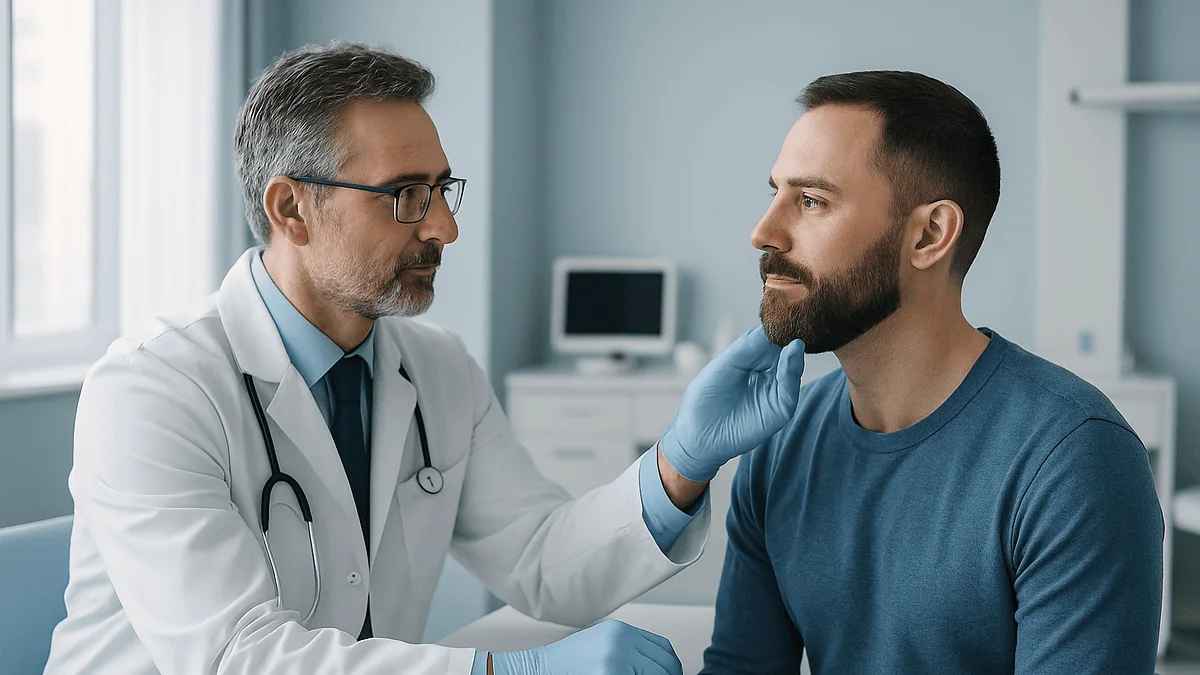
Both approaches are cosmetic rather than medically necessary, and both share a prerequisite that is easy to skip: someone qualified should look at why the beard is patchy in the first place. Some causes settle on their own, some recur, and one or two make either procedure a poor idea until the underlying condition is controlled. That assessment belongs to a clinician, not a consultation form.
How a beard transplant actually works, step by step
Most beard transplants borrow hair from the back and sides of the scalp. These follicles tend to be more resistant to the hormonal signal that thins hair elsewhere, and they carry that resistance with them when moved, a principle surgeons call donor dominance.
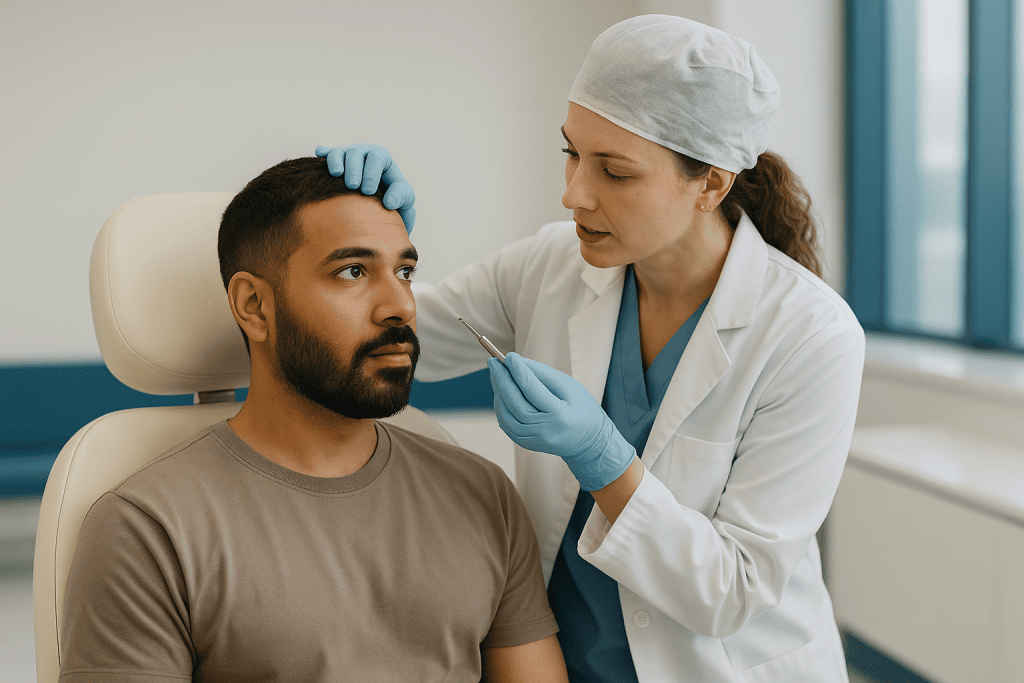
The follicles are harvested in one of two ways. Follicular unit extraction, or FUE, uses a tiny circular punch to remove individual follicular units one at a time, leaving scattered dot scars that are hard to see once the hair regrows. Follicular unit transplantation, or FUT, removes a narrow strip of scalp that is then divided under magnification, leaving a single fine linear scar. Either way, the recipient sites in the beard are made with a needle or small blade, and the grafts are placed into them.
Beard work is fiddly. Natural beard hairs mostly grow one to a follicle rather than in the clusters common on the scalp, so surgeons often split grafts down to single or double hairs for a believable result. Angle matters as much as number: hair on the cheek lies flatter than hair on the chin, and a graft placed upright where its neighbors lean will look wrong forever.
Procedures typically run several hours under local anesthetic, and MedlinePlus notes that more than one session may be needed depending on the area being covered. What surprises people most is the shedding phase. MedlinePlus describes transplanted hairs commonly falling out in the weeks after surgery before new growth begins within a few months. The follicle has survived; only the hair shaft has been shocked. Judging the result before that regrowth is like judging a garden the week after planting.
How beard micropigmentation works and why it is called shading
Beard micropigmentation belongs to the same family as scalp micropigmentation, often shortened to SMP. A technician uses a fine needle to place pigment into the upper dermis, the skin layer just beneath the surface, in thousands of small dots. Each dot is meant to mimic a cut hair seen end-on. Done well and viewed at stubble length, the eye blends the dots and the real hairs into a single even field.
That is why the industry word is shading rather than drawing. The technician is not sketching hairs; they are adjusting the density of shadow across the face so a thin cheek matches a fuller chin. Pigment is chosen to match hair color and skin undertone, and most practitioners build the result over several sessions spaced weeks apart, going lighter first because pigment can always be added but is hard to remove.
It is still a tattoo, and the medical evidence on tattoos applies. Mayo Clinic lists the recognized risks: skin infections, allergic reactions to pigment, raised bumps called granulomas, keloid scars in people prone to them, and bloodborne infections such as hepatitis if equipment is not sterile. Mayo also notes that tattoo pigment can occasionally cause swelling or burning during MRI scans, rarely but worth telling a radiographer about.
Regulation of who may perform cosmetic tattooing varies widely by region, and training standards are not uniform. Hygiene questions are therefore not rude; they are the whole point of the consultation.
Micropigmentation can also be used to soften the look of scars, including the linear scar from a strip transplant, which is one reason the two techniques sometimes end up on the same face.
Who each approach usually suits, and who is asked to wait
A transplant tends to suit someone whose patchiness is stable, who has enough healthy donor hair to spare, who wants a beard with real length or texture, and who can accept a year-long timeline and a permanent change. Because scalp hair keeps its own character after moving, people whose scalp and beard hair differ sharply in curl or color are usually warned that the match will be close rather than identical.

Micropigmentation tends to suit someone who shaves to stubble by choice, who does not have enough donor hair for the coverage they want, who has scarring where follicles cannot easily be placed, or who has a medical reason to avoid surgery. It also suits people who want to test how they feel about fuller coverage before committing to something surgical, although it is not a fully reversible test.
Both groups are asked to wait in certain situations. Active alopecia barbae, an autoimmune condition in which the immune system attacks beard follicles and produces smooth round bald patches, is the clearest example. Placing grafts into an area under active attack risks losing them, and the NHS notes that hair in alopecia areata often regrows on its own within about a year, which can make surgery premature. Skin infection at the site, uncontrolled diabetes that slows healing, bleeding disorders, a known tendency to keloid scarring, and some medicines that thin the blood all prompt a pause or a conversation with the prescribing clinician.
Surgeons also commonly ask younger adults to wait, since beard pattern can still be filling in through the twenties. Anyone whose distress about the beard feels out of proportion to what others see deserves a gentler conversation before any needle is involved, and a good team will start one.
Beard transplant vs beard micropigmentation at a glance: comparison table
Placed side by side, the two options stop looking like competitors and start looking like answers to different questions.
| Feature | Beard transplant | Beard micropigmentation |
|---|---|---|
| What it is | Surgical relocation of living follicles | Cosmetic tattooing of pigment dots |
| What you get | Real hair that grows and can be styled | A two-dimensional impression of stubble |
| Anesthetic | Local anesthetic, awake | Usually topical numbing cream, sometimes none |
| Sessions | Often one, occasionally more for large areas | Typically several, weeks apart |
| Visible downtime | Redness and crusting for days to a couple of weeks | Redness for a day or two; dots look darker at first |
| When it looks finished | Months, after shedding and regrowth | After the final session settles |
| Best beard length | Any, from stubble to full | Stubble only |
| Longevity | Usually long-lasting, not guaranteed | Fades over years, needs touch-ups |
| Main risks | Infection, scarring, poor growth, wrong angle | Infection, allergy, blurring, color shift |
| Reversibility | Not reversible | Laser removal possible but incomplete |
Two rows deserve emphasis. The best beard length row is the practical dividing line for most people. The longevity row is where the honest conversation lives: a transplant is not literally permanent and pigment is not literally temporary, but their maintenance curves point in opposite directions. One asks for patience up front and little afterward. The other asks for little up front and periodic attention for as long as you want it to look right.
Neither row should be read as a promise. The timelines above describe typical ranges reported by mainstream sources, and individual healing, skin type and sun exposure move them in both directions.
Do beard transplants last forever?
The honest answer is: usually for a very long time, but not as a guarantee, and not in the way the word forever implies.
The biology in your favor is donor dominance. Follicles taken from the back of the scalp are typically resistant to dihydrotestosterone, or DHT, the hormone by-product that shrinks follicles in pattern baldness. They keep that resistance after relocation, which is why transplanted scalp hair generally persists even as untreated hair elsewhere thins. Mayo Clinic describes hair transplantation as a way to make use of remaining hair, which is a useful framing: the surgery redistributes what you have rather than creating new supply.
Several things can still erode the result. A proportion of grafts may simply fail to take, especially if handled roughly, kept out of the body too long, or placed into skin with poor blood supply such as dense scar. Hair thins everywhere with age; a transplanted follicle is protected from DHT, not from time. If the original patchiness had a progressive cause that was never identified, the native hair around the grafts may keep thinning, changing the overall look even if every graft survives. Smoking and poorly controlled diabetes are both associated with slower wound healing in general medical evidence and can affect graft survival.
Mayo Clinic is also plain that results of hair loss surgery vary and that some people need more than one procedure to reach the look they want. No credible surgeon can promise a number of surviving grafts or a density in advance. What they can do is explain their own approach, show how they plan angles and distribution, and describe how they handle the occasional area that grows in thinner than hoped.
How long does beard micropigmentation last, and how does it look after 10 years?
Nobody can give you a well-evidenced ten-year picture of beard micropigmentation, because the peer-reviewed literature on it is thin and mostly short-term. What exists is a century of experience with decorative tattoos, and that evidence is instructive.
Pigment fades. Mayo Clinic notes that tattoos change over time, and that fading is influenced by sun exposure, skin type and the pigment itself. The face receives more ultraviolet light than almost any other part of the body, so a beard shadow is working under harder conditions than a scalp treatment hidden by hair or a hat.
Pigment also migrates. Individual dots can soften and spread as the skin’s immune cells slowly move particles around, and dots placed too close or too deep may blur into patches rather than staying crisp. Some black pigments drift toward a bluish or greenish tinge as they lighten, a phenomenon familiar from older tattoos, which is why practitioners spend so long on color matching.
Then there is the face itself. Over a decade the jawline changes shape, skin loosens and the line where beard meets cheek naturally softens. A pattern drawn for a thirty-year-old’s contours will sit on a forty-year-old’s. Regular touch-ups exist to keep pace with all three processes, and the interval between them is set by your skin and lifestyle rather than by any fixed schedule the evidence can support.
Removal is possible with laser, but Mayo Clinic describes tattoo removal as often requiring multiple treatments, with complete removal not always achievable. Anyone weighing micropigmentation should treat it as long-lasting with a maintenance requirement, not as a trial that can be wiped clean.
What the first days and weeks usually look like after each procedure
After a transplant, the beard area is typically red and slightly swollen for a few days, with tiny crusts forming around each graft. Care teams generally ask people to avoid touching, scratching or shaving the area, to sleep with the head slightly raised, and to follow a specific washing routine while the grafts anchor. The donor area on the scalp may feel tight or tender, and small scabs appear where follicles were removed.
Around two to six weeks in, most of the transplanted hairs fall out. MedlinePlus describes this shedding as expected and notes that new growth begins within a few months, with the overall result continuing to fill in over the months that follow. This is the stretch when people most often panic and most often send anxious messages to their surgeon. It is also the stretch when patience is the entire treatment.
Micropigmentation moves faster and shallower. Redness usually settles within a day or two. The dots look darker, larger and sharper than the finished result for the first week or so because pigment sits in the top layer of skin before the surface heals over it and softens the tone. Practitioners typically ask people to avoid heavy sweating, swimming, saunas and direct sun until the skin has closed, and to skip harsh exfoliants. Subsequent sessions, usually spaced a few weeks apart, refine density and correct any spots that healed lighter than intended.
Both routes share one instruction: do not judge the outcome early. One is waiting for follicles to wake up; the other is waiting for skin to settle. Photographs taken in the first fortnight of either flatter neither.
Risks and side effects, stated plainly
Because both procedures are elective, the risk conversation deserves more time than it usually gets.
For transplants, MedlinePlus lists infection, bleeding and scarring among the general risks of the surgery. Specific to beard work, surgeons also describe folliculitis, an inflammation of hair follicles that produces small pimple-like bumps as new hairs push through; temporary numbness or altered sensation in the cheeks and donor area; visible pitting or a cobblestone texture if grafts sit slightly proud of the skin; and hairs that grow at an unnatural angle if placement was rushed. Poor growth in a section is possible and may need a second session. The donor area can look thinner if too much is taken, which is why surgeons plan around lifetime supply rather than a single beard.
For micropigmentation, the tattoo evidence summarized by Mayo Clinic applies directly: bacterial skin infection, allergic reactions to pigment that can appear years later, granulomas, keloid formation in susceptible people, and transmission of bloodborne infections when needles or ink are reused or improperly sterilized. Cosmetic outcomes carry their own risks, including a hairline drawn too sharp, color that heals warmer or cooler than intended, and blurring over time. Skin conditions such as eczema or psoriasis can flare where the skin is worked.
Alternatives exist and a fair consultation names them: doing nothing and keeping the beard short; grooming techniques that shape around thin areas; treating an underlying condition medically where one is found; or accepting a beard that is genuinely yours, gaps included. None of these is a lesser option. They are options.
Why a patchy beard needs a diagnosis before either choice
The most common reason for a patchy beard is nothing medical at all. Beard density is largely inherited, follows no rule about masculinity or hormone levels, and often keeps filling in through a person’s twenties. A transplant or shading can address it, but so can time and lowered expectations.
The causes that matter are the ones that change the plan. Alopecia barbae, the beard form of alopecia areata, produces smooth, often circular bald spots that can appear suddenly. The NHS describes alopecia areata as an autoimmune process in which hair frequently regrows within a year, sometimes with further episodes later. A dermatologist may offer treatment such as corticosteroid injections into the patch to calm the immune response; whether, when and for how long that is appropriate is a decision for the prescribing clinician. Operating on or tattooing over an active patch invites disappointment.
Scarring from acne, burns, surgery or injury destroys follicles permanently. Grafts can sometimes be placed into mature scar tissue, although blood supply is poorer and survival less predictable, and pigment can help camouflage what remains. Tinea barbae, a fungal infection of the beard area, causes red, scaly, sometimes pustular patches and needs antifungal treatment before anything cosmetic. Thyroid disease, iron deficiency and some medicines can thin hair generally, and Mayo Clinic notes that hair loss evaluation often includes examination of the pattern and, where needed, blood tests.
Hair pulling that a person may not fully register also produces irregular patches with broken hairs. The point is not to alarm; most patchy beards are simply patchy beards. The point is that a ten-minute look by someone trained to tell these apart can save a year and a scar.
Can you combine beard micropigmentation with a transplant?
Yes, and the combination is more common than either industry’s marketing suggests, because each covers the other’s weakness.
The most frequent pairing is a transplant that grows in slightly less dense than hoped, followed by shading between the grafts to close the visual gaps. The real hairs provide texture and length; the pigment fills the shadow underneath. Viewed at stubble length the result reads as denser than either alone. Viewed with a longer beard the hairs dominate and the pigment quietly disappears beneath them.
The second pairing is camouflage. Anyone who has had a strip transplant carries a linear donor scar on the back of the scalp, and micropigmentation is widely used to break up that line so short haircuts are possible. The same approach can soften a facial scar into which grafts could not safely be placed.
Order matters. Most teams prefer to complete the transplant first and let it mature fully, since MedlinePlus describes new growth continuing over months, before deciding how much pigment, if any, is needed. Tattooing over freshly placed grafts risks disturbing them, and tattooing over skin that will later receive grafts gives the surgeon a less predictable canvas, although it is not impossible. If pigment already exists and surgery is being considered, the surgeon needs to see it and plan around it.
Combining approaches also combines their risk profiles and their maintenance needs. The transplanted hair should persist with little upkeep; the pigment beneath it will still fade and may still need refreshing. Both practitioners should know about each other’s work, and the treating team should coordinate the sequence rather than leaving you to referee.
What people often get wrong about beard transplants and shading
The first misunderstanding is that micropigmentation grows anything. It does not, and no lighting or filter changes that. Anyone hoping to grow a beard out should treat pigment as a stubble-only technique.
The second is the reverse: that a transplant delivers a beard within days. It delivers grafts within hours and then, as MedlinePlus describes, most of those hairs shed before regrowing over months. The finished look is a slow arrival.
Third, people assume transplanted hair becomes beard hair. It becomes hair that lives in the beard. It keeps the texture, curl and color of the scalp it came from, which is usually close enough, and occasionally noticeably different.
Fourth, the belief that pigment is permanent and maintenance-free. Tattoo evidence summarized by Mayo Clinic describes fading and change over time, and facial skin gets more sun than almost anywhere else on the body. Touch-ups are part of the deal.
Fifth, that more grafts always means a better result. Beard follicles are mostly single hairs, spacing and angle create realism, and donor hair is a finite lifetime resource that a person may want for their scalp later.
Sixth, that before-and-after galleries represent typical outcomes. They represent selected outcomes, photographed in selected light, at selected lengths. They are useful for judging a practitioner’s eye, not for predicting your own face.
Seventh, that the option with the lower upfront cost is automatically the better value. Costs vary too widely by region and case for any figure to be meaningful here, and a fair comparison has to include the number of sessions, the maintenance over years and the price of correcting a result you dislike. That arithmetic belongs in a consultation, not an advertisement.
Questions to ask your care team before deciding
A good consultation is a two-way interview. These questions tend to separate careful practitioners from confident ones.
- What do you think is causing my patchiness, and have you ruled out alopecia barbae, fungal infection or scarring that would change the plan?
- Given how I actually wear my beard day to day, which approach fits that habit, and would you tell me if neither is a good idea?
- For a transplant: which harvesting method do you propose and why, how many hairs per graft do you plan for the beard, how do you decide angles, and how much donor hair would remain for the future?
- For micropigmentation: what training and hygiene certification do you hold, how do you sterilize equipment, how do you choose and test pigment color, and how many sessions do you anticipate?
- What does the shedding phase or the settling phase look like for your patients, and at what point would you consider a result finished enough to judge?
- What are the specific complications you have seen in your own practice, and how did you manage them?
- If part of the result grows in thin, heals lighter, blurs or fades, what happens next, and who decides?
- How will this look in ten years, honestly, and what maintenance should I budget time for?
- Are any of my medicines or health conditions relevant, and should you speak with the clinician who prescribes them before we proceed?
- Can I see healed results at least a year out, not just fresh ones, and ideally at the beard length I plan to wear?
Bring the answers home and sit with them. Any practitioner who bristles at the list, promises a specific density or survival figure, or pushes you to book the same day has answered the most important question already.
When to call your doctor after a beard transplant or micropigmentation
Most people heal from either procedure without incident, and mild redness, tenderness and small crusts are expected. A short list of signs is not.
Contact the treating team promptly if redness spreads beyond the treated area or becomes hot and increasingly painful; if you notice pus, cloudy discharge or a foul smell; if you develop a fever or feel generally unwell in the days after treatment; if bleeding continues despite firm gentle pressure; or if grafts come away with bleeding rather than as dry crusts. These can indicate infection or graft disturbance and are easier to manage early.
After micropigmentation, also report blistering, raised itchy patches at the pigment sites, or a rash that appears weeks or even years later, since Mayo Clinic notes that allergic reactions to tattoo pigment can be delayed. Any thickened, growing scar tissue should be assessed, particularly if you or a relative has formed keloids before.
Seek emergency care immediately for swelling of the lips, tongue or throat, difficulty breathing, widespread hives, dizziness or a racing heart shortly after a procedure or a medicine given for it. These are signs of a severe allergic reaction and cannot wait for a callback.
Separately from healing, new smooth bald patches appearing in the beard or scalp, patches that enlarge quickly, or hair loss accompanied by scaling, pustules or broken hairs warrant a dermatology review whether or not you have had a procedure, because they point toward conditions that need diagnosis rather than coverage. Every decision about what to do next, including whether to proceed, pause or add a second approach, rests with the clinicians who have examined you.
Frequently asked questions
Do beard transplants last forever?
Usually for many years, but not as a guarantee. Follicles from the back of the scalp typically resist the hormone that drives pattern thinning and keep that resistance after moving. Some grafts may not survive, hair thins with age everywhere, and surrounding native hair can keep changing if the original cause was never identified. Mayo Clinic notes results of hair loss surgery vary and some people need more than one procedure.
Do people regret beard micropigmentation?
Some do, although no reliable study measures how many. The regrets practitioners and dermatologists describe cluster around color that healed too warm or cool, a beard line drawn too sharp for the face, dots that blurred, and the discovery that pigment only works at stubble length. Removal is possible by laser but Mayo Clinic notes complete removal is not always achievable, so treat the decision as long-lasting.
Is SMP cheaper than a hair transplant?
Upfront, pigment work is often less involved than surgery, but no meaningful figure can be given because costs vary enormously by region, practitioner and how much area is treated. A fair comparison has to include multiple sessions, touch-ups over years, and the possibility of correcting a result you dislike. Ask each practitioner for a complete written breakdown and weigh it against how long you expect to want the result.
How does beard micropigmentation look after 10 years?
Lighter, softer and possibly slightly different in tone, unless it has been refreshed. Tattoo evidence summarized by Mayo Clinic shows pigment fades with sun exposure and time, and individual dots can spread and blur. The face also changes shape over a decade, so a pattern designed for younger contours may sit differently. Periodic touch-ups exist to keep pace with all three effects.
Can I grow a long beard after beard micropigmentation?
You can, but the pigment stops helping. Micropigmentation imitates cut hairs at the skin surface, so once real hair grows past a few millimeters the dots are hidden by some hairs and exposed as dots between others. People who want a full or shaped beard are generally steered toward a transplant, sometimes with pigment added later to deepen the shadow beneath the hair.
Does a beard transplant hurt?
The procedure itself is done under local anesthetic, so the main discomfort is the numbing injections and the sensation of pressure rather than pain. Afterward, most people describe tightness, tenderness and itching for several days in both the beard and the donor area. Your care team will advise on comfort measures; severe or worsening pain, especially with spreading redness or fever, should be reported promptly.
When can I shave after a beard transplant?
Only when your surgeon says so. Grafts need time to anchor in their new sites, and most teams ask people to avoid razors, trimmers and rubbing the area for a period of weeks while crusts fall away naturally. Once cleared, transplanted hair can be shaved, trimmed or grown like any other, which is one of the main practical differences from micropigmentation.
What causes a patchy beard in the first place?
Most often genetics, which is not a medical problem and may keep filling in through the twenties. Medical causes include alopecia barbae, an autoimmune condition that produces smooth round patches and frequently regrows within a year according to the NHS, scarring from acne or injury, fungal infection of the beard area, and general hair-thinning conditions such as thyroid disease. A dermatologist can distinguish these before any cosmetic decision.
Is beard micropigmentation the same as a tattoo?
Essentially yes. It uses a needle to deposit pigment into the upper dermis, the same principle as decorative tattooing, though with finer needles, diluted pigments and a dot pattern designed to mimic follicles. That means the risks Mayo Clinic lists for tattoos apply: infection, allergic reactions, granulomas, keloids, bloodborne disease from unsterile equipment, and rarely discomfort during MRI. Hygiene and practitioner training matter accordingly.
Can I have beard micropigmentation and a transplant together?
Yes, and the combination is common. Pigment is often added after a transplant has fully matured to deepen shadow between grafts, or to camouflage a donor scar or a facial scar where grafts could not be placed. Most teams complete the surgery first and wait for regrowth before deciding how much pigment is needed. Both practitioners should coordinate, and the treating team should set the sequence.
References
This article is for general information only and is not a substitute for professional medical advice. Please consult a qualified doctor about your individual situation.

More from the Blog
Why Hair Transplant Repair Is Often Staged: Sequencing Graft Removal, Redesign and Regrafting
Hair transplant repair is usually staged because each step changes the conditions for the next. Misplaced grafts are typically removed first, the scalp is…
DHI Explained: What Direct Hair Implantation Changes in Practice
DHI (direct hair implantation) is a variation of the FUE hair transplant in which extracted follicles are loaded into a spring-driven implanter pen and…
Preparing for an Eyebrow Transplant: Brow Design Consultation, What to Pause and the Day Before
Eyebrow transplant preparation usually involves a brow design consultation where the surgeon maps shape, hair direction and donor area; a medical review of medicines…
DHI Hair Transplant Risks Explained Honestly: Swelling, Folliculitis and Uneven Growth
DHI hair transplant risks are largely the same as for any follicular unit extraction procedure: temporary forehead and eyelid swelling, folliculitis around new grafts,…
The Best Age for a Hair Transplant: Why Surgeons Say No to Most 20-Somethings
There is no single best age for a hair transplant, but most surgeons prefer patients roughly between their late 20s and mid-40s, once the…
Stem Cell Hair Transplants: Where the Science Really Stands Today
No proven, standardized stem cell hair transplant exists yet. Procedures sold under that name are usually conventional follicle transplants combined with experimental cell injections.…