

Best Exercises for Bone Health: Load-Bearing Moves Your Skeleton Responds To
Key Takeaways
- Bone responds to the size and novelty of a load, not repetition count: 50 jump landings send a stronger building signal than 5,000 flat steps.
- Exercise effects are local: tennis players have measurably denser bone in their racket arm, so a full program must load hips, spine, and forearms separately.
- Swimming and cycling, however fit they make you, are weight-supported and do little for density, competitive cyclists often show surprisingly low bone density.
- Realistic exercise-driven density gains run about 1–3% per year, measurable on a scan only after six to twelve months of consistent training.
- Falls cause over 95% of hip fractures and one in four adults 65+ falls yearly, making daily five-minute balance practice as protective as any density gain.
- With osteoporosis, the key movement modification is avoiding loaded forward spine flexion and forceful twisting, not avoiding lifting itself, which remains protective when coached.
The best exercises for bone health pair impact work, jumping, jogging, stair climbing, dance, with progressive resistance training such as squats, lunges, rows, and overhead presses, two to three times a week. Bone adapts only to loads that exceed its everyday demands, so gradually increasing challenge matters more than long duration. Walking helps maintain bone; swimming and cycling do little for density. Balance training lowers fall risk.
Watch a nine-year-old on a playground for five minutes and you’ll see a near-perfect bone-building program: jumping off ledges, hanging from bars, sprinting, landing, climbing. Nobody prescribed it. Their skeletons are simply getting exactly the signal bone craves, brief, varied, forceful loading.
Somewhere between that playground and middle age, most of us trade all of it for sitting, strolling, and the occasional swim. The skeleton notices. Bone is living tissue that remodels constantly, and it follows a blunt rule: use it under load, or lose it slowly.
The encouraging news is that the signal still works at 50, 70, even 90: it just needs to be delivered deliberately, and with more care than a fourth-grader takes. Here’s what the evidence actually supports, which popular workouts quietly do nothing for your bones, and how to load a skeleton that already has some wear on it.
Why your skeleton responds to load in the first place
Bone looks inert on an X-ray, but it behaves more like muscle than like scaffolding. Your body replaces roughly 10% of your skeleton every year through remodeling, crews of cells dissolving old bone while others lay down new tissue. What tips that balance toward building is mechanical strain.
Embedded throughout bone are cells called osteocytes that act as strain gauges. When a load bends bone slightly, landing from a hop, hoisting a loaded barbell, catching yourself on a stair, those cells sense the deformation and signal bone-building cells to reinforce that exact spot. This principle, described in the 1800s and known as Wolff’s law, still anchors modern exercise research.
Two details matter for anyone designing a workout. First, bone responds to the magnitude and novelty of a load, not the repetition count. Fifty jumps beat five thousand steps because each landing produces force several times body weight, while a step produces roughly one. Second, the response is stubbornly local. Tennis players show measurably denser bone in their racket arm than their free arm, same person, same diet, same hormones, different loading. Squats strengthen hips and spine; they do nothing for your wrists. A skeleton-wide program has to load the sites that matter most for fractures: hip, spine, and forearm.
What does 'weight-bearing exercise' actually mean?
The phrase gets used loosely, and the looseness costs people results. In bone research it covers two distinct categories, and a complete program needs both.
- Weight-bearing impact exercise means working against gravity on your feet: jogging, jumping, stair climbing, hiking, dancing, tennis. The jolt of each footstrike or landing is the bone signal. Higher impact generally means a stronger signal, running loads the skeleton with two to three times body weight per stride, jumping with more.
- Resistance (strength) training means muscles pulling hard against external load, free weights, machines, resistance bands, or challenging bodyweight moves. When a muscle contracts forcefully, its tendon tugs on bone, and that tug is itself a building stimulus. This is how you load the spine and forearms, which impact work largely misses.
Notice what’s absent from both lists: swimming, cycling, and most water aerobics. They’re weight-supported, not weight-bearing: the water or the saddle carries you, so the skeleton feels little strain. They earn their place for cardiovascular health, joint-friendly conditioning, and stamina, and the NHS and Mayo Clinic both recommend them for overall fitness. For density specifically, though, the evidence is consistently underwhelming, and studies of competitive road cyclists have repeatedly found lower-than-expected bone density despite superb fitness. Great heart, quiet skeleton.
What are 8 exercises that strengthen your bones?
If you want a concrete starting roster, these eight cover the hip, spine, and forearm: the three sites where fractures do the most damage. They scale from beginner to advanced, and none requires a gym membership, though a few benefit from one.
- Jumping or hopping10 to 20 landings, done most days, is one of the best-studied hip stimuli in people without osteoporosis.
- Squatsa chair sit-to-stand at first, progressing to added weight; loads hips and lumbar spine.
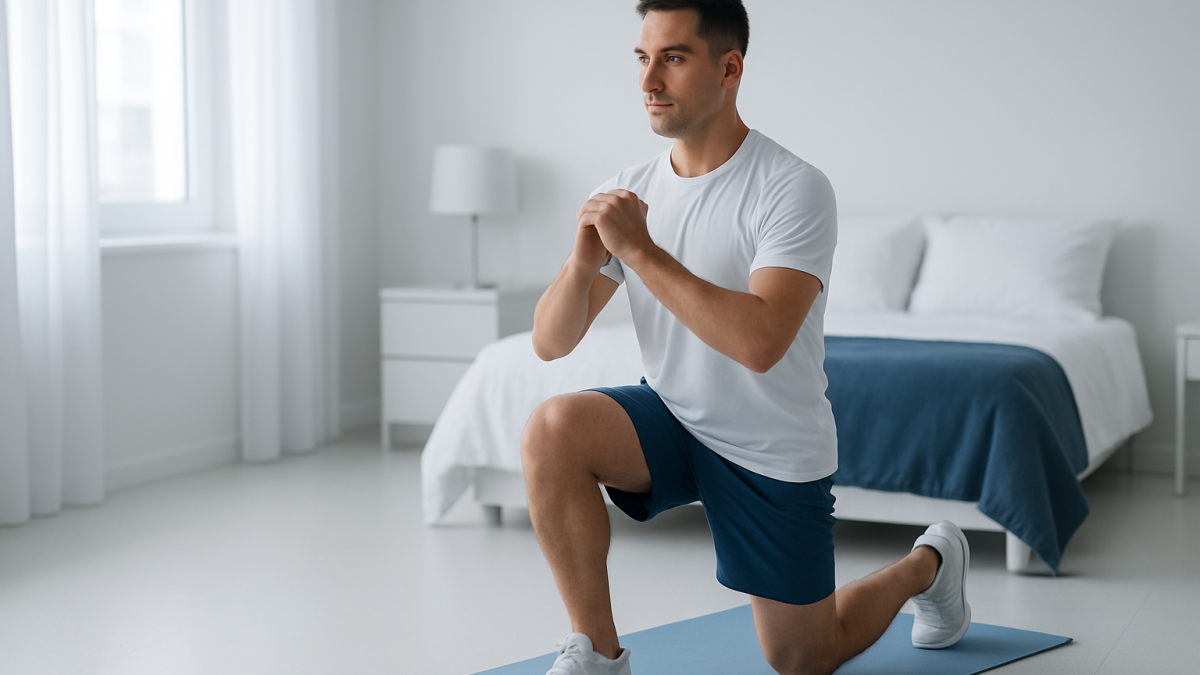
- Lunges or step-upssingle-leg loading for the hip, plus balance practice in the same move.
- A hip hinge (deadlift pattern)picking a weight up from mid-shin with a flat back; trains the spine to bear load safely, which is precisely what daily life demands.
- Overhead presscompresses the spine vertically and loads the wrists and forearms.
- Rows or assisted pull-upsstrong pulling muscles support posture and load the forearm, a common fracture site.
- Stair climbing or hill hikingimpact plus gravity, with a bigger per-step force than flat walking.
- Heel dropsrise onto your toes, then drop your heels briskly to the floor; a gentle, controllable impact suitable even for cautious starters.
Form matters more than any of the names. If you’re new to lifting or have low bone density, a physical therapist or qualified trainer teaching you the hinge and squat is worth more than any equipment purchase you’ll ever make.
Does jumping really build bone, or is that hype?
It’s one of the better-supported claims in exercise science, with honest caveats about who it applies to.
Trials in premenopausal women found that brief daily jumping, on the order of 10 to 20 jumps with rest between, repeated over months, produced small but measurable gains in hip bone density, around half a percent to one percent. That sounds modest until you remember the alternative at midlife is gradual loss, so a gain of any size represents a real reversal of trajectory. A separate year-long study in older men had participants hop on one leg daily; the hopping leg’s hip showed improved bone density while the other leg served as its own comparison. Hard to design cleaner evidence than that.
The mechanism fits the physics. A brisk jump landing generates ground reaction forces several times body weight, concentrated exactly where hip fractures happen. Bone also seems to respond best to loads that are brief, fast, and unusual, which is why a minute of jumping can out-signal an hour of walking.
The caveats: results are strongest in people with healthy or moderately low bone mass. If you’ve been diagnosed with osteoporosis, have had a fragility fracture, or have joint problems that make landings painful, high-impact work isn’t the automatic answer: Mayo Clinic guidance specifically flags high-impact exercise as a category to discuss with your clinician first. Heel drops and low hops offer a gentler entry point, and even those deserve a professional’s sign-off if your bones are already fragile.
How heavy should you lift for bone?
Heavier than most bone-health advice has historically dared to suggest, provided you build up gradually and your technique is sound.
For years, people with low bone density were steered toward light weights and high repetitions out of caution. Then researchers began testing supervised, genuinely heavy resistance training in postmenopausal women with low bone mass. A well-known Australian randomized trial found that twice-weekly, closely supervised high-intensity lifting, loads challenging enough that only about five repetitions were possible, improved spine and hip bone density more than a gentle home program did, with an excellent safety record under supervision. That study reshaped expert thinking: intensity, not repetition volume, appears to drive the bone response.
What that means in practice:
- Choose a weight that feels genuinely hard by the last two or three repetitions of a set of five to eight.
- Progress slowly, add small increments only when the current load feels controlled from first rep to last.
- Prioritize compound movements (squat, hinge, press, row) over isolation exercises; they load more skeleton per minute.
- Two sessions a week is the evidence-backed floor; three works if recovery allows.
The non-negotiable is supervision while you learn, especially with any diagnosis of low bone density. “Heavy” in these trials meant heavy relative to a carefully coached individual, never heavy improvised alone in a garage on day one. The load builds the bone; the coaching prevents the load from finding a weak link first.
Is walking enough to protect your bones?
Here’s where honesty has to override enthusiasm: walking is superb for your heart, mood, blood sugar, and longevity, and it’s better for bone than sitting. But as a density-building tool, the evidence says it mostly plays defense.
Studies of regular walkers show they tend to preserve hip bone density better than sedentary peers, yet trials rarely find meaningful density gains from ordinary walking alone. The physics explains why. A flat, comfortable stride loads the skeleton with roughly body weight: a force your bones already experience thousands of times a day and have long since adapted to. Bone remodels in response to novelty and magnitude; a familiar load whispers where it needs a shout.
You can raise walking’s bone value without abandoning it:
- Add hills or stairs, which increase per-step force and muscle pull on the hip.
- Vary your paceshort brisk intervals produce sharper loading than a steady amble.
- Carry a light backpack (a few books’ worth, well-fitted), effectively raising body weight modestly. Skip this if you have spine fragility or a history of vertebral fracture.
- Change terraintrails and grass introduce the small unpredictable loads and balance demands pavement never does.
Keep walking daily. Just don’t let it be your entire bone strategy. Think of it as the floor of the program, with lifting and impact work as the walls and roof.
Why swimmers and cyclists need a bone plan too
This section exists because the people who need it most are often the fittest people in the room, and the least likely to suspect a problem.
Water supports about 90% of your body weight when you’re chest-deep, and a bicycle saddle carries most of the rest of the load a runner’s skeleton would absorb. Both activities build impressive hearts, lungs, and endurance while leaving the skeleton nearly unloaded. Research on masters swimmers and, more strikingly, competitive road cyclists has found bone density at or below that of non-exercisers, in some cyclist cohorts, low enough to meet criteria for concern despite elite fitness. Hours of training, minimal bone signal.
None of this argues against swimming or cycling. If arthritis makes impact painful, water exercise may be the only sustainable movement you have, and its benefits for joints, balance confidence, and cardiovascular health are well documented by Harvard Health and others. The argument is for addition, not substitution.
- Swimmers and cyclists should treat resistance training as mandatory, not optional, two sessions weekly hitting hips, spine, and arms.
- Add small doses of land-based impact if your joints and bone status allow: heel drops, stair climbs, brief hops.
- If you’ve trained exclusively in water or on wheels for years, a conversation with your clinician about bone density screening is reasonable, particularly past midlife.
Fitness and bone strength travel together often enough that we assume they’re the same thing. They aren’t.
Balance training: the half of bone health nobody markets
A fracture requires two things: a vulnerable bone and a force strong enough to break it. Exercise headlines obsess over the first. The second, usually a fall, deserves equal billing, because falls cause more than 95% of hip fractures, and the CDC reports that about one in four adults 65 and older falls each year.
That reframes the math. Even if your bone density budged only slightly, halving your odds of hitting the ground could do more for your fracture risk than any density gain a workout can deliver. Balance training is where exercise earns that discount, and the evidence here is arguably stronger than the density evidence.
Tai chi has some of the best trial support: its slow weight shifts, single-leg stances, and controlled turns train exactly the reflexes that catch a stumble, and studies consistently show meaningful reductions in fall rates among older adults who practice it. Simpler drills work too:
- Stand on one leg while brushing your teeth, hand hovering near the counter, not gripping it.
- Walk heel-to-toe along a hallway line, ten steps out and back.
- Practice sit-to-stands from a chair without using your hands; leg strength is itself fall protection.
- Step sideways and backward during walks, falls rarely arrive from straight ahead.
Five minutes daily beats a long weekly session, because balance is a skill your nervous system maintains through frequent rehearsal. Conveniently, the leg-strengthening exercises earlier in this article double as balance work. Your skeleton gets the load; your reflexes get the rehearsal.
What is the quickest way to increase bone density?
People search this phrase constantly, so it deserves a straight answer: there is no quick way, and anyone selling one is selling something other than physiology.
Bone remodels on a slow clock. A single remodeling cycle at one spot on the skeleton takes roughly three to six months from old bone removed to new bone fully hardened. Exercise-driven improvements measurable on a DXA scan typically require six to twelve months of consistent training, and clinicians usually wait a year or two between scans because the technology can’t reliably detect smaller, shorter-term shifts. Well-run exercise trials report density gains in the range of about 1% to 3% per year at the hip or spine. Modest numbers, until you compare them with the several-percent-per-year losses some women experience in the years surrounding menopause. Turning a minus into a plus is a bigger swing than the digits suggest.
The fastest legitimate route, then, is simply the most efficient one:
- Progressive resistance training twice weekly, loading hips, spine, and arms.
- Brief impact work (hops, heel drops, stair intervals) most days, if your bone status permits.
- Adequate calcium, vitamin D, and protein so the raw materials match the signal.
- Consistency over intensity spikes, bone rewards the person still training in month ten, not the one who went hard for three weeks in January.
Speed isn’t the metric that matters here. Direction is.
Can you reverse osteoporosis with exercise alone?
The honest answer: exercise can slow bone loss, modestly improve density at loaded sites, and substantially cut fall risk, but the evidence does not support exercise alone reliably reversing established osteoporosis, meaning restoring bone to normal density. Anyone promising that is ahead of the science.
Here’s what the research does show for people with the diagnosis. Supervised resistance and impact programs in this population have produced small density gains or slowed losses at the spine and hip, along with better posture, stronger backs, and fewer falls, outcomes that matter enormously even when the DXA number moves little. Mayo Clinic and the NHS both position exercise as a core part of osteoporosis management for exactly these reasons. Fracture risk isn’t a single number; it’s density plus bone quality plus fall probability plus muscle and reflexes, and exercise improves most of those levers at once.
What exercise cannot do is substitute for medical management when your clinician recommends it. Osteoporosis treatment decisions involve fracture history, bone density, age, and other risk factors that only you and your care team can weigh together. The most evidence-aligned framing is this: exercise is necessary but often not sufficient. Skipping it leaves benefit on the table no treatment can replace, no prescription teaches your legs to catch a stumble. Relying on it exclusively, against medical advice, gambles with a skeleton that has already declared itself fragile.
Both-and, not either-or. That’s not hedging; it’s what the trials show.
Exercising safely when your bones are already fragile
A diagnosis of osteoporosis or low bone density changes the risk calculus, not the mission. Movement remains protective; a few specific movements become the exception. Mayo Clinic’s guidance for exercising with osteoporosis centers on protecting the spine, and it’s worth internalizing before your next workout.
The patterns to modify or avoid:
- Loaded forward flexionbending forward at the waist with a rounded back, as in toe touches, traditional sit-ups, and some yoga forward folds. Vertebrae weakened by osteoporosis are most vulnerable to compression fractures in exactly this position.
- Forceful twistinggolf-swing-style rotation under load, or abrupt trunk twists in fitness classes.
- High-impact landingsjumping and running warrant an individualized green light rather than a blanket one, especially after any prior fracture.
- High fall-risk activitiesthink honestly about icy sidewalks, ladders, and sports with sudden collisions.
What stays firmly on the menu: hip hinges with a neutral spine (learned with coaching), squats, presses, rows, heel drops, brisk and varied walking, tai chi, and back-extension exercises that strengthen the muscles supporting your vertebrae. Note the pattern: it’s not “avoid bending over,” it’s “bend at the hips with a long spine instead of curling through it.” That distinction is trainable in a session or two with a physical therapist, and it protects you while unloading groceries just as much as while lifting weights.
Fragile bones need loading most of all. They just need it delivered with precision.
How much and how often: a realistic weekly plan
The research converges on a pattern that fits inside a normal life: two or three strength sessions, frequent brief impact doses, near-daily balance practice, and everyday movement filling the gaps. Here’s how that assembles into a week.
| Component | Frequency | Example | Why bone cares |
|---|---|---|---|
| Resistance training | 2–3 days/week | Squats, hip hinge, press, row: 2–3 hard sets each | Muscle pull loads spine, hip, and forearm directly |
| Impact work | Most days, 2–5 min | 10–20 hops or heel drops, or stair intervals | Brief high-magnitude forces are bone’s strongest signal |
| Balance practice | Daily, 5 min | Single-leg stands, heel-to-toe walking, tai chi moves | Falls cause over 95% of hip fractures |
| Weight-bearing cardio | Most days, 30 min | Brisk walking with hills, hiking, dancing | Maintains bone, muscle, and everything else |
| Rest between strength days | 48 hours | Swim, cycle, or stroll on off days | Bone-forming cells respond better to loading with recovery |
Two design notes. First, bone appears to prefer loading spread across the week over one marathon session: a few minutes of hops daily out-signals an hour of them on Saturday. Second, the plan should start well below your capacity and climb. Tendons, joints, and bone all adapt slower than motivation does, and the injury that derails month two erases every gain from month one. Begin embarrassingly easy; progress relentlessly.
Bone at every age: why the timing of exercise matters
Your skeleton runs on a lifetime budget, and the deposits and withdrawals follow a predictable schedule worth knowing.
Childhood through the 20s is the deposit window. Bone mass climbs steeply through adolescence and peaks by around age 30. The jumping, sprinting, and climbing kids do naturally builds a reserve they’ll draw on for the next six decades, one of many reasons active childhoods pay compound interest. A higher peak means more cushion before any later loss reaches fragile territory.
The 30s and 40s are maintenance years. Density plateaus, then drifts slowly downward. Exercise here mostly defends the balance, and builds the strength habits that will matter enormously later. This is the cheapest decade in which to learn to lift well.
Menopause is the steep withdrawal. Estrogen restrains the cells that break bone down, and as it declines, women can lose up to 20% of their bone density in the five to seven years after menopause. This is the single most consequential window for starting or intensifying resistance training, because exercise directly counters the accelerated loss. Men lose bone too, more gradually, but by their 70s the gap narrows, and roughly one in four hip fractures occurs in men.
Beyond 70, priorities shift toward the fall side of the fracture equation: leg strength, balance, and reaction time. The trials are clear that adaptation never fully stops. Strength gains have been documented in people in their 90s. Late is real; too late mostly isn’t.
What your bones need besides exercise
Loading tells bone to build; nutrition supplies the bricks. A strong training program on a poor foundation is a construction crew waiting on deliveries.
- Calcium is bone’s primary mineral, and food is the preferred source, dairy, fortified plant milks, canned fish with bones, leafy greens, tofu set with calcium. The NIH Office of Dietary Supplements publishes intake recommendations by age and sex; if your diet falls short, discuss whether a supplement makes sense with your clinician rather than guessing at the pharmacy shelf.
- Vitamin D governs how well you absorb that calcium. Skin makes it from sunlight, but production drops with age, latitude, and time indoors, so many adults run low without symptoms. A blood test settles the question; your clinician can interpret it against NIH guidance.
- Protein is roughly half of bone’s volume by structure and essential for the muscle your program is building. Older adults in particular tend to under-eat it; spreading protein across meals supports both tissues.
- Smoking is directly toxic to bone-forming cells and accelerates density loss, one more entry on the long list of reasons to quit, with real bone benefit after stopping.
- Heavy alcohol use impairs bone formation and, just as practically, multiplies fall risk. Moderation guidance from mainstream health agencies applies doubly here.
None of these substitutes for loading, and loading doesn’t substitute for them. Bone health is one of the clearest cases in medicine where the boring fundamentals, done together, outperform any single dramatic intervention.
When to see a doctor before, or because of, your bone workout
Most healthy adults can begin walking, balance drills, and light resistance work without a permission slip. Several situations, though, genuinely warrant a medical conversation first, and a few symptoms should send you in regardless of your exercise plans.
Talk with a clinician before starting or intensifying a program if you have diagnosed osteoporosis or low bone density, a previous fracture from a minor fall, long-term use of medications known to affect bone (your prescriber can tell you), a history of eating disorders or very low body weight, or conditions affecting balance, joints, or the heart. This isn’t gatekeeping: it’s how you find out whether jumping is a green light or a modification for your particular skeleton.
See a doctor promptly, exercise aside, if you notice:
- Height loss of more than about an inch and a half from your young-adult height, which can signal silent vertebral compression fractures.
- New or worsening mid-back pain, especially arriving suddenly or after a minor strain like a cough or lifting a bag.
- A visibly increasing stoop or curve in the upper back.
- Any fracture from standing height or lessa wrist broken bracing a simple fall is a bone-density question until proven otherwise.
Ask, too, about bone density screening. DXA scanning is generally recommended for women 65 and older, and earlier for anyone with elevated risk factors; men should raise the question by their 70s. Osteoporosis is silent until it isn’t. A twenty-minute scan is how you hear it early, while exercise still has the most to offer.
Frequently asked questions
What are 8 exercises to strengthen your bones?
A well-rounded set: jumping or heel drops, squats, lunges or step-ups, a hip hinge (deadlift pattern), overhead presses, rows, stair climbing or hill hiking, and brisk dance or racket sports. Together these load the hip, spine, and forearm: the three most consequential fracture sites. Start with bodyweight versions, add resistance gradually, and get coaching on the hinge and squat, especially if you have low bone density.
What is the quickest way to increase bone density?
There isn’t a quick way, bone remodels over months, and scan-visible changes typically take six to twelve months or longer. The most efficient legitimate route is progressive resistance training twice weekly plus brief daily impact work like hops or heel drops, supported by adequate calcium, vitamin D, and protein. Expect gains around 1–3% per year, which is meaningful mainly because it reverses what would otherwise be gradual loss.
Can I reverse osteoporosis with exercise?
Exercise alone has not been shown to reliably reverse established osteoporosis, meaning restoring bone to normal density. What supervised resistance and impact training can do is slow further loss, produce modest density improvements at loaded sites, strengthen posture, and substantially reduce fall risk, all of which lower fracture risk. Treat exercise as an essential partner to whatever plan your clinician recommends, not a replacement for it.
Is walking enough to keep my bones strong?
Walking helps maintain hip bone density and is far better than inactivity, but trials rarely show it builds meaningful new bone, because a flat stride delivers a load your skeleton adapted to long ago. Keep walking daily, and upgrade its bone value with hills, stairs, brisk intervals, or varied terrain. Then add resistance training twice a week: that combination covers what walking alone cannot.
Does swimming build bone density?
No, water supports roughly 90% of your body weight, so swimming provides almost no skeletal loading, and studies of long-term swimmers show little bone benefit. Swimming remains excellent for the heart, lungs, and joints, and may be the best option when arthritis makes impact painful. Swimmers should simply add land-based resistance training twice weekly, and gentle impact work like heel drops if their bone status allows.
How often should I do bone-strengthening exercise?
Aim for resistance training two to three days a week with about 48 hours between sessions, plus short impact doses, one to two minutes of hops or heel drops, most days if your bones can handle impact. Bone appears to respond better to frequent brief loading than to occasional long sessions. Layer in five minutes of daily balance practice and regular brisk walking, and the weekly picture is complete.
Which exercises should I avoid if I have osteoporosis?
Avoid or modify movements that bend the spine forward under load, toe touches, traditional sit-ups, deep rounded-back forward folds, along with forceful trunk twisting and, unless individually cleared, high-impact jumping. Vertebrae weakened by osteoporosis are most vulnerable in flexed, loaded positions. Hip hinges with a neutral spine, squats, presses, rows, heel drops, and tai chi generally remain safe and beneficial; a physical therapist can tailor specifics to your scan results.
Am I too old to start exercising for my bones?
No, strength gains have been documented in people in their 90s, and bone and muscle retain adaptability throughout life. Priorities shift with age: past 70, leg strength and balance training deliver the biggest fracture protection because they prevent the falls that cause over 95% of hip fractures. Start below your capacity with supervision if you have health conditions, and progress gradually. Late starts still change outcomes.
How long before exercise changes my bone density?
Plan on six to twelve months of consistent training before changes could register on a DXA scan, and clinicians often wait one to two years between scans because smaller shifts fall within the measurement’s margin of error. A full bone remodeling cycle takes roughly three to six months per site. Strength and balance improvements arrive much sooner, within weeks, and those protect you against falls long before the density number moves.
Do I need a bone density test before starting bone exercises?
Not necessarily for gentle activity like walking, balance drills, and light strength work. A DXA scan is generally recommended for women 65 and older, for younger postmenopausal women with risk factors, and is worth discussing for men by their 70s. Get evaluated before high-impact or heavy lifting if you’ve had a fracture from a minor fall, notable height loss, or long-term use of medications that affect bone.
References
This article is for general information only and is not a substitute for professional medical advice. Please consult a qualified doctor about your individual situation.

More from the Blog

DOMS: Why Muscles Hurt Two Days Later and What Actually Speeds Recovery
DOMS, or delayed onset muscle soreness, is muscle pain that peaks 24–72 hours after unfamiliar or intense exercise, especially movements that lengthen a muscle…
How to Do a Pull-Up: A Progression That Works for Beginners
To do a pull-up, hang from a bar with palms facing away and hands slightly wider than your shoulders, pull your shoulder blades down…
Calisthenics: How Bodyweight Training Builds Strength, and Where It Hits a Ceiling
Calisthenics builds strength by loading muscles with your own body weight and progressing through harder leverage, such as moving from incline push-ups to full…
Romanian Deadlift Form: The Hip Hinge That Protects Your Back When Done Right
A Romanian deadlift is a hip-hinge exercise: you hold a barbell or dumbbells, keep knees slightly bent and back neutral, and push your hips…

Walking Pads and Incline Walking: What Desk-Walking Does for Steps, Blood Sugar and Backs
A walking pad is a slim, low-speed treadmill built for slow walking under a standing desk. Used consistently, it adds real steps and light…
Zone 2 Cardio: The Easy-Pace Training Everyone Suddenly Swears By
Zone 2 cardio is steady, easy-pace aerobic exercise done at roughly 60 to 70 percent of your maximum heart rate: a pace where you…