

Bloating, Spotting or Pelvic Pain After GIFT: What Is Expected and When to Call Your Team
Key Takeaways
- Bloating after a GIFT procedure has three separate sources at once: enlarged ovaries, laparoscopic carbon dioxide gas, and progesterone slowing the bowel.
- NHS guidance reports mild ovarian hyperstimulation syndrome in up to 33 in 100 stimulated cycles and severe OHSS in around 1 in 100, with symptoms usually beginning within about a week of the trigger injection.
- Shoulder tip pain in the first few days after keyhole surgery is trapped gas irritating the diaphragm; shoulder pain that appears weeks later with bleeding or faintness is an ectopic pregnancy warning sign.
- Light pink or brown spotting for a day or two after egg collection, and ongoing spotting with vaginal progesterone, are expected; bleeding that soaks a pad in an hour is not.
- Ectopic pregnancy symptoms typically develop between the fourth and twelfth week of pregnancy, after the test rather than in the first week after GIFT, which is why an early scan is planned.
- Direction of travel beats intensity: a symptom that is easing is behaving as expected, while any symptom that is building day on day deserves a same-day call.
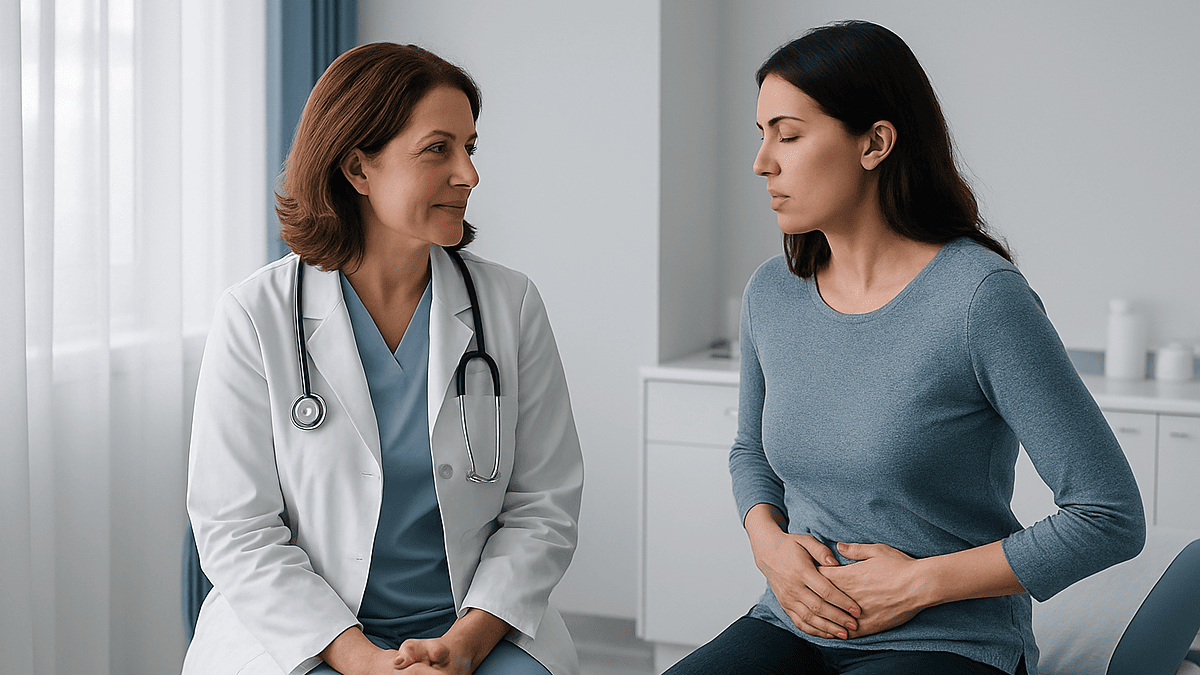
Mild bloating, light spotting and crampy pelvic discomfort are common for several days after a GIFT (gamete intrafallopian transfer) cycle, because the ovaries are enlarged by hormone stimulation and the tubes are reached through small laparoscopic cuts. Symptoms that worsen rather than ease, rapid abdominal swelling, severe or one-sided pain, heavy bleeding, breathlessness or fainting need same-day contact with the fertility team.
Three days after the transfer, the waistband that fit on the morning of the procedure will not button. Someone sits on the edge of the bed, one hand on a tender abdomen, running the same loop of questions: is this the gas from the keyhole surgery, the ovaries, the hormones, or the start of something that should not be happening? Bloating after a GIFT procedure is one of the most searched worries in fertility care, and the search results rarely explain why so many different things can cause the same tight, swollen feeling.
That confusion is understandable. A GIFT cycle stacks several events on top of each other within about two weeks: injections that push the ovaries far past their usual size, a trigger shot, an egg collection, a laparoscopy, and then daily progesterone. Each one leaves a signature in the body. Some of those signatures are harmless and expected. One or two are not.
This explainer sets them side by side so the reader can tell the difference, and so the phone call to the care team, when it is needed, happens early rather than late.
How a GIFT cycle works, and why the body has so much to recover from
GIFT stands for gamete intrafallopian transfer. A gamete is a reproductive cell, an egg or a sperm, and in GIFT the eggs and sperm are placed together directly into a fallopian tube so that fertilization happens inside the body rather than in a laboratory dish. MedlinePlus lists it among the assisted reproductive technologies alongside IVF, and notes that it is now used far less often than IVF because embryos cannot be observed before placement.
The sequence matters for understanding the aftermath. First comes ovarian stimulation: daily hormone injections encourage many follicles, the fluid-filled sacs that each hold an egg, to grow at once. Ovaries that normally sit the size of a walnut can swell to several times that volume. A trigger injection then matures the eggs. Eggs are collected, usually through a needle guided by ultrasound through the vaginal wall, though in some settings collection and transfer are done in the same laparoscopy.
Laparoscopy is keyhole surgery: the abdomen is inflated with carbon dioxide gas, a thin camera and instruments pass through small cuts near the navel, and a fine catheter delivers the eggs and prepared sperm into one or both tubes. The gas is released, the cuts are closed, and the person goes home the same day in most cases, according to the NHS description of laparoscopy.
Finally, progesterone is usually prescribed to support the uterine lining during the two-week wait. Progesterone is the hormone that relaxes smooth muscle, including the bowel, and holds the lining in place.
Every one of those steps can produce bloating, spotting or pelvic ache. The job of the next sections is to say which step produces which symptom, how long each usually lasts, and where the line sits between expected and urgent.
Who GIFT is usually offered to, and who is usually asked to wait
Because fertilization happens in the tube, GIFT only works when at least one fallopian tube is open and healthy. MedlinePlus describes it as an option for unexplained infertility, mild male factor infertility and some cases of endometriosis, where the sperm and egg simply need help meeting. It is not an option for tubal blockage or severe tubal damage, which is one of the main reasons IVF has largely replaced it.
Some people are drawn to GIFT for personal or religious reasons, since conception takes place inside the body. Others reach it after several unsuccessful intrauterine insemination cycles. The treating team weighs tubal anatomy, egg reserve, sperm parameters and the person’s fitness for a general anaesthetic before suggesting it.
Waiting is often advised in a few situations. Anyone showing early signs of ovarian hyperstimulation syndrome during stimulation may have the cycle paused or the plan changed, because surgery on already swollen, fragile ovaries carries extra risk. Active pelvic infection, uncontrolled thyroid or diabetes, or a recent major abdominal operation can also lead a surgeon to defer the laparoscopy until the body is better prepared.
Age and weight are discussed respectfully and specifically, not as judgments: both change how the ovaries respond to stimulation and how an anaesthetic is managed, and both shape the monitoring plan.
None of this is a verdict. The decision to proceed, delay or choose a different route sits with the treating team and the person in front of them, with the test results on the table. What the reader can do is understand that the same features that make someone a good candidate, open tubes and responsive ovaries, are the very things that produce the bloating and pelvic sensations described next.
Why does bloating after a GIFT procedure happen at all?
Three separate engines drive bloating after a GIFT procedure, and they often run at the same time.
The first is the ovaries themselves. After stimulation, each ovary may contain a dozen or more follicles, and after the eggs are collected those follicles become corpus luteum cysts, the hormone-producing structures that remain once the egg has gone. Mayo Clinic notes that enlarged, hormonally active ovaries can leak fluid into the abdomen, and even a modest amount of free fluid produces a heavy, distended feeling low in the belly.
The second engine is the carbon dioxide gas used to lift the abdominal wall during laparoscopy. The NHS explains that a small amount of trapped gas can irritate the diaphragm and cause pain in the shoulder tip and upper abdomen, along with a feeling of fullness, and that this typically settles over a few days as the gas is absorbed.
The third is progesterone. It slows the muscular movement of the bowel, so food and gas travel more slowly and constipation becomes more likely. Many people describe this as “pregnancy bloating” even before any pregnancy test, because it is produced by the same hormone.
Layer those together and the result is a belly that looks and feels several sizes larger for a week or so after transfer. The reassuring pattern is one that peaks within the first few days and then slowly eases, even if it does not vanish completely during the two-week wait.
The pattern that is not reassuring, and that the next section covers in detail, is swelling that keeps increasing day on day, especially when it arrives with nausea, reduced urination or difficulty taking a full breath.
When bloating is a warning sign: ovarian hyperstimulation syndrome explained
Ovarian hyperstimulation syndrome, usually shortened to OHSS, is an exaggerated response to fertility hormones in which the ovaries become very swollen and fluid shifts out of the blood vessels into the abdomen and, in severe cases, the chest. It is the single most important reason a fertility team takes bloating seriously.
The NHS IVF guidance reports that mild OHSS is common, affecting as many as 33 in 100 people who undergo ovarian stimulation, while around 1 in 100 develop a severe form. Those figures come from IVF populations, and the stimulation phase of GIFT is essentially the same, so the risk profile is broadly comparable; GIFT-specific numbers are not reported in mainstream guidance.
Timing helps separate OHSS from ordinary post-procedure fullness. Mayo Clinic notes that symptoms usually begin within about a week of the trigger injection, and that the condition can last longer or appear later if a pregnancy follows, because the pregnancy hormone hCG keeps the ovaries active.
Mild OHSS tends to produce bloating, mild nausea and ovarian tenderness. Moderate OHSS adds visible abdominal swelling, more persistent nausea or vomiting, and weight gain from retained fluid. Severe OHSS is marked by rapid weight gain, a tense, painful abdomen, breathlessness, markedly reduced urine output and dizziness, and it carries a risk of blood clots and kidney strain.
Teams often ask people to keep an eye on daily weight and waist size during the two-week wait precisely because a steady upward drift is more telling than any single uncomfortable day. The management of OHSS, whether rest, fluid guidance, monitoring or admission, is decided by the treating team based on examination and blood tests, not by the person at home. The home task is simpler: notice the trend and report it early.
Spotting after GIFT procedure: what light bleeding usually means
Light spotting in the days after a GIFT cycle has several ordinary explanations, and only a few concerning ones.
If the eggs were collected through the vaginal wall, the needle leaves tiny puncture sites that can ooze pinkish or brown discharge for a day or two. Instruments used to steady the cervix can cause a similar brief trace. Neither usually amounts to more than a smear on underwear or toilet paper.
Progesterone used for luteal support is often given as a vaginal preparation, and that route commonly causes irritation and spotting on its own, particularly brownish discharge that looks like old blood. The NHS IVF information lists spotting and discharge among the expected side effects of fertility medications.
Around the time a period would have been due, light bleeding can mean one of two very different things: the cycle has not resulted in pregnancy and a withdrawal bleed is beginning, or a pregnancy has implanted and the lining has shed a small amount. A home test or clinic blood test is the only way to tell; the pattern of bleeding is not a reliable guide. Teams usually ask that progesterone is not stopped on the basis of spotting alone, because the decision depends on the test result and belongs to the prescribing clinician.
Bleeding that soaks a pad within an hour, contains clots larger than a coin, or arrives with worsening one-sided pain or faintness is a different matter. The NHS ectopic pregnancy guidance highlights exactly that combination as a reason to seek urgent care, and the section on ectopic risk below explains why tubal placement makes this especially relevant after GIFT. Spotting, in short, is usually a footnote; the amount and the company it keeps decide whether it becomes a headline.
Pelvic pain after GIFT: the three usual sources and how each one feels
Pelvic pain after GIFT almost always comes from one of three places, and each has a recognizable character.
Incision pain is the easiest to place. The small laparoscopic cuts near the navel and lower abdomen feel bruised and sting when the person sits up, coughs or laughs. The NHS notes that this kind of discomfort is expected and generally eases over the first few days, with most people able to return to normal activities within about five days after a diagnostic laparoscopy; a procedure that also involves egg collection and tubal transfer may feel heavier for slightly longer.
Referred gas pain is the strange one. Carbon dioxide left under the diaphragm irritates a nerve that shares its pathway with the shoulder, so pain lands in the shoulder tip or upper chest rather than where the surgery happened. Walking and changing position help it disperse, and it typically fades within a few days.
Ovarian pain is the deepest and the most persistent. Enlarged ovaries pull on their supporting ligaments, producing a dull, aching, dragging sensation low on one or both sides that worsens with sudden movement, bending or intercourse. This can last through the two-week wait and beyond if a pregnancy follows, because the corpus luteum cysts stay active.
What none of these should do is escalate. Pain that becomes sharp and severe, settles firmly on one side, radiates to the shoulder in the second or third week rather than the first few days, or arrives with faintness, vomiting or heavy bleeding needs the team’s attention the same day. Two rarer surgical causes, bleeding inside the abdomen or injury to the bowel or bladder, are listed by the NHS as recognized laparoscopy complications; they are uncommon but they announce themselves with worsening rather than improving pain, fever, or an abdomen that becomes rigid to the touch.
GIFT procedure recovery time: what the first days and weeks usually look like
Recovery after GIFT runs on two overlapping clocks: the surgical clock, which winds down within days, and the hormonal clock, which keeps ticking until the pregnancy test and sometimes well beyond it.
Day of the procedure: drowsiness from the anaesthetic, a sore throat if a breathing tube was used, shoulder tip ache, and a belly that feels inflated. Most people go home the same day with someone to accompany them, as the NHS advises for laparoscopy.
Days one to three: the gas-related fullness and shoulder pain are at their peak and then start to recede. Incision sites are tender. Light spotting from the egg collection route may appear. Walking around the house helps the gas disperse; heavy lifting and strenuous exercise are generally discouraged by surgical teams while the cuts heal, though the exact guidance comes from the individual clinic.
Days four to seven: surgical soreness fades for most people. Ovarian aching and progesterone-related bloating take over as the main sensations. This is the window in which Mayo Clinic says OHSS, if it is going to develop, usually becomes apparent, so the daily weight and waist check matters most here.
Days eight to fourteen: the two-week wait proper. Breast tenderness, mood changes, constipation and fatigue are common and are driven by progesterone whether or not a pregnancy has begun. Spotting near the end of this window is discussed in the earlier section.
After the test: if negative, symptoms generally resolve within a week or so of stopping luteal support, on the team’s instruction. If positive, bloating and ovarian tenderness can persist or briefly worsen because hCG keeps the ovaries stimulated, and the team usually arranges an early scan, partly to confirm that the pregnancy is in the uterus rather than the tube.
Each of these ranges is a typical pattern drawn from laparoscopy and stimulation guidance, not a promise about any one person’s cycle.
Ectopic pregnancy after tubal placement: why pain on one side matters more after GIFT
An ectopic pregnancy is one that implants outside the uterus, most often inside a fallopian tube. It cannot continue, and if the tube ruptures it causes internal bleeding that can be life-threatening. The NHS reports that it affects around 1 in every 90 pregnancies in the general population and that the risk is somewhat higher after fertility treatment.
GIFT deserves particular attention here for an obvious anatomical reason: the gametes are deliberately placed in the tube. If fertilization happens and the resulting embryo does not travel down into the uterus in time, it implants where it is. Mainstream guidance does not publish a GIFT-specific ectopic rate, so this article will not invent one, but every fertility team treating with GIFT plans an early scan for exactly this reason.
The symptom pattern is what the reader needs to hold in mind. According to the NHS, ectopic symptoms usually develop between the fourth and twelfth week of pregnancy, counted from the last period. That places the danger window after the pregnancy test, not in the first week after the procedure. The classic trio is persistent pain low on one side, vaginal bleeding or brown watery discharge, and pain in the shoulder tip that appears in that later window rather than the first few days after laparoscopy. Pain on opening the bowels or passing urine, and faintness or collapse, complete the picture.
The overlap with ordinary post-GIFT sensations is real: one-sided ovarian ache, spotting, even shoulder pain all occur harmlessly. The distinguishing features are timing and trajectory. Harmless symptoms peak early and fade. Ectopic symptoms begin later and build. When the pattern is unclear, a scan and a blood hormone level settle it, and arranging that sits squarely with the treating team.
Does bloating after a GIFT procedure mean it worked?
This is the question behind many of the late-night searches, and the honest answer is that bloating is not a signal either way.
Progesterone, whether made by the ovaries or given as luteal support, produces nearly all of the sensations people associate with early pregnancy: breast tenderness, fullness, constipation, fatigue and mood swings. Those sensations appear in cycles that end in a negative test just as readily as in cycles that end in a positive one. Mayo Clinic’s OHSS guidance adds a twist: because hCG from a developing pregnancy keeps the ovaries active, bloating sometimes worsens rather than eases in a cycle that has succeeded, but it also worsens in people with developing OHSS who are not pregnant. The symptom is the same; the cause differs.
The same caution applies to cramping. Uterine cramping around the time of implantation is often described, but the uterus also cramps in response to progesterone withdrawal, to an irritated cervix, and to nearby swollen ovaries. No study in mainstream guidance has found a cramp pattern that reliably predicts pregnancy.
Spotting is the least informative of all. “Implantation bleeding” is a popular phrase, but the NHS describes bleeding in early pregnancy as common and of varied significance, and the same light bleeding precedes a period.
Why does this matter for a symptom article? Because reading the body for clues during the two-week wait turns every twinge into a verdict and every quiet afternoon into a loss. It also tempts people to stop or change progesterone on the strength of a guess. The pregnancy test, timed by the team, is the only reliable readout. Bloating tells the reader that the ovaries and the hormones are doing what they were asked to do; it does not tell them what the tube did with the gametes.
Expected or concerning? A side-by-side guide to symptoms after GIFT
The table below summarizes the patterns described in the sections above. It is a guide to the conversation with the care team, not a tool for self-diagnosis, and any symptom that worries the person is a legitimate reason to call regardless of where it sits.
| Symptom | Usually expected | Worth a call today | Urgent, seek care now |
|---|---|---|---|
| Bloating | Peaks in first few days, slowly eases; waist stable or shrinking | Waist or weight rising day on day; nausea; passing less urine | Tense, rapidly swelling abdomen with breathlessness or dizziness |
| Spotting or bleeding | Pink or brown smear for 1–2 days after collection; light spotting with vaginal progesterone | Fresh red bleeding lasting more than a day; bleeding with increasing pain | Soaking a pad an hour, large clots, or bleeding with faintness |
| Pelvic pain | Dull ache both sides; incision soreness easing over about 5 days | Pain that is not improving after a week; new one-sided ache after the test | Severe, sharp or one-sided pain; rigid abdomen; collapse |
| Shoulder tip pain | First few days after laparoscopy, improves with walking | Returns or appears in week two or three | Shoulder pain with faintness or heavy bleeding |
| Fever | Not expected | Low-grade temperature, or redness and discharge at a cut | High fever with worsening abdominal pain or vomiting |
| Breathing | Normal | Mild breathlessness on exertion | Breathlessness at rest, chest pain, or a swollen painful calf |
Two features cut across every row. Direction of travel matters more than intensity on any single day: a symptom that is improving, however unpleasant, is behaving as expected, while one that is building is not. And combinations matter more than single symptoms: bloating alone is routine, bloating with reduced urine and breathlessness is the OHSS pattern Mayo Clinic describes, and pain with bleeding and faintness is the ectopic pattern the NHS describes. Clinics usually give an out-of-hours number for exactly these moments, and using it is expected rather than a nuisance.
GIFT vs IVF differences: how the method changes what you feel afterward
People often arrive at GIFT after reading about IVF, and the two share more than they differ, which is why so much IVF evidence applies. The differences, though, explain a few distinctive after-effects.
The stimulation phase is essentially identical. Both use injectable hormones to grow multiple follicles and a trigger to mature the eggs, so the OHSS risk, the enlarged ovaries and the ovarian ache described above belong to both, and the NHS IVF figures for OHSS frequency are the best available guide for GIFT as well.
The transfer is where they part. In IVF, eggs are fertilized in the laboratory and the resulting embryo is placed into the uterus through the cervix with a soft catheter, usually without anaesthetic and without any abdominal cuts. In GIFT, the gametes are placed into the tube by laparoscopy under general anaesthetic. That adds the incision soreness, the carbon dioxide shoulder pain, the drowsiness and the small surgical risks the NHS lists for laparoscopy, none of which an IVF transfer involves. Recovery from the transfer step is therefore measured in days for GIFT and in hours for IVF.
Information differs too. In IVF, the laboratory can see whether fertilization occurred and how the embryo is developing before transfer. In GIFT, nobody knows whether fertilization happened until the pregnancy test. MedlinePlus notes this as one reason GIFT is now rarely chosen.
Finally, the site of placement shifts the balance of ectopic risk. IVF places the embryo in the uterus, although embryos can still migrate to the tube; GIFT starts in the tube and relies on natural transport to the uterus. Both groups are offered an early scan, but the reasoning is more pressing after GIFT.
None of this makes one approach better. It explains why someone recovering from GIFT feels like a surgical patient for a few days in a way an IVF patient usually does not.
Reasonable self-care during the wait, and what to avoid
Most of the early discomfort after GIFT responds to simple measures, and the care team will usually have given specific instructions that take priority over anything written here.
Gentle walking helps on two fronts. It moves the carbon dioxide gas along so shoulder tip pain eases sooner, and the NHS laparoscopy guidance notes that light activity after keyhole surgery supports recovery. The same movement reduces the risk of blood clots, which Mayo Clinic flags as a complication of OHSS because concentrated blood clots more readily. Long periods lying completely still are not protective for a pregnancy and are not advised for the body.
Fluids and fibre address the progesterone-driven sluggish bowel. Many teams suggest water, soups and fibre-rich foods rather than large fizzy drinks, which add gas to an already inflated abdomen. Exact fluid targets during suspected OHSS are set by the clinic, since too little and too much both cause problems.
Comfort measures for incision sites include loose waistbands, keeping the cuts clean and dry, and watching for redness or discharge. Heavy lifting, vigorous exercise and intercourse are commonly paused until the team says otherwise, both for the incisions and for the enlarged ovaries, which can twist on their supporting tissue, a complication called ovarian torsion that presents with sudden severe one-sided pain.
What to avoid is as important. Pain relief choices in a possible pregnancy are not all equivalent; anti-inflammatory medicines, for instance, are often discouraged around implantation, so the right option is a question for the prescribing clinician rather than the medicine cabinet. Stopping or adjusting progesterone because of spotting, or because a test “looks” negative, is also a decision for the team. Daily weight and waist measurements, written down, give the team something concrete to work with if a call becomes necessary.
What people often get wrong about bloating, spotting and pain after GIFT
Fertility forums are generous with reassurance and with alarm, and both are often misplaced. A few corrections, each grounded in mainstream guidance.
“Bloating means the ovaries are over-stimulated.” Usually not. Mild bloating after stimulation and laparoscopy is nearly universal, while severe OHSS affects around 1 in 100 according to the NHS. The distinguishing feature is a rising trend with reduced urine or breathlessness, not the presence of bloating itself.
“Shoulder pain after keyhole surgery is a sign of a heart problem or a clot.” In the first few days it is almost always trapped gas irritating the diaphragm, as the NHS describes. Shoulder pain that appears weeks later, especially with bleeding or faintness, is a different symptom and needs urgent review.
“Spotting means the cycle has failed, so progesterone can be stopped.” Spotting occurs in successful and unsuccessful cycles alike, and vaginal progesterone itself causes it. The decision to stop luteal support belongs to the prescribing clinician after a test.
“Lying flat protects the gametes.” No evidence from mainstream guidance supports strict bed rest after transfer, and inactivity raises clot risk, which matters more in an OHSS-prone body.
“GIFT avoids the risks of IVF.” It avoids laboratory fertilization but adds a general anaesthetic and laparoscopy, and places the gametes in the tube. The risk profile is different, not smaller.
“If an early scan is normal, OHSS is ruled out.” Mayo Clinic notes OHSS can worsen after a positive test because pregnancy hormone keeps the ovaries active, so monitoring continues even when the news is good.
The thread running through every myth is the same: a single symptom on a single day says little, and trajectory, combination and timing say almost everything.
Questions to ask your care team before and after GIFT
A ten-minute conversation before the procedure prevents most of the two-in-the-morning uncertainty afterward. These questions are drawn from the symptom issues above; the answers will be specific to the person and the clinic, which is exactly the point.
- Was egg collection done through the vagina or during the laparoscopy, and what kind of spotting should that produce?
- How many follicles were stimulated, and does that put me at higher or lower risk of ovarian hyperstimulation syndrome?
- What daily measurements would you like me to keep during the two-week wait, and what change in weight or waist size should prompt a call?
- Which pain relief is acceptable while a pregnancy is possible, and which should I avoid?
- How long do you expect the incision soreness and shoulder tip pain to last, and when would you consider them to have gone on too long?
- If I see spotting or bleeding, should I keep taking the progesterone until I have spoken to you?
- When will the pregnancy test be, and when is the early scan planned to confirm the pregnancy is in the uterus?
- What is the out-of-hours number, and which symptoms mean I should go straight to emergency care rather than wait for a call back?
- Were both tubes used for the transfer, and does that change the ectopic risk you are watching for?
- If this cycle does not succeed, what would the recovery look like before any further treatment is considered?
Writing the answers down, ideally in the same notebook used for daily weight and symptoms, turns vague worry into a record the team can act on. A few clinics provide a printed symptom diary for this purpose; if not, a plain page with date, weight, waist, pain score and any bleeding is enough. Every answer here, and every decision that follows from it, rests with the treating team.
When to call your doctor: red-flag signs after GIFT
Most people recover from a GIFT cycle with nothing more than a tender, swollen week. A minority develop complications that are treatable when caught early and dangerous when ignored, and the signs below are the ones that mainstream guidance from the NHS and Mayo Clinic consistently flags.
Contact the fertility team the same day, using the out-of-hours number if needed, for: abdominal swelling that is increasing day by day or a steady rise in weight; nausea or vomiting that stops you keeping fluids down; passing noticeably less urine than usual or urine that has become dark; pelvic pain that is not improving after about a week or that is getting worse; fresh red bleeding heavier than spotting; a temperature, or redness, warmth or discharge at an incision site; and shoulder tip pain that appears or returns after the first few days.
Seek emergency care immediately, by calling the emergency number or going to the nearest emergency department, for: severe or sudden one-sided pelvic pain; a tense, rigid or rapidly swelling abdomen; bleeding that soaks a pad within an hour or contains large clots; fainting, collapse, or feeling faint on standing; breathlessness at rest, chest pain, or coughing up blood; a swollen, painful calf; and pain with bleeding at any point between the fourth and twelfth week of a confirmed pregnancy, the window the NHS identifies for ectopic symptoms.
Tell whoever assesses you that you have had a GIFT cycle, which tube or tubes were used, the date of the trigger injection and any luteal support you are taking. That information shortens the path to the right scan and blood test.
None of this is a list for self-diagnosis. It is a list of reasons to let the people who know the cycle make the call. Calling early about a symptom that turns out to be gas costs an afternoon; waiting on a symptom that turns out to be OHSS or an ectopic pregnancy can cost far more.
Frequently asked questions
How long does bloating after a GIFT procedure normally last?
Ordinary bloating usually peaks in the first few days after the laparoscopy and then slowly eases, though a milder fullness from progesterone and enlarged ovaries often continues through the two-week wait. Mayo Clinic notes that bloating from ovarian hyperstimulation syndrome tends to appear within about a week of the trigger injection and can persist longer if a pregnancy follows, so a steadily increasing waist or weight should be reported.
Is spotting after GIFT procedure a sign that something went wrong?
Usually not. A pink or brown smear for a day or two after egg collection, and intermittent spotting while using vaginal progesterone, are both common and expected. Spotting around the time a period would be due can occur in successful and unsuccessful cycles alike. Fresh red bleeding heavier than spotting, clots, or bleeding with worsening one-sided pain or faintness should be reported the same day.
What does the typical GIFT procedure recovery time look like?
Surgical recovery from the laparoscopy is measured in days: the NHS notes most people return to normal activities within about five days of a diagnostic laparoscopy, and a procedure including transfer may feel heavier for slightly longer. Hormonal recovery runs for the full two-week wait and, if a pregnancy follows, beyond it, because ovarian swelling and progesterone effects continue.
Why do I have pelvic pain after GIFT on only one side?
In the first week, one-sided ache most often comes from the ovary that responded more strongly to stimulation, or from the side where instruments were used. Pain that becomes sharp, severe or sudden can indicate ovarian torsion or internal bleeding and needs urgent assessment. New one-sided pain that begins after a positive test is a recognized ectopic pregnancy warning and should be reviewed promptly.
What are the main GIFT vs IVF differences for recovery?
Both involve the same ovarian stimulation, so bloating and OHSS risk are comparable. GIFT adds a general anaesthetic and laparoscopy for the transfer, which brings incision soreness, trapped-gas shoulder pain and a few days of surgical recovery that an IVF transfer does not. GIFT also places gametes in the tube, so the team watches more closely for ectopic pregnancy at the early scan.
Can I tell from bloating or cramping whether the GIFT cycle worked?
No. Progesterone produces breast tenderness, bloating, constipation and cramping whether or not a pregnancy has begun, and mainstream guidance identifies no symptom pattern that reliably predicts the result. Bloating can even worsen in both pregnant cycles and in developing OHSS. The pregnancy test, timed by the care team, is the only dependable readout.
Should I stop progesterone if I start bleeding after GIFT?
That decision belongs to the prescribing clinician, not to the person at home. Spotting occurs in cycles that go on to be positive as well as negative, and vaginal progesterone itself causes spotting. Most teams ask that luteal support continues until they have reviewed the bleeding and the test result, so the right step is to call rather than change anything.
Is shoulder pain after GIFT laparoscopy normal?
In the first few days, yes. The NHS explains that carbon dioxide gas left under the diaphragm irritates a nerve shared with the shoulder, producing shoulder tip pain that improves with walking and settles as the gas is absorbed. Shoulder pain that returns or appears in the second or third week, particularly with bleeding, dizziness or one-sided pelvic pain, is treated as a possible sign of ectopic pregnancy.
How do I know if bloating is ovarian hyperstimulation syndrome?
The pattern, not the bloating alone, is the clue. OHSS produces swelling that increases day by day, often with nausea or vomiting, weight gain from retained fluid, reduced urine output and, in severe cases, breathlessness. The NHS reports severe OHSS in around 1 in 100 stimulated cycles. Keeping a daily weight and waist record gives the care team the information they need to assess it.
When is an ectopic pregnancy most likely to show symptoms after GIFT?
The NHS states that ectopic symptoms usually develop between the fourth and twelfth week of pregnancy, counted from the last period. That means the window opens after the pregnancy test rather than in the first days after the procedure. Persistent one-sided pain, bleeding or brown discharge, later-onset shoulder tip pain and faintness in that window need urgent care, and an early scan is planned to confirm the pregnancy site.
References
- NHS: IVF, Risks (including ovarian hyperstimulation syndrome and ectopic pregnancy)
- NHS: Laparoscopy (keyhole surgery), what happens and recovery
- NHS: Ectopic pregnancy
- MedlinePlus Medical Encyclopedia: Infertility (assisted reproductive technologies including GIFT)
This article is for general information only and is not a substitute for professional medical advice. Please consult a qualified doctor about your individual situation.

More from the Blog
Bloating, Spotting or Pelvic Pain After GIFT: What Is Expected and When to Call Your Team
Mild bloating, light spotting and crampy pelvic discomfort are common for several days after GIFT because the procedure combines ovarian stimulation, egg retrieval and…

Does ICSI Work Better Than IVF for Everyone? Common Misconceptions Corrected Plainly
No. ICSI, where a single sperm is injected directly into an egg, helps most when sperm cannot fertilize eggs on their own, such as…
ICSI Cycle Preparation: Screening Tests, Stimulation Monitoring and the Retrieval Day
ICSI preparation typically involves screening tests for both partners (hormone and infection blood tests, a pelvic ultrasound, and a semen analysis), followed by around…
Natural-Cycle vs Medicated IUI: How Ovulation Tracking Changes the Insemination Plan
Natural-cycle IUI places washed sperm in the uterus timed to the body's own ovulation, tracked with urine LH tests or ultrasound. Medicated IUI adds…
Getting Ready for Male Infertility Testing: Abstinence Days, Records to Bring and What Is Asked
To prepare for a male fertility test, follow the lab's abstinence window (usually two to seven days without ejaculation), avoid fever-inducing illness, hot tubs,…
Embryo Transfer Step by Step: What Happens in the Room From Catheter to Ultrasound Check
An embryo transfer is a short outpatient step near the end of an IVF cycle. With a full bladder and an ultrasound probe on…