

Blue Light and Sleep: How Much Screens Really Matter, According to the Research
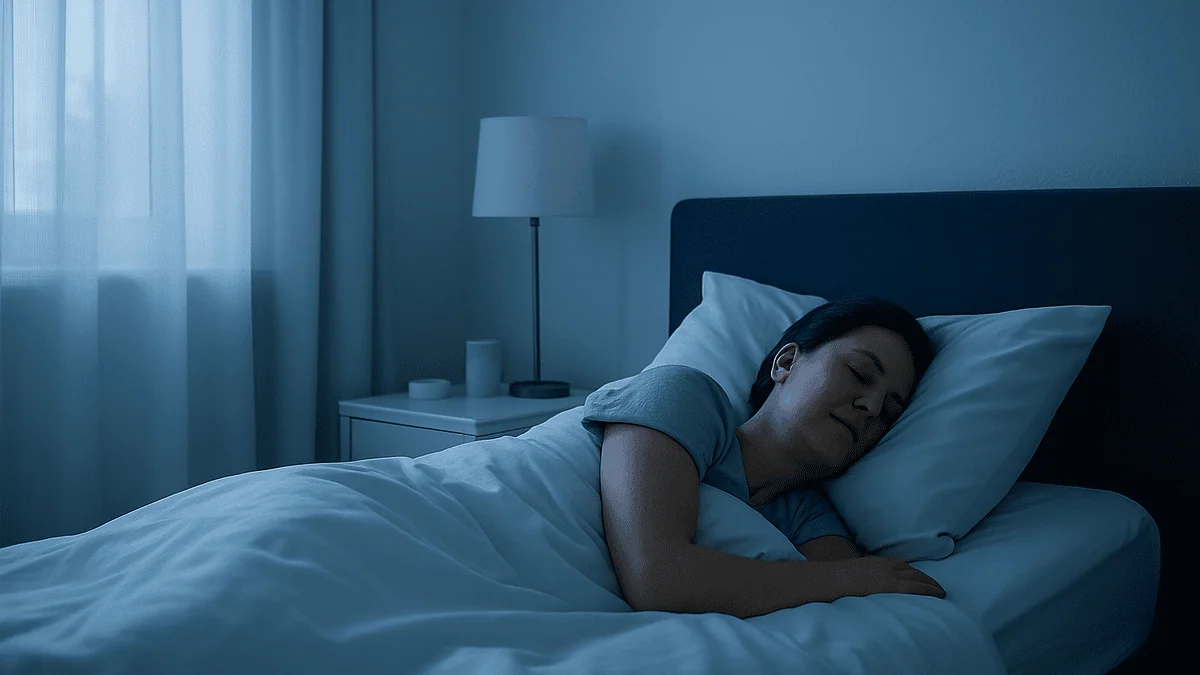
Key Takeaways
- In a controlled Harvard experiment, 6.5 hours of blue light suppressed melatonin about twice as long as green light and shifted the body clock roughly 3 hours versus 1.5.
- Sensitivity to evening light varies about 50-fold between healthy adults, so the same phone can be trivial for one person and disruptive for another.
- A phone at arm's length delivers roughly 10–40 lux at the eye, usually less than the overhead light in the room, and far less than the 1,000-plus lux of a cloudy morning outdoors.
- A 2023 Cochrane review of 17 randomized trials rated the sleep evidence for blue light glasses as low certainty, and a 2021 trial found night mode made no measurable difference to sleep.
- In a 2025 survey of more than 45,000 students, each extra hour of screen use in bed was linked to about 59 percent higher odds of insomnia symptoms, regardless of the type of content.
- One night of sleeping under about 100 lux of room light raised heart rate and next-morning insulin resistance in healthy adults, which is why darkness, not colored light, is the overnight goal.
Blue light from screens can delay melatonin release and shift the body clock, but the effect of typical evening phone use is modest. Laboratory trials show a clear mechanism; real-world trials of blue light glasses and night mode show small or uncertain benefits. What you do on the screen, how late, and how bright your bedroom is matter at least as much as the color of the light.
Picture the last thing you saw before falling asleep last night. For most adults it was not a ceiling or a book spine; it was a rectangle of light about the size of a hand, held roughly a foot from the face. That habit is why the phrase blue light and sleep is climbing search charts again as of September 2026, pushed along by a wave of short videos promoting bedtime “rules”, a large Norwegian student survey linking in-bed screen use to insomnia symptoms, and a systematic review that found blue light glasses do far less than their marketing suggests.
The trouble is that the online conversation has split into two camps: screens are frying your circadian rhythm, or the whole thing is a myth. The research supports neither. It supports something more useful, and more specific, about brightness, timing and what you are actually doing with the device at 11:40 p.m.
Here is what the evidence shows, graded by how strong it is, and what is worth changing first.
What changed recently in the blue light and sleep debate
Three developments reshaped this topic, and none of them say blue light is harmless. They say the story was told backwards.
The first was a Cochrane systematic review published in 2023 that pooled 17 randomized trials of blue-light filtering spectacle lenses. A systematic review is a structured summary of every eligible study on a question. The reviewers found no clear benefit for eye strain and judged the evidence on sleep to be low certainty and inconsistent: some small trials reported better sleep, others reported none, and most were short and prone to bias.
The second arrived in 2025, when researchers analyzing a Norwegian survey of more than 45,000 university students reported that each additional hour of screen use after going to bed was associated with roughly 59 percent higher odds of insomnia symptoms and about 24 minutes less sleep. Strikingly, scrolling social media was no worse than watching video or reading on a device. Because this was a survey, it shows association, not cause; but it nudged attention from the wavelength of the light to the behavior of staying awake with a device.
The third is older but keeps resurfacing: a 2019 laboratory study of 55 adults found that the amount of light needed to suppress melatonin by half varied about 50-fold between individuals. Some people’s melatonin fell with light as dim as a candle; others needed light approaching a bright office. That single number explains why your partner can read a tablet in bed and sleep soundly while you cannot.
The Harvard Health summary cited below still stands as the clearest statement of the underlying biology, and it is the right place to start.
How does blue light affect sleep? The mechanism in plain words
Your eyes contain a third type of light sensor that has nothing to do with seeing. Alongside the rods and cones sit intrinsically photosensitive retinal ganglion cells, a small population of cells containing a pigment called melanopsin. Melanopsin responds most strongly to light at a wavelength near 480 nanometers, which we perceive as sky blue.
These cells send a direct signal to the suprachiasmatic nucleus, a cluster of about 20,000 neurons in the hypothalamus that acts as the body’s master clock. The clock, in turn, controls the pineal gland’s release of melatonin, the hormone that signals “night” to the rest of the body. Melatonin does not knock you out like a sedative; it opens the door to sleep by lowering alertness and core temperature at the right time.
Blue-enriched light at night does two separate things. It suppresses melatonin while the light is on, and it shifts the clock later, so that tomorrow’s melatonin starts later too. The classic experiment behind the Harvard Health article compared 6.5 hours of blue light with green light of similar brightness. Blue suppressed melatonin for about twice as long and shifted circadian timing by roughly three hours, versus about 1.5 hours for green.
Two caveats matter before you panic about a phone. That experiment used long, bright exposure under laboratory conditions, far beyond a half-hour of scrolling. And the clock responds to all visible light; blue is simply the most potent per unit of brightness. A very bright white lamp with little blue can out-shift a dim blue screen. Intensity and duration, not color alone, decide the outcome.
How much light does a phone actually emit compared with daylight?
Light is measured in lux, a unit of how much light lands on a surface. The numbers put screens in perspective.
| Light source (at the eye) | Approximate lux | Blue content |
|---|---|---|
| Direct midday sunlight | 50,000–100,000 | High |
| Overcast daylight, outdoors | 1,000–10,000 | High |
| Bright office or kitchen | 300–500 | Moderate to high (LED) |
| Living room lamps, evening | 50–150 | Depends on bulb |
| Smartphone, arm’s length, medium brightness | roughly 10–40 | Moderate to high |
| Candle at one meter | about 10 | Very low |
| Full moon | under 1 | Low |
Values are typical ranges; screen output varies several-fold with brightness setting and distance.
Read across the rows and a pattern appears. A phone held at arm’s length delivers a fraction of the light of the ceiling fixture above it. Yet the 2019 sensitivity study found some people’s melatonin dropping meaningfully at around 10 lux, roughly phone territory. So the honest answer to “is a phone bright enough to matter?” is: for a sensitive minority, yes; for many others, the bathroom light they switch on afterward is the bigger hit.
Distance is the lever people forget. Light intensity falls with the square of distance, so a screen held 30 centimeters away delivers about four times the light of the same screen at 60 centimeters. Dimming the display, holding it farther away, and dimming the room all compound. One small Mayo Clinic experiment reported that a device turned to low brightness and held about 35 centimeters from the face produced light levels unlikely to disturb melatonin.
What the evidence actually says: grading the strength
Not all findings deserve equal weight, so here is the picture ranked by study type.
Strong, mechanistic evidence (controlled lab studies). Blue-enriched light suppresses melatonin and delays the circadian clock in a dose-dependent way. Dozens of experiments agree. This is settled physiology.
Moderate evidence (small randomized crossover trials). In the best-known study, 12 healthy adults read either a light-emitting e-reader or a printed book for four hours before bed on five consecutive nights. The e-reader delayed melatonin onset by about 1.5 hours, lengthened the time to fall asleep by roughly 10 minutes, reduced REM sleep, and left participants groggier the next morning. Real effects, but note the design: four hours at maximum brightness is not an average evening.
Observational evidence (surveys and cohorts). Large studies consistently link late-night screen use with shorter sleep and more insomnia symptoms, especially in adolescents. Association, not proof; people who cannot sleep also reach for their phones.
Weak or uncertain evidence (interventions people buy). Blue light glasses, night mode settings and screen filters have produced mixed results in randomized trials, with most trials small, short and unblinded. The 2023 Cochrane review rated the sleep evidence as low certainty.
Expert opinion. Advice to stop screens an hour before bed, keep devices out of the bedroom and dim lights in the evening appears in NHS, Mayo Clinic and MedlinePlus guidance. It is sensible, low-risk and consistent with the physiology, but the one-hour figure itself is a judgment, not a trial result.
Put together: the mechanism is real, the typical real-world effect is modest, and individual sensitivity varies enormously.
Is it the light, or what you are doing on the screen?
A sleep researcher once summarized the problem this way: the phone is a lamp, a casino and a newsroom, and only the lamp has anything to do with blue light.
Consider what the Norwegian survey found. Students who used screens in bed slept less and reported more insomnia symptoms regardless of whether they were gaming, messaging, scrolling or watching. If wavelength were the main driver, the activity should not matter. That it did not matter points to two other mechanisms.
The first is time displacement, the plainest explanation in sleep science: 40 minutes of scrolling is 40 minutes not spent asleep. Surveys that adjust for bedtime often find the “screen effect” shrinks considerably once you account for people simply going to bed later.
The second is cognitive and emotional arousal. Interactive content, unpredictable rewards, work email and alarming news raise heart rate and keep the brain in problem-solving mode. Sleep onset requires the opposite: a drift of attention away from the self. Passive content such as a familiar audiobook produces less of this arousal, which is why some trials of “screens before bed” find little effect when the content is calm and the brightness is low.
None of this makes light irrelevant. In the e-reader trial, the content was identical in both arms (a book), and the lit screen still delayed melatonin. Light shifts the clock; content delays the decision to sleep. In a real bedroom at midnight, both happen at once, and the second is usually the larger of the two. That ordering is the single most useful idea in this article.
Do blue light glasses or night mode filters actually help?
Two products promise to fix the problem without changing behavior. The trials are humbling for both.
Blue light glasses come in two very different strengths. Clear or faintly tinted lenses sold for “screen protection” typically filter 10–25 percent of blue wavelengths; amber or orange lenses used in research filter most of it. Several small randomized trials of amber lenses worn for the last two to three hours of the evening reported earlier melatonin rise and modest sleep improvements, including in people with insomnia and in some psychiatric populations. The clear lenses most people buy were not tested in those studies and are unlikely to filter enough light to matter. The 2023 Cochrane review concluded the overall sleep evidence was low certainty, with inconsistent results and short follow-up.
Night mode, the warm-tint setting built into phones and laptops, has a thinner record. A 2021 randomized study of 167 young adults compared an hour of phone use at bedtime with night mode on, night mode off, and no phone at all. Sleep measured by wrist devices did not differ meaningfully between the three groups. In the subgroup who already slept well, the no-phone group had slightly better sleep; the warm tint made no detectable difference.
The likely reason is that these settings shift color without dropping brightness much. A warm-tinted screen at full brightness still delivers plenty of melanopsin-activating light. Lowering brightness, by contrast, cuts every wavelength at once.
Verdict: amber glasses are a reasonable experiment for a sensitive person or a shift worker, with low risk. Night mode is harmless but should not be mistaken for a sleep intervention. Neither replaces putting the device down.
Should you sleep with blue lights on? What bedroom light does overnight
The question sounds odd until you look around a modern bedroom: router lights, charger LEDs, a television standby glow, a streetlight through thin curtains. Many of these are blue or white, and they stay on all night.
A 2022 study from Northwestern University measured what happens when 20 healthy adults slept one night in a room at about 100 lux, roughly the level of a dim overhead light, compared with a near-dark room. Under the light, participants spent more time in lighter sleep stages, their heart rate stayed higher, heart rate variability was lower, and insulin resistance was higher the next morning. A single night was enough to show these shifts. Larger observational studies in older adults have linked habitual bedroom light exposure with higher rates of obesity, high blood pressure and diabetes. Those are associations, but they line up with the lab findings.
Small LED indicators emit far less than 100 lux, so they are unlikely to affect metabolism. They can still bother light-sensitive sleepers and nudge the clock when they shine directly at the pillow. A strip of tape or a repositioned charger solves it.
Are there any advantages to sleeping with the lights on? One, and it is real: safety. Falls during night-time bathroom trips are a leading cause of injury in older adults, and a sudden switch from darkness to a bright bathroom is both dazzling and alerting. The evidence-aligned compromise is a dim, warm-colored night light placed low, near the floor, along the route to the bathroom, rather than a bedside lamp. For children who fear the dark, the same principle applies: dim, warm, and away from the face.
Why do I wake up at 2am and can't go back to sleep?
This is one of the most searched sleep questions in the world, and blue light is usually only the second half of the answer.
Waking briefly in the night is normal. Sleep runs in cycles of about 90 minutes, and the second half of the night contains lighter sleep and more REM, from which people surface easily. Most of these awakenings last seconds and are forgotten. The problem begins when the brain switches fully on.
Common drivers of the 2am wake include alcohol, which sedates early and then fragments sleep as it wears off three to four hours later; a full bladder; hot flashes during menopause; untreated sleep apnea, where breathing pauses jolt the brain awake; a bedroom that has warmed up overnight; and plain anxiety, which tends to flood in when there are no distractions. Age plays a part as well: deep sleep declines across adulthood, so night-time arousals become more noticeable.
Here is where screens enter. The instinct on waking is to check the time, then the notifications. That delivers a dose of light to fully dilated pupils at the hour when the clock is most sensitive to being pushed later, and it adds content that invites rumination. The combination is close to ideal for staying awake.
Sleep clinicians generally advise the opposite: do not check the clock, keep lights off, and if you have been awake for what feels like 20 minutes, get up, sit somewhere dim and dull, and return to bed only when sleepy. Cognitive behavioral therapy for insomnia, a structured program that retrains the association between bed and sleep, is the first-line treatment when 2am waking becomes a pattern. Persistent waking, especially with snoring or gasping, belongs in the doctor’s office rather than the settings menu.
What is the 10 3 2 1 0 rule for sleep, and does the evidence back it?
The rule circulating on social platforms goes like this: no caffeine within 10 hours of bed, no food or alcohol within 3, no work within 2, no screens within 1, and 0 presses of the snooze button. It is memorable, which is why it spreads. How does each number hold up?
10 hours, caffeine. Caffeine has a half-life of roughly five hours in healthy adults, longer in pregnancy and with some medicines. A controlled trial found caffeine taken six hours before bed cut measured sleep by about an hour. Ten hours is conservative but directionally correct; the NHS suggests avoiding caffeine for at least several hours before bed. Grade: moderate.
3 hours, food and alcohol. Alcohol reliably fragments the second half of the night, so the alcohol half is well supported. Large late meals can worsen reflux and raise core temperature, but a light snack is harmless for most people. Grade: moderate for alcohol, weak for food.
2 hours, work. No trial defines two hours, but the principle of winding down mental arousal is standard in insomnia therapy. Grade: expert opinion.
1 hour, screens. Consistent with the physiology and with every major guideline, though the specific hour is a convention rather than a measured threshold. Grade: moderate for the principle, weak for the number.
0 snoozes. Interestingly, a 2022 study of habitual snoozers found a 30-minute snooze window did not clearly harm sleep or next-day performance. Grade: weak either way.
Taken as a whole, the rule is sound expert opinion dressed as precision. Follow the caffeine and alcohol parts first; they have the best data.
Morning light: the half of the blue light story most articles skip
If evening blue light pushes the clock later, morning blue light pulls it earlier, and the second effect is just as well established as the first. Yet almost every article on blue light and sleep treats it purely as a villain.
The circadian system is not a timer; it is a clock that drifts and must be reset daily. For most people the internal day runs slightly longer than 24 hours, so without a strong morning signal the clock slides later, bedtimes creep, and mornings get harder. Bright light in the first hour or two after waking is the strongest reset signal the body receives, and the melanopsin cells that respond to it are tuned to exactly the blue-rich spectrum of daylight.
The scale difference is enormous. Ten minutes outdoors on an overcast morning delivers more than 1,000 lux; a sunny morning delivers tens of thousands. A well-lit kitchen manages a few hundred. People who spend the day indoors live in what researchers call biological dusk, which flattens the contrast between day and night that the clock depends on. Then, in the evening, a screen that would be trivial against a daylight-anchored clock becomes a larger share of the day’s total light.
This has practical consequences. Teenagers with delayed sleep timing, shift workers trying to realign, and anyone who feels permanently jet-lagged often gain more from brightening their mornings than from dimming their evenings. Timed morning light exposure is a recognized approach for circadian rhythm sleep disorders in the NIH guidance cited below, usually under clinical supervision.
A fair summary: the goal is not less blue light. It is more of it at the right time and less at the wrong one.
Common myths about blue light and sleep, corrected
Viral claims tend to be half-true, which is what makes them durable. Here are the ones that circulate most.
Myth: screen blue light damages the retina. Screens emit far less blue light than the sky. Harvard Health and ophthalmology bodies agree there is no evidence that device light harms the eye. The sleep effect is a clock effect, not an injury.
Myth: blue light glasses treat insomnia. Clear “computer” lenses block too little light to change melatonin. Amber lenses show small, inconsistent effects in short trials. No guideline recommends either as a treatment for insomnia.
Myth: night mode makes bedtime scrolling safe. A randomized trial found no sleep difference with the tint on or off. Warm color at full brightness still alerts the clock; the content still alerts the mind.
Myth: any screen before bed ruins sleep. The e-reader trial that launched much of the concern used four hours at maximum brightness. A dim screen, held at distance, showing calm content, has a far smaller measured effect, and in some people none that can be detected.
Myth: red light is a sleep aid. Red and amber light are simply less alerting than blue. Darkness remains better than any colored light, and there is no good evidence that red light actively improves sleep.
Myth: blue light is the main reason people sleep badly. Caffeine, alcohol, irregular schedules, untreated apnea, pain and anxiety each explain more insomnia than screen color does. Blue light is one adjustable input among many, and rarely the largest.
The pattern in every myth is the same: a real mechanism, stretched well past the dose at which it was measured.
Screen time before bed: a realistic evening plan, in order of payoff
Advice that demands a screen-free monastery after 8 p.m. fails because nobody keeps it. The evidence supports a sequence instead, starting with the changes that move the needle most.
- Anchor the morning first. Get outside, or at least to a bright window, within an hour of waking, for 10–20 minutes. This sets the clock so that evening light has less to push against.
- Fix the big chemical inputs. Move caffeine earlier and treat alcohol as a sleep disruptor rather than a sleep aid. These two have stronger trial evidence than anything involving screens.
- Dim the room, not just the screen. Switch to lamps rather than overhead lights for the last hour or two. Room lighting usually contributes more lux than a phone.
- Change what the screen does, then how bright it is. Swap interactive, work-related or emotionally charged content for passive, familiar material; drop brightness to the lowest comfortable setting; hold the device farther away.
- Give the device a bedtime outside the bedroom. Charging the phone in another room removes both the 2am light dose and the temptation that follows it. If it must stay for an alarm, keep it face-down and out of reach.
- Make darkness the default overnight. Blackout blinds or an eye mask, standby LEDs covered, and a dim warm floor-level night light if safety requires one.
Keep each change for two weeks before judging it; circadian shifts take days to show. If you want a quick personal test, compare how long it takes to fall asleep across five phone-free nights and five ordinary nights. The 50-fold variation in light sensitivity means your own answer may differ from the average, and that is the answer that counts.
Who is most sensitive to blue light at night: children, teens and shift workers
Averages hide the groups for whom this topic is not a minor tweak.
Children. A child’s pupils are larger and the lens inside the eye is clearer than an adult’s, so more short-wavelength light reaches the retina. Small laboratory studies suggest children’s melatonin is suppressed more strongly than adults’ by the same evening light. Combined with the finding that bedroom screens are linked to shorter sleep in school-aged children, this is the strongest case for keeping devices out of children’s bedrooms at night.
Adolescents. Puberty shifts the internal clock later by about one to two hours, a biological change seen across cultures. A teenager who cannot fall asleep before midnight is not simply undisciplined. Evening screen light pushes an already late clock later still, while early school starts cut the other end. Teens are the group in whom observational studies show the largest associations between night-time screen use and insufficient sleep. Morning daylight and a consistent wake time help more than any filter.
Shift workers. Someone finishing a night shift at 7 a.m. drives home into exactly the daylight that tells the clock to wake up. Here amber glasses on the commute, blackout blinds and a dark bedroom have a clearer rationale, and small trials support them for improving daytime sleep.
Older adults. The aging lens yellows and transmits less blue light, which partly explains weaker circadian signals, earlier bedtimes and more fragmented sleep with age. For this group the risk runs the other way: too little daytime light, especially in care settings. Brighter days and darker nights, rather than blue-light avoidance, are the evidence-based priority.
One rule does not fit all of these. The physiology is shared; the dose and the timing that matter are not.
When to see a doctor about sleep problems
Adjusting light is a reasonable first step for occasional poor sleep. It is not a substitute for assessment when sleep problems persist or when they come with warning signs. Talk with your doctor or a sleep specialist if any of the following apply.
- Trouble falling or staying asleep at least three nights a week for three months or longer, despite reasonable changes to light, caffeine and schedule. This meets the usual definition of chronic insomnia, for which cognitive behavioral therapy for insomnia is the recommended first-line treatment.
- Loud snoring, witnessed pauses in breathing, waking gasping or choking, or morning headaches. These are red flags for sleep apnea, which can raise blood pressure and cardiovascular risk and is treatable once diagnosed.
- Severe daytime sleepiness: dozing while driving, in meetings or mid-conversation. Do not drive if you are struggling to stay awake at the wheel.
- An uncomfortable urge to move the legs in the evening that eases with movement, which may indicate restless legs syndrome.
- A teenager or adult who cannot fall asleep until 2 or 3 a.m. and cannot wake for school or work, month after month. This pattern may be delayed sleep phase disorder, a circadian condition with specific treatments including timed light.
- Sleep problems that began after starting a new medicine, or that occur alongside low mood, persistent anxiety, chest pain, palpitations or unexplained weight change.
- Acting out dreams, sleepwalking that risks injury, or frequent night terrors in a child.
Never stop or change a prescribed medicine because of sleep side effects without discussing it with the clinician who prescribed it; many sleep complaints linked to medicines can be managed by timing or an alternative. If you are considering melatonin or any over-the-counter sleep product, raise it with your doctor or pharmacist first, particularly for children, in pregnancy, or alongside other medicines. Every treatment decision belongs with your treating clinician.
Frequently asked questions
How does blue light affect sleep in simple terms?
Blue-rich light activates melanopsin cells in the retina that report brightness to the brain’s master clock, which then suppresses melatonin and pushes the clock later. The result is feeling alert later and sleeping lighter at first. The effect is dose-dependent: bright, prolonged light shifts the clock by hours in lab studies, while a dim screen for a short time has a much smaller and more variable effect.
Do blue light glasses work for sleep?
The evidence is weak and mixed. Amber lenses that block most blue light produced modest improvements in some small trials, especially when worn for two to three hours before bed, but a 2023 Cochrane review of 17 randomized trials judged the sleep evidence to be low certainty. Clear lenses marketed for screen use block too little light to change melatonin meaningfully.
Is screen time before bed really that bad for sleep?
It depends on brightness, duration and content more than on the screen itself. Four hours of a bright e-reader delayed melatonin by about 1.5 hours in one trial, but a dim screen showing calm content for 20 minutes has a far smaller effect. Interactive, work-related or upsetting content keeps the mind alert, and time spent scrolling is time not spent asleep; both matter at least as much as light color.
Should you sleep with blue lights on?
No. Even moderate room light overnight, around 100 lux, has been shown to lighten sleep and raise heart rate and next-morning insulin resistance in healthy adults. Small LED indicators are far dimmer but can still bother sensitive sleepers if they shine toward the pillow. Cover standby lights, use blackout blinds or an eye mask, and aim for genuine darkness.
Are there any advantages to sleeping with the lights on?
Safety is the one genuine advantage, mainly for older adults and young children. Falls during night-time bathroom trips are common, and switching on a bright light is both dazzling and alerting. The compromise supported by the physiology is a dim, warm-colored night light placed low near the floor along the route, rather than a lamp near the face.
Why do I wake up at 2am and can't go back to sleep?
Brief awakenings are normal in the lighter second half of the night; they become a problem when the brain fully switches on. Alcohol wearing off, a full bladder, hot flashes, anxiety, a warm room and sleep apnea are common triggers. Checking a phone makes it worse by adding light to dilated pupils and content to think about. Persistent 2am waking, especially with snoring, deserves a medical assessment.
What is the 10 3 2 1 0 rule for sleep?
It is a social-media heuristic: no caffeine within 10 hours of bed, no food or alcohol within 3, no work within 2, no screens within 1, and zero snoozes. The caffeine and alcohol parts have the strongest trial support; the screen hour matches guideline advice but the exact number is a convention; the food and snooze parts rest on thin evidence. Treat it as sensible expert opinion, not precision.
Does night mode on my phone help me sleep?
Probably not by itself. A 2021 randomized trial of 167 young adults found no meaningful difference in measured sleep whether night mode was on, off, or the phone was not used at all. Warm tint changes color but not brightness much, so the clock still receives alerting light. Lowering brightness, holding the device farther away, and stopping earlier do more than the tint setting.
Does morning light help with sleeping better at night?
Yes, and the evidence is as strong as for evening light. Bright light in the first hour or two after waking resets the body clock earlier, counteracting its natural drift later and making evening sleepiness arrive on time. Ten to twenty minutes outdoors, even on a cloudy day, delivers far more light than indoor lighting. It is especially useful for teenagers and people whose sleep timing has drifted late.
Can melatonin supplements counteract blue light from screens?
Melatonin supplements are not a fix for evening screen habits. NIH guidance notes short-term melatonin appears safe for most adults and may help jet lag and delayed sleep timing, but evidence for ordinary insomnia is limited, and products vary widely in actual content. Questions about whether, when and how to use melatonin, particularly for children or alongside other medicines, belong with your doctor or pharmacist.
References
- NHS: How to fall asleep faster and sleep better
- MedlinePlus: Healthy Sleep
- NIH National Heart, Lung, and Blood Institute: Circadian Rhythm Disorders
- NIH NCCIH: Melatonin, What You Need To Know
This article is for general information only and is not a substitute for professional medical advice. Please consult a qualified doctor about your individual situation.

More from the Blog
Mattress Firmness and Back Pain: What the Evidence Says About Medium-Firm
The best-studied answer is medium-firm. In a randomized trial of 313 adults with chronic low back pain, people given a medium-firm mattress reported less…
Sleep Restriction Therapy: The Counterintuitive Insomnia Treatment That Works
Sleep restriction therapy is a structured part of cognitive behavioral therapy for insomnia that temporarily limits time in bed to roughly the hours a…
Sleep Positions Explained: Back, Side or Stomach: What Each Does to Breathing, Spine and Reflux
No single sleep position is best for everyone. Side sleeping suits most adults: it keeps the upper airway more open, reduces snoring and, on…
Exercise Before Bed: Does Evening Training Ruin Sleep? What the Trials Say
For most healthy adults, exercise before bed does not ruin sleep. Randomized trials show moderate evening workouts leave total sleep time and deep sleep…
Sleeping Too Much: When Long Sleep Is a Symptom Rather Than a Luxury
Sleeping too much is usually defined as regularly needing more than nine hours a night and still feeling unrefreshed. It can be a normal…
Cognitive Shuffling: The Fall-Asleep Trick Backed by a Small Study
Cognitive shuffling is a bedtime technique in which you picture a random series of unrelated, emotionally neutral objects, often by working through the letters…