

Breast Reduction After 50 and Beyond: What Surgeons Consider About Skin, Health and Screening

Key Takeaways
- Age is not a listed exclusion for breast reduction in Mayo Clinic or NHS guidance; stable health, non-smoking status and realistic expectations are what surgeons assess.
- After menopause, falling estrogen replaces glandular breast tissue with fat, which changes how the breast is reshaped and how it appears on a mammogram.
- Mayo Clinic notes a baseline mammogram may be requested before breast reduction and another afterward, and removed tissue is routinely sent for pathology.
- Blood thinners, anti-inflammatory painkillers, some supplements and hormone therapy all affect surgical risk, and any change to them belongs to the prescribing clinician.
- NHS guidance suggests two to six weeks off work and around six weeks without heavy lifting, with scars continuing to fade for a year or more.
- Chest pain, sudden breathlessness, a swollen painful calf, a tense rapidly enlarging breast, or dark skin at the nipple edge are reasons to seek care the same day.
Breast reduction after 50 is common and age alone is not a barrier. Surgeons look instead at overall health, skin elasticity, medicines, smoking status and up-to-date breast screening, often asking for a mammogram before surgery. Recovery usually spans several weeks, with lifting limits of around four to six weeks. Whether and when to operate is a decision made with the treating team after a full assessment.
The physical therapist had asked a simple question: where exactly does your back hurt? Her patient, 58, laughed and pointed at the deep grooves her bra straps had carved into both shoulders over three decades. She had raised two children, worked thirty years at a desk, and only now, with the house quieter, had begun to wonder whether the weight she carried on her chest was something she still had to live with.
Her family doctor did not dismiss the idea. What she heard instead was a list of things a surgeon would want to understand first: how her skin had changed since menopause, what her blood pressure and blood sugar looked like, which tablets she took, and when she had last had a mammogram.
That list is the honest subject of this article. Breast reduction after 50 is neither unusual nor automatically riskier, but the conversation around it is different from the one a 28-year-old has. Here is what surgeons actually weigh, explained by medical evidence rather than myth.
What breast reduction after 50 actually involves
Breast reduction, also called reduction mammaplasty, removes excess breast tissue, fat and skin to make the breasts smaller, lighter and better supported. The goal is relief from the physical load, not a cosmetic ideal, although the two overlap.
The operation is done under general anesthesia, meaning you are fully asleep. Mayo Clinic describes the usual approach: the surgeon makes an incision around the areola (the darker ring of skin around the nipple), often extending down to the crease beneath the breast. Tissue is removed, the remaining breast is reshaped, and the nipple and areola are moved higher on the chest while usually staying attached to their own blood and nerve supply. The incisions are closed in layers and dressed. Mayo Clinic notes the procedure may be done as an outpatient or with a short hospital stay.
For a person over 50, the mechanics are identical. What changes is the planning. Older breast tissue tends to contain more fat and less firm glandular tissue, which affects how the surgeon shapes what remains. Skin that has lost elasticity may need more careful tailoring to sit smoothly without creasing. Neither is a problem in itself; both are simply factors the surgeon measures and plans around.
Some surgeons send the removed tissue to a pathology laboratory for routine examination. This is standard practice rather than a sign of concern, and it is one of the reasons screening history matters before the operation, which we return to later.
The operation typically takes a few hours, varying with breast size and the technique used. The surgeon’s consultation will cover incision pattern, expected scar placement and the likely new cup range, all of which are estimates rather than guarantees.
Is 60 too old to have a breast reduction?
No, not on the basis of the number itself. Mayo Clinic lists the usual candidates for breast reduction as adults who are physically healthy, non-smokers, and troubled by back, neck or shoulder pain, skin irritation under the breasts, or restricted activity. None of those criteria has an upper age limit.

What surgeons do with an older patient is shift the emphasis from chronological age to what clinicians call physiological age: how well the heart, lungs, kidneys and immune system are working, and how the body is likely to cope with a few hours of anesthesia and several weeks of healing. A fit 64-year-old who walks daily, has controlled blood pressure and does not smoke may be a more straightforward surgical candidate than a 45-year-old with uncontrolled diabetes.
Breast reduction at 60 or beyond therefore starts with a frank health review rather than a conversation about age. Expect questions about breathlessness on stairs, chest pain, previous blood clots, any heart or lung diagnosis, and how you recovered from earlier operations. Routine blood tests and sometimes an electrocardiogram (a tracing of the heart’s electrical rhythm) are common before elective surgery in older adults, and the anesthesia team will often want to meet you ahead of the day.
Many people in their fifties and sixties describe a particular motive: the children are grown, the mortgage is lighter, and the shoulder grooves and rashes have been tolerated for long enough. That reasoning is entirely legitimate. The surgeon’s role is not to judge the timing but to confirm that the body is ready for it, and to say clearly if something needs addressing first.
Does breast size decrease after menopause, and why does it matter here?
Often the breasts change more in composition than in size. Menopause, which Mayo Clinic reports occurs at an average age of 51, brings a sustained fall in estrogen. Estrogen helps maintain the milk-producing glandular tissue, so as levels drop, that tissue shrinks and is gradually replaced by fat. The breast becomes softer and, for many people, sits lower because the supporting ligaments and skin also lose firmness.
Whether the breasts shrink overall depends on body weight. Fat is laid down in the breast in proportion to fat elsewhere, so a person whose weight stays stable may notice smaller, softer breasts, while someone who gains weight after menopause may find their breasts larger than before. Mayo Clinic’s menopause overview notes weight gain and loss of breast fullness as common changes in this period.
This matters for breast reduction in three ways. First, a breast that is mostly fat is reshaped differently from a dense glandular one; the surgeon may rely more on removing fat and tailoring skin. Second, lower, softer breasts usually mean the nipple needs to be repositioned a greater distance, which influences the incision pattern. Third, breast density affects mammography. Fatty breasts are easier to read on a mammogram, which is one reason screening in later life is often clearer, though not infallible.
A common question is whether waiting for “menopause to finish shrinking things” makes surgery unnecessary. For people whose symptoms come from the sheer weight of the breasts, the change in composition rarely removes the load. Fat weighs roughly the same as gland; the shoulder grooves do not care which tissue is pulling on the straps.
How skin changes after 50 affect the surgical plan
Skin is the envelope the surgeon has to work with, and after 50 it behaves differently. Collagen production slows, elastic fibers fragment, and the dermis, the thicker layer beneath the surface, becomes thinner. The practical result is skin that stretches more easily and springs back less.
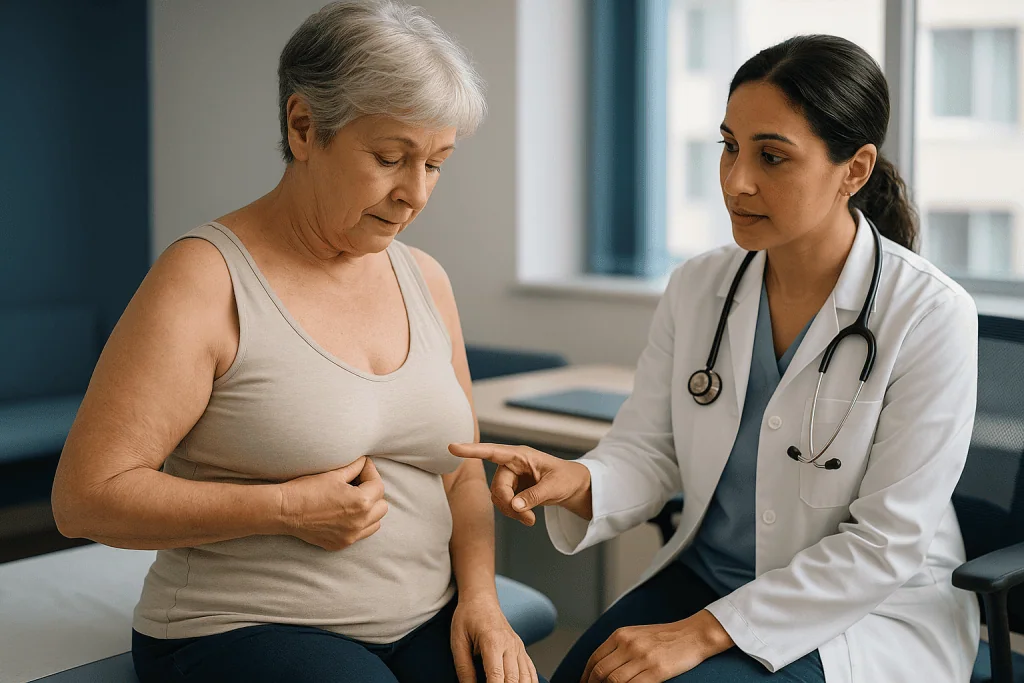
For breast reduction this has specific consequences. A surgeon operating on firm, elastic skin can rely on it to contract and smooth itself over the reshaped breast. With less elastic skin, more of the excess has to be removed and tailored directly, which can mean longer incisions or a different pattern. The surgeon is effectively re-draping fabric that no longer shrinks to fit.
Healing also tends to be slower. NHS guidance on breast reduction notes that scars take time to fade and may remain visible, and in older skin the maturation of a scar from red and raised to pale and flat generally takes longer. Thinner skin at the lower part of the breast, where the vertical and horizontal incisions meet, is an area surgeons watch closely for delayed healing in all ages, and particularly in smokers and people with diabetes.
Sun damage counts too. Years of exposure on the upper chest can leave skin that bruises and tears more readily. None of this rules out surgery; it changes how the surgeon plans tension on the wound and how long you are asked to protect the scars from sun and strain.
Stable body weight before surgery helps the skin result. Weight that falls significantly afterward can leave the newly tailored envelope loose again, so surgeons usually prefer to operate once weight has been steady for a period of months. Your surgeon will say what range is reasonable for you.
Which health conditions surgeons check before breast reduction after 50
A surgeon’s pre-operative review is really a risk map. Over 50, several conditions become more common, and each changes something concrete about the plan.
Blood pressure comes first. Uncontrolled hypertension raises the chance of bleeding during and after surgery and strains the heart under anesthesia. Most teams want it managed and stable before an elective operation. Diabetes is next: high blood sugar slows wound healing and raises infection risk, so surgeons typically ask about recent control and may request a blood test reflecting the previous few months.
Heart and lung disease matter because general anesthesia for a few hours is real work for both systems. A history of angina, heart failure, atrial fibrillation (an irregular heart rhythm), chronic bronchitis or sleep apnea will usually prompt a pre-anesthesia assessment and sometimes a conversation with the specialist who looks after that condition.
Clotting risk rises with age and with any elective surgery. Mayo Clinic lists blood clots among the possible risks of breast reduction. Previous deep vein thrombosis, certain inherited clotting tendencies, obesity, reduced mobility and some hormone therapies all shift the calculation, and the team may plan compression stockings, early walking and, where indicated, a clot-preventing medicine chosen by the anesthetist.
Smoking deserves its own line. Both Mayo Clinic and the NHS advise against smoking before and after breast reduction because nicotine narrows small blood vessels and impairs the blood supply the nipple and skin flaps depend on. Most surgeons ask for a smoke-free period before the operation; the length is set by the team.
Finally, body mass index is usually recorded. It is not a judgment, simply one of several numbers that affect anesthesia risk and wound healing, and the team will explain how it factors into timing.
Medicines and supplements: what the surgical team wants to know
By the mid-fifties, many people take at least one regular medicine, and several of the common ones interact with surgery. The team needs an honest, complete list, including anything bought without a prescription.
Blood-thinning medicines are the obvious concern. Anticoagulants, which slow the body’s clotting system, and antiplatelet drugs, which make platelets less sticky, both increase bleeding during an operation. They are often prescribed after a stroke, heart valve replacement, stent or clot, and stopping them carries its own serious risk. The decision about whether to pause, bridge or continue sits entirely with the prescribing clinician and the surgical team working together; it is never a decision for the patient to make alone.
Common over-the-counter painkillers of the anti-inflammatory class also affect platelets, and many surgeons ask about them for the same reason. Some herbal and dietary supplements can thin the blood or interact with anesthesia, which is why teams routinely ask about them even though they are not prescriptions.
Hormone therapy for menopause symptoms is relevant because estrogen-containing treatments raise the risk of blood clots, and surgery raises it further. Whether it needs adjusting around the operation is a judgment for the prescribing clinician. The same applies to certain treatments for osteoporosis, diabetes and heart rhythm problems, each of which has its own timing considerations around fasting and anesthesia.
The pattern is consistent: the article can describe why these medicines matter, but any change in what you take, when you take it or whether you stop it must come from the person who prescribed it, in conversation with the surgical team. Bring the actual packets or a printed list to the consultation; memory is unreliable and the stakes are real.
Breast reduction and mammograms: screening before and after surgery
Screening is where breast reduction after 50 differs most sharply from the same operation in younger adults, and it deserves careful explanation.
A mammogram is a low-dose X-ray of the breast used to find changes too small to feel. In the United States, CDC reports that the U.S. Preventive Services Task Force recommends mammograms every two years for women aged 40 to 74 at average risk. Anyone over 50 considering breast reduction is therefore already within the screening age range, and surgeons routinely ask whether screening is up to date.
Mayo Clinic specifically notes that a baseline mammogram may be requested before breast reduction and another some months after. The logic is straightforward. Before surgery, the team wants to know the breast is clear, because operating on an undetected abnormality complicates everything that follows. After surgery, the reshaped breast and its healing scars look different on imaging, and a new baseline lets future mammograms be compared against the post-operative appearance rather than mistaking scar tissue for something new.
Tissue removed during the operation is usually sent for routine pathology, the laboratory examination of tissue under a microscope. Occasionally this reveals an unexpected finding. That possibility is not a reason for alarm; it is a reason to keep screening current and to tell the surgeon about any family history of breast or ovarian cancer, which may prompt additional imaging before a decision is made.
Afterwards, screening continues on the usual schedule. Reduction does not remove the need for mammograms, and it does not make them impossible. MedlinePlus advises telling the mammography team about any previous breast surgery so the images are interpreted with that history in mind. Keep a copy of your operation note; radiologists find it genuinely useful.
Who is usually a candidate, and who is usually asked to wait
The clearest candidates share a recognizable profile. Mayo Clinic describes people whose breast size causes chronic back, neck or shoulder pain, persistent rashes or skin irritation beneath the breasts, deep grooves from bra straps, limited physical activity, or difficulty finding clothing, and who are in good general health. NHS criteria for publicly funded reduction point to similar functional problems rather than appearance alone.
Over 50, the additional markers of a good candidate are practical: stable weight for a sustained period, controlled blood pressure and blood sugar, no active smoking, up-to-date breast screening with no unresolved findings, and realistic expectations about scars and the time healing takes.
Some people are asked to wait, and the reasons are usually fixable. A recent mammogram showing something that needs further assessment must be resolved first. Blood sugar that is poorly controlled is a common reason to defer, because the risk of wound breakdown is too high to accept for an elective operation. Current smoking almost always leads to a request for a smoke-free interval. A planned significant weight loss is another reason to pause, since the result is better when weight is stable.
Heart or lung conditions that are new, worsening or not yet investigated will prompt referral back to the relevant specialist before a surgical date is considered. Likewise, a recent clot, stroke or heart attack usually means waiting until the treating physician is satisfied the risk has settled.
Being asked to wait is not a refusal. In most cases it is the surgeon saying: this will go better in six months if we address this first. The honest surgeon would rather delay than operate into avoidable risk, and the decision on timing always rests with the treating team after seeing the whole picture.
How painful is breast reduction recovery?
Most people describe the first few days as sore and tight rather than sharply painful, and the pattern is consistent across ages. The breasts feel heavy, bruised and swollen; moving the arms pulls on the incisions; and sleeping on the back, often propped up, is usual for the first week or two. Mayo Clinic lists pain, bruising and swelling as expected in the early period.
Pain control is planned before you leave the hospital. The team will prescribe or recommend pain relief appropriate to your other medicines and conditions, and for older adults that choice is made with particular care, since kidney function, stomach lining and interactions with blood thinners all affect which options are suitable. Follow the regimen given and raise concerns with the team rather than adjusting it yourself.
Discomfort typically eases noticeably within the first one to two weeks, though tenderness, tightness and altered sensation can continue for longer. Numbness or tingling around the nipples and along the incisions is common and often improves over months; Mayo Clinic notes that some change in sensation can be lasting.
A surgical bra or compression garment is usually worn continuously for several weeks. It feels restrictive but supports the healing tissue and reduces swelling, and most people find it reduces pain with movement.
Two things make recovery harder than it needs to be: trying to do too much too soon, and ignoring the instructions on arm movement. Reaching into high cupboards, lifting grandchildren and carrying groceries all strain the incisions. The surgeon will give specific limits. One useful mental reframe: the operation removed a load you carried for years; the few weeks of restriction are short by comparison.
Breast reduction recovery time week by week
Timelines vary with the extent of surgery, overall health and how closely instructions are followed, so the ranges below are typical rather than promised. NHS guidance suggests two to six weeks off work depending on the job, avoiding heavy lifting and strenuous exercise for around six weeks, and expecting scars to fade gradually over a year or more. Mayo Clinic similarly advises avoiding heavy lifting for several weeks and warns that final shape and scar appearance take months to settle.
| Period | What usually happens | Typical limits |
|---|---|---|
| Days 1–3 | Swelling, bruising and tightness at their peak; drains, if used, may be removed; dressings checked | Rest, short walks, no arm reaching above shoulder height |
| Week 1–2 | Soreness eases; first follow-up visit; stitches reviewed | Light daily tasks only; surgical bra worn continuously |
| Weeks 2–6 | Return to desk-based work for many; swelling continues to fall | No heavy lifting or vigorous exercise until the surgeon clears it |
| Months 2–6 | Shape settles; sensation often improving; scars still pink | Scar care and sun protection; gradual return to full activity |
| Up to 12–24 months | Scars mature and fade; final result assessed | Routine screening resumes on the usual schedule |
Older adults often ask whether recovery is slower after 50. Tissue healing does slow modestly with age, and conditions such as diabetes slow it further, so the upper end of each range is more common. Walking from the first day matters more than it sounds: it lowers clot risk, improves breathing and lifts mood. Build in help at home for the first week, especially if you live alone, and arrange transport to follow-up appointments in advance.
Risks worth understanding in plain language
Every operation carries risk, and the honest way to assess breast reduction after 50 is to know the specific ones and which rise with age or health conditions.
Mayo Clinic lists bleeding, infection, poor wound healing, scarring, changes in nipple or breast sensation, difficulty breastfeeding, asymmetry between the breasts, loss of nipple or areola tissue, and the general risks of anesthesia including blood clots. NHS guidance adds that some people need further surgery for complications or to refine the result.
Wound healing problems cluster at the junction where the incisions meet beneath the breast, and they are more frequent in smokers, people with diabetes and people with higher body weight. Fat necrosis, where fatty tissue in the breast loses its blood supply and becomes firm, is more likely in fattier breasts, which is relevant after menopause; it is usually harmless but can produce lumps that need imaging to distinguish from other causes.
Nipple blood supply is the risk surgeons think about most. The nipple is kept alive on a stalk of tissue, and in very large or low breasts that stalk is long. In a small proportion of cases, particularly in smokers, the blood supply fails and part or all of the nipple is lost. Some surgeons will discuss a different technique, in which the nipple is removed and replaced as a graft, when the risk is judged high.
Anesthesia risk tracks health rather than age itself. A thorough pre-operative assessment is the main safeguard, and it is the reason surgeons ask so many questions.
What the evidence does not support is the idea that breast reduction raises breast cancer risk. Screening after surgery continues normally, and the removed tissue is examined, so if anything the process adds scrutiny rather than removing it.
Alternatives to breast reduction: what can I do instead?
Surgery is not the only route, and surgeons genuinely prefer patients who have tried the alternatives first, partly because it clarifies whether symptoms come from breast weight or from something else.
A professionally fitted supportive bra is the first step. Wide, padded straps and a firm band distribute weight across the back rather than the shoulders. Many people have never been measured properly, and the difference a well-fitted bra makes to shoulder grooves and upper back ache can be substantial.
Physical therapy targets the posture and muscle patterns that heavy breasts encourage: rounded shoulders, a forward head and weak upper back muscles. Strengthening exercises and posture work relieve some pain in some people, and even when they do not resolve it, they improve the baseline from which surgery and recovery begin.
Skin care for the fold beneath the breasts addresses the rashes. Keeping the area dry, using a breathable cotton layer or moisture-wicking liner, and treating fungal irritation when a clinician diagnoses it can make the daily discomfort manageable.
Weight management is often raised, and it should be raised respectfully. Breast tissue after menopause is largely fat, so a stable or lower body weight can reduce breast volume in some people. For many, however, breasts remain disproportionately large regardless of weight, and the NHS notes that weight loss alone does not reliably correct the problem. No one should be made to feel the surgery is a reward for reaching a number on a scale.
Liposuction-only reduction removes fat through small incisions without reshaping skin. It suits a narrow group with modest excess, good skin elasticity and minimal sagging, which is uncommon after 50. The surgeon will say honestly whether it applies.
What people often get wrong about breast reduction after 50
Several beliefs circulate widely enough to deserve direct correction.
“I’m too old; surgeons won’t operate.” Age is not a listed exclusion in Mayo Clinic or NHS guidance. Surgeons decline when health is not stable, not when a birthday passes. Plenty of people in their sixties and seventies have the operation after a proper assessment.
“It will hide breast cancer on mammograms.” The reverse is closer to the truth. Removed tissue is examined, a post-operative mammogram establishes a new baseline, and screening continues as before. Scar tissue can look different on imaging, which is exactly why telling the mammography team about the surgery matters.
“Recovery takes months in bed.” Early walking is encouraged from the first day, and most people are managing light daily activity within a week or two. The restrictions are on lifting and strenuous exercise, not on moving.
“The breasts will sag again within a year.” Reshaped breasts do settle, and gravity and aging continue, but a reduction that also lifts the breast typically holds its position for years. Significant weight change is the main thing that alters the result.
“Menopause will shrink them anyway.” It changes the composition more than the load. Someone whose symptoms come from weight rarely finds menopause solves them.
“Hormone therapy means I can’t have surgery.” It means the prescribing clinician and surgical team discuss clot risk and timing. That is a conversation, not a prohibition.
“Smaller incisions are always better.” Shorter scar techniques exist, but after 50, less elastic skin often needs the longer anchor-shaped pattern to sit smoothly. A surgeon who chooses it is matching the technique to the tissue, not being old-fashioned. The best incision is the one that gives a secure, well-healed result for your skin.
Questions to ask your care team
A consultation goes better with specific questions prepared. These are the ones that tend to produce the most useful answers for someone over 50.
- Which of my health conditions or medicines changes the plan, and who decides how they are managed around surgery?
- Do you want a mammogram before the operation, and when should I have the first one afterward?
- Will the removed tissue be sent for pathology, and how will I be told the result?
- Given my skin and breast composition, which incision pattern do you recommend and why?
- What is the risk to nipple blood supply in my case, and would a graft technique ever be considered?
- How many weeks of lifting and exercise restriction should I plan for, and what help at home will I need?
- What signs after surgery should make me call the ward or go to emergency care?
- How will my weight, if it changes, affect the result over time?
- What is your approach if a wound heals slowly, and how common is that in patients with my profile?
- Who do I contact in the evenings or on weekends during the first two weeks?
Bring a written list of every medicine and supplement, your most recent mammogram date and result, and any family history of breast or ovarian cancer. If English is not your first language or you process information better with company, bring someone to take notes. It is reasonable to ask for a second consultation after thinking things over; a good surgical team expects it.
The most revealing question is often the simplest: what would make you ask me to wait? The answer tells you what the team considers the real risks in your case, and it keeps the decision where it belongs, with the people who have examined you.
When to call your doctor
Most recoveries are uneventful, but a few signs should never be waited out. Contact your surgical team the same day, or go to emergency care, if any of the following appear.
Seek urgent care immediately for chest pain, sudden breathlessness, coughing up blood, or a painful, swollen, warm calf. These can indicate a blood clot in the leg or lung, a recognized risk after any surgery and one that rises with age and reduced mobility.
Call the surgical team the same day for a breast that becomes markedly more swollen, tense or painful than the other, which can signal bleeding beneath the skin; for spreading redness, increasing warmth, a foul-smelling discharge or pus from the incisions; for a fever that develops in the days after surgery; or for any part of the nipple or skin edge that turns dark, dusky or black, since this may mean the blood supply is struggling and early assessment matters.
Also report wound edges that separate, dressings soaked with bright red blood, severe pain not controlled by the medicines you were given, or a rash or breathing difficulty that could be a reaction to a medicine.
Beyond the recovery period, keep up routine breast screening on the schedule your doctor sets, and report any new lump, skin change, nipple discharge or persistent pain in either breast promptly, exactly as you would without surgery. Firm areas can be fat necrosis or scar tissue, but that is a conclusion for a clinician with imaging, not a self-diagnosis.
If you are unsure whether something is normal, call. Surgical teams would far rather answer an unnecessary question than hear about a problem a day too late.
Frequently asked questions
Is 60 too old to have a breast reduction?
No, age alone does not rule out breast reduction. Surgeons assess overall health, skin quality, medicines, smoking status and breast screening rather than the number on a birth certificate. A fit 60-year-old with controlled blood pressure and no active smoking may be a straightforward candidate. The decision follows a full pre-operative assessment and rests with the surgical and anesthesia team.
How painful is breast reduction recovery?
Most people describe soreness, tightness and swelling rather than severe pain, with the first few days the most uncomfortable. Discomfort usually eases noticeably within one to two weeks, though tenderness and altered sensation can continue longer. The team plans pain relief suited to your other medicines and conditions, and a supportive surgical bra reduces pain with movement. Raise any poorly controlled pain with the team rather than adjusting medicines yourself.
Does breast size decrease after menopause?
Composition changes more reliably than size. Falling estrogen causes glandular tissue to shrink and be replaced by fat, so breasts become softer and often sit lower. Whether they get smaller depends mainly on body weight; weight gain after menopause can make breasts larger. For people whose symptoms come from breast weight, menopause rarely removes the load, because fat and gland weigh about the same.
What can I do instead of breast reduction?
Alternatives to breast reduction include a professionally fitted supportive bra, physical therapy for posture and upper back strength, careful skin care for the fold beneath the breasts, and weight management where appropriate. These relieve symptoms for some people and are usually tried first. Liposuction-only reduction suits a small group with good skin elasticity, which is less common after 50. Your surgeon can say honestly which options apply to you.
How long is breast reduction recovery time after 50?
NHS guidance suggests two to six weeks off work depending on the job and around six weeks without heavy lifting or strenuous exercise, with scars fading over a year or more. Healing slows modestly with age and more so with diabetes or smoking, so the upper end of each range is more common after 50. Early walking is encouraged from the first day to reduce clot risk.
Do I need a mammogram before breast reduction surgery?
Often, yes. Mayo Clinic notes that a baseline mammogram may be requested before breast reduction and another some months afterward, and anyone over 50 falls within the routine screening age range described by CDC. The pre-operative image confirms the breast is clear; the post-operative one gives radiologists a new baseline so scar tissue is not mistaken for something new later.
Can I still have mammograms after breast reduction?
Yes, and screening continues on the usual schedule. Breast reduction and mammograms are fully compatible, although scar tissue and reshaped breast can look different on imaging. MedlinePlus advises telling the mammography team about any previous breast surgery so images are read with that history. Keeping a copy of your operation note is genuinely useful for the radiologist.
Does breast reduction after 50 leave worse scars?
Scars are permanent at any age, and after 50 they may take longer to mature from pink and raised to pale and flat. Less elastic skin often requires the longer anchor-shaped incision pattern so the breast sits smoothly. Sun protection, following scar care advice and not smoking all support healing. The surgeon will show where incisions are planned so expectations are realistic.
Will my blood pressure or diabetes stop me having a breast reduction?
Not necessarily, but both need to be controlled first. Uncontrolled high blood pressure increases bleeding risk, and poorly controlled blood sugar slows wound healing and raises infection risk, so surgeons commonly defer elective surgery until these are stable. Management of the conditions and their medicines around the operation is decided by the prescribing clinician together with the surgical team.
Does menopause hormone therapy affect breast reduction surgery?
It can affect clot risk, because estrogen-containing hormone therapy raises the chance of blood clots and surgery raises it further. That does not automatically prevent the operation; it means the prescribing clinician and surgical team discuss timing and precautions such as early walking and compression. Never stop or alter hormone therapy on your own before surgery; ask the clinician who prescribed it.
References
This article is for general information only and is not a substitute for professional medical advice. Please consult a qualified doctor about your individual situation.
Add us as a Preferred Source to see more of our trusted health content across Google Search, AI Overviews and Discover.

Planning This Treatment in Turkey
Our full guide for international patients: techniques, hospital stay, recovery and cost.
More from the Blog

Pain After Breast Augmentation: Tightness, Muscle Ache and Safe Ways to Stay Comfortable
Pain after breast augmentation is usually a tight, heavy, muscle-ache sensation across the chest that peaks in the first two to three days and…

Recovering From Accessory Breast Treatment: Arm Movement, Garments and Return to Work
Recovery after accessory breast removal usually means a few days of underarm soreness and swelling, gentle arm movement from the first day, a compression…

Warning Signs After Breast Reconstruction: Redness, Swelling and Flap Changes to Report Fast
After breast reconstruction, report spreading redness, new warmth, swelling that grows rather than settles, pain that worsens after day three, cloudy or foul-smelling drainage,…

Which Breast Lift (Mastopexy) Technique Suits You? Crescent, Donut, Lollipop and Anchor
Breast lift techniques are named for their incision shapes. A crescent lift removes a sliver of skin above the areola, a donut lift circles…

Liposuction Alone or Gland Excision? How Gynecomastia Surgery Is Matched to Tissue Type
Liposuction removes fatty tissue, while surgical excision removes the firmer glandular disc behind the nipple, so surgeons choose based on what the chest actually…

Breast Imaging Around Fat Transfer: Why Scans Are Taken First and Reviewed Later
A mammogram after fat transfer is usually arranged so radiologists can compare the new images with a baseline scan taken before surgery. Grafted fat…