

Bruising After Surgery: The Normal Timeline and the Signs of a Problem

Key Takeaways
- Surgical bruising usually peaks around 48 to 72 hours after the operation, the same point at which most people are first alone at home and inspecting it.
- A healthy bruise moves from purple to green to yellow because hemoglobin is broken down into biliverdin (green), bilirubin (yellow) and hemosiderin (brown).
- Bruises drift downhill with gravity, so discoloration in the groin after hip surgery or along the jaw after a facelift is old blood moving, not new bleeding.
- A bruise is flat and soft; a hematoma is a firm or ballooning lump, and one that enlarges within hours, especially in the neck, needs urgent assessment.
- The NIH Office of Dietary Supplements notes vitamin E can raise bleeding risk, and fish oil, ginkgo and garlic supplements are listed alongside common pain relievers as bruise-makers.
- Evidence for arnica, bromelain and vitamin K creams comes from small, mixed trials, while cold, elevation, compression and early walking rest on stronger and more consistent data.
Bruising after surgery is expected: blood leaks from small vessels cut or stretched during the operation and settles beneath the skin. Most surgical bruises shift from purple to green to yellow and fade within two to three weeks, often drifting downward with gravity. Rapid swelling, a firm and growing lump, spreading redness, fever, or new bruising far from the incision should prompt a same-day call to the surgical team.
The recovery video starts the same way every time: a phone camera, a bathroom mirror, and a swollen, plum-colored thigh or jawline on day four. The caption asks the question that has pushed bruising after surgery into trending search territory as of March 2025: “Is this normal, or did something go wrong?” Comment sections answer with confidence and no evidence, blaming surgeons, recommending creams, and occasionally telling a worried stranger to stop a prescribed medicine.
Part of the surge is structural. Far more operations now end with same-day discharge, so the first dramatic color change happens at home rather than on a ward where a nurse would glance at it and say “that’s fine.” The other part is simply that a bruise is a visual event, and visual events travel.
What follows is the timeline clinicians actually use, the physiology behind the colors, where the research is solid and where it is thin, and the short list of signs that deserve a phone call rather than a search.
Why bruising after surgery happens, even when everything went well
A bruise is blood that has escaped from damaged capillaries, the thread-thin vessels that feed skin and fat, and pooled in the tissue beneath the surface. Surgery damages capillaries by design. A scalpel divides them, a retractor stretches them, liposuction cannulas shear them, and even a cleanly placed cannula for an IV line pierces a few. The body closes the leak within minutes using platelets and clotting proteins, but the blood that already escaped has nowhere to go until white blood cells slowly digest it.
Surgeons reduce this leakage with cautery, careful handling and sometimes compression, yet some bleeding into tissue is unavoidable. The amount depends on the operation, on the person, and on timing: swelling often peaks around 48 to 72 hours after an operation, and the bruise tends to look its worst at the same point, which is precisely when most people are home, tired, and inspecting themselves closely for the first time.
Two features of surgical bruising surprise people. First, the bruise can be larger than the incision because blood spreads through the loose tissue planes under the skin. Second, it can arrive late. Blood released deep in a muscle or beneath a fascial layer, the thin fibrous sheet that wraps muscles, may take several days to work toward the surface, so a bruise that “appears” on day five near a hip or knee replacement is usually old blood finally becoming visible, not fresh bleeding.
None of this means the bruise should be ignored. It means the baseline expectation should be colorful, asymmetric and slightly alarming, which is why knowing the normal pattern matters more than any single photograph.
The normal bruise timeline after surgery, day by day
Clinicians read a bruise the way a gardener reads a leaf: by color, texture and trajectory. The sequence below is drawn from the patient guidance published by MedlinePlus, the NHS and Mayo Clinic, with the slower surgical version noted where it differs.
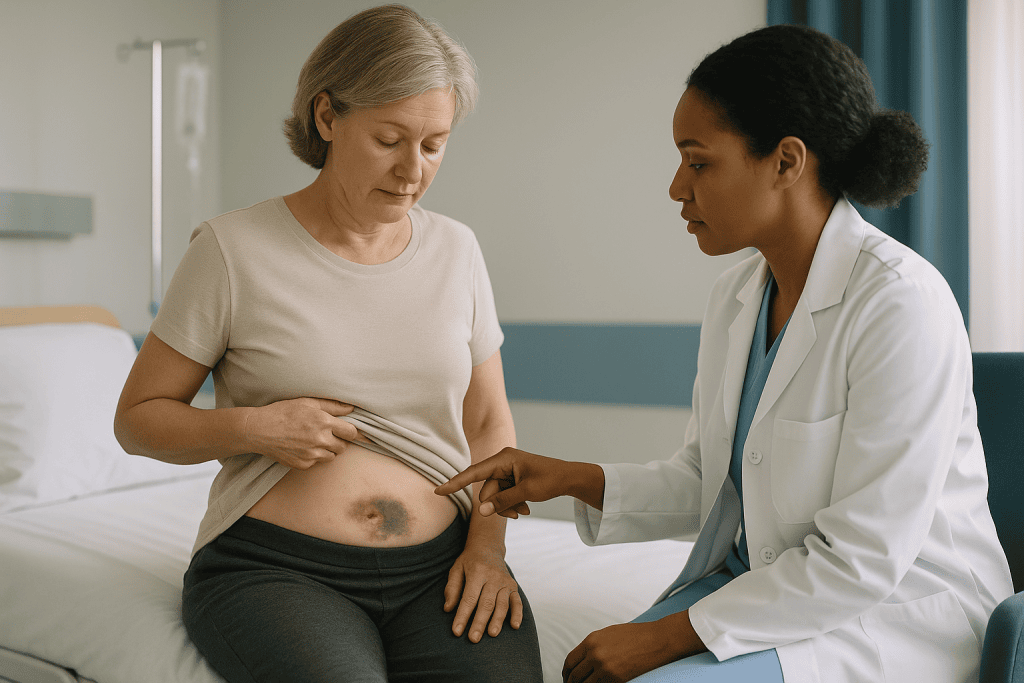
- Days 0 to 2: red or dark purple, often warm and tender. Fresh blood still carries oxygen-rich hemoglobin, which looks red through the skin’s layers. Swelling is rising rather than falling.
- Days 2 to 5: deep blue or purple-black. The hemoglobin has lost its oxygen and the overlying skin may feel tight. This is the stage that generates the most searches and the most unnecessary panic.
- Days 5 to 7: green edges appear. Enzymes in white blood cells convert hemoglobin to biliverdin, a green pigment.
- Days 7 to 10: yellow and then light brown. Biliverdin becomes bilirubin (yellow), and iron is stored as hemosiderin (brown).
- Days 10 to 21: the patch fades from the center outward and the skin returns to its usual tone.
An ordinary knock on a coffee table follows this arc in roughly two weeks. A surgical bruise is often bigger, deeper and fed by more blood, so stretching the whole sequence to three weeks is ordinary, and four weeks after extensive liposuction or a joint replacement is not unusual. The tell is direction: each day should look a little more yellow and a little less purple. A bruise that is fading, even slowly, is behaving.
Tenderness fades faster than color. By the end of the first week most people can press on a healing bruise without wincing even though it still looks dramatic. That mismatch between how it looks and how it feels is reassuring, and the reverse mismatch is the one to notice.
Why the bruise shows up far from the incision
One of the most common worried messages to surgical nurses reads: “My incision looks perfect, but my bruise is somewhere else.” The answer is gravity. Blood in loose subcutaneous tissue drifts downhill over several days, following the same path as a drop of water on a slightly tilted pane of glass.
Patterns are predictable enough that experienced teams warn about them in advance. After a facelift or rhinoplasty, blood slides from the cheeks into the lower eyelids and jawline. After shoulder surgery it tracks down the upper arm toward the elbow. After a hip replacement or a hernia repair, discoloration can appear in the groin, the inner thigh and, in men, the scrotum, which looks frightening and is usually harmless. After breast augmentation or a breast lift, bruising commonly pools along the lower fold of the breast and the side of the chest wall. After abdominal liposuction, the flanks and the top of the thighs often turn yellow before the abdomen itself does.
Position matters too. Someone who spends the first days reclining with the operated leg elevated will see the bruise settle toward the buttock and back of the thigh rather than the shin. This drift is not spreading infection or new bleeding; it is old blood obeying physics.
Distance alone is not a red flag. Combination is. A bruise that tracks downhill and lightens is normal. A new dark area that appears above the incision, that enlarges hour by hour, or that comes with a firm swelling, is a different event and is covered in the warning-sign table and the section on when to see a doctor.
Post surgical bruising timeline: how long is too long?
The honest answer has two parts: how long the color lasts, and how long a faint stain can remain afterward. They are different questions with different answers.

Color follows the breakdown sequence described above and is almost always gone within three to four weeks, even after large operations. Beyond that window, two benign explanations are common. The first is hemosiderin staining, a flat brownish or rust-colored mark left behind when iron from the broken-down blood lodges in the skin. It is more frequent on the lower legs and after extensive liposuction, and it can take months to fade. The second is residual swelling that makes the area look slightly discolored under certain lighting. Neither is tender, firm or warm.
What should not happen is a bruise that stops progressing. If on day ten an area is still as purple as day three, or if the color is darkening rather than lightening, something is adding blood or the blood is not being cleared. The usual causes are continued oozing from a small vessel, a hematoma (a collected pocket of blood, covered next), or less commonly a clotting problem or an interaction with a medicine or supplement. None of these require guesswork at home; they require a look from the surgical team.
Age changes the clock. Skin thins and capillaries become more fragile with the decades, and older adults clear bruises more slowly, so a five-week fade in a 78-year-old after a knee replacement is less surprising than the same in a 30-year-old. Chronic conditions that affect circulation, such as diabetes or peripheral artery disease, also slow clearance. Timelines in this article are averages, and the surgical team’s expectation for a specific operation and a specific person always overrides them.
Hematoma vs bruise after surgery: what is the difference?
The two words are often used interchangeably online, and the confusion is costly, because one is cosmetic and the other sometimes needs treatment.
A bruise, clinically a contusion or ecchymosis, is blood spread thinly through tissue. It is flat or only mildly raised, soft, and changes color on schedule. A hematoma is blood that has collected into a pocket. It forms a lump that may feel firm, rubbery or like a water balloon, and because the blood is concentrated rather than dispersed, the overlying skin can stay dark purple for longer and may look shiny or stretched.
Small hematomas are common after many procedures and simply reabsorb over a few weeks; surgical teams often leave them alone and monitor. Larger ones matter for three reasons. They stretch the skin and can compromise its blood supply, they create a space where bacteria can grow, and in enclosed areas such as the neck after thyroid surgery or the groin after a vascular procedure, they can press on important structures. In those settings a hematoma that expands quickly is treated as urgent, and surgical teams tell patients exactly that before discharge.
A seroma is the third cousin in this family: a collection of clear, straw-colored tissue fluid rather than blood, common after procedures that create a space under the skin, such as abdominoplasty, hernia repair with mesh, or breast surgery. It feels like a soft, sloshing swelling and is rarely discolored.
At home, the practical distinction is texture and growth. Flat, soft and lightening is a bruise. Lumpy, firm and stable is probably a small hematoma worth mentioning at follow-up. Lumpy, firm and growing within hours, especially with throbbing pain, is a same-day call, and if the lump is in the neck and breathing or swallowing feels different, it is an emergency.
What changed recently
Nothing about the biology of a bruise has changed. What has shifted, as of March 2025, is where people experience it and what they are told about it.
The first change is logistical. Operations that routinely required two or three nights in hospital a decade ago, including many joint replacements, hernia repairs and breast procedures, are now frequently done as day cases or with a single overnight stay. The visible peak of swelling and discoloration at 48 to 72 hours therefore lands at home. Patient-education pages at MedlinePlus, the NHS, Mayo Clinic and Cleveland Clinic have all expanded their plain-language guidance on wound care and bruising in response, and each now states the same core message: color change through purple, green and yellow over roughly two weeks is expected, and swelling that grows, spreading redness or fever are the signs that need review.
The second change is in supplement awareness. The NIH Office of Dietary Supplements fact sheet on vitamin E states that the vitamin can increase the risk of bleeding, particularly in people taking blood thinners, and Mayo Clinic’s current guidance on easy bruising lists fish oil, ginkgo and garlic supplements alongside common pain relievers as things that make bruises more likely. Pre-operative questionnaires have followed suit; most now ask about supplements by name rather than lumping them under “other.”
The third change is the one driving search traffic: short-form video. Recovery diaries are genuinely useful for setting expectations, and they are also where most of the myths in this article originate, including the claim that heavy bruising proves the surgeon was careless and the suggestion that people stop a prescribed blood thinner to “heal faster.” The sections that follow sort those claims by the quality of evidence behind them.
What the evidence actually says
Advice about surgical bruising comes in three grades of evidence, and it helps to know which grade you are reading.
Strong, from randomized trials: very little, because bruising is rarely the main outcome a trial measures. The best-supported points are indirect. Trials of early walking after surgery show clear benefits for blood clots and lung complications, and gentle movement also helps lymphatic drainage, which is the system that clears bruise pigments. Trials in facial and dental surgery consistently find that cold applied in the first day or two reduces swelling, and reduced swelling is associated with less visible bruising.
Moderate, from observational data: that older age, thinner skin, chronic steroid use and certain medicines and supplements are associated with more extensive bruising. These are well-documented associations in large patient series, not proofs of cause, but they are consistent and biologically plausible.
Weak, from small trials or expert opinion: most of what circulates online. Topical arnica, bromelain and vitamin K creams have been tested in small randomized trials, mainly in cosmetic surgery, with mixed results; some show slightly faster color fading, others show no difference, and the trials are too small and varied to support a confident recommendation either way. Compression garments after liposuction and body contouring are standard practice backed by surgeon consensus rather than large trials.
Where does that leave a reader? The things with the best evidence are also the dullest: follow the team’s instructions on cold packs and compression, walk as advised, keep incisions clean, and give it time. The things with the loudest marketing have the least data. That is not an argument against trying a cream the surgical team is comfortable with; it is an argument against expecting much from it, and against spending money or worry on it.
Normal bruising vs warning signs: a side-by-side table
Most people do not want a lecture at 11 p.m.; they want to know which column they are in. The table below condenses the guidance from the sources cited at the end into a single comparison. It is a screening aid for deciding whether to call, not a substitute for the surgical team’s own discharge instructions, which take priority for a specific operation.
| Feature | Expected after surgery | Reason to contact the team |
|---|---|---|
| Color over time | Purple to green to yellow, lighter each day | Darkening, or no change after 7 to 10 days |
| Size | Peaks by day 3, then shrinks; may drift downward | Expanding over hours, especially above the incision |
| Texture | Flat or slightly raised, soft | Firm, tense, shiny or ballooning lump |
| Pain | Tender, easing from day 3 onward | Throbbing, worsening, or out of proportion |
| Skin around incision | Mild pink edge, settles | Spreading redness, streaks, heat, pus or foul odor |
| Whole-body signs | Tiredness, mild low mood | Fever, chills, dizziness, fainting, racing heart |
| Location | Near the incision or downhill from it | New bruises on unrelated areas, bleeding gums or nosebleeds |
| Function | Stiffness that improves with gentle movement | Numbness, tingling, a cold or pale limb, difficulty breathing or swallowing |
A useful habit is a daily photograph in the same light at the same time, ideally with a coin beside the bruise for scale. Memory exaggerates; a sequence of photos shows the direction of travel in seconds and gives a nurse or surgeon something objective to assess over the phone or through a patient portal. Many teams now ask for exactly this.
If a single feature in the right-hand column is present, call. If several are, do not wait for office hours.
Medicines and supplements that make bruising after surgery worse
A bruise is a bleeding event in miniature, so anything that slows clotting or weakens vessel walls enlarges it. Surgical teams screen for these before an operation, which is why the pre-admission questionnaire is longer than it looks.
Prescribed blood thinners, including anticoagulants and antiplatelet drugs, are the most significant. People take them for serious reasons such as atrial fibrillation, heart valves, stents and previous clots, and the decision about whether and when to pause them around an operation is made jointly by the surgeon and the prescribing clinician, often with a cardiologist or hematologist. It is never a decision to make alone, before or after surgery. Stopping one because a bruise looks ugly can trade a cosmetic problem for a stroke or a clot in a stent.
Over-the-counter anti-inflammatory pain relievers reduce platelet stickiness, which is why many teams prefer alternatives in the days around an operation. Corticosteroids taken long term thin the skin and the capillary walls, producing the characteristic easy bruising seen in some people with asthma, rheumatoid arthritis or transplants. Some antidepressants that act on serotonin also modestly increase bruising, a point Mayo Clinic’s easy-bruising guidance mentions.
Supplements are the quiet contributors. The NIH Office of Dietary Supplements notes that vitamin E can increase bleeding risk, especially with blood thinners, and fish oil, ginkgo, garlic, ginger and ginseng are all listed in mainstream guidance as potential bruise-makers. Alcohol in the first days after surgery dilates vessels and interacts with pain medicines.
The practical point is disclosure, not alarm. Bring every bottle, including the gummies, to the pre-operative appointment, and after surgery ask before restarting anything that was paused. The prescribing clinician decides what resumes and when; the surgical team decides what the bruise means in that context.
How to reduce bruising after surgery without doing harm
The measures that genuinely help are modest and mostly free, and they matter most in the first 72 hours, while small vessels are still sealing.
Cold, applied as the surgical team directs, narrows vessels and limits the amount of blood that leaks into tissue. The usual pattern is a wrapped cold pack for short periods with breaks between, never directly on skin and never over an area with reduced sensation, because numb skin can be frost-damaged without the person noticing. After the first few days cold stops helping and some teams switch to warmth to encourage circulation and clearance; follow the specific instructions rather than a video.
Elevation uses gravity in your favor. A limb raised above heart level, or a head propped on extra pillows after facial surgery, drains fluid away from the operated area and reduces both swelling and the pool of blood available to spread. Compression garments and elastic bandages do the same job mechanically and are standard after liposuction, abdominoplasty and many orthopedic procedures; they should be snug, not painful, and should not cause numbness or tingling.
Movement is the underrated one. Walking as soon as the team allows, even to the kitchen and back, pumps the lymphatic system that carries bruise pigments away, and has strong trial evidence for preventing blood clots. Rest is still essential; the goal is gentle, frequent motion rather than exertion.
Things to avoid: heavy lifting, straining, vigorous massage of the bruised area (which can reopen vessels), hot tubs and saunas in the early period, and any topical product on or near an incision without the team’s approval. Protein, iron and vitamin C from ordinary food support healing; there is no evidence that extra supplements speed bruise clearance in people who are already eating normally.
Common myths about surgical bruising
Every trending topic grows a set of confident falsehoods. These are the ones surgical nurses hear most, with what the evidence actually supports.
“A big bruise means the surgeon was rough.” Bruise size depends more on the operation, the tissue and the person than on technique. Liposuction, facial surgery and joint replacement produce dramatic bruising in skilled hands. Two people having the identical procedure from the same surgeon can look completely different on day four. Technique matters, but a bruise is not a scorecard.
“If the color goes green, it’s infected.” Green is biliverdin, a normal pigment produced as hemoglobin breaks down. Infection announces itself with spreading redness, heat, increasing pain, pus or fever, not with the color sequence that every healthy bruise follows.
“Stop the blood thinner until the bruise is gone.” This is the most dangerous claim in the comment sections. Prescribed anticoagulants protect against clots and strokes; a bruise is the lesser risk by a wide margin. Any change belongs to the prescribing clinician.
“Arnica cream will clear it in days.” Small randomized trials in cosmetic surgery have produced mixed results, some showing a slightly faster fade and others none. If the surgical team is happy for it to be used away from the incision, it is unlikely to harm, but it is not a reliable accelerator.
“Massage it out.” Firm massage in the first week can reopen fragile vessels and enlarge the bruise. Gentle lymphatic techniques are sometimes recommended later, by a trained therapist, with the surgeon’s agreement.
“Bruises that drift are spreading bleeding.” Old blood moving downhill is expected. New bleeding expands the area quickly and usually comes with a firm swelling and pain.
Bruise colors and healing stages: what each shade means
The color of a bruise is a chemistry lesson written on the skin, and reading it correctly removes most of the anxiety.
Fresh blood is red because hemoglobin, the iron-containing protein in red blood cells, is carrying oxygen. Through skin, which filters light, fresh pooled blood looks red-purple. Within a day or two the trapped cells give up their oxygen and the hemoglobin darkens, producing the blue-purple or near-black appearance of a bruise at its peak. Depth deepens the hue: blood close to the surface looks redder, blood lying under a thicker layer of fat or muscle looks bluer or may not be visible at all.
From around day five, macrophages, the white blood cells that act as the body’s clean-up crew, arrive in numbers and begin digesting the hemoglobin. The first product is biliverdin, which is green. Biliverdin is then converted to bilirubin, the yellow pigment also responsible for jaundice, and the bruise turns yellow from the edges inward. Iron freed from the hemoglobin is packaged as hemosiderin, which is brown and is the last color to leave. In people with dark skin the sequence is identical but the colors are muted; the bruise may read as a darker or purplish patch that becomes slightly lighter and more brown-toned, and tenderness and swelling are better guides than color.
Why does one bruise skip stages or show several at once? Because it is really many small bleeds of different ages and depths layered together. A single patch can show purple at the center, green around it and yellow at the margin, which is a sign of healing in progress rather than confusion.
The only colors that warrant concern are the absence of change, a return to darker tones, or a black, dry or blistered area over a tense swelling, which can signal that the skin’s blood supply is compromised and needs urgent review.
Does the type of surgery change what is normal?
Yes, substantially, and knowing the typical pattern for a specific procedure prevents a lot of unnecessary worry.
Facial surgery (facelift, rhinoplasty, eyelid surgery) produces the most visible bruising relative to the size of the operation, because facial skin is thin and well supplied with vessels. Discoloration around both eyes after rhinoplasty is routine, peaks around day three and usually fades within two weeks; the whites of the eyes can also show a harmless blood-red patch that clears on its own.
Liposuction and body contouring involve passing a cannula through fat across a wide area, so bruising is extensive, often covering most of the treated zone, and can take three to four weeks to fade, with hemosiderin staining occasionally lasting longer. Compression garments are standard.
Breast augmentation, breast lift and reduction commonly produce bruising along the lower fold of the breast and the side of the chest, settling over two to three weeks. A rapidly enlarging, firm, painful breast on one side in the first days is the classic presentation of a hematoma and needs same-day contact.
Joint replacement and other orthopedic surgery releases blood deep in muscle, so bruising often appears late and far from the incision, tracking down the limb over a week. Calf pain, swelling of the whole leg, or a limb that is pale, cold or numb is a different problem and needs urgent assessment.
Abdominal and laparoscopic surgery leaves small bruises around port sites and sometimes a broader area of discoloration where instruments passed through the abdominal wall. Bruising that spreads across the flanks with worsening abdominal pain, dizziness or faintness is not a normal pattern.
Thyroid, neck and vascular access procedures are the special case: any growing neck swelling, voice change, or difficulty breathing or swallowing is an emergency regardless of color.
When to see a doctor
Every surgical team gives discharge instructions with a phone number, and those instructions take precedence over anything written here. The list below exists for the moment when the paperwork is lost and the question is simply whether to call. The answer in each case is yes, and for the final group, the answer is to seek emergency care or call emergency services.
Call the surgical team the same day if:
- a bruise is growing noticeably over hours rather than days, or a new dark area appears above the incision;
- there is a firm, tense or ballooning lump under the bruise, especially if it is painful or shiny;
- pain is worsening after day three instead of easing, or needs more relief than prescribed;
- redness is spreading from the incision, the skin is hot, there is pus, a foul smell, or the wound edges are opening;
- there is fever, chills or feeling generally unwell;
- bruising has not changed color at all after 7 to 10 days, or is darkening;
- new bruises are appearing on parts of the body that were not operated on, or there are nosebleeds, bleeding gums, or blood in urine or stool.
Seek emergency care immediately if:
- a neck or throat swelling is enlarging, or breathing, swallowing or voice is affected;
- a limb below the surgical site becomes pale, cold, numb or weak;
- there is dizziness, fainting, a racing heart or breathlessness alongside the bruise, which can signal significant blood loss;
- the skin over a swelling turns black, blisters or breaks down;
- there is chest pain, sudden shortness of breath, or a swollen, painful calf, which can indicate a blood clot.
People on blood thinners, those with known bleeding or clotting disorders, and anyone taking long-term steroids should have a lower threshold for calling. Never stop or alter a prescribed medicine in response to bruising; raise it with the prescribing clinician, who will weigh the bruise against the reason the medicine was started. A call that turns out to be unnecessary is a good outcome. Surgical teams would far rather reassure ten people than miss one hematoma.
Questions worth asking the surgical team before the operation
Most of the anxiety around bruising after surgery is avoidable, because the surgical team already knows roughly what to expect for a given procedure. The trick is to ask before the operation, when the answers can be written down, rather than at 2 a.m. afterward.
Useful questions, in roughly the order they matter:
- Where will bruising typically appear for this operation, and where might it drift? A surgeon who mentions that groin bruising after a hip replacement is normal has prevented one frightened phone call.
- When does it usually peak, and when should it be clearly fading? Ask for the team’s own numbers, which will reflect their experience with the specific technique.
- Which of my medicines and supplements should pause, who makes that decision, and when exactly do they restart? Write the answer down and confirm it at discharge.
- Should I use cold, warmth, compression or elevation, and for how many days? Instructions vary widely by procedure.
- Is there any topical product you are comfortable with me using, and how far from the incision?
- What does a hematoma look like after this operation, and what should I do if I think I have one?
- What is the direct number for after-hours concerns, and is a photo through the patient portal acceptable?
Two habits help afterward. Take a daily photo in consistent light with a coin for scale, which turns a vague worry into a trend line a nurse can interpret in seconds. And keep the discharge sheet on the refrigerator rather than in a bag; it is the one document that outranks every search result, including this article.
Bruising is the body’s visible record of an operation, and it fades on a schedule that is slow but reliable. Knowing the schedule, and the short list of exceptions, is most of what it takes to recover with confidence rather than dread.
Frequently asked questions
How long does bruising last after surgery?
Most surgical bruises fade within two to three weeks, with extensive procedures such as liposuction or joint replacement sometimes taking four. Color should lighten a little each day after the peak at around day three. A flat brownish stain can linger for months after large bruises, particularly on the lower legs, and is harmless. A bruise that is not changing after 7 to 10 days should be reviewed.
Is it normal for a bruise to appear days after surgery?
Yes. Blood released deep in muscle or beneath fascia can take several days to reach the surface, so a bruise that appears on day five after a knee or hip replacement is usually old blood becoming visible. It should then follow the normal color sequence. A new area that enlarges rapidly, is firm, or is painful is a different situation and warrants a call.
What is the difference between a hematoma and a bruise after surgery?
A bruise is blood spread thinly through tissue and feels flat and soft. A hematoma is blood collected into a pocket, which forms a firm, rubbery or balloon-like lump that may stay dark for longer. Small hematomas often reabsorb on their own; a growing, tense or painful one, or any lump in the neck affecting breathing or swallowing, needs urgent assessment by the surgical team.
Why is my post surgical bruising timeline slower than my friend's?
Bruise clearance varies with age, skin thickness, the operation, and medicines or supplements. Older adults have more fragile capillaries and slower clearance, long-term steroids thin the skin, and blood thinners, anti-inflammatory pain relievers, vitamin E, fish oil and ginkgo all enlarge bruises. Two people having the same procedure can look very different at day five without either being abnormal.
Does a green or yellow bruise mean infection?
No. Green and yellow are the normal pigments biliverdin and bilirubin, produced as the body breaks down hemoglobin, and they signal healing. Infection shows itself through spreading redness around the incision, heat, increasing pain, pus, a foul smell or fever. If any of those appear, contact the surgical team the same day regardless of the bruise’s color.
Can I reduce bruising after surgery with arnica or vitamin K cream?
The evidence is weak and mixed. Small randomized trials, mostly in cosmetic surgery, have shown anything from a slightly faster fade to no difference, and the studies are too small to support a confident recommendation. If the surgical team is comfortable with a product being used away from the incision, it is unlikely to harm, but cold, elevation, compression and gentle walking have better support.
Should I stop my blood thinner because of heavy bruising after surgery?
No. Prescribed anticoagulants and antiplatelet medicines protect against strokes and clots, which are far more dangerous than a bruise. Decisions about pausing or restarting them around an operation belong to the prescribing clinician and the surgical team working together. If bruising seems excessive while taking one, report it promptly so the team can assess, but do not change the medicine yourself.
Why does my bruise look darker or different if I have dark skin?
The same color sequence occurs, but melanin mutes it, so a bruise may appear as a deeper or purplish patch that becomes slightly lighter and more brown-toned over time rather than showing obvious green and yellow. Swelling, tenderness and texture are more reliable guides than color. A firm, growing or increasingly painful area should be reviewed whatever its shade.
When should post surgery bruising be a concern?
Call the surgical team if a bruise grows over hours, develops a firm or tense lump, darkens instead of lightening, comes with worsening pain, spreading redness, pus or fever, or if new bruises appear on unoperated areas. Seek emergency care for an enlarging neck swelling, breathing or swallowing difficulty, a pale, cold or numb limb, fainting, chest pain or a swollen painful calf.
Is it safe to massage a bruise after surgery to help it fade?
Firm massage in the first week can reopen fragile vessels and enlarge the bruise, so it is best avoided unless the surgical team specifically advises it. Some surgeons recommend gentle lymphatic drainage techniques later in recovery, delivered by a trained therapist. Gentle walking, elevation and compression as instructed achieve the same drainage goal with less risk in the early days.
References
This article is for general information only and is not a substitute for professional medical advice. Please consult a qualified doctor about your individual situation.

More from the Blog

Alcohol and Supplements Before Surgery: What to Stop and When
Most surgical teams ask patients to avoid alcohol for at least 24 to 48 hours before anesthesia, and small randomized trials suggest heavier drinkers…

Nausea and Sore Throat After Anesthesia: Why They Happen and What Helps
Nausea after anesthesia affects roughly one in three people and usually settles within 24 hours; it is driven by anesthetic gases, opioid pain medicines,…

Wound Healing Foods: Protein, Zinc and Vitamin C: What Speeds Recovery
Wound healing foods are those that supply the raw materials a healing wound uses most: protein for new tissue, zinc for cell division and…

Blood Clots After Surgery: Why Risk Peaks, the Prevention Steps and the Warning Signs
Blood clots after surgery, mainly deep vein thrombosis and pulmonary embolism, are most likely in the first two weeks and remain more common for…

Post-Op Fever: When It Is Normal and When It Means Infection
A post op fever is common and usually harmless in the first 48 hours after surgery, when tissue injury releases inflammatory signals that briefly…

Are You Awake During Liposuction? Anesthesia Options Explained Calmly
It depends on the anesthesia chosen. Liposuction can be performed while you are fully awake using tumescent local anesthesia, lightly sedated in a 'twilight'…