

Exercise After Surgery: When to Walk, Lift and Train Again

Key Takeaways
- Walking within 24 hours of surgery is the most strongly evidenced form of post-operative exercise, reducing pneumonia, bowel paralysis and clot risk across many types of operation.
- Skin heals in about two weeks, but the fascia closed during abdominal surgery regains most of its strength over roughly six weeks, which is why lifting limits outlast the visible wound.
- Healthy older adults can lose a meaningful share of leg strength after one to two weeks of bed rest, so inactivity, not the operation itself, often explains a slow recovery.
- The WHO's 2020 guidelines and current CDC guidance count every minute of movement, which means a two-minute corridor walk is a legitimate exercise session in early recovery.
- Specific return-to-sport dates and the six-week lifting rule rest on tissue biology and expert consensus rather than randomized trials, and they vary between surgeons for good reason.
- Sudden breathlessness, chest pain or a swollen, painful calf after surgery are emergency signs of a possible blood clot, whatever your activity level has been.
Most people can begin gentle walking within a day of surgery, often the same day, because early movement lowers the risk of blood clots, pneumonia and muscle loss. Light range-of-motion work usually follows in the first weeks, while lifting anything heavier than light household items and resuming running or strength training typically waits 4–12 weeks depending on the operation. Your surgical team's written plan always takes priority.
The clip is twelve seconds long. A woman in a hospital gown, a fresh dressing over her knee, shuffles down a corridor with a walker while a nurse counts the steps. The caption reads “replaced this morning, walking this afternoon.” As of September 2026, videos like this one have pushed exercise after surgery into the top tier of health searches, and for once the viral moment reflects real practice rather than wishful thinking.
Same-day discharge for joint replacement, enhanced recovery protocols that ask patients to sit up within hours of an operation, and a growing interest in prehabilitation (getting fitter before surgery to recover faster afterward) have quietly rewritten the old advice. A generation ago, the instruction was rest. Today it is move, but move the right way.
That shift leaves a practical gap. People know they are supposed to get up. They are far less sure when it is safe to carry groceries, swim a few lengths or pick up a barbell again. This piece walks through what mainstream evidence supports, what remains expert opinion, and the warning signs that mean you should stop and call.
What changed recently: from bed rest to walking the same day
For most of the twentieth century, surgeons prescribed days of bed rest after an operation. That advice has been steadily dismantled, and the dismantling is what people are noticing now.
Three threads explain the current attention. The first is enhanced recovery after surgery, usually shortened to ERAS, a bundle of hospital practices that includes getting patients out of bed and walking within 24 hours of many operations. MedlinePlus patient guidance on recovery after surgery now treats early movement as a standard expectation rather than an optional extra, and most hospital groups have adopted some form of it.
The second thread is physical activity policy. The World Health Organization’s guidelines, published in November 2020, dropped the old rule that activity only counted in bouts of ten minutes or more. Every minute of movement counts, which matters enormously when a two-minute corridor walk is all a patient can manage. The CDC’s current adult guidance, drawn from the 2018 Physical Activity Guidelines for Americans, adopted the same position.
The third thread is prehabilitation. Trials in people awaiting major abdominal and cancer surgery have tested whether supervised exercise and nutrition in the weeks before an operation reduce complications afterward. Results are mixed and depend on the population studied, but the idea has traveled far beyond research units and into waiting-room conversations.
What has not changed is the biology. Lying still thickens the blood in the legs, shrinks muscle, and lets the lower lungs collapse slightly. Hospitals changed their advice because those risks turned out to be larger than the risk of a careful walk.
Why is exercise important for health, especially after an operation?
Ask why exercise matters in general and the answer fills a textbook: lower cardiovascular risk, better blood sugar control, stronger bones, improved mood. Ask why it matters in the week after surgery and the answer becomes sharply specific.

Start with the lungs. Anesthesia and pain both encourage shallow breathing. The lowest segments of the lungs partially collapse, a condition called atelectasis, and collapsed lung tissue is where post-operative pneumonia tends to begin. Standing up and walking opens those segments more effectively than any exercise done lying down.
Next, the veins. When calf muscles do not contract, blood pools in the deep veins of the legs, and pooled blood clots. Deep vein thrombosis, a clot in those veins, can break free and travel to the lungs as a pulmonary embolism. Cleveland Clinic lists prolonged immobility after surgery among the leading risk factors. Walking is one of the few clot-prevention measures that costs nothing and has no side effects.
Then, muscle. Healthy older adults can lose a meaningful share of their leg strength after only one to two weeks of strict bed rest, and surgical stress accelerates that loss. Lost muscle is slow to rebuild and is the single biggest reason recovery feels longer than people expect.
Finally, the gut. Abdominal operations and opioid pain medicines slow bowel movement. Gentle walking helps the intestines resume normal activity, which is why many wards track the first walk and the first passage of gas with equal interest.
None of this requires a gym. It requires getting vertical, early and often, within whatever limits your team has set.
Walking after surgery: how soon and how far
Walking is the one form of exercise after surgery that nearly every patient is cleared for, and it deserves more respect than it usually gets.
Timing first. After many operations, including laparoscopic procedures, joint replacements and cesarean births, nurses aim to have you sitting on the edge of the bed within hours and taking a few steps the same day or the next morning. The first attempt is usually supervised, because blood pressure can drop on standing after anesthesia and lightheadedness is common.
Distance is measured in minutes and laps, not miles. A realistic early target is several short walks a day, each lasting a couple of minutes, rather than one long effort. Think of it as dosing movement across the day. Three or four brief walks spread between meals do more for lung expansion and blood flow than one exhausting push that leaves you in bed for the rest of the afternoon.
Progress by small increments. Adding one lap of the ward, or one extra minute on each walk, every day or two is a reasonable pace for most people. If you had a joint replacement, the walker or crutches are part of the exercise, not a sign of failure; weight-bearing rules vary by procedure and the physical therapist will tell you how much load the new joint can take.
At home, the pattern continues. Walking to the mailbox, then to the corner, then around the block. Pain that eases as you walk is typical; pain that builds with each step, or breathlessness that seems out of proportion to the effort, is not, and both belong in the section on warning signs below.
When can I exercise after surgery? A phase-by-phase framework
Rehabilitation professionals tend to think in phases rather than dates, and borrowing that habit makes the question “when can I exercise after surgery” far easier to answer for your own situation.
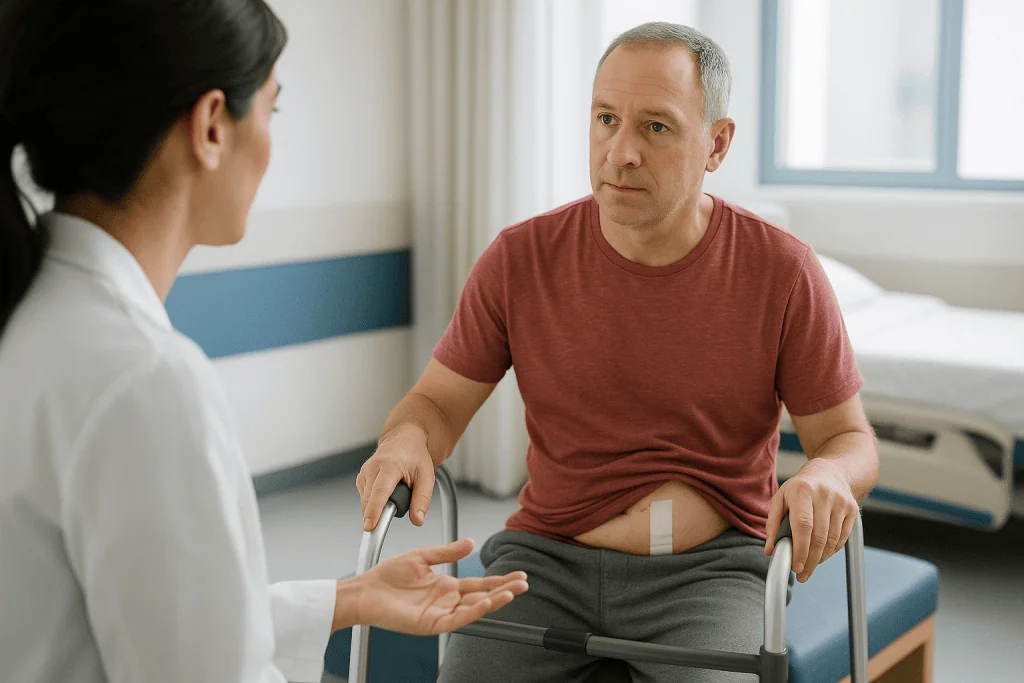
Phase one covers the first days. The goal is protection and circulation: breathing exercises, ankle pumps, getting out of bed, short walks. Nothing here should strain the surgical site.
Phase two usually spans weeks one to three or four. Swelling settles, stitches or staples come out, and the focus shifts to restoring normal range of motion (the full arc a joint can comfortably move through) and basic function, such as climbing stairs or standing from a chair without using your hands. Walks lengthen. A stationary bike with no resistance may appear in the plan after knee or hip surgery.
Phase three, roughly weeks four to eight for many procedures, reintroduces load. Light resistance bands, bodyweight exercises, swimming once the wound has fully closed, and longer bouts of moderate cardio. Lifting limits begin to lift, though not all at once.
Phase four is return to sport or heavy training, often from eight to twelve weeks and later for spinal fusion, major abdominal reconstruction or operations involving the breastbone. Here the concern is less about the wound and more about whether strength, balance and confidence have caught up with ambition.
The dates are indicative. Phases move at the speed of healing tissue, and tissue does not read calendars. A smoker, a person with diabetes or someone who went into surgery deconditioned may spend longer in each phase, while a fit person may move through quickly. The physical therapist’s job is to tell you which phase you are in and what unlocks the next one.
Exercise after surgery timeline by procedure
Readers want numbers, so here are typical ranges drawn from mainstream patient guidance such as Mayo Clinic and MedlinePlus recovery pages. Treat them as the shape of a normal recovery, not as permission. The written instructions from your surgical team override every cell in this table.
| Procedure | First walk | Light cardio and range of motion | Lifting more than light household items | Running or strength training |
|---|---|---|---|---|
| Laparoscopic abdominal surgery (gallbladder, appendix) | Same day | Week 1–2 | Around 4–6 weeks | Around 6 weeks, as cleared |
| Open abdominal or hernia repair | Day 0–1 | Week 2–4 | 6–8 weeks or longer | 8–12 weeks, as cleared |
| Knee replacement | Day 0–1 with walking aid | Week 1–2 (bike without resistance later) | Around 6 weeks | Low-impact sport 3 months; high impact often discouraged |
| Hip replacement | Day 0–1 with walking aid | Week 1–2 | Around 6 weeks | Low-impact sport 6–12 weeks |
| Cesarean birth | Day 0–1 | Week 1–2 walking; pelvic floor work early | After postpartum check, often 6 weeks | After postpartum check, gradual |
| Cardiac surgery through the breastbone | Day 1 | Supervised cardiac rehab from 2–6 weeks | Sternal precautions typically 6–12 weeks | Through cardiac rehab, individually paced |
Two patterns stand out. Walking starts almost immediately regardless of the operation, because its benefits are universal. Heavy lifting waits longest for operations that cut through the abdominal wall or breastbone, because those structures bear load with every cough and every carried bag, and a repair that fails under early strain can need a second operation.
Lifting restrictions after surgery: what the limits really mean
“Nothing heavier than a gallon of milk” is the phrase many patients carry home, and it is worth unpacking what the restriction is protecting.
After abdominal surgery, the layer that matters is the fascia, the tough connective sheet that holds the abdominal wall together and that the surgeon stitched closed. Skin heals in about two weeks. Fascia regains strength far more slowly, and most of its eventual tensile strength returns over roughly six weeks, with remodeling continuing for months. Lifting raises pressure inside the abdomen, and that pressure pushes outward against the repair. Lift too much too soon and the result can be an incisional hernia, a bulge where intestine or fat pushes through a weakened scar.
After cardiac surgery through the breastbone, the restriction is about the sternum itself, which is held with wire and heals like any broken bone. Pushing, pulling or carrying weight with the arms stresses the two halves. The usual instruction, sometimes called sternal precautions, is to avoid lifting or reaching behind you for a defined period, and to hug a pillow when coughing.
After spinal surgery, limits often extend to bending and twisting as well as lifting, because the structures being protected are discs, fused segments or hardware.
Lifting restrictions after surgery are therefore not arbitrary caution. They match the healing timeline of a specific tissue. The practical consequence: light movement that does not load the repair, such as walking, is encouraged during the same weeks that lifting is forbidden. The two instructions are not in conflict. They protect different things.
When the limit is lifted, it is lifted gradually. Resuming with half of your previous load and building over several weeks gives healed tissue, and the muscles around it, a chance to adapt.
Range of motion exercises: why the small movements come first
Nobody posts a video of ankle circles. Yet in the first fortnight after surgery, these unglamorous movements do more for long-term function than anything that looks like a workout.
Range of motion exercises move a joint gently through its available arc without added resistance. After knee replacement, the classic examples are heel slides (sliding the heel toward the buttock while lying down) and quad sets (tightening the thigh muscle to press the back of the knee flat). After shoulder surgery, pendulum swings, letting the arm hang and drift in small circles, are often the first permitted movement. After abdominal surgery, deep breathing and gentle pelvic tilts serve a similar role.
The mechanism is scar management. Injured tissue heals by laying down collagen, and collagen that is never stretched organizes itself into dense, random fibers that bind structures together. This is adhesion, and it is why a knee left immobile after replacement can end up stiff enough to need a second procedure to free it. Controlled movement in the early window encourages collagen to align along the lines of normal motion instead.
Frequency beats intensity. Several short sessions through the day, each lasting a few minutes, outperform one long effort. Mild discomfort is expected; sharp or escalating pain is a signal to stop. Swelling that worsens after a session, rather than settling within an hour or two, suggests the session was too long.
Range of motion work also lays the groundwork for strength. A muscle can only generate force through the range it can move, so restoring the arc comes before restoring the power. Patients who skip this phase and jump to resistance training often plateau early, then wonder why the joint still feels tight six months on.
How do I get my energy back after surgery?
Post-operative fatigue surprises people more than pain does. Pain was expected. The bone-deep tiredness that lasts weeks after a routine operation was not.
Several things drive it. Surgery triggers an inflammatory response that consumes energy and disturbs sleep. Anesthetic agents clear within days, but the sleep disruption of a hospital stay lingers. Blood loss lowers oxygen-carrying capacity. Reduced appetite shrinks fuel intake just when the body is rebuilding tissue. And deconditioning, the loss of muscle and cardiovascular fitness from inactivity, creates a loop in which everything feels harder, so you do less, so you lose more.
Exercise is the intervention that breaks the loop, provided it is dosed correctly. The principle is called graded activity: a baseline you can manage comfortably, repeated daily, then increased by small steps regardless of how you feel on a given day. Pushing hard on good days and crashing on bad ones produces the boom-and-bust pattern that prolongs fatigue.
Walking is the natural tool. Short walks spaced through the day, lengthened gradually, rebuild cardiovascular fitness without loading the surgical site. Pairing movement with daylight, especially in the morning, helps reset sleep rhythms that the hospital scrambled.
Nutrition matters as much as movement. Healing demands protein and calories, and people recovering from surgery frequently eat too little of both. A dietitian can help if appetite is poor for more than a few days.
Finally, patience. For many major operations, full energy takes weeks to months to return, and the trajectory is rarely a straight line. Fatigue that is not gradually improving by the end of the first month, or that worsens, is worth raising with your clinician, since anemia, infection or low mood can all masquerade as simple tiredness.
How can I best recover my muscles after surgery?
The question people type is usually about soreness after a workout. After surgery, the stakes are higher: you are rebuilding muscle that was lost, not just repairing muscle that was challenged.
Three levers matter, and they interact.
The first is progressive loading. Muscle grows in response to a stimulus slightly beyond what it is used to, then adapts, then needs a slightly larger stimulus. After surgery that stimulus starts absurdly small, perhaps standing from a chair five times, and grows week by week. Resistance bands and bodyweight exercises carry most people through the first two months; free weights come later and only with clearance.
The second is protein. Muscle protein synthesis, the process of building new muscle fibers, requires a steady supply of amino acids, and the post-surgical body is often in a catabolic state, breaking down more tissue than it builds. Spreading protein across meals rather than loading it into dinner appears to support synthesis better, and older adults need somewhat more per meal to trigger the same response. A dietitian or your surgical team can set targets appropriate to your kidneys, your operation and your usual diet.
The third is sleep. Growth hormone release and tissue repair concentrate in deep sleep, and pain, medicines and anxiety all fragment it. Protecting a consistent sleep window is a recovery intervention, not a luxury.
What about soreness? Delayed-onset muscle soreness, the stiffness that peaks a day or two after unfamiliar exercise, is normal and harmless. It should be felt in the muscle, not at the incision or inside the joint. Rest days, gentle movement and warmth ease it. Soreness localized to the surgical site is a different matter and belongs in the conversation with your team.
What the evidence actually says about exercise after surgery
Honest grading matters here because the advice spans everything from well-tested hospital protocols to educated guesswork.
Strongest: early mobilization. Randomized trials and large observational studies of enhanced recovery programs consistently show that getting patients out of bed within 24 hours shortens hospital stays and reduces complications such as pneumonia and ileus (temporary paralysis of the bowel). The effect is robust across abdominal, orthopedic and gynecologic surgery. This is the part of the field where the evidence and the viral videos agree.
Strong: clot prevention through movement. The link between immobility and venous thrombosis is supported by decades of observational data and by the mechanisms of blood flow. Walking is recommended alongside, not instead of, whatever clot prevention your team prescribes.
Moderate: structured rehabilitation after joint replacement. Randomized trials show that supervised or well-designed home exercise improves range of motion and function in the months after knee and hip replacement. Whether supervised therapy beats a good home program for every patient is genuinely debated, and trials have produced conflicting results.
Moderate but mixed: prehabilitation. Several randomized trials in major abdominal and cancer surgery suggest that exercise and nutrition before an operation can reduce complications, particularly in frail or deconditioned patients. Other trials have found no difference. The honest summary is promising, population-dependent and not yet settled.
Weakest: specific lifting limits and return-to-sport dates. The six-week rule for lifting after abdominal surgery rests on the known biology of fascial healing and on expert consensus, not on trials that compared six weeks with four or eight. The same applies to most return-to-running dates. Surgeons choose conservative figures because the cost of a failed repair is high, and that caution is reasonable. It is still opinion, and it varies between surgeons.
How does exercise benefit brain health and mood during recovery?
Surgery is hard on the mind as well as the body. Low mood in the weeks afterward is common, and in older adults, post-operative delirium (sudden confusion and inattention after an operation) affects a meaningful minority. Exercise has a role in both.
Start with mechanism. Physical activity increases blood flow to the brain and raises levels of brain-derived neurotrophic factor, a protein that supports the growth and survival of neurons. Over the long term, regular activity is associated with lower rates of cognitive decline, and the World Health Organization’s physical activity guidelines list cognitive health alongside cardiovascular benefits. Evidence for mood is strong: randomized trials show that regular aerobic exercise reduces symptoms of depression, with effects in the range of some talking therapies for mild to moderate symptoms.
In the hospital setting, early mobilization is one component of delirium-prevention bundles, along with sleep protection, hydration and keeping glasses and hearing aids within reach. The evidence here is observational and bundled, so the specific contribution of walking is hard to isolate, but the direction is consistent.
The harder question is how to exercise when depressed, when the inertia of low mood meets the real limits of a healing body. The practical answer from behavioral research is to shrink the task until it is almost trivially small. Not “go for a walk” but “put on shoes and stand at the door.” Not a thirty-minute plan but a two-minute one, done at the same time each day. Momentum follows action more reliably than action follows motivation.
Company helps. Walking with a family member, or joining a cardiac or pulmonary rehabilitation group where one is offered, adds accountability and reduces the isolation that feeds low mood. Persistent sadness, loss of interest or hopelessness lasting more than two weeks warrants a conversation with a clinician, because post-operative depression is treatable and rarely lifts on willpower alone.
Common myths about exercise after surgery
Viral confidence and clinical caution rarely travel together. Here are the claims circulating most widely, and what mainstream evidence says about each.
“If they walked the same day, they can train the same week.” Early walking and early training are different things. Walking is prescribed because its benefits begin within hours. Training loads tissue that has not yet regained strength. The same protocol that gets a knee-replacement patient walking on day one typically keeps them off impact sport for months.
“Rest is safest; movement risks the repair.” For nearly all operations, prolonged rest carries the greater risk: clots, pneumonia, muscle loss and a longer stay. The exception is a small set of procedures with explicit immobilization orders, and in those cases your team will say so plainly.
“Pain means damage, so stop at the first twinge.” Some discomfort is expected during range of motion work and early walking. The distinction that matters is between discomfort that settles within an hour or two and pain that escalates, sharpens or localizes to the incision.
“No pain, no gain.” The opposite error. Pushing through sharp or worsening pain after surgery is how incisional hernias and stiff joints happen.
“A fitness tracker goal of ten thousand steps applies after surgery.” That figure originated in marketing, not research, and the WHO and CDC now emphasize that any movement counts. Early recovery is measured in minutes and laps, not step totals.
“Prehabilitation guarantees a faster recovery.” Trials are mixed. Getting fitter before surgery is sensible and may help, especially for people who start out deconditioned, but it is not a guarantee, and no pre-surgical program replaces the surgeon’s post-operative plan.
Signs you are doing too much, too soon
Recovery has a feedback system. Learning to read it prevents most setbacks, and the signals are more specific than “listen to your body.”
Swelling is the most reliable gauge after joint surgery. Some swelling is normal for weeks. Swelling that is noticeably worse the morning after a session, or that no longer settles overnight, indicates that the volume of activity exceeded what the joint could tolerate. The fix is usually to reduce duration, not to stop entirely.
Pain pattern is the second signal. Soreness in muscles that eases with gentle movement is expected. Pain at the incision that builds through the day, a new bulge beneath a scar when you cough or stand, or joint pain that is worse at the end of a session than at the beginning are all signs of overload.
Fatigue that spills into the next day is the third. If a walk leaves you unable to do your range of motion exercises that evening, or if you need a long nap after every session, the dose was too high. Graded activity means the next step should feel manageable, not heroic.
Wound changes deserve attention. Increased redness spreading outward, new drainage or an incision that was closed and begins to separate are reasons to stop exercising and contact your team the same day.
The pattern to aim for is boring: a little more each week, with symptoms that stay stable or improve. If you find yourself bargaining (“I’ll push today and rest tomorrow”), that is the moment to step back. Lost time after a setback almost always exceeds the time saved by hurrying.
When to see a doctor
Most of this article concerns judgment calls. The situations below are not judgment calls. They are reasons to contact your surgical team the same day, or to seek emergency care.
Seek emergency care immediately for sudden shortness of breath, chest pain, coughing up blood, fainting or a racing heartbeat that comes on at rest. These can signal a pulmonary embolism, a blood clot that has traveled to the lungs, which is a medical emergency regardless of how recently you were walking.
Contact your team the same day for the following:
- Pain, swelling, warmth or redness in one calf or thigh, especially if one leg is noticeably larger than the other. Cleveland Clinic lists these as the classic signs of deep vein thrombosis.
- A fever, or chills and sweats, in the days or weeks after surgery.
- Spreading redness around the incision, pus or foul-smelling drainage, or an incision that begins to open.
- A new bulge beneath or near a scar, particularly one that appears when you cough or lift.
- Pain that is escalating rather than easing despite prescribed pain relief.
- Numbness, tingling or weakness in a limb that is new or worsening.
- Persistent vomiting, inability to pass urine or a swollen, hard abdomen.
- Low mood, hopelessness or loss of interest lasting more than two weeks.
If you take a blood thinner or any other medicine prescribed around your operation, do not alter or stop it to make exercise easier or because you feel recovered. Dosing and duration are decisions for the prescribing clinician, who knows your clot risk and your bleeding risk.
And when the question is simply “is this safe for me yet,” ask. Surgical teams would far rather answer a cautious question than treat an avoidable complication, and no general article, including this one, knows what your surgeon saw inside the wound.
Frequently asked questions
When can I exercise after surgery?
Gentle walking usually begins the same day or the day after most operations, with range-of-motion exercises added in the first two weeks. Light cardio such as a stationary bike or swimming typically follows once the wound is fully closed, and lifting more than light household items generally waits four to twelve weeks depending on the procedure. Your surgical team’s written plan sets the actual dates for you.
Is walking after surgery really safe on the first day?
For most operations, yes, and it is actively encouraged. The first walk is supervised because blood pressure can drop on standing after anesthesia. Early walking expands the lungs, keeps blood moving in the legs and helps the bowel restart. The exceptions are procedures with explicit immobilization or non-weight-bearing orders, which your team will state clearly.
What do lifting restrictions after surgery actually protect?
They protect a specific healing tissue. After abdominal surgery it is the fascia, the strong connective layer that was stitched closed and that can tear into an incisional hernia under pressure. After cardiac surgery through the breastbone it is the sternum, healing like a broken bone. After spinal surgery it is discs, fused segments or hardware. Each tissue has its own timeline.
What is a typical exercise after surgery timeline for knee replacement?
Most people walk with a walker or crutches on the day of surgery or the next day, begin range-of-motion exercises immediately, and progress to a stationary bike over the first weeks. Low-impact sport such as cycling or swimming often resumes around three months. Mayo Clinic notes that high-impact activities like running are generally discouraged long term to protect the implant.
How can I best recover my muscles after surgery?
Combine progressive loading, adequate protein and consistent sleep. Start with very small resistance tasks and increase gradually each week. Spread protein across meals rather than concentrating it at dinner, since muscle protein synthesis responds to regular supply. Protect a consistent sleep window, as deep sleep is when tissue repair peaks. Soreness in muscle is normal; pain at the incision or inside the joint is not.
How do I get my energy back after surgery?
Use graded activity: set a small daily baseline of walking you can manage comfortably, repeat it every day, and increase by small steps regardless of how you feel. Avoid the boom-and-bust pattern of pushing hard on good days. Eat enough protein and calories, get morning daylight to reset sleep, and raise fatigue that is not improving by the end of the first month with your clinician.
How does exercise benefit brain health after an operation?
Physical activity increases cerebral blood flow and raises brain-derived neurotrophic factor, a protein that supports neuron survival. Early mobilization is part of hospital bundles aimed at preventing post-operative delirium in older adults, though that evidence is observational. Over the long term, regular activity is associated with lower rates of cognitive decline, and randomized trials show it reduces depressive symptoms.
How to exercise when depressed and recovering from surgery?
Shrink the task until it feels almost trivial, then do it at the same time each day. Putting on shoes and standing at the door counts. Two minutes of walking counts. Momentum tends to follow action rather than the other way round. Walking with someone adds accountability. If low mood lasts more than two weeks, tell your clinician, since post-operative depression is treatable.
Does prehabilitation before surgery speed up recovery?
The evidence is promising but mixed. Several randomized trials in major abdominal and cancer surgery found fewer complications after supervised exercise and nutrition programs, especially in frail or deconditioned patients, while other trials found no difference. Getting fitter before an operation is sensible, but it does not guarantee a faster recovery and never replaces the post-operative plan from your surgical team.
What are the warning signs that mean I should stop exercising after surgery?
Stop and seek emergency care for sudden breathlessness, chest pain, coughing up blood or fainting. Contact your team the same day for calf pain or swelling in one leg, fever, spreading redness or drainage at the incision, a new bulge near the scar, or pain that escalates despite prescribed relief. Swelling that no longer settles overnight means the activity dose is too high.
References
- MedlinePlus: After Surgery
- Cleveland Clinic: Deep Vein Thrombosis (DVT)
- World Health Organization: Physical activity fact sheet
- CDC: Adult Activity: An Overview
This article is for general information only and is not a substitute for professional medical advice. Please consult a qualified doctor about your individual situation.

More from the Blog

Anesthesia and Memory: Postoperative Cognitive Changes Explained
Anesthesia and memory loss are linked mainly in the short term. Confusion in the first days after surgery (postoperative delirium) is common in older…

Pain After Surgery: Multimodal Relief and the Alternatives to Opioids
Pain after surgery is usually worst in the first two to three days and then eases steadily. Most surgical teams now use multimodal relief:…

Pre-Op Tests: Which Blood Work, ECG and Scans Are Needed Before Surgery
Pre-op tests are chosen to match your health and the type of operation, not ordered as a standard package. Healthy adults having minor surgery…

Incision Care After Surgery: Cleaning, Showering and the Signs of Infection
Incision care after surgery means keeping the wound clean, dry and protected while the skin edges seal. Most people can shower about 48 hours…

Bruising After Surgery: The Normal Timeline and the Signs of a Problem
Bruising after surgery is expected: blood leaks from small vessels cut or stretched during the operation and settles beneath the skin. Most surgical bruises…

Alcohol and Supplements Before Surgery: What to Stop and When
Most surgical teams ask patients to avoid alcohol for at least 24 to 48 hours before anesthesia, and small randomized trials suggest heavier drinkers…