

Incision Care After Surgery: Cleaning, Showering and the Signs of Infection

Key Takeaways
- A closed surgical incision becomes watertight at about 48 hours, which is why most teams allow a short shower after that point but no soaking until the wound is fully healed.
- Trials comparing antibiotic ointment with plain petrolatum on clean wounds found similar infection rates and more allergic rashes with the antibiotics.
- WHO's 2018 global guidelines found no evidence that advanced or silver dressings beat a standard sterile dressing on a stitched, closed incision.
- Hydrogen peroxide, rubbing alcohol and iodine scrubs damage the cells that close a wound; mild soap and water or saline clean it without that cost.
- Non-absorbable stitches and staples left beyond roughly two weeks become harder to remove and leave more marks, so the removal date is part of the treatment.
- Redness that spreads, pus, fever of 100.4°F (38°C) or higher, worsening pain or a wound that opens are the signs that an incision needs same-day medical review.
Incision care after surgery means keeping the wound clean, dry and protected while the skin edges seal. Most people can shower about 48 hours after a closed incision if the surgical team agrees, washing gently with mild soap and water and patting dry. Avoid scrubbing, soaking, hydrogen peroxide and unprescribed ointments. Spreading redness, pus, fever, increasing pain or a wound that opens needs prompt medical review.
A woman three days out from gallbladder surgery sat on the edge of her bathtub this spring, phone in one hand, scissors in the other, trying to decide whether a video with four million views knew more about her incision than the printed sheet from the recovery nurse. The video said to peel the dressing off and “let it breathe.” The sheet said to leave it alone until Friday. She chose the sheet, then searched anyway.
She is not alone. As of May 2026, searches for incision care have climbed sharply on the back of a wave of short videos promising faster healing with peroxide scrubs, honey, essential oils and uncovered wounds. Some of that advice is harmless. Some of it reopens wounds.
This guide walks through what surgeons, infection-control agencies and wound-healing trials actually agree on: how to clean an incision, when showering is safe, what belongs on the skin and what does not, and the handful of signs that mean the wound needs a professional’s eyes rather than a comment section’s.
What changed recently in incision care advice
The science of wound care moves slowly, which is part of why a viral clip can sound newer than it is. The last major shifts came from two agencies, and both pushed in the same direction: simpler, not fancier.
In 2017 the CDC published its first full update of surgical site infection guidance in nearly two decades. A surgical site infection, usually shortened to SSI, is an infection that develops in the wound or deeper tissues within 30 days of an operation (or up to 90 days if an implant was placed). The 2017 guideline told hospitals to prepare skin with alcohol-based antiseptic, to have patients wash with soap at least the night before surgery, and to stop giving preventive antibiotics once the incision was closed, because extra doses after closure did not lower infection rates.
The WHO followed with its own global guidelines in 2016 and a second edition in 2018. One finding matters directly to anyone at home with a bandage: the WHO panel found no good evidence that “advanced” dressings, including silver-impregnated and hydrocolloid types, outperform a plain sterile dressing on a closed, stitched wound. The recommendation was to use a standard dressing unless the surgeon has a specific reason not to.
Since then, the CDC has refreshed its patient-facing pages into plainer language, and national health services have aligned their shower advice around a 48-hour window for most closed incisions. What has not changed is the core: the body does the healing, and the job of incision care is to keep interference, bacteria and friction out of its way.
The 2026 surge in search interest, then, is not a response to new evidence. It is a response to confident online claims that the evidence does not support, and this article grades those claims section by section.
Incision care basics: what is happening under the dressing
Picture a paper cut, then multiply the depth. A surgical incision passes through the epidermis (the thin outer layer of skin), the dermis (the thicker living layer beneath it with blood vessels and nerves) and often fat and the fascia, the tough fibrous sheet covering muscle. The surgeon closes each layer, and the closure you can see is only the top one.

Healing follows a predictable timeline. In the first 24 to 48 hours, platelets and a protein called fibrin plug the gap and a scab or dried film forms. From roughly day two, white blood cells clear debris; the wound may look slightly pink and feel warm, which is inflammation doing its job rather than infection. By day three to five, skin cells migrate across the surface, a process called epithelialization, and the incision becomes watertight. Collagen then fills the dermis over weeks, and the scar keeps remodeling for a year or more.
That sealing step around 48 hours is the single most useful number in incision care. Before it, water and bacteria can slip between the edges. After it, a closed incision tolerates a brief shower well. It also explains why surgeons bristle at early dressing changes: every peel of adhesive tape tugs on edges that have only just started to knit.
Wounds closed edge to edge with stitches, staples or glue are said to heal by primary intention. Wounds left open to fill in from the bottom, which surgeons sometimes do after draining an abscess, heal by secondary intention and need a different, nurse-directed routine. Everything in this article refers to the first kind unless stated otherwise.
How to clean a surgical incision without doing harm
The honest answer to “how do I clean it” is that for most closed incisions you barely do. The skin seals itself, and the goal of cleaning is to remove dried blood, sweat and loose skin without disturbing the edges.
Patient instructions from national services and surgical centers converge on the same gentle routine once your team says the dressing can come off:
- Wash your hands with soap for 20 seconds before touching anything near the wound.
- Let lukewarm water run over the incision, or use a clean washcloth, with a mild unscented soap. Do not scrub, and do not aim a shower jet straight at it.
- Rinse and pat dry with a clean towel or gauze. Rubbing lifts scabs and strips the migrating skin cells.
- Apply a fresh dressing only if your surgeon asked you to; otherwise leave the skin bare and dry.
Soap and water earn their place through decades of use and through trials of traumatic wounds that found tap water irrigation no worse than sterile saline for preventing infection. The products people reach for instinctively do worse. Hydrogen peroxide fizzes because it is reacting with tissue enzymes, and in laboratory and clinical studies it damages the very cells that close a wound. Rubbing alcohol dries and stings. Povidone-iodine scrubs are used on intact skin in the operating room, where surgeons weigh the trade-off; the same strength on an open edge is cytotoxic, meaning it kills living cells.
Steri-Strips, the thin adhesive tapes placed across an incision, should be left alone until they curl off on their own or your team removes them, typically within one to two weeks. Trimming the loose ends with clean scissors is fine; pulling them is not.
Showering after surgery: when is it safe to get the incision wet?
Nothing lifts a recovering person’s mood like the first proper shower, and the good news is that the evidence is on the side of letting people have it fairly early.
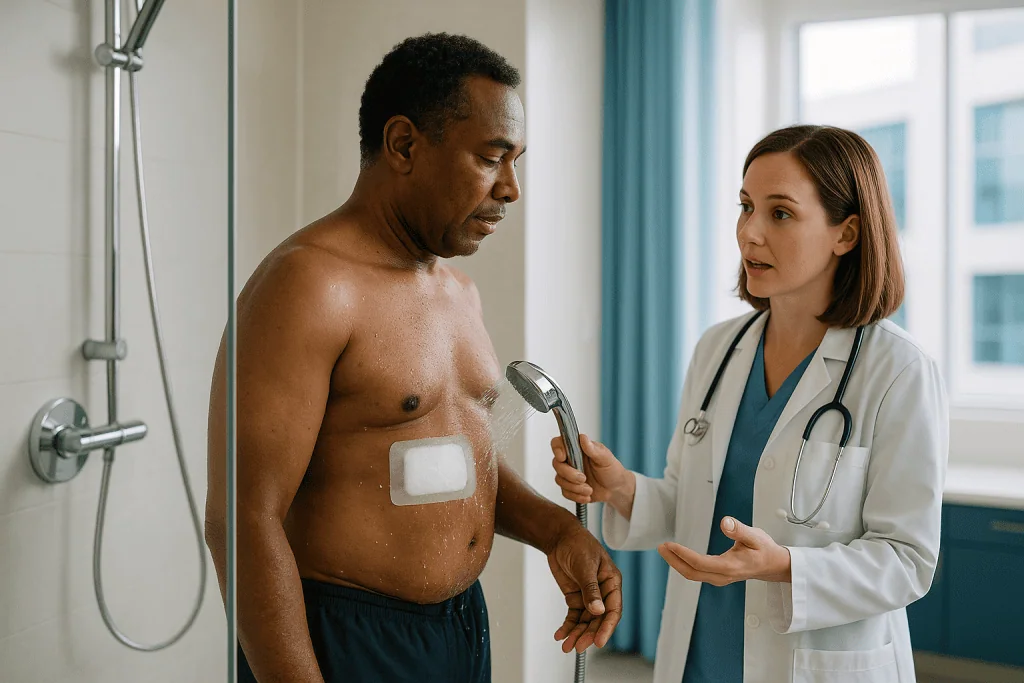
Pooled analyses of randomized trials comparing early showering, usually from 12 to 48 hours after a clean, closed procedure, with delayed showering found no increase in surgical site infections in the early group. The number of patients studied was modest and the trials varied in quality, so the conclusion is best described as moderate-to-low certainty evidence of no harm, rather than proof of benefit. Still, it is enough that the NHS tells patients they can usually shower 48 hours after surgery, and most US surgical teams give similar advice for incisions closed with stitches, staples or glue.
A few practical rules make a shower safe rather than merely allowed. Keep it short, keep the water warm rather than hot, and let it run over the incision instead of hitting it directly. Skip bath oils, body scrubs, loofahs and perfumed washes near the wound. Afterward, pat dry and leave the area uncovered or redress as instructed. If a waterproof dressing was applied in the operating room, many surgeons want it left on through the shower and removed only at the follow-up visit.
Submerging the incision is a different question. Baths, hot tubs, pools and lakes soak the wound, soften the sealing layer and, in the case of hot tubs and open water, expose it to concentrated bacteria. Standard advice is no soaking until the wound is fully closed and any stitches or staples are out, often around two weeks, and longer for incisions near the groin, armpit or skin folds.
Showering after surgery with drains, external fixators or an open wound follows its own rules, and those come from the surgical team, not a general guide.
Do incisions heal better covered or uncovered?
This is the question behind the “let it breathe” videos, and the physiology gives a clear answer: wounds do not breathe. Skin cells migrating across an incision get their oxygen from the blood supply underneath, not from the air above. What the air does is dry the surface, and a dry crust is a wall that cells must tunnel under, which slows closure slightly and tends to leave a wider scar.
That is the basis of moist wound healing, a principle supported by laboratory work since the 1960s and by trials in chronic and traumatic wounds. For a stitched surgical incision, though, the practical difference is small. Once the edges have sealed, around 48 hours, the wound is protected by its own new skin, and large trials comparing dressings with no dressing on closed incisions have found similar infection rates either way.
So the fair summary is:
- For the first one to two days, cover it. A sterile dressing keeps bacteria, clothing and curious fingers off a wound that is not yet watertight.
- After that, covering is optional for most clean incisions on the trunk and limbs, and the choice depends on comfort and friction. A waistband rubbing across an appendectomy scar is a good reason to keep a light dressing on.
- Keep covering wounds that weep, sit in a skin fold, or lie where sweat and movement collect, such as the groin or under the breast.
Nothing here supports ripping off the operating-room dressing on day one to speed things up. The edges knit on their own schedule, and exposure does not accelerate them. If a dressing becomes soaked, loose or dirty before the team said to remove it, replace it with a clean one rather than leaving the wound open.
When should I stop covering my incision?
Surgeons give an individual date for a reason: the right day depends on where the incision is, how it was closed and how much the surrounding skin moves. But the general pattern is consistent enough to describe.
Most teams want the original dressing left in place for 24 to 48 hours, which covers the window before the wound seals. A growing number apply a transparent waterproof film in the operating room that stays on for five to seven days, through showers, and comes off at the first follow-up. Guidelines from the CDC and WHO do not insist on either approach, because comparative trials have not shown one dressing schedule to be clearly safer than another on closed wounds.
Once the first dressing is off, the signals to go uncovered are simple. The incision is dry, meaning no fluid stains a gauze pad over several hours. The edges are flat and together with no gaps. Clothing does not rub across it. If all three are true, bare skin is fine, and it is easier to glance at the wound each day when nothing is taped over it.
Keep a light dressing longer when the wound still weeps a little clear or pink fluid, when it sits under a bra band, belt or brace, or when you work in dust, grease or soil. Stitches and staples that have not yet been removed do not by themselves require a cover, but tape across them can catch and tug, so many people prefer a loose gauze pad.
Stopping the cover is not the same as stopping care. Hands still get washed before touching the area, sunscreen or shade still protects the new scar once it has closed, and the daily look-over continues until the follow-up visit.
What is the best ointment to use on incisions? The honest answer
Drugstore shelves imply that healing needs a tube of something, and the viral feeds add honey, coconut oil and vitamin E to the list. The trial evidence is far less enthusiastic.
For clean surgical wounds, randomized trials have compared triple-antibiotic ointment (bacitracin, neomycin and polymyxin B) and single-agent bacitracin with plain white petrolatum, the ingredient in petroleum jelly. Infection rates were similarly low in both groups, generally around 1 to 2 percent, while the antibiotic group had more contact dermatitis, an itchy allergic rash. Neomycin is among the most common causes of contact allergy in North America, and bacitracin has prompted dermatology groups to advise against routine use on surgical wounds. The strength of this evidence is moderate: several trials, consistent results, mostly in dermatologic surgery.
Petrolatum works not by killing bacteria but by keeping the surface moist and protecting it from friction. Dermatologists often recommend it on sutured skin wounds for that reason. Many general and orthopedic surgeons prefer nothing at all on a closed incision, because an ointment under a dressing can trap moisture and soften the skin edges. Both positions are defensible, and the person who closed your wound knows which applies.
Honey has real antibacterial activity in the laboratory and medical-grade preparations are used by wound nurses on some chronic ulcers, but there is no trial evidence that kitchen honey helps a closed surgical incision, and it is not sterile. Vitamin E applied to scars performed no better than placebo in controlled studies and caused rash in up to a third of users. Essential oils have no supporting trials and are frequent sensitizers.
The rule that survives the evidence: put nothing on an incision that your surgical team did not approve, and never apply a prescription cream someone else was given.
What helps incisions heal faster? Mostly the unglamorous things
If a product could reliably speed surgical wound healing, hospitals would hand it out at discharge. What the data actually point to are habits, and most of them are about not slowing the body down.
Blood supply decides healing speed, and nicotine constricts blood vessels. Smokers have roughly double the rate of wound complications after surgery in large observational cohorts, and stopping for four weeks or more before an operation measurably reduces the risk. The effect runs in both directions, so continuing to abstain afterward matters. This is the single biggest modifiable factor, and it is backed by strong, consistent observational evidence plus randomized trials of quit programs.
Blood sugar comes next. High glucose impairs white blood cell function and collagen formation; keeping it in the range your clinician set during recovery is associated with fewer infections in trial and cohort data. Protein supplies the amino acids collagen is built from, and people recovering from surgery need somewhat more than usual; a dietitian can translate that into meals. Vitamin C and zinc are needed for collagen cross-linking, but supplementing beyond a normal diet has not been shown to help unless a deficiency exists.
Movement helps circulation, and gentle walking from the first day is encouraged after most procedures. Lifting, twisting and stretching the incision line are not, because tension pulls the edges and widens the eventual scar. The usual guidance of nothing heavier than a gallon of milk for a few weeks exists for the wound as much as for the deeper repair.
Sleep, hydration and keeping the dressing schedule round out the list. None of it is exciting. All of it has more evidence behind it than anything sold with the word “accelerate” on the label.
Stitches, staples, glue and strips: how each closure is cared for
The closure method changes the small details of incision care more than most people expect. Here is how the common types compare, using guidance from national patient resources; your own instructions override any row in the table.
| Closure type | Typical removal | Showering | Care notes |
|---|---|---|---|
| Non-absorbable stitches (sutures) | 5–14 days, removed by a clinician; longer on joints and the back | Usually from 48 hours, pat dry | Do not trim or pull; a loose knot end can be left |
| Absorbable stitches | Dissolve over weeks; no removal | Usually from 48 hours | Small white or clear fragments may surface and can be left alone |
| Skin staples | 7–14 days, removed with a staple remover | Usually from 48 hours | Avoid dressings that catch on staples; report any that lift or dig in |
| Skin glue (tissue adhesive) | Peels off in 5–10 days | Brief showers often allowed early; no soaking | No ointments or creams, which dissolve the glue; do not pick |
| Adhesive strips (Steri-Strips) | Fall off in 7–14 days | Can get wet; pat dry | Trim curled ends; replace only if told |
| Open wound packed with gauze | Nurse-directed dressing changes | Per wound team | Follow written packing instructions exactly |
Sutures and staples share one point that surprises people: leaving them in too long is not safer. Beyond about two weeks, the skin starts to grow around them, removal becomes harder, and track marks are more likely. Keep the removal appointment even if the wound looks finished.
Glue deserves its own warning because the viral advice to “moisturize the scar” is actively harmful here. Petrolatum and most lotions dissolve tissue adhesive, which can let the edges separate before they have sealed.
Signs of incision infection: normal healing versus real trouble
Most anxious searches at 2 a.m. come from a wound that looks worse than expected but is healing normally. Knowing what normal looks like prevents those searches, and knowing what abnormal looks like makes the real ones count.
Normal in the first week: a thin line of pink or light red along the edges, no wider than a fingertip; mild warmth; mild swelling; itching from day three or four as nerve endings regrow; small amounts of clear, straw-colored or slightly blood-tinged fluid in the first two days; and firmness under the incision, a healing ridge, that softens over weeks. Bruising that drifts downward with gravity is common after abdominal and chest surgery and is not infection.
Signs of incision infection, which affect roughly 2 to 4 percent of surgical patients according to CDC surveillance, tend to arrive on days three to seven and get worse rather than better:
- Redness that spreads outward beyond the edges, especially if you can watch it grow over a day. Drawing a line around it with a pen makes the change obvious.
- Thick, cloudy, yellow, green or foul-smelling drainage. Pus is never normal.
- Pain that increases after day two or three instead of easing, or a wound that becomes hard and hot.
- Fever of 100.4°F (38°C) or higher, chills or feeling unwell.
- Edges that gape or open, called dehiscence.
Two related problems are not infection but still need review. A seroma is a pocket of clear fluid under the incision that feels like a soft water balloon; a hematoma is a pocket of blood that feels firmer and looks bruised. Both can sometimes be left to absorb, and both can become infected, so they belong in the same call to the clinic.
The CDC’s basic patient guidance ends with a line worth remembering: if you are unsure whether a change is normal, ask rather than wait.
What the evidence actually says, graded
Wound care is unusual in medicine: it is practiced constantly and studied unevenly. Grading the main claims by the type of evidence behind them makes the strong recommendations easier to trust and the weak ones easier to ignore.
Strong evidence (multiple randomized trials, consistent results). Preventive antibiotics given before the incision lower infection rates; continuing them after closure does not, which is why both CDC and WHO recommend stopping at the end of the operation. Alcohol-based skin antiseptic before surgery beats older preparations. Topical antibiotic ointment offers no advantage over petrolatum on clean wounds and causes more rashes.
Moderate evidence (fewer or smaller trials, or trials plus strong cohort data). Early showering at 24 to 48 hours does not increase infection in closed wounds. Advanced dressings do not outperform standard sterile dressings on primarily closed incisions. Smoking cessation before surgery reduces wound complications. Keeping glucose controlled during recovery lowers infection risk in people with diabetes.
Weak evidence or expert opinion. The exact day to remove a dressing; whether to leave a healed incision bare or covered after 48 hours; silicone sheets or gel for scar appearance (small trials, mixed quality, modest benefit); the belief that vitamin C or zinc supplements help a well-nourished person heal faster.
No supporting evidence, or evidence of harm. Hydrogen peroxide, rubbing alcohol or iodine scrubs on open edges; kitchen honey; essential oils; vitamin E oil on scars; removing dressings early to “air out” a wound; soaking in baths or hot tubs before closure.
The practical lesson from this ladder is that the strongest evidence belongs to things done in the operating room. Home incision care rests mostly on moderate evidence and sensible physiology, which is exactly why written instructions from the team that saw your wound carry more weight than anything general, this article included.
Common myths about incision care, corrected
Each of these circulated widely in the spring 2026 wave of videos. Each has a straightforward answer.
“Wounds need air to heal.” Cells at the wound surface draw oxygen from blood vessels beneath them. Air dries the surface and forms a crust that slows cell migration. Covering for the first two days protects the seal; after that, bare or covered are both acceptable for clean incisions.
“If it does not sting, it is not cleaning.” The fizz of hydrogen peroxide and the sting of alcohol are signs of tissue injury, not of effectiveness. Soap and water, or saline, clean an incision without harming the cells that close it.
“A thick layer of antibiotic ointment prevents infection.” Trials show no fewer infections than petrolatum and more allergic rashes. Many surgeons prefer nothing on a closed wound.
“Picking off the scab speeds healing.” A scab is a temporary roof; tearing it off removes the new skin growing beneath it and restarts the process, usually with a wider scar.
“Redness means infection.” A narrow pink border and mild warmth are normal inflammation. Infection is redness that spreads, with pus, growing pain or fever.
“Stitches can stay in until they fall out.” Non-absorbable sutures and staples that stay past about two weeks become harder to remove and leave more marks. The removal date is part of the treatment.
“Honey, coconut oil or essential oils are natural, so they are safe.” None has trial evidence on surgical incisions, none is sterile from a kitchen jar, and essential oils are among the most common causes of allergic skin reactions.
“No swimming is an outdated rule.” Soaking softens the sealed edge and pools, lakes and hot tubs carry bacterial loads that a brief shower does not. The rule stands until the wound is fully closed and the team clears it.
Who heals more slowly, and what to do about it
Healing is not a fair race. Several conditions change the odds, and the people who have them are often told so in a hurried sentence at discharge. The detail deserves more than that.
Diabetes raises surgical site infection risk through impaired immune cell function and small-vessel damage; CDC data show roughly double the rate in people with poorly controlled glucose. The practical response is tighter monitoring in the weeks after surgery, with any target set by the clinician who manages the diabetes, and a lower threshold for calling about redness or drainage.
Higher body weight is associated with more wound complications, mostly because fat has a thinner blood supply and because skin folds trap moisture. Keeping incisions in folds clean and dry, using a soft absorbent pad, and checking them with a mirror or a helper each day addresses the mechanism without any need for judgment about the number on a scale.
Corticosteroids, some immunosuppressants and certain cancer treatments slow collagen formation and blunt inflammation, which can also mask the early signs of infection. Anyone taking them should not stop or adjust them on their own; the prescribing clinician and the surgeon coordinate that before the operation. What the patient can do is watch for subtler signals, such as a wound that stays wet or an edge that will not flatten.
Older skin is thinner and heals more slowly, and tape can tear it. Gentle removal of adhesives, pulling the skin away from the tape rather than the tape away from the skin, prevents a second wound beside the first.
Poor nutrition, kidney disease, peripheral artery disease and radiation to the surgical area all slow healing too. The common thread is that these groups benefit most from an early follow-up and from reporting changes promptly, because their wounds give less warning.
When to see a doctor about an incision
Most incisions need nothing more than the scheduled follow-up. The ones that need an earlier call usually declare themselves clearly if you know the list.
Contact the surgical team the same day, or use the after-hours line, for any of these:
- Redness spreading more than about half an inch beyond the edges, or red streaks running away from the wound toward the body.
- Thick, cloudy, yellow or green drainage, or any foul smell.
- Fever of 100.4°F (38°C) or higher, shaking chills, or feeling suddenly unwell.
- Pain that increases after the first few days, or a wound that becomes hard, hot and swollen.
- Edges that separate, a gap you can see into, or anything that looks like tissue or fat showing.
- Bleeding that soaks through a dressing and does not stop with 10 minutes of firm pressure.
- A stitch or staple that has pulled out, or glue that has lifted with the edges apart.
Call emergency services or go to an emergency department for signs that the problem is no longer just the skin: a wound that opens widely after abdominal surgery, especially if something bulges through; sudden chest pain or shortness of breath; a swollen, painful calf, which can signal a blood clot; confusion or fainting; or fever with a fast heartbeat and a wound that is rapidly changing, which can be the start of sepsis, a life-threatening body-wide reaction to infection.
Everything about treatment follows from that assessment. Whether an infected incision needs oral antibiotics, intravenous antibiotics, drainage or reopening is a decision for the treating clinician, who can see the wound and knows what lies beneath it. Starting leftover antibiotics at home, applying someone else’s prescription cream or draining a swelling yourself can mask the signs the team relies on and delay the right care.
After the incision closes: scar care that has some evidence
Once the stitches are out and the skin is sealed, a different phase of incision care begins, and the evidence here is thinner but still useful.
Scars remodel for 12 to 18 months. In the first weeks the line is red and raised because of dense new blood vessels and immature collagen; it flattens and fades as collagen fibers reorganize. Two things reliably make scars worse: sun and tension. New scar tissue has little pigment protection and darkens permanently with ultraviolet exposure, so shade, clothing or a broad-spectrum sunscreen once the skin is intact is recommended by dermatology sources for at least six months. Tension from stretching or heavy lifting across the line widens it, which is one more reason activity limits run past the day the wound looks healed.
Silicone gel sheets and silicone gels have the best evidence of any over-the-counter scar product, with small randomized trials showing modestly flatter, less red scars when used for several hours a day over two to three months. The quality of those trials is limited, so the fair description is “probably helps somewhat.” Gentle massage of a closed scar is widely recommended by surgeons and physical therapists and is low risk, though trial support is weak.
Hypertrophic scars are raised and red but stay within the original wound; keloids grow beyond it and are more common in people with darker skin and on the chest, shoulders and earlobes. Both can be treated by a dermatologist or surgeon, and early assessment gives more options.
Onion-extract gels, vitamin E and cocoa butter have not outperformed plain moisturizer in controlled studies. A bland moisturizer applied after the wound has fully closed is reasonable, inexpensive and unlikely to cause a rash, which is more than can be said for most of what the feeds recommend.
Frequently asked questions
How do I clean a surgical incision at home?
Wash your hands, let lukewarm water and a mild unscented soap run over the incision, rinse, and pat dry with a clean towel or gauze. Do not scrub, and do not use hydrogen peroxide, alcohol or iodine on the edges, because they damage healing cells. Redress only if your surgical team asked you to, and follow any written timing they gave for the first dressing change.
How long after surgery can I shower?
Most people with a closed incision can shower about 48 hours after surgery if the surgical team agrees, since trials of early showering have not shown higher infection rates. Keep it brief, let water run over rather than directly onto the wound, and pat dry afterward. Baths, pools and hot tubs wait until the wound is fully closed and any stitches or staples are out.
What are the first signs of an infected incision?
The earliest signs are usually redness that spreads outward from the edges, pain that increases after the first few days instead of easing, and cloudy or foul-smelling drainage. Fever of 100.4°F (38°C) or higher, warmth, hardness and swelling often follow. These typically appear between days three and seven. A narrow pink border and mild itching are normal and are not infection.
When should I stop covering my incision?
Most surgeons want the first dressing left on for 24 to 48 hours, or longer if a waterproof film was applied in the operating room. After that, a clean, dry incision with closed edges can usually be left uncovered. Keep a light dressing if the wound still weeps, if clothing rubs it, or if it sits in a skin fold. Your written instructions take priority over general timing.
Do incisions heal better covered or uncovered?
Covered for the first day or two, then either is acceptable for a clean closed incision. Wounds do not need air; their cells take oxygen from the blood supply beneath, and drying the surface slightly slows closure. Trials comparing dressings with no dressing on sealed incisions found similar infection rates. Covering mainly matters where friction, sweat or dirt would otherwise reach the wound.
What is the best ointment for a surgical incision?
For clean closed wounds, randomized trials found plain petrolatum performs as well as antibiotic ointments for preventing infection, with fewer allergic rashes. Many surgeons prefer nothing on a closed incision, and anything applied to skin glue can dissolve it. Honey, vitamin E and essential oils lack supporting trials. Use only what your surgical team approved, and never a cream prescribed for someone else.
What helps incisions heal faster?
Not smoking, keeping blood sugar in the range your clinician set, eating enough protein, gentle walking and avoiding strain across the incision line have the most evidence. Keeping the wound clean, dry and protected for the first two days matters more than any product. Supplements beyond a normal diet have not been shown to speed healing in people without a deficiency.
Is it normal for an incision to itch or feel hard?
Yes. Itching usually begins around day three to four as nerve endings regrow and histamine is released during healing, and a firm ridge under the incision is new collagen that softens over weeks. Neither means infection. Itching combined with spreading redness, drainage or fever is different and should be reported. Avoid scratching, which can lift scabs and introduce bacteria.
Can I use hydrogen peroxide on my incision?
Routine use is not recommended. Hydrogen peroxide fizzes because it reacts with tissue enzymes, and studies show it damages the skin and immune cells that close a wound, so it can slow healing rather than prevent infection. Mild soap and water or sterile saline clean an incision just as well. If your team has a specific reason to recommend an antiseptic, follow their instructions.
When should I worry about redness around an incision?
A thin pink or red border about a fingertip wide along the edges is normal inflammation during the first week. Worry when the redness spreads more than about half an inch beyond the wound, grows over a day, forms streaks, or comes with pus, increasing pain, warmth or fever. Outlining the red area with a pen makes any spread easy to see and useful to describe when you call.
References
- MedlinePlus: Surgical wound care – closed
- MedlinePlus: Surgical wound infection – treatment
- NHS: How should I care for my stitches?
- CDC: About Surgical Site Infections
This article is for general information only and is not a substitute for professional medical advice. Please consult a qualified doctor about your individual situation.

More from the Blog

Anesthesia and Memory: Postoperative Cognitive Changes Explained
Anesthesia and memory loss are linked mainly in the short term. Confusion in the first days after surgery (postoperative delirium) is common in older…

Pain After Surgery: Multimodal Relief and the Alternatives to Opioids
Pain after surgery is usually worst in the first two to three days and then eases steadily. Most surgical teams now use multimodal relief:…

Exercise After Surgery: When to Walk, Lift and Train Again
Most people can begin gentle walking within a day of surgery, often the same day, because early movement lowers the risk of blood clots,…

Pre-Op Tests: Which Blood Work, ECG and Scans Are Needed Before Surgery
Pre-op tests are chosen to match your health and the type of operation, not ordered as a standard package. Healthy adults having minor surgery…

Bruising After Surgery: The Normal Timeline and the Signs of a Problem
Bruising after surgery is expected: blood leaks from small vessels cut or stretched during the operation and settles beneath the skin. Most surgical bruises…

Alcohol and Supplements Before Surgery: What to Stop and When
Most surgical teams ask patients to avoid alcohol for at least 24 to 48 hours before anesthesia, and small randomized trials suggest heavier drinkers…