

Can Women With Diffuse Thinning Have a Hair Transplant? Why Donor Stability Decides

Key Takeaways
- In diffuse thinning the donor area at the back of the head may itself be miniaturizing, and transplanted follicles keep the behavior they had before the move.
- Female pattern hair loss usually spares the back and sides, which is why many women with a widening part remain reasonable surgical candidates after assessment.
- Telogen effluvium can mimic permanent diffuse thinning yet typically settles over around six months without any procedure, so surgery is never the first step.
- Transplanted hairs are expected to shed within roughly the first six weeks and regrow over months, with a fuller appearance taking up to about nine months.
- Topical minoxidil requires at least six months of use before its effect can be judged, and any benefit is lost if treatment stops.
- Evidence for low-level laser devices and platelet-rich plasma in hair loss remains limited and mixed, so they should be described as uncertain rather than proven.
Some women with diffuse thinning can have a hair transplant, but many cannot, and the deciding factor is the donor area at the back and sides of the scalp. If those follicles are also miniaturizing, moving them adds no lasting density. Candidacy depends on a specialist assessment, often with trichoscopy and sometimes a scalp biopsy, and on ruling out reversible causes of shedding first.
She has started photographing her part in the same bathroom, under the same light, every few weeks. Not because anyone told her to, but because she no longer trusts her own memory of how wide it used to be. The photos agree with her. The scalp shows through a little more each time, and it shows through everywhere, not in a neat receding line she could at least name.
Somewhere along the way she read that surgery moves hair from the back of the head to the front, and a reasonable question followed: what if the back of my head is thinning too? That single question sits at the center of every honest conversation about a hair transplant for women with diffuse thinning. The procedure exists. The technique is mature. What decides the outcome is not the surgeon’s hands but whether the hair being moved is itself built to last.
This explainer walks through how specialists make that judgment, why the answer is often “not yet” rather than “never,” and what to do in the meantime.
What does "diffuse thinning" actually mean, and why does it change the conversation?
Diffuse thinning means the hair is losing density across a wide area of the scalp rather than in a defined patch or a receding hairline. Individual hairs become finer and shorter, the gaps between them widen, and the overall effect is a scalp that shows through under bright light. Nothing is bald, exactly. Everything is simply less.
That distinction matters because most of what people know about hair transplants comes from the male experience. Men with pattern hair loss usually thin at the crown and temples while the hair at the back and sides stays thick. That thick band is the donor supply, and the entire logic of transplant surgery rests on it. Diffuse thinning scrambles the picture, because the thinning may include the very region a surgeon would normally harvest from.
Diffuse thinning is also not a diagnosis. It is a description of what the eye sees, and several very different conditions produce it. Female pattern hair loss, the hormonally influenced miniaturization that affects more than half of women at some point in life according to Cleveland Clinic, often looks diffuse over the top of the head while sparing the back. Telogen effluvium, a temporary shedding triggered by illness, childbirth, surgery, rapid weight loss or emotional stress, is diffuse everywhere and usually settles on its own. Diffuse unpatterned alopecia, a less common form in which miniaturization involves the whole scalp including the donor zone, looks similar in the mirror yet leads to a very different surgical conversation.
Telling these apart is the first job, and it belongs to a clinician rather than a search engine. The reason is simple: two women with identical photographs can receive opposite advice about surgery, and both can be right.
How a hair transplant for women with diffuse thinning actually works
A hair transplant does not create new hair. It redistributes hair the patient already has. Follicular units, the natural bundles of one to four hairs that grow from a single opening in the scalp, are removed from an area where hair is dense and stable, then placed into tiny incisions in the area that is thinning. MedlinePlus describes the two harvesting methods in plain terms: a strip of scalp is removed and divided into grafts under magnification, or individual units are extracted one by one through small punches. The first leaves a thin linear scar hidden by surrounding hair; the second leaves scattered dot scars. Both are performed under local anesthetic, usually as a day procedure.
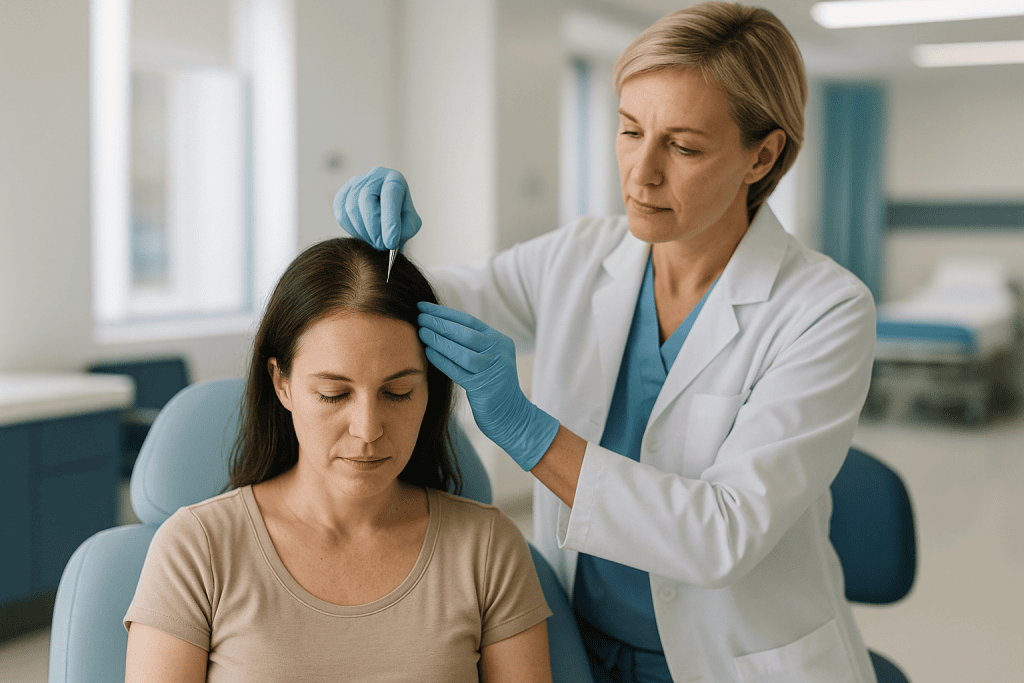
The principle that makes any of this worthwhile is called donor dominance. A follicle carries its behavior with it. Hair moved from a zone that is genetically resistant to the hormone signals driving pattern loss keeps that resistance in its new location, which is why transplanted hair in the right patient continues growing for decades. Move a follicle that was already programmed to miniaturize, however, and it will miniaturize in its new home just as it would have in its old one.
For women, the surgical goal is usually different from the goal for men. Few women lose their frontal hairline, so surgeons rarely rebuild one. The typical request is to add density along the part, the widened central strip that is hardest to disguise, or to thicken the temples where a ponytail or updo exposes the scalp. Grafts are placed between existing hairs rather than into bare skin, which demands care to avoid damaging the native follicles that are still working.
The Mayo Clinic notes that surgical hair restoration can be painful, carries risks of bleeding and scarring, and may require more than one session. It is medicine, not a cosmetic shortcut, and it is only ever as good as the hair that goes into it.
Why donor stability decides: the "safe zone" that is not always safe
Surgeons speak of the occipital safe zone, the band across the back of the head and above the ears where follicles in classic pattern hair loss are largely spared. In a man with a horseshoe of thick hair and a bald crown, that zone is plainly visible. In a woman with diffuse thinning, it has to be verified rather than assumed.
Verification comes down to a question the eye alone cannot answer: are the hairs at the back of the head all roughly the same caliber, or is there a mix of thick terminal hairs and fine, wispy ones? Miniaturization is the hallmark of a follicle under hormonal attack. Each growth cycle produces a slightly thinner, shorter, paler hair than the last. When a magnified view of the donor zone shows a wide spread of shaft diameters, those follicles are not stable, and transplanting them would spend a finite resource on hair that is destined to fade.
Think of it as moving trees from one side of a garden to another. If the soil on the sending side is healthy and the trees are mature, they will thrive where they are planted. If the trees on the sending side are already dropping leaves for the same reason the receiving side went bare, relocation solves nothing and leaves both plots poorer.
There is a second, quieter reason donor stability matters. Harvesting thins the donor area. In a stable zone that thinning is invisible because there is density to spare. In an already-fragile zone, harvesting can leave visible sparseness at the back of the head, trading one problem for two. Mayo Clinic lists scarring among the recognized risks of the procedure, and scars are far easier to hide under thick hair than under thin.
None of this makes surgery impossible for every woman with diffuse thinning. It makes the assessment of the donor zone the single most consequential step, and it is why an ethical specialist will sometimes advise against an operation the patient came prepared to have.
Female pattern hair loss or diffuse unpatterned alopecia: how specialists tell them apart
Two conditions account for most of the confusion, and the table below sets out the features a clinician weighs. Neither column is a checklist for self-diagnosis; the same features can appear in other conditions, and the distinction often requires magnified examination or a biopsy.

| Feature | Female pattern hair loss | Diffuse unpatterned alopecia |
|---|---|---|
| Where the thinning is worst | Top of the scalp; part widens, often in a “Christmas tree” shape toward the front | Across the entire scalp with no clear pattern |
| Back and sides of the head | Usually spared or only mildly affected | Involved; miniaturization visible on magnification |
| Frontal hairline | Typically preserved | May thin along with everything else |
| Course over time | Slowly progressive over years | Also progressive; harder to predict |
| Donor zone for surgery | Often stable enough to consider | Generally unreliable; surgery usually not advised |
| Usual first step | Medical treatment, with surgery discussed later if stable | Medical treatment and non-surgical options |
MedlinePlus describes female pattern baldness as thinning mainly on the top and crown that usually starts with widening of the center part, while the front hairline stays put. That description is the reason many women with pattern loss remain reasonable surgical candidates: the hair at the back has stayed out of the fight.
Diffuse unpatterned alopecia breaks that rule. The name is descriptive, and it signals to a surgeon that the ordinary map does not apply. In practice, specialists rarely make the call from a single visit. They look for the spread of hair diameters under magnification, sometimes repeat the examination months apart to gauge the pace of change, and may take a small scalp biopsy, a sample examined under a microscope, to count follicles and confirm what the surface suggests.
Patience at this stage is not a delay tactic. Where a woman lands in this table shapes every recommendation that follows.
Who is usually a candidate for hair transplant for women with diffuse thinning, and who is asked to wait
The women most often considered for surgery share a profile that has less to do with how much hair they have lost than with how the loss is distributed and how settled it is. A stable donor zone comes first: thick, uniform hair at the back and sides that has not changed noticeably over a period of observation. A localized target area comes second, most commonly a widened part or sparse temples, where a modest number of grafts can produce a visible difference. A settled underlying condition comes third, meaning the shedding has slowed, any reversible causes have been addressed, and medical treatment, if used, has been given time to work.
Women with hair loss from scarring, a burn, a surgical incision or traction from tight hairstyles that has been stopped are often good candidates too, because the surrounding hair is normal and the damaged area is fixed in size.
Those usually asked to wait, or advised against surgery altogether, fall into recognizable groups. Anyone still in an active phase of shedding, since operating during a storm makes it impossible to judge the result or protect existing hair. Anyone whose thinning has not yet been diagnosed, because transplanting hair into an untreated inflammatory or autoimmune process can fail outright. Anyone with a donor zone that shows miniaturization, for the reasons already described. Anyone with a medical condition that makes minor surgery risky, or who is taking medicines that affect clotting, until the prescribing clinician has weighed in.
Expectations belong on this list as well. NHS guidance is candid that hair transplant results vary and that the procedure does not suit everyone. A woman hoping to restore the density of her twenties across the whole top of her head is asking the donor supply for more than it can physically give. A woman hoping to narrow her part enough that it stops being the first thing she notices in photographs is asking a question surgery can sometimes answer.
The final word always belongs to the treating team, who can weigh factors no article can see.
What actually happens at the assessment
A thorough consultation for diffuse thinning looks less like a sales appointment and more like a detective interview. The clinician wants to know when the change began, whether it arrived gradually or in a sudden wave of shedding, and what happened in the months before. Childbirth, a hospital admission, a crash diet, a new medicine, a bereavement or a bout of severe illness can each trigger telogen effluvium, and the shedding typically lags the trigger by two to three months, which is why patients often fail to connect the two.
Family history follows. Pattern hair loss runs in families on both sides, and a mother or grandmother with a widening part is a relevant clue. Menstrual history, menopause status, symptoms suggesting thyroid disease and any signs of excess androgen such as acne or unwanted facial hair help the clinician decide which blood tests, if any, are worth ordering.
Then comes the examination. A gentle pull test, in which a small bundle of hairs is tugged to see how many come away, gives a rough measure of active shedding. Trichoscopy, the examination of the scalp with a handheld magnifier or dermatoscope, is where the donor question gets its first real answer. The clinician looks at the back of the head for uniform, thick shafts versus a mix of fine and coarse hairs, and at the part for the small yellow dots and single-hair follicles that mark miniaturization.
Blood tests are chosen to fit the story rather than run as a reflex. Mayo Clinic lists a scalp biopsy among the tools used when the picture stays unclear; a tiny core of skin is removed under local anesthetic and examined to count and characterize follicles, which can settle the pattern-versus-diffuse question decisively.
What a good assessment should not include is pressure. A clinician who has looked carefully at a diffusely thinning scalp and immediately booked surgery has skipped the step that determines whether surgery makes sense.
Reversible causes that have to be ruled out before anyone talks about surgery
Hair is one of the body’s least essential tissues, and the body treats it that way. When something goes wrong elsewhere, hair is often the first thing rationed, which means diffuse thinning can be a messenger rather than the disease. Operating before the message has been read is a mistake no careful team makes.
Telogen effluvium leads the list. Shedding of 50 to 100 hairs a day is normal, as Mayo Clinic notes; in telogen effluvium the number climbs sharply because a stressor has pushed a large share of follicles into their resting phase at once. The hair comes out in handfuls, alarmingly, from everywhere. The reassuring part is that the follicles are not damaged. Once the trigger has passed, regrowth follows, and Cleveland Clinic describes the condition as typically lasting around six months before settling. A woman in the middle of this process may look like a candidate for diffuse-thinning surgery and be nothing of the kind.
Thyroid disease, both underactive and overactive, is another recognized cause of diffuse loss, and MedlinePlus lists it alongside iron deficiency, significant illness and certain medicines including some used for blood pressure, mood and chemotherapy. Iron matters because follicles are rapidly dividing tissue with a high appetite for oxygen; low stores are common in women of menstruating age and are simple to test for. Rapid weight loss and restrictive eating patterns deprive the follicle of protein and energy in much the same way.
Scalp conditions belong here too. Seborrheic dermatitis, psoriasis and, less commonly, autoimmune conditions can thin hair diffusely and respond to treatment aimed at the skin rather than the hair.
The practical point is that treating a reversible cause can restore density that no surgery could match, using no donor hair at all. That is why the surgical conversation is rightly the last one in the sequence, not the first.
Where medicines fit, before and after surgery
For most women with pattern-type thinning, medical treatment is the foundation and surgery, if it happens at all, is built on top of it. The reason is arithmetic. A transplant adds a fixed number of hairs. A treatment that slows the ongoing loss of native hairs protects a far larger number. Combining the two is common, and the decision about what to use, whether to use anything, and for how long rests entirely with the prescribing clinician.
Topical minoxidil is the treatment with the longest track record in women. Its exact mechanism is still debated, but it appears to prolong the growth phase of the hair cycle and enlarge miniaturized follicles, producing thicker shafts over time. Timelines matter more than most patients expect: Mayo Clinic notes that at least six months of use is needed before it becomes clear whether it is helping, and that any benefit fades if treatment stops. A temporary increase in shedding in the early weeks is a recognized effect as old resting hairs are pushed out ahead of new growth.
Anti-androgen medicines, which block or reduce the hormone signals that drive follicle miniaturization, are prescribed to some women, particularly where there are signs of androgen excess. Their use requires medical supervision and is unsuitable in certain situations, including pregnancy, which is one reason this is never a self-directed choice. Harvard Health reviews these options in the context of female pattern hair loss and is clear that evidence is stronger for some than others.
Around surgery, medicines serve two purposes. Before the procedure, a period of treatment allows the team to see whether the condition is stable, which feeds directly into the donor-stability question. After the procedure, continued treatment protects the native hairs surrounding the grafts, so that the part does not simply widen again around a newly dense strip. None of this is prescriptive. It is a description of why the medical and surgical conversations happen together.
What the following days, weeks and months usually look like
The first surprise for many patients is how uneventful surgery day itself is. Local anesthetic numbs the scalp, the procedure runs for several hours depending on the number of grafts, and most people go home the same day with a light dressing or none at all. Soreness, tightness and mild swelling of the forehead over the next few days are expected; MedlinePlus notes that the scalp may be tender and that small crusts form around each graft before falling away.
Then comes the part nobody enjoys. Within roughly the first six weeks, according to MedlinePlus, the transplanted hairs shed. This is normal and it is not failure. The follicle beneath the skin has survived the move and has simply entered a resting phase, as any follicle does after a shock. Some patients also notice temporary shedding of native hairs near the grafts, a phenomenon surgeons call shock loss; in most cases those hairs return as the scalp recovers.
New growth begins over the following months, fine and often lighter in color at first, thickening with each cycle. MedlinePlus puts the timeline for a fuller appearance at up to around nine months, and many surgeons ask patients to reserve judgment for a full year, since late-arriving grafts and the gradual thickening of shafts continue to change the picture.
Practical restrictions in the early weeks are about protecting grafts while they anchor: gentle washing as directed, no scratching at crusts, avoiding heavy exercise, swimming and direct sun on the scalp for the period the team specifies, and sleeping with the head slightly elevated to limit swelling. Hair coloring and heat styling wait until the team gives the go-ahead.
Women deserve one specific warning. Because grafts are placed between existing hairs, and because longer hair is often kept during the procedure, the recovery is sometimes easier to conceal than it is for men, but the shedding phase can feel disproportionately alarming for someone whose starting point was already thin. Knowing the timeline in advance is the best antidote.
Risks, limits and the honest arithmetic of coverage
Every surgical procedure carries risk, and hair transplantation, for all its refinement, is no exception. Mayo Clinic lists bleeding, infection, scarring and the possibility that transplanted hair looks unnatural if placement is poor. Small cysts can form where a graft is placed too deep, temporary numbness of the scalp is common while nerves recover, and the linear scar from strip harvesting can widen in some individuals. Folliculitis, an inflammation around the new follicles, occasionally appears in the weeks after surgery and is usually manageable with the team’s guidance.
The risks specific to women with diffuse thinning are different in kind. The first is transplanting hair that is not built to last, which spends donor supply on a result that fades. The second is damaging native follicles in a densely populated recipient area during graft placement, a risk that rises when the surgeon is working between hairs rather than into bare skin. The third is a visible donor area, since a woman whose back and sides are already borderline has little density to hide the evidence of harvesting.
Then there is the arithmetic. A scalp can carry only so many follicular units, and the donor zone can spare only a fraction of them across a lifetime. Transplanting into diffuse thinning is inefficient by nature: because the target area is large and already partly populated, each graft raises overall density only slightly. This is why surgeons steer women toward concentrating grafts where they change the visual impression most, typically the part line and the frontal-temporal corners, rather than spreading them thinly across the whole top of the head where the effect would be diluted to invisibility.
A candid consultation will say this plainly. If the numbers do not add up, no amount of technique changes them, and the most useful thing a surgeon can offer is the recommendation not to operate.
Alternatives when donor area thinning in women rules out surgery
Being told that surgery is not the right path can land as a door closing. In practice it redirects effort toward options that, for diffuse thinning, often do more for how a woman looks and feels than a transplant could.
Medical treatment remains the anchor, as described earlier, because protecting existing hair is the highest-leverage move available when the donor supply cannot be spent.
Camouflage products fill the gap immediately. Colored fibers that cling to existing hairs, tinted powders and sprays that darken the scalp beneath thin hair all work by reducing the contrast between hair and skin that makes a widened part visible. They wash out, they cost nothing in donor hair, and for many women they are the difference between thinking about the scalp all day and not thinking about it at all.
Scalp micropigmentation places medical-grade pigment into the scalp to mimic the look of shaved follicles or to shade the skin under thinning hair. It is a tattoo, with the permanence and fading behavior that implies, and it demands a skilled practitioner and a realistic conversation about how it will look as hair changes.
Hairpieces have moved a long way from the wigs of a previous generation. Partial toppers clip or bond onto existing hair to add density exactly where the part is widest, and NHS guidance lists wigs and hairpieces among standard options, noting that they may be available through health services in some circumstances.
Low-level laser devices and platelet-rich plasma injections are widely marketed. Harvard Health notes that evidence for these remains limited and mixed, with small studies, short follow-up and varying protocols, so they are best understood as options with uncertain benefit rather than proven treatments. Anyone considering them should ask what the evidence actually shows rather than accept a testimonial.
Lastly, stopping traction from tight braids, extensions and ponytails protects the hair that remains, and is free.
What people often get wrong
“If I have hair on the back of my head, I have donor hair.” Presence is not the same as stability. The question is whether those follicles are uniform and resistant, which requires magnified examination, not a glance in the mirror.
“A transplant will stop my hair loss.” It will not. Surgery moves hair; it does nothing to the process driving the thinning. Native hairs around the grafts continue on their own trajectory unless something else slows them, which is why medical treatment and surgery are so often discussed together.
“Women’s hair loss is rare, so mine must be something serious.” Cleveland Clinic notes that more than half of women experience noticeable hair loss at some point. Common is not the same as trivial, but it does mean the pathways for assessment are well worn.
“Shedding means my follicles are dying.” In telogen effluvium the follicles are resting, not dying, and the hair returns. Even in pattern loss, miniaturization is a slow shrinking rather than a sudden death, which is exactly why treatments that act on the growth cycle have something to work with.
“More grafts means a better result.” In diffuse thinning, spreading a large number of grafts across a wide area can produce almost no visible change, while a smaller number concentrated along the part can be transformative. Placement strategy matters more than the headline count.
“The transplanted hair fell out, so the surgery failed.” Shedding of grafted hairs in the first weeks is the expected course, with regrowth following over months according to MedlinePlus. Judgment before a year is premature.
“Supplements will fix it.” Correcting a documented deficiency, such as low iron confirmed on a blood test, can help. Taking supplements without a deficiency has no demonstrated benefit for hair, and some in excess can cause harm. The NIH Office of Dietary Supplements is the place to check what the evidence actually shows.
Questions to ask your care team
A consultation about diffuse thinning is a two-way examination, and the questions a woman brings shape the quality of the answers she receives. These are the ones that tend to matter most.
- What is my diagnosis, and how confident are you in it? What would change your mind?
- Have reversible causes been ruled out? Which blood tests, if any, do you recommend and why?
- What did you see when you examined the back and sides of my scalp under magnification? Is my donor area stable, borderline or involved?
- Would a scalp biopsy add useful information in my case, and what would it look for?
- Do you recommend a period of observation or medical treatment before deciding on surgery? How long, and what would you be watching for?
- If surgery is an option, where exactly would you place grafts, and what visible change is realistic given my donor supply?
- How would you protect my existing hairs in the recipient area during placement?
- What is the plan for the hair I still have? How will we slow the ongoing loss so the result is not undone?
- What does recovery look like for someone with my hair length and thinning pattern, and how visible will the shedding phase be?
- What are the specific risks in my case, including the appearance of the donor area afterward?
- If you would not recommend surgery for me, what would you recommend instead, and what does the evidence say about it?
- Who do I contact if something concerns me in the days after any procedure, and what warning signs should prompt an urgent call?
Notice that none of these questions is about technique brand names or graft counts. They are about diagnosis, stability, strategy and honesty. A team that welcomes them, and answers the last one without hesitation, is a team worth trusting with a decision this personal.
When to call your doctor
Hair thinning is rarely an emergency, but a few situations deserve prompt attention rather than a wait-and-see approach, and a few after any procedure need a same-day call.
Before any treatment, seek medical advice if hair loss arrives suddenly and in large amounts, comes out in distinct patches, or is accompanied by itching, pain, burning, scaling, redness or pustules on the scalp, since these can signal inflammatory or infective conditions that need treatment in their own right. Hair loss alongside unexplained weight change, persistent fatigue, palpitations, feeling unusually cold or hot, changes in menstrual pattern, new facial hair or acne, or loss of eyebrow and body hair should also be assessed, because these combinations point toward causes beyond the scalp. NHS guidance is explicit that sudden or patchy loss, or loss with scalp symptoms, warrants a visit.
After a hair transplant, contact the treating team without delay if there is bleeding that does not stop with gentle pressure, spreading redness, warmth or swelling of the scalp, pus or foul-smelling discharge from graft sites or the donor wound, a fever, severe or worsening pain that is not controlled by the measures the team advised, or numbness that is getting worse rather than better. Signs of an allergic reaction, such as a rash, facial swelling or difficulty breathing, are a reason to seek emergency care immediately.
There is also a quieter reason to pick up the phone. If the emotional weight of hair loss is affecting sleep, mood, relationships or the willingness to leave the house, that is a health concern in its own right and a doctor is the right person to tell. Hair loss in women is common, it is often treatable, and the decisions about how to manage it belong in a conversation with a clinician who has examined the scalp in question, not to the stranger in the mirror.
Frequently asked questions
Is a female pattern hair loss transplant different from a transplant for men?
Yes, in goal and technique. Women rarely lose the frontal hairline, so surgeons usually add density along a widened part or at the temples rather than rebuilding a hairline. Grafts are placed between existing hairs, which demands care to avoid damaging native follicles. The donor area also has to be verified as stable under magnification, because female thinning is more likely than male thinning to involve the back and sides.
How is hair transplant candidacy for women actually decided?
A specialist takes a detailed history, examines the scalp with a magnifier to assess whether donor hairs are uniform and thick, may order blood tests suggested by the history, and sometimes takes a small scalp biopsy. Candidacy favors a stable donor zone, a defined target area such as the part, and a settled underlying condition. Active shedding, undiagnosed thinning or a miniaturizing donor area usually lead to a recommendation to wait or to pursue other options.
What is diffuse unpatterned alopecia, and why does it matter for surgery?
Diffuse unpatterned alopecia is a form of hair loss in which follicle miniaturization affects the entire scalp, including the back and sides that surgeons normally harvest from. Because moved follicles keep their original behavior, grafts taken from a miniaturizing donor zone will thin in their new location too. For that reason surgery is generally not advised, and medical treatment plus non-surgical options become the focus.
Can donor area thinning in women improve with treatment so that surgery becomes possible later?
Sometimes the picture changes. If the thinning at the back turns out to be telogen effluvium or a reversible cause such as thyroid disease or iron deficiency, the donor area can recover once the cause is addressed. If the miniaturization is hormonally driven, medical treatment may slow it and thicken shafts, and a specialist may reassess after a period of observation. Any decision about later surgery rests with the treating team.
Does a hair transplant stop further hair loss?
No. A transplant relocates hair that already exists; it does nothing to the underlying process causing the thinning. Native hairs around the grafts continue on their own course, which is why most women considering surgery are also advised to discuss ongoing medical treatment with a prescribing clinician to protect the hair they still have. Without that, the part can widen again around a newly dense strip.
Why did the transplanted hair fall out a few weeks after surgery?
This is the expected course, not a failure. MedlinePlus describes transplanted hairs shedding within roughly six weeks as the follicles enter a resting phase after the move. The follicles remain in place beneath the skin and begin producing new hair over the following months, with a fuller appearance developing over up to around nine months. Surgeons typically ask patients to reserve judgment until about a year has passed.
How long should I try medical treatment before considering surgery?
There is no universal number, but the timelines of the medicines themselves set a floor. Mayo Clinic notes that topical minoxidil needs at least six months before its effect can be judged. Many specialists also want to see the condition stable across two examinations several months apart before recommending an operation. The appropriate duration in any individual case is a decision for the prescribing clinician and the surgical team together.
Are platelet-rich plasma or laser treatments proven for diffuse thinning in women?
Not to the standard of the established treatments. Harvard Health describes the evidence for these approaches as limited and mixed, based largely on small studies with short follow-up and varying protocols. That does not mean they never help, but it does mean they should be presented as options with uncertain benefit. Anyone considering them is entitled to ask a clinician what the published evidence actually shows.
Will a hair transplant leave visible scars in women with thin hair?
It can. Strip harvesting leaves a thin linear scar at the back of the head, and follicle-by-follicle extraction leaves small dot scars. In a dense donor area these are hidden by surrounding hair; in a thin or borderline donor area they may show, particularly with short styles or when hair is worn up. This is one of the reasons donor stability is weighed so heavily before surgery is recommended.
Which blood tests are usually considered for a woman with diffuse thinning?
The choice follows the history rather than a fixed panel. Clinicians commonly consider thyroid function and iron stores, since both are recognized causes of diffuse loss listed by MedlinePlus, and may add hormone tests where there are signs of androgen excess or menstrual irregularity. Other tests depend on symptoms and medicines. Interpreting results and deciding what, if anything, to treat is the role of the clinician who ordered them.
References
- NHS: Hair loss
- MedlinePlus: Female pattern baldness
- MedlinePlus: Hair transplant
- Cleveland Clinic: Hair Loss in Women
This article is for general information only and is not a substitute for professional medical advice. Please consult a qualified doctor about your individual situation.

More from the Blog
DHI Explained: What Direct Hair Implantation Changes in Practice
DHI (direct hair implantation) is a variation of the FUE hair transplant in which extracted follicles are loaded into a spring-driven implanter pen and…

Preparing for an Eyebrow Transplant: Brow Design Consultation, What to Pause and the Day Before
Eyebrow transplant preparation usually involves a brow design consultation where the surgeon maps shape, hair direction and donor area; a medical review of medicines…

DHI Hair Transplant Risks Explained Honestly: Swelling, Folliculitis and Uneven Growth
DHI hair transplant risks are largely the same as for any follicular unit extraction procedure: temporary forehead and eyelid swelling, folliculitis around new grafts,…
The Best Age for a Hair Transplant: Why Surgeons Say No to Most 20-Somethings
There is no single best age for a hair transplant, but most surgeons prefer patients roughly between their late 20s and mid-40s, once the…

Stem Cell Hair Transplants: Where the Science Really Stands Today
No proven, standardized stem cell hair transplant exists yet. Procedures sold under that name are usually conventional follicle transplants combined with experimental cell injections.…
Hairline Lowering Surgery Cost: Surgical Advancement vs Grafting, Priced
Hairline lowering (forehead reduction) surgery typically falls between EUR 3,250 and 8,450 as an international guide range, compared with roughly GBP 5,000–10,000 in the…