

Can You Drive After TMS? Why Most People Return to Normal Activities the Same Day

Key Takeaways
- TMS uses no anesthesia or sedation, which is why Mayo Clinic guidance says most people can drive themselves home and resume normal activities right after a session.
- The most common side effects are scalp discomfort and a mild headache, and both typically ease as a course progresses.
- A standard rTMS course runs on weekdays for roughly four to six weeks, so being able to drive yourself removes the need to arrange dozens of lifts.
- Seizure is the serious but rare risk, which is why epilepsy history, metal implants near the head, heavy alcohol use, and certain medicines are screened for before treatment.
- Electroconvulsive therapy and ketamine-based treatments do require an escort home; the driving restriction people attach to TMS online usually comes from confusing it with these.
- Deep brain stimulation for depression remains investigational and involves brain surgery, placing it at the opposite end of the invasiveness spectrum from TMS.
Most people can drive after TMS the same day. Transcranial magnetic stimulation uses no anesthesia or sedation, so alertness and reaction time are not impaired the way they are after procedures such as electroconvulsive therapy. Typical after-effects are mild scalp discomfort or a headache. Anyone who feels lightheaded, unusually fatigued, or unwell after a session should wait and tell the care team before getting behind the wheel.
A woman in her forties sits in the waiting room with her car keys in her lap, turning them over and over. Her first session is in ten minutes. She has read that transcranial magnetic stimulation is “non-invasive,” and she believes it, but a quieter question keeps surfacing: if a machine is about to send magnetic pulses into my brain, am I really going to drive myself home afterward?
It is one of the most practical questions people bring to a TMS appointment, and it deserves a precise answer rather than a shrug. Driving after TMS is, for the large majority of people, exactly what happens on day one, and on day twenty. No sedative, no needle, no recovery bay. You walk in, you sit in a chair that looks like it belongs in a dentist’s office, and you walk out.
This explainer looks at why that is true, where the honest exceptions lie, what the first hour after a session usually feels like, and which signs mean you should hand over the keys and call your treating team instead.
Why driving after TMS is usually fine the same day
The short reason is that nothing in a TMS session dulls the parts of you that driving depends on. Transcranial magnetic stimulation, usually shortened to TMS, is a treatment that uses a magnetic coil held against the scalp to deliver brief pulses into a small region of the brain. There is no anesthetic, no sedative, no muscle relaxant, and no intravenous line. Mayo Clinic’s patient guidance states plainly that after a session you can return to your normal activities, including driving yourself home, because you remain awake and alert throughout.
Compare that with the two treatments people most often confuse with TMS. Electroconvulsive therapy is performed under general anesthesia and is followed by a recovery period in which driving is not permitted. Some newer infusion or nasal-spray treatments for depression cause temporary dissociation and sedation, and people are asked not to drive until the next day. TMS belongs to a different category entirely. Its effects on the brain are targeted and gradual, building over weeks of repeated sessions rather than hitting in a single dose.
What TMS can do on the day is leave you with a sore scalp, a mild headache, or a sense of being “tapped on” for twenty minutes. Those are nuisance effects, not impairments. They do not slow reaction time or cloud judgment. The one caution worth taking seriously is the rare person who feels lightheaded or faint after a session, which is discussed in detail further down. For everyone else, the drive home after TMS is simply a drive home.
How does TMS work in the brain?
Think of the coil as a very precise magnet that switches on and off hundreds of times a session. Each switch creates a brief magnetic field that passes through the skull without resistance and induces a tiny electrical current in the brain tissue directly beneath it. That current nudges nerve cells, or neurons, into firing. Repeat the nudge thousands of times across a course of treatment and the targeted circuit begins to behave differently.
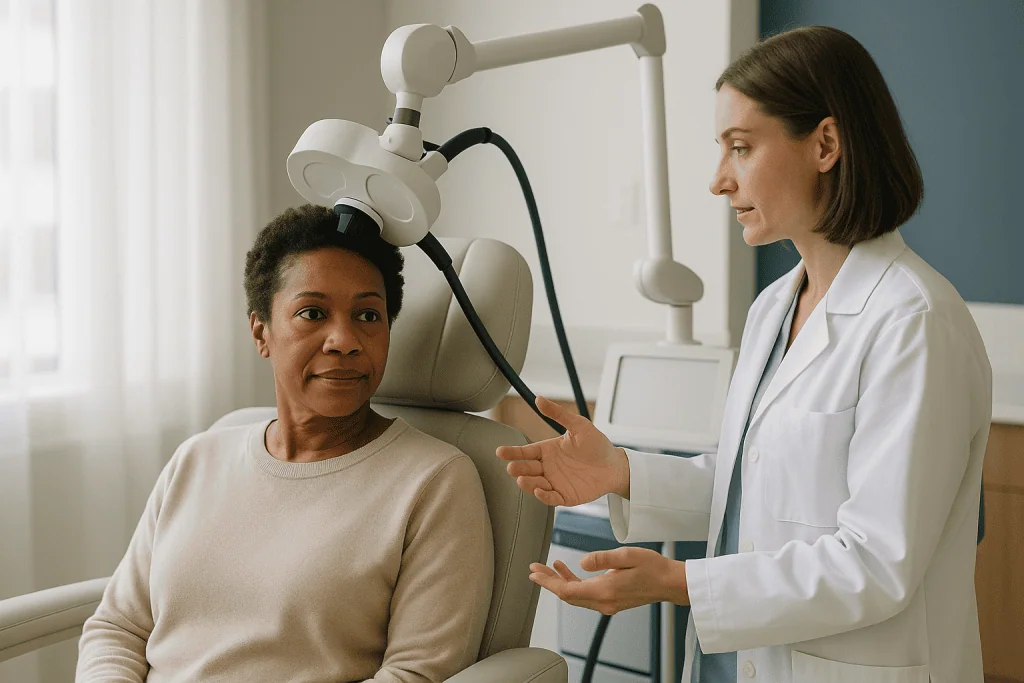
The target in depression is usually a region at the front of the brain called the dorsolateral prefrontal cortex, which plays a role in mood regulation, motivation and decision-making. Brain-imaging studies have found this region tends to be underactive in people with depression. Repetitive TMS, often written as rTMS, is designed to raise activity there and in the wider mood network it connects to. Cleveland Clinic and Mayo Clinic both describe this as the working theory, while noting that the exact mechanism is still being studied.
Two details matter for the driving question. First, the field reaches only a few centimeters into the brain. It does not spread through the whole organ, and it does not reach the brainstem structures that control wakefulness. Second, the effect is cumulative. A single session produces no sudden shift in how you think or feel, which is precisely why there is nothing to “wear off” before you can safely operate a car.
Many people are surprised that the magnetic field is similar in strength to that of an MRI scanner. The difference is the pulse pattern. An MRI holds a steady field to take pictures; TMS flicks it on and off to stimulate.
What actually happens in a TMS session, minute by minute
The first appointment is longer than the rest because the team has to find your personal settings. You sit in a reclining chair and are given earplugs, since the coil makes a loud clicking sound with each pulse. A technician or clinician positions the coil over the motor cortex, the strip of brain that controls movement, and delivers single pulses until your thumb or hand twitches. That twitch identifies your “motor threshold,” the pulse strength your brain responds to. Treatment intensity is set relative to it, and the coil is then moved forward to the treatment site over the prefrontal cortex. This mapping is why Mayo Clinic describes the first session as taking longer than later ones.
Subsequent sessions are routine. You sit, the coil is placed in the mapped position, and the pulses begin. Most people describe the sensation as a woodpecker tapping on the scalp, firm but not sharp. You stay awake. You can talk between pulse trains, listen to music, or simply watch the ceiling. Standard rTMS sessions typically run somewhere between twenty and forty minutes, according to Mayo Clinic, and newer theta-burst patterns deliver the pulses in a shorter block.
When the last pulse ends, the coil is lifted away and you stand up. There is no observation period required for most people, though many units ask you to wait a few minutes on the first day simply to check how you feel. Then you collect your coat and leave, usually heading straight back to work, school, errands, or home.
The pattern repeats on weekdays for several weeks. The rhythm, more than any single session, is what the treatment relies on.
Who TMS is usually for, and who is usually asked to wait
TMS is most commonly offered to adults with major depressive disorder whose symptoms have not responded adequately to one or more courses of antidepressant medicine or talking therapy. Mayo Clinic and Cleveland Clinic both frame it this way: a second-line option for depression that has proved stubborn. It has also been studied, and in some countries approved, for obsessive-compulsive disorder, certain smoking-cessation programs, and migraine, though depression remains the main use.

Suitability depends on screening rather than guesswork. Because the magnetic field interacts with metal, the first questions a team asks concern anything implanted in or near the head: aneurysm clips, cochlear implants, deep brain stimulators, stents in the neck, bullet fragments, or electrodes. Devices lower in the body, such as pacemakers or implanted drug pumps, are also reviewed carefully. Standard dental fillings and braces are not usually a barrier.
People with a personal history of epilepsy or seizures are generally asked to wait or are steered toward other treatments, since the stimulation can, rarely, provoke a seizure. A history of head injury, brain tumor, or stroke prompts the same careful review. Pregnancy is discussed case by case. People with bipolar disorder can be treated, but Cleveland Clinic notes a small risk of triggering a manic episode, so monitoring is closer.
Someone in the middle of a severe episode with active thoughts of suicide is usually not a candidate for a treatment that takes weeks to act; a faster intervention may come first. None of these are permanent exclusions. They are reasons the treating team may say “not now,” and that judgment belongs to them.
What to expect after a TMS session: the first hour
Walk out of the room and the most common feeling is, frankly, nothing much. The scalp where the coil rested may feel tender, as if you have been wearing a tight hat. Some people notice a dull headache that settles within an hour or two. Mayo Clinic lists these two, scalp discomfort and headache, as the most frequent side effects, and both tend to fade as the course goes on and the scalp adapts.
A handful of people feel a brief tingling or twitching in the face during the session, because the pulses can stimulate nearby muscles and nerves. That stops when the coil stops. A few describe feeling slightly lightheaded as they stand, particularly on the first day when nerves are high and breakfast may have been skipped. Sitting for a minute usually resolves it.
What you should not expect is grogginess, confusion, slurred speech, blurred vision, or the heavy-limbed feeling that follows sedation. If any of those appear, they are not typical TMS effects and need to be reported.
Practically, the first hour looks like this for most people: a sip of water, a check-in with the technician about how the session felt, and then the normal day resumes. Driving, taking the bus, cycling, or walking are all reasonable. Eating is fine. Working is fine. Many people schedule sessions in a lunch break or before the commute precisely because the aftermath is so uneventful.
The one sensible habit is to notice how you feel each day rather than assuming. Treatment is repeated often enough that a pattern, if there is one, will show itself quickly.
Can you work after TMS? Exercise, screens, caffeine and alcohol
Yes, and most people do. Because there is no sedation and no incision, there is no clinical reason to take the day off. Cleveland Clinic’s guidance is that you can go back to work, school, or your usual routine immediately after treatment. People in jobs that require sharp concentration, such as driving for a living, operating machinery, or clinical work, often ask whether they should build in a buffer. For the first session, a short pause to see how you feel is reasonable. After that, the pattern of your own response is your best guide, in conversation with the team.
Exercise is not restricted. Some people find a walk after a session eases the mild headache. Vigorous training is fine if you feel up to it, though it is sensible to drink water, since dehydration can worsen headaches of any kind.
Screens, reading, and detailed work are unaffected. TMS does not touch the visual pathways, and there is no eye dilation or light sensitivity as there might be after some eye or dental procedures.
Caffeine is a small practical point. Large amounts can lower the seizure threshold slightly and may make a headache more likely, so most teams suggest keeping intake steady rather than loading up before a session. Alcohol deserves a more direct answer: heavy drinking lowers the seizure threshold, interferes with sleep, and works against recovery from depression. Teams typically ask people to avoid alcohol during a course, and certainly to avoid drinking before a session. Any change in your usual medicines, including sleep aids or anything new from another prescriber, should be flagged to the TMS team, because some medicines also affect seizure risk.
TMS side effects same day: what is common, what is rare
Side effects of TMS split neatly into two groups: the ones almost everyone should expect at some point, and the ones that are genuinely rare but need to be understood because they are the reason screening exists.
The common group is short and mild. Scalp discomfort at the coil site, a headache that responds to rest and fluids, facial twitching during the pulses, and occasionally lightheadedness right after standing. Mayo Clinic describes these as generally mild to moderate and improving over the course of treatment. Hearing is protected with earplugs because of the clicking; without them, temporary hearing changes have been reported, which is why no reputable unit treats without ear protection.
The rare group is where the honest conversation lives. Seizure is the most serious, and Mayo Clinic classifies it as rare. It is more likely in people with epilepsy, recent head injury, heavy alcohol use, or on certain medicines, which is exactly why those are screened for. Mania or hypomania, an abnormally elevated mood, can be triggered in people with bipolar disorder, according to Cleveland Clinic. Fainting is occasionally reported, usually in the first days and often linked to anxiety or an empty stomach.
None of the common effects change your fitness to drive. Of the rare ones, a seizure or a fainting spell obviously does, and any such event should end driving for the day and prompt a review of whether, and when, driving can resume. Local rules on driving after a seizure vary by region and are set by licensing authorities, not by the TMS unit, so the treating team will guide you on what applies where you live.
Driving after TMS compared with other brain treatments
Much of the anxiety around driving after TMS comes from mixing it up with other treatments that do require someone else to drive. The table below sets them side by side, using the categories that actually determine fitness to drive: whether anesthesia or sedation is used, and what the typical same-day after-effects are.
| Treatment | Anesthesia or sedation | Typical same-day effects | Usual advice on driving home |
|---|---|---|---|
| Repetitive TMS | None | Scalp discomfort, mild headache | Usually allowed the same day |
| Electroconvulsive therapy (ECT) | General anesthesia plus muscle relaxant | Confusion, memory gaps, drowsiness | Not permitted; escort required |
| Ketamine or esketamine treatment | No anesthesia, but causes sedation and dissociation | Dizziness, altered perception, nausea | Not permitted until the next day |
| Deep brain stimulation (DBS) surgery | Surgery under anesthesia | Post-operative recovery | Not permitted; recovery period applies |
| Transcranial direct current stimulation (tDCS) | None | Skin tingling, mild itch | Usually allowed |
Two points stand out. First, the dividing line is sedation, not whether a treatment “touches the brain.” TMS and tDCS both act on the brain directly and both leave the driver fully functional. Second, the ECT and ketamine rows explain why clinics are so emphatic about escorts for those treatments, and why the same caution gets wrongly transferred to TMS in online forums.
The comparison is descriptive, not a ranking. Each treatment has its own place and its own evidence base, and choosing between them is a clinical decision made with your psychiatrist on the basis of your history, not on the basis of who drives you home.
When driving after TMS is not a good idea: the exceptions
The rule that most people drive after TMS has a short list of exceptions, and knowing them is more useful than a blanket reassurance.
The first day deserves its own mention. Not because the treatment behaves differently, but because you do not yet know how you respond. If you are anxious, skipped a meal, or simply want to concentrate on the experience rather than traffic, having someone drive for the first session is a reasonable personal choice. It is a comfort decision, not a safety requirement.
Lightheadedness that does not settle within a few minutes of sitting is the second exception. It is uncommon, but if the room still feels unsteady when you stand, stay seated, tell the team, and do not drive until it has fully passed. The same applies to any episode of fainting, however brief.
A headache that is severe rather than mild, or that comes with visual disturbance or nausea, should be assessed before you leave rather than driven through. It is very unlikely to be caused by TMS, but it is not a headache to ignore.
Any seizure, muscle jerking beyond the usual facial twitching during pulses, or confusion ends driving for that day and triggers a formal review.
Finally, there is the exception that has nothing to do with the coil. Depression itself can impair concentration, and some antidepressant medicines cause drowsiness, particularly when newly started or adjusted. If you were struggling to drive safely before TMS began, that does not change on day one. Talk honestly with your prescriber about whether driving is sensible during this stretch of treatment. The decision sits with them and with you, not with the TMS schedule.
What the following weeks usually look like
A standard rTMS course is delivered on weekdays over roughly four to six weeks, according to Mayo Clinic, with some protocols adding a tapering phase afterward. That is a lot of appointments, and the logistics matter more than most people anticipate. Driving yourself removes the need to arrange lifts for twenty or more visits, which is one reason the same-day return to activity is such a practical advantage of this treatment.
Week one is about adaptation. The scalp is most tender, headaches are most likely, and the clicking sound is most intrusive. By the second week most people report the sensation as background noise. Some notice small changes in sleep or energy early on; others notice nothing for a while. Both patterns are normal, and neither predicts the eventual result.
The middle weeks are where mood change, if it comes, usually begins to show. Harvard Health’s summary of the evidence notes that benefit tends to emerge gradually across the course rather than suddenly. Keeping a brief daily note of mood, sleep, and side effects is genuinely useful here, because the team will ask, and memory of mood is unreliable.
Toward the end of the course the conversation turns to what comes next: continuing medicine, psychotherapy, a maintenance schedule, or simply monitoring. Some people return later for a further course if symptoms come back; Mayo Clinic notes that repeat treatment is possible.
Driving stays the same throughout. Unless a new side effect appears, nothing about week five changes your fitness to drive compared with week one. The treatment’s effects build in the mood circuits, not in the reflexes.
How long does it take for TMS to work?
Here the honest answer is “weeks, and not for everyone.” TMS is not a treatment that produces a change you can feel walking out of the building. Its proposed mechanism is the gradual retuning of an underactive mood network through repeated stimulation, and that takes repetition.
Mayo Clinic’s guidance is that, when rTMS helps, symptoms may begin to improve after a few weeks of daily sessions. Some people notice an early lift in energy or sleep before mood itself shifts. Others feel little until well into the course, then describe a change that seems to arrive over a few days. Family members sometimes spot it before the person does.
Not everyone responds. Harvard Health’s review of the research describes TMS as effective for a meaningful proportion of people with treatment-resistant depression, while being clear that a sizeable group does not experience significant benefit. Publishing a single response percentage here would be misleading, because figures differ by protocol, population, and how “response” is defined across studies. Your treating team can discuss the numbers that apply to the protocol they use.
Durability is the other question. Benefit can last for months, and relapse is possible; maintenance sessions or a repeat course are used in some services to address this. The evidence on the ideal maintenance schedule is still developing, and practice varies.
Two practical implications follow. The first is patience: stopping after a quiet first week is premature. The second is honesty with the team: if you are three weeks in and feel nothing, say so, because the plan can be revisited rather than simply run out.
TMS therapy pros and cons, weighed honestly
Any treatment explainer that only lists advantages is marketing. Here is the balance as the mainstream evidence presents it.
On the positive side, TMS is non-invasive, requires no anesthesia, and leaves daily life largely intact, including driving and work. Its side-effect profile is mild for most people and does not include the weight gain, sexual dysfunction, or emotional flattening that some people experience with antidepressant medicines. It can be combined with medicine and psychotherapy rather than replacing them. For people who have tried several medicines without adequate benefit, it offers a different mechanism rather than another variation on the same one.
On the other side, the commitment is substantial. Daily weekday attendance for weeks is hard to sustain alongside work, caring responsibilities, or distance from a treatment center. The benefit, when it comes, is gradual and not guaranteed, and relapse can occur. Rare but serious risks, chiefly seizure and, in bipolar disorder, mania, mean screening is strict, and some people are excluded. Access varies widely between regions and health systems, and the evidence for uses beyond depression is thinner.
A fair summary, drawing on Mayo Clinic, Cleveland Clinic, and Harvard Health, is that TMS is a well-established option for treatment-resistant depression with a favorable safety profile and a real but variable effect. Whether its pros outweigh its cons for you depends on how many other options you have tried, your medical history, and how workable the schedule is. That weighing is a shared decision with your psychiatrist, and it is reasonable to ask them to walk you through the alternatives before committing.
Can deep brain stimulation treat depression? Where TMS sits among brain stimulation options
People searching about TMS often stumble into deep brain stimulation, or DBS, and wonder whether it is a stronger version of the same thing. It is not. DBS is a surgical treatment in which thin electrodes are implanted deep in the brain and connected to a pulse generator placed under the skin of the chest. Mayo Clinic describes its established uses as movement disorders such as Parkinson’s disease, essential tremor, and dystonia, along with certain cases of epilepsy and obsessive-compulsive disorder.
For depression, DBS remains investigational. Mayo Clinic lists depression among conditions being studied, and results from trials have been mixed. It is not a routine option and is offered, where at all, within research settings to people with very severe, long-standing depression who have exhausted other treatments. Because it involves brain surgery and general anesthesia, it is on the opposite end of the invasiveness spectrum from TMS, and driving is certainly not on the agenda the same day.
Between the two sit several other approaches. Electroconvulsive therapy is the longest-established and is often used when depression is severe or life-threatening, at the cost of anesthesia and some memory side effects. Vagus nerve stimulation uses an implanted device to stimulate a nerve in the neck and is approved in some countries for long-term treatment-resistant depression. Transcranial direct current stimulation uses a weak current through scalp electrodes and is still largely a research tool for depression.
The point of laying these out is not to rank them but to show that TMS occupies a particular niche: more targeted than medicine, far less invasive than surgery, and compatible with a normal day. Which, if any, is appropriate for a given person is a specialist decision.
What people often get wrong about TMS and driving
Myth one: “They must sedate you, it’s brain stimulation.” No. There is no sedative in a TMS session. The confusion comes from ECT, which does require anesthesia. The two are different treatments with different mechanisms, and Mayo Clinic’s guidance on returning to normal activities after TMS reflects that.
Myth two: “You should rest for the afternoon to let it work.” There is no evidence that resting improves TMS outcomes. The treatment’s effect is produced by the pulses, not by what you do afterward. Going back to work or taking a walk does nothing to undo it.
Myth three: “If I feel fine on day one, I will feel fine every day.” Mostly true, but worth qualifying. Side effects can occasionally appear later in a course, particularly if sleep, alcohol intake, or medicines change. Checking in with yourself each day is sensible.
Myth four: “TMS makes you drowsy like a sleeping tablet.” It does not act on the brain’s arousal systems. Some people feel tired after sessions, but this is usually the ordinary tiredness of depression, early starts, or a tense first week, rather than a drug-like effect.
Myth five: “A good session means a strong headache.” Discomfort is not a sign the treatment is working, and a mild session is not a wasted one. The coil position and intensity are set by mapping, not by how much it hurts.
Myth six: “Nobody can drive themselves to any psychiatric treatment.” Many people drive to therapy, to medication reviews, and to TMS every week. Where driving is restricted, it is because of a specific sedating treatment or a specific symptom, not because of the specialty.
Questions to ask your care team
A good TMS consultation leaves you knowing what will happen, what might go wrong, and what the plan is if it does. These questions tend to surface the answers that matter.
- Which protocol will I receive, standard rTMS or a theta-burst pattern, and how long will each session take?
- How many sessions are planned, over how many weeks, and what happens if I have to miss some?
- Based on my medical history, is there anything that raises my seizure risk, and have you checked my current medicines against it?
- Do you expect me to be able to drive myself home after the first session, or would you prefer I bring someone that day?
- What side effects should I report immediately, and who do I contact outside clinic hours?
- Will I continue my current medicine and therapy during the course, and who is coordinating that?
- How will we measure whether it is working, and at what point would we decide it is not?
- If it helps, what is the plan for keeping the benefit, and if it does not, what are the next options?
- Are there any activities, substances, or sleep patterns I should change during the course?
- If I have a history of bipolar disorder, how will you monitor for mood elevation?
Bring the list in writing. Depression blunts memory, and a first consultation covers a great deal. It is entirely reasonable to ask the team to write their answers down too, particularly the contact details for out-of-hours concerns and the specific symptoms they want to hear about. The team’s answers, not a general article, are the ones that govern your treatment.
When to call your doctor
TMS has a reassuringly short list of emergencies, but the items on it are serious and should never be sat on until the next appointment.
Call emergency services or go to the nearest emergency department if you or someone with you experience a seizure: loss of consciousness, rhythmic jerking of the limbs, or a period of confusion you cannot account for. The same applies to fainting with injury, a sudden severe headache unlike any you have had before, new weakness or numbness on one side of the body, difficulty speaking, or a sudden change in vision. These are not expected effects of TMS and need urgent assessment regardless of their cause.
Contact the TMS team or your psychiatrist the same day if you notice a marked lift in mood that feels unusual, with racing thoughts, reduced need for sleep, or impulsive behavior, since this can indicate a manic or hypomanic episode. Report any new or worsening thoughts of self-harm or suicide immediately; crisis lines in your region are available around the clock, and the treating team needs to know.
Less urgent, but still worth a call before the next session: a headache that persists beyond a day, scalp pain that is getting worse rather than better, any ringing or change in hearing, lightheadedness that recurs after sessions, or a new medicine started by another prescriber.
On driving specifically, the rule is simple. If you have had a seizure, a faint, or a spell of confusion, do not drive until the team has reviewed you and advised on any licensing requirements that apply. Every decision about continuing, pausing, or adjusting treatment belongs with the clinicians who know your history.
Frequently asked questions
Can you drive yourself home after your first TMS session?
Usually yes. The first session is longer because the team maps your motor threshold, but it involves no sedation, and Mayo Clinic notes people can return to normal activities including driving. Some people prefer a companion on day one simply because they do not yet know how they will feel. If you feel lightheaded when you stand, wait until it fully passes and tell the team before leaving.
How does TMS work in the brain?
A magnetic coil on the scalp produces brief pulses that induce a small electrical current in the brain tissue beneath it, prompting neurons to fire. In depression the target is the dorsolateral prefrontal cortex, a mood-regulating region that tends to be underactive. Repeating the stimulation across weeks is thought to raise activity in that region and its connected network, though the precise mechanism is still being studied.
What are the pros and cons of TMS therapy?
Pros: non-invasive, no anesthesia, mild side effects for most people, no interference with driving or work, and it can be combined with medicine and therapy. Cons: daily weekday sessions for weeks, benefit that is gradual and not guaranteed, possible relapse, rare but serious risks such as seizure, and strict screening that excludes some people. Weighing these for your situation is a decision to make with your psychiatrist.
Can deep brain stimulation be used to treat depression?
Only in research settings at present. Deep brain stimulation is an established surgical treatment for movement disorders such as Parkinson’s disease, and Mayo Clinic lists depression among conditions still being studied. Trial results have been mixed, so it is not a routine option. It involves implanted electrodes and general anesthesia, which makes it far more invasive than TMS.
What should I expect after a TMS session on the same day?
Most people feel much as they did before, with perhaps a tender scalp or a mild headache that settles within an hour or two. Facial twitching during the pulses stops when the coil stops. Grogginess, confusion, or slurred speech are not typical TMS effects and should be reported straight away. Eating, working, exercising, and driving are all usually fine.
Can you work after TMS?
Yes. Cleveland Clinic guidance is that you can return to work or school immediately after treatment, since there is no sedation or incision. Many people book sessions before work or in a lunch break. If your job involves driving for a living or operating machinery, it is sensible to see how you respond on day one and discuss any concerns with the team.
Are TMS side effects the same day dangerous?
The common ones are not. Scalp discomfort, headache, and brief facial twitching are mild and do not affect alertness. The rare dangerous effects are seizure and, in people with bipolar disorder, a manic episode; both are the reason for pre-treatment screening and both require immediate contact with the team. Fainting is occasionally reported, usually early in a course, and should end driving for that day.
Does TMS make you tired or drowsy?
Not in the way a sedative does. TMS does not act on the brain’s arousal systems, so it does not cause drug-like drowsiness. Some people do feel tired after sessions, which is more often the ordinary fatigue of depression, early appointments, or a tense first week. If tiredness is heavy or new, mention it to the team so it can be assessed alongside your medicines and sleep.
Is driving after accelerated or theta-burst TMS any different?
The same principles apply. Theta-burst and accelerated protocols deliver pulses in shorter or more frequent blocks, but they still involve no anesthesia or sedation, so alertness is unaffected. Because some accelerated schedules involve several sessions in one day, teams may ask how you are feeling between sessions. Your treating team will tell you if their specific protocol carries any additional instruction.
What are the red flags that mean I should not drive after TMS?
A seizure, a faint, lasting lightheadedness, confusion, a sudden severe headache, new one-sided weakness, or a change in vision or speech. These are rare and most are not expected effects of TMS, but each means you should not drive and should be assessed, urgently for the neurological signs. Any seizure also triggers a review of regional driving rules, which the team will explain.
This article is for general information only and is not a substitute for professional medical advice. Please consult a qualified doctor about your individual situation.
Add us as a Preferred Source to see more of our trusted health content across Google Search, AI Overviews and Discover.

More from the Blog

Parkinsonism and Life Expectancy: Why the Type Matters and How It Differs from Parkinson’s
Parkinsonism life expectancy depends on the cause. Drug-induced parkinsonism often improves once the triggering medicine is reviewed, and the NHS now links Parkinson's disease…

Aphasia Treatment After Stroke or Brain Injury: How Speech-Language Therapy Is Planned
Aphasia is treated mainly with speech-language therapy, planned by a speech-language pathologist after a detailed assessment of how a person speaks, understands, reads and…

Grade 1 Concussion Recovery Time: How Long Mild Symptoms Last in Adults and When to Be Rechecked
Most adults with a grade 1 (mild) concussion feel back to normal within about two weeks, and the large majority within four weeks, according…

When Does Insomnia Need a Sleep Study? What the Overnight Test Can and Cannot Show
Insomnia on its own usually does not need a sleep study. Clinicians diagnose insomnia from your history and a sleep diary, and the usual…

Vascular Dementia Life Expectancy: What Studies Show, Why It Varies and What Shapes the Outlook
Large studies place average survival in vascular dementia at roughly 3 to 5 years after symptoms begin, shorter than the average for Alzheimer's disease,…

VP Shunt vs Endoscopic Third Ventriculostomy: How Surgeons Choose for Adult Hydrocephalus
In adults, surgeons choose between a VP shunt and endoscopic third ventriculostomy (ETV) mainly by where cerebrospinal fluid is blocked. A clear obstruction inside…